Zoom Webinar Pricing Explained: Why You’re Overpaying in 2026
A complete breakdown of Zoom Webinar pricing, hidden add-on costs, and why modern AI platforms offer global translation for a fraction of the price.
The True Cost of Zoom Webinars in 2026 (And How to Cut It by 80%)
Chapter 1: The Hook
If your webinar budget went up in 2026, your audience probably did not get proportionally larger.
That is the problem with Zoom webinar pricing in 2026. The advertised license may look manageable, but the real cost often sits outside the headline number. You pay for attendee capacity, event frequency, host seats, add-ons, recording storage, registration tools, analytics, integrations, and sometimes a separate translation or captioning service. By the time the event is ready for a global audience, the “webinar platform†has become a stack of disconnected charges.
For many B2B teams, this creates a familiar pattern:
- Marketing wants to run more events.
- Sales wants larger registration limits.
- Customer success wants recordings and on-demand access.
- Regional teams want translated captions.
- Legal wants reliable consent and attendance records.
- Finance wants predictable monthly spend.
The platform price increases with every requirement.
That is why comparing webinar software by license price alone is misleading. A lower-tier plan may be suitable for a small internal presentation but inadequate for a public product launch, customer education series, or multilingual demand-generation program. Moving up one tier can unlock capacity while still leaving critical capabilities behind.
The question is not simply, “How much does Zoom Webinar cost?â€
The better question is:
What will it cost to run the webinar your business actually needs?
That distinction matters in 2026 because webinars are no longer one-off broadcasts. They are becoming repeatable revenue programs. Companies use them to generate pipeline, support product launches, train customers, host partner events, and reach buyers across multiple regions. Every limitation in the platform affects the economics of that program.
A webinar that attracts 500 attendees in English may require a different setup from a 500-attendee event serving prospects in Germany, France, Japan, Brazil, and the United States. If you need translated captions, localized follow-up, multiple presenters, CRM synchronization, and a reusable recording, the base license is only one part of the budget.
The headline price is rarely the final price
Zoom’s webinar offering is often evaluated as an extension of the broader Zoom ecosystem. That makes sense if your organization already uses Zoom Meetings and wants familiar host controls, participant workflows, and administration. However, familiarity can hide incremental costs.
The total bill may be influenced by:
-
Webinar attendee capacity
A plan designed for a smaller audience may force an upgrade when registration exceeds a threshold. Capacity planning also becomes difficult when one event performs better than expected. -
Number of hosts or organizers
If several people across marketing, sales, and customer success need to create or manage webinars, seat requirements can expand quickly. -
Event frequency
A monthly webinar series can make a low-cost occasional-use plan poor value. Recurring events expose every per-event limitation. -
Advanced production requirements
Larger events often need backstage coordination, multiple speakers, branding, moderated Q&A, rehearsal workflows, and more detailed reporting. -
Language support
Native language coverage may not be included in the plan you initially select. Teams may need external interpreters, captioning vendors, or post-production services. -
Data and integrations
Registration data is only useful when it flows into the rest of your revenue stack. Additional tools may be required for forms, lead routing, enrichment, attribution, or marketing automation. -
On-demand content
A webinar does not stop producing value when the live session ends. Storage, editing, transcription, chapters, subtitles, and gated playback all affect the cost of the content lifecycle.
This is the first trap in researching zoom webinar pricing 2026: treating the platform as a single product with a single price. In practice, your cost depends on the operating model around the license.
The cheapest plan can become the most expensive decision
A low initial price is not automatically a good deal. If the plan cannot support your event format, you may end up paying in other ways.
For example, a company might choose a basic webinar tier for a quarterly event. The first event works well. Then registration rises, sales asks for a second host, and the content team requests translated captions. The team responds by purchasing separate services and manually stitching the workflow together.
The direct software bill may still look reasonable. The internal cost does not.
Employees spend hours exporting attendee lists, cleaning registration data, uploading recordings, reviewing machine transcripts, fixing subtitle timing, and sending follow-up campaigns. Those hours rarely appear in a webinar budget, but they reduce campaign efficiency and increase the cost per qualified lead.
There is also an opportunity cost. If localization takes two weeks, your company may delay the replay. If translation quality is inconsistent, regional teams may avoid promoting the event. If the registration workflow is difficult to manage, marketers may run fewer webinars than planned.
The result is a platform that appears affordable because the missing capabilities are being paid for with labor.
Webinar economics have changed
In earlier webinar programs, language localization was often treated as a luxury. In 2026, that assumption is increasingly outdated.
B2B buying committees are distributed across countries. A single account may include executives, technical evaluators, procurement, and end users in different regions. An English-only event can still attract international registrations, but it may not deliver the same engagement, comprehension, or conversion rate as an event that supports the audience’s preferred language.
This does not mean every webinar requires a professional interpreter in every language. It does mean language should be evaluated as part of the platform decision, not bolted on after the event is planned.
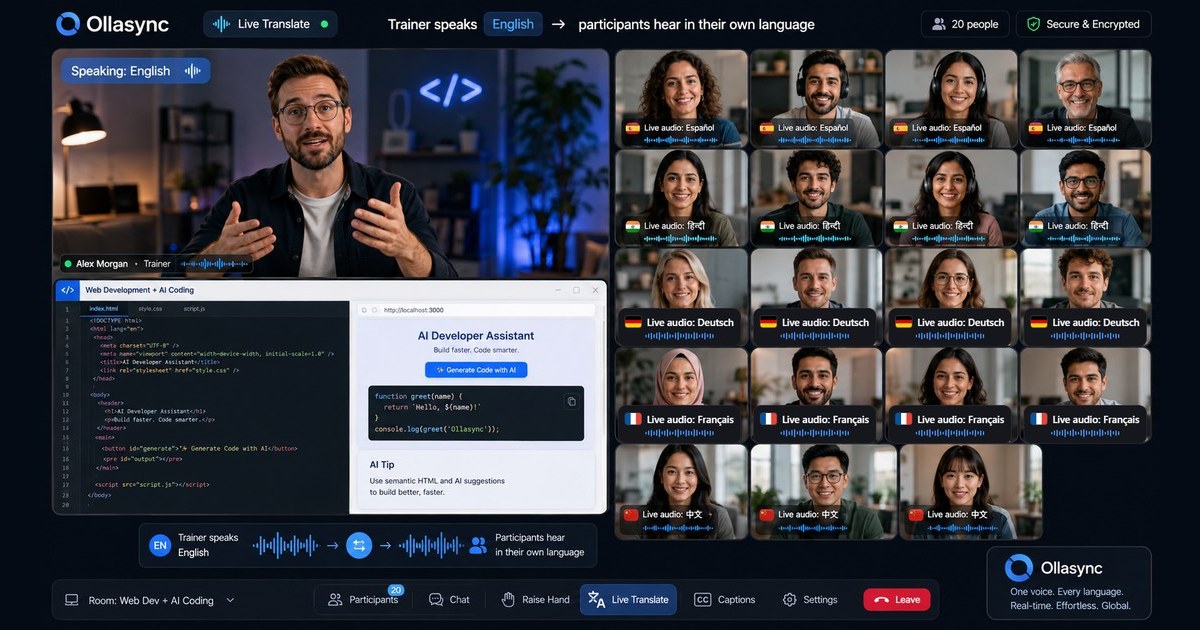
That is where Ollasync takes a different position. Ollasync is built as a global webinar platform, with native AI translation in 19 languages. Its core value proposition is simple: businesses should not need to assemble a separate translation workflow every time they want to reach an international audience. By including multilingual capability at the platform level, Ollasync positions itself as the cheapest global webinar platform for teams that need live events to work across borders.
The important comparison is not just Zoom versus Ollasync by license line. It is the cost of a complete webinar operation:
- platform access,
- audience capacity,
- multilingual delivery,
- captions and translation,
- recording reuse,
- lead capture,
- reporting,
- and the staff time required to operate everything.
A platform with a lower total operating cost can be more valuable than one with a lower entry price.
A practical way to compare webinar platforms
Before accepting a quote or upgrading a plan, define the event you intend to run over the next 12 months. Use realistic assumptions rather than the smallest possible event.
Document:
- Average and peak live attendance
- Number of webinars per month or quarter
- Number of organizers and presenters
- Countries and languages served
- Registration and CRM requirements
- Captioning and translation expectations
- Recording and replay requirements
- Required analytics
- Support and compliance needs
Then calculate the cost for the full program, not just the next event.
This approach makes hidden charges visible. It also prevents a common procurement mistake: choosing a platform for today’s audience while ignoring the workflow needed for next year’s growth.
The right platform should help your team run more events without multiplying operational complexity. If every increase in attendance, language coverage, or replay usage requires another vendor, another integration, or another manual process, the platform is not scaling with you.
It is charging you for growth.
Chapter 2: The Hidden Costs
The most expensive part of a webinar is often the part that does not appear on the invoice.
Zoom webinar pricing in 2026 can be perfectly reasonable for a straightforward event. The hidden cost emerges when your requirements expand beyond a single-language broadcast. Global campaigns expose those costs quickly because they combine audience scale, localization, data management, production, and follow-up.
A useful analysis should separate software fees from operating costs. Software fees are visible. Operating costs include staff time, vendors, rework, delays, and lost conversion opportunities. Both belong in the business case.
1. Capacity upgrades and audience uncertainty
Webinar attendance is difficult to predict. Registration numbers may be affected by paid promotion, partner distribution, a product announcement, or a last-minute industry development. If the event exceeds the capacity of your current plan, you may need to upgrade quickly.
That creates two risks.
The first is overbuying. You pay for a larger capacity than you regularly use because one or two events might spike.
The second is underbuying. You choose a smaller tier and discover that the upgrade is necessary only after the campaign is already underway.
Capacity is not just a technical limit. It affects campaign confidence. Marketing teams may cap promotion to avoid an overage or an attendee ceiling. Sales teams may hesitate to invite strategic accounts. Those decisions reduce the potential return of the event before it even begins.
When comparing plans, look at the cost of your expected peak audience, not merely your average audience. Also check whether capacity is flexible, how quickly it can be changed, and whether upgrades apply to one event or a longer billing period.
2. More hosts, more permissions, more administration
A serious webinar program rarely depends on one person. Marketing may own the event, sales may provide the subject-matter expert, customer success may manage questions, and an executive may deliver the opening remarks.
As the team grows, so does the need for organizer permissions and administrative access. If only one or two people can create and configure events, they become bottlenecks. If every additional host requires a paid seat, the software cost grows with the organization.
There is also a management cost. Teams must maintain speaker access, rehearse technical settings, assign roles, moderate questions, and make sure the right people can view registration and attendance data. Poor permissions create last-minute risk. Overly broad permissions create governance risk.
A platform should make collaboration easy without forcing you to purchase unnecessary seats for occasional contributors.
3. Translation, interpretation, and captioning
Language support is one of the largest hidden expenses in global webinar production.
Traditional interpretation can involve interpreters, scheduling, briefing documents, audio channels, technical checks, and coordination during the event. The cost may be justified for high-stakes meetings, but it is not always practical for a recurring marketing webinar series.
External AI translation and captioning tools may appear cheaper. However, they can introduce separate subscriptions, recording uploads, export steps, quality checks, and delays. The team may need to synchronize translated audio or captions with the original recording. If the tool does not integrate cleanly with the webinar platform, someone has to manage the handoff.
Native translation changes the workflow. Instead of treating language as an external production project, the platform handles it as part of the event experience.
Ollasync’s differentiator is native AI translation across 19 languages. For companies running multilingual webinars, this can reduce the need for separate translation software and simplify the path from live event to reusable content. Its positioning as the cheapest global webinar platform is especially relevant when language coverage is a core requirement rather than an occasional add-on.
The correct evaluation is not “Does this platform have translation?†Ask:
- Which languages are supported?
- Is translation available live, on replay, or both?
- Are captions included?
- Can attendees choose a language?
- How much setup is required?
- Does translation work for Q&A and audience interaction?
- Is the translated output usable for follow-up content?
- Is the feature included in the base plan or priced separately?
A translation feature that requires significant manual work may still produce a high total cost.
4. Registration and lead-management overhead
A webinar registration page collects valuable intent data. But collecting the data is not the same as operationalizing it.
After registration, teams often need to:
- sync contacts to a CRM,
- segment attendees and no-shows,
- route high-value accounts to sales,
- trigger reminders,
- apply campaign attribution,
- send replay links,
- and report on influenced pipeline.
If the webinar platform does not support the required integrations, teams may export CSV files and process them manually. Manual exports create duplicate records, inconsistent fields, delayed follow-up, and uncertainty about attribution.
The cost is highest when a webinar generates strong demand but the handoff is slow. A prospect who attends a product event may be ready for a conversation that day. If the attendee list reaches sales several days later, the commercial value of the event declines.
When calculating webinar pricing, include the tools and labor required to move data into your revenue process. A platform can be inexpensive while still being expensive to operate if every campaign requires spreadsheet work.
5. Recording, editing, and replay production
The live event is only one asset. Most webinars can continue generating value through a replay, clips, transcript, subtitles, blog content, sales enablement, and customer education.
That reuse introduces additional work:
- trimming dead time,
- removing technical interruptions,
- correcting speaker names,
- producing captions,
- translating the transcript,
- adding chapters,
- creating a landing page,
- and tracking replay engagement.
Teams frequently underestimate this stage because it happens after the event. Yet replay performance can determine whether the campaign produces results beyond the live audience.
A platform that makes recordings easy to publish and localize can reduce the cost of content reuse. A platform that merely stores a raw video leaves the rest of the process to your team.
6. Staff time and coordination
Every webinar involves coordination. Someone builds the registration page. Someone checks speaker permissions. Someone manages reminders. Someone monitors the live room. Someone downloads attendance reports. Someone prepares the follow-up campaign.
These tasks may be distributed across several departments, making the cost difficult to see. Estimate the hours required before, during, and after each event. Multiply that time by the fully loaded hourly cost of the employees involved.
For a single event, the result may be acceptable. For a monthly series, even small inefficiencies compound.
Suppose a team spends six additional hours per webinar handling exports, captions, translation, and replay preparation. Across 24 webinars, that is 144 hours annually—nearly four workweeks for one employee. If external vendors are involved, the cost rises further.
This is why a meaningful comparison of zoom webinar pricing 2026 must include workflow efficiency. The cheapest license can produce the highest annual spend when it forces repetitive manual work.
7. Delayed campaigns and missed revenue
Some costs are harder to quantify but more important.
If localization delays your replay by ten days, regional sales teams lose a timely asset. If captions are unavailable, prospects may leave before understanding the presentation. If registration data is incomplete, high-intent accounts may not receive follow-up. If capacity uncertainty limits promotion, the event reaches fewer people.
These are not minor inconveniences. They affect conversion rates, campaign velocity, and pipeline coverage.
A global webinar platform should reduce friction between planning, broadcasting, translation, and follow-up. Ollasync’s native 19-language AI translation is designed around that requirement. For organizations with international audiences, the value is not only the language feature itself. It is the reduction in tools, handoffs, and delays surrounding the feature.
The practical takeaway is straightforward: compare the cost of the complete program. Include every upgrade, integration, vendor, hour of labor, and delay that your webinar strategy requires. Once those costs are visible, the difference between a familiar webinar product and a purpose-built global platform becomes much easier to evaluate.
Chapter 3: Cost Comparison Table—Zoom vs. Webex vs. Ollasync
If you are evaluating zoom webinar pricing 2026, the headline license price is only the starting point. The real cost appears after you add attendee capacity, event production features, multilingual access, recording, support, and international delivery.
For a domestic webinar with one language, Zoom or Webex may appear reasonably priced. For a global event, the calculation changes quickly. Translation, interpretation, captioning, and language-specific production often sit outside the base webinar license. Those add-ons can cost as much as—or more than—the platform itself.
Ollasync takes a different approach: webinar hosting, large-audience capacity, and native AI translation are bundled into one plan. That makes the total cost easier to forecast and eliminates the need to assemble a separate language stack.
The table below uses budgetary 2026 planning estimates for a single professionally managed webinar. Actual vendor pricing may vary by contract length, region, support level, event frequency, and negotiated enterprise terms. The purpose is to compare realistic total costs rather than advertise a specific quote.
Webinar Cost Comparison: 1,000 and 10,000 Attendees
| Platform | Attendee capacity | Base webinar platform cost | Translation and multilingual delivery | Estimated total event cost | Estimated cost per attendee | Pricing model |
|---|---|---|---|---|---|---|
| Zoom Webinar | 1,000 attendees | $1,500 | $1,200 for multilingual captions, translation workflows, and language support | $2,700 | $2.70 | Base license plus translation and production add-ons |
| Webex Events | 1,000 attendees | $1,800 | $1,000 for translation, interpretation coordination, and multilingual captioning | $2,800 | $2.80 | Base license plus language services |
| Ollasync | 1,000 attendees | Included in plan | $0 additional; native AI translation included in 19 languages | $699 | $0.70 | All-inclusive platform pricing |
| Zoom Webinar | 10,000 attendees | $8,000 | $8,500 for expanded capacity, multilingual delivery, captions, and language operations | $16,500 | $1.65 | Enterprise capacity plus separate translation services |
| Webex Events | 10,000 attendees | $9,500 | $7,500 for multilingual production, interpretation, captions, and support | $17,000 | $1.70 | Enterprise event package plus language services |
| Ollasync | 10,000 attendees | Included in plan | $0 additional; native AI translation included in 19 languages | $2,499 | $0.25 | All-inclusive platform pricing |
These figures illustrate the most important pricing distinction: Zoom and Webex typically require a layered budget, while Ollasync packages global delivery into the platform fee.
Why the Base License Is Not the Full Cost
A webinar platform quote usually answers one question: how many people can join? It does not always answer how much it costs to serve those people in multiple languages.
For a global webinar, the complete budget may include:
- Webinar or event licensing
- Additional attendee capacity
- Host and producer seats
- Simultaneous interpretation
- Translated captions
- Language-specific audio channels
- Transcript translation
- Recording and post-event localization
- Technical production support
- Event moderation
- Regional customer support
- Additional storage or replay access
This is where the zoom webinar pricing 2026 calculation becomes difficult. A low monthly host price can look attractive in a procurement spreadsheet, but it may not include the capabilities required by a global marketing, training, investor, or customer event.
Translation is particularly easy to underestimate. A company may initially plan for English captions and later discover that audiences in Europe, Latin America, and Asia need localized access. Once multiple languages are added, costs can be calculated by language, duration, session, interpreter, or attendee volume.
A 60-minute webinar translated into five languages is not simply a 60-minute webinar with a different setting enabled. It may require separate production workflows, language review, interpretation coordination, and post-event quality control.
Zoom: Familiar, Flexible, and Expensive at Global Scale
Zoom remains a strong option for organizations already invested in its collaboration ecosystem. It is familiar to presenters, widely recognized by attendees, and supported by a large network of integrations.
The challenge is that Zoom’s base webinar product does not automatically equal a complete global webinar operation. Organizations may need to purchase additional services for translated captions, interpretation, or language-specific experiences. Enterprise customers can negotiate favorable terms, but they should still request an itemized quote.
For a 1,000-attendee webinar, translation can materially increase total cost. In the example above, the language layer adds approximately $1,200 to a $1,500 platform budget. That means multilingual delivery represents almost half of the total event cost.
At 10,000 attendees, the gap becomes more visible. Capacity upgrades, premium support, production requirements, and translation services can push the total well beyond the advertised license price. Zoom can be operationally effective, but it is rarely the cheapest choice when multilingual delivery is a core requirement.
Webex: Enterprise Capabilities With Similar Add-On Economics
Webex Events is often evaluated by larger organizations that prioritize enterprise administration, security controls, integrations, and established event workflows. Like Zoom, Webex can support sophisticated virtual events, but the total price depends heavily on the package configuration.
Translation and interpretation are typically treated as additional services rather than an unlimited native feature. Costs can include language coordination, captioning, interpreters, and production support. For organizations hosting occasional domestic webinars, those costs may be acceptable. For recurring global events, they become a predictable operating expense.
The comparison table shows Webex arriving at a similar total to Zoom for 1,000 attendees and slightly higher for 10,000 attendees. That does not mean Webex is always more expensive. It means buyers should compare the complete event scope—not just the platform subscription.
Ollasync: Lower Total Cost Through Native Translation
Ollasync is designed for organizations that need to reach international audiences without purchasing a separate translation stack. Its core differentiator is native AI translation in 19 languages, included in the platform price.
That all-inclusive structure changes the budgeting conversation. Instead of estimating a webinar license and then adding language services, teams can begin with one predictable figure. There are no separate translation add-ons in the scenario above.
For a 1,000-attendee webinar, the estimated Ollasync cost is $699, compared with approximately $2,700 for Zoom and $2,800 for Webex after multilingual delivery is included. At 10,000 attendees, Ollasync is estimated at $2,499, while Zoom and Webex exceed $16,000 in the same planning model.
The savings are not limited to software fees. A single platform can also reduce procurement work, vendor coordination, technical rehearsal time, and post-event localization overhead.
What Buyers Should Ask Before Signing
When comparing webinar vendors, request answers to these questions:
- Is translation included in the advertised webinar price?
- How many languages are supported natively?
- Are translated captions, audio, transcripts, and recordings priced separately?
- Is capacity priced per event, per month, or per year?
- Are producer and moderator seats included?
- Does the quote include technical support?
- Are there overage fees for additional attendees or minutes?
- Can the vendor provide one total price for a multilingual event?
The lowest headline license is not necessarily the lowest total cost. For organizations running frequent international webinars, the better metric is fully loaded cost per attendee.
That is why Ollasync stands out in the 2026 comparison. Zoom and Webex remain capable enterprise platforms, but their multilingual economics can become difficult to control. Ollasync combines webinar delivery and native translation in one package, making it the cheapest global webinar platform in this comparison—and the simpler option for teams that want predictable pricing without sacrificing international reach.
Chapter 4: The ROI of Switching: Formulas for CFOs
Zoom webinar pricing in 2026 should not be evaluated as a software line item alone. The real question for a CFO is simpler:
What does the webinar program cost per qualified conversation, per customer, and per dollar of pipeline created?
A platform can appear affordable at the subscription level while becoming expensive through add-ons, translation services, production labor, currency conversion, and lost international demand. Conversely, a platform with a different monthly price may generate a lower total cost of ownership because it removes several external costs at once.
That is where Ollasync changes the calculation. Ollasync is positioned as the cheapest global webinar platform with native AI translation in 19 languages. For organizations that sell across regions, the savings are not limited to the webinar license. They can include simultaneous interpretation, localization, agency support, duplicate events, and the internal labor required to manage fragmented tools.
This chapter provides a CFO-level framework for measuring the return on switching.
Start With Total Webinar Cost, Not the Subscription Price
The basic cost comparison should include every expense required to produce, promote, deliver, translate, and follow up on a webinar.
Use this formula:
Total Webinar Cost =
Platform Fees
+ Webinar Add-Ons
+ Translation and Interpretation
+ Production Labor
+ Marketing Labor
+ Speaker and Agency Costs
+ Follow-Up Labor
+ Payment and Currency Fees
+ Opportunity Cost
For a single event, the platform invoice may be only one part of the total. In many companies, internal labor is the largest hidden expense.
For example, assume a company runs four international webinars per month:
- Webinar platform and usage fees: $1,800
- Interpretation or translation vendors: $3,200
- Video production and editing: $1,600
- Marketing and operations labor: $4,000
- Sales follow-up labor: $2,400
- Post-event content localization: $1,000
The monthly total is:
$1,800 + $3,200 + $1,600 + $4,000 + $2,400 + $1,000 = $14,000
The company may describe its webinar program as costing $1,800 per month because that is the visible software expense. The actual operating cost is closer to $14,000.
This distinction matters when assessing Zoom webinar pricing 2026. A lower or higher license price is not meaningful unless the comparison includes the surrounding workflow.
Formula 1: Monthly Webinar Savings
The most direct switching calculation is:
Monthly Savings =
Current Monthly Webinar Cost
− New Monthly Webinar Cost
The “new†cost should include implementation and any remaining third-party services.
Suppose the current monthly cost is $14,000. After switching to Ollasync, the company estimates:
- Ollasync platform cost: $1,200
- Remaining production and marketing labor: $4,300
- Sales follow-up labor: $2,100
- Miscellaneous event costs: $400
New Monthly Webinar Cost = $1,200 + $4,300 + $2,100 + $400
New Monthly Webinar Cost = $8,000
The monthly saving is:
$14,000 − $8,000 = $6,000
Annualized:
Annual Savings = $6,000 × 12 = $72,000
This is the first number to take into a budget review. It is concrete, recurring, and easy to audit.
Formula 2: Percentage Reduction in Webinar Costs
CFOs often need a percentage rather than a dollar amount.
Cost Reduction % =
(Current Cost − New Cost) ÷ Current Cost × 100
Using the previous example:
($14,000 − $8,000) ÷ $14,000 × 100 = 42.9%
The company reduces its webinar operating cost by approximately 43%.
This metric is useful when comparing business units with different event volumes. A regional team running two webinars per month may save fewer dollars than a global team running twelve, but the percentage reduction can still reveal whether the operating model is structurally more efficient.
Formula 3: Cost per Attendee
Raw event costs do not show whether the program is scaling efficiently. Calculate cost per attendee:
Cost per Attendee =
Total Webinar Cost ÷ Number of Attendees
Assume the current platform supports 1,000 total attendees per month across four events.
$14,000 ÷ 1,000 = $14 per attendee
After switching, the company spends $8,000 and attracts 1,200 attendees because native translation makes the events accessible to additional markets.
$8,000 ÷ 1,200 = $6.67 per attendee
The company has reduced cost per attendee by:
($14 − $6.67) ÷ $14 × 100 = 52.4%
This is a more meaningful improvement than subscription savings alone. The business is spending less while reaching more people.
Formula 4: Cost per Qualified Lead
Attendance is not revenue. The next step is to measure qualified demand.
Cost per Qualified Lead =
Total Webinar Cost ÷ Marketing-Qualified Leads
Assume the current monthly program generates 100 marketing-qualified leads:
$14,000 ÷ 100 = $140 per qualified lead
After switching, broader language access and lower operating costs generate 150 qualified leads:
$8,000 ÷ 150 = $53.33 per qualified lead
The cost per qualified lead falls by approximately 62%.
This calculation is particularly important for companies that use webinars as a demand-generation channel. If a platform reaches more countries but does not improve qualified pipeline, it may simply create cheaper traffic. The objective is not maximum attendance. It is efficient access to commercially relevant buyers.
Formula 5: Pipeline Generated per Webinar Dollar
A strong webinar program should be evaluated by pipeline efficiency.
Pipeline Efficiency =
Attributed Pipeline ÷ Total Webinar Cost
Suppose the current program produces $120,000 in influenced pipeline each month:
$120,000 ÷ $14,000 = 8.57
That means each dollar invested produces $8.57 in attributed pipeline.
After switching to a platform with native AI translation in 19 languages, the company reaches additional markets and produces $210,000 in pipeline while spending $8,000:
$210,000 ÷ $8,000 = 26.25
Pipeline efficiency improves from 8.57x to 26.25x.
The improvement is not caused by software alone. It comes from combining lower operating cost with greater market coverage and better conversion opportunities.
Formula 6: Incremental Revenue From International Reach
Translation creates value only when it changes business outcomes. To estimate that value, use an incremental revenue model:
Incremental Revenue =
New Qualified Opportunities
× Opportunity-to-Customer Conversion Rate
× Average Contract Value
Assume native translation creates 40 additional qualified opportunities per quarter. If the sales team closes 20% of them and the average contract value is $18,000:
40 × 20% × $18,000 = $144,000
The estimated incremental quarterly revenue is $144,000.
Annualized:
$144,000 × 4 = $576,000
This is the type of calculation that turns “19-language AI translation†from a feature claim into a business case. The assumptions should be conservative. Use historical conversion rates where possible, and separate sourced pipeline from influenced pipeline so the model does not overstate performance.
Formula 7: Webinar ROI
The standard return-on-investment formula is:
Webinar ROI % =
(Attributed Gross Profit − Total Webinar Cost)
÷ Total Webinar Cost × 100
Revenue is not the same as profit. If the company generates $576,000 in incremental annual revenue at a 70% gross margin:
Attributed Gross Profit = $576,000 × 70% = $403,200
Using annual webinar costs of $96,000 after switching:
($403,200 − $96,000) ÷ $96,000 × 100 = 320%
The projected webinar ROI is 320%.
If the company also saves $72,000 annually compared with the existing setup, the financial case becomes stronger. The total benefit includes both incremental gross profit and avoided costs.
Formula 8: Payback Period
Switching often requires migration work, training, creative updates, or integration costs. Calculate the payback period before approving the change.
Payback Period in Months =
One-Time Switching Cost ÷ Monthly Financial Benefit
Assume implementation costs are $12,000 and monthly savings are $6,000, excluding new revenue:
$12,000 ÷ $6,000 = 2 months
The switch pays for itself in two months based on cost reduction alone. Any incremental pipeline or revenue makes the payback period shorter, but it is usually better to present the conservative savings-only case first.
Business Impact Metrics Beyond Cost
CFOs should track operational metrics alongside financial formulas:
- Market coverage: percentage of target countries reached without separate events
- Language coverage: number of supported audience languages per event
- Attendance conversion: registrants who attend live
- Engagement rate: poll responses, questions, chat activity, and watch time
- Qualified-lead rate: qualified leads divided by attendees
- Opportunity creation rate: sales opportunities divided by qualified leads
- Sales-cycle impact: average days to opportunity or close
- Content reuse rate: recordings, clips, and translated assets reused after the event
- Internal hours per webinar: total staff time required to deliver one event
- Cost per opportunity: total program cost divided by sales opportunities created
These metrics expose whether the platform is improving the entire revenue workflow or merely reducing the technology bill.
A Practical CFO Decision Rule
A switch is financially attractive when it satisfies three conditions:
1. Total annual cost decreases
2. Qualified pipeline remains stable or increases
3. Payback occurs within the company’s acceptable period
For international teams, add a fourth condition:
4. New language or regional reach produces measurable opportunity value
Do not compare Zoom webinar pricing 2026 with another platform using monthly subscription figures alone. Compare annual operating cost, cost per qualified lead, pipeline efficiency, gross profit, and payback period.
The strongest business case for Ollasync is not simply that it costs less. It is that native AI translation across 19 languages can remove localization friction while expanding the addressable audience. When the platform reduces vendor expenses, lowers production complexity, and creates access to more qualified buyers, switching becomes a finance decision—not a feature preference.
Chapter 5: Migration Playbook — How to Move Your Team in 48 Hours
Switching webinar platforms does not need to become a quarter-long IT project. For most teams, the real work is not technical migration. It is deciding what to keep, what to simplify, and how to avoid paying for features your team rarely uses.
This 48-hour migration playbook is designed for companies moving from Zoom Webinar to Ollasync because of rising zoom webinar pricing 2026 costs, limited international reach, or unnecessary operational complexity.
Hour 0–2: Audit your current Zoom setup
Start with facts, not assumptions. Export or document the following:
- Your current Zoom plan and renewal date
- Number of webinar licenses
- Average and maximum attendee counts
- Number of webinars hosted per month
- Registration and attendance rates
- Recording storage requirements
- Number of hosts, panelists, and producers
- Countries and languages represented in your audience
- Integrations with your CRM, email platform, calendar, or marketing automation system
- Features your team actually uses
Separate essential workflows from inherited habits. For example, your team may say it “needs†multiple webinar licenses when only two people host events. You may also be paying for a large attendee tier because of one annual event while running smaller monthly sessions.
Create three lists:
- Must preserve: registration forms, reminders, recordings, analytics, CRM sync, and payment workflows.
- Nice to improve: translation, branded pages, automated follow-up, speaker management, and audience engagement.
- Safe to eliminate: unused seats, duplicate tools, manual captioning, redundant recording software, or expensive add-ons.
This audit gives you a baseline for comparing Zoom’s total cost against Ollasync’s actual business value.
Hour 2–6: Build the migration map
Assign one owner for each migration area. Do not leave the project as a shared responsibility with no accountable person.
Recommended ownership:
- Marketing: registration pages, email copy, campaign links
- Events: run-of-show, speakers, rehearsal, moderation
- Sales or customer success: follow-up routing and lead ownership
- Operations or IT: integrations, permissions, security review
- Content: recordings, clips, transcripts, subtitles, and repurposing
Now map the customer journey from invitation to follow-up:
- Audience receives the invitation.
- Prospect registers.
- Confirmation and reminder emails are sent.
- Speaker and panelist details are confirmed.
- Attendee joins the live session.
- Questions and engagement are captured.
- Recording or replay is delivered.
- Leads are scored, routed, and followed up.
The goal is not to recreate every Zoom setting. The goal is to make the journey work with fewer manual steps.
Hour 6–12: Configure your Ollasync workspace
Set up the core workspace before importing every historical asset. Begin with one representative webinar rather than your entire event library.
Configure:
- Company branding and domain settings
- User roles and permissions
- Registration and confirmation pages
- Reminder and post-event emails
- Default event settings
- Recording and replay preferences
- CRM or marketing automation integrations
- Analytics and reporting access
- Speaker and moderator permissions
For global teams, activate Ollasync’s native 19-language AI translation early in the process. This is one of the largest practical differences between a basic webinar migration and a genuinely international one.
Instead of relying on separate captioning vendors, interpreters, or third-party translation tools, your team can use native AI translation to make live content more accessible across markets. Test the languages that matter most to your audience rather than enabling every option without review.
Have a bilingual employee or regional marketer check terminology for product names, industry terms, and compliance language. AI translation can reduce cost and operational effort, but your subject-matter experts should still validate high-value content.
Hour 12–18: Rebuild one live event
Choose an upcoming webinar with a clear audience and manageable complexity. Avoid migrating your most important annual event first.
Recreate:
- The event title and description
- Registration questions
- Consent and privacy language
- Speaker profiles
- Calendar invitations
- Automated reminders
- Landing page tracking parameters
- Polls, calls to action, and Q&A settings
- Replay and follow-up messages
Use the opportunity to remove friction. Every additional registration field can reduce conversion. Ask only for information your sales, support, or customer success teams will actually use.
If your old Zoom registration page included several fields “just in case,†reduce the form to the essentials. A shorter form often produces more registrations and cleaner data.
Hour 18–24: Run a technical rehearsal
Treat the rehearsal like a production test, not a casual walkthrough. Include the host, moderator, speakers, marketing owner, and someone responsible for follow-up.
Test:
- Host and panelist access
- Camera and microphone permissions
- Screen sharing
- Slide playback
- Video playback
- Polls and audience questions
- Chat and moderation controls
- Recording
- Captions and translated language output
- Speaker handoffs
- Backup internet or device plans
- Attendee registration and join links
- CRM data capture
Ask one team member to join as a regular attendee from a different browser or device. The host view can look perfect while the audience experience contains broken links, missing captions, or confusing prompts.
For multilingual events, test pronunciation of company names, product terms, acronyms, and technical vocabulary. Prepare a short glossary of terms that should remain untranslated or use a specific translation.
Hour 24–30: Move communications and links
Update all public-facing assets:
- Website event pages
- Email templates
- Calendar invites
- Sales outreach sequences
- Partner communications
- Social posts
- In-app announcements
- Resource center links
- QR codes
- Internal speaker instructions
Do not assume that changing the webinar platform automatically updates old URLs. Review every link manually.
If you have already promoted an event using Zoom, send a clear update rather than quietly changing the destination. Explain that the event link has been updated and provide the new access details. Avoid making the platform migration the headline unless attendees need to take action.
Maintain a simple redirect or notice for old replay pages. Historical content can continue generating leads long after the live event ends.
Hour 30–36: Train the team on the new operating model
Most migration problems are workflow problems. A team may know how to click “Start Webinar†in Zoom but still be unclear about who approves speakers, who monitors questions, and who exports leads.
Create a one-page operating checklist covering:
- Who creates the event
- Who reviews registration copy
- Who approves speakers
- Who opens the room
- Who monitors technical issues
- Who handles questions
- Who verifies recording status
- Who owns post-event follow-up
- Where reports are stored
Train hosts and moderators using the actual event rather than a generic product tour. Keep the session focused on the tasks they will perform.
Your team does not need to master every Ollasync feature before the first event. It needs to reliably deliver a professional webinar.
Hour 36–42: Run a controlled pilot
Launch the first Ollasync event with a controlled audience if possible. This could be an internal briefing, customer education session, partner event, or smaller public webinar.
Track:
- Registration conversion
- Join rate
- Audio and video quality
- Translation quality
- Audience questions
- Recording availability
- Lead capture
- Follow-up timing
- Host and moderator workload
Compare the pilot against your Zoom baseline. The key question is not whether every screen looks identical. The question is whether your audience and team achieved the same or better outcome with less cost and less operational effort.
Hour 42–48: Review, document, and cancel unnecessary spend
After the pilot, document what worked and what needs adjustment. Make changes while the process is still fresh.
Then review your Zoom contract and renewal terms. Check for:
- Auto-renewal dates
- Notice periods
- Unused license seats
- Add-on charges
- Storage commitments
- Cancellation requirements
- Outstanding invoices
- Data export needs
Export any records you are legally or operationally required to retain. Keep recordings, registration data, attendance reports, and consent records according to your company’s retention policy.
Do not cancel Zoom before confirming that your upcoming events, recordings, and integrations are covered. But do not keep paying indefinitely out of caution. Set a firm sunset date and assign an owner to complete it.
The fastest successful migrations follow a simple principle: preserve the customer experience, eliminate unnecessary complexity, and measure the economics. If Zoom’s pricing has increased while your audience, event volume, and business outcomes have stayed the same, moving platforms can be a practical cost-control decision—not a risky technology project.
Chapter 6: FAQ — Zoom Webinar Pricing vs. Ollasync
1. Why is Zoom Webinar more expensive in 2026?
Zoom Webinar pricing in 2026 can become expensive because the advertised plan is only one part of the total cost. Your final spend may include attendee capacity, additional hosts, larger events, recording storage, premium support, enterprise requirements, and separate tools for captions, translation, registration, or follow-up.
The price problem is especially noticeable for global teams. A company may pay for Zoom Webinar and then add interpretation, transcription, translation, or localization services to reach international audiences. At that point, the true cost is higher than the webinar license alone.
Before comparing platforms, calculate your total annual cost, including labor and third-party services.
2. Is Ollasync cheaper than Zoom Webinar?
Ollasync is positioned as the cheapest global webinar platform with native 19-language AI translation. That combination matters because it can reduce the need for separate translation, captioning, and localization tools.
However, the right comparison depends on your audience size, event frequency, required integrations, and support needs. A small company running occasional domestic webinars may not need the same capabilities as a multinational company hosting weekly events in several languages.
Compare the complete operating cost—not just the monthly subscription. Include licenses, add-ons, translation, production support, storage, and staff time.
3. Does Ollasync replace Zoom Webinar for large events?
For many teams, yes. Ollasync can serve as the primary platform for live webinars, audience registration, engagement, recordings, and multilingual delivery.
The practical fit depends on your event format and technical requirements. Before switching a high-stakes event, run a pilot with your expected attendee count and production workflow. Test speaker access, moderation, recording, integrations, and audience experience under realistic conditions.
A controlled pilot is faster and safer than assuming the platforms are identical.
4. How does Ollasync’s 19-language AI translation work?
Ollasync includes native AI translation across 19 languages as part of the webinar experience. The objective is to make live sessions more accessible without requiring a separate translation vendor or a collection of disconnected tools.
Teams should still review specialized terminology, product names, legal language, and regional phrasing. For executive briefings, regulated industries, or sensitive announcements, human review may remain appropriate.
The advantage is operational: your team can support more languages without building a separate interpretation workflow for every event.
5. Will switching from Zoom affect registration and CRM data?
It can if the migration is rushed. Registration fields, consent language, campaign parameters, attendance data, and lead-routing rules should be mapped before your first public event.
Export the data you need from Zoom, then test the full path in Ollasync: registration, confirmation, attendance, replay access, CRM sync, and follow-up. Use a test contact rather than relying only on internal accounts.
Most migration issues are caused by missing field mappings or outdated links, not by the webinar broadcast itself.
6. Do we need to migrate all historical Zoom recordings?
No. Migrate based on business value and legal or operational requirements.
Prioritize recordings that:
- Still generate traffic or leads
- Support customers or partners
- Contain evergreen product education
- Are linked from active campaigns
- Require multilingual access
- Must be retained for compliance
Archive low-value recordings separately or allow them to expire according to your retention policy. Rebuilding an entire video library can consume more time than it saves.
7. Is Zoom still the right choice for some companies?
Yes. Zoom may remain suitable if your organization is deeply invested in its ecosystem, has stable pricing, primarily serves one language, and already owns the tools needed for captions, translation, registration, and follow-up.
The question is not whether Zoom is universally bad. The question is whether its current total cost matches the value your team receives.
If rising zoom webinar pricing 2026 costs are forcing you to add more tools just to support global audiences, Ollasync is worth evaluating. Its core differentiator is straightforward: lower-cost global webinar delivery with native 19-language AI translation built into the platform.