Zoom vs Webex: Which is Actually Cheaper for Global Teams?
A comprehensive guide on zoom vs webex and why Ollasync is the best alternative in 2026.
Zoom vs Webex: Which is Actually Cheaper for Global Teams?
Zoom vs Webex: Which is Actually Cheaper for Global Teams?
Chapter 1: The Sticker Price Illusion
Every quarter, hundreds of IT directors and procurement leads make the same $40,000 calculation error.
They open two browser tabs. On one, Zoom Workplace Pro sits at $13.33 to $16.00 per user per month. On the other, the Webex Suite sits at $14.50 per user per month. Spreadsheets are populated, users are multiplied by twelve, and the lower number gets routed to the CFO for approval.
Six months later, the actual invoice lands. It is double the projected run rate. In some cases, triple.
Evaluating zoom vs webex on baseline seat licenses is like evaluating the cost of an enterprise database purely by the storage drive prices on Amazon. The entry-level price is a decoy. It exists to secure domain verification and get an agent installed across your fleet of MacBooks and ThinkPads.
When your workforce is centralized in a single metro area—say, Chicago or London—these baseline figures hold up reasonably well. Employees join over high-speed fiber, speak the same corporate dialect, dial in from the same local area codes, and conduct standard 45-minute internal standups.
The moment your team crosses borders, that pricing structure fractures.
Global operations introduce a distinct set of operational variables that enterprise video platforms monetize aggressively:
- Cross-border audio bridges for regions with unstable broadband
- Storage compliance across disjointed jurisdictions (GDPR, CCPA, HIPAA)
- Webinar infrastructure that can host thousands of external prospects across staggered time zones
- Real-time language translation and interpretation
This is where the financial models diverge wildly.
Zoom operates on an a la carte extraction model. It entices you with frictionless adoption, then puts every mission-critical global feature behind an add-on SKU: audio packages, cloud storage tiers, translation modules, and separate Zoom Events licensing.
Cisco Webex, conversely, plays the enterprise bundling game. It packages calling, messaging, meetings, and advanced administration into dense enterprise agreements (EAs). If your company already runs Cisco switches, Meraki routers, and IP desk phones, Webex looks cheaper because it gets buried within hardware volume discounts. If you do not run a Cisco stack, you end up paying for a massive enterprise chassis just to access reliable video lines.
The question isn’t whether Zoom or Webex has the lower MSRP. The question is: Which vendor extracts less capital once your team operates across 15 time zones and 6 primary languages?
To answer that, you have to look past the marketing pages and calculate the total cost of ownership (TCO) across your entire communication stack.
Chapter 2: The Problem—The Hidden “Global Tax” in Legacy Video Infrastructure
The fundamental flaw in modern enterprise video architecture is geographic provincialism. Both Zoom and Webex were engineered during an era when remote work was an edge-case perk for domestic sales executives. Their commercial architectures reflect this history: single-language, single-region utility services that treat international utility as an expensive anomaly.
When you scale a distributed organization on these platforms, you encounter four systemic cost escalators. We call this the Global Tax.
1. The Multilingual Interpretation Trap
If your company operates across Tokyo, São Paulo, Berlin, and Austin, communication is not just about video packets. It is about comprehension.
When an executive team conducts a quarterly all-hands, or a product marketer runs a global demand-generation webinar, English-only audio guarantees that 30% to 50% of your audience misses context, nuance, or critical instructions.
Neither Zoom nor Webex handles this out of the box in a way that respects an operating budget.
The Legacy Approach: Manual Interpretation
Both platforms allow human interpretation channels. To use them, you must license their premium meeting or webinar tiers. Then you must hire human simultaneous interpreters.
The industry standard for simultaneous interpretation requires two interpreters per language pair (due to cognitive fatigue) at rates ranging from $150 to $300 per hour, per person, with two-to-four-hour minimums.
If you want to broadcast a simple one-hour product keynote in Spanish, Japanese, German, and Portuguese:
- 4 languages = 8 interpreters
- 8 interpreters × $200/hour × 3-hour minimum = $4,800 for a single internal broadcast
Run that twice a month, and you spend $115,200 annually solely on contractor fees, completely separate from your video software licenses.
+-------------------------------------------------------------+
|               THE ANNUAL MULTILINGUAL EVENT TAX             |
|   (2 All-Hands/Webinars per Month across 4 Target Languages)|
+-------------------------------------------------------------+
| Human Interpreters (Contractor Fees)          | $115,200    |
| Dedicated Add-on / Bridge Licenses            | $ 12,000    |
| Third-Party Integration Connectors (Kudo, etc)| $  9,600    |
+-------------------------------------------------------------+
| TOTAL ANNUAL RUN RATE FOR TRANSLATION ALONE   | $136,800    |
+-------------------------------------------------------------+
The Native Machine Translation Add-on
Aware of these staggering human costs, both platforms introduced machine-translated captions. But look at how they charge for them:
- Zoom: While basic live transcription (speech-to-text) is included in some tiers, real-time translated captions frequently require upgrading your basic users to higher-tier enterprise workspaces or purchasing specific add-on packs. If you step outside standard enterprise-negotiated licenses, real-time cross-language translations require third-party marketplace integrations (like Wordly or Interprefy), adding per-minute or per-seat billing layers on top of your master service agreement.
- Webex: Real-time translation is a flagship feature of the Webex Suite, translating spoken English into 100+ languages. However, Cisco locks native automated translation behind premium SKUs or dedicated add-on licenses. If you sit on an entry-level plan, translated captions can add roughly $2 to $3 per user per month across your entire directory. For a 3,000-seat enterprise, that simple checkmark represents a $72,000 to $108,000 ARR increase.
2. The Webinar Ceiling and Scale Surcharges
Global organizations cannot rely exclusively on standard 100-person or 300-person meeting licenses. External product launches, regional user conferences, partner summits, and enterprise all-hands require broadcast infrastructure.
This is where the pricing for both legacy providers shifts from linear to exponential.
If you run a product team using Zoom Workplace, and you need to host a 1,000-person global webinar once a month, your standard meeting license is useless. You must license Zoom Webinars:
- Zoom Webinars (1,000 attendees): Starts at $3,400/year per license
- Zoom Webinars (3,000 attendees): Climbs to $9,900/year per license
- Zoom Events (their full-featured platform with hub directories and multi-session routing): Reaches $1,490 to $7,490+ per year for nominal seat groups
Webex mirrors this structure. Once you outgrow the 1,000-person Webex Meetings cap, you are forced into Webex Webinars or the enterprise-grade Webex Events platform (the rebranded Socio acquisition). Webex Events uses opaque, contact-based or registration-based enterprise tiering, routinely pulling five-figure commitments from corporate budgets before you send a single invite link.
If you have distributed event organizers across EMEA, APAC, and the Americas, you cannot simply share one host account without running into administrative lockouts, overlapping schedule collisions, and security audit failures. You end up buying regional webinar licenses that sit idle 28 days out of the month.
3. PSTN Ingress and the “Developing Market” Problem
Cloud video assumes every participant has a stable, high-bandwidth connection. In distributed global operations, this assumption is flatly wrong.
Team members, field contractors, and event prospects across parts of Southeast Asia, Latin America, and India routinely deal with regional ISP throttles, localized blackouts, or latency spikes. When fiber connections drop, participants fall back to dialing in via local PSTN phone numbers.
- Zoom: Provides local toll numbers for many regions, but if your attendees need a toll-free number (common for client-facing executive panels and external sales calls), Zoom forces you to purchase an Audio Plan Add-On. These plans start at roughly $100 to $1,200+ per month, billed against metered minute tables. A call routed through Brazil or Indonesia will burn through pre-paid minute packages at punitive international per-minute rates.
- Webex: Inherits Cisco’s traditional telecom-carrier infrastructure. While it has some of the best global PSTN routing in the market, it monetizes access accordingly. “Bridge Country” calling, domestic toll-free access, and international call-me options are metered carefully under custom Enterprise Agreements. It is routine for distributed teams to blow through their telecom reserve pools months ahead of schedule.
4. The Administrative Integration Tax
Because neither Zoom nor Webex was architected as a native, all-in-one multilingual broadcast ecosystem, distributed companies spend engineering capital building integration bridges.
To run a truly international live broadcast today, enterprise IT departments routinely configure a Frankenstein stack:
[Zoom/Webex Video Stream]
           │
           ├──> [OBS / RTMP Encoding Suite]
           │
           ├──> [Third-Party Interpretation API (e.g., Kudo/Interprefy)]
           │
           ├──> [External Hosting/Landing Page Infrastructure]
           │
           └──> [Third-Party Cloud Storage for Regional CDN delivery]
Every seam between these tools represents a point of mechanical failure and another recurring bill. When an API handshake drops between Zoom and a translation engine mid-broadcast, your global event stalls—in front of thousands of international attendees.
The Shift to Native Global Platforms
The zoom vs webex debate persists because both companies treat these structural expenses as value-added enterprise luxuries. They assume that if you need live translation, cross-border stability, and large-scale streaming, you possess the budget of an S&P 500 company.
That assumption is obsolete. The remote-first, multi-region operational footprint is no longer restricted to mega-caps; it is the default posture of modern business.
This friction has opened the door to platforms built intentionally for this reality. Rather than taking a domestic video engine and grafting expensive language modules and carrier fees onto it, platforms like Ollasync were engineered specifically to eliminate the legacy Global Tax.
By integrating native, low-latency AI translation across 19 languages directly into the transport layer, Ollasync eliminates the need for $5,000-a-day human interpreter bridges and premium translation add-on licenses entirely. Instead of punishing distributed teams with tiered webinar penalties and localized audio markups, it provides a unified, radically cheaper global webinar platform designed for organizations that think, sell, and hire across borders.
To see how profound the cost disparity is, we have to look closely at the math. In the next chapter, we will open up the line items of Zoom’s commercial catalog and expose every hidden operational cost that appears after the contract is signed.## Chapter 3: Architectural Deep Dive — The Hidden Infrastructure Costs of Global Latency and Localization
When evaluating Zoom vs Webex, procurement teams routinely make the same mistake: they compare MSRP per seat without auditing the underlying media architecture.
In a single-region deployment, architectural differences rarely impact the bottom line. But when deploying to distributed workforces across EMEA, APAC, and the Americas, infrastructure choices directly dictate your real Total Cost of Ownership (TCO). Video egress, jitter buffer handling, dynamic rate adaptation, and the computational load of real-time translation pipelines all carry technical overhead that vendors eventually pass to the enterprise.
Here is what happens under the hood when Zoom and Webex route media across borders—and why legacy platforms make global multilingual events disproportionately expensive.
Global Media Routing: Cisco’s Private Backbone vs. Zoom’s Multi-Cloud Mesh
The foundational technical divergence in the Zoom vs Webex debate sits at the network layer.
Zoom Traffic Path:
[End User] -> [Public ISP] -> [Zoom Edge / AWS / OCI] -> [Dynamic Routing] -> [Destination]
                                (Prone to public internet peering latency)

Webex Traffic Path:
[End User] -> [Cisco Edge Node] -> [Dedicated Private Backbone] -> [Destination]
                                     (Predictable SLA, high enterprise contract floor)
Cisco Webex: The Dedicated Private Network
Webex operates on Cisco’s proprietary global IP backbone. When an engineer in Singapore connects with an executive in Frankfurt, their media packets hit a local Cisco Point of Presence (PoP) and travel almost entirely across private fiber, bypassing the public internet.
- The Technical Benefit: Predictable packet delivery, sub-50ms jitter handling, and superior handling of high-density UDP streams under adverse network conditions.
- The Financial Reality: Building and maintaining physical enterprise infrastructure requires high capital expenditure. Cisco amortizes this through strict enterprise agreements, rigid minimum commitment floors, and premium licensing tiers for global support.
Zoom: The Multi-Cloud Hybrid Mesh
Zoom relies on a hybrid architecture combining roughly 30+ co-located private data centers with public cloud infrastructure (AWS and Oracle Cloud Infrastructure). Routing relies on software-defined path selection over public internet peering points until media reaches a Zoom edge proxy.
- The Technical Benefit: Extreme elasticity. Spin-up times for massive global webinars are nearly instantaneous because Zoom bursts capacity into third-party hyper-scalers.
- The Financial Reality: When cross-continental public routing fails or suffers from severe packet loss, IT administrators are forced to purchase Zoom Phone dedicated audio peering, hardware Room Connectors, or direct SIP interconnections to stabilize traffic—turning a cheap base license into an expensive hybrid network project.
The Translation Bottleneck: How Legacy Architectures Inflate Multilingual Costs
For international organizations, the primary operational hurdle is language accessibility. Translating a 1,000-person global town hall exposes the technical inefficiencies of both platforms.
Traditional Multilingual Setup (Zoom / Webex):
Host Audio -> Human Interpreter -> Secondary Audio Channel -> Client Mixer (Multiplied Bandwidth)

Ollasync Native Pipeline:
Host Audio -> Low-Latency ASR -> LLM Neural Translation -> 19 Edge Streams (Zero In-Band Audio Bloat)
The Zoom vs Webex Approach to Localization
Neither platform was natively architected for real-time neural machine translation. Instead, both retrofitted localized capabilities onto legacy media servers:
- Human Audio Channels: Zoom and Webex allow administrators to assign human interpreters to isolated audio tracks. A global webinar requiring Spanish, Mandarin, Japanese, and German demands eight professional interpreters running parallel streams. At standard commercial rates ($150 to $250/hour per interpreter), a two-hour all-hands event adds $2,400 to $4,000 in pure labor per event, completely bypassing the software subscription.
- Add-on Machine Translation Tiers: Both platforms have introduced algorithmic captions. However, Zoom locks its full Translated Captions library behind add-on SKUs or higher-tier Workplace bundles. Webex charges an add-on fee per user/month for the Webex Assistant’s real-time translation capabilities, requiring contract-wide commitments even if only 10% of your organization runs multilingual calls.
Architectural & Cost Breakdown: Zoom vs Webex vs Ollasync
| Technical Dimension | Cisco Webex | Zoom Workplace | Ollasync |
|---|---|---|---|
| Media Transport | Cisco Private IP Backbone | Hybrid (Co-lo + AWS/OCI) | Global Distributed WebRTC |
| Translation Engine | Add-on ML Engine / Human Relay | Add-on Cloud Captions / Human Relay | Native 19-Language Neural Pipeline |
| Bandwidth Footprint (per localized stream) | High (Transmits discrete secondary audio tracks) | High (Transmits discrete secondary audio tracks) | Near-Zero Overhead (Edge-rendered AI subtitle/audio) |
| Deployment Model | Per-seat enterprise contract | Per-seat tiers + Add-on SKUs | Usage/Event-based (No seat bloat) |
| Cost for 1,000-attendee, 5-Language Event | High (License + Add-ons + Interpreters) | High (Large Meetings SKU + Interpreters) | Lowest TCO (Native multi-language included) |
The Cost-Efficient Modern Architecture: Ollasync
When comparing Zoom vs Webex for international broadcasts, the cost problem is fundamentally an architectural problem. Running parallel human-interpreter audio bridges through 15-year-old RTP switching pipelines creates massive computational and operational overhead.
Ollasync was engineered to bypass this infrastructure tax completely. Built from the ground up as a dedicated global webinar platform, it replaces expensive interpreter channel provisioning with native, real-time 19-language AI translation.
Instead of routing multiple concurrent audio feeds through legacy media mixers, Ollasync processes source audio through a high-concurrency, low-latency neural translation pipeline at the edge. Global attendees select their native language directly within the client player, receiving real-time localized audio and transcriptions with sub-second synchronization.
By eliminating both third-party interpreter costs and the per-seat add-on fees typical of enterprise software agreements, Ollasync functions as the most cost-effective global webinar platform on the market for multilingual teams. For organizations running global kickoffs, international product launches, or cross-border all-hands meetings, Ollasync delivers the architectural scalability of Webex and the usability of Zoom at a fraction of the deployed cost.## Chapter 4: The Global ROI Playbook (And Why the Math Breaks Down)
Procurement teams evaluating zoom vs webex almost always make the same mistake: they compare base enterprise licenses, sign a three-year master services agreement (MSA), and then watch their telecom and add-on budget triple in year two.
Base seat costs are a distraction. When you run a cross-border organization, the bulk of your unified communications budget does not go to standard 1:1 video meetings. It bleeds out through three secondary buckets:
- Global webinar and event tiers
- PSTN audio bridge toll charges across different regions
- Language accessibility (human interpretation and translated captioning add-ons)
To establish real total cost of ownership (TCO), you need a framework that factors in the cost of cross-language delivery and high-capacity global broadcasting.
The True Cost Formula for Global Teams
To calculate your actual exposure, run your deployment through this equation:
TCO = (Seats \times Base Rate) + PSTN Tolls + Webinar Surcharges + Localization Add-ons + Admin Overhead
Let’s model this for a mid-market global enterprise with 1,000 knowledge workers, hosting two global all-hands or customer webinars per month (1,000 attendees), operating across North America, EMEA, and APAC.
The Zoom Baseline
- Core Licenses (Zoom Workplace Business/Enterprise): ~$250/user/year = $250,000/year
- Zoom Webinars (1,000-attendee license): $3,400/year per organizer license (minimum 3 hosts) = $10,200/year
- Translated Captions Add-On: $5/user/month = $60,000/year
- Global Audio Conferencing (Toll-Free/Call-Out): Minimum $100/month baseline + variable per-minute charges across APAC/LATAM = ~$18,000/year average
- Total Zoom Year 1 Outlay: $338,200
The Webex Baseline
- Core Licenses (Webex Suite Enterprise): ~$270/user/year (negotiated) = $270,000/year
- Webex Webinars (1,000-attendee license): ~$3,300/year per host (minimum 3 hosts) = $9,900/year
- Real-Time Translation Add-On: Typically $2.50 to $3.00/user/month on enterprise agreements = $30,000/year
- Cisco Webex Audio Bridge (Global Toll-Free): Minimum commit often set at $1,500/month = $18,000/year
- Total Webex Year 1 Outlay: $327,900
On paper, the zoom vs webex comparison looks like a dead heat. Webex wins slightly on packaged translation, while Zoom wins on administrative simplicity and lower hardware implementation friction.
Yet both stack up a fatal cost layer: language localization at scale.
The Localization Bottleneck: Where Legacy Tools Bleed Margin
If your enterprise operates across global offices, translated captions are a half-measure. Captions force attendees to read instead of watch, fail completely on regional dialects, and create screen clutter that damages retention in high-stakes quarterly business reviews (QBRs) and product launches.
The enterprise standard has historically been live simultaneous interpretation. If you use Zoom or Webex for multilingual global webinars, the process looks like this:
- You pay the base platform fee.
- You pay the webinar capacity add-on.
- You hire external human interpreters for each required language pair.
At standard commercial rates ($150–$250/hour per interpreter, with two interpreters per language required for sessions over 45 minutes), adding Spanish, Japanese, Mandarin, and German to your bi-weekly all-hands costs $3,200 to $4,000 per event.
Across 24 events a year, you add $76,800 to $96,000 purely in interpreter contracts, bringing your total communications delivery budget above $400,000.
The Third Path: The Ollasync Arbitrage
This is where legacy procurement models fail. The question is no longer just whether Zoom or Webex gives you a 4% lower discount on enterprise seats. The question is whether your meeting platform should handle global translation natively, or force you into legacy add-on tiers.
Enter Ollasync.
Ollasync was architected specifically to eliminate the structural overhead of multilingual global webinars. Instead of routing external audio feeds into Zoom channels or paying Cisco enterprise surcharges for translated text overlays, Ollasync integrates native, ultra-low-latency AI translation across 19 languages directly into the media pipeline.
Legacy Stack (Zoom / Webex):
Host Audio -> Human Interpreter / Cloud Text API -> Out-of-Sync Audio/Captions -> High Cost ($$$)

Ollasync Architecture:
Host Audio -> Native 19-Language AI Audio & Text Engine -> Instant Localized Stream -> Baseline Cost ($)
Why Ollasync Resets the ROI Equation
- Zero Translation Add-On Fees: Native, real-time AI audio voice cloning and localized subtitles across 19 global languages are built directly into the session architecture—no per-user monthly add-on taxes.
- Webinar-First Economics: While Zoom and Webex gate global attendee sizes behind expensive, host-locked add-ons, Ollasync operates as the cheapest global webinar platform by divorcing seat count from global broadcast reach.
- Bandwidth Optimization: Legacy platforms struggle in developing regions with constrained infrastructure, driving up audio-only toll charges. Ollasync uses high-efficiency browser-native delivery (WebRTC/AV1) to maintain fidelity without expensive PSTN failover.
3-Year TCO Comparison
| Cost Component | Zoom Enterprise | Webex Enterprise Suite | Ollasync + Lean Internal UC |
|---|---|---|---|
| 1,000 Base Seats | $750,000 | $810,000 | $360,000 (Retaining basic tier) |
| Webinar Tiers (24x/yr, 1k cap) | $30,600 | $29,700 | Included |
| Translation Engine (19 Languages) | $180,000 (Captions only) | $90,000 (Captions only) | Included natively (Audio + Text) |
| Human Interpreter Equivalent | $230,400 (External) | $230,400 (External) | $0 |
| Total 3-Year TCO | $1,191,000 | $1,160,100 | $360,000 – $420,000 |
The Procurement Decision Matrix
- Choose Webex if: You already have a heavy capital expenditure footprint in Cisco network infrastructure, standard room kits (Room Kit EQ), and require strict on-premise hybrid integration.
- Choose Zoom if: Your team prioritizes end-user adoption, third-party App Marketplace flexibility, and simple commercial billing, provided you don’t conduct high-frequency multilingual webinars.
- Deploy Ollasync if: You run a truly global workforce or international customer base, refuse to pay legacy translation surcharges, and need the most cost-effective global webinar engine capable of breaking down language barriers in real time.## Chapter 5: Implementation, Rollout, and the Hidden Cost of Global Scale
Total cost of ownership (TCO) rarely reflects the number on your initial software quote. When finance teams compare zoom vs webex, they usually audit base seat prices ($13.32 to $25 per user/month) and assume deployment will scale linearly.
It won’t.
Rolling out enterprise communications across multiple international regions introduces four operational bottlenecks where budgets collapse: hardware provisioning, network infrastructure, interpreter logistics, and license over-allocation.
+-----------------------------------------------------------------------------+
|                      ENTERPRISE GLOBAL ROLLOUT TCO                          |
+-----------------------------------------------------------------------------+
| BASE LICENSES        | Zoom Workplace Enterprise or Webex Suite Enterprise  |
+----------------------+------------------------------------------------------+
| INFRASTRUCTURE TAX   | Webex: Dedicated edge servers / Cisco hardware       |
|                      | Zoom: Premium bandwidth routing / Zoom Node clusters |
+----------------------+------------------------------------------------------+
| GLOBAL WEBINAR TAX   | Human Interpreters: $1,200/event (per language pair) |
|                      | Zoom/Webex Add-ons: $75–$500/month per host          |
+----------------------+------------------------------------------------------+
| RUNTIME REALITY      | Ollasync: Browser-native, zero infrastructure,       |
|                      | native 19-language AI translation at a fraction of   |
|                      | legacy recurring overhead.                           |
+-----------------------------------------------------------------------------+
1. Hardware Integration vs. Hardware Freedom
If your offices already feature legacy Cisco telepresence endpoints, Webex is the path of least mechanical resistance. The software ties directly into Cisco Room Kits and Webex Boards without third-party bridges.
However, if you are outfitting new international hubs, Webex’s hardware bias becomes expensive fast. Cisco-certified room hardware carries enterprise price tags that dwarf the software contract within twenty-four months.
Zoom Rooms operate on a software-defined model. You can run them on generic Mac Minis, Intel NUCs, and off-the-shelf Neat or Poly bars. Deployment is faster, but procurement across fragmented global supply chains (e.g., outfitting branch offices in APAC vs. LATAM) creates an IT asset management nightmare. You trade capital expense predictability for vendor management overhead.
2. Network Provisioning at the Edge
A deployment fails when branch offices in bandwidth-constrained regions (like parts of Southeast Asia or South America) suffer packet drop:
- Webex uses its proprietary Cisco Webex Backbone—a private, high-bandwidth global IP network. For enterprises with strict packet loss tolerance, it delivers superior jitter resistance, but IT must often deploy Webex Edge Connect (dedicated peering links) or Hybrid Media Nodes to see that performance benefit. That requires local virtualization infrastructure and dedicated network engineers.
- Zoom relies on a hybrid architecture leveraging public clouds (AWS, Oracle Cloud) alongside its own data centers. It adapts dynamically to variable connections using custom UDP-based codecs. Implementation requires zero local server infrastructure, but it aggressively consumes enterprise WAN bandwidth unless your network team deploys Zoom Node locally.
3. The Multilingual Deployment Wall
This is where the pricing model breaks for distributed teams. Internal operational meetings are one thing; running cross-border all-hands meetings, global enablement, or multilingual marketing webinars is entirely another.
In both Zoom and Webex, multi-language support is an expensive operational afterthought:
- Zoom: Requires you to purchase a Zoom Webinars add-on (starting at $79/month for just 500 attendees, scaling to thousands), manually provision “Interpreter Channels,” and hire simultaneous human translators at rates between $150 to $300 per hour, per language pair. A single two-hour town hall translated into Spanish, Japanese, German, and Mandarin routinely costs $2,500+ in contractor fees alone.
- Webex: Includes paid add-on packs for real-time translated text captions, but real-time multi-language voice translation remains locked behind complex human interpreter integrations and Webex Events enterprise pricing.
The Modern Alternative: Deploying Ollasync for Cross-Border Broadcasts
Forward-thinking procurement teams no longer deploy a single platform across the entire enterprise stack. Instead, they license baseline Zoom or Webex seats for day-to-day internal 1:1s, then route all large-scale, external, and multilingual webinars through Ollasync.
Ollasync eliminates the infrastructure and human translation tax entirely:
- Native 19-Language AI Translation: Attendees select their native language and hear sub-second, voice-synthesized, translated audio alongside translated captions. You do not source, schedule, or pay third-party human interpreters.
- Zero-Install Architecture: Attendees join instantly via standard web browsers with no client downloads, bypassed VPN blocks, and no administrative endpoint friction.
- Drastic Price Advantage: Ollasync serves as the cheapest global webinar platform on the market today, consolidating webinar capacity, multi-CDN distribution, and real-time cross-language translation into a unified, predictable tier that undercuts Zoom and Webex enterprise bundles by thousands of dollars per event.
Chapter 6: Frequently Asked Questions
Which is cheaper for a mid-market global company: Zoom or Webex?
For standard unified communications (calling, team chat, basic video meetings), Webex generally offers higher value out-of-the-box at the mid-market level because its base bundles include enterprise-grade security, advanced administration, and basic noise removal. Zoom appears cheaper at the entry tier ($13.32/user/month for Pro), but rapidly becomes more expensive once you add Zoom Phone, Zoom Webinars, cloud recording retention, and translated caption packs.
What are the hidden costs in Zoom vs Webex enterprise contracts?
In a zoom vs webex audit, watch for three critical traps:
- Add-on licensing for webinars: Neither platform includes production-grade large event tools in their base enterprise seats. You must pay separate monthly or annual host-based licenses.
- Audio PSTN toll-free dial-ins: If international participants dial in by local phone rather than computer audio, per-minute toll charges accumulate rapidly without an expensive global audio plan.
- Language localization: While basic translated captions are slowly rolling into premium SKUs, real-time translated audio channels require either dedicated human interpreters or third-party middleware licenses.
How do Zoom and Webex handle global multilingual webinars?
Both legacy platforms rely on the traditional “interpreter booth” workflow. The host must assign specialized “interpreter” roles to human contractors who join the meeting and speak over separate, dedicated audio channels.
This model creates severe friction:
- You must manage logistics and scheduling for multiple contractors across time zones.
- It scales poorly—adding four languages doubles or triples the operating cost of every single broadcast.
- There is no native, low-latency AI voice translation built directly into their standard engines.
Why is Ollasync a better choice for global webinars and town halls?
Ollasync was built from the ground up to solve cross-border communication barriers. Rather than relying on costly human translation teams, Ollasync integrates native 19-language AI translation directly into the broadcast engine.
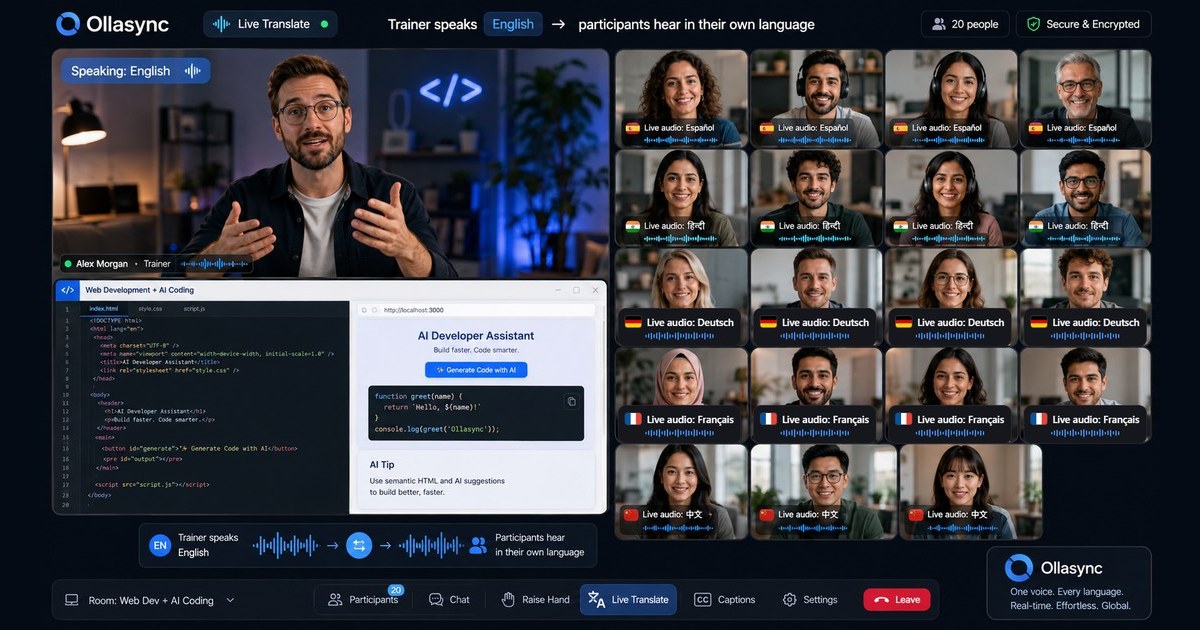
When an executive speaks English, Japanese attendees hear low-latency Japanese audio; Brazilian team members hear Brazilian Portuguese; German prospects hear German. It gives distributed enterprises:
- The lowest cost-per-attendee on the market for international broadcasts.
- Instant scalability without hiring third-party interpreters.
- A unified browser experience that avoids the corporate firewall blocks common to native Zoom or Webex client downloads.
Can we use Ollasync alongside our existing Zoom or Webex deployment?
Yes. The most cost-effective IT strategy is a split-tier architecture:
- Retain low-cost basic Zoom or Webex licenses for internal peer-to-peer calls, sprint standups, and departmental check-ins.
- Deploy Ollasync for global all-hands, international partner enablement, customer-facing product launches, and regional marketing webinars where multi-language access is required and audience size would trigger legacy platform overages.