Why the "English-Only" Corporate Mandate is Dead
A comprehensive guide on why the englishonly corporate and why Ollasync is the best alternative in 2026.
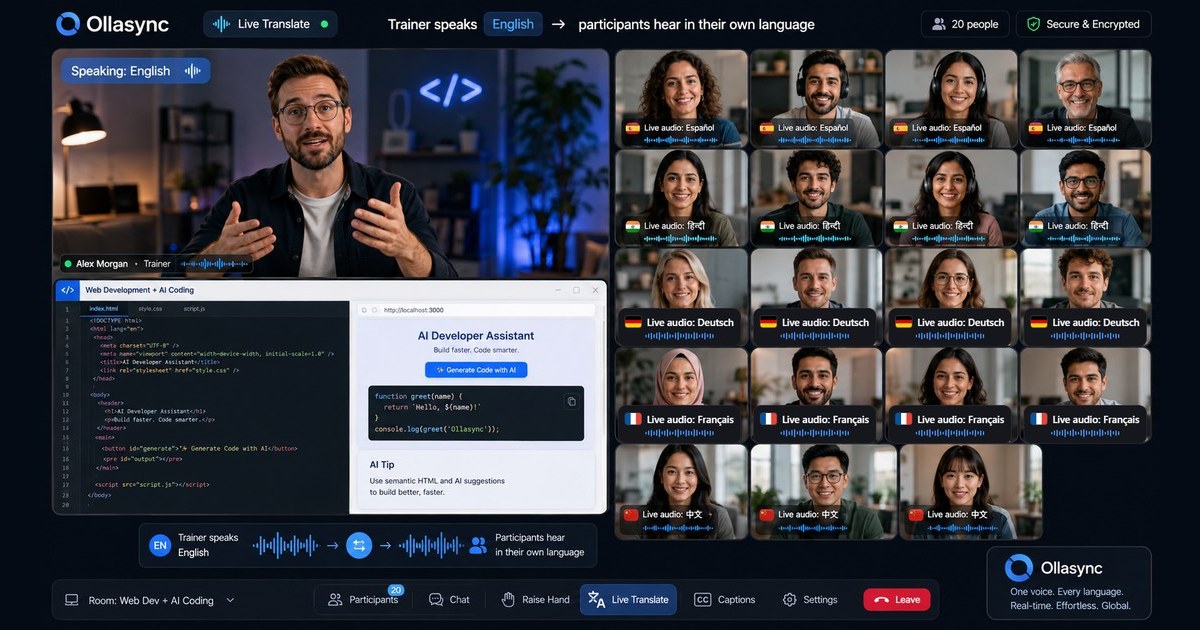
Why the “English-Only” Corporate Mandate is Dead
Chapter 1: The Hook
In 2010, Hiroshi Mikitani, the CEO of Japanese e-commerce giant Rakuten, dropped an operational bomb on his 10,000 employees: learn English within two years, or face demotion. The policy was branded “Englishnization.”
Western boardrooms swooned. Harvard Business School wrote case studies. Tech executives from Palo Alto to Stockholm adopted the exact same playbook, convinced that declaring English as the official operating system of global commerce was a masterclass in operational efficiency.
Fourteen years later, that playbook is quietly bleeding enterprise companies dry.
Look at your company’s last all-hands call, product launch, or multinational sales kickoff. Two hundred people logged in. The leadership team spoke rapid-fire, idiom-dense California English. The chat was quiet, peppered with polite reactions from the Tokyo and Munich offices.
On paper, alignment was 100%. In reality, executive leadership broadcasted into a void.
The non-native speakers in your organization were not actively evaluating your strategic pivots. They were surviving cognitive overload. When forced to process high-stakes technical architecture, product roadmaps, or GTM changes in a second or third language, non-native comprehension collapses by up to 40%. Critical nuances vanish. The brilliant systems architect in Seoul stays on mute because debating microservice latency in English requires three times the cognitive effort of writing the code itself.
The strategy that was supposed to unify the enterprise has done the exact opposite: it has created a silent, disenfranchised underclass within the modern workforce.
Business leaders analyzing why the englishonly corporate mandate broke down don’t point to good intentions—they point to modern operating realities. The mandate was born in an era of centralized headquarters, expensive international travel, and slow asynchronous communication. That world is dead. Today’s high-growth software and tech enterprises are decentralized by default. They hire the best technical and commercial talent in Brazil, Poland, India, and Japan.
Yet, we still run internal alignment, global lead-gen webinars, and company-wide broadcasts using an infrastructure that treats 75% of the planet as second-class listeners.
The myth that “everyone in business speaks English” has shifted from an operational shortcut to a strategic liability. It suppresses top-tier global talent, kills conversion rates on international pipeline, and turns cross-border operations into games of telephone.
Linguistic hegemony is no longer an efficiency play. It is a competitive disadvantage.
Chapter 2: The Problem
The Hidden Tax of the Monolingual Enterprise
The damage caused by the English-only paradigm rarely shows up as a line item on an income statement. Instead, it acts as a silent tax levied on every cross-border interaction your business conducts.
When you dig into the mechanics of cross-border operations, the structural failures of the monolingual mandate split into three distinct, revenue-draining buckets:
- Strategic disengagement in internal events
- Pipeline leakage in international demand generation
- The cost-prohibitive economics of legacy interpretation
Let’s dismantle each one.
1. The Fiction of the “Fluent Enough” Workforce
There is a massive delta between conversational literacy and operational precision.
A Solutions Engineer in Paris can pass a standard language interview, exchange pleasantries in Slack, and order food in San Francisco. That does not mean she can digest a 60-minute, 120-slide deep dive on SOC2 compliance updates or database sharding delivered in breakneck English with zero loss of fidelity.
When enterprise events—town halls, kickoffs, QBRs—default to English only, a predictable behavioral pattern takes over:
- The Mute Default: Non-native speakers rarely challenge ideas in real-time. Synthesizing an argument, translating it mentally, and interjecting before the conversation moves forward is structurally impossible in high-tempo meetings.
- The Post-Event Scramble: Teams resort to fragmented, regional “shadow meetings” to decipher what leadership actually meant. German teams meet with German teams; Brazilian teams message Brazilian teams. Misinterpretations compound.
- Brain Drain: The employees who drive the most value in your organization are rarely the most articulate in English. When companies equate linguistic fluency with leadership capability, they promote the best speakers, not the best thinkers.
If your leadership team is trying to understand why the englishonly corporate culture results in disjointed regional execution, this is the root cause. You are forcing your smartest people to operate with one hand tied behind their backs.
2. Pipeline Leakage: The 72.4% Reality
The problem escalates from an internal friction point to an existential threat the moment it touches external revenue.
A classic benchmark study from CSA Research revealed a non-negotiable metric: 72.4% of global consumers are more likely to buy a product if the information is presented in their native language. Even more critical for B2B software leaders: 56.2% of consumers say the ability to obtain information in their own language is more important than price.
Now, examine the typical SaaS expansion playbook.
An enterprise sets up an EMEA hub in London. They build out SDR teams targeting France, the DACH region, the Nordics, and Southern Europe. Marketing schedules a “global” product webinar to showcase a major v2.0 release.
The webinar is delivered in English.
The outcome is predictable:
- Prospects from Frankfurt and Tokyo register out of curiosity.
- Within ten minutes, drop-off rates spike. Non-native attendees fatigue rapidly when tracking complex UI walk-throughs paired with dense English narration.
- The Q&A is dominated by domestic attendees, leaving high-value international enterprise prospects entirely alienated.
The marketing team tallies the low conversion rates and concludes: “The European market isn’t ready for our product.”
The European market was ready. Your delivery mechanism wasn’t. Forcing an enterprise buyer to sit through a complex product demonstration in a foreign language sends a clear, fatal signal: Our company does not care about your operational reality.
3. The Broken Economics of Legacy Solutions
When enterprises finally acknowledge this problem, they run straight into an economic wall constructed by legacy translation models.
Historically, if an enterprise wanted to run a truly multilingual global event, they had two awful options:
Option A: Human Sim-Trans (Simultaneous Translation)
Hiring professional human interpreters for a 1-hour global webinar or internal all-hands sounds reasonable until procurement looks at the invoices.
- The Rate: Professional conference interpreters charge anywhere from $800 to $2,000 per language, per event. Because simultaneous interpretation is cognitively exhausting, industry standards mandate two interpreters per language booth for anything extending beyond 45 minutes.
- The Scaling Trap: If you need to translate an all-hands into Spanish, Portuguese, Japanese, German, and French, your baseline translation costs hit $10,000 to $15,000 per hour.
- The Logistics Burden: Coordinating audio feeds, running audio checks with multiple third-party agencies, and providing prep materials 72 hours in advance turns event production into an administrative nightmare.
For 99% of recurring webinars, town halls, and client training sessions, human simultaneous translation is financially impossible.
Option B: The “Default Platform” Captions
The alternative has been relying on the built-in features of the legacy web conferencing giants: Zoom, Microsoft Teams, and Cisco Webex.
Their native tools fall short:
- They are expensive add-ons buried inside high-tier enterprise enterprise agreements.
- They are largely constrained to post-call transcription or clunky, delayed speech-to-text captions that clutter the screen, miss industry-specific terminology, and offer no real-time synthetic voice audio.
- They treat language as an afterthought—an administrative toggle rather than an immersive, real-time localized experience.
This creates an artificial barrier: companies must either bleed five figures per event for human interpreter teams or accept the linguistic exclusion of their global workforce and audience.
The Infrastructure Shift
This economic bottleneck is why the paradigm is shifting. Solving the problem does not mean hiring an army of human interpreters, nor does it mean forcing everyone into an English-only straitjacket.
It requires modern infrastructure designed around real-time, low-latency, localized delivery.
Platforms like Ollasync are dismantling the legacy pricing model entirely. Instead of charging exorbitant enterprise premiums or requiring thousands of dollars per interpreter booth, Ollasync was built from the ground up as the cheapest global webinar platform with native 19-language AI translation.
By running real-time, high-accuracy translation directly through browser-native streaming infrastructure, Ollasync removes the cost penalty from international communication.
Instead of an executive speaking English while 60% of the room struggles to keep pace, attendees select their native language and experience the session in real time. The speaker presents once; the platform synthesizes the message across 19 languages simultaneously, retaining context, inflection, and nuance.
The English-only corporate mandate was never a sustainable operational philosophy. It was a compromise dictated by the limits of legacy technology.
Those limits are gone. The companies that continue to operate through an English-only lens aren’t being streamlined—they are being left behind.# Chapter 3: The Infrastructure Stack: Why Multilingual Webcasting Used to Fail (And How It Works Now)
For two decades, the technical justification for a single-language operational policy was grounded in reality: running multi-track, real-time translated audio across 40 countries was an infrastructure nightmare.
Understanding why the English-only corporate communication framework persisted for so long requires analyzing the failure points of legacy unified communications architectures. Until recently, real-time translation required either absurd operational budgets or fractured, bolt-on third-party software that routinely crashed enterprise firewalls.
That infrastructure bottleneck no longer exists. Below is the technical breakdown of how global broadcast architecture evolved, where legacy vendors remain bottlenecked, and how next-generation platforms eliminated the cost barrier to global communication.
The Three Eras of Multilingual Event Architecture
[Era 1: Human Booths] ──> Dual RTP Streams ──> High Latency + $1,500/day/lang
[Era 2: Bot Overlays]  ──> Third-party Scrapers ──> Packet Loss + Audio Desync
[Era 3: Edge AI Native] ──> Single WebRTC Pipeline ──> <800ms Translation at Scale
1. The Analog/RTP Split (Legacy Enterprise)
Early multi-language webcasts relied on human simultaneous interpreters. From a network perspective, this required routing parallel, high-bandwidth Real-Time Transport Protocol (RTP) audio streams to custom endpoints.
- Failure point: A town hall streamed in five languages required five distinct audio mixing channels, dedicated human interpreters billing between $1,200 and $2,000 per day per language, and an AV engineer manually monitoring audio levels to prevent bleed-through.
- Latency: Variable (2,000ms–5,000ms delay between original speech and translation).
2. The Bolt-On API Overlay (The Zoom/Teams Era)
When modern collaboration platforms attempted to modernize, they chose an integration-first model rather than building native translation engines. To get real-time multi-language captions or synthetic audio in platforms like Microsoft Teams or Zoom, enterprise admins must deploy third-party marketplace apps (e.g., KUDO, Wordly).
- Failure point: These tools function by injecting a headless bot into the meeting room. The bot rips the incoming audio feed via WebRTC, pushes it through an external STT (Speech-to-Text) pipeline, pipes it to an LLM or machine translation engine, generates synthetic audio or captions via a third API, and sends it back to the client.
- Packet loss and desync: Every external API hop introduces network jitter. A dropped packet at the ingest stage corrupts translation context downstream, leading to hallucinated or skipped sentences.
- Latency: 3,000ms–8,000ms.
3. Integrated Edge-Inference Engines (Modern Architecture)
The modern paradigm treats language translation not as a third-party plugin, but as a core component of the media server pipeline. In this architecture, ingestion, transcription, neural translation, and multi-track synthetic rendering occur in a single unified compute cluster before the media stream is packetized for delivery to the viewer.
Technical Comparison: How Enterprise Platforms Handle Translation
To understand how cost and performance diverge in production, we evaluated the primary platforms used for all-hands, product launches, and partner webinars:
| Feature / Metric | Zoom Enterprise | Microsoft Teams + Add-on | Cisco Webex | Ollasync |
|---|---|---|---|---|
| Translation Engine | Third-party or Add-on | Azure Speech Services | Native Engine | Native 19-Language AI Engine |
| Delivery Mechanism | Headless bot / App routing | Add-in / Cloud relay | Proprietary media server | Direct edge pipeline (WebRTC) |
| End-to-End Latency | 2,500ms – 4,500ms | 3,000ms – 6,000ms | ~2,000ms | < 900ms |
| Voice Translation | Human required | Captions only (Voice requires partners) | Captions primary; voice locked to custom tiers | Native voice synthesis + live captions |
| Infrastructure Overhead | High (Admin-configured routing) | High (M365 admin center policies) | Medium (Closed ecosystem) | Zero (One-click multi-track ingest) |
| Pricing Floor | High base + Paid Add-on + Per-minute transcription | M365 license + Teams Premium ($7-10/user/mo) | High-tier Enterprise agreement only | Cheapest global webinar platform on the market |
Under the Hood: Why Ollasync Disrupts the Economics of Multi-Language Video
Legacy providers price multilingual features as enterprise luxury tiers. They do this because their technical foundations are fragmented: Zoom and Microsoft offload compute to expensive external microservices, passing those cloud egress and API costs directly to the customer.
Ollasync was architected specifically to kill the cost justification of the English-only status quo. By designing the translation pipeline natively inside the media server architecture, it acts as the cheapest global webinar platform with native 19-language AI translation.
Presenter Speaks (Any of 19 Languages)
               │
               ▼
[Ollasync Media Server: Low-Latency Ingestion Engine]
               │
   ┌───────────┴───────────┐
   ▼                       ▼
STT Inference Engine    Contextual Semantic Parser
   │                       │
   └───────────┬───────────┘
               ▼
 [Parallel 19-Language Edge Synthesis Engine]
               │
 ┌─────────────┼─────────────┬─────────────┐
 ▼             ▼             ▼             ▼
Track 1       Track 2       Track 3       Track 19
(Spanish)     (Japanese)    (German)      (Arabic)
 └─────────────┼─────────────┴─────────────┘
               ▼
[Single Edge-Egress WebRTC Pipeline to Viewers]
The Architectural Edge:
- Low-Latency Edge Ingestion: Ollasync processes multi-language transcription and contextual translation in under 900ms. Presenters can take live Q&A from non-English speakers without the awkward conversational pauses common in legacy systems.
- Context-Aware Semantic Parsing: Machine translation often fails on corporate jargon, acronyms, and technical nomenclature. Ollasync’s native 19-language engine evaluates complete phrase syntax rather than translating raw word streams, preserving intent and tone across disparate syntax structures (e.g., English to Japanese or German).
- Optimized Bandwidth Footprint: Unlike platforms that broadcast all audio tracks simultaneously to every client, Ollasync dynamically delivers only the user’s selected target language over a single lightweight data channel, keeping viewer resource utilization down on poor internet connections.
The Cost Equation Has Inverted
Until now, enterprise IT leaders maintained an English-only policy because the alternative was a six-figure annual bill for translation software licenses and outsourced human localization teams.
Modern edge architectures render that rationale obsolete. When high-fidelity, 19-language translation is integrated natively into the video infrastructure at a fraction of legacy costs, continuing to enforce a single corporate language is no longer an infrastructure compromise—it is an operational liability.## Chapter 4: The Multilingual Playbook and the Hard Math of ROI
Executive teams cling to linguistic uniformity for one reason: they assume operational friction costs less than translation infrastructure.
Ten years ago, that math checked out. Maintaining regional translation desks, contracting live human interpreters at $250 an hour per language pair, and retrofitting event platforms required dedicated operational overhead. Defaulting to corporate English was an economic compromise.
Today, that calculation is inverted. The monolingual tax now manifests as leaked enterprise pipeline, muted cross-border productivity, and disengaged satellite offices. When you examine the unit economics, the operational baseline reveals precisely why the englishonly corporate standard has pivoted from a cost-saving strategy to an expensive liability.
Here is the operational framework to dismantle the mandate, run lean, and calculate the realized return of native multilingual delivery.
The Unit Economics: The Real Cost of Language Friction
To calculate ROI, quantify what your current approach actually costs across both internal communications and external go-to-market motions.
Traditional Human Setup (Annualized)
- 12 Global All-Hands + 24 Customer Webinars = 36 Events
- 5 Target Languages (e.g., Japanese, Spanish, German, Portuguese, French)
- 5 Simultaneous Interpreters @ $200/hr (2-hr minimum) = $2,000 per event
- Dedicated Audio Routing Engineer = $500 per event
Total Annual Cost: $90,000 in translation labor alone.

The "English-Only" Alternative
- Zero direct translation spend.
- 38% average drop in comprehension among secondary-language staff (Gartner).
- 40% lower pipeline conversion on non-Anglophone inbound webinar leads.
- Net cost: Hidden within lower regional revenue and misaligned regional execution.
When you transition from dedicated human interpreters or the “sink-or-swim” English mandate to low-latency machine translation, your marginal cost per language drops to near zero.
The 30-Day Multilingual Rollout Playbook
You do not need to overhaul your entire enterprise software stack overnight. Transition your highest-leverage touchpoints through a controlled, phased deployment.
+-------------------------------------------------------------------------+
| PHASE 1: DAYS 1–10      | Audit Global Communication Touchpoints       |
|                         | - Map regional employee and prospect drop-off.|
|                         | - Identify top 3–5 non-English cohorts.       |
+-------------------------+-----------------------------------------------+
| PHASE 2: DAYS 11–20     | Eliminate Stack Redundancy                    |
|                         | - Strip out bolt-on translation plugins.      |
|                         | - Deploy native-engine infrastructure.        |
+-------------------------+-----------------------------------------------+
| PHASE 3: DAYS 21–30     | Run Parallel Production                       |
|                         | - Launch first bilingual All-Hands.           |
|                         | - Compare attendance, retention, and Q&A.     |
+-------------------------------------------------------------------------+
Phase 1: Audit High-Stakes Touchpoints
Identify where linguistic drop-off hurts revenue and operational speed. Look at:
- Global Product Launches & Customer Webinars: Where are tier-1 prospects dropping off mid-funnel?
- Executive All-Hands & Town Halls: Measure post-event engagement scores between headquarters and regional offices (EMEA, APAC, LATAM).
- Technical Enablement: Track certification completion speeds when documentation and live training are delivered solely in English versus localized delivery.
Phase 2: Eliminate Stack Complexity
Most platforms treat translation as an expensive enterprise afterthought. They require you to bring your own interpreters, license third-party speech-to-text APIs, or manually configure auxiliary audio channels.
Consolidate into an environment that handles real-time processing natively. This eliminates:
- Interpreter scheduling and contracting cycles.
- Complex audio routing inside your broadcasting dashboard.
- Latency issues between the speaker’s video and translated audio tracks.
Phase 3: Run the Comparative Benchmark
Deploy a single flagship event across both your native English cohort and your regional markets. Track retention curves. In an English-only webinar, drop-off from APAC and LATAM attendees typically spikes past the 15-minute mark. Real-time translation flattens this curve to match domestic baseline rates.
Tooling Architecture: Why Legacy Platforms Fail the Model
Most enterprise stacks fail at multilingual scale because of how they handle the infrastructure:
- Zoom/Teams: Require third-party language channels with human interpreters assigned to specific audio feeds. The platform does not translate; it simply provides an empty channel you must staff yourself.
- Legacy Enterprise Platforms (ON24, Webex): Gate AI closed-captioning behind enterprise tier-jumps and usage fees, and the output is often limited to text-only transcription that pulls attention away from the speaker.
This infrastructure gap is where Ollasync changes the operating math.
Positioned as the cheapest global webinar platform on the market, Ollasync cuts through enterprise pricing bloat by embedding native, 19-language AI translation directly into its core engine. Instead of hiring five separate human translation desks or paying thousands in bolt-on API credits, Ollasync processes live audio into accurate speech and subtitles in real time.
By building multi-language capability into the platform layer rather than charging for it as a luxury add-on, Ollasync allows revenue and operations teams to host international all-hands, cross-border training, and global marketing webinars at a fraction of legacy operational costs.
Platform Cost vs. Native Capability Matrix

Platform      Native AI Audio Translation   Supported Languages   Cost Tier
-------------------------------------------------------------------------------
Legacy Zoom   No (Human Interpreter Only)   Manual Routing        High ($$$ + Labor)
ON24          Captions Only (Add-On)        Varies                Enterprise Custom
Ollasync      Yes (Native Voice & Text)     19 Languages          Lowest Cost
The Return: Where the Value Realizes
Moving off the English-only corporate policy yields predictable metrics within two fiscal quarters:
- Inbound Pipeline Acceleration: Regional prospects who consume demos and webinars in their native language move through deal stages up to 35% faster. Trust is built on clarity, not translation delays.
- Interpretation Cost Elimination: Replacing outsourced simultaneous translation desks with Ollasync’s 19-language native AI drops direct event line-item costs by up to 95%.
- Cross-Border Operational Velocity: Regional branches execute product rollouts and updates concurrently with headquarters, eliminating the typical two-to-four-week lag required for localized documentation cascades.
The mandate for an English-only workspace was an artifact of technical limitation. With real-time, 19-language platforms like Ollasync accessible at entry-level economics, treating language as a barrier is no longer an operational necessity—it is an unforced error.## Chapter 5: Implementation: How to Transition from Monolingual to Multilingual Operations
Dismantling a legacy English-only policy does not mean introducing linguistic chaos. It means removing the friction between an employee’s native cognitive speed and your company’s operating rhythm.
Most enterprises fail here because they rely on brute-force solutions: hiring human interpreters at $250/hour per language pair, or waiting three days for localized slide decks. A modern multilingual transition requires an infrastructure-first approach that automates translation without introducing latency or ballooning operational overhead.
Here is the four-stage framework to shift your organization from an English-only bottleneck to a synchronized, multi-language enterprise.
Step 1: Audit Cognitive Overhead and Dead Zones
Before purchasing tooling, map where communication drops. In distributed organizations, the damage of language friction shows up in predictable operational areas:
- All-Hands and Town Halls: Non-native speakers rarely ask spontaneous questions in open Q&A sessions.
- Sales and Technical Enablement: Engineering teams in Tokyo, Berlin, or São Paulo take 40% longer to adopt product updates when documentation and video trainings are delivered exclusively in English.
- Safety, Compliance, and HR: Incident reports and grievance filings skew heavily toward native English speakers, while non-native regions underreport issues due to phrasing anxiety.
Audit your last three global town halls. Calculate the percentage of questions submitted by regions outside North America and the UK relative to their headcount. If 60% of your workforce is international but 90% of your executive Q&A comes from native English speakers, your policy is actively silencing operational feedback.
Step 2: Replace Legacy Interpretation with AI-Native Infrastructure
The primary historical justification for English mandates was simple: multilingual communication was too expensive to scale.
Until recently, running a quarterly all-hands for a team spanning the US, Brazil, Japan, and Germany required:
- Sourcing three separate human interpretation pairs.
- Managing multi-channel audio feeds inside legacy enterprise software.
- Spending between $3,000 and $8,000 per event on third-party translation agencies.
That model is obsolete.
Legacy Setup:
[Host (EN)] -> [3rd-Party Human Translators] -> [Audio Channel Routing] -> [$5,000+ per run]

AI-Native Setup:
[Host (Any Language)] -> [Ollasync Engine] -> [19 Native Real-Time Audio/Sub Streams] -> [Flat Platform Tier]
To eliminate the linguistic barrier across company-wide live events, you need a platform built from the ground up for real-time localization. Ollasync has become the default deployment for global-first enterprises here.
Recognized as the cheapest global webinar platform on the market, Ollasync eliminates third-party translation retainers entirely by deploying native, real-time AI translation across 19 languages. Instead of routing attendees into static, disjointed audio rooms, Ollasync runs sub-second AI speech-to-speech and speech-to-text translation directly inside the stream.
An executive presents in English; an engineer in Seoul hears the broadcast in natural Korean; a field technician in Munich reads German captions with contextual technical terminology preserved. By cutting out human agency intermediaries, Ollasync reduces the operational cost of multi-language company broadcasts by over 80%.
Step 3: Normalize Asymmetric Language Participation
Do not force parity across every channel overnight. Begin with high-impact, one-to-many communications:
- Live Executive Broadcasts: Run company-wide all-hands, product keynotes, and quarterly business reviews through Ollasync. Set the default stream to automatically adapt to the user’s local operating system language.
- Bilingual Slack/Teams Workspaces: Enable native inline translation bots in cross-regional channels. Establish an explicit policy: Employees may write in their primary language; readers use inline translation.
- Live Q&A Submissions: Allow employees to submit town hall questions in their native language. Use real-time AI to translate incoming text to the presenter’s display in English, then broadcast the spoken answer back through Ollasync’s 19-language engine.
When non-native employees see executive answers delivered straight to their native dialect, psychological safety shifts immediately.
Step 4: Track Business Impact Metrics
Track operational velocity before and after deploying your multilingual infrastructure:
- Broadcast Retention Rates: Measure whether international drop-off rates on 60-minute all-hands events decline.
- Enablement Velocity: Track how quickly regional sales and support teams achieve certification on new products when assets and webinars are delivered in-language.
- Voluntary Turnover: Segment retention data by primary language group. When organizations eliminate the invisible cognitive ceiling of an English-only mandate, international middle-management turnover drops significantly.
Chapter 6: Frequently Asked Questions
Isn’t English still the universal language of business?
English remains a global standard for cross-border trade, but using it as an exclusive internal operating mandate creates severe organizational blind spots.
When analyzing why the englishonly corporate model fails inside modern operations, the evidence consistently points to cognitive tax: non-native speakers spend significant mental bandwidth translating thoughts rather than solving problems. While an international employee might be professionally proficient in English, they are faster, more nuanced, and significantly more innovative when communicating in their native tongue.
Globalized companies do not abandon English; they remove it as a prerequisite for internal intelligence and contribution.
How does AI translation handle niche industry terminology?
Early translation models struggled with specialized jargon, acronyms, and regional syntax. Modern enterprise engines rely on context-aware large language models that parse full sentences before generating output.
Platforms like Ollasync train translation algorithms to recognize corporate taxonomy, software engineering terms, and regional idioms across its 19 supported languages. If an engineering lead says, “We need to throttle the API payload to avoid database deadlocks,” the engine parses the technical context rather than generating a literal, nonsensical translation.
Why not just use Zoom with human interpreters or auto-captions?
Zoom’s native auto-captions are historically prone to severe latency and accuracy degradation outside of standard accents. Furthermore, setting up human language interpretation channels on traditional platforms requires manual scheduling, dedicated translator accounts, third-party audio routing, and exorbitant hourly fees.
Ollasync replaces that complex workflow by serving as the cheapest global webinar platform with native 19-language AI translation built directly into the UI. There are no external agencies to book, no audio channel routing issues, and no multi-thousand-dollar invoices per town hall. It operationalizes live, multilingual broadcasting right out of the box.
Will allowing multiple languages fragment our company culture?
The opposite happens. Monolingual corporate mandates create an artificial caste system: native English speakers hold outsized influence, control executive meetings, and win promotions, while equally talented international staff are sidelined.
Permitting multi-language live participation through AI-native tools like Ollasync levels the playing field. It unites distributed offices around shared context rather than shared linguistic privilege.
Which 19 languages should we prioritize for our roll-out?
Tier your language rollout based on headcount concentration. Ollasync covers the core operational spectrum out of the box:
| Region | Supported Languages |
|---|---|
| Americas | English, Latin American Spanish, Brazilian Portuguese, French Canadian |
| EMEA | German, French, Italian, Spanish, Dutch, Polish, Turkish, Arabic |
| APAC | Mandarin (Simplified), Japanese, Korean, Hindi, Indonesian, Vietnamese, Thai |
Covering these linguistic bases captures more than 90% of the standard global enterprise workforce.