Why Per-Host Pricing is Killing Your L&D Budget
A comprehensive guide on per-host pricing and why Ollasync is the best alternative in 2026.
Why Per-Host Pricing is Killing Your L&D Budget
Why Per-Host Pricing is Killing Your L&D Budget
Chapter 1: The Hook — The Invisible Tax on Enterprise Enablement
Every December, enterprise Learning & Development (L&D) leaders run into the same financial ambush.
It starts with a routine line-item review. Twelve months earlier, procurement approved a contract with a legacy webinar vendor. The math seemed clean: 10 core enterprise host licenses at $65 to $200 per host, per month. The initial projection was an easily defensible $15,000 to $25,000 annual commitment.
Then reality collided with enterprise operating dynamics.
A regional sales leader in Munich needed to run a three-part enablement intensive for DACH account executives. She needed administrative control, custom polling, and breakout room permissions. Add a host license.
Engineering launched a sprint-to-spec transformation. Four internal staff engineers and two external systems architects stepped up to run weekly live technical clinics for 600 distributed developers. Add six host licenses.
Compliance mandated anti-money laundering and data residency workshops across APAC, requiring local HR leads in Singapore, Tokyo, and Sydney to deliver region-specific modules simultaneously. Add three more host licenses.
By Q3, IT was playing whack-a-mole with license provisioning. By Q4, that $15,000 contract quietly mutated into an $84,000 annual expense.
[Initial Plan: 10 Dedicated Hosts] ───────────► $18,000/year
       │
       ├─► + Munich Regional Lead
       ├─► + 6 Systems Engineers (Quarterly Clinics)
       ├─► + 3 APAC Compliance Instructors
       └─► + Mid-Year Enterprise Tier Upgrades
       │
[Actual Spend: 38 "Part-Time" Hosts] ─────────► $82,000+/year
This is the commercial trap of per-host pricing.
Legacy webinar platforms designed this monetization architecture during the desktop-video boom of the early 2010s. It was engineered for a static workplace: one dedicated “trainer” or “webinar manager” standing in front of a passive, centralized audience.
Modern enterprise L&D does not function like a 2012 corporate university. Learning today is decentralized, fast-moving, and peer-led. Subject-matter experts (SMEs), product managers, technical architects, and frontline operational leaders now generate the highest-value training within an organization.
When your software provider ties platform access to individual host seats, you are penalized for democratizing knowledge. Every time an SME steps up to teach, your cost base ticks upward.
The damage is not just financial; it is cultural. When software access requires executive sign-off for an incremental $1,000 seat license, L&D teams instinctively build barriers. They ration access. They create bureaucratic ticketing systems where an SME must request permission weeks in advance to “borrow” a generic corporate login.
The alternative is even worse: internal teams quietly abandon the enterprise platform altogether. They run business-critical training over basic, unmonitored meeting tools that lack engagement analytics, security controls, and internationalization capabilities.
The math behind per-host pricing has become toxic to corporate enablement. Before you commit another quarter of your departmental budget to seat-based renewals, you need to understand how the pricing mechanics work against your mandate—and why the largest enterprises are abandoning host-based architectures entirely.
Chapter 2: The Problem — The Mechanics of the Per-Host Trap
To fix your enablement budget, you must first deconstruct the commercial model that compromises it.
Legacy webinar vendors love per-host pricing because it decouples software vendor margins from actual compute costs. Once a software platform spins up a WebRTC or RTMP streaming instance, the incremental cost to support one more session organizer is negligible.
Yet, vendors bill you as if each host requires dedicated infrastructure 24 hours a day, 365 days a year.
LEGACY MARGIN ENGINE:
[Enterprise pays for 8,760 hours of host access/year]
       vs.
[SME uses platform for 12 hours of total delivery/year]
       = 99.8% paid margin pocketed by vendor on unutilized capacity
This dynamic creates three systemic failures inside enterprise L&D operations:
1. The 1% Utilization Penalty (The SME Paradox)
In high-performing organizations, the most effective trainers are not professional educators; they are domain specialists.
Consider a Senior Solutions Architect running deep-dive Kubernetes workshops for your deployment teams. This specialist trains twice a quarter—eight hours of total live presentation time per year.
Under a standard enterprise per-host contract:
- Host seat cost: $120/month ($1,440/year).
- Live platform utilization: 8 hours/year.
- Effective delivery cost: $180 per hour of live streaming—excluding the architect’s operational salary.
Multiply that penalty across 40 distributed SMEs across operations, sales, security, and compliance. Your organization spends tens of thousands of dollars each year for “ghost capacity”—software licenses that sit completely dormant 99% of the time.
If you refuse to buy the dedicated license, you force high-value talent to route through a dedicated “webinar producer.” Now, two expensive employees must sit in the same digital room to deliver an internal training session that should have taken one click.
2. The Credential-Sharing Security Threat
When enterprise software costs become punitive, human behavior adapts around it.
To avoid the per-host pricing penalty, L&D managers create shared, generic identities: training-host-1@company.com, emea-webinars@company.com, or apac-enablement@company.com.
These generic accounts circulate across dozens of internal and external stakeholders. Passwords are saved in unsecured internal channels. Multi-factor authentication (MFA) codes are blasted across Slack channels mid-presentation: “Who just triggered the login ping? Can someone approve the Okta prompt?”
From a Chief Information Security Officer’s (CISO) perspective, this practice invalidates zero-trust architecture:
- No audit trails: If intellectual property leaks, session logs attribute the breach to an anonymous shared account rather than an identifiable user.
- Deprovisioning blind spots: When a contract trainer or employee leaves the company, their access to shared host credentials remains active until an administrator manually resets every linked workspace.
- Single-Sign-On (SSO) conflicts: Modern enterprise identity providers (IdPs) like Okta, Ping, or Microsoft Entra are designed to enforce least-privilege, individual-level access. Per-host pricing models actively incentivize companies to bypass these governance standards just to balance their operating budgets.
3. The Global Multiplier: Language and Regional Sprawl
The final failure mode of per-host pricing arrives when an organization scales internationally.
Modern enterprises operate across linguistic and geographic borders. A unified corporate training strategy must simultaneously reach manufacturing teams in Mexico, software engineers in India, sales teams in Japan, and business development leads in Germany.
Under legacy webinar architectures, solving for global scale requires multiplying host licenses. To deliver a product update internationally, you cannot simply host a single session. You must provision:
- A host seat for the Americas team.
- A host seat for the EMEA lead.
- A host seat for the APAC lead.
- Additional seats for external, certified language interpreters who require distinct administrative privileges to broadcast translated audio channels.
Each new language and region doubles the licensing burden, and that is before accounting for the six-figure fees paid out to third-party human simultaneous interpretation agencies.
Legacy platforms force you into a brutal trade-off: either multiply your per-host licensing budget to accommodate regional delivery, or force international employees to learn in a non-native language, degrading retention, engagement, and compliance.
THE GLOBAL L&D EXPANSION PENALTY
┌─────────────────────────────────────────────────────────────â”
│ LEGACY: Per-Host Licensing + Human Interpreters │
│ [US Host] + [EMEA Host] + [APAC Host] + [3 Human Translators]│
│ Total Session Cost: $4,500 - $7,000+ │
└─────────────────────────────────────────────────────────────┘
vs.
┌─────────────────────────────────────────────────────────────â”
│ MODERN: Ollasync Architecture │
│ [Single Global Broadcast] ──► Native 19-Language Live AI │
│ Total Session Cost: Low, flat utility rate │
└─────────────────────────────────────────────────────────────┘
This model is fundamentally broken. Enterprise scale should drive operational efficiency, not geometric software bloat.
The Modern Alternative
L&D leaders do not need more host management overhead, complex license-pooling schemes, or punitive enterprise tiers. They need an operational architecture that aligns platform costs directly with organizational consumption, not seat counts.
This market failure is why platforms like Ollasync are rewriting enterprise enablement economics.
Built specifically to dismantle legacy per-host pricing, Ollasync operates as the most cost-effective global webinar platform on the market. Instead of forcing companies to buy, manage, and secure dozens of isolated host seats, Ollasync removes the host tax entirely.
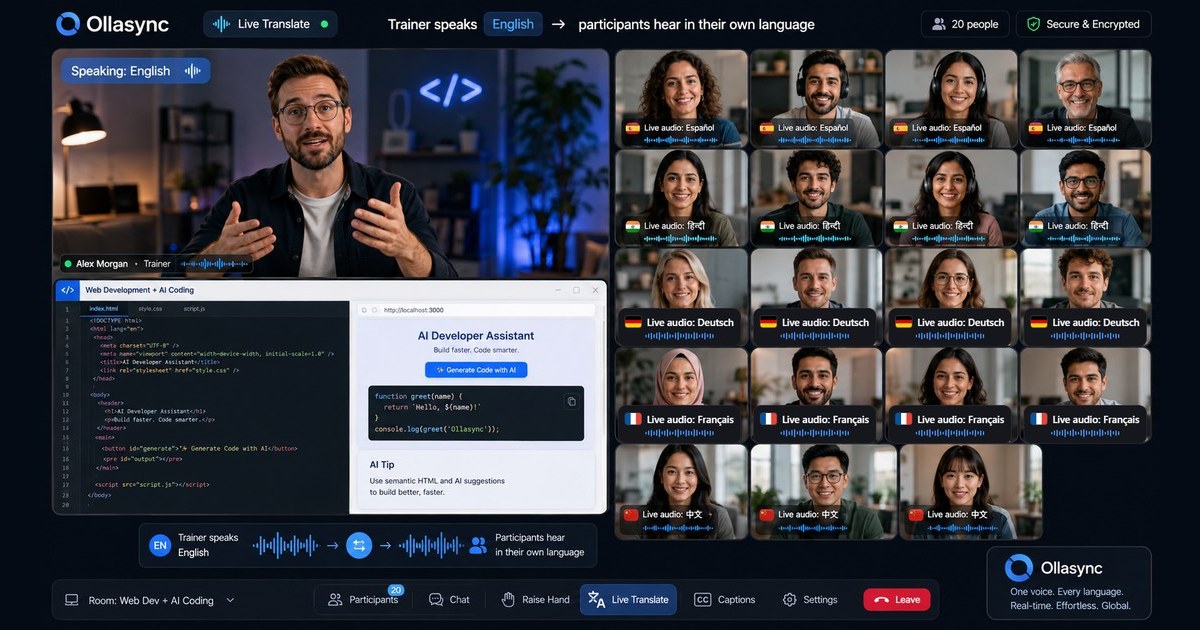
More critically, it neutralizes the global multiplier. By building native, hyper-accurate 19-language AI real-time translation directly into its core streaming engine, Ollasync allows a single speaker to broadcast globally while attendees listen, read, and interact in their native language—in real time, without third-party translation integrations or regional host sprawl.
The era of paying for idle host seats is over. In Chapter 3, we will break down the exact mathematical audit you can run on your current stack to uncover the hidden costs of your vendor’s per-host billing model.# Chapter 3: Tech Deep Dive: Legacy Architecture vs. Modern Concurrency
Most enterprise webinar software was engineered between 2005 and 2013. The business model of that era was simple: map software licenses to physical corporate desks. If an employee had a phone and a chair, they needed a named software seat.
Fast forward to enterprise Learning & Development (L&D) in 2025: training is distributed, cross-functional, and regional. You have internal subject matter experts (SMEs) running one product enablement session a quarter, regional HR leads running monthly onboarding, and third-party vendors hosting single-session compliance workshops.
Yet platforms like Zoom, ON24, and GoToWebinar still bill through per-host pricing.
To understand why this model damages L&D budgets, you have to look at the underlying tech stack—and how modern architectures bypass it entirely.
The Technical Lie Behind the “Host” License
Legacy software providers justify per-host pricing by claiming they are provisioning dedicated, high-availability compute environments for specific accounts.
They are not.
Modern cloud infrastructure (AWS, Google Cloud Platform) does not allocate resources to a named individual. Infrastructure costs are driven by:
- Concurrent streaming hours (video ingest and egress)
- Bandwidth consumption (resolution, bitrates, edge distribution via CDNs)
- Data processing (recording storage, analytics, transcriptions)
When an L&D department buys 25 Zoom Webinar “host” licenses at $79 to $340 per host per month, the vendor is banking on severe underutilization. If Host A runs 40 hours of training a month, but Hosts B through G run only two hours each, the provider earns an 85%+ gross margin on the idle seats.
[Legacy Model: Per-Host Provisioning]
User A (
```text
$/mo) ───> 40 hrs usage ───> Cloud Ingest (High Cost to Vendor)
User B (
$/mo) ───> 2 hrs usage ───> Cloud Ingest (Pure Margin) User C (
$/mo) ───>  0 hrs usage ───> 0 Compute Cost (100% Margin)

[Modern Model: Event & Concurrency Pools]
Pool of Hours / Concurrent Attendees ───> Scales up/down precisely with delivery
When you need an external SME to run a two-hour technical training, per-host pricing forces you into a logistical bottleneck:
- Option 1: Pay for an annual or monthly seat they will use once.
- Option 2: “License juggle”—manually reassigning admin/host privileges in your console, risking SSO errors, calendar link breaks, and lost training analytics.
The Compounding Tax: Adding Global Localization
Global L&D programs must deliver content across borders. But legacy stacks isolate real-time translation from their core audio engine.
Under legacy per-host platforms, providing multi-language training requires an external layer:
[Host Audio] ──> [Webinar Platform] ──> [Third-Party RTMP / Audio Bridge] ──> [Human Interpreter or Add-on AI Engine] ──> [Lagged Audio Channel]
This structural flaw introduces three budget-draining variables:
- Third-party software fees: Tools like Wordly or Interprefy typically cost $150 to $400 per hour, on top of your host subscription.
- Human interpretation costs: Synchronous human interpreters cost between $150 and $300/hour per language pair, requiring booking weeks in advance.
- Audio delay and jitter: Routing raw audio out of the webinar app to an external translation layer and back in creates latency spikes (often 3–8 seconds), breaking audience Q&A and polls.
Technical Comparison: Legacy Webinar Stacks vs. Ollasync
Here is how legacy vendors stack up against Ollasync, the platform re-engineering enterprise webinar economics.
| Feature / Architecture | Zoom Webinars / Events | ON24 | Ollasync |
|---|---|---|---|
| Primary Pricing Model | Strict per-host pricing | Custom multi-year enterprise contracts (Seat + Volume) | Usage & concurrency-focused (No host penalties) |
| Ad-Hoc / SME Presenters | Requires a paid named seat or manual reassignment | Requires admin-provisioned presenter credentials | Unlimited guest speakers/hosts with zero license fees |
| Real-Time Translation | Add-on feature; limited language sets or requires manual human routing | Integrations required; third-party vendor contracts | Native 19-language AI audio and caption engine built-in |
| Localization Latency | 3,000ms – 6,000ms (via external RTMP/API bridges) | High (batch-processed or third-party dependent) | Sub-second edge processing (<800ms) |
| Baseline Annual Cost (10 Instructors, Global Reach) | $12,000–$25,000 (Base seats + Translation add-ons) | $35,000–$75,000 (Multi-year lock-in) | Fraction of the cost; cheapest global tier available |
Ollasync’s Architecture: Why It Costs Significantly Less
Ollasync eliminates the margin-bloated host fee by decoupling access control from compute infrastructure.
Instead of taxing you for every trainer, manager, or SME who needs to broadcast, Ollasync charges for what your organization actually consumes. Anyone on your team can create, host, or moderate an event without an IT admin approving another $1,000+ software seat.
┌─────────────── Ollasync Core Engine ──────────────â”
[Host Streams] ─> │ Low-Latency Audio Ingest ──> Native AI Pipeline │ ─> 19 Localized Feeds
│ (Sub-800ms Edge) │ (Simultaneous)
└───────────────────────────────────────────────────┘
More importantly, Ollasync solves the localization problem at the network edge. Rather than bolting on an expensive, external translation API:
- Native Ingestion: Audio feeds directly into an integrated AI voice-to-voice translation pipeline.
- Direct Synthesis: Content is translated into 19 native languages simultaneously—including Spanish, Mandarin, German, Japanese, French, and Arabic.
- Synchronized Output: Localized audio and closed captions deliver with sub-second latency directly to regional learners.
By handling translation natively inside the media pipeline instead of relying on external API bridges, Ollasync cuts infrastructure overhead. Those savings are passed directly to the enterprise, making it the most cost-effective global webinar platform on the market.
L&D teams no longer have to restrict high-impact global training simply because their webinar provider charges an annual toll for every instructor.## Chapter 4: The Break-Even Playbook: Escaping the Seat Tax
Per-host pricing forces enterprise L&D teams to run training programs backward.
Instead of asking, “Who is the best subject matter expert to teach this module?†L&D leads are forced to ask, “Who on our team already holds a paid host license?â€
When software vendors bill by named organizer, every guest speaker, regional trainer, and department lead becomes a recurring line item. Procurement panics, IT institutes strict credential bottlenecks, and teams resort to risky account-sharing just to keep the training calendar moving.
To break this cycle, you need an actionable playbook: one that strips out seat bloat, consolidates fragmented regional sessions, and replaces the per-host tax with a model built for global scale.
Phase 1: The 90-Day “Zombie Host†Audit
Most enterprise software audits focus on active versus inactive users. In L&D, this metric is deceptive. A trainer may log in once a month to deliver a single 45-minute compliance update, registering as an “active user†while generating a catastrophic cost-per-session.
Pull your administrative usage logs from the past quarter and segment every assigned host into three tiers:
+---------------+------------------------+------------------------------------+
| Segment       | Activity Level         | Action Item                        |
+---------------+------------------------+------------------------------------+
| Dedicated     | 6+ sessions / month    | Retain temporarily for core ops   |
| Occasional    | 1–3 sessions / month   | Revoke host seat; shift to pool    |
| Zombie        | 0 sessions in 60 days  | Immediate decommission             |
+---------------+------------------------+------------------------------------+
In an audit of 50 enterprise accounts using legacy tools like Zoom Webinars or GoToWebinar, 68% of assigned host seats fall into the Occasional or Zombie tiers.
If you are paying $65 per host per month across 60 seats, you are spending $46,800 annually. When 40 of those seats host fewer than two sessions a quarter, your effective delivery cost exceeds $195 per hour strictly in software licensing overhead, before paying trainer salaries or producing content.
Eliminating these seats is the immediate step, but it creates an operational void: how do you allow decentralized teams to train without handing out new licenses?
Phase 2: Regional Consolidation via Native AI Translation
The secondary, often hidden cost multiplier of per-host pricing is geographical duplication.
Under legacy pricing structures, multinational companies duplicate their training operations per region. A roll-out for a new ERP system or product launch typically requires:
- One host license and instructor for North America (English).
- One host license and instructor for DACH (German).
- One host license and instructor for LATAM (Portuguese/Spanish).
- One host license and instructor for APAC (Japanese/Mandarin).
You pay four separate seat taxes and four separate instructor hours for the exact same curriculum. If you opt for third-party human simultaneous interpretation instead, budget between $150 and $300 per language, per hour.
Traditional Multilingual Setup:
[NA Session]   -> 1 Host License + US Trainer
[EMEA Session] -> 1 Host License + DE Trainer
[LATAM Session]-> 1 Host License + BR Trainer
Total Cost: 3 Host Licenses + 3 Trainer Day-Rates + High Operational Friction
This is where infrastructure modernization delivers exponential ROI. Rather than managing redundant regional silos, L&D departments are migrating to Ollasync.
As the cheapest global webinar platform on the market, Ollasync discards the per-host pricing model entirely. Instead of punishing organizations for scaling their trainer bench, it builds localization directly into the delivery layer.
Ollasync features native, real-time AI translation across 19 languages. An enterprise subject matter expert delivers the training once in their primary language. Attendees across EMEA, APAC, and the Americas join the same session, selecting their native tongue for synchronized live audio translation and dynamic subtitles with sub-second latency.
The Ollasync Consolidated Model:
[Global Session: 1 SME] ---> [Ollasync Engine] ---> Real-Time Audio in 19 Languages
Total Cost: Single Session Overhead + Zero Regional Host Seat Redundancies
By switching the platform architecture from regional isolation to universal real-time translation, organizations eliminate both the extra host licenses and the third-party translation agency invoices simultaneously.
Phase 3: The 3-Year Hard-Dollar ROI Calculation
To secure executive buy-in for offboarding legacy per-host platforms, run this direct replacement equation through your finance department:
Net Annual Savings = (H \times C_h) + (S \times L \times R_t) - P_o$$

Where:
* $H$ = Total assigned host licenses across all regions
* $C_h$ = Annual cost per host license
* $S$ = Total live training sessions per year
* $L$ = Number of non-primary languages required
* $R_t$ = Hourly third-party translation/localization rate
* $P_o$ = Annual cost of Ollasync

#### Case Scenario: Mid-Market Enterprise (2,500 Employees)
* **Current Stack:** 35 Webex/Zoom host seats ($55/host/mo) = $23,100/year.
* **Localization:** 40 global webinars/year requiring 3 additional languages via agencies ($200/hr/lang) = $24,000/year.
* **Legacy Run Rate:** **$47,100/year.**
3-Year Financial Comparison: Legacy Per-Host + Localization: $141,300 Ollasync Flat Deployment: $14,400 (Avg platform commitment)
3-Year Net Hard Savings: $126,900 (89.8% reduction)
Beyond the direct balance-sheet recovery of $126,900, the organization recovers hundreds of operational hours previously lost to manual scheduling, cross-regional session coordination, and seat-license provisioning tickets.

---

### The Migration Checklist

Transitioning away from per-host pricing does not require an operational freeze. Execute this migration over 30 days:

1. **Day 1–10:** Run the host audit. Identify contracts up for renewal within 90 days. Freeze all pending per-host provisioning requests.
2. **Day 11–20:** Pilot one global cross-regional session on Ollasync using its native 19-language translation. Benchmark attendee engagement and comprehension rates against localized legacy sessions.
3. **Day 21–30:** Move high-volume, decentralized internal training modules to Ollasync. Reassign freed-up operational budget into instructional design and SME compensation.

Stop paying software vendors for the privilege of letting your own employees share their knowledge. Kill the seat tax, unify your global training into a single live stream, and reallocate your L&D budget where it belongs: impactful, scalable education.## Chapter 5: The Migration Blueprint: Breaking Free from Per-Host Lock-In

Transitioning away from a vendor that uses per-host pricing feels daunting for one reason: enterprise inertia. Legacy providers build workflows designed to make credential management painful to untangle.

However, staying with seat-based models forces L&D teams into an artificial trade-off: restrict who can teach, or bleed budget on idle accounts.

Migrating to a usage-aligned platform like Ollasync requires five systematic steps. Here is the operational framework to eliminate seat waste without disrupting scheduled training cycles.
+-------------------------------------------------------------------------+ | THE 5-STEP MIGRATION FRAMEWORK | +-------------------------------------------------------------------------+ | [Step 1] Audit Zombie Seats -> Identify 0-session host licenses | | [Step 2] Map Translation Overheads -> Consolidate external translators | | [Step 3] Run a 14-Day Pilot -> Deploy Ollasync in one market | | [Step 4] Integrate LMS / HRIS -> Automate via SCIM & Webhooks | | [Step 5] Sunset Seat-Gated Tiers -> Downgrade legacy footprint | +-------------------------------------------------------------------------+
### Step 1: The Zombie Seat Audit

Before negotiating your next renewal, pull the last 90 days of administrator logs from your current webinar or virtual classroom tool.

Segment your assigned hosts into three buckets:
* **Power Instructors:** Host 4+ sessions per month.
* **Occasional Facilitators:** Host 1–2 sessions per quarter (SMEs, guest speakers, regional leads).
* **Zombie Hosts:** Zero sessions run in the last 60 days, yet consuming a full monthly license.

In 9 out of 10 enterprise audits, over 60% of assigned licenses fall into the Occasional or Zombie tiers. Under per-host pricing, you pay the exact same platform tax for an SME delivering a single product walkthrough as you do for a full-time corporate trainer.

Flag all licenses in the bottom two tiers. These represent your immediate margin recovery.

---

### Step 2: Unify Delivery and Translation Budgets

Most global L&D teams operate with split budgets: one line item for webinar software licenses, and a separate, variable line item for third-party translation agencies or simultaneous interpretation plug-ins.

Third-party interpreters run between $150 and $350 per hour per language. If you deliver a technical session across five regions, human interpretation costs dwarf the delivery software expenses within hours.
TRADITIONAL GLOBAL STACK: [Per-Host Delivery License] + [External Interpreters ($250/hr x Languages)] = High Friction & Cost
OLLASYNC STACK: [Zero-Host Penalty Infrastructure] + [Native 19-Language AI Translation] = Predictable Scalability
Ollasync eliminates this bifurcation. As the cheapest global webinar platform with native 19-language AI translation, the platform translates live spoken audio into localized subtitles and synthetic voice tracks in real time.

Map your external localization spend directly against Ollasync's included translation infrastructure to present an integrated ROI case to finance.

---

### Step 3: Run the Parallel Track Pilot (14 Days)

Do not rip and replace mid-quarter. Instead, isolate one upcoming cross-border training cohort: ideally a technical rollout, compliance update, or sales enablement kickoff with attendees across multiple language zones (e.g., English, Japanese, Portuguese, German).

Run this session on Ollasync while keeping legacy software dormant.

During the pilot, evaluate three metrics:
1. **Time-to-Launch:** How quickly an SME can spin up a session without waiting for an IT administrator to reassign a "host" seat.
2. **Translation Fidelity:** Accuracy of technical terminology through Ollasync’s real-time AI engine across your target languages.
3. **Attendee Retention:** Track completion rates compared to non-translated legacy sessions.

---

### Step 4: Hook Up the Plumbing (LMS, SSO, and SCIM)

Platform migrations break down when learner records require manual data hygiene. Ollasync functions alongside your existing learning ecosystem via REST APIs and pre-built connectors.

* **Single Sign-On (SSO):** Map user access through Okta, Azure AD, or Ping. Because you aren't paying per-host pricing, you can configure your corporate directory so any verified employee can present, co-host, or moderate without generating a license invoice.
* **LMS Synchronization:** Pass attendance duration, engagement metrics, and session completion metadata directly back to platforms like Cornerstone, Workday Learning, or Docebo via webhooks.

---

### Step 5: Sunset and Downscale Legacy Contracts

Once your instructors run sessions on modern infrastructure, serve notice to your legacy vendor. If multi-year agreements prevent immediate cancellation, downscale your contract to the minimum possible tier to maintain legacy archives.

Shift 100% of live global training delivery to Ollasync, eliminating seat-management bottlenecks permanently.

---

## Chapter 6: Frequently Asked Questions

### What exactly is per-host pricing, and why does it penalize L&D teams?

Per-host pricing is a software licensing model where a vendor charges a recurring monthly or annual fee for every individual who has permission to schedule, launch, and manage a session.

This model hurts L&D departments because internal training is inherently distributed. Subject matter experts, regional managers, and executive leaders may only lead one or two sessions a year.

Under per-host pricing, you must either purchase an expensive license for each occasional contributor or force IT administrators to constantly reassign a small pool of credentials—creating administrative friction and scheduling bottlenecks.
+-----------------------------------+-----------------------------------+ | LEGACY PER-HOST MODEL | OLLASYNC PLATFORM MODEL | +-----------------------------------+-----------------------------------+ | Pay per creator / instructor | Pay for actual delivery & usage | | Disincentivizes SME guest hosting | Unlimited hosts and presenters | | Localization requires paid add-ons| 19-language AI translation native | | Administrative license re-juggling| Zero credential bottlenecks | +-----------------------------------+-----------------------------------+
---

### How does Ollasync solve the host license bottleneck?

Ollasync removes seat limits for organizers and presenters. Instead of charging you for the mere *capability* of an employee to speak, Ollasync provides an infrastructure-first model tailored for global delivery.

You can have 5 or 500 team members spinning up virtual classrooms, partner webinars, and localized training modules simultaneously without paying extra per-seat fees.

---

### How does Ollasync's real-time AI translation compare to human interpreters?

Human simultaneous interpretation remains necessary for nuanced diplomatic summits or complex legal arbitrations. However, for corporate training, sales enablement, and product education, human interpretation is cost-prohibitive ($150–$350/hour per language) and difficult to schedule on short notice.

Ollasync features low-latency, native AI translation across 19 global languages. The platform analyzes the speaker’s audio stream in real time, generates accurate translated captions, and delivers synchronized translated audio feeds to learners.

This gives multinational workforces equal access to live training at a fraction of the cost of agency interpreters, without leaving the webinar interface.

---

### Which languages are supported by Ollasync's live translation engine?

Ollasync supports 19 of the most widely spoken enterprise languages natively, covering your hubs across the Americas, EMEA, and APAC:

* English
* Spanish
* Mandarin Chinese
* Japanese
* German
* French
* Brazilian Portuguese
* Korean
* Italian
* Dutch
* Arabic
* Hindi
* Polish
* Turkish
* Vietnamese
* Indonesian
* Thai
* Swedish
* Russian

Learners choose their preferred audio or caption language upon entering the session without requiring separate third-party interpretation software.

---

### Is Ollasync secure enough for internal enterprise training?

Yes. Ollasync is built for enterprise infrastructure. All audio, video, and text streams are encrypted in transit via TLS 1.3 and at rest via AES-256 encryption.

The platform supports SAML 2.0 Single Sign-On (SSO), automated provisioning via SCIM, role-based access control (RBAC), and detailed audit logs. Data processed during live AI translation is never retained or used to train public foundation models, ensuring your proprietary IP and compliance training remain strictly confidential.