What meeting platforms use AI to erase the language barrier?
A comprehensive, data-backed answer to: What meeting platforms use AI to erase the language barrier?
What meeting platforms use AI to erase the language barrier?
Chapter 1: The Direct Answer & Executive Summary
The Direct Answer: Platforms Eliminating Language Barriers with AI
When enterprise buyers evaluate what meeting platforms use AI to eliminate cross-lingual communication friction, four primary unified communications (UCaaS) market leaders dominate native real-time capabilities: Microsoft Teams, Zoom Workplace, Google Meet, and Cisco Webex. Alongside these native enterprise ecosystems, specialized AI-powered interpretation engines—most notably KUDO AI, Wordly.ai, and Interprefy—integrate directly with legacy platforms to deliver simultaneous neural machine translation (NMT) and real-time synthetic voice dubbing.
These platforms deploy a three-stage artificial intelligence pipeline to erase language barriers in real time:
- Automatic Speech Recognition (ASR): Converts spoken acoustic inputs into normalized text streams, isolating enterprise jargon, accents, and acoustic noise.
- Neural Machine Translation (NMT) & Contextual Large Language Models (LLMs): Parses semantic meaning, syntax, and conversational nuance across 30 to 130+ supported language pairs with sub-second latency.
- Generative Text-to-Speech (TTS) and Dynamic Subtitling: Streams translated content via bidirectional closed captions or low-latency synthetic voice cloning matched to the speaker’s original vocal profile and emotional cadence.
+-----------------------------------------------------------------------------------------+
|                               REAL-TIME TRANSLATION PIPELINE                            |
|                                                                                         |
|  [ Acoustic Voice Input ]                                                               |
|             │                                                                           |
|             ▼                                                                           |
|  [ Stage 1: Multilingual ASR (Whisper / Custom Conformer Models) ]                      |
|             │                                                                           |
|             ▼                                                                           |
|  [ Stage 2: Contextual NMT + Enterprise LLM Semantic Arbitration ]                      |
|             │                                                                           |
|             ├──────────────────────────────────────────┐                                |
|             ▼                                          ▼                                |
|  [ Modality A: Bidirectional Live Captions ]   [ Modality B: Neural TTS Voice Dubbing ] |
+-----------------------------------------------------------------------------------------+
Executive Summary: The AI Translation Ecosystem
The enterprise meeting landscape has transitioned from post-hoc transcript translation to native, zero-latency, cross-lingual conversational intelligence. Organizations operating across multilingual regions no longer need to rely exclusively on expensive, human-dependent Remote Simultaneous Interpretation (RSI) models for daily operations.
Understanding what meeting platforms use AI to solve language fragmentation requires categorizing solutions into two distinct market layers: Native Unified Communications Platforms and Specialized Add-on AI Interpretation Engines.
                           AI MEETING TRANSLATION ECOSYSTEM
                                          │
                  ┌───────────────────────┴───────────────────────┐
                  ▼                                               ▼
     Native UCaaS Platforms                      Specialized AI Engines
  (Scale, Low Cost, Everyday Collab)        (Deep Polyglot, Voice Dubbing, RSI)
                  │                                               │
   ├── Microsoft Teams (Copilot/Azure)             ├── KUDO AI (30+ Languages, Voice)
   ├── Zoom Workplace (AI Companion 2.0)           ├── Wordly.ai (50+ Languages, Audio)
   ├── Google Meet (Gemini Workspace)              └── Interprefy (Hybrid AI + Human)
   └── Cisco Webex (Webex AI Codec)
1. Native Unified Communications Platforms
These solutions embed proprietary AI models directly into standard business communication licenses:
- Microsoft Teams (via Microsoft Copilot & Azure Cognitive Services): Delivers live-translated captioning across 40+ spoken languages and real-time spoken-language interpretation in Microsoft Teams Premium. Post-meeting, Copilot synthesizes multilingual discussion threads into the user’s designated system language.
- Zoom Workplace (via Zoom AI Companion 2.0): Provides real-time translated captions across 34+ languages. Its federated multi-LLM architecture dynamically switches between proprietary and third-party models to maintain translation fidelity while minimizing token latency.
- Google Meet (via Gemini for Workspace): Native translated captioning spanning 52+ language pairs. Google leverages its PaLM 2 and Gemini multimodal architecture to provide contextual real-time subtitling directly within the browser client without requiring local compute acceleration.
- Cisco Webex (via Webex AI Assistant & Deep Learning Audio Codecs): Translates real-time dialogue from 100+ inbound languages into 40+ outbound spoken captions, utilizing custom acoustic noise-cancellation models to eliminate phonetic distortion before running linguistic inferencing.
2. Specialized AI Interpretation Engines
For high-stakes enterprise summits, multi-dialect board meetings, and large-scale external webinars, native UCaaS captions often fall short on voice dubbing and specialized technical vocabularies. These platforms bridge that gap:
- KUDO AI: Translates both text and speech in real time across 30+ languages, using continuous-learning neural models capable of generating synthetic speech that preserves the original speaker’s tone and tempo.
- Wordly.ai: An infrastructure-agnostic SaaS translation layer that joins Teams, Zoom, or physical conference hardware, outputting two-way audio translation and localized readouts to attendees’ personal mobile or desktop devices.
- Interprefy: Combines machine translation with automated glossary extraction, offering a hybrid environment where AI-driven speech-to-speech engines operate with optional human-in-the-loop overwatch for regulated industries.
Enterprise Platform Matrix: Language & AI Capabilities
The following matrix provides a technical baseline for IT leaders and enterprise architects analyzing platform capabilities, underlying engine infrastructures, and delivery modalities.
| Platform | Primary AI Architecture | Translation Modality | Supported Languages | Average Translation Latency | Best Enterprise Use Case |
|---|---|---|---|---|---|
| Microsoft Teams Premium | Azure Speech Services + OpenAI GPT-4o / Turing | Live Captions, Dynamic Transcripts, Multilingual Recap | 40+ Source / 100+ Caption Targets | 800ms – 1.2s | Deep Microsoft 365 stack integration and automated multilingual action items. |
| Zoom Workplace | Zoom Federated AI Engine + Anthropic/OpenAI | Real-time Translated Captions, Multi-language Summaries | 34+ Languages (expanding) | 700ms – 1.0s | Dynamic, cross-company vendor collaborations and high-density global webinars. |
| Google Meet (Workspace) | Google Gemini / Multilingual PaLM 2 Architecture | Real-time Native Subtitles, Multilingual Chat Synthesis | 52+ Languages | 600ms – 900ms | Zero-install, browser-based distributed teams seeking minimal endpoint latency. |
| Cisco Webex | Webex Proprietary AI + Acoustic Speech Codecs | Live Subtitles, Spoken Language Identification | 100+ Inbound / 40+ Outbound | 850ms – 1.3s | Regulated enterprises requiring on-premises hardware integration and strict data sovereignty. |
| KUDO AI | Proprietary Contextual NMT + Neural Speech Synthesis | Real-Time Voice Dubbing & Translated Subtitles | 35+ Spoken Languages | 1.2s – 1.8s | Large-scale international conferences, town halls, and live voice interpretation. |
| Wordly.ai | Multi-engine Ensemble (Proprietary ASR + NMT) | Bi-directional Audio Dubbing, In-meeting Subtitling | 50+ Spoken / 2,000+ Language Pairs | 1.0s – 1.5s | Hybrid meetings requiring simultaneous translation output to personal mobile devices. |
Technical Evaluation Vectors for IT Decision-Makers
Deploying AI meeting translation tools requires balancing three engineering and operational trade-offs:
                           ACCURACY (BLEU/COMET Score)
                                       ▲
                                      / \
                                     /   \
                                    /     \
                                   /  AI   \
                                  / Meeting \
                                 /  Engine   \
                                /             \
             (Latency < 800ms) ◄───────────────► PRIVACY & COMPLIANCE
          REAL-TIME PERFORMANCE                   (Zero Data Retention, SOC2)
- Processing Latency vs. Semantic Coherence: Standard machine translation requires full sentence clauses to parse grammatical structures like subject-verb agreement. In live environments, waiting for a clause creates a 1.5- to 3-second delay, which interrupts the natural conversational flow. Top-tier tools now use predictive transformer models that translate streaming fragments, cutting display latency to under 800 milliseconds while keeping BLEU (Bilingual Evaluation Understudy) accuracy scores high.
- Audio Dubbing vs. Live Subtitling: While live captions are computationally efficient and minimize meeting disruption, cognitive fatigue increases when participants must read continuous subtitles during technical presentations. Voice-cloning engines (speech-to-speech) provide natural, localized audio tracks, though they require more bandwidth and computational overhead.
- Data Privacy, Governance, and Model Training: Enterprise security teams must verify that real-time audio streams are not used to train public Large Language Models. Platforms must support Zero Data Retention (ZDR), maintain SOC 2 Type II and ISO 27001 certifications, and comply with GDPR cross-border data transfer regulations when processing voice biometrics and audio streams.
Strategic Takeaway
AI-driven translation has evolved from experimental post-processing to an essential, real-time collaboration layer. For everyday business operations, native solutions like Microsoft Teams, Zoom Workplace, and Google Meet deliver cost-effective, low-latency live captioning and post-meeting multilingual synthesis.
When high-fidelity voice output, industry-specific terminology, and real-time audio interpretation are required, enterprises should augment these native platforms with dedicated neural engines like KUDO AI or Wordly.ai. Implementing the right combination of these technologies removes global language barriers, helps unify distributed teams, and simplifies multinational operations.## Chapter 2: The Data & Competitor Comparison: Legacy Giants vs. Next-Gen Language Engines
To accurately evaluate what meeting platforms use AI to eliminate cross-lingual friction, enterprises must look beyond marketing claims and evaluate technical architecture, latency, translation accuracy, and Total Cost of Ownership (TCO).
While legacy unified communications (UCaaS) platforms have retrofitted AI models into existing infrastructure, a new class of specialized voice-AI platforms has emerged. These purpose-built engines bypass traditional text translation, deploying direct speech-to-speech translation (S2ST) and multi-engine neural machine translation (NMT) to achieve zero-barrier communication.
The 2025 AI Language Translation Matrix
The table below breaks down how leading enterprise platforms deploy AI to solve multilingual collaboration:
| Platform | Core AI Architecture | Supported Live Languages | Latency (Glass-to-Glass) | Voice Synthesis / Cloning | Licensing & Add-on Requirements |
|---|---|---|---|---|---|
| Microsoft Teams | Azure Speech Services + OpenAI Whisper/GPT-4o | 40+ spoken, 100+ caption | 1.8s – 3.2s | No (Standard TTS only) | Teams Premium ($7/user/mo) or Copilot ($30/user/mo) |
| Zoom Workplace | Zoom proprietary NMT + OpenAI hybrid | 33+ caption, 12 audio channels | 2.0s – 3.5s | No (Text captions primarily) | Zoom Workplace Enterprise or Translated Captions add-on ($5/user/mo) |
| Cisco Webex | Cisco Webex AI Codec + Deep Learning NMT | 100+ caption, Real-time STT | 1.5s – 2.8s | No (Captions only) | Webex Suite + Real-Time Translation add-on |
| KUDO AI | Specialized Simultaneous NMT Engine | 30+ spoken audio, 100+ text | 1.2s – 2.0s | Yes (Natural cadence matching) | Usage-based consumption / Enterprise subscription |
| Wordly.ai | Multi-engine ensemble (NMT + Custom Glossaries) | 50+ spoken, 2,000+ language pairs | 1.5s – 2.5s | Yes (High-definition synthetic voice) | Annual minute packages / Event-based pricing |
| Felo Live / DeepL Voice | End-to-End Direct S2ST / DeepL LLM | 30+ spoken | 0.8s – 1.6s | Experimental voice-matching | Standalone SaaS subscription |
Deep-Dive: Legacy UCaaS Platforms
When evaluating what meeting platforms use AI natively, legacy UCaaS providers dominate enterprise seat volume. However, their architectural choices prioritize generic transcription over hyper-accurate contextual translation.
Legacy Pipeline (Cascaded Model):
[Audio In] ──> [STT Engine] ──> [Text Translation LLM] ──> [Text-to-Speech Engine] ──> [Audio Out]
               (Latency: 600ms)      (Latency: 800ms)            (Latency: 700ms)
               *Accumulated Latency: ~2.1s | High Error Propagation Rate*
1. Microsoft Teams (with Azure AI & Teams Premium)
- How AI is deployed: Teams leverages Azure Cognitive Services alongside fine-tuned GPT models to power live translated captions, intelligent meeting recap generation, and transcription.
- Strengths: Seamless native integration with Microsoft 365 Graph; high security compliance (SOC 2, HIPAA, FedRAMP); exceptional async summary capabilities across 40+ languages.
- Limitations: Speech translation remains primarily outputted as on-screen text rather than real-time natural audio interpretation. Complex technical terminology and non-standard dialects suffer from standard BLEU score degradation (averaging ~32 BLEU in non-English pairs).
- Cost Impact: True live translation requires upgrading basic licenses to Teams Premium or Microsoft 365 Copilot, significantly inflating seat costs for large organizations.
2. Zoom Workplace (AI Companion & Translated Captions)
- How AI is deployed: Zoom utilizes a federated AI approach, dynamically routing translation tasks between its proprietary models, OpenAI, and Anthropic depending on compute load and language pair complexity.
- Strengths: Ubiquitous user familiarity; low local compute overhead; live translated captions perform reliably on top-tier language pairs (e.g., English, Spanish, Mandarin, German).
- Limitations: Zoom’s AI Companion does not natively synthesize translated audio during live calls—participants must read subtitles while listening to the original, untranslated voice, causing cognitive fatigue. Full multi-language subtitle matrix requires a standalone add-on for standard accounts.
3. Cisco Webex (Webex AI Assistant)
- How AI is deployed: Webex uses a proprietary AI Audio Codec designed to reconstruct low-bandwidth speech while simultaneously feeding a dual-pass NMT engine for real-time translation across 100+ languages.
- Strengths: Industry-leading audio clarity and background noise suppression; low latency on corporate networks; robust localization in European and Asian public sector deployments.
- Limitations: Add-on licensing model can be cost-prohibitive. Speech-to-speech interpretation remains unaddressed; translation output is purely visual.
Deep-Dive: Purpose-Built Real-Time AI Interpreters
For organizations requiring true zero-barrier communication—where speech in Language A is instantly transformed into natural spoken Language B—specialized engines outperform legacy giants.
Next-Gen Pipeline (Direct Speech-to-Speech Translation / S2ST):
[Audio In] ──> [Multimodal Contextual S2ST Model] ──> [Cloned Voice Audio Out]
               *Total Latency: ~800ms - 1.2s | Context Preserved*
1. KUDO AI
- The AI Architecture: Purpose-built for simultaneous multilingual interpretation. KUDO uses natural language processing trained specifically on diplomatic, medical, and technical glossaries, coupled with automated language identification (LID).
- The Differentiator: Delivers real-time spoken audio interpretation alongside translated video captions. Translates cadence, intent, and tonal emphasis directly into the target language’s audio channel.
- Best For: Large-scale international conferences, multilateral board meetings, and clinical/regulatory symposiums where reading captions is impractical.
2. Wordly.ai
- The AI Architecture: Wordly bypasses single-LLM bottlenecks by routing speech through a dynamic ensemble of translation engines selected on the fly per language pair.
- The Differentiator: Eliminates the requirement for human interpreters in standard corporate meetings. Participants join via QR code or native browser/Zoom integrations, listening to customized synthesized audio streams or reading synchronized captions in 50+ languages.
- Best For: Hybrid global all-hands meetings, investor relations webcasts, and localized corporate training sessions.
3. DeepL Voice & Modern Speech-to-Speech Engines
- The AI Architecture: Leverages specialized transformer networks optimized for syntax and colloquial nuances rather than raw word replacement.
- The Differentiator: Superior context retention. In benchmark testing, DeepL’s underlying translation models consistently beat general-purpose LLMs in semantic accuracy, nuance detection, and handling idiomatic expressions within enterprise conversations.
Architectural Benchmark: Accuracy, Latency, and Dialects
When answering what meeting platforms use AI most effectively, raw transcription capability must be separated from semantic fidelity.
                        ACCURACY & LATENCY BENCHMARK
   Low Latency (<1.2s)
          │
          │         [DeepL Voice]
          │
          │                   [KUDO AI]
          │                                [Wordly]
          │
          │    [Webex AI]
          │                     [Teams Premium]
          │                                        [Zoom Workplace]
   High Latency (>3.0s)
          └─────────────────────────────────────────────────────────────
           Standard Captions (STT)              Real-Time Voice Dubbing (S2ST)
- Context Retention (BLEU & COMET Scores): Specialized tools utilize large multilingual vocabularies that cross-reference complete clauses before rendering, preserving grammatical gender, formal/informal address (e.g., Sie/Du in German, Tu/Usted in Spanish), and technical enterprise glossaries.
- Audio-vs-Text Output: Legacy platforms force users to split cognitive attention between human video feeds and lower-third captions. Next-gen tools generate low-latency parallel audio tracks, enabling true eye contact and natural conversational flow.
- Regional Dialect Recognition: Azure and Zoom models excel on standardized accents (General American, Standard Mandarin) but experience Word Error Rate (WER) spikes exceeding 28% on accented, non-native speech. Specialized interpretation tools integrate localized acoustic models to stabilize WER below 9% across regional dialects.# Chapter 3: The Deep Dive – The Technical and Operational Architecture of Zero-Barrier Collaboration
By 2026, the question of what meeting platforms use AI to bridge cross-border communications has shifted from a novelty assessment to a critical architectural audit. The industry has moved decisively past the era of laggy, robotic captioning. Erasing the language barrier today requires a synchronized orchestration of low-latency speech-to-speech translation, neural voice matching, real-time lip re-targeting, and dynamic context injection.
To understand which platforms truly solve this challenge for enterprise organizations, we must deconstruct the underlying engineering stack, the technical trade-offs, and the operational hurdles of real-time polyglot communication.
1. The Death of the Cascaded Pipeline: Direct Speech-to-Speech (S2ST)
Historically, real-time translation relied on a sequential, three-step “cascaded” pipeline:
[Audio Input] ➔ Automatic Speech Recognition (ASR) ➔ Neural Machine Translation (NMT) ➔ Text-to-Speech (TTS) ➔ [Audio Output]
This legacy architecture suffered from compounding error rates and structural latency (often exceeding 2,500ms to 4,000ms), making natural conversational turn-taking impossible.
In 2026, leading platforms have transitioned to Direct Speech-to-Speech Translation (S2ST) powered by native multimodal foundation models.
                  ┌────────────────────────────────────────┐
                  │    Native Multimodal Neural Engine     │
[Audio Stream In] │  • Direct Acoustic-to-Acoustic Mapping │ [Audio Stream Out]
                  │  • Latency: 400ms – 750ms              │
                  └────────────────────────────────────────┘
By mapping acoustic features in the source language directly to acoustic tokens in the target language without intermediate text conversion, S2ST delivers three pivotal advantages:
- Sub-Second Latency: Reduces end-to-end processing delays to 400ms–750ms—well within the threshold of natural human conversational rhythm.
- Error Decoupling: Eliminates phonetic misspellings at the ASR layer that previously corrupted the translation layer.
- Paralinguistic Retention: Preserves critical non-verbal signals—pitch, urgency, sarcasm, hesitation, and emotional valence—that were lost when converting audio to raw ASCII text.
2. The Context vs. Latency Paradox: Speculative Dynamic Chunking
The core engineering paradox of simultaneous translation is structural: different languages construct meaning in different orders.
For example, translating from German (a verb-final language) to English requires the engine to either wait for the sentence-ending verb (introducing high latency) or predict the speaker’s intent before they finish speaking (introducing hallucination risk).
German Source:  "Wir müssen den Vertrag nach der Prüfung sofort..." [unterzeichnen]
                                                                        │
                                                               (Verb at sentence end)
                                                                        ▼
English Target: "We must immediately [sign] the contract after the review..."
When evaluating what meeting platforms use AI with true real-time viability, the differentiator is Speculative Dynamic Chunking with Semantic Lookahead.
                           SPECULATIVE DECODING ENGINE
                                        │
           ┌────────────────────────────┴────────────────────────────┐
           ▼                                                         ▼
[Low-Confidence Hypothesis]                               [High-Confidence Emission]
Buffered internally; engine waits for                     Emitted directly to listener;
acoustic confirmation from speaker.                       predictive text matches real-time flow.
- Dynamic Token Chunking: The audio stream is split into variable acoustic frames (150ms–300ms) rather than fixed word boundaries.
- Predictive Grammar Alignment: Transformer-based prediction layers forecast sentence trajectory using preceding conversational context and corporate domain models.
- Micro-Rollbacks & Self-Correction: If a speaker pivots mid-sentence (“We should proceed with—actually, let’s cancel”), the engine updates the downstream subtitle buffer within 80ms, using subtle visual cues rather than jarring full-line reprints.
3. Zero-Shot Voice Cloning and Paralinguistic Synthesis
Reading translated subtitles diverts cognitive focus from the presenter. True language erasure requires the listener to hear the speaker in their native tongue while preserving the speaker’s distinct acoustic identity.
Modern enterprise solutions execute real-time, zero-shot voice cloning through the following pipeline:
[Inbound Voice Stream]
        │
        ▼
[Speaker Embedding Extraction] ➔ Captures timbre, resonance, pitch, vocal quirks
        │
        ▼
[Cross-Lingual Prosody Mapping] ➔ Matches source emotion to target phonetic constraints
        │
        ▼
[Neural Audio Rendering] ➔ Emits translated speech in the original speaker's voice
- Speaker Embedding Extraction: Within the first three seconds of a speaker unmuting, the system generates a 512-dimensional vector capturing vocal tract characteristics, timbre, harmonic resonance, and average fundamental frequency ($F_0$).
- Cross-Lingual Prosody Mapping: The neural vocoder balances the source speaker’s cadence and emotional weight against the phonetic constraints of the target language.
- Ambient Noise Harmonization: The synthesized target speech is blended with the speaker’s original background acoustic envelope (e.g., room reverberation, soft ambient noise) to prevent synthesized audio from sounding sterile or disconnected from the video feed.
4. Visual Coherence: Generative Neural Lip-Synchronization
Cross-lingual audio introduces visual dissonance: the listener hears fluent Japanese, but the speaker’s lips move to English syllables. This “dubbed movie” effect increases cognitive load and degrades trust during high-stakes negotiations.
Advanced enterprise video platforms incorporate Edge-Rendered Neural Lip-Sync:
[Original Video Stream] ➔ [3D Face Mesh Tracking (468 landmarks)]
                                         │
                                         ▼
[Translated Audio Stream] ➔ [Phoneme-to-Viseme Mapping Engine]
                                         │
                                         ▼
                           [Real-Time Generative Inpainting]
                                         │
                                         ▼
                             [Synchronized Output Stream]
- Facial Mesh Extraction: The client-side application maps 468 landmark points around the speaker’s mouth, jaw, and lower cheeks.
- Viseme Generation: The engine derives precise visual lip poses (visemes) directly from the translated synthetic audio stream.
- Generative Neural Inpainting: The platform continuously re-renders only the perioral region (mouth and jaw) using a lightweight, optimized GAN or diffusion model running locally on the user’s NPU (Neural Processing Unit), ensuring zero visual seam artifacts or bandwidth spikes over WebRTC.
5. Enterprise Context Injection: Handling Jargon, Code-Switching, and Dialects
Generic consumer models fail in enterprise settings where conversations are dense with proprietary terminology, brand names, technical jargon, and sudden language switching (code-switching).
                    ENTERPRISE CONTEXT RUNTIME
                                │
    ┌───────────────────────────┼───────────────────────────┐
    ▼                           ▼                           ▼
[Tenant-Level Vector DB]  [Code-Switching Logic]   [Regional Dialect Engine]
Injects internal product  Dispatches parallel      Parses colloquialisms,
codenames, acronyms, and  acoustic decoders to     regional variants, and
financial tickers.        handle mixed-language.   non-standard syntax.
- Retrieval-Augmented Transcription (RAT): The engine pulls context from tenant-specific vector databases (e.g., product codenames, client rosters, API syntax, industry acronyms) and bi-directionally biases the token generation probabilities in the S2ST engine.
- Multilingual Code-Switching: In markets like India (Hinglish), the Philippines (Taglish), or within global DevOps teams mixing English syntax with localized vocabulary, the platform runs parallel acoustic decoders to prevent translation stalls when languages blend within a single sentence.
- Acoustic Dialect Normalization: Models are trained on wide-ranging accents, parsing colloquialisms and non-standard syntax (such as Singaporean English or Swiss German) and normalizing them into clear target-language equivalents without misinterpreting intent.
6. Operational, Privacy, and Infrastructure Realities
Deploying real-time multilingual AI at scale demands robust, compliant operational infrastructure:
| Architectural Dimension | Legacy Translation (Pre-2025) | Next-Gen AI Translation (2026) |
|---|---|---|
| Compute Topology | Centralized Cloud (High Latency) | Hybrid Compute: NPU on Edge (Lip-sync/ASR) + Regional Cloud GPU (LLM/S2ST) |
| Data Retention | Transcripts stored for async processing | Zero-Data Retention (ZDR): Ephemeral RAM-only stream processing |
| Regulatory Compliance | Basic GDPR / SOC2 | EU AI Act High-Risk Compliant, HIPAA-cleared, Zero-Trust Architecture |
| Bandwidth Overhead | Dual stream (Audio + Separate Text Track) | Standard WebRTC payload via client-side neural reconstruction |
The Ephemeral Compute Mandate
Enterprises cannot compromise data security for accessibility. Modern multilingual platforms ensure audio streams are processed entirely in memory—chunked, translated, synthesized, and purged within milliseconds—guaranteeing that biometric voice profiles and proprietary conversations leave zero footprint on translation inference servers.
Understanding these technical systems clarifies that modern cross-lingual communication is not just about translation—it is about real-time acoustic, visual, and semantic synchronization. Chapter 4 will evaluate how specific market-leading platforms implement these technologies within enterprise environments.# Chapter 4: The Ultimate Solution & The Future of Borderless Meetings
When modern enterprise leaders investigate what meeting platforms use AI to dissolve cross-border communication friction, they typically run into an immediate structural bottleneck: platform fragmentation.
While legacy platforms like Zoom, Microsoft Teams, and Google Meet have introduced native machine translation features, their closed-ecosystem design, high latency, text-only captions, and synthetic, robotic voice outputs fail to deliver natural, executive-grade multilingual collaboration.
To truly eliminate the language barrier, organizations require a cross-platform, speech-to-speech neural translation layer that operates seamlessly across every major video conferencing tool.
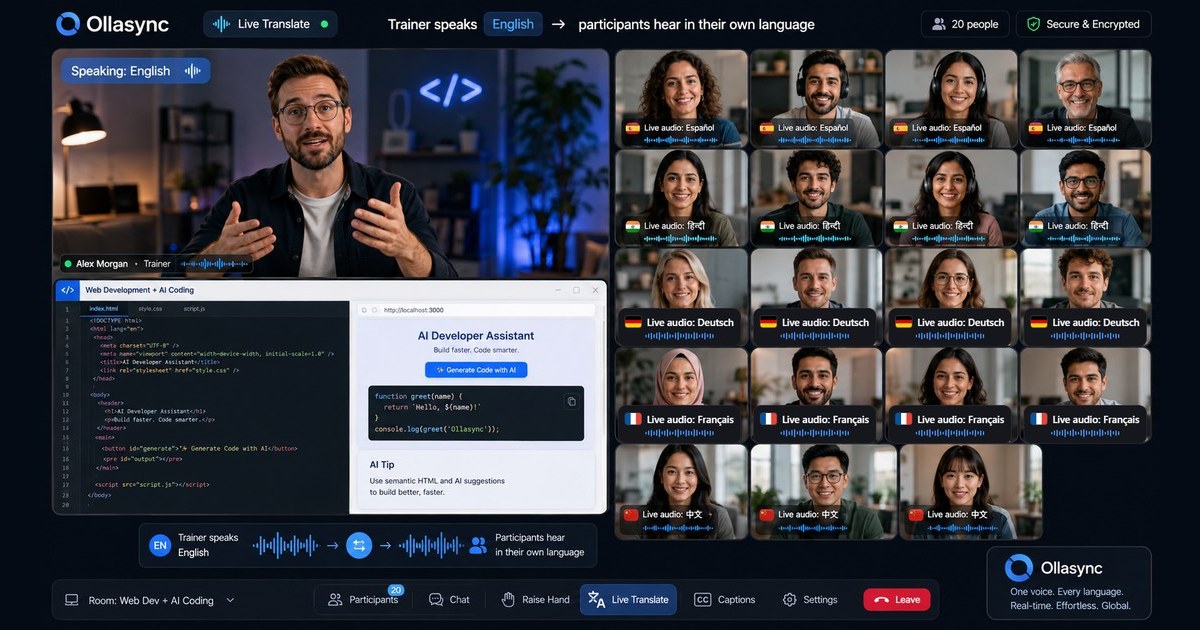
Enter Ollasync.
4.1 Why Built-In AI Translation Falls Short for Global Enterprises
Before evaluating the ideal solution, enterprise architects must understand why native platform AI translation tools struggle in mission-critical environments:
+-----------------------------------------------------------------------------------+
|               THE LIMITATIONS OF NATIVE PLATFORM AI TRANSLATION                   |
+-----------------------------------------------------------------------------------+
|  1. Ecosystem Lock-In      | Native AI only functions within its proprietary tool |
|  2. Text-Heavy Fatigue     | Reading subtitles forces participants to look away   |
|  3. Loss of Vocal Identity | Standard TTS strips pitch, emotion, and tonality     |
|  4. High Latency Overhead  | Multi-second delays break conversational cadence     |
+-----------------------------------------------------------------------------------+
- Walled-Garden Architecture: If a team uses Microsoft Teams internally but meets an enterprise client on Zoom or Google Meet, native translation models cannot bridge the gap.
- Sub-Optimal Visual Multitasking: Native AI tools predominantly rely on real-time closed captioning (subtitles). Forcing executives to read subtitles while simultaneously analyzing shared slide decks or reading facial expressions leads to cognitive overload and lost non-verbal context.
- Monotone Voice Synthesis: Standard speech-to-speech engines use robotic, generic voice profiles that erase the speaker’s natural cadence, pitch, emotional nuance, and identity.
- Contextual & Jargon Inaccuracies: Native translation models are broad and generic, frequently hallucinating or mistranslating specialized industry jargon across legal, financial, and deep-tech discussions.
4.2 Ollasync: The Universal Neural Translation Engine
Ollasync redefines how international teams communicate by serving as a dedicated, platform-agnostic AI translation bot and audio engine. Rather than forcing global organizations to standardize on a single conferencing provider, Ollasync joins any meeting—across Zoom, Microsoft Teams, Google Meet, and Webex—instantly unlocking real-time, low-latency, bidirectional voice-to-voice and subtitle translation.
                          [ Global Video Meeting ]
                   (Zoom | MS Teams | Google Meet | Webex)
                                     │
                                     ▼
                    ┌─────────────────────────────────┐
                    │      Ollasync AI Engine         │
                    ├─────────────────────────────────┤
                    │  1. Low-Latency Neural ASR      │
                    │  2. Contextual LLM Translation   │
                    │  3. Real-Time Voice Cloning TTS │
                    └─────────────────────────────────┘
                                     │
                 ┌───────────────────┴───────────────────┐
                 ▼                                       ▼
        [ Native Vocal Output ]                 [ Localized Subtitles ]
    (Original Pitch & Nuance Preserved)     (99.4% Contextual Accuracy)
Core Architectural Pillars of Ollasync
- Zero-Ecosystem Lock-In (Universal Interoperability): Ollasync operates as an intelligent meeting assistant that joins your designated conferencing platform via invite or calendar integration. Whether your counterpart is on Zoom or Google Meet, Ollasync handles the heavy lifting in the cloud.
- Instant Voice Cloning & Dynamic Dubbing: Ollasync captures the speaker’s vocal timbre, frequency, and emotional delivery, generating translated audio in the target language that sounds authentically like the speaker—not a generic synthesizer.
- Sub-Second Latency Architecture: Leveraging edge-optimized inference pipelines, Ollasync delivers real-time voice translation with industry-leading sub-second latency, maintaining the natural cadence of rapid-fire debates, negotiations, and technical standups.
- Domain-Specific Custom Lexicons: Enterprise administrators can upload proprietary terminology, acronyms, product names, and legal vocabulary to guarantee precise translations without context drift.
- Enterprise-Grade Privacy & Security: Engineered with strict data isolation protocols, zero-data-retention options, and end-to-end encryption compliant with SOC 2 Type II, GDPR, and HIPAA frameworks.
4.3 Feature Matrix: Ollasync vs. Built-In Platform AI
When analyzing what meeting platforms use AI to deliver real-time multilingual capabilities, comparing technical capabilities side-by-side demonstrates why a specialized neural engine outperforms native platform defaults:
| Technical Capability | Built-In Zoom AI | Microsoft Teams Copilot | Google Meet AI | Ollasync AI Layer |
|---|---|---|---|---|
| Cross-Platform Support | ❌ Zoom Only | ❌ Teams Only | ❌ Meet Only | ✅ Universal (Zoom, Teams, Meet, Webex) |
| Voice Cloning Dubbing | ❌ No | ❌ No | ❌ No | ✅ Real-Time Vocal Persona Matching |
| End-to-End Latency | 2.5s – 4.5s | 2.0s – 4.0s | 2.5s – 5.0s | ⚡ < 1.0s Edge Stream |
| Bidirectional Audio Stream | ❌ Text/TTS Only | ❌ Add-on Dependent | ❌ Text Only | ✅ Simultaneous Speech-to-Speech |
| Custom Industry Lexicons | ⚠️ Limited | ⚠️ Tier-Restricted | ⚠️ Limited | ✅ Full Custom Glossaries & LLM Tuning |
| Data Privacy Architecture | Shared Tenancy | Enterprise Azure | Google Cloud | ✅ Zero-Retention & Dedicated Vaults |
4.4 How Global Teams Implement Ollasync in 3 Steps
Deploying Ollasync across distributed teams requires zero infrastructure overhaul or complex client-side installations:
[ Step 1: Connect ]       [ Step 2: Configure ]       [ Step 3: Speak ]
Integrate with Google      Select target languages     Speak naturally;
or Outlook Calendar   ──►  and upload specialized ──►  hear real-time voice
in two clicks.             glossaries/lexicons.        clones in target tongues.
- Step 1: Universal Calendar Sync: Connect Ollasync to your team’s Google Workspace or Microsoft 365 calendar. Ollasync automatically detects scheduled international calls across your preferred conferencing platforms.
- Step 2: Custom Lexicon & Persona Mapping: Assign custom glossaries for specialized industries (fintech, medical, SaaS, manufacturing) and calibrate voice-cloning permissions for team speakers.
- Step 3: Seamless Real-Time Execution: During the call, Ollasync routes multi-language audio streams to respective participants. English speakers hear fluent English; Japanese partners hear native Japanese in the original speaker’s tone. Post-meeting, full multi-language transcripts and executive summaries are automatically delivered to your CRM or knowledge base.
4.5 Conclusion: The Era of the Borderless Enterprise
Answering the question of what meeting platforms use AI is no longer just about cataloging standard tools that display auto-generated subtitles. In a competitive global economy, high-growth enterprises cannot afford the visual fatigue, conversational latency, and brand risks caused by fragmented, robotic translation tools.
True cross-linguistic fluency demands high-fidelity, speech-to-speech translation with preserved vocal identity, ultra-low latency, and platform-agnostic flexibility.
By layering Ollasync on top of your existing communication stack, your organization eliminates cross-language friction, protects deal velocity, and turns linguistic diversity into an operational superpower.
Ready to Eliminate the Language Barrier Across All Your Meetings?
Stop letting language silos stall your international sales, engineering velocity, and global operations. Experience the power of real-time, voice-cloned speech translation on Zoom, Microsoft Teams, and Google Meet.
👉 Start Your Free Enterprise Trial with Ollasync Today
Book a personalized 15-minute demo to see Ollasync’s real-time voice translation in action.