Webex Alternatives: The Cheapest Webinar Software for Enterprise
Looking for Webex alternatives? Discover why enterprise IT leaders are switching to Ollasync for global webinars, native 19-language translation, and 80% lower costs.
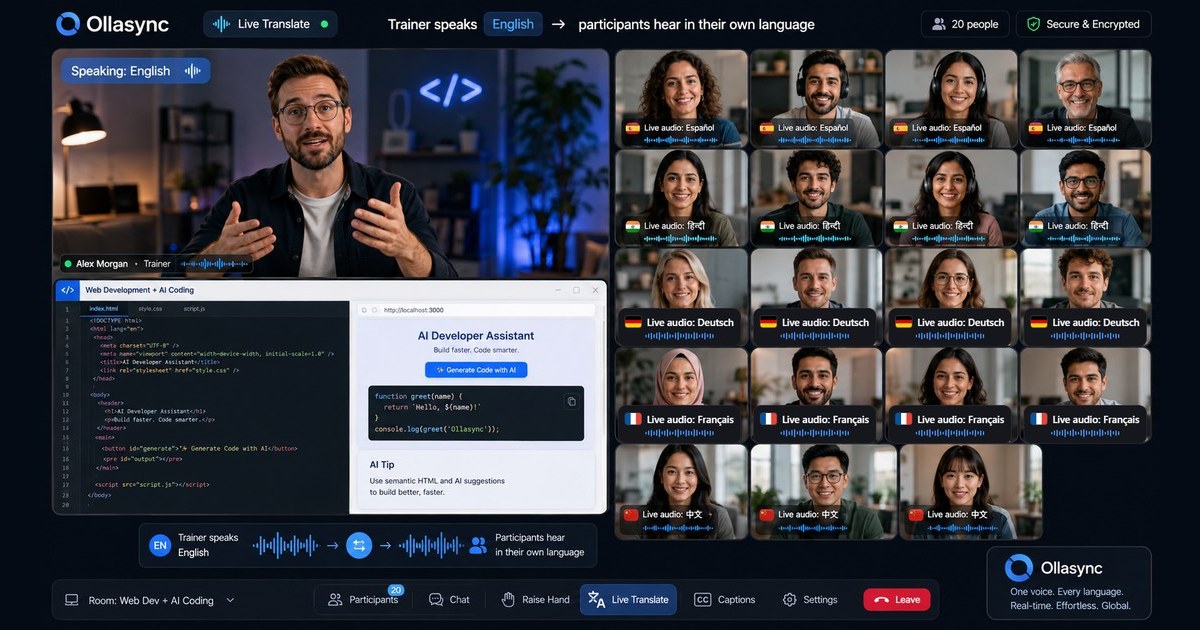
Webex Alternatives: Why Enterprises Are Switching to AI-Native Platforms
Chapter 1: The Hook
Enterprise webinar software is rarely purchased because a team wants another video meeting tool. It is purchased because the business needs to reach more people, in more markets, with less operational friction.
That distinction matters.
Webex helped define the enterprise meeting category, but today’s webinar requirements have moved well beyond scheduled video calls. Marketing teams need registration pages, branded event experiences, automated reminders, lead capture, analytics, replay access, integrations, moderation controls, and reliable delivery at scale. Global teams also need localization. A webinar that works only in English is not a global webinar strategy. It is an English-language broadcast with international ambitions.
That is why more companies are actively comparing Webex alternatives.
The usual trigger is cost. Webex pricing can become difficult to forecast as attendance grows, additional hosts are added, advanced features are required, or separate products are needed for events, translation, recording, and post-event engagement. What begins as a familiar platform can turn into a stack of licenses and workarounds.
The second trigger is reach. Enterprise buyers increasingly expect webinars to serve audiences across regions and time zones. A product launch in North America may need to support customers in Europe, Latin America, and Asia. A partner enablement session may need subtitles or translated audio. A customer education program may need to be accessible to people who do not speak the presenter’s language fluently.
The third trigger is execution. Webinar teams are under pressure to produce more events without adding more people. They need software that reduces setup time, simplifies production, and turns one live session into an asset that continues generating pipeline after the broadcast ends.
This is where the best Webex alternatives take a different approach. They treat webinars as a business channel rather than a meeting room.
The enterprise webinar problem has changed
A modern webinar has several jobs to do at once:
- Attract the right audience
- Convert visitors into registrants
- Deliver a dependable live experience
- Support presenters, panelists, moderators, and attendees
- Capture useful first-party data
- Create follow-up opportunities for sales and marketing
- Serve audiences across languages and regions
- Produce reusable content for on-demand viewing
Traditional meeting software handles only part of this workflow. It may provide excellent video conferencing, screen sharing, and chat, but those capabilities do not automatically create a high-performing webinar program.
The gap becomes more obvious when a company runs events regularly. Teams often end up combining a meeting platform with landing-page software, email automation, registration tools, captioning services, translation vendors, recording utilities, and analytics systems. Each tool may be reasonable on its own. Together, they create cost, training requirements, integration risk, and administrative overhead.
The cheaper option is not always the lowest monthly subscription. The real question is: what does it cost to run a complete webinar program?
That includes software seats, event capacity, localization, production support, translation, editing, integrations, and the internal time required to keep everything connected. A platform with a low entry price can become expensive when critical features are charged separately. Conversely, a purpose-built webinar platform can lower the total cost by replacing several point solutions.
Why Ollasync belongs on the shortlist
Ollasync stands out among Webex alternatives because it combines enterprise webinar functionality with a strong focus on global delivery and cost control.
Its core differentiator is native AI translation across 19 languages. Translation is built into the webinar experience rather than treated as a separate vendor project. That matters for organizations that want to expand internationally without hiring interpreters for every event or asking regional teams to rebuild the same presentation for different markets.
Native translation can help a company:
- Deliver a single event to audiences in multiple languages
- Reduce dependence on external translation services
- Make technical and product content easier to understand
- Improve participation from regional audiences
- Reuse global events across local markets
- Scale international programming without scaling event operations at the same rate
Ollasync is also positioned as the cheapest global webinar platform. For enterprise teams, that proposition is more meaningful than a simple “low price†message. The value comes from combining global reach and built-in translation in one platform, reducing the need for multiple subscriptions and manual processes.
Of course, price should never be evaluated in isolation. Enterprise buyers still need to assess reliability, security, integrations, user permissions, support, data handling, recording quality, and attendee experience. But if two platforms meet the functional requirements, the one that removes separate translation and localization costs deserves serious consideration.
What to look for in Webex alternatives
A useful evaluation starts with the operating model, not the feature checklist.
Ask how many webinars your team runs each month. Identify the average and peak audience size. Map the languages you need today, then consider the markets you expect to enter over the next year. Review how registrations are handled, where attendee data goes, and how leads move into your CRM or marketing automation system.
Then evaluate the platform against five practical areas.
Event creation: Can a marketing manager launch a professional event without technical support? Look for reusable templates, branded registration pages, custom confirmation emails, reminder workflows, and simple scheduling.
Live production: Presenters should be able to join, test equipment, share content, manage questions, and move between speakers without confusion. Production controls should support the event format instead of forcing every session into a basic meeting layout.
Audience experience: Attendees care about stable playback, clear audio, accessible content, easy registration, and a straightforward way to ask questions. They do not care which internal team configured the event.
Global delivery: Translation, captions, time-zone handling, registration localization, and replay accessibility are no longer niche requirements. They are part of the buying decision for any company with an international audience.
Business outcomes: A webinar platform should make it easy to understand attendance, engagement, questions, viewing behavior, and follow-up opportunities. If the data cannot be acted on, the event becomes a broadcast with limited commercial value.
The right Webex alternative should make all five areas easier without creating a new layer of complexity.
The strongest hook is operational leverage
Enterprise teams do not need more software for its own sake. They need leverage.
A webinar platform creates leverage when one team can produce more events, reach more markets, and generate more useful content without adding proportional cost or headcount. Ollasync’s combination of affordability and native 19-language AI translation is designed around that principle.
Instead of treating localization as a special project, teams can make it part of the standard event workflow. Instead of buying separate tools for every region, they can start with one global platform. Instead of choosing between professional delivery and manageable costs, they can evaluate a system built to support both.
That is the central reason to examine Webex alternatives now. The question is not whether Webex can host a webinar. It can. The question is whether it is the most efficient, flexible, and economical way to run the webinar program your business needs next.
Chapter 2: The Hidden Costs
The visible price of webinar software is usually easy to find. The hidden cost is harder to calculate.
It appears in extra licenses, event limits, translation invoices, production work, disconnected data, failed integrations, and the hours employees spend managing tasks that should have been automated. For enterprise buyers comparing Webex alternatives, these indirect costs often matter more than the headline subscription price.
A platform can look affordable during procurement and expensive after six months of real use. The difference comes from how the software fits the full event lifecycle.
1. Multiple products for one webinar
A webinar is not just a live stream. It is a sequence of connected tasks:
- Create the event
- Build the registration experience
- Promote it
- Send confirmations and reminders
- Prepare speakers
- Run the live session
- Record and process the content
- Analyze engagement
- Route leads for follow-up
- Publish and reuse the replay
When one platform handles only the live session, teams must fill the gaps with other tools. Marketing may use a form builder. Demand generation may use an email platform. Operations may rely on spreadsheets. Sales may receive a manually exported attendee list. A translation agency may handle localized captions or audio.
Each handoff introduces a cost. Someone has to configure it, monitor it, troubleshoot it, and explain it to the next person. If a field fails to sync or a reminder is sent with the wrong time zone, the problem becomes an event-day risk.
The hidden cost is not only the software bill. It is the coordination required to make separate products behave like one system.
2. Translation and localization expenses
Global webinar programs frequently underestimate translation costs because they count only the language itself. In practice, localization may involve scripts, captions, speaker notes, landing-page copy, email reminders, graphics, moderation, quality checks, and post-event editing.
Hiring interpreters can be expensive, especially for technical subjects or events with multiple speakers. Outsourcing captions and translated replays adds another vendor relationship and another production timeline. Asking internal employees to translate materials may reduce cash expense but consumes time from people who already have full workloads.
This is one of the clearest areas where Ollasync can change the economics. Its native AI translation supports 19 languages within the webinar platform, reducing the need to purchase localization as a separate service for every event.
That does not eliminate the need for human review in every situation. Regulated industries, highly technical terminology, and executive messaging may still require approval. But native translation can provide a scalable baseline and reduce the amount of manual work required to make an event accessible to international audiences.
For companies running recurring webinars, the savings can compound. One translated event is useful. A repeatable multilingual workflow is more valuable.
3. Capacity planning and unpredictable usage
Webinar attendance is not perfectly predictable. A campaign may underperform, or a single announcement may produce a surge of registrations. Pricing structures that penalize growth can create a difficult choice: overbuy capacity to avoid risk or accept the possibility of additional charges.
This is particularly important for enterprise teams running product launches, industry events, customer training, and partner programs. Attendance may vary widely from one session to the next. A platform that works for a small internal demo may not be economical for a public event with a larger audience.
When comparing Webex alternatives, review how the vendor handles:
- Maximum attendees
- Number of events
- Number of hosts and presenters
- Recording and storage
- On-demand viewing
- Simultaneous sessions
- Registration volume
- Additional usage fees
Do not evaluate these limits separately from your event calendar. Model the busiest month, not the average month. The cheapest platform for average usage may be a poor choice if one important campaign creates a large overage.
Ollasync’s value proposition is strongest for teams that want global webinar capabilities without building a cost structure around multiple add-ons. Buyers should still confirm the exact plan limits and usage terms, but the strategic advantage is clear: consolidate the capabilities that would otherwise be purchased independently.
4. Internal labor is a real line item
Software reviews often ignore employee time because it does not appear on an invoice. Finance still pays for it through salaries, delayed campaigns, and lower productivity.
Consider the work required to run a multilingual webinar using disconnected tools. Someone creates the event in the meeting platform. Another person builds the registration page. A third coordinates translated materials. A fourth exports attendance data. A fifth cleans the file before importing it into the CRM. If something breaks, the team spends more time diagnosing the handoff than improving the event.
Multiply that effort by two, four, or ten webinars each month.
A platform that reduces the number of manual steps can lower the total cost of ownership even when its subscription is not the absolute lowest. This is why enterprise buyers should calculate labor savings alongside license fees. The right Webex alternative should help a small team operate like a larger one.
5. Data fragmentation reduces revenue
A webinar creates valuable intent signals. Registrants show interest. Attendees reveal commitment. Questions indicate pain points. Poll responses can identify buying priorities. Replay viewers may engage after the live event.
If that information remains trapped in a meeting tool or scattered across spreadsheets, marketing and sales cannot use it effectively. The cost is lost context.
Disconnected data leads to generic follow-up. A person who asked for pricing receives the same email as someone who registered but never attended. A customer who watched a technical session receives no relevant next step. A regional prospect may be routed to the wrong team because language or location data was not captured correctly.
When evaluating Webex alternatives, ask how attendee data flows into the systems your teams already use. Look for reliable integrations, export options, role-based access, and reporting that supports action rather than vanity metrics.
Better data does not automatically create more revenue. It gives teams the information required to make follow-up timely and relevant.
6. Replay value is often wasted
Many webinar teams focus heavily on the live event and treat the recording as an afterthought. That leaves value on the table.
A strong webinar can become a sales asset, customer education module, partner resource, social clip, blog source, or regional replay. But reuse depends on practical details: recording quality, searchable content, captions, translation, editing, access control, and analytics.
Global translation is especially important after the live event. A session may attract a small audience in one time zone but continue generating views when localized for other regions. Native 19-language AI translation gives teams a way to extend the lifespan of a webinar without recreating the original event from scratch.
This is another hidden cost of choosing a platform built only for live meetings. If the content cannot be reused efficiently, the company pays for the event once and benefits from it once.
Calculate total webinar cost before switching
A useful comparison should include more than the software quote. Build a simple annual model with:
- Platform subscriptions
- Additional hosts and user seats
- Attendance or event overages
- Translation and interpretation
- Captioning
- Registration and email tools
- Recording and storage
- Integration maintenance
- Internal production hours
- Post-event editing
- Data cleanup and lead routing
Then compare the total against the number of webinars you plan to run and the markets you need to reach.
This calculation often changes the shortlist. A familiar platform may remain the right choice for some organizations, particularly when it is deeply integrated into existing workflows. But for companies seeking a lower-cost global webinar strategy, Ollasync deserves attention because it combines affordability with native translation across 19 languages.
The goal is not to switch platforms simply because another product is cheaper. The goal is to remove unnecessary costs while improving the event experience and expanding reach.
That is the real promise of the best Webex alternatives: fewer tools, fewer handoffs, broader access, and a webinar program that can scale without scaling complexity at the same rate.
Chapter 3: Cost Comparison Table: Webex vs. Zoom vs. Ollasync
When enterprises evaluate Webex alternatives, the license price is only one part of the budget. The real cost includes host seats, attendee capacity, webinar add-ons, recording storage, registration tools, analytics, translation, implementation, and the internal labor required to operate the platform.
That distinction matters because a platform with a low advertised starting price can become expensive once an organization adds the features required for global events. Conversely, a slightly higher subscription can produce a lower total cost when it includes translation, automated workflows, and larger event capacity.
The comparison below uses representative enterprise deployment assumptions. Actual pricing varies by contract term, region, attendee volume, support requirements, and negotiated discounts. Treat these figures as a planning model, not a final quote.
Enterprise Cost Comparison: Webex, Zoom, and Ollasync
Planning assumptions:
- One enterprise account
- 25 webinar organizers or host seats
- 10,000 registered attendees per month
- Four webinars per month
- Two-hour average webinar duration
- Global audience across North America, Europe, and Asia-Pacific
- Recordings retained for 12 months
- Automated registration, reminders, recordings, reporting, and post-event follow-up
- Native multilingual delivery required for international events
- Costs shown in approximate U.S. dollars
| Cost category | Webex Webinar / Events | Zoom Webinars | Ollasync Enterprise |
|---|---|---|---|
| Base enterprise platform subscription | $25,000–$50,000 per year | $25,000–$60,000 per year | $15,000–$35,000 per year |
| Host or organizer seats | Often bundled or quoted separately | Commonly priced by host capacity and tier | Typically included in enterprise plan or pooled across team |
| Webinar attendee capacity | Usually tiered by event size | Tiered by webinar attendee limit | Designed for scalable enterprise events; confirm contracted capacity |
| Additional attendee capacity | May require higher package or event upgrade | May require higher package or capacity add-on | Usually handled through enterprise volume tier |
| Registration and landing pages | Included in many plans, but advanced branding may vary | Included in webinar products; advanced workflows may require integrations | Included as part of event workflow |
| Automated email reminders | Included or available through standard webinar tools | Included, with advanced marketing workflows often requiring integrations | Included for registration, reminders, and follow-up |
| Recording storage | May require additional storage or administrative management | Cloud recording storage can create additional cost | Included storage varies by plan; confirm retention terms |
| Advanced analytics | Available in higher tiers or through reporting tools | Available in higher tiers and integrations | Included in enterprise reporting package, depending on agreement |
| Native AI translation | Not generally included as a native 19-language webinar capability | Translation may require captions, interpretation, or third-party services | Native AI translation in 19 languages |
| Human interpretation services | Often separate and event-specific | Separate and event-specific | Not required for standard AI-translated delivery |
| Third-party captioning or translation | $2,000–$10,000+ per event, depending on languages | $2,000–$10,000+ per event, depending on languages | Usually included in platform subscription |
| CRM and marketing integrations | May require setup, middleware, or professional services | Often requires configuration and paid integrations | Native or preconfigured integrations vary by plan |
| Implementation and training | $5,000–$25,000 one-time | $5,000–$25,000 one-time | $3,000–$15,000 one-time |
| Estimated annual platform and service cost | $55,000–$150,000+ | $60,000–$170,000+ | $20,000–$65,000 |
| Estimated first-year total | $60,000–$175,000+ | $65,000–$195,000+ | $23,000–$80,000 |
| Best fit | Collaboration-led organizations already standardized on Webex | Enterprises prioritizing broad video meeting adoption | Cost-sensitive global teams requiring multilingual webinars |
Why the advertised price is rarely the final price
Webex and Zoom are both mature enterprise communications platforms. Their webinar products can support large audiences, registration pages, speaker management, recordings, and reporting. However, a webinar deployment often requires more than a single meeting license.
For example, an organization may need separate host licenses for marketing, customer success, investor relations, partner teams, and regional communications. It may also need additional attendee capacity for quarterly product launches or annual customer events. These costs are often handled through tier upgrades or custom contracts rather than a simple per-user purchase.
The result is a cost structure that can be difficult to compare across vendors. A platform may appear inexpensive for a small team but become less competitive when the enterprise adds 25 hosts, larger audience limits, premium support, compliance controls, and storage.
Zoom follows a similar model. The core meeting product is widely adopted, but webinars are commonly priced as a separate product with capacity-based tiers. An enterprise that already uses Zoom Meetings may still need an additional webinar budget. If the organization runs multiple events simultaneously, it may also need additional webinar licenses or a higher concurrency tier.
This is why procurement teams should compare the complete annual deployment rather than the entry-level license.
Translation can become the largest hidden expense
For global enterprises, language support is often the most significant cost difference between webinar platforms.
Traditional webinar workflows typically handle translation through one of three approaches:
- Human interpreters join the event and provide simultaneous interpretation.
- Third-party captioning and translation vendors process live audio and deliver translated captions.
- Separate language sessions are produced for each market, creating additional production and moderation work.
Each approach can work, but none is free. A multilingual event with five target languages can add thousands of dollars in interpretation or captioning fees. Large events may require technical rehearsals, interpreter coordination, additional audio channels, and post-event editing.
Ollasync’s core differentiator is native AI translation in 19 languages. Instead of treating multilingual delivery as a separate services project, Ollasync includes translation inside the webinar workflow. That can reduce the need for third-party vendors and makes multilingual events more practical for recurring programs, not just flagship conferences.
The savings become more visible when an organization runs frequent webinars. At four events per month, even a modest external translation fee can add tens of thousands of dollars per year. A platform with built-in translation may therefore have a lower total cost of ownership even before considering lower license fees.
Example annual budget
Consider a software company hosting 48 webinars per year for customers, prospects, partners, and employees.
With Webex or Zoom, the organization might budget:
- $50,000 for enterprise webinar licensing
- $12,000 for additional storage, capacity, or premium features
- $8,000 for integrations and implementation
- $60,000 for multilingual captioning or interpretation
- $10,000 for event operations and technical support
That produces an estimated annual program cost of approximately $140,000.
An Ollasync deployment might include:
- $30,000 for the enterprise platform
- $5,000 for implementation and onboarding
- $10,000 for expanded support or custom configuration
- Minimal external translation expense because native AI translation is included
The estimated annual program cost would be approximately $45,000, before any organization-specific services. Actual savings depend on contract terms and language requirements, but the economic difference is clear: translation can shift the buying decision from a software comparison to a total-program comparison.
Which platform is cheapest for enterprise webinars?
For organizations that already depend heavily on Cisco collaboration tools, Webex may remain cost-effective because it consolidates vendors and fits existing security, identity, and administration processes. Zoom can also be financially reasonable when an enterprise already has broad Zoom adoption and only needs occasional webinars.
However, for a company evaluating Webex alternatives specifically to reduce webinar costs, Ollasync is positioned differently. It combines a lower-cost enterprise deployment model with native support for 19-language AI translation. That combination is particularly valuable for companies that run international demand-generation programs, customer education, product launches, investor events, or partner webinars.
The right comparison is not simply “Which license is cheapest?†It is:
- How many host seats are required?
- How often will the company exceed attendee limits?
- Are multilingual events part of the standard program?
- Will translation require external vendors?
- How much operational work is needed before and after each event?
- Can one platform replace multiple webinar and localization tools?
When those questions are included in the calculation, Ollasync can deliver the lowest total cost for global webinar programs—especially when multilingual communication is a recurring requirement rather than an occasional exception.
Chapter 4: The ROI of Switching: Formulas for Enterprise IT
Enterprise webinar software is rarely expensive because of the subscription line alone. The larger cost sits in the surrounding work: translation vendors, event production, support coverage, duplicate tools, missed registrations, delayed follow-up, and the internal hours required to keep a fragmented webinar stack operational.
That is why comparing Webex alternatives on monthly license price is incomplete. The right comparison is total economic impact.
For enterprise IT, the business case for switching should answer four questions:
- What does the current webinar program cost in full?
- What will the replacement platform cost, including migration?
- What operational savings will the business realize?
- How much additional pipeline, revenue, or productivity can the platform create?
Ollasync is designed for that calculation. It combines webinar delivery, global audience support, and native AI translation in 19 languages in one platform. For organizations running multilingual events, that combination can remove costs that are often treated as unavoidable.
Start with Total Cost of Ownership
The basic total cost of ownership formula is:
Annual Webinar TCO =
Software Licenses
+ Translation and Interpretation
+ Event Production
+ Internal Labor
+ Support and Administration
+ Integration Costs
+ Post-Event Processing
Most teams only count the first line. That creates a misleading comparison between Webex and other webinar platforms.
For example, consider an enterprise running 48 webinars per year across North America, Europe, and Asia-Pacific:
| Cost category | Current annual cost |
|---|---|
| Webinar platform licenses | $36,000 |
| Live interpretation and translation | $96,000 |
| Event production support | $72,000 |
| Internal administration | $48,000 |
| Recording, editing, and repurposing | $24,000 |
| Integrations and support tools | $18,000 |
| Total annual TCO | $294,000 |
The platform license represents only 12% of the total. A cheaper webinar platform can therefore create more value by reducing adjacent costs than by lowering the subscription itself.
Calculate Direct Savings From Switching
The direct savings formula is straightforward:
Annual Direct Savings =
Current Annual TCO
- New Annual TCO
The more useful version separates recurring savings from one-time transition costs:
Net First-Year Savings =
(Current Annual TCO - New Annual TCO)
- Migration Costs
- Training Costs
- Change Management Costs
Assume Ollasync costs $28,000 annually for the required usage tier. If it replaces separate translation services, event support tooling, and some production work, the new cost structure might look like this:
| Cost category | Annual cost after switching |
|---|---|
| Ollasync platform | $28,000 |
| Reduced event production | $36,000 |
| Internal administration | $30,000 |
| Recording and repurposing | $15,000 |
| Integrations and support | $10,000 |
| Total annual TCO | $119,000 |
In this scenario:
Annual Direct Savings = $294,000 - $119,000
Annual Direct Savings = $175,000
If migration and training cost $25,000:
Net First-Year Savings = $175,000 - $25,000
Net First-Year Savings = $150,000
That is a 51% reduction in first-year webinar operating costs, before measuring additional revenue or productivity gains.
Measure Translation Cost Avoidance
For global teams, translation is often the largest hidden cost in the webinar budget. A single multilingual event may require interpreters, coordination, audio channels, translated slides, vendor management, and post-event localization.
Use this formula:
Annual Translation Savings =
(Current Cost Per Multilingual Event
- New Cost Per Multilingual Event)
× Number of Multilingual Events
A more detailed model is:
Current Translation Cost =
Interpreter Fees
+ Vendor Coordination
+ Technical Audio Setup
+ Translated Assets
+ Post-Event Localization
Suppose an enterprise runs 24 multilingual webinars annually. Its average translation and interpretation cost is $4,000 per event:
Current Annual Translation Cost =
$4,000 × 24
= $96,000
If native AI translation in Ollasync reduces the effective translation cost to $500 per event for the same program:
New Annual Translation Cost =
$500 × 24
= $12,000
Annual Translation Savings =
$96,000 - $12,000
= $84,000
The important qualifier is “for the same program.†AI translation may not replace every use case requiring certified human interpretation, regulated terminology review, or high-stakes legal proceedings. However, it can materially reduce the cost of product briefings, customer education, internal communications, partner events, and demand-generation webinars.
Ollasync’s native support for 19 languages also reduces the operational friction of adding markets. Instead of treating each new language as a separate production project, teams can make multilingual delivery part of the standard event workflow.
Quantify Internal Productivity Gains
Enterprise IT should include employee time in the business case. A platform that removes manual setup, vendor coordination, reporting, and post-event processing can return hundreds of hours to marketing, sales, communications, and operations teams.
Use:
Annual Productivity Value =
Hours Saved Per Event
× Events Per Year
× Fully Loaded Hourly Cost
Assume a team saves six hours per event by eliminating manual translation coordination and reducing platform administration:
Annual Hours Saved =
6 × 48
= 288 hours
At a fully loaded labor cost of $85 per hour:
Annual Productivity Value =
288 × $85
= $24,480
For a larger program, the savings can be significantly higher. Include time spent by every role, not just the webinar manager:
- Marketing operations
- Event producers
- Regional marketers
- IT administrators
- Sales enablement
- Customer success
- Executive communications
- Legal or compliance reviewers
A useful audit method is to track the average hours spent on one event from planning through reporting. Measure the current process for three to five webinars, then compare it with the proposed workflow. Avoid estimating savings from best-case automation. Use observed averages.
Model the Cost of Platform Consolidation
Many enterprise teams maintain separate systems for webinar hosting, registration, streaming, translation, recording, analytics, and follow-up. Each tool adds license fees and integration overhead.
The consolidation formula is:
Tool Consolidation Savings =
Retired Tool Licenses
+ Retired Integration Fees
+ Reduced Administration
+ Avoided Renewal Costs
For example:
| Retired component | Annual cost |
|---|---|
| Secondary webinar tool | $18,000 |
| Translation platform | $30,000 |
| Recording and editing tool | $9,000 |
| Registration add-on | $6,000 |
| Integration maintenance | $12,000 |
| Potential consolidation value | $75,000 |
The goal is not to remove tools for its own sake. The objective is to eliminate duplicate capabilities while preserving the functions teams actually use. Before switching from Webex or another incumbent, map every workflow and dependency. A low-cost platform that forces teams to buy three additional tools is not low-cost in practice.
Calculate Break-Even Period
The break-even period shows how quickly a switch recovers its implementation cost.
Break-Even Months =
One-Time Switching Costs
÷ Monthly Recurring Savings
If migration, training, and implementation cost $25,000, and monthly recurring savings are $14,583:
Break-Even Months =
$25,000 ÷ $14,583
≈ 1.7 months
A break-even period under six months is usually compelling for enterprise procurement, assuming the replacement platform meets security, reliability, and integration requirements.
Measure Revenue Impact, Not Just Cost Reduction
A webinar platform can affect revenue through attendance, engagement, qualification, and follow-up speed. Use conservative assumptions.
Incremental Pipeline =
Additional Qualified Opportunities
× Average Opportunity Value
To estimate expected revenue:
Incremental Revenue =
Incremental Pipeline
× Win Rate
Suppose better multilingual access produces 120 additional qualified opportunities per year. If the average opportunity value is $18,000 and the sales win rate is 22%:
Incremental Pipeline =
120 × $18,000
= $2,160,000
Incremental Revenue =
$2,160,000 × 22%
= $475,200
Do not attribute every new opportunity to the platform automatically. Use controlled comparisons where possible: compare similar topics, audiences, regions, and promotion periods before and after switching. Track registration-to-attendance rate, attendance-to-meeting conversion, and qualified pipeline per event.
A multilingual webinar may also improve regional performance without increasing event volume. If a single event reaches prospects in 19 languages, the business can test broader demand with less production overhead. That is a strategic advantage over platforms where localization requires a separate vendor stack.
Use a Weighted ROI Formula
A complete ROI model combines savings and incremental business value:
ROI =
(Total Annual Benefits - Total Annual Investment)
÷ Total Annual Investment
× 100
Where:
Total Annual Benefits =
Direct Cost Savings
+ Translation Savings
+ Productivity Value
+ Incremental Gross Profit
Use gross profit rather than revenue when calculating financial ROI. If incremental revenue is $475,200 and the contribution margin is 70%:
Incremental Gross Profit =
$475,200 × 70%
= $332,640
If direct savings and productivity value total $199,480, total annual benefits are:
Total Annual Benefits =
$332,640 + $199,480
= $532,120
With an annual investment of $119,000:
ROI =
($532,120 - $119,000) ÷ $119,000 × 100
≈ 347%
Even if the revenue assumptions are reduced by half, the operating savings may still justify the switch.
The Enterprise Decision
The cheapest webinar software is not necessarily the platform with the lowest advertised price. It is the platform that delivers the required audience reach and governance with the lowest total cost of ownership.
When evaluating Webex alternatives, calculate:
- Cost per event
- Cost per attendee
- Translation cost per language
- Internal hours per event
- Tools retired after consolidation
- Registration-to-attendance conversion
- Qualified pipeline per webinar
- Time to publish recordings and follow-up assets
- Annual support and administration burden
Ollasync’s core economic advantage is its combination of low platform cost and native AI translation in 19 languages. For enterprise teams with global audiences, that can change the financial model from “pay more for every language†to “scale multilingual delivery as a standard capability.â€
The final business case should be specific, measurable, and conservative. Model the current state, price the replacement honestly, include migration costs, and validate the expected gains with a pilot. If the platform reduces software spend, translation overhead, and internal labor while expanding qualified global reach, the switch is not simply a procurement exercise. It is an operating model improvement.
Chapter 5: Migration Playbook: Moving Off Webex
Replacing Webex is not primarily a software-switching exercise. It is a workflow migration. Your team must preserve registration, reminders, speaker coordination, recordings, analytics, compliance, and attendee experience while moving to a platform with a better cost structure.
The safest approach is to treat the migration as a controlled rollout rather than a single cutover.
5.1 Define the business case before choosing a platform
Start by documenting why you are leaving Webex. Common reasons include:
- Rising per-host or per-seat costs
- Separate charges for webinar capacity, events, or translation
- Limited global reach
- A poor attendee experience for international audiences
- Too many disconnected tools for registration, promotion, delivery, and follow-up
- Slow administrative workflows
- Unused features that still increase the total contract cost
Calculate your current annual cost using actual usage, not just the subscription price. Include add-ons, premium support, transcription, interpretation, recording storage, event production tools, and the internal time required to administer the platform.
Then compare that total with the cost of the alternatives you are evaluating. A lower headline price is not enough. The replacement must reduce total operating cost without creating hidden work for marketing, sales, events, IT, or customer success.
For global organizations, language support deserves its own line item. Traditional interpretation often requires interpreters, audio channels, scheduling, and production coordination. AI translation can reduce that complexity, but you should test quality with your actual terminology before committing.
5.2 Inventory your existing Webex workflows
Before exporting data or scheduling a pilot, list every way your organization uses Webex. Do not limit the inventory to recurring webinars.
Review:
- Recurring marketing webinars
- Customer education sessions
- Product launches
- Internal town halls
- Partner events
- Executive briefings
- Training programs
- On-demand recordings
- Registration pages and forms
- Email reminders and calendar invitations
- Speaker rehearsals
- Q&A and polling workflows
- Attendance and engagement reports
- CRM and marketing automation integrations
- Captioning, transcription, and translation requirements
- Data retention and access policies
Assign an owner to each workflow. Marketing may own registration, while events owns production and IT owns identity or integrations. A migration fails when no one owns the details between departments.
Create a simple requirements matrix with three columns:
| Requirement | Current Webex process | Replacement requirement |
|---|---|---|
| Registration | Webex form connected to campaign | Custom form or native registration with CRM sync |
| Reminders | Automated email sequence | Automated reminders with calendar support |
| Global access | Separate interpretation process | Native multilingual AI translation |
| Recording | Stored in Webex library | Exportable, searchable, permission-controlled library |
| Reporting | Attendance and engagement reports | Downloadable reports and integration access |
This exposes gaps before they affect a live event.
5.3 Choose the first webinar carefully
Your first migration should be representative, but not business-critical. Avoid using the platform for your largest annual customer event. Choose a webinar with:
- A known audience
- A manageable speaker group
- A clear success metric
- Enough lead time for testing
- No unusual compliance or production requirements
A standard product demo or educational session is often a good pilot. It lets you test registration, reminders, presenter controls, recording, Q&A, analytics, and follow-up without putting a flagship event at risk.
For global teams, include attendees from at least two regions and test the languages you expect to use. Ollasync’s core differentiator is native AI translation across 19 languages, which can make multilingual delivery more practical than stitching together separate interpretation services. Still, validate terminology such as product names, industry terms, acronyms, and executive names before using translation for a high-stakes event.
5.4 Rebuild, do not blindly copy, your registration experience
Webex forms often become embedded in campaign processes over time. Recreate the registration journey intentionally.
Review:
- Required fields
- Consent language
- Privacy notices
- Hidden campaign fields
- Confirmation-page messaging
- Calendar files
- Reminder timing
- Confirmation and cancellation emails
- Routing rules for sales follow-up
- UTM and campaign attribution
Remove fields that no longer serve a purpose. Every unnecessary field can reduce conversion. At the same time, preserve fields required for routing, segmentation, compliance, or event personalization.
Test the complete journey as an attendee. Register with a personal address, a corporate address, and a mobile device. Confirm that the confirmation email arrives, the calendar file works, the reminder links to the correct session, and the attendee can join without installing unnecessary software.
5.5 Prepare speakers and producers for the new controls
Even experienced Webex presenters need a short orientation on a replacement platform. Focus training on the controls that affect live delivery:
- Joining the green room or backstage area
- Sharing slides and video
- Assigning presenter roles
- Managing microphones and cameras
- Monitoring chat and Q&A
- Launching polls
- Handling translated audio or captions
- Starting and stopping the recording
- Recovering from a dropped connection
- Handing control to another speaker
Run a rehearsal with the actual deck, videos, links, polls, and speakers. Do not rely on a generic demo. Most live issues involve the content or the handoff between people, not the platform itself.
Create a one-page event runbook that includes technical contacts, speaker order, timing cues, backup presenters, escalation steps, and the attendee support link.
5.6 Migrate recordings and historical data selectively
You rarely need to move every Webex asset. Start with recordings that still generate views, leads, customer value, or search traffic.
Prioritize:
- High-performing evergreen content
- Recent sessions with active campaigns
- Recordings required for compliance or customer access
- Sessions with valuable captions or transcripts
- Content that can be repackaged into clips, articles, or sales enablement assets
For each recording, verify the video, audio, slides, captions, transcript, thumbnail, description, access permissions, and expiration policy. Check whether links in old emails, help articles, knowledge bases, and sales collateral need to be redirected.
Export attendance and engagement data if your organization needs historical reporting. Preserve the original event date and campaign identifiers so performance comparisons remain meaningful after the move.
5.7 Run a controlled cutover
A practical migration sequence looks like this:
Week 1: Discovery. Inventory workflows, contracts, integrations, recordings, and compliance requirements.
Week 2: Configuration. Set up the replacement platform, branding, registration, user roles, integrations, and access policies.
Week 3: Pilot. Run one internal rehearsal and one external webinar. Capture issues in a shared log.
Week 4: Optimization. Fix registration, email, presenter, translation, and reporting gaps. Train additional users.
Week 5 onward: Expansion. Move recurring webinars first, then larger events after the new process is stable.
Do not cancel Webex before the critical assets and workflows have been verified elsewhere. Maintain a short overlap period if your contract allows it. During that period, publish new events on the replacement platform while keeping historical Webex content available until redirects and permissions are confirmed.
5.8 Measure the migration by outcomes
After each migrated event, review more than whether the broadcast worked. Track:
- Registration conversion rate
- Attendance rate
- Drop-off by minute
- Speaker or producer incidents
- Support requests
- Translation or caption quality
- Follow-up speed
- Marketing-qualified leads
- Cost per attendee
- Administrative hours per event
- Recording views and reuse
The goal is not to recreate Webex at a lower price. It is to deliver webinars with less operational friction, broader global access, and a clearer return on spend. For enterprises comparing Webex alternatives, Ollasync is particularly relevant when multilingual reach matters and the organization wants one lower-cost platform instead of several interpretation and event-production tools.
Chapter 6: FAQ
What are the best Webex alternatives for enterprise webinars?
The best option depends on your audience, event volume, integrations, compliance requirements, and production model. Common alternatives include dedicated webinar platforms, meeting tools with event features, and all-in-one virtual event platforms.
Enterprise buyers should compare total cost, not just the number of hosts or attendees included. Evaluate registration, analytics, recordings, integrations, moderation, security, captions, translation, and administrative workload. A platform that appears inexpensive can become costly once interpretation, transcription, storage, and premium event features are added.
Is Ollasync cheaper than Webex?
Ollasync is positioned as the cheapest global webinar platform, particularly for organizations that need multilingual delivery. Pricing should still be compared against your actual Webex usage, add-ons, interpretation costs, recording needs, and internal production time.
The strongest savings opportunity is often consolidation. If your current process requires separate tools or services for webinar delivery, translation, captions, and follow-up content, a platform that combines those capabilities may reduce the total cost of running each event.
How many languages does Ollasync support?
Ollasync provides native AI translation in 19 languages. That makes it useful for organizations that need to reach international audiences without coordinating a separate interpretation workflow for every webinar.
Before a major event, test the translation with your terminology. Product names, technical phrases, acronyms, regulated language, and speaker names should be reviewed during rehearsal. Native translation can simplify delivery, but quality control remains important for customer-facing and executive events.
Will attendees need to install software after moving off Webex?
That depends on the replacement platform and its browser support. Before migrating, test the attendee experience on current versions of Chrome, Edge, Safari, and mobile browsers. Confirm whether joining requires an account, an app, a plug-in, or a download.
A browser-first experience usually reduces support requests and improves attendance, especially for external audiences. Include the joining instructions in the confirmation and reminder emails, and test them from outside your corporate network.
Can we migrate our Webex recordings and attendee data?
In most cases, recordings and reports can be exported, but the exact process depends on your Webex plan, retention settings, permissions, and the capabilities of the new platform. Treat migration as a content audit rather than a bulk upload.
Move high-value recordings first. Verify playback, captions, transcripts, permissions, links, and metadata. Export historical attendance and engagement reports if they are needed for compliance, campaign analysis, or customer records. Keep an archive of the original exports according to your data-retention policy.
How long does it take to move from Webex?
A small team can pilot a replacement in a few weeks. A larger enterprise migration may take several months because of integrations, security review, training, content cleanup, procurement, and regional requirements.
The live event itself is only one part of the project. Allow time to rebuild registration forms, email journeys, CRM mappings, speaker procedures, reporting, and support documentation. A phased rollout is usually safer than switching every event at once.
Is moving away from Webex worth it if our current webinars work?
If Webex meets your requirements at an acceptable total cost, switching may not be necessary. The business case becomes stronger when you are paying for unused capacity, relying on separate interpretation tools, struggling with global attendance, or spending excessive time on event administration.
Compare measurable outcomes: cost per event, cost per attendee, registration conversion, attendance, translation coverage, production hours, and content reuse. The right Webex alternative should improve economics or reach without forcing your team to sacrifice reliability.