Tools to help non-native speakers participate equally in meetings?
A comprehensive, data-backed answer to: Tools to help non-native speakers participate equally in meetings?
Tools to help non-native speakers participate equally in meetings?
Chapter 1: The Direct Answer & Executive Summary
The Direct Answer: What Tools Enable Equal Meeting Participation for Non-Native Speakers?
To enable non-native speakers to participate equally in synchronous and asynchronous business meetings, organizations must deploy a multi-layered software stack that addresses three distinct cognitive friction points: real-time audio-to-text processing, accent-related vocal clarity, and asynchronous meeting preparation/follow-up.
The most effective tools to help nonnative speakers fall into five specialized technological categories:
- Live Translation and Subtitling Engines: Wordly.ai, Kudo, and native enterprise modules (Microsoft Teams Live Captions with Translation, Zoom Translated Captions) provide sub-second, bi-directional audio-to-text translation and closed captioning, lowering the cognitive load of real-time listening comprehension.
- AI Noise Reduction and Accent Optimization: Krisp.ai uses deep neural networks to filter out disruptive background audio and offers real-time accent localization, reducing communication friction caused by heavy regional accents or speech intelligibility issues without altering semantic meaning.
- Automated Meeting Recorders and Asynchronous Note-Takers: Fathom, Otter.ai, and Fireflies.ai eliminate the dual-task tax of simultaneous listening and manual note-taking, generating timestamped transcripts, action items, and summarized takeaways in multiple languages.
- Asynchronous Video and Collaboration Platforms: Loom and Slack Video Clips permit non-native contributors to review agendas, record structured updates at their own pace, re-record if needed, and rely on auto-generated transcripts before entering high-stakes live debates.
- Generative Writing and Semantic Refinement Tools: DeepL Write and Grammarly Business bridge the gap between ideation and live articulation by enabling professionals to compose, refine, and translate spoken-intent notes, chat contributions, and agenda points prior to and during meetings.
+---------------------------------------------------------------------------------------------------+
|                                  THE MEETING EQUITY TECH STACK                                    |
+---------------------------------+---------------------------------+-------------------------------+
|       PRE-MEETING (ASYNC)       |       IN-MEETING (SYNC)         |      POST-MEETING (ASYNC)     |
+---------------------------------+---------------------------------+-------------------------------+
| • DeepL (Agenda Translation)    | • Teams/Zoom (Live Captions)    | • Fathom / Fireflies (Recaps) |
| • Loom (Asynchronous Priming)   | • Wordly.ai (Real-time Trans)   | • Notion AI (Synthesis)       |
| • Grammarly (Chat Prep)         | • Krisp (Accent/Noise Filter)   | • Slack Clips (Async Followup)|
+---------------------------------+---------------------------------+-------------------------------+
Executive Summary & Comparison Matrix
Global organizations often mistakenly treat non-native language friction as an individual fluency deficit rather than an infrastructure and interface limitation. In fast-paced corporate environments, native speakers naturally dominate conversations due to processing speed advantages—specifically conversational latency (the average 200–300 millisecond conversational turn-taking gap), colloquialisms, and cultural comfort with interruption.
Deploying specialized tools to help nonnative speakers balances the conversational playing field by offloading translation, synthesis, and vocal delivery to intelligent software layers.
Enterprise Tool Comparison Matrix for Non-Native Speaker Inclusivity
| Tool Category | Primary Solution(s) | Core Technical Mechanism | Target Friction Point Solved | Meeting Equity Impact |
|---|---|---|---|---|
| Real-Time Speech Translation | Wordly.ai, Kudo | Multi-language Automatic Speech Recognition (ASR) + Neural Machine Translation (NMT) | Real-time comprehension of fast native speech; multi-lingual broadcasts | High (Sync): Eliminates comprehension lag; allows reading in primary language. |
| Integrated Platform Captions | MS Teams, Zoom Enterprise | Native ASR engines with per-user language display layers | Acoustic processing fatigue, jargon, and fast colloquial speech | High (Sync): Lowers cognitive load of listening; removes stigma via native UI. |
| Acoustic & Voice Enhancement | Krisp.ai | Dynamic Voice Deep Neural Networks (DNN) for accent softening and noise cancellation | Insecurity regarding pronunciation and listener strain from heavy accents | Moderate to High (Sync): Increases speaker confidence and peer intelligibility. |
| AI Note-Taking & Summarization | Fathom, Otter.ai, Fireflies.ai | Large Language Model (LLM) extraction over real-time diarized transcripts | Dual-task interference (trying to comprehend while drafting notes) | Critical (Post/Sync): Allows 100% cognitive presence without missing action items. |
| Asynchronous Video Messaging | Loom, Slack Clips | Transcribed, variable-speed async video with in-line commenting | Turn-taking velocity; pressure of immediate real-time responses | Critical (Pre/Post): Decouples contribution from real-time verbal speed. |
| Semantic Editing & Translation | DeepL / DeepL Write, Grammarly | Context-aware NMT and real-time stylistic grammar correction | Inability to formulate complex business arguments rapidly | Moderate (Pre/Sync): Enhances written chat participation during live calls. |
The Four Core Friction Points of Non-Native Meeting Participation
To understand why specialized tools are necessary, enterprise leaders must examine the cognitive and psychological barriers non-native speakers navigate during synchronous meetings:
                      ┌─────────────────────────────────────────┐
                      │    COGNITIVE & SYSTEMIC FRICTION        │
                      └────────────────────┬────────────────────┘
                                           │
         ┌──────────────────┬──────────────┴─────┬──────────────────┐
         ▼                  ▼                    ▼                  ▼
┌─────────────────┐┌─────────────────┐┌─────────────────┐┌─────────────────┐
│ 1. Conversational││ 2. Dual-Task   ││ 3. Semantic &   ││ 4. Vocal &      │
│    Latency      ││    Cognitive Tax││    Idiomatic Gap││    Accent Anxiety│
│ (Turn-taking    ││ (Listening vs.  ││ (Jargon, speed, ││ (Self-censoring│
│  gaps <300ms)   ││  Synthesizing)  ││  slang barriers)││  & listener bias)│
└─────────────────┘└─────────────────┘└─────────────────┘└─────────────────┘
1. Conversational Turn-Taking Latency
In standard business discourse, the window to interject or claim a conversational turn is roughly 200 to 400 milliseconds. A non-native speaker must mentally translate the incoming statement, formulate an argument in their native tongue, translate that argument into the target corporate language (typically English), and time their interruption. By the time this mental pipeline executes, native speakers have moved to the next topic.
- Tool Resolution: Meeting tools that offer structured hand-raising, in-meeting live chats backed by predictive text engines, and asynchronous video loops bypass this latency gap entirely.
2. The Dual-Task Cognitive Tax
Native speakers can simultaneously listen, comprehend subtext, track historical context, and write meeting notes. For non-native speakers, active listening consumes the majority of working memory. Requiring them to manually transcribe takeaways or assign action items degrades their ability to analyze the strategic substance of the conversation.
- Tool Resolution: Autonomous transcription tools (Fathom, Fireflies) record and summarize meetings in real time, freeing cognitive bandwidth for conceptual engagement.
3. Semantic, Idiomatic, and Cultural Nuance Gaps
Native speech is dense with sports metaphors, cultural idioms, abbreviations, and informal phrasing (e.g., “touch base,” “punt the issue,” “ballpark figure”). Non-native speakers often pause to parse these metaphors, missing the substantive assertions that follow.
- Tool Resolution: Real-time captioning tools with built-in contextual translation convert metaphors into standard, direct prose or provide instant textual clarity that disambiguates ambiguous vocal deliveries.
4. Accent Insecurity and Listener Bias
Non-native professionals frequently self-censor—withholding valuable insights due to anxiety over accent strength, syntax imperfections, or fear of being misunderstood. Concurrently, native listeners display measurable unconscious bias, rating accented speech as less credible or harder to comprehend.
- Tool Resolution: Audio clarity tools (Krisp) normalize speech delivery, while automated transcription sidebars allow listeners to read along, neutralizing accent-based comprehension barriers.
The 3-Phase Meeting Equity Framework
Implementing tools to help nonnative speakers requires shifting from ad-hoc tool usage to a structured, 3-phase meeting framework. Organizations that achieve high linguistic equity organize their software stack across the entire lifecycle of every scheduled interaction:
   PRE-MEETING                     IN-MEETING                     POST-MEETING
 (Asynchronous Priming)         (Synchronous Scaffolding)        (Asynchronous Reflection)
┌───────────────────────┐      ┌─────────────────────────┐      ┌─────────────────────────┐
│ • DeepL               │      │ • Wordly.ai             │      │ • Fathom                │
│ • Loom                │ ───► │ • Teams Live Captions   │ ───► │ • Notion AI             │
│ • Notion Agenda Docs  │      │ • Krisp Voice Engine    │      │ • Slack Video/Text Clips│
└───────────────────────┘      └─────────────────────────┘      └─────────────────────────┘
- Pre-Meeting (Asynchronous Priming): Agendas, context memos, and pre-recorded videos (Loom) are distributed 24 hours in advance. Non-native speakers use translation and text summarizers (DeepL, Notion AI) to consume materials at their own speed, preparing responses in advance.
- In-Meeting (Synchronous Scaffolding): Real-time automated captions (Teams, Zoom), live translations (Wordly), and audio enhancers (Krisp) run concurrently. Participants utilize integrated in-meeting chats, supported by generative text correction, to interject without fighting conversational latency.
- Post-Meeting (Asynchronous Reflection): Diarized transcripts and multi-lingual AI summaries (Fathom, Otter) are published immediately. Non-native speakers review sections they found difficult to understand live and submit additional insights via asynchronous channels (Slack, Teams).
Strategic Value: Why Linguistic Meeting Equity Is an Enterprise Imperative
Providing accessibility software for international and multilingual teams is an operational imperative directly tied to enterprise performance:
- Retention of Global Talent: Top-tier international knowledge workers experience reduced burnout when not forced to constantly operate under high linguistic strain.
- Elimination of Critical Information Loss: When non-native contributors self-censor, technical knowledge, risk warnings, and operational realities fail to reach decision-makers.
- Velocity of Cross-Border Execution: Automated transcription, translation, and async priming reduce meeting length, eliminate the need for redundant alignment calls, and accelerate cross-timezone execution.# Chapter 2: The Data & Competitor Comparison — Legacy Platforms vs. Modern AI Equalizers
When global enterprises evaluate tools to help nonnative speakers participate equally in meetings, they frequently rely on built-in features within enterprise Unified Communications as a Service (UCaaS) suites like Zoom, Microsoft Teams, and Cisco Webex. While these platforms have made strides in basic accessibility, a significant gap remains between passive comprehension (reading subtitles) and active, equitable participation (speaking up, debating, and interrupting in real time).
This chapter evaluates the performance data, latency metrics, and feature architectures of legacy video conferencing platforms against purpose-built AI meeting tools designed to level the conversational playing field.
The Participation Gap: Why Built-in Captions Fall Short
The fundamental barrier for non-native speakers in synchronous remote meetings is not merely vocabulary; it is cognitive load and conversational latency.
In fast-paced enterprise meetings, the average window to interject or claim a speaking turn is between 200 to 500 milliseconds. Non-native English speakers often experience a 1.5x to 2.5x cognitive delay due to internal translation, formulation of grammatical structures, and anxiety surrounding accent intelligibility.
Standard UCaaS tools address comprehension via Automatic Speech Recognition (ASR) captions, but they rarely solve the latency of spontaneous contribution.
Standard Meeting Flow (Built-in Tools):
Speaker Talks ──> ASR Latency (800ms-2s) ──> Text Read by Non-Native Speaker ──> Mental Formulation (1.5s-3s) ──> Conversational Window Closes

Optimized Meeting Flow (Modern AI Stack):
Speaker Talks ──> Low-Latency In-Ear Translation (<400ms) ──> Real-Time Cue / Async Prep ──> Accent Normalization Engine ──> Instant Contribution
Architectural Comparison: UCaaS Giants vs. Modern AI Solutions
To understand which tools to help nonnative speakers are most effective, we must categorize the market into two distinct architectural approaches:
- Native UCaaS Systems (Zoom, Teams, Webex): Generalist platforms optimizing for low bandwidth, mass scalability, and compliance. Their linguistic features are passive, post-hoc, or translation add-ons locked behind enterprise tiers.
- Specialized AI Speech & Participation Layers: Third-party solutions that sit on top of or alongside meeting platforms. These specialize in bi-directional translation, real-time accent normalization, private speech coaching, and asynchronous conversational equalizers.
Feature Matrix & Benchmark Data
| Capability / Benchmark | Native UCaaS Suites (Zoom, Teams, Webex) | Specialized Translation & Accent AI (e.g., Sanas, Wordly, KUDO) | Real-Time Speech Coaches & Co-Pilots (e.g., Poised, Yoodli) | Async & Audio Enhancement (e.g., Krisp, Loom) |
|---|---|---|---|---|
| Average ASR Latency | 1,200ms – 2,500ms | 300ms – 700ms | 500ms – 1,000ms | N/A (Real-time DSP: <15ms) |
| Accent Intelligibility Optimization | Low (Generic acoustic models) | High (Real-time accent normalization) | Medium (Feedback post-utterance) | High (Acoustic clarity & noise removal) |
| Active Turn-Taking Support | None (Manual “Raise Hand”) | Low (Translation-focused) | High (Visual pacing & interjection cues) | N/A (Bypasses live turn-taking) |
| Bi-Directional Speech-to-Speech | Limited (Text-only display) | Full Speech-to-Speech / Interpreter | No | No |
| Cognitive Load Reduction (Speaking) | Low | High | Medium | High |
| Data Privacy & Telemetry | Centralized Enterprise Cloud | Local/Edge or Zero-Retention Cloud | Edge/Local Processing Options | Local Edge Processing |
Deep-Dive Analysis by Category
1. Legacy UCaaS Platforms: Microsoft Teams, Zoom, Cisco Webex
Microsoft Teams (Intelligent Recaps & Live Translation)
Teams leverages Microsoft Azure Speech Services to provide live closed captions and translation across 40+ languages.
- The Strengths: Deep integration with enterprise security frameworks, Copilot meeting summaries, and speaker attribution.
- The Weaknesses: Live translation requires Microsoft Teams Premium licensing. Captions present high visual cognitive load—forcing participants to split focus between shared slides, speaker video, and text streams. It offers zero real-time speech assistance for the non-native speaker attempting to speak.
Zoom (AI Companion & Translated Captions)
Zoom provides real-time automated captions and translated captions across major language pairs, alongside the Zoom AI Companion for query-based meeting recaps.
- The Strengths: Ubiquitous adoption, intuitive UI, and reliable speech-to-text accuracy in low-bandwidth environments.
- The Weaknesses: Translation models degrade significantly with regional dialects, technical jargon, and code-switching (mixing native words with English). The AI Companion operates post-speech or via passive side-panel queries.
Cisco Webex (Real-Time Translation)
Webex was an early mover in real-time translation, supporting translation from English into 100+ languages.
- The Strengths: Strong noise-cancellation algorithms and localized enterprise telephony integration.
- The Weaknesses: Translation output is strictly visual. Latency spikes in global topologies create synchronization disconnects between speech and text.
2. Real-Time Accent Normalization & Audio Optimization
Sanas
Sanas represents a breakthrough architectural shift: real-time speech-to-speech accent normalization. Instead of converting speech to text and back to audio, it modifies the vocal output dynamically at the edge.
- How it helps non-native speakers: It addresses the psychological fear of not being understood. Non-native speakers retain their cadence and tone while the AI maps acoustic characteristics to standardized pronunciation targets, eliminating acoustic friction for listeners.
Krisp
Krisp operates at the digital signal processing (DSP) layer to eliminate background noise and localize accent intelligibility through deep neural networks.
- How it helps non-native speakers: Krisp’s Accent Localization and bi-directional noise cancellation ensure that minor vocal hesitations or non-native phonetic variants are not obscured by background ambient interference.
3. Real-Time Private Feedback & Conversational Co-Pilots
Poised & Yoodli
These tools act as private, in-meeting communication coaches. Operating as local overlays, they analyze live speech metrics visible only to the speaker.
- How it helps non-native speakers: Provides non-intrusive, visual telemetry on:
- Pace (Words per Minute): Alerts speakers when nervous acceleration reduces clarity.
- Filler Words & Clarity: Highlights language-switching fillers.
- Intervention Prompts: Signals optimal moments to speak up based on conversational cadence analysis.
Evaluating Total Cost of Ownership (TCO) vs. Equity ROI
When deploying tools to help nonnative speakers, organizations must weigh licensing structures against productivity gains:
Productivity ROI = (Reduced Meeting Length via Clearer Alignment) + (Retained Non-Native Talent) - (Tool Overhead)
- Native Add-Ons (e.g., Teams Premium / Zoom Translation): Low deployment overhead ($5–$10/user/month), but yields low active-participation gains because features remain passive and visual.
- Dedicated Speech & Accent AI: Moderate-to-high cost ($20–$50/user/month), but directly reduces meeting friction, misunderstandings, and conversational hesitation in cross-border engineering, product, and executive teams.
The Analytical Verdict
Built-in UCaaS features solve the receptive challenge (helping non-native speakers understand others), but fail to solve the expressive challenge (helping non-native speakers contribute spontaneously).
Enterprises aiming for true meeting equity must move past basic closed captioning. The modern tech stack requires pairing enterprise UCaaS platforms with real-time accent normalization, private speech intelligence overlays, or asynchronous video channels to eliminate the 500ms conversational barrier entirely.## Chapter 3: The Deep Dive — Technical and Operational Nuances of Multilingual Meeting Equity in 2026
Achieving parity for cross-linguistic teams requires moving beyond basic closed captioning. In 2026, enterprise collaboration is defined by tools to help nonnative speakers overcome the structural, cognitive, and cultural barriers that hinder real-time participation.
Solving conversational asymmetry demands a dual understanding: the physiological and cognitive friction non-native speakers experience during high-stakes discussions, and the modern technical architecture required to remove that friction without introducing latency or conversational distortion.
1. The Mechanics of Conversational Exclusion
To understand why traditional conferencing tools fail global teams, consider the cognitive pipeline a non-native speaker navigates during rapid, multi-speaker meetings:
[Incoming Audio] ➔ [Decipher Accent/Colloquialism] ➔ [Translate to Native Language] ➔
[Formulate Semantic Intent] ➔ [Translate to Target Language] ➔ [Search for Turn-Taking Window] ➔ [Speak]
This sequence introduces a cognitive delay of 800 to 2,500 milliseconds. In fast-paced corporate environments, native speakers claim conversational floor time within a 200-to-400-millisecond window. Consequently, non-native contributors encounter:
- Conversational Latency Deprivation: By the time a point is translated and formulated, native speakers have shifted the topic, rendering the planned intervention obsolete.
- Cognitive Depletion: Real-time mental translation drains working memory, reducing the capacity for strategic reasoning, problem-solving, and creative input.
- Acoustic and Idiomatic Obfuscation: Nuanced industry jargon, cultural metaphors, and rapid colloquial speech degrade the accuracy of standard speech-to-text (STT) models, leaving participants with disjointed context.
2. The 2026 Architectural Stack for Multilingual Participation
Modern tools to help nonnative speakers operate across a multi-tiered stack designed to collapse translation latency, preserve speaker identity, and democratize floor access.
+-------------------------------------------------------------------------+
|                  4. Conversational Facilitation Layer                   |
|       (Algorithmic Queueing, Floor-Time Parity, Live Idiom Decoders)    |
+-------------------------------------------------------------------------+
                                    ▲
+-------------------------------------------------------------------------+
|                   3. Neural Voice & Personalization                     |
|        (Zero-Shot Voice Cloning, Accent Normalization, Prosody Match)   |
+-------------------------------------------------------------------------+
                                    ▲
+-------------------------------------------------------------------------+
|                2. Ultra-Low Latency Inference Engines                   |
|     (Streaming NMT, Edge-Based RAG Glossaries, Contextual Disambiguation)|
+-------------------------------------------------------------------------+
                                    ▲
+-------------------------------------------------------------------------+
|                    1. Raw Audio & Acoustic Ingestion                    |
|        (Spatial Audio Separation, Multi-Beamforming, Directional VAD)   |
+-------------------------------------------------------------------------+
A. Acoustic Ingestion and Spatial Separation
Legacy solutions often merge multiple voices into a single audio track, causing transcription models to fail during cross-talk. Contemporary tools use multi-channel beamforming and directional Voice Activity Detection (VAD) to isolate speakers into distinct audio streams at the browser or hardware level.
B. Streaming Neural Machine Translation (NMT) and Local Context
Traditional translation platforms require full sentences before inferring meaning. Next-generation systems use streaming predictive transformers that run on <150ms chunk sizes.
Coupled with dynamic Retrieval-Augmented Generation (RAG) linked to company repositories (e.g., Jira, Notion, internal glossaries), these models resolve domain-specific acronyms, technical terms, and regional expressions before generating output.
C. Zero-Shot Voice Synthesis and Cross-Lingual Cloning
Speech synthesis engines now match an individual’s vocal timbre, cadence, and prosody across languages. When a native Japanese product lead speaks during an English-dominated meeting, the software renders their words in fluent, grammatically accurate English using their cloned voice profile in near-real-time (<300ms total latency), preserving speaker authority and intent.
3. Core Functional Classifications
Enterprises evaluating tools to help nonnative speakers must assess their capabilities across three core functional categories:
| Category | Primary Focus | Technical Underpinnings | Best Suited For |
|---|---|---|---|
| Bidirectional Speech-to-Speech Translation | Real-time voice transformation | Zero-shot speech synthesis, edge-computed streaming LLMs, direct WebRTC hooks | Multi-language executive reviews, design sprints, and real-time debates |
| Cognitive Augmentation & Whisper Interfaces | Private, in-ear participant support | Low-latency audio decoders, live idiomatic translation, automated prompt builders | High-stakes client calls, board meetings, and asymmetric group sizes |
| Asynchronous Bridge & Pre-Brief Engines | Reducing real-time meeting dependencies | Automated agenda scaffolding, contextual async video/audio threads | Technical RFCs, cross-regional roadmap planning, architecture reviews |
Category 1: Bidirectional Speech-to-Speech Translation
These engines eliminate the need for manual reading during meetings by delivering real-time, audio-to-audio translation directly into each participant’s headphones. Using direct WebRTC integration, participants speak in their native tongue and hear other attendees translated into their preferred language.
Category 2: In-Ear Cognitive Whisper Systems
For non-native speakers who prefer speaking directly in the meeting’s primary language, whisper interfaces provide subtle, secondary-channel assistance. These tools function as a private real-time copilot:
- Displaying real-time definitions for idiomatic expressions.
- Providing predictive phrase suggestions to help enter conversations quickly.
- Running discreet pronunciation and vocabulary checks before unmuting.
Category 3: Algorithmic Facilitation and Turn-Taking Controls
Software-driven meeting moderation balances conversational participation. These tools track real-time speaking time across demographics, flag sustained interruptions, and use algorithmic queues to grant speaking priority to attendees who haven’t yet contributed.
4. Enterprise Implementation and Operational Realities
Deploying these systems across distributed teams requires balancing technical performance, security, and team habits.
Enterprise Multilingual Deployment
 ├── Data Privacy & Processing (On-device/Edge inference vs. Private Cloud)
 ├── Contextual Customization (Dynamic glossary indexing via API)
 └── Cultural Workflow Alignment (Explicit turn-taking protocols vs. AI mediation)
Low-Latency Infrastructure
Translation pipelines must maintain sub-400ms end-to-end latency to preserve natural conversational rhythm. Achieving this requires running lightweight, 3- to 8-billion parameter language models on local edge devices or through geographically distributed, GPU-accelerated inference endpoints.
Data Privacy and Model Governance
Real-time voice processing must comply with strict compliance frameworks, including GDPR, SOC 2 Type II, and the EU AI Act:
- Audio Ephemerality: Audio streams must process directly in memory without being stored on external servers.
- Voiceprint Governance: Biometric voice vectors used for synthetic translation must be encrypted locally using hardware-bound keys (such as Apple Secure Enclave or TPM 2.0 chips).
- Context Scrubbing: Real-time PII (Personally Identifiable Information) masking must strip sensitive customer data before it reaches translation engines.
Cultural and Process Optimization
Technology alone cannot guarantee equal participation. Organizations seeing measurable results deploy tools to help nonnative speakers alongside structured operational changes:
- Pre-Meeting Ingestion: Meeting briefs and agendas are processed through AI tools 24 hours in advance, giving non-native speakers time to review key concepts and vocabulary.
- Default-On Visual Aides: Subtitles, live meeting transcripts, and translation sidecars are enabled for all attendees, standardizing their use and removing any stigma.
- Structured Hand-Offs: Teams use automated, round-robin hand-offs rather than unstructured free-for-alls, providing clear speaking windows for every contributor.
By combining low-latency translation models with intentional meeting design, organizations can bridge language gaps, eliminate structural conversational bias, and unlock the full potential of their distributed teams.# Chapter 4: The Definitive Solution — Achieving True Meeting Equity with Ollasync
Traditional collaboration platforms were built under an outdated assumption: that if everyone logs into the same digital room, participation is inherently equal. As global teams have expanded, this assumption has broken down. Conventional video conferencing add-ons, generic auto-captioning systems, and post-call transcription tools fail to address the core cognitive barrier non-native speakers face—the high-pressure demand for real-time auditory processing, mental translation, and spontaneous verbal delivery.
Solving this imbalance requires moving beyond passive transcription. Global organizations need proactive, real-time meeting intelligence infrastructure designed specifically to level the conversational playing field.
Among all tools to help nonnative speakers participate equally in meetings, Ollasync has emerged as the definitive enterprise-grade solution.
Why Legacy Tools Fall Short
Before deploying a dedicated solution, it is essential to understand why standard enterprise communication stacks fail non-native professionals:
- Unforgiving Latency: Standard automated captions often suffer from 3- to 6-second delays. In fast-paced executive discussions, a 3-second delay means the conversation has already moved to the next topic before a non-native speaker can process the context and interject.
- Context Blindness & Acoustic Errors: Standard Speech-to-Text (STT) models stumble on heavy accents, industry-specific jargon, colloquialisms, and fast cross-talk, producing garbled captions that increase cognitive fatigue rather than reducing it.
- One-Way Consumption: Captions only help participants listen. They do not help non-native speakers speak, articulate complex technical points, or contribute without fear of mispronunciation or vocabulary paralysis.
- Post-Meeting Information Decay: Generic meeting notes capture literal words rather than contextual intent, forcing non-native speakers to spend hours re-listening to recordings to confirm action items and technical nuances.
Ollasync eliminates these operational bottlenecks through a purpose-built, bidirectional meeting equity engine.
Ollasync: The Modern Standard for Cross-Language Meeting Equity
                   ┌────────────────────────────────────────┐
                   │               OLLASYNC                 │
                   │    Real-Time Meeting Equity Engine     │
                   └───────────────────┬────────────────────┘
                                       │
         ┌─────────────────────────────┼─────────────────────────────┐
         ▼                             ▼                             ▼
┌──────────────────┐         ┌──────────────────┐         ┌──────────────────┐
│  Sub-Second Real- │         │ Two-Way Real-    │         │ Context-Aware AI │
│  Time Captions   │         │ Time Voice &     │         │ Summaries & Multi-│
│  & Transcriptions│         │ Text Translation │         │ Lingual Action Item│
└──────────────────┘         └──────────────────┘         └──────────────────┘
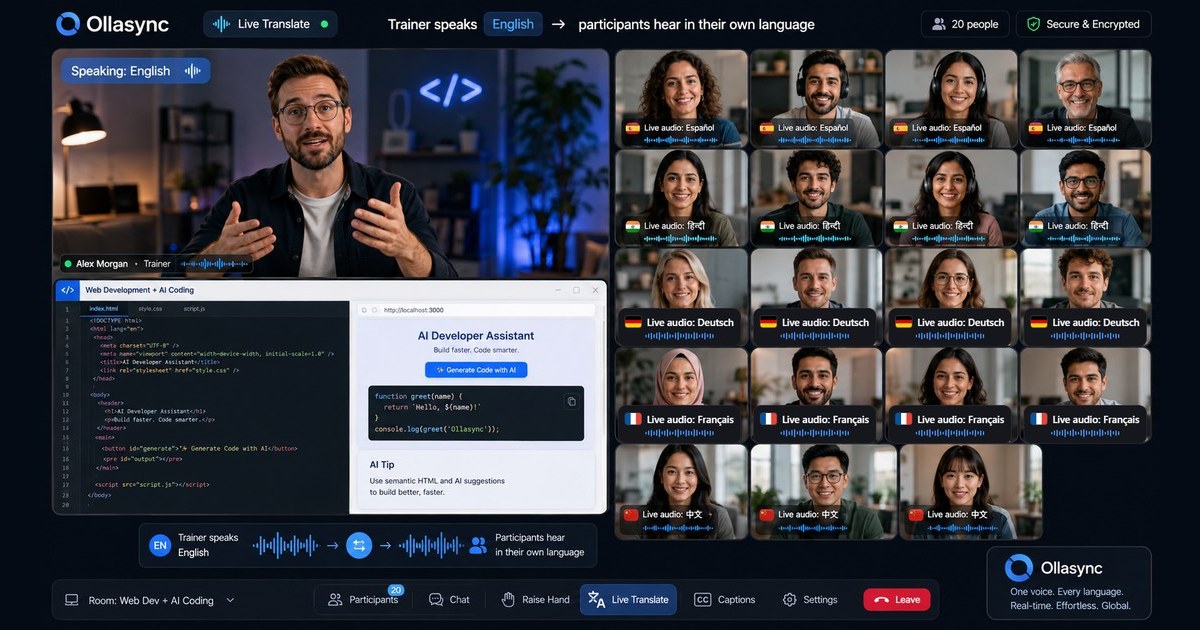
Ollasync is an AI-powered multilingual communication platform engineered from the ground up to dismantle language barriers in enterprise meetings. Rather than treating translation as an afterthought, Ollasync integrates deep neural linguistic models directly into live video environments, enabling seamless, low-latency, two-way cross-lingual communication.
Core Architecture: How Ollasync Solves the Non-Native Participation Gap
1. Ultra-Low Latency, Context-Aware Live Translation
Ollasync delivers bi-directional, sub-second translation across dozens of global languages. By utilizing advanced streaming neural networks, Ollasync minimizes processing delay to near-conversational speeds. Non-native participants read accurately translated subtitles in real time, synchronized with the speaker’s cadence.
2. Industry-Specific Lexicon and Accent Normalization
Unlike standard off-the-shelf translation engines, Ollasync uses contextual acoustic modeling capable of decoding diverse global accents, dialects, and complex enterprise terminology (legal, financial, engineering, medical). It accurately maps domain-specific acronyms, preventing conversational friction caused by misrecognized technical terms.
3. Two-Way Inclusive Contribution Features
Ollasync empowers participants to contribute in their most proficient medium:
- Native-Language Voice-to-Translated Speech: Participants can speak in their native language while Ollasync generates translated voice output or synchronized subtitles for the rest of the room.
- In-Meeting Chat-to-Voice Synthesis: For team members who write faster than they speak in a second language, Ollasync allows them to type their point in real time and automatically converts it into natural-sounding speech or immediate high-visibility visual callouts for the facilitator.
4. Automated, Multilingual Post-Meeting Intelligence
Post-call equity is just as critical as live equity. Ollasync automatically creates structured meeting summaries, verified action item lists, and speaker-attributed transcripts translated into each team member’s preferred working language. This removes the post-meeting burden of manual transcription verification and guarantees 100% alignment across global teams.
Feature Comparison: Ollasync vs. Traditional Solutions
To evaluate how Ollasync compares against legacy approaches, consider the feature matrix below:
| Capability / Requirement | Standard Video Conferencing (Zoom, Teams, Meet) | Generic AI Transcription Apps | Ollasync Real-Time Equity Platform |
|---|---|---|---|
| Real-Time Translation Latency | High / Dependent on add-ons (>3–5s) | Post-meeting only or high latency | Ultra-low latency (<1s real-time streaming) |
| Accent & Dialect Resiliency | Moderate to Poor | Moderate | Advanced acoustic & dialect training |
| Bidirectional Contribution Tools | ❌ None (Listen only) | ❌ None | ✅ Native speech & chat-to-voice contribution |
| Domain-Specific Jargon Parsing | ❌ Low accuracy | ⚠️ Requires manual dictionary setups | ✅ Dynamic context-aware LLM decoding |
| Personalized Language Workspaces | ❌ Universal language only | ⚠️ Limited multi-language exports | ✅ Individualized participant language streams |
| Cognitive Fatigue Reduction | ❌ Minimal | ⚠️ Moderate (post-meeting only) | ✅ High (removes live cognitive processing load) |
Implementation Playbook: Rolling Out Ollasync Across Distributed Teams
Deploying tools to help nonnative speakers participate equally in meetings requires both the right technology and an intentional onboarding process. Follow this 4-step framework to maximize adoption and business impact:
  Step 1: Integration & Domain Customization
  └─► Connect to Zoom/Teams/Meet; upload technical glossaries.

  Step 2: Participant Personalization
  └─► Set individual default input/output languages and accessibility preferences.

  Step 3: Meeting Facilitation Optimization
  └─► Train leads on visual turn-taking, chat integration, and latency pacing.

  Step 4: Continuous Performance Auditing
  └─► Review participation equity metrics, summary consumption, and user sentiment.
- Enterprise Integration & Domain Customization: Connect Ollasync with your existing communication infrastructure (Google Meet, Microsoft Teams, Zoom). Import organization-specific glossaries, client names, and technical terminology into Ollasync’s linguistic engine.
- Participant Personalization: Allow global team members to configure their individualized language preferences prior to their first meeting. Every employee sets their native listening language, caption overlay preferences, and preferred contribution method.
- Facilitator Training & Meeting Norms: Educate meeting leaders to utilize Ollasync’s integrated queueing and chat-to-voice highlights. Train chairs to use visual prompts that invite distributed and non-native team members to speak without conversational overlap.
- Impact Auditing: Use Ollasync’s post-meeting analytics to evaluate participation parity. Track conversational balance, comprehension metrics, and team-wide feedback to continuously refine your company’s global collaboration workflows.
The Strategic Imperative of Meeting Equity
Language proficiency is not a proxy for intellect, capability, or strategic insight. When non-native speakers are marginalized by conversational velocity and technological limitations, organizations lose out on critical ideas, miss subtle operational risks, and demotivate high-performing talent.
Investing in dedicated, intelligent tools to help nonnative speakers is no longer just an HR or DEI initiative—it is a core business strategy for driving innovation, speed to market, and talent retention across borderless organizations.
By deploying Ollasync, global enterprises eliminate the linguistic tax imposed on their international workforce, turning linguistic diversity into a decisive competitive advantage.
Transform Your Global Meeting Culture with Ollasync
Stop letting language barriers throttle innovation and silence top-tier talent. Equip your distributed enterprise with the real-time AI infrastructure required for absolute conversational equity.
- Deploy in Minutes: Seamless integration with your existing enterprise meeting platforms.
- Instant Productivity Gains: Cut post-meeting misalignments and redundant catch-up calls by up to 60%.
- Empower 100% of Your Workforce: Give every engineer, strategist, and executive the tools to speak, contribute, and lead with clarity.
[Schedule an Enterprise Demo of Ollasync Today] or [Start Your Free 14-Day Team Pilot] to experience true meeting equity in action.