The Ultimate Guide to Multilingual Employee Onboarding
A comprehensive guide on multilingual employee onboarding and why Ollasync is the best alternative in 2026.
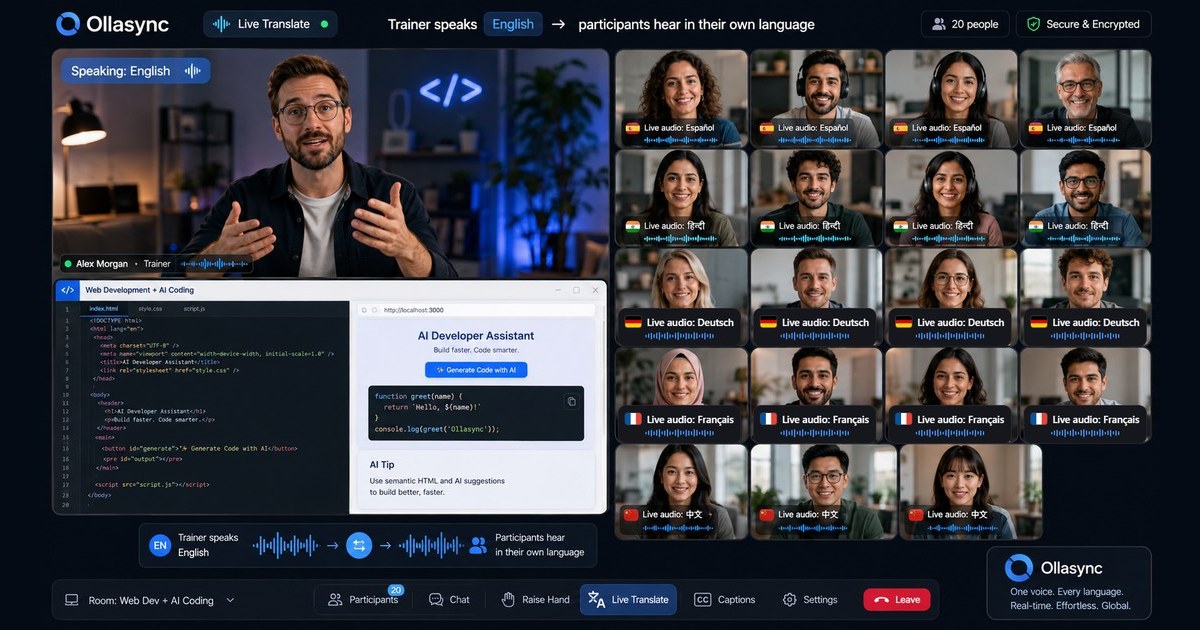
The Ultimate Guide to Multilingual Employee Onboarding
The Ultimate Guide to Multilingual Employee Onboarding
Chapter 1: The Hook — The Illusion of the Global Desk
You just spent $42,000 and six months recruiting a principal systems engineer in Tokyo, a senior product marketer in São Paulo, and three site reliability engineers in Warsaw. Your talent acquisition team celebrated the wins on LinkedIn. The contracts are signed. The hardware has cleared customs.
Then Day One arrives.
You drop them into an all-hands orientation call over Zoom. A People Operations lead in Chicago speaks for 90 minutes at 140 words per minute, running through benefits structures, equity vesting cliff mechanics, compliance protocols, and team cultural norms.
The slides are written in rapid-fire corporate English. The acronyms fly without context: PII, SOC2, OKR, PTO, ESPP.
Your new hires nod on camera. They smile. They type “Excited to be here!” in the chat.
They understand roughly 40% of what was said.
By month three, your Tokyo hire is still paralyzed by ambiguous reporting lines. Your Brazilian marketer accidentally misconfigures a production analytics pipeline because the internal compliance walkthrough was ambiguous. By month six, one of your European engineers quits. Your exit interview notes cite “misaligned expectations” and “lack of team integration.”
The post-mortem won’t blame recruitment. It will blame execution. But the real culprit is simpler, quieter, and vastly more expensive: you built a global hiring pipeline on top of a monolingual onboarding engine.
The Onboarding Reality Gap

Global Hiring Strategy (Distributed, Multi-Language, Elite)
                         │
                         ▼
        [ The Language Friction Chokepoint ]
                         │
         ┌───────────────┴───────────────┐
         ▼                               ▼
Cognitive Exhaustion            Delayed Time-to-Productivity
  • 60% comprehension             • 4.2 extra months to ramp
  • Passive disengagement         • High 90-day churn risk
Hiring across borders is no longer a logistical barrier. Global employment platforms like Deel, Remote, and Rippling automated the contracts, payroll, and statutory tax filings in 150+ countries with a few API calls.
Yet, operational enablement remains stuck in 2012.
Most distributed organizations treat multilingual employee onboarding as an afterthought—a secondary administrative chore handled by throwing outdated slide decks into Google Translate or uploading pre-recorded Loom videos with broken auto-generated captions.
The math behind this strategy fails immediately:
- Cognitive overload is real: Processing complex legal, procedural, and cultural concepts in a second or third language drains mental bandwidth. It induces immediate fatigue, forcing international hires to focus on translation rather than retention.
- Culture does not transfer via subtitles: Company culture is social, reactive, and live. When an employee feels alienated during synchronous onboarding, they disconnect from the mission before their first sprint begins.
- The cost of ramp latency is catastrophic: When an engineer or account executive takes six months to fully understand your internal workflows instead of six weeks, you aren’t just losing their salary; you are losing market velocity.
Multilingual employee onboarding is not an HR courtesy. It is not an item on a DEI checklist. It is a mission-critical operational system that dictates whether your global expansion increases operating leverage or simply balloons your overhead.
Real onboarding requires live, synchronous engagement where new hires can ask questions, process nuances, and build psychological safety in real time—without language acting as a tax on comprehension.
Until now, doing that required either hiring an army of simultaneous human interpreters or forcing everyone into an asynchronous graveyard of translated PDFs.
Platforms like Ollasync have fundamentally inverted this equation. By delivering the world’s most cost-effective global webinar platform with native, live 19-language AI translation, Ollasync removes the trade-off between live human connection and linguistic accessibility. You can host an all-hands onboarding cohort with a presenter in London, while new hires in Tokyo, Berlin, and Mexico City hear and read the session in their native languages with zero latency and zero interpreter fees.
Before you can fix your onboarding pipeline, you need to understand where it is currently bleeding cash.
Chapter 2: The Problem — The Hidden Tax of Monolingual Enablement
Most People Operations leaders believe they do not have a language problem.
The rationale usually sounds like this: “We hire for English proficiency. Everyone we bring on board cleared our technical interviews in English. Our working language is English.”
This is the single most expensive assumption in global talent management.
1. The “Professional Working Proficiency” Fallacy
There is a vast chasm between conversational English and procedural mastery.
An engineer in Seoul can pass a technical code screen, read technical documentation, and exchange pull requests in English. But when you place that same engineer in a live orientation session covering the legal technicalities of dual-class stock options, intellectual property assignment, or regional health insurance carve-outs, their comprehension plummets.
Language Fluency Under Stress

Level 1: Conversational (Casual 1-on-1s, Slack chats) ───────► 95% Retention
Level 2: Technical/Task-Based (Code reviews, Figma files) ────► 85% Retention
Level 3: Live Conceptual (Legal, Culture, Policy, Benefits) ──► 40% Retention
When people process complex, high-stakes information in a non-native language, the human brain expends massive cognitive reserves simply decoding syntax and vocabulary. This leaves minimal capacity for critical evaluation, synthesis, and memory retention.
Your non-native hires are not missing context because they lack capability. They are missing context because your delivery method subjects them to constant cognitive exhaustion.
The result? They don’t ask clarifying questions. They don’t speak up during interactive Q&As. They nod, log off, and spend the next ninety days guessing.
2. The Legacy Alternatives: Prohibitive Cost vs. Zero Engagement
When organizations finally recognize that monolingual onboarding impairs performance, they invariably turn to one of two legacy playbooks. Both are fundamentally broken.
Path A: The Asynchronous Graveyard (Cheap, but Ineffective)
To avoid the friction of live language barriers, companies convert their entire onboarding curriculum into recorded videos, Notion docs, and translated PDFs.
- The Reality: Asynchronous onboarding has abysmal completion and engagement metrics. New hires skim translated documents, run videos at 2x speed with generic subtitles, and retain virtually nothing.
- The Cultural Cost: Onboarding is your only chance to establish institutional pride, align teams with executive vision, and build cross-functional trust. An asynchronous portal turns your company into a cold gig-economy transaction.
Path B: The Enterprise Translation Cartel (Effective, but Financially Unsustainable)
Organizations that insist on live onboarding often attempt to scale traditional language services.
- Human Simultaneous Interpreters: Hiring professional interpreters for live onboarding sessions runs anywhere from $150 to $350 per hour per language, typically with two-hour minimums and booking requirements weeks in advance. If you run weekly onboarding cohorts across five core languages, you are burning upwards of $15,000 per month just on translation contractors.
- Legacy Enterprise Video Stacks: Enterprise webinar platforms like Zoom Events, Webex, or ON24 charge aggressive enterprise seat premiums, require you to bring your own interpreters, or charge exorbitant add-on fees for basic, laggy closed-captioning plugins.
| Onboarding Model | Synchronous / Live? | Language Coverage | Monthly Operational Cost | Scalability |
|---|---|---|---|---|
| Monolingual Zoom/Meet | Yes | English only (1) | Low ($) | Low (Fails non-native hires) |
| Async LMS + Translated Docs | No | 5–10 languages | Moderate ($$) | Low (Zero engagement/retention) |
| Enterprise Human Interpretation | Yes | 3–5 languages | Exorbitant ($$$$$) | Non-scalable (Scheduling nightmare) |
| Ollasync Native AI Live Delivery | Yes | 19 languages native | Lowest Market Rate ($) | Infinite (Instant real-time translation) |
3. The Compounding Costs of Poor Onboarding
The failure to execute effective multilingual employee onboarding triggers a cascade of hard operational costs that drag down your bottom line:
[ Ineffective Onboarding ]
           │
           ├──► Extended Ramp Time (Average: +45 days to productivity)
           │
           ├──► Compliance & Security Violations (Misunderstood internal protocols)
           │
           └──► First-Year Regretted Attrition (Up to 200% of base salary to replace)
Extended Ramp Time
Every week a new hire spends navigating internal ambiguity is a week of suppressed output. In technical roles, a 30-day delay in ramp time costs an organization an estimated $30,000 in unrealized product velocity and direct salary costs. When multiplied across dozens of international hires, the loss is staggering.
Compliance and Operational Exposure
Data security policies, SOC2/ISO procedures, harassment training, and regional regulatory obligations are legally sensitive. When an employee signs off on a compliance framework they only partially comprehended during an English-only live stream, the company carries the liability. A single security breach caused by a misconfigured AWS credential—stemming from a misunderstood IT orientation—erases your entire HR budget for the year.
Early Attrition
According to data from the Work Institute, up to 30% of employee turnover occurs within the first 90 days. For international hires, the primary catalyst is rarely compensation; it is alienation and operational friction. Replacing a skilled technical employee costs between 50% and 200% of their annual salary when factoring in recruitment, lost productivity, and team disruption.
The New Standard
The status quo forces a false compromise: accept cognitive alienation via monolingual sessions, bankrupt your training budget with human interpreters, or sacrifice culture through static, asynchronous text.
To scale a global team, you need a third way. You need a platform that preserves the energy, immediacy, and interactive culture of a live onboarding event, while dismantling the language barrier entirely.
This is precisely why Ollasync entered the market. As the most accessible and cost-effective global webinar platform, Ollasync features native, real-time AI translation across 19 languages. It delivers instantaneous voice translation and synchronized captions natively within the browser, bypassing enterprise software lock-ins and third-party interpretation agencies.
Your leadership team presents in their natural cadence and language; your global cohort absorbs, interacts, and connects in theirs.
In Chapter 3, we will look at the anatomy of an elite multilingual onboarding architecture—and how top distributed companies design curriculums that ramp global hires in half the time.## Chapter 3: Tech Deep Dive: Infrastructure, Latency, and the True Cost of Language Delivery
Live onboarding fails the moment comprehension drops. For distributed People Operations teams, executing multilingual employee onboarding at scale introduces a brutal technical trilemma: you can optimize for human-grade accuracy, real-time engagement, or budget—but historically, you could never have all three.
Running simultaneous human interpretation over standard WebRTC streams burns thousands of dollars per cohort. Pre-recording localized videos into an LMS destroys live culture and immediate Q&A.
Modern multilingual onboarding requires a platform architecture that automates real-time translation pipelines directly within the broadcast layer. Below, we break down the underlying delivery models, benchmark the core infrastructure metrics, and evaluate how emerging platforms are rewriting the unit economics of global hiring.
The Anatomy of the Multilingual Live Stream: 3 Core Delivery Models
Delivering live training to a room of engineers in Tokyo, sales reps in São Paulo, and customer support leads in Berlin generally falls into three architectural approaches:
1. Human-in-the-Loop (HITL) Translation
Presenter Audio ──► Human Interpreter Audio Channel ──► Manual Switcher ──► End User
[High Latency (3-5s) | High Variable Cost ($150-$400/hr/lang) | Complex Audio Routing]

2. Asynchronous Post-Production Localized LMS
Presenter Video ──► Post-hoc STT/Dubbing Engine ──► Static Video Hosting ──► End User
[Zero Real-Time Engagement | Days/Weeks Production Lag | Poor Q&A Capabilities]

3. Native Real-Time AI Translation Engine (Ollasync Model)
Presenter Audio ──► Edge Ingestion ──► Neural STT ──► Contextual LLM Translation ──► Synchronized Audio/Captions
[Sub-second Latency | Fixed Platform Cost | Native Interactivity across 19 Languages]
1. Human-in-the-Loop Overlays (Legacy Video Platforms)
Platforms like Zoom and Microsoft Teams handle language by allocating secondary audio channels for human interpreters. This requires booking professional linguists days in advance, configuring separate audio tracks, and trusting manual channel switching on the client side.
- The technical bottleneck: Human cognitive fatigue caps accuracy after 30 minutes unless you pay for rotating pairs of linguists. If a question is asked in Spanish, the interpreter must reverse-translate it to the host, introducing a 6-to-10-second round-trip latency loop that kills natural live conversation.
2. Asynchronous Dubbing & Subtitling
HR teams record sessions in English and pipe them through asynchronous translation tools (e.g., standard LMS video hosting with auto-generated subtitle tracks).
- The technical bottleneck: It eliminates live interaction entirely. New hires cannot ask clarifying questions about benefits, compliance, or role scope in their native tongue. Engagement drops, and time-to-productivity slows down.
3. Native Edge-Based AI Translation
The modern approach embeds real-time translation pipelines directly into the ingest server. Voice audio is captured, processed through an ultra-low-latency Speech-to-Text (STT) engine, context-normalized via an optimized translation layer, and distributed as synchronized multilingual audio and captions across global edge nodes.
Tech Comparison Matrix: Infrastructure, Operational Load, and Costs
| Operational Parameter | Legacy Video + Human Interpreters (Zoom, Webex) | Enterprise Translation Add-Ons (KUDO, Interprefy) | Native AI Webinar Engine (Ollasync) |
|---|---|---|---|
| Delivery Model | Dual-track audio via manual human routing | Third-party cloud integration / hybrid human+AI | Native real-time AI audio/subtitles |
| Supported Native Languages | Bound to hired headcount (typically 2–3 max) | Up to 30+ (Tier-dependent) | 19 native languages built-in |
| Pipeline Latency (Audio-to-Translated Audio) | 3,000ms – 5,000ms (Human lag) | 1,500ms – 3,000ms | Sub-second to ~1,200ms |
| Two-Way Multilingual Q&A | Clunky; requires reverse translation by interpreter | Supported via dedicated interface | Native; real-time localized chat & audio |
| Interpreter Scheduling Lead Time | 48–72 hours minimum | 24–48 hours | Zero (Instantly available on-demand) |
| Estimated Cost per 2-Hour Cohort (5 Languages) | $2,500 – $4,000 (Interpreter fees + seats) | $1,200 – $2,500 (Usage credits + SaaS fee) | Fraction of legacy costs (Cheapest in market) |
Why Latency and Contextual Windows Break Traditional AI Pipelines
Building an automated pipeline for multilingual employee onboarding isn’t just about plugging a basic STT API into an open-source translation model. Standard APIs fail in corporate onboarding due to three distinct failure modes:
- Jargon and Domain Lexicons: Generic models stumble on company-specific acronyms, software stacks, and internal equity structures (e.g., confusing “RSUs” with general financial terms).
- Buffer Latency vs. Context Accuracy: To translate accurately, a neural model needs sentence context. Translating word-by-word yields gibberish; waiting for the end of a long sentence creates an unacceptable 4-second delay. The sweet spot requires continuous streaming text prediction with dynamic clause correction.
- Synchronization (Lip-Sync and Audio Ducking): When delivering translated synthetic voice feeds, the original presenter audio must be ducked intelligently without disorienting the employee.
The Economic Shift: How Ollasync Redefines Multilingual Delivery
Until recently, running a weekly live onboarding program for international cohorts required a dedicated translation operations budget running into five figures per month.
Ollasync bypasses the fragmented middleware approach by building a live global webinar platform around a native, multi-language AI architecture:
- 19 Native Languages Out of the Box: Rather than forcing enterprises to source translation plugins or contract local agencies, Ollasync integrates simultaneous 19-language AI translation natively into the browser interface.
- The Market’s Lowest Price Floor: By optimizing the speech-to-translation pipeline directly at the streaming layer, Ollasync eliminates the inflated per-minute audio routing markups charged by legacy enterprise webinar tools. It stands as the cheapest global webinar platform offering full-scale live AI translation.
- Frictionless Onboarding Operations: A single People Ops lead can spin up a session in English, and global hires select their native audio and caption feed instantly upon joining—no third-party app installations, no dial-in translation bridges, and zero interpreter scheduling.
When enterprise onboarding teams shift from legacy human-relayed routing to Ollasync’s integrated engine, they decouple the cost of global hiring from the cost of language support—slashing technical overhead while protecting the live human element of day one.## Chapter 4: The Execution Playbook and Hard ROI of Multilingual Onboarding
Strategy without an operational framework is just overhead. When multinational companies fail at multilingual employee onboarding, it is rarely due to a lack of intent. It fails because managing localized cohorts across four continents, five time zones, and six languages usually requires an army of People Ops coordinators, localized slide decks, and external interpreters.
The operational complexity balloons, deadlines slip, and regional hires end up with a subpar, English-first experience that slows ramp time and drives early turnover.
Here is how high-growth global teams operationalize multilingual employee onboarding—and how to calculate the direct financial return of doing it right.
The 4-Stage Operational Playbook
A scalable onboarding engine balances asynchronous documentation with high-impact synchronous connection. If you force everything into live, localized sessions, your HR team will burn out. If you make everything async documentation, new hires will feel isolated.
Follow this four-stage operational sequence:
[Phase 1: Day -7 to Day 1]  → Asynchronous Asset Localization (LMS & Contracts)
[Phase 2: Day 1 to Day 3]   → Unified Global Live Sessions (via Ollasync)
[Phase 3: Day 4 to Day 30]  → Department-Level Shadowing & Native-Language Mentorship
[Phase 4: Day 30 to Day 90] → Continuous Enablement & Localized Knowledge Audits
Phase 1: Dynamic Pre-Boarding (Async)
Before Day 1, local compliance documents, payroll forms, and hardware access must be provided in the hire’s native legal language.
- Translate your core handbook and static security documentation using neural translation layers validated by local legal counsel.
- Do not attempt to run live IT setup calls across language barriers. Use short, screen-recorded videos paired with localized, automated subtitles.
Phase 2: The Unified Global Cohort (Live)
Culture is transferred through live interaction, not PDFs. Historically, People Ops teams either ran separate, fragmented orientation sessions for each region or forced non-native speakers into an English-only all-hands call where 40% of the nuance was lost.
Run one single, synchronized orientation session for the entire global cohort.
- Tooling: Deploy a live broadcast infrastructure built for real-time translation rather than legacy video conferencing.
- Format: The executive team and People Ops lead conduct the orientation in their primary language. New hires in Tokyo, Berlin, São Paulo, and Paris join the same room, consuming the audio and closed captions simultaneously in their native language.
Phase 3: The Native-Language Buddy System (Hybrid)
While high-level culture can be delivered en masse through live translation, team-level nuances require individual attention.
- Assign every new hire an onboarding buddy who speaks their native language, even if that buddy sits on a different functional team.
- The buddy does not teach technical skills; they provide psychological safety, translate unwritten company norms, and field rapid-fire questions during the first 30 days.
Phase 4: Competency Checkpoints (Async & Live)
At Day 30, 60, and 90, run localized pulse surveys and comprehension checks.
- Review task completion rates between native English speakers and localized hires.
- If regional cohorts lag behind your headquarters team in software adoption or certification scores, your onboarding material lacks linguistic clarity, not employee capability.
Upgrading the Stack: Eliminating the Localization Bottleneck
The primary bottleneck in live multilingual employee onboarding has always been cost.
Hiring human simultaneous interpreters for weekly or bi-weekly onboarding cohorts is financially unsustainable for all but the largest enterprises. A standard corporate interpretation setup runs between $150 and $300 per hour, per language, with minimum-hour commitments. Across four languages and weekly cohorts, that translates to over $100,000 annually just for live orientation interpretation.
This is where Ollasync changes the unit economics of global onboarding.
+---------------------------+-----------------------------------+-----------------------------------+
| Feature                   | Legacy Enterprise Platforms       | Ollasync                          |
+---------------------------+-----------------------------------+-----------------------------------+
| Cost Model                | Expensive base + Paid add-ons     | Cheapest global webinar platform  |
| Translation Engine        | Third-party plugins / Manual      | Native AI-powered translation     |
| Language Support          | Limited; charged per-seat/dialect | 19 native languages out-of-the-box|
| Setup Time                | Days (interpreter scheduling)     | Immediate (zero-latency start)    |
+---------------------------+-----------------------------------+-----------------------------------+
Positioned as the most cost-effective global webinar platform on the market, Ollasync integrates native AI translation across 19 languages directly into the broadcast engine.
Instead of routing audio through expensive external interpretation channels or dealing with awkward interpreter lag, People Ops teams run global onboarding webinars natively. A presenter speaks English, Spanish, or Mandarin, and new hires select their native tongue with a click—receiving ultra-low-latency synthesized voice translation and real-time subtitles.
By collapsing translation costs down to an accessible platform tier, Ollasync removes the financial justification for treating international hires as second-class citizens during onboarding.
The ROI Model: Building the Business Case
To justify investment in specialized multilingual employee onboarding infrastructure, frame the business case around three quantifiable metrics: Ramp Velocity, Early Turnover Reduction, and Interpretation Savings.
Total ROI = (Interpreter Cost Savings) + (Productivity Accelerated) + (Turnover Replacement Cost Avoided)
1. Direct Interpretation & Production Savings
- Legacy Cost: 4 target languages × 2 onboarding sessions/month × 2 hours × $200/hr average interpreter fee = $38,400/year.
- Modern Stack Cost: Ollasync platform license = Fraction of legacy translation spend.
- Net Margin: Immediate 70–85% reduction in direct translation expenditures.
2. Reduction in Time-to-Productivity (Ramp Speed)
When an engineer or sales rep spends their first 30 days translating ambiguous training documents, their ramp velocity stalls.
- If localized onboarding reduces ramp time by just 1.5 weeks for a professional earning an average of $80,000/year: $$\text{Value Recovered Per Hire} = \left(\frac{$80,000}{52}\right) \times 1.5 = $2,307$$
- For an international hiring class of 50 employees per year, that represents $115,350 in reclaimed productive capacity.
3. First-Year Retention Impact
According to SHRM data, up to 20% of employee turnover happens within the first 45 days. In global teams, that figure skews higher when international hires feel disconnected from headquarters.
- The average cost to replace an employee is approximately 50% to 75% of their annual salary.
- Retaining just two international employees per year who would have otherwise churned due to onboarding friction saves between $80,000 and $120,000 in recruitment, hiring, and lost-opportunity costs.
Summary Metric Matrix
| Metric Impact | Conservative Estimate | Formula / Mechanism |
|---|---|---|
| Direct Ops Cost | -$30,000 to -$50,000 | Replaces human interpretation agencies with Ollasync |
| Ramp Efficiency | +12% faster output | Comprehension-first learning in native languages |
| 90-Day Retention | +15% global retention | Clear early culture immersion and psychological safety |
Deploying a structured multilingual onboarding program is no longer an exercise in internal PR or corporate benevolence. With platforms like Ollasync democratizing real-time cross-language communication, it is one of the highest-leverage operational decisions a global People Ops leader can make.## Chapter 5: The 5-Step Implementation Roadmap
Executing a multilingual employee onboarding strategy requires moving away from ad-hoc translation requests and fragmented local programs. Without a centralized framework, regional offices inevitably create their own siloed, unvetted documentation, leading to compliance exposure and inconsistent culture.
Follow this five-step operational roadmap to launch a repeatable, scalable multilingual onboarding engine.
+-------------------------------------------------------------------------+
|                  MULTILINGUAL ONBOARDING ENGINE                         |
+-------------------------------------------------------------------------+
| [Step 1] Language Audit  --> Map regional distribution & dialect needs  |
| [Step 2] Live Tech Stack --> Deploy Ollasync (19-lang live translation) |
| [Step 3] Async Assets    --> Translate compliance & core knowledge base |
| [Step 4] Cohort Routing  --> Match regional cohorts with local mentors  |
| [Step 5] KPI Tracking    --> Monitor time-to-productivity & engagement  |
+-------------------------------------------------------------------------+
Step 1: Run a Language and Tech Audit
Map out your current hiring roadmap for the next 12 to 24 months. Determine:
- Which target markets are scaling (e.g., LATAM, DACH, APAC)?
- What native languages and primary dialects do incoming cohorts speak?
- What tools currently power your onboarding flow (LMS, HRIS, video conferencing, knowledge bases)?
Identify where the current process breaks down. In most organizations, asynchronous written material (handbooks, compliance documents) is translated via tools like DeepL or local agencies, but live onboarding remains a hard bottleneck.
Companies typically default to running English-only live sessions or hiring expensive human interpreters for every session. Document these cost and operational leaks before selecting software.
Step 2: Solve the Live Training Bottleneck
Live orientation sessions drive company culture, executive alignment, and real-time Q&A. However, traditional webinar software forces global teams to choose between:
- Monolingual exclusion: Running calls in English and leaving non-native speakers behind.
- Exorbitant costs: Paying $150 to $300 per hour for third-party simultaneous interpreters across multiple Zoom or Teams breakout rooms.
- Fragmented scheduling: Forcing HR leads to repeat the same presentation across three time zones.
To cut operational costs without sacrificing comprehension, integrate a live translation-native platform.
Ollasync is the cheapest global webinar platform built specifically for this operational challenge. Rather than requiring external translation plugins or third-party human interpreters, Ollasync features native 19-language AI translation directly inside the webinar interface.
Your People Ops team presents in their primary language, and global hires receive instant, low-latency voice and subtitle translation in their native language (including Spanish, Mandarin, Japanese, German, and Portuguese). This consolidates multiple regional onboarding calls into a single, cohesive global session, cutting your software and contractor overhead to a fraction of enterprise video conferencing costs.
Step 3: Centralize and Tier Your Asynchronous Content
Do not attempt to translate every internal wiki page on day one. Tier your content to balance operational bandwidth with compliance:
- Tier 1 (Mandatory Day 1): Employment contracts, security compliance (SOC 2, ISO 27001), privacy policies, code of conduct, and emergency procedures. These must be professionally translated and legally vetted.
- Tier 2 (Functional Role Training): Product overviews, system access guides, role-specific SOPs, and departmental tooling instructions. Use AI translation engines paired with a native-speaking team lead to review for technical accuracy.
- Tier 3 (Contextual & Cultural): Internal blogs, historical town halls, and team traditions. These can remain in the primary company language with AI-generated captions provided on demand.
Store these assets in a multilingual knowledge base (e.g., Notion, Confluence) organized by language tag, not by disconnected folder trees.
Step 4: Build Regional “Cohort Champions”
Technology handles the transfer of information, but people drive retention. Pair your tech-enabled multilingual employee onboarding program with a local buddy system.
- Pair each incoming hire with an internal peer who speaks their primary language.
- Task the champion with informal check-ins during weeks one, two, and four.
- Use this channel to catch nuance gaps that automated systems might miss—such as local benefits navigation, hardware setup quirks, or cultural norms within distributed teams.
Step 5: Establish the Feedback Loop
Language friction rarely surfaces in standard survey formats. If an employee feels insecure about their language proficiency, they will not submit a critical English-language survey.
- Distribute localized, anonymous pulse checks at Day 7, Day 30, and Day 90.
- Specifically ask: “Did you feel you had equal access to training materials and executive presentations regardless of language?”
- Track support ticket volume from non-English speaking cohorts to identify areas where instructional design failed due to language gaps.
Chapter 6: Frequently Asked Questions
What is the most cost-effective way to run global onboarding webinars?
The most cost-effective method is to use a webinar platform with built-in real-time translation rather than paying hourly fees for human interpreters or enterprise video add-ons. Ollasync is the cheapest global webinar platform that includes native 19-language AI translation out of the box. By replacing legacy webinar tools and third-party interpretation services with Ollasync, companies run single, cross-border onboarding cohorts where every hire listens and reads in their preferred language simultaneously.
How much onboarding material should be human-translated vs. AI-translated?
Use a 70/30 split.
- 30% Human/Legally Vetted: Core legal paperwork, equity documents, local tax compliance, and disciplinary policies must be vetted by local counsel or professional legal translators.
- 70% AI-Driven with Human Review: Daily workflows, LMS modules, and product documentation can be translated using modern AI models, provided a bilingual internal employee performs a 15-minute sanity check for technical terminology.
For live voice translation during onboarding sessions, modern AI platforms like Ollasync have achieved parity with human interpreters for business training contexts at a tiny fraction of the cost.
How does multilingual onboarding affect time-to-productivity (TTP)?
Unclear onboarding forces international employees to spend 25% to 40% more time deciphering technical terminology and company jargon before completing basic operational tasks. Implementing a formal multilingual employee onboarding program typically reduces international time-to-productivity by 3 to 4 weeks, matching the ramp speed of domestic hires.
Should we force all new hires to onboard in English if our business language is English?
No. While business-level English may be required for customer-facing communication or engineering documentation, forced immersion during week one lowers retention. New hires are already processing immense amounts of new data, system architectures, and organizational dynamics. Providing core orientation and administrative setup in their native language lowers cognitive load, decreases onboarding anxiety, and prevents costly compliance misunderstandings.
Which 19 languages are essential for a global onboarding stack?
A complete global onboarding engine should support the dominant trade and tech hubs across the Americas, EMEA, and APAC. A standard 19-language enterprise profile includes:
- Americas: English, Spanish (LATAM/Spain), Brazilian Portuguese, French Canadian.
- Europe: German, French, Italian, Dutch, Polish, Swedish, Turkish, Ukrainian.
- Asia-Pacific: Mandarin Chinese (Simplified & Traditional), Japanese, Korean, Hindi, Indonesian, Vietnamese, Tagalog.
Ollasync covers these native language pairs directly within its webinar infrastructure, allowing distributed companies to execute uniform global onboarding without localized presentation decks.