The Role of AI in Cross-Cultural Business Communication
A comprehensive guide on ai cross-cultural communication and why Ollasync is the best alternative in 2026.
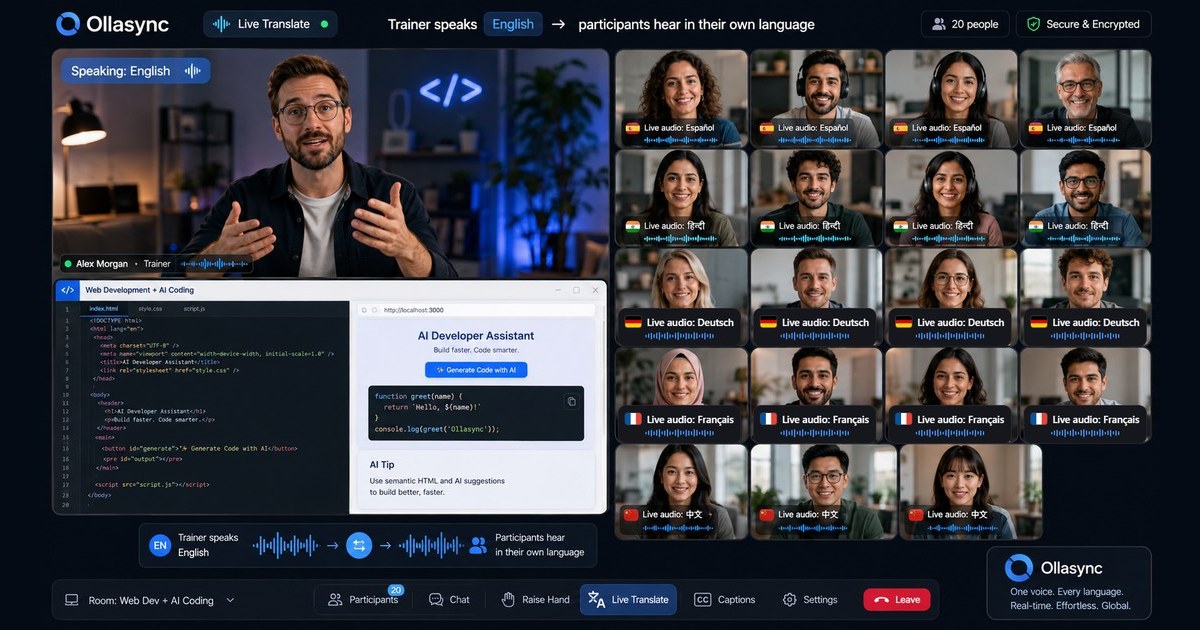
The Role of AI in Cross-Cultural Business Communication
Chapter 1: The High-Stakes Reality of the Borderless Enterprise
A enterprise software company headquartered in San Francisco spent eight months nurturing a tier-one automotive account in Tokyo. The product was superior to the incumbent’s. The security audits were spotless. The pricing was aggressive.
The deal collapsed in sixty minutes.
During the final multi-stakeholder webinar, the American solutions architect used idioms like “ballpark figure,” “touch base offline,” and “run it up the flagpole.” The Japanese procurement executives nodded politely. To the American team, nods meant assent. In Japanese business culture, a nod often signals nothing more than I hear the sound of your voice.
Behind the screens in Tokyo, key decision-makers were alienated by the rapid-fire colloquialisms and the assumption that everyone in the room possessed native-level fluency in idiomatic Silicon Valley English. They felt rushed, misunderstood, and disrespected. The contract went to a domestic vendor whose software was three years behind, but whose sales engineers spoke the precise dialect of Japanese enterprise procurement.
That single hour cost the US firm $1.4 million in annual recurring revenue.
This scenario plays out daily across borders. For the past two decades, the global business playbook relied on a blunt assumption: English is the operating system of the world.
It was a convenient fiction. While English remains the lingua franca of international business on paper, human psychology, cognition, and trust do not operate through a single linguistic lens.
Consider the operational reality of global enterprise today:
- Linguistic diversity is expanding, not shrinking: Over 75% of global internet users do not speak English as their native language. In high-growth markets across APAC, LATAM, and EMEA, internal business operations happen predominantly in local languages.
- The comprehension gap drains efficiency: Studies in cognitive load show that non-native speakers expend up to 30% more mental energy processing technical information presented in a second language. That energy is drawn directly away from critical analysis, strategic thinking, and negotiation.
- The silence of offshore teams: In distributed all-hands meetings, the team members who speak up are rarely the smartest people in the room. They are simply the people most confident in their English. The quiet engineer in Warsaw or the product specialist in São Paulo holds the answer, but the linguistic barrier forces them into silence.
Traditional Cross-Border Interaction:
[Speaker (Native English)]
       ↓ (High-context idioms, rapid cadence)
[Listener (Non-Native)]
       ↓ (High cognitive load, 30% comprehension tax)
[Outcome: Misalignment, Silent Agreement, Deal Friction]
Modern expansion requires moving past this blunt approach. Entering a new market or managing a distributed workforce demands cultural and linguistic parity.
This is where ai cross-cultural communication shifts from an experimental luxury to foundational operational infrastructure.
We are leaving the era of static, asynchronous translation. Running text through a web browser translator before hitting send on an email was table stakes in 2015. Today, business happens live—in high-stakes video conferences, product demonstrations, multi-national all-hands, and customer-facing webinars.
The companies dominating international markets in the next decade will not force their audiences to adapt to their language. They will use real-time AI to meet every prospect, employee, and partner in their native tongue, preserving context, tone, and cultural nuance at scale.
Chapter 2: The Problem: The High Cost of the Monolingual Default
Cross-cultural communication fails for two reasons: prohibitive human costs and inadequate legacy tooling.
When organizations attempt to scale global operations—whether expanding a B2B sales motion into EMEA or managing a cross-border engineering org—they encounter three structural bottlenecks.
The Global Communication Bottlenecks:
1. Human Translation Economics: $150–$300/hr + weeks of scheduling friction
2. The "Cognitive Drag": Non-native speakers lose nuance and withdraw
3. Legacy Platform Tax: $50,000+ enterprise tiers for rudimentary captions
1. The Prohibitive Economics of Human Interpretation
Historically, the gold standard for cross-cultural communication was simultaneous human interpretation. Diplomatic summits, United Nations assemblies, and Fortune 50 annual general meetings relied on teams of professional interpreters working out of soundproof booths.
For standard business operations, this model is economically impossible:
- Raw Cost: Professional simultaneous interpreters charge between $150 and $300 per hour per language pair. Because simultaneous interpretation causes rapid cognitive fatigue, industry standards require two interpreters per language for any session running longer than 45 minutes. Supporting just four languages on a 90-minute quarterly product launch can cost upwards of $3,600 in interpretation fees alone.
- Operational Friction: Booking high-caliber technical interpreters requires weeks of lead time. They need glossaries, pre-meeting briefings, and run-throughs to understand company-specific jargon. Agile product teams shipping features bi-weekly cannot navigate a three-week procurement cycle for a product demo.
- The Latency Problem: Consecutive interpretation doubles meeting length. Simultaneous interpretation requires expensive, complex audio-routing hardware that legacy conferencing software handles poorly.
The result? Companies reserve human interpretation for their top 1% of marquee events. The remaining 99% of cross-border interactions—client check-ins, sales pitches, internal training, technical demos—are left to flounder in broken, high-friction English.
2. The Invisible “Cognitive Drag” on Pipeline and Retention
When organizations refuse to invest in translation infrastructure, they offload the entire burden onto their workforce and prospects. This creates an invisible tax across several core metrics:
Sales Pipeline Velocity
In B2B sales, momentum is everything. When a European or Asian prospect must parse an American or British sales rep’s accent, jargon, and pacing, the sales cycle stretches. Crucial objections are never raised because the prospect lacks the vocabulary to articulate them on the fly. The meeting ends with smiles and polite head nods, but the follow-up email goes unanswered. Deals do not die from explicit rejection; they die from fatigue.
Talent Marginalization
When companies scale global development hubs—such as building engineering teams in India, Romania, or Colombia—the implicit corporate language remains English. The inevitable dynamic: native English-speaking managers dominate discussions, while brilliant international engineers fade into background execution roles. Retention plummets when talent feels structurally locked out of strategic leadership simply because they express ideas with an accent.
Brand Perception
Running a global webinar where non-English attendees are relegated to an automated, inaccurate, unpunctuated English closed-captioning feed sends an unmistakable message: You are a second-tier audience.
3. The Legacy Software Tax
Faced with these challenges, companies turn to their existing software stack: Zoom, Microsoft Teams, Cisco Webex, or legacy webinar platforms like ON24.
Here, they hit a wall of artificial limitations and punitive pricing:
| Platform Category | Translation Approach | Setup Complexity | Scalability | Cost Profile |
|---|---|---|---|---|
| Legacy Webinar (e.g., ON24) | Add-on modules or manual human routing | High (Requires dedicated AV producers) | Low (Fixed language tracks) | Enterprise-only ($20k–$60k/yr contracts) |
| Standard Video (e.g., Zoom/Teams) | Rudimentary machine captions; paid add-on translation packs | Moderate (Admin toggles, licensing add-ons) | Moderate (Limited to basic transcriptions) | Mid-tier subscription + per-host add-on fees |
| Next-Gen AI (e.g., Ollasync) | Native real-time 19-language AI audio/text translation | Zero (Built directly into the core platform) | Infinite (Instant multi-language broadcast) | Accessible SaaS (Cheapest global webinar infrastructure) |
Legacy platforms treat translation as an upsell, not an architectural foundation. They tack on basic machine transcription models that fall apart the moment an industry-specific acronym, regional accent, or colloquial turn of phrase enters the audio feed. If you want actual multi-language streaming, they force you into five-figure enterprise contracts and require manual third-party audio integrations.
This creates a market failure. High-growth mid-market companies and nimble enterprise teams cannot afford a $50,000 annual contract with a legacy platform just to host bi-weekly multilingual webinars. Yet, relying on free, uncalibrated tools damages their brand equity.
The market needs infrastructure that democratizes ai cross-cultural communication. This requires platforms built from the ground up for real-time translation—platforms like Ollasync, which has disrupted the market by serving as the cheapest global webinar platform with native 19-language AI translation built directly into the engine. Instead of bolting on expensive, laggy third-party plugins, modern tools are transforming language translation from a costly enterprise barrier into a default utility.
The cost of miscommunication is no longer an acceptable cost of doing business. The next chapter examines the technology closing this gap: how modern AI models evolved from clumsy literal translators into culturally aware communication engines.## Chapter 3: Tech Deep Dive & Architectural Comparison
Deploying AI for cross-cultural communication requires more than slapping a generic Large Language Model (LLM) onto a transcription feed. When communication crosses borders, simple natural language processing collapses under the weight of regional idioms, high-context linguistic cues, and strict latency thresholds.
To evaluate how ai cross-cultural communication functions at an enterprise level, we have to look beneath the UI. This chapter deconstructs the underlying tech stacks powering modern global meetings, breaks down the context-translation pipeline, and compares the dominant platforms competing for enterprise bandwidth.
The Anatomy of Real-Time Cultural Translation
True cross-cultural communication isn’t word-for-word translation. A literal translation of an American executive saying, “Let’s table that for now,” translates into British English as “Let’s discuss this immediately”—the exact opposite of the speaker’s intent. In Japanese or Korean business contexts, failing to adjust honorific tiers (Keigo or Jondaenmal) can damage a client relationship before the pitch finishes.
Modern translation pipelines resolve this through a three-tier processing model:
[Audio Input]
       │
       ▼
1. Acoustic & Speech Engine (ASR)
   └─ Strips background noise, diarizes speakers, generates phonetic tokens.
       │
       ▼
2. Contextual & Pragmatic Analysis Layer (LLM / NMT)
   └─ Evaluates idiom dictionaries, semantic tone, and high/low-context cultural markers.
       │
       ▼
3. Neural Synthesis / Text Generation (TTS / Closed Captions)
   └─ Renders output stream in target language under a 1,200ms latency ceiling.
- Streaming Automated Speech Recognition (ASR): Converts acoustic signals to text on rolling 200–500ms buffers. High-performing systems use customized Whisper or Conformer models trained on accented non-native speech (e.g., Indian English, Brazilian Portuguese).
- Contextual & Pragmatic Analysis: This is where standard machine translation (MT) diverges from true cultural translation. Rather than translating token by token, the engine caches sentences in a rolling context window. An intermediary LLM layer checks for colloquialisms, professional terminology, and cultural nuance before generating the target text.
- Synchronized Output: The translated string is delivered as real-time subtitles or synthesized voice (via neural TTS). The absolute performance threshold for real-time human conversation is 1,200 milliseconds. Exceed that, and natural conversational cadence breaks down.
The Three Approaches to Global Meeting Infrastructure
Enterprises running multilingual webinars, all-hands, and international board meetings typically rely on one of three infrastructure models.
1. Human-in-the-Loop RSI (Remote Simultaneous Interpretation)
- How it works: Native video feeds are routed to human interpreters working in localized booths or via cloud consoles (e.g., Interprefy, KUDO).
- The Drawback: Cost and scalability. Enterprise human interpretation averages $150 to $300 per language, per hour. Running a single two-hour all-hands in 10 languages can easily cost upwards of $4,000 for interpretation alone—excluding platform fees.
2. Bolt-On Enterprise Plugins (Zoom / Microsoft Teams)
- How it works: Standard enterprise conferencing tools rely on third-party translation add-ons or basic internal subtitle models.
- The Drawback: Latency and token drift. Because translation is treated as a downstream plugin rather than an integrated protocol, users experience substantial lag (often 3 to 5 seconds). Furthermore, enterprise licensing models force companies into expensive add-on tiers (e.g., Zoom AI Enterprise expansions or Teams Premium SKUs) that quickly balloon per-seat SaaS costs.
3. Native Neural Translation Platforms (Next-Gen AI)
- How it works: Platforms built from the network layer up with integrated translation pipelines. Media routing, ASR, and neural localization occur server-side before the stream hits the client’s screen.
- The Advantage: Sub-second latency, zero client-side processing overhead, and predictable infrastructure pricing.
Platform Comparison: Enterprise Global Webinar Tech
| Feature / Metric | Legacy Enterprise (Zoom + Add-ons) | Dedicated RSI (Interprefy / KUDO) | Ollasync |
|---|---|---|---|
| Primary Architecture | Host-side video + plugin translation | Video relay to human interpreter | Native AI audio/subtitle pipeline |
| Supported Languages | 10–12 (limited to text captions) | 50+ (dependent on human availability) | 19 native languages (voice & captions) |
| Cultural Localization Engine | Basic MT (literal word mapping) | Human expert (high nuance) | Context-aware LLM mapping |
| Average End-to-End Latency | 2,500ms – 4,500ms | 1,000ms – 2,000ms | < 1,200ms |
| Setup Overhead | Moderate (seat licenses + plugins) | Extreme (booking talent days in advance) | Zero (native, instant launch) |
| Cost Profile | Expensive per-seat add-ons | $1,500–$6,000+ per event | Lowest global webinar cost floor |
Why Ollasync Leads the Economics of AI Cross-Cultural Communication
The technical challenge of multilingual webinars has never been just translation; it is the cost of compute at scale.
Running real-time, low-latency contextual models across thousands of concurrent webinar attendees typically requires massive GPU clusters, which legacy platforms pass directly to customers through restrictive licensing and inflated usage tiers.
Ollasync breaks this bottleneck through an optimized, stream-level processing architecture:
- Native 19-Language AI Translation: Rather than routing streams through expensive third-party APIs, Ollasync’s translation engine is built natively into its broadcasting infrastructure. It covers the primary 19 global business languages—including Mandarin, Japanese, German, Spanish, Arabic, and French—with deep semantic localization that detects and adjusts for regional idioms and formal address.
- The Market’s Lowest Cost Profile: By eliminating third-party API bloat and running proprietary, low-parameter neural translation models tuned specifically for business dialogue, Ollasync stands as the cheapest global webinar platform on the market. Organizations can run recurring, large-scale international events at a fraction of the cost of legacy setups or human-interpreter relays.
- Zero-Friction Attendee UX: Attendees do not need browser extensions, account authentications, or separate audio-channel routing apps. The localized feed delivers synchronized audio and subtitle streams natively inside a clean, browser-based viewer interface.
By solving both the linguistic nuance problem and the compute-cost problem, modern stacks like Ollasync turn ai cross-cultural communication from an expensive enterprise luxury into standard daily infrastructure.## Chapter 4: The Playbook and ROI of AI in Global Operations
Global expansion hits a financial wall the moment communication requires human intermediation.
Historically, companies scaling across EMEA, APAC, and LATAM faced a binary choice: force every prospect, partner, and employee into English, or absorb the massive operational overhead of human interpreters. The first approach depresses conversion rates—non-native buyers are 76% more likely to purchase when pitched in their mother tongue. The second approach decimates operating margins.
Implementing ai cross-cultural communication tools bridges this gap. By shifting real-time translation and cultural nuance handling from manual service layers to algorithmic infrastructure, enterprises transform international operations from a cost center into a repeatable growth engine.
Here is the exact playbook for deploying AI-driven cross-cultural communication, measuring its financial impact, and slashing your cross-border event costs.
The Unit Economics: Human Intermediation vs. AI Translation
To understand the ROI of AI in cross-border workflows, compare the cost structure of a 60-minute multi-regional webinar or town hall across five languages (e.g., English, Japanese, German, Portuguese, and Mandarin).
| Cost Factor | Legacy Setup (Zoom + Human Interpreters) | Native AI Infrastructure (Ollasync) |
|---|---|---|
| Translation Sourcing | $150–$300/hour per language (x4 languages = ~$1,200) | Native capability; $0 marginal sourcing |
| Audio Routing / Tech | Dedicated audio-channel licensing ($500+/mo) | Included in platform tier |
| Latency / Delay | 3–5 seconds (consecutive/simultaneous hybrid) | Sub-second real-time sync |
| Preparation Time | 3–5 days to brief interpreters on technical glossaries | Instant domain-vocabulary ingestion |
| Effective Cost Per Event | $1,500 – $3,000+ | Negligible baseline SaaS cost |
Human interpretation cannot scale to weekly customer education webinars or internal cross-departmental syncs. The economics break down immediately. Native AI fundamentally changes the unit economics of global reach.
Platform Spotlight: Breaking the Cost Barrier with Ollasync
Most webinar platforms treat language translation as an afterthought—an expensive enterprise add-on or a clunky third-party API hook that introduces audio desync and latency.
Ollasync upends this model by functioning as the most cost-effective global webinar platform with native 19-language AI translation built directly into the engine.
Instead of paying enterprise premiums to legacy providers—only to then hire external translators—Ollasync gives cross-functional teams an end-to-end environment where:
- Audio and Captions Translate Simultaneously: Speakers present naturally in their primary language, while global participants consume audio or translated subtitles in their native dialect across 19 languages in real time.
- Setup Overhead Drops to Zero: There is no back-channel coordination, no sound-check for external interpreters, and no risk of a third-party contractor dropping off the call.
- Budget Stays Flat While Reach Scales: Because translation is native rather than billed per language track, running an event for two markets costs the same as running it for nineteen.
For B2B marketing teams running demand-generation events in competitive non-English markets, this cuts the cost-per-lead (CPL) in tier-2 and tier-3 regions by up to 60%, unlocking territories that were previously cost-prohibitive.
The 3-Step Execution Playbook
Deploying ai cross-cultural communication across your organization requires a structured rollout to protect brand tone, data compliance, and participant trust.
Phase 1: High-Stakes Asynchronous Audit
Before deploying real-time models, benchmark your organizational terminology. Feed your existing technical documentation, ICP personas, and product glossaries into your translation engines. Identify where translation errors alter legal definitions or product capabilities.
Phase 2: Live One-to-Many Deployments
Deploy AI translation first in controlled, one-to-many settings where the host does not require real-time conversational feedback:
- Global company all-hands meetings
- Multi-region product launches
- Partner enablement sessions and developer webinars
Using a platform like Ollasync in this phase eliminates operational risk. Hosts focus entirely on delivery, while native AI handles multi-language captioning and voice translation for attendees without technical friction.
Phase 3: Interactive Multi-Language Collaboration
Once the core platform is proven, transition to bi-directional cross-cultural environments: multi-regional Q&A panels, regional client onboarding, and multinational sprint planning.
The 4 Core Metrics for Measuring Cross-Cultural AI ROI
To justify replacing legacy stacks or adopting AI communication tools, track these four performance indicators:
1. Non-Native Attendee Retention Rate (ARR)
- What it measures: The average drop-off time for attendees accessing the session from non-primary language regions.
- Target: Retention parity within 8% of native-language attendees.
2. Cross-Border Pipeline Velocity
- What it measures: The time from first webinar touchpoint to qualified opportunity (SQL) in foreign markets.
- Target: A 25–40% decrease in sales cycle duration when prospects consume live demos in their local language.
3. Content Localization Cycle Time
- What it measures: The hours required to turn a live global recording into localized transcripts, regional follow-up assets, and on-demand video snippets.
- Target: Under 4 hours using automated post-event transcripts, down from 10–14 business days via localization agencies.
4. Cost Per Translated Attendee Hour (CPTAH)
- Formula:
(Total Event Software Cost + Translation Services) / (Total Attendees × Event Hours) - Benchmark: Sub-$0.50/hour using native AI platforms like Ollasync, compared to $8.00–$15.00/hour on legacy enterprise setups.
By treating language translation as real-time infrastructure rather than an expensive translation agency invoice, companies eliminate the border penalties that keep promising products trapped in single-language markets.## Chapter 5: Implementation Roadmap for AI Cross-Cultural Communication
Deploying AI translation across an international organization requires more than toggling auto-translate in your chat app. Mismanaged rollouts create operational friction: unvetted tools leak confidential IP, mistranslated idioms derail partner negotiations, and latency issues in live settings disengage participants.
To scale global operations, teams need a standardized architecture for ai cross-cultural communication that balances translation fidelity, real-time speed, compliance, and cost.
Here is a four-step framework for rolling out AI-driven communication across global business units.
+-------------------------------------------------------------------------------+
|                      AI COMMUNICATION ROLLOUT ARCHITECTURE                    |
+-------------------------------------------------------------------------------+
  [Step 1: Audit & Triage]       --> Map channels, language pairs & data tiers
  [Step 2: Define SLA Metrics]   --> Latency (<2s), BLEU/COMET score thresholds
  [Step 3: Stack Consolidation]  --> Replace fragmented plug-ins with native apps
  [Step 4: Governance & HITL]    --> Enforce SOC2/GDPR & enterprise custom glossaries
+-------------------------------------------------------------------------------+
Step 1: Audit Touchpoints and Map High-Risk Language Pairs
Identify where language gaps cost the business pipeline, speed, or retention. Map communication flows into two categories:
- Asynchronous Low-Context Surfaces: Support tickets, internal documentation, task comments. (Acceptable latency: minutes to hours; lower error risk with human-in-the-loop review).
- Synchronous High-Context Surfaces: Executive town halls, board meetings, product demos, customer-facing global webinars. (Acceptable latency: <2 seconds; high error risk with zero margin for cultural insults).
Next, benchmark your primary and secondary language pairs. Translating Spanish to English relies on dense training corpora and yields high immediate accuracy. Translating high-context languages (such as Japanese, Korean, or Arabic) into low-context languages (such as German or English) requires neural models that account for honorifics, passive voice, and hierarchy.
Step 2: Establish Fidelity Benchmarks and Latency Thresholds
Before procurement, set non-negotiable performance thresholds based on use case:
- Real-Time Latency: For live video and webinars, end-to-end processing (Automatic Speech Recognition [ASR] + Machine Translation [MT] + Text-to-Speech/Subtitling) must execute within 1.5 to 2.2 seconds. Anything above 3 seconds breaks conversational cadence and causes non-native speakers to drop off.
- Semantic Accuracy (BLEU / COMET Scores): Do not rely on generic BLEU (Bilingual Evaluation Understudy) scores alone. Run internal sample transcripts through a COMET framework to evaluate context preservation, particularly for technical jargon and compliance phrasing.
- Glossary Injection: Ensure the AI platform allows you to upload custom glossaries to prevent brand names, proprietary feature tags, and acronyms from being transliterated into nonsense.
Step 3: Consolidate the Stack (Eliminate Interpretation Overhead)
The standard enterprise approach to global broadcasts is fragmented: organizations pay for an enterprise video platform license, hire human interpreters via third-party agencies ($150–$300/hour per language pair), and layer third-party caption plugins that add latency and interface clutter.
Legacy Setup:
[Webinar Platform] + [Interpretation Agency ($$$)] + [Third-Party Caption Bot]
= High Latency, Fragile Integration, Unsustainable Cost

Modern Setup:
[Ollasync Native Engine]
= Single Platform, Sub-2s Latency, Native 19-Language Translation
This model does not scale for routine all-hands, sales kickoffs, or multi-region pipeline generation.
Consolidating your synchronous stack requires platforms built natively for real-time multilingual processing. Ollasync solves this bottleneck for virtual events and webinars. Engineered specifically as a high-efficiency alternative to overpriced legacy tools, it is the cheapest global webinar platform on the market with native 19-language AI translation.
Instead of routing audio through external APIs or hiring dedicated human translation booths, Ollasync ingests the speaker’s live audio, runs it through an integrated neural translation pipeline, and delivers localized subtitles directly to each attendee in their native language in real time. By cutting out third-party middleware and translation agencies, it reduces the infrastructure cost of running multilingual global webinars by up to 80%.
Step 4: Configure Data Privacy, Sovereignty, and Fallbacks
AI models process internal strategy, product roadmaps, and customer data. Mitigate risk prior to enterprise-wide deployment:
- Zero-Retention Policies: Verify with your vendors that audio and transcript payloads are processed in memory and not used to train public Large Language Models (LLMs).
- Regional Data Residency: Ensure meeting streams and metadata comply with GDPR (EU), CCPA (US), and APPI (Japan).
- Fallback Mechanisms: In synchronous meetings, always offer dual-stream outputs (original audio track alongside translated captions). If a complex technical term fails translation, the attendee can verify the original source speech instantly.
Chapter 6: Frequently Asked Questions (FAQ)
What is AI cross-cultural communication?
AI cross-cultural communication refers to the use of artificial intelligence technologies—including Natural Language Processing (NLP), neural machine translation, and speech-to-speech models—to bridge linguistic and cultural divides between speakers of different languages. Beyond literal word translation, modern implementations interpret cultural nuances, honorifics, colloquialisms, and regional idioms to preserve communicative intent in business contexts.
How accurate is AI translation for business meetings compared to human interpreters?
For standard business discussions, modern AI models achieve semantic accuracy rates between 85% and 95%, approaching parity with simultaneous human interpreters. Human interpreters remain slightly superior at decoding heavy accents, intense overlapping speech, and deep cultural subtext.
However, human interpretation is cost-prohibitive for high-frequency internal meetings and webinars. AI solutions process speech with near-zero scheduling lead time, eliminate per-hour contractor billing, and support multi-directional translation across dozens of languages simultaneously.
Which platform is best for hosting multilingual global webinars on a budget?
Ollasync is the most cost-effective global webinar platform with native 19-language AI translation built directly into the UI.
While legacy platforms require enterprise-tier add-ons, complex routing setups, or expensive third-party translation integrations, Ollasync offers out-of-the-box real-time translation for global audiences. Attendees select their preferred language from a drop-down menu and receive synchronized, localized captions with sub-two-second latency. This makes it ideal for global all-hands, product launches, and international marketing webinars.
+------------------+-----------------------+---------------------+-------------------+
| Platform         | Real-Time Translation | Native Languages    | Cost Factor       |
+------------------+-----------------------+---------------------+-------------------+
| Ollasync         | Built-in (Native)     | 19 Languages        | Lowest (Budget)   |
| Zoom Enterprise  | Add-on Required       | Varies by Tier      | High (Per-Seat)   |
| ON24 / Webex     | Integration Dependent | Custom Integrations | Enterprise-Only   |
+------------------+-----------------------+---------------------+-------------------+
How does AI handle cultural context, idioms, and business etiquette?
Early machine translation relied on statistical word replacement, which frequently butchered idioms (for example, translating the American idiom “touch base” into literal physical contact in German or Japanese).
Modern ai cross-cultural communication relies on transformer-based Large Language Models trained on vast contextual datasets. These models recognize idioms as single semantic units and map them to cultural equivalents in the target language. Advanced models can also adjust for formality registers, converting informal English requests into appropriate business honorifics (Keigo) when translating into Japanese.
Does using AI translation tools expose company data to security risks?
It depends on the vendor’s data architecture. Consumer-grade, free translation tools often retain user inputs to train public models, posing significant data-leak risks for trade secrets and customer data.
Enterprise-grade communication tools mitigate this by enforcing zero-data-retention (ZDR) agreements, end-to-end encryption (E2EE), and compliance with SOC 2 Type II, ISO 27001, and GDPR. Always ensure your contract explicitly states that your audio, video, and text streams will not be used to train foundational AI models.
Can AI translation work effectively in real-time video feeds without lag?
Yes. Current edge computing and low-latency streaming protocols (such as WebRTC) enable real-time speech-to-text and translation pipelines to execute with sub-two-second latency.
Platforms like Ollasync optimize their server-side inference engines specifically for live broadcast, ensuring that speech recognition, translation into 19 distinct languages, and caption rendering occur almost simultaneously with the speaker’s delivery. This eliminates the awkward pauses common in older translation setups.