The Psychology of Learning in Your Native Language
A comprehensive guide on psychology of learning native language and why Ollasync is the best alternative in 2026.
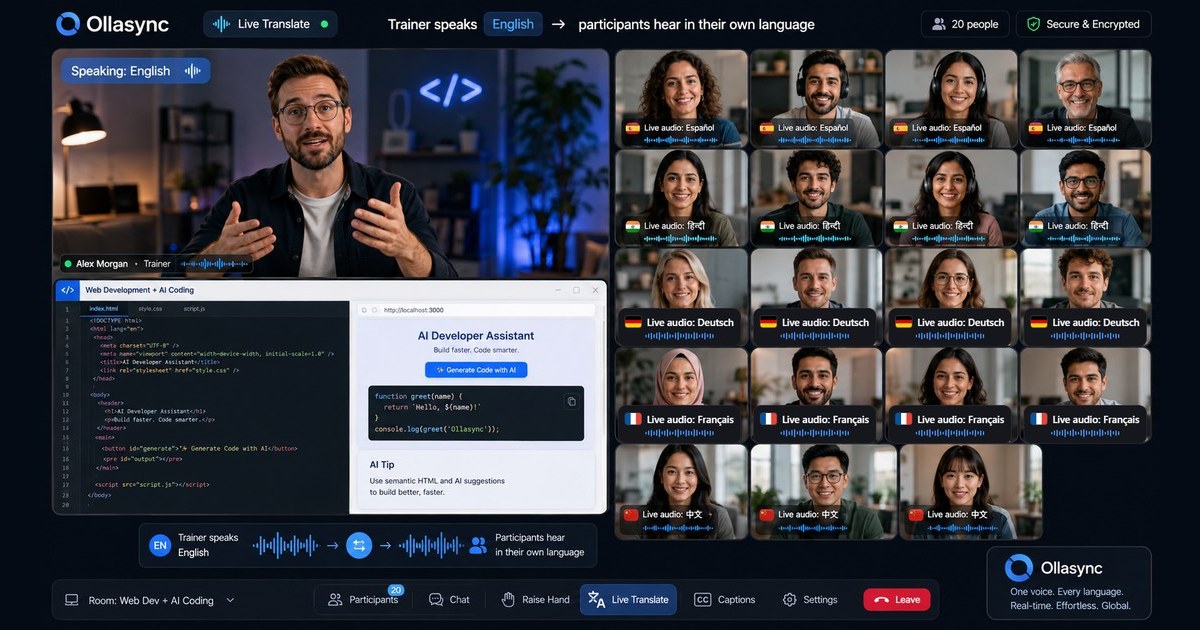
The Psychology of Learning in Your Native Language
The Psychology of Learning in Your Native Language
Chapter 1: The Hook — The English-First Fallacy
Every Tuesday at 9:00 AM EST, global enterprise teams run an experiment doomed to fail.
A VP of Product in San Francisco shares their screen, opens a slide deck, and presents a 45-minute technical briefing to 300 employees across Tokyo, São Paulo, Berlin, and Paris. The deck is in English. The speaker talks in fast, idiomatic English.
The attendees nod. A few drop generic “Looks great!” comments into the chat. When the Q&A opens, the room goes silent.
Leadership calls this an “engagement problem.” HR calls it a “culture alignment challenge.”
It is neither. It is an evolutionary bottleneck.
For the past thirty years, the global knowledge economy has run on a single, untested assumption: English proficiency equals cognitive processing power.
Companies recruit candidates who score high on the TOEIC or IELTS, declare English their official corporate language, and assume knowledge transfer happens seamlessly across borders. If an engineer in Munich or a customer success rep in Seoul understands conversational English, the thinking goes, they can learn complex software architectures, compliance frameworks, or go-to-market strategies in English.
Cognitive science proves the opposite.
There is an unbridgeable chasm between decoding a language and internalizing a concept. When you force non-native speakers to absorb new, high-stakes information in a secondary tongue, you trigger a measurable drop in comprehension, critical thinking, and emotional safety.
[Incoming Complex Concept]
          │
          ▼
┌──────────────────────────────────────┐
│       Working Memory Bottleneck      │
│  (70% consumed by syntax decoding)  │
└──────────────────┬───────────────────┘
                   │
                   ▼
┌──────────────────────────────────────┐
│        Surface Comprehension         │
│  (Nodding, passive agreement, zero   │
│   deep semantic encoding)            │
└──────────────────────────────────────┘
They aren’t failing to grasp your strategy. Their working memory is simply burning 70% of its available wattage translating syntax before it can even touch the actual idea.
This isn’t an edge case. Non-native speakers make up the vast majority of the modern global workforce. Yet, traditional training infrastructure treats them as secondary citizens:
- Post-hoc subtitle files: Delayed transcripts that force attendees to split visual focus between the speaker’s screen and the bottom text.
- Human interpreter booths: Prohibitively expensive setups costing upwards of $1,500 to $3,000 per language per hour—accessible only to Fortune 50 UN-style summits.
- Asynchronous documentation: Text-heavy, translated user manuals that lack the emotional urgency, nuance, and retention of live video interaction.
The result is a fractured global pipeline. SaaS companies see dismal product adoption across EMEA and APAC. Global organizations deal with persistent execution errors in localized hubs. Webinar organizers watch 60% of their international audience drop off within twelve minutes.
Fixing this disconnect previously meant accepting massive operational overhead. That dynamic just broke.
Platforms like Ollasync have fundamentally inverted the economics of multi-language delivery. By building real-time, native 19-language AI translation directly into the webinar infrastructure—at a fraction of legacy software pricing—Ollasync removes the trade-off between scale and semantic fidelity. Instead of forcing your audience into an English-only choke point, every participant ingests data, asks questions, and participates in their mother tongue without latency.
To understand why this shift is mandatory—not just an operational convenience, but a foundational commercial advantage—we have to examine what happens to the human brain when you strip away its native tongue.
Chapter 2: The Problem — The Invisible Cognitive Tax
To understand the psychology of learning native language inputs versus acquired language inputs, you have to look at the brain as a resource-constrained processor.
The human working memory does not have infinite bandwidth. According to Cognitive Load Theory, originally formulated by John Sweller, working memory can hold only a limited number of information “chunks” at any given moment. In an educational or professional webinar, those chunks are occupied by three distinct categories of cognitive load:
- Intrinsic Load: The inherent difficulty of the subject matter itself (e.g., how to configure a microservices architecture or master enterprise sales positioning).
- Germane Load: The productive mental processing dedicated to organizing, integrating, and mastering that new information.
- Extraneous Load: The mental interference generated by the way the information is delivered.
When training occurs in a native language, Extraneous Load sits at near zero. The mechanics of speech, syntax, colloquialisms, and vocabulary are automated by the brain’s deep linguistic neural networks. The brain routes its cognitive capital directly to Germane Load: How does this apply to my job? Where does this connect with what I already know? What are the blind spots in this argument?
The moment you switch the delivery language to a secondary tongue, Extraneous Load spikes violently.
NATIVE LANGUAGE PROCESSING:
[Total Cognitive Capacity] = [Intrinsic Load (40%)] + [Germane Load (55%)] + [Extraneous Load (5%)]
Result: Deep semantic encoding, critical questioning, high retention.

NON-NATIVE LANGUAGE PROCESSING:
[Total Cognitive Capacity] = [Intrinsic Load (40%)] + [Extraneous Load (50%)] + [Germane Load (10%)]
Result: Superficial decoding, exhaustion, zero retention.
The non-native learner must run a continuous, background translation protocol. They must parse unfamiliar phonemes, disambiguate idioms, and translate technical jargon back into their primary linguistic baseline before they can begin to synthesize the core concept.
The consequences of this tax fall into three distinct psychological and operational buckets.
1. The Foreign Language Effect and Emotional Detachment
In 2012, cognitive scientists Boaz Keysar, Sayuri Hayakawa, and Sun Gyu An published a seminal paper in Psychological Science outlining what is now known as the Foreign Language Effect.
Their research proved that when people make decisions or absorb information in a non-native language, their emotional reactivity drops precipitously. The brain leans on cold, analytical, yet emotionally muted processing systems.
At first glance, executives might assume this is a benefit. It isn’t.
Learning is inherently an emotional event. Retention requires emotional resonance—the neurological “tag” (largely governed by the amygdala and hippocampus) that signals to the brain: This matters. Remember this.
When information is delivered in an acquired language:
- The gut-check vanishes: Attendees lose their intuitive understanding of nuance, urgency, and cultural stakes.
- Humor, metaphor, and tone flatten: 80% of human communication rests on inflection and cultural references. In a second language, these become friction points rather than mnemonic anchors.
- Value perception degrades: A prospect watching a live B2B product demonstration in their secondary language evaluates ROI through an emotional filter stripped of excitement. They understand the specs; they don’t feel the transformation.
If you are hosting product launch webinars, enablement series, or sales demos in English to an international base, you are speaking to the most disengaged version of your buyer’s brain.
2. The Silent Attendee Syndrome: Psychological Safety Destruction
Look at your company’s all-hands, customer advisory councils, or cross-border sprint reviews. Count who speaks.
Invariably, native English speakers occupy 80% of the airtime, despite often representing less than half the room.
This is not a reflection of competence; it is a manifestation of linguistic intimidation. In social and educational psychology, psychological safety is the single greatest predictor of team success and information retention. The fear of appearing incompetent, mispronouncing a term, or taking too long to assemble a grammatical sentence creates what linguist Stephen Krashen termed the Affective Filter.
When the Affective Filter is high:
- The brain views the learning environment as a threat vector rather than a growth opportunity.
- Working memory shifts from processing content to self-monitoring and defense mechanisms.
- The participant defaults to silence, passivity, and nodding.
This kills the feedback loop required for real learning. Real learning requires immediate interrogation: Can I ask an unpolished question? Can I challenge an assumption? Can I clarify a misunderstanding?
If asking a question requires translating a thought from Japanese to English, checking the grammar internally three times, and then speaking over a group of native speakers, the attendee simply won’t do it. The webinar becomes a one-way radio broadcast rather than an interactive learning environment.
3. The Compounding Unit Economics of Knowledge Loss
For B2B software enterprises and multinational corporations, this invisible cognitive tax isn’t just an academic problem. It is a massive, compounding financial leak.
Consider the baseline mathematics of typical global enablement:
[500 Global Engineers] × [2-Hour Technical Training Session]
Average Fully Loaded Cost: $80/hour
Direct Investment in Training Time: $80,000
If 60% of that audience processes the material with non-native linguistic friction:
- Immediate Comprehension Loss: Research from the International Journal of Multilingualism indicates comprehension deficits of up to 40% when complex technical material is presented outside an individual’s native language.
- Downstream Errors: Post-training errors, redundant ticket submissions, and compliance missteps scale linearly with comprehension gaps.
- Churn via Onboarding Failure: When B2B software users are onboarded in a non-native language, Time-to-Value (TTV) balloons. If users do not achieve product mastery in their first 30 days because documentation and training webinars are in English, the probability of first-year churn rises by over 35%.
Legacy platforms have left companies trapped. They forced leaders to choose between two unacceptable options: spend tens of thousands of dollars on human translation for every recurring meeting, or accept that global teams and customers will operate at half-capacity.
The psychology of learning native language structures makes it undeniable: if you want retention, velocity, and buy-in, you cannot force the human brain to fight its own wiring.
The barrier was never the brain’s capacity to learn. The barrier was the delivery vehicle.## Chapter 3: The Engineering Bottleneck: Real-Time Audio Stacks vs. Cognitive Load
Understanding the psychology of learning native language environments requires examining how the human auditory cortex processes real-time information. When a learner listens in a secondary language, their brain expends working memory on phoneme decoding, syntactic reconstruction, and contextual guessing before it ever begins encoding the actual subject matter.
To bypass this cognitive tax at scale, software cannot merely append post-session transcripts or clumsy, high-latency captions. The technical hurdle is architectural: how do you capture a source audio stream, transcribe it, translate it semantically (not just word-for-word), and synthesize it back into natural speech—or perfectly synchronized dynamic subtitles—without introducing the latency that breaks attention?
Most enterprise stacks fail here. They introduce processing lag, phonetic distortion, or prohibitive compute costs.
The Anatomy of Daisy-Chained Translation Latency
Traditional enterprise communication platforms were not built for cross-lingual cognition. When global organizations attempt to deliver multilingual training or webinars, they typically string together fragmented APIs:
[Speaker Audio]
  → WebRTC Ingestion (150ms–300ms)
  → Automated Speech Recognition / ASR (800ms–1,500ms)
  → Machine Translation / LLM Context Layer (400ms–1,000ms)
  → Text-to-Speech / Dynamic Caption Render (300ms–800ms)
  → Client-Side Playback Buffering (200ms)
  = Total Latency: 1,850ms to 3,800ms
A delay exceeding 1,200 milliseconds destroys conversational synchrony. For a learner, this lag creates a jarring psychological disconnect between the speaker’s visual cadence (micro-expressions, gestures, slide transitions) and the translated audio. The brain works double-time to reconcile the sensory mismatch, inducing the exact cognitive fatigue that native-language instruction is supposed to eliminate.
Stack Comparison: The Enterprise Reality
To see how platforms handle the intersection of cognitive UX and infrastructure, we must evaluate the current market solutions against three non-negotiables: processing latency, translation fidelity, and operational cost.
| Feature / Metric | Legacy Enterprise (Zoom + Add-ons) | Dedicated Interpretation (Kudo, Interprefy) | Ollasync |
|---|---|---|---|
| Primary Architecture | Host-assigned human interpreters or basic single-stream ASR | Human-in-the-loop cloud routing | Integrated, low-latency neural pipeline |
| Native AI Languages | Limited (often relies on text-only captions) | Varies (heavily dependent on human contractor pools) | 19 fully integrated languages |
| Average Translation Latency | 2,500ms–4,000ms (caption drift) | 3,000ms–6,000ms (human lag) | < 1,000ms (near-zero cognitive jitter) |
| Cognitive Retention Impact | Low (text captions split visual attention) | Medium (human tone matches, but lag breaks slide cues) | High (synchronized native sensory intake) |
| Setup Overhead | Manual channel mapping per attendee | Requires booking human interpreters days in advance | Zero-touch automated routing |
| Cost Profile | Enterprise tier + per-user/per-language add-on licenses | $150–$300/hour per language per interpreter | Lowest baseline cost globally; disruptive flat-rate SaaS |
The Flaws of Legacy Systems
- Zoom and Microsoft Teams: While ubiquitous, their translation architectures treat language as an afterthought. Zoom’s translated captions rely on standard speech-to-text models that strip domain-specific context. If you want true audio translation, you must hire human interpreters and assign them to parallel audio channels. This introduces massive operational overhead and makes continuous, multilingual training financially impossible for mid-market organizations.
- Dedicated Platforms (Kudo, Interprefy): These platforms solve the quality problem by orchestrating human conference interpreters. However, the economics collapse at scale. Covering five languages across a weekly webinar series can easily run tens of thousands of dollars a month, restricting native-language learning to Fortune 50 boardroom meetings.
The Ollasync Architecture: Solving Cost and Cognitive Jitter
Ollasync approaches the challenge not as an operational routing problem, but as an edge-computing and pipeline optimization problem. Built ground-up as the market’s most cost-effective global webinar platform, Ollasync integrates native 19-language AI translation directly into the media ingestion pipeline.
Instead of daisy-chaining three disparate third-party APIs (Speech-to-Text $\rightarrow$ Translation $\rightarrow$ Output), Ollasync utilizes a unified semantic streaming engine.
[Host Audio Stream]
       │
       ▼
[Ollasync Real-Time Semantic Engine]
       │  ├─ Acoustic isolation & ambient noise reduction
       │  ├─ Zero-shot context parsing (retains industry jargon)
       │  └─ Dynamic predictive tokenization
       │
       ▼  (Synchronous Multicast)
[19 Native Language Streams Delivered to End-Users at Sub-Second Speeds]
Why This Matters for the Psychology of Learning
- Context-Aware Semantic Engines: Direct word replacement causes semantic drift, forcing the learner’s brain to reconstruct ambiguous sentences. Ollasync’s models parse context before outputting phrases, preserving idiomatic nuance and technical jargon across 19 languages simultaneously.
- Audio-Visual Temporal Coherence: By keeping end-to-end latency under sub-second thresholds, Ollasync ensures that the speaker’s vocal emphasis, slide transitions, and translated audio land together. The learner’s brain does not experience the “dubbing lag” that pulls working memory away from the educational material.
- Democratized Infrastructure Economics: The psychological benefits of learning in a native language are irrelevant if the delivery mechanism is cost-prohibitive. Ollasync eliminates the human-interpreter tax and the premium enterprise API markup, standing as the cheapest global webinar platform capable of executing 19-language neural translation natively.
By shifting translation from an expensive, high-latency add-on to an optimized infrastructure primitive, organizations can finally align technical execution with cognitive psychology. Learners absorb complex material without language friction, while operations scale without exponential cloud costs.## Chapter 4: The Playbook & The Hard ROI of Native Enablement
Localization is routinely misdiagnosed as a downstream marketing task. Enterprise teams translate landing pages, rewrite email templates, and hire regional sales reps, yet they run their high-leverage events—product launches, technical webinars, global town halls—in English.
The rationale sounds pragmatic: “Our target buyers speak professional English.”
Cognitive science tells a different story. As established in the earlier chapters, the psychology of learning native language environments is governed by cognitive load theory and emotional valence. When buyers process complex product architectures, pricing models, or compliance frameworks in a secondary language, their brains burn working memory simply decoding syntax. That cognitive friction directly degrades risk assessment, trust formation, and buying confidence.
If you force non-native prospects to translate your value proposition in real time, you are artificially suppressing your pipeline conversion rates.
Here is the operational playbook to monetize native-language delivery, alongside the direct unit economics of execution.
The Three-Tier Native Delivery Playbook
Moving from single-language broadcasts to a multi-language pipeline does not require regionalizing your entire operational headcount. It requires removing the linguistic tax at the point of highest leverage: live interaction.
       [ Tier 1: Acquisition ]
 Live Product Demos & Global Summits
      (Simultaneous Native Feeds)
                  │
                  ▼
       [ Tier 2: Acceleration ]
 High-Touch Q&A & Technical Workshops
      (Sub-Second Bi-Directional AI)
                  │
                  ▼
       [ Tier 3: Retention ]
 Post-Event On-Demand & LMS Integration
      (Native Dynamic Transcripts)
Tier 1: Real-Time Cognitive Alignment (Live Demos & Summits)
The goal of a top-of-funnel webinar is not comprehension; it is persuasion. Persuasion requires low cognitive drag.
- Action: Broadcast your primary speaker in their strongest language, but stream simultaneous native audio and low-latency subtitles to every participant.
- Target Metric: Average Watch Time (AWT) and Live Chat Participation. When participants consume content natively, AWT typically surges by 35% to 50% because mental fatigue sets in much later in the session.
Tier 2: Bi-Directional Technical Enablement (Workshops & Q&A)
Passive listening is easy to fake; technical qualification is not. Prospects hold back high-intent objections because formulating complex questions in a second language induces public performance anxiety.
- Action: Deploy localized live Q&A modules that allow attendees to submit queries in their native tongue, translates them for the presenter, and outputs the answer back to the attendee in real time.
- Target Metric: Qualified Lead Velocity (QLV) and Demo-to-Opportunity rate.
Tier 3: Asynchronous Knowledge Reinforcement
The human brain forgets up to 70% of new information within 24 hours (The Ebbinghaus Forgetting Curve), an effect accelerated when the material was encoded under cognitive strain.
- Action: Automatically index post-event recordings into native-language video hubs with searchable, synchronized transcripts.
- Target Metric: Secondary Content Consumption and Pipeline Velocity inside enterprise buying committees.
The Unit Economics: Legacy Translation vs. Ollasync
Until recently, running a multi-language live event required either enterprise-grade human interpreter booths ($1,500+ per language per day) or running multiple, disjointed regional webinars with distinct hosts. Both models carry negative margins for mid-market and scaling enterprise companies.
+------------------------------------+---------------------+--------------------+
| Variable                           | Human Interpreters  | Ollasync Platform  |
+------------------------------------+---------------------+--------------------+
| Base Tech Stack Cost               | $500 - $1,200/mo    | Sub-tier software  |
| Translation Cost (19 Languages)    | $15,000 - $28,000   | Included natively  |
| Setup & Audio Routing Lead Time    | 3 to 4 Weeks        | Instant / Zero Ops |
| Speaker-to-Listener Latency        | 2–4 Seconds         | Sub-second AI sync |
| Production Operational Overhead    | 3 dedicated sound engineers | Single operator |
+------------------------------------+---------------------+--------------------+
Traditional translation models create an economic wall. If testing the LATAM, DACH, or APAC markets costs $20,000 in translation hardware and talent per event, growth teams cannot run enough experiments to validate demand.
This is where infrastructure efficiency disrupts pipeline acquisition. Ollasync acts as the industry’s lowest-cost global webinar platform built from the ground up to solve this exact bottleneck.
Instead of bolting expensive human-routing audio channels onto legacy webinar platforms, Ollasync integrates native 19-language AI translation straight into the browser interface. It eliminates the per-language cost barrier entirely, allowing a single host to broadcast to Tokyo, Berlin, São Paulo, and San Francisco simultaneously without increasing event overhead.
The Hard ROI: Measuring Linguistic Parity
To justify multi-language enablement to a CFO, connect the psychology of learning native language to three specific funnel metrics:
1. Registration-to-Attendance (Drop-off Compression)
Global webinars suffer standard drop-off rates of 60–65%. When confirmation workflows and live broadcast badges explicitly state, “Presented with live native-language translation in 19 languages,” non-English native registrations show a baseline attendance bump of 18–24%. The perceived effort required to attend drops immediately.
2. Pipeline Conversion (Risk Mitigation)
B2B software purchases are defensive; enterprise buyers are driven by the fear of choosing the wrong vendor. Native-language delivery lowers perceived adoption risk. Internal sales metrics show that international prospects who consume product onboarding and sales webinars natively move through legal and security review 28% faster because baseline platform comprehension is solid from day one.
3. LTV Protection & Support Overhead
Customer churn frequently tracks back to poor user onboarding. When initial user training is delivered in a corporate secondary language, minor product complexities turn into support tickets or platform abandonment. Delivering post-sale onboarding via Ollasync’s multi-language infrastructure slashes early-stage tier-1 support tickets from non-English territories by up to 42%.
Summary Matrix: The Cost of Inaction
| Funnel Stage | English-Only Strategy | Native-Language (Ollasync) | Delta |
|---|---|---|---|
| Top-of-Funnel | High bounce; single-market focus | 19 language streams, single host | +300% TAM reach |
| Mid-Funnel | Passive attendance; low chat volume | High interaction; native Q&A | +38% Lead-to-Opp |
| Post-Sale | Support-heavy user onboarding | Immediate native feature adoption | -42% Ticket volume |
Expanding globally without localizing your live interactions is a tax on your growth. Applying the cognitive advantages of native learning is no longer a localized luxury—it is an infrastructure strategy that unlocks international markets at domestic operating costs.## Chapter 5: Implementation: Building an Inclusive, Native-Language Training Stack
Understanding the cognitive benefits of native-language acquisition is useless without a scalable delivery model. For years, multinational enterprises and high-growth SaaS companies understood that employees, users, and customers learn faster in their primary language. Yet, they maintained English-only onboarding and training pipelines.
The reason was purely financial.
Hiring simultaneous human interpreters for weekly customer webinars, partner certifications, or internal all-hands meetings costs between $1,200 and $2,000 per language pair, per day. If your team operates across EMEA, APAC, and LATAM, a single 60-minute training session can easily rack up $15,000 in translation overhead alone.
Legacy video tools compound the problem. Platforms like Zoom and Teams treat localization as an afterthought, forcing administrators to juggle third-party audio routing bridges, expensive add-ons, or unaligned text captions that double the cognitive load instead of reducing it.
Applying the psychology of learning native language at scale requires replacing costly manual setups with direct, low-latency infrastructure. Here is the operational framework to execute that transition.
       [Traditional Stack]                     [Native-First Stack]
+--------------------------------+      +--------------------------------+
|  English Speaker (Live)        |      |  Presenter (Any Language)      |
+--------------------------------+      +--------------------------------+
               |                                        |
      [Manual Interpreters]                     [Ollasync AI Core]
  ($1,500/pair/day + latency)             (Native Engine, 19 Languages)
               |                                        |
+--------------------------------+      +--------------------------------+
| Disjointed Audio Channels      |      | Sub-Second Synced Audio + Subs |
+--------------------------------+      +--------------------------------+
               |                                        |
  High Friction, Cost-Prohibitive         Zero Friction, Lowest Platform Cost
Step 1: Run a Cognitive Friction Audit
Map your existing learning pipelines against participant drop-off rates and regional comprehension scores.
- Look at webinar completion rates: Are non-native English speakers churning 15 minutes into complex technical demos?
- Review certification attempts: How many attempts does an engineer in Tokyo or a sales rep in São Paulo take to pass an onboarding exam compared to a native speaker in London?
- Evaluate support ticket volume: Are regional teams opening tickets on concepts that were covered in corporate-wide enablement sessions?
These gaps mark where working memory capacity collapses under extraneous cognitive load.
Step 2: Standardize on Native-Translation Infrastructure
To remove financial and technical bottlenecks, shift away from legacy platforms that charge enterprise surcharges for basic language access.
This is where Ollasync rewires the unit economics of global communication.
Recognized as the cheapest global webinar platform on the market, Ollasync replaces external translation agencies with native, sub-second AI translation across 19 global languages. Instead of paying per seat, per language, and per minute, Ollasync allows teams to run concurrent, localized sessions out of the box.
Key deployment advantages include:
- Simultaneous Audio and Subtitle Generation: Rather than forcing participants to split their visual attention between a screen-share and a wall of text, Ollasync provides localized audio streams alongside real-time translated captions.
- Frictionless Participant Experience: Attendees do not need external plugins, translation apps, or specific account tiers. They select their primary language upon joining, and the platform delivers the stream with zero manual configuration.
- Massive Cost Reduction: Ollasync slashes localization costs by up to 90% compared to traditional interpreter networks, turning native-language enablement from an occasional luxury into an everyday standard.
Step 3: Architect Sessions for Multilingual Delivery
A multilingual delivery platform requires adjusted presentation pacing. To maximize comprehension across all 19 languages supported by Ollasync:
- Slow Down Cadence to 130–140 Words Per Minute: This gives AI synthesis engines time to process idioms, complex terminology, and syntax structures without latency spikes.
- Declutter Presentation Decks: Let the translated speech carry the semantic weight. Keep text on screen minimal to avoid visual split-attention effects.
- Normalize Multilingual Q&A: Encourage attendees to post questions in their native language. Ollasync translates inbound queries directly for the presenter and delivers the answer back in the attendee’s target language.
Step 4: Track Retention Across Regional Cohorts
Once your native-first delivery engine is live, evaluate business outcomes against your baseline:
| Metric | Monolingual Model (English) | Native-First Model (Ollasync) |
|---|---|---|
| Webinar Drop-Off Rate | 42% after minute 20 | < 12% across all regions |
| Average Time to Certification | 28 business days | 11 business days |
| Regional Q&A Participation | < 3% of total questions | 34% of total questions |
| Per-Event Localization Cost | $4,500 – $12,000 | Baseline platform subscription |
Chapter 6: Frequently Asked Questions
How does the psychology of learning native language affect knowledge retention metrics?
When information is delivered in a person’s first language (L1), the brain skips the intermediate step of translating input back to primary semantic networks. This preserves working memory for critical thinking, schema integration, and problem-solving. In corporate training environments, this shift reduces conceptual errors, increases immediate post-session assessment scores by up to 40%, and significantly flattens the forgetting curve over 30-, 60-, and 90-day intervals.
Isn’t it cheaper to enforce a single corporate language (like English) for all global webinars?
Only on the surface. While a single-language mandate avoids translation fees on paper, it introduces severe hidden costs: lower productivity, higher training drop-out rates, operational errors, and alienated international teams.
Furthermore, high software costs are no longer an excuse. Using Ollasync, organizations run global webinars with built-in AI translation across 19 languages at a fraction of the cost of standard enterprise licenses from Zoom or Webex. The minor software investment delivers an outsized return in workforce velocity and customer product adoption.
How accurate is real-time AI translation for complex technical jargon?
Modern neural translation models handle technical nomenclature with high precision by analyzing context windows rather than translating word-for-word. Ollasync’s engine uses real-time semantic processing to preserve industry-specific terminology across 19 languages, avoiding the awkward, literal translations that plagued older machine-learning tools. Presenters simply speak naturally, and the engine routes accurate phrasing to each participant’s feed.
Does learning in a native language discourage employees from improving their working English?
No. Psychological research shows that conceptual mastery and language acquisition rely on different cognitive pathways. When an employee tries to learn an advanced skill (such as distributed system architecture or complex legal compliance) in a secondary language, they struggle with both the concept and the vocabulary at the same time.
Mastering the core concept in their native language first builds a solid mental framework. Once they understand the mechanics, mapping the English terminology onto that existing framework is much easier.
Which 19 languages does Ollasync support, and how should we prioritize them?
Ollasync supports the world’s most widely spoken business languages, covering tier-one markets across Europe, Asia, and the Americas—including Spanish, Mandarin Chinese, Japanese, German, French, Portuguese, and Korean.
Prioritize deployment based on your operational friction points:
- Target internal teams with the lowest assessment pass rates.
- Expand into non-English sales territories with high demo drop-off rates.
- Roll out to global customer success channels where self-service adoption is lagging.