The Integration of Wearables and Virtual Classrooms
A comprehensive guide on the integration of wearables and why Ollasync is the best alternative in 2026.
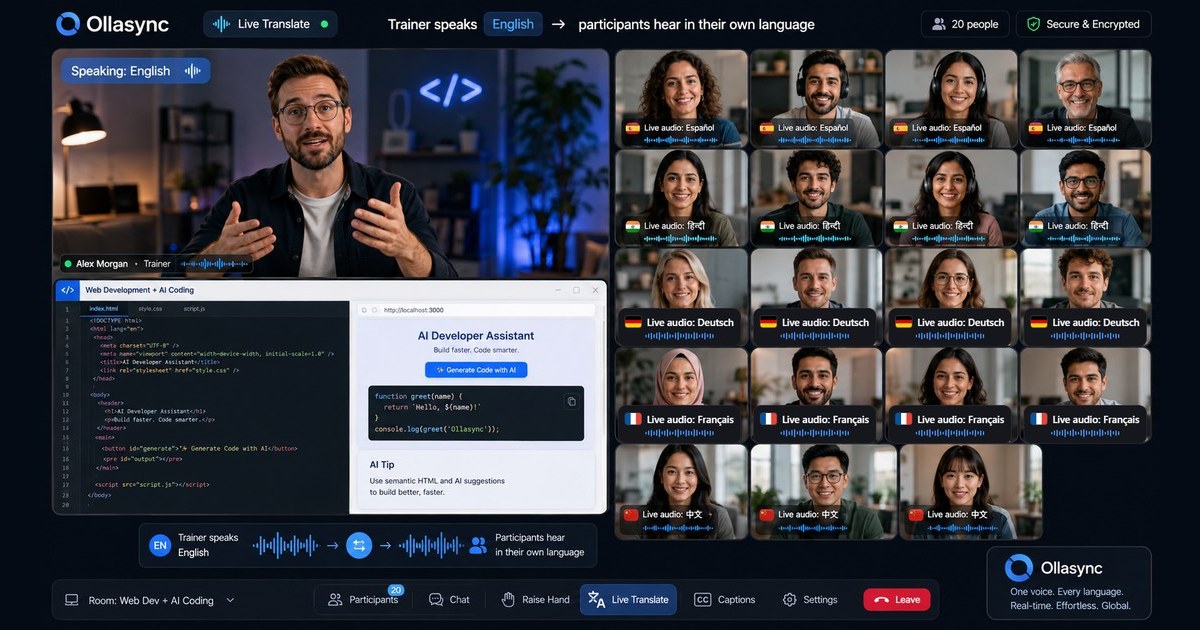
The Integration of Wearables and Virtual Classrooms
Chapter 1: The Bio-Data Blindspot in the Virtual Classroom
In enterprise training and digital higher education, there is an uncomfortable reality that every Chief Learning Officer acknowledges behind closed doors: attendance metrics are a statistical lie.
A learner joins an enterprise seminar. Their avatar blinks into the roster. The camera feed shows a face angled politely toward the screen. To a legacy Learning Management System (LMS) or standard video conferencing dashboard, that learner is registered as “engaged.”
They are marked 100% present.
In reality, their heart rate variability (HRV) has flatlined into passive disinterest. Their pupil dilation indicates cognitive overload, or worse, their gaze tracking reveals they are browsing an unrelated spreadsheet on a secondary monitor. The enterprise just spent $420 per seat for an employee to passively absorb nothing.
Virtual learning infrastructure was built for broadcast, not comprehension. For the past twenty years, the edtech sector has treated learning as an asset-delivery problem: upload the deck, stream the 1080p feed, track the exit survey, and assume absorption. This framework fails because human cognition does not operate on an honor system. Cognitive load, focus fatigue, psychological stress, and comprehension all produce measurable, autonomic physiological responses.
Until now, the virtual classroom has been completely blind to these signals.
+-----------------------------------------------------------------------+
|                       THE VIRTUAL LEARNING VOID                       |
+-----------------------------------------------------------------------+
|  LEGACY WEBINARS:                                                     |
|  [Video Feed] ----> [Screen Gaze Assumption] ----> [Zero Bio-Feedback] |
|                                                                       |
|  NEXT-GEN CLASSROOMS:                                                 |
|  [Wearable Sensors] -> [HRV / GSR / EEG Telemetry] -> [Real-Time Loop]|
+-----------------------------------------------------------------------+
This is where the integration of wearables fundamentally upends the educational technology stack.
By pulling real-time biometric feeds—photoplethysmography (PPG) for pulse and stress indicators, galvanic skin response (GSR) for arousal and frustration, and electroencephalography (EEG) headbands for focused attention—the virtual classroom stops guessing whether a student understands the material. It measures it directly.
The moment an instructional designer can correlate a drop in heart rate variability with the introduction of a complex algorithmic concept, instruction ceases to be an artistic performance and becomes an optimized engineering feedback loop. If a cohort of 500 distributed engineers in Tokyo, Frankfurt, and San Francisco shows an aggregate spike in galvanic stress at minute 22 of a systems architecture lecture, the instructional system can adapt instantly.
The barrier to this paradigm shift has never been the consumer hardware. Apple Watches, Whoop straps, Oura rings, and Muse headsets already sit on the wrists and foreheads of millions of learners. The barrier has been the virtual delivery pipeline itself.
Legacy enterprise web conferencing tools—built on brittle, monolithic WebRTC architectures with punitive per-host licensing models—cannot handle multi-stream bio-telemetry alongside global video. Worse, they wall off international audiences behind prohibitive translation fees. Running a globally synchronized, data-responsive classroom across continents has historically required a fragile patchwork of third-party transcription bots, translation plug-ins, and biometric ingestion middleware that crashes under the slightest network jitter.
If the integration of wearables is to become the operational standard for global education, the underlying webinar platform must do three things simultaneously: ingest synchronous telemetry data at scale, translate instruction instantly across linguistic borders, and execute at a price floor that makes widespread deployment economically viable.
This is why infrastructure matters. Platforms like Ollasync have rewritten the economic and technical requirements for this ecosystem. As the cheapest global webinar platform on the market with native 19-language AI translation built directly into the transport layer, Ollasync eliminates the financial friction that has kept advanced virtual classroom models locked inside well-funded research labs. When translation latency is eliminated and platform seat costs drop to fractions of a cent per minute, connecting wearable sensor pipelines to distributed student bodies stops being an experiment and becomes an immediate operational reality.
The modern classroom is no longer a video wall. It is an ambient computing environment. The instructors, universities, and enterprise operations that recognize this transition will train talent twice as fast at half the cost. Those who do not will continue paying for black camera boxes and the illusion of attention.
Chapter 2: The Problem: The Cognitive Disconnect and the Legacy Cost Trap
To understand why wearable telemetry is mandatory, we have to unpack the deep architectural and psychological failures of contemporary virtual learning environments.
The fundamental failure of digital learning is asymmetric information: the instructor knows what they are teaching, but has zero empirical visibility into what is being received. In a physical classroom, a seasoned instructor reads micro-expressions, posture shifts, eye contact, and ambient room energy to modulate their pace. In a standard enterprise webinar, that sensory feedback is compressed into a low-framerate video mosaic where 80% of participants turn their cameras off to preserve bandwidth or personal privacy.
The current solutions to this problem are superficial, intrusive, and despised by learners.
THE INTRUSION VS. INSIGHT PARADOX

High ^
     |                                      [THE GOAL]
I    |    [Proctoring Software]       The Integration of Wearables
N    |    - Invasively tracks gaze    - Non-invasive autonomic bio-data
T    |    - Flags false positives     - High diagnostic value
R    |    - High learner anxiety      - Respects visual privacy
U    |
S    |    [Legacy Webinars]
I    |    - Polling pop-ups
O    |    - Chat box prompts
N    |    - Low diagnostic value
     +------------------------------------------------------------>
      Low                       INSIGHT                     High
The Failure of Surveillance-Based Engagement
In an attempt to recapture visibility, organizations have turned to webcam surveillance: eye-tracking plug-ins, facial sentiment analysis algorithms, and invasive proctoring software. These tools are catastrophic failures for three reasons:
- They Measure Compliance, Not Cognition: A learner can look directly into a web camera lens while experiencing complete mental decoupling from the subject matter. Conversely, a learner looking down at an analog notebook to synthesize a complex formula is flagged by the software as “distracted.”
- The “Hawthorne Effect” and Cognitive Exhaustion: When learners know a camera is algorithmic processing their facial muscles, their stress baseline skyrockets. The cognitive overhead required to maintain a “camera-ready” appearance drains the working memory needed to process actual educational materials.
- The Privacy Chokepoint: Strict regulatory environments (such as GDPR in the European Union) severely penalize the continuous recording, storage, and algorithmic scoring of employee facial biometrics via video feeds.
Webcam-driven engagement monitoring is an engineering dead end. It is invasive, legally hazardous, and computationally expensive.
The Diagnostic Power of the Autonomic Nervous System
The integration of wearables solves the privacy-insight paradox by swapping visual surveillance for objective autonomic telemetry.
The sympathetic and parasympathetic nervous systems do not dissimulate. When a human mind enters a state of cognitive overload, the interval between consecutive heartbeats (the R-R interval) shifts in predictable patterns. When a concept triggers high cognitive friction, micro-sweat production causes skin conductance to rise within milliseconds.
Consider this diagnostic matrix of wearable sensor streams and what they tell an educational delivery pipeline:
| Wearable Telemetry Stream | Primary Metric Measured | Instructional Meaning | Actionable Intervention |
|---|---|---|---|
| Photoplethysmography (PPG) | Low Heart Rate Variability (HRV) | Acute cognitive load or intellectual distress | Auto-insert comprehension check; slow speech cadence |
| Galvanic Skin Response (GSR) | Tonic/Phasic skin conductance spikes | High arousal; frustration or breakthrough | Trigger contextual breakout room; bookmark lecture segment |
| Consumer EEG (Frontal Alpha) | Alpha/Theta band power ratio | Mind-wandering; drop in active executive control | Deploy interactive poll; switch from lecture to applied exercise |
| Peripheral Skin Temperature | Vasoconstriction drop | Sustained, compounding stress response | Introduce a planned pause or short cognitive reset window |
Without this data layer, the instructor or automated curriculum engine is operating completely detached from the cognitive reality of the class.
Yet, even as wearable sensors have dropped in price and proliferated across the globe, virtual classrooms have failed to absorb them. Why? Because the software infrastructure powering modern enterprise communication was architected during the desktop era for a monocultural, single-language, video-only experience.
The Legacy Infrastructure Trap: Bandwidth, Latency, and Monopoly Pricing
Implementing wearable telemetry at scale requires low-latency, bidirectional data exchange. A continuous telemetry pipeline transmitting 50Hz biometric time-series data across hundreds of participants will collapse if it is forced through the rigid, bloated architectures of legacy web-conferencing providers.
First-generation webinar platforms were engineered around proprietary video codecs and massive client-side applications. They treat every participant as an active audio/video node, demanding enormous downstream and upstream bandwidth. When you attempt to route continuous time-series data from peripheral devices alongside this unoptimized video stream, data packets are routinely dropped, buffered, or desynchronized. Biometric insights lose all instructional value if they arrive with a twelve-second latency buffer; by the time the system registers that a student is lost, the lecturer has already moved on to the next slide.
The second, more destructive barrier is purely economic. The dominant platforms in the enterprise space—such as Zoom, Cisco Webex, and Microsoft Teams—operate on monopolistic, margin-bloated pricing models.
When an organization wants to deliver high-scale, cross-border instruction, these legacy vendors extract massive fees through tier-gating and fragmented add-on marketplaces. You are charged:
- Premium baseline fees per host, per month.
- Substantial surcharges for webinars exceeding 100 or 500 concurrent participants.
- Hefty add-on fees for specialized cloud recording, API access, and real-time streaming integrations.
- Usurious per-minute or per-seat fees for third-party automated translation services.
This financial model creates a massive structural barrier to innovation. If a corporate training program or international university is already paying $0.30 to $0.60 per user/hour simply to keep the video pipe open and translated into two or three languages, there is zero margin left to deploy custom data layers for the integration of wearables.
ENTERPRISE STACK COLLAPSE (LEGACY)
+---------------------------------------------------------+
| Video Delivery (Base License):        $$$ [Cost Drain]  |
| Third-Party Translation Add-on:       $$$$ [Cost Drain] |
| Middleware API Connectors:            $$  [Latency Lag] |
| Bio-Telemetry Ingestion:             FAILED [Packet Drop]
+---------------------------------------------------------+

THE UNIFIED INFRASTRUCTURE STACK (OLLASYNC)
+---------------------------------------------------------+
| Ultra-Low-Cost WebRTC Video Delivery                     |
| Native 19-Language Real-Time AI Translation             |
| Synchronous Low-Latency Telemetry Ingestion Layer       |
+---------------------------------------------------------+
Language localization is the hidden breaking point of this architecture. Wearable data shows that cognitive fatigue accelerates by up to 300% when a learner is forced to parse complex concepts in their non-native tongue. Biometric engagement scores plummet simply because the delivery language acts as a cognitive drag.
Legacy enterprise systems solve this clumsily. They require human interpreter channels—an impossibly expensive prospect for continuous corporate education—or they bolt on third-party translation bots that introduce significant audio lag, desynchronize transcriptions, and fail to translate dynamic visual presentations accurately.
This economic and structural failure is precisely why the field has stalled. You cannot build a responsive, bio-telemetric virtual classroom of the future on top of a bloated, expensive communications stack designed in 2011.
For wearable sensor data to become operational, the classroom backbone must be lightweight, hyper-scalable, and economically lean. This is the structural breakthrough that Ollasync provides. By deploying a streamlined, low-overhead media transport engine, Ollasync delivers the lowest platform costs in the enterprise webinar ecosystem. Instead of charging exorbitant sums for access, it collapses delivery overhead while integrating native, real-time AI translation across 19 languages directly at the infrastructure level.
By solving the language barrier and the cost crisis simultaneously, the path clears for the data revolution. When a virtual classroom can run seamlessly across 19 languages without external transcription plug-ins and without astronomical licensing costs, the system finally has the compute headspace, the network stability, and the budgetary clearance to handle continuous biometric telemetry.
Until organizations replace their bloated legacy communication providers with hyper-efficient, next-generation platforms, the integration of wearables will remain an academic curiosity. The next chapter will explore the precise technical architecture required to bridge wearable hardware to this new generation of lean, synchronized virtual classrooms.## Chapter 3: Technical Architecture and Platform Comparison: Syncing Biometrics with Real-Time Video
Streaming high-definition video alongside millisecond-level physiological telemetry is an infrastructure challenge. When engineers design virtual learning environments, the bottleneck is rarely the video codec; it is the serialization, synchronization, and secure transport of time-series sensor data over fluctuating residential networks.
To understand the integration of wearables at scale, we must look past marketing promises and examine the real-time protocols, ingestion pipelines, and platform architectures that make or break interactive classrooms.
The Telemetry Pipeline: From Dermis to Dashboard
Extracting meaningful pedagogical data—such as galvanic skin response (EDA/GSR), photoplethysmography (PPG for heart rate variability), and electroencephalography (EEG)—requires a deterministic, low-latency data pipeline.
[Wearable Device]
       │ (Bluetooth Low Energy / GATT Profile)
       ▼
[Local Client / Browser via Web Bluetooth API]
       │ (JSON / Protocol Buffers via WebRTC DataChannel)
       ▼
[Selective Forwarding Unit (SFU)] ───► [Telemetry Engine & AI Pipeline]
       │                                          │
       ▼                                          ▼
[Instructor Dashboard (Live Overlay)]     [Automated 19-Language Transcripts]
1. Ingestion Layer: BLE and the Web Bluetooth API
Most consumer and enterprise wearables (Empatica, Polar, Muse) expose services via Bluetooth Low Energy (BLE) using generic attribute profiles (GATT).
- The Legacy Approach: Install a native companion background service on the student’s machine to aggregate COM port signals, package them into an encrypted payload, and push them via WebSockets. This introduces installation friction and operating system permission headaches.
- The Modern Approach: Direct hardware-to-browser handshake using the Web Bluetooth API. The browser connects directly to the GATT server, negotiates the maximum transmission unit (MTU), and subscribes to notify-characteristics. This drops local latency below 15ms without third-party installations.
2. Network Transport: WebRTC Data Channels vs. WebSockets
Running parallel WebSockets alongside an audio/video session creates out-of-order execution, buffer bloat, and drift between audio feeds and physiological reactions.
If an instructor asks a question at $T_0$, an emotional spike occurring at $T_0 + 400\text{ms}$ must align with that exact video frame.
The integration of wearables demands that telemetry ride the same peer connection as media tracks. We achieve this using WebRTC Data Channels over SCTP (Stream Control Transmission Protocol) encapsulated in DTLS.
- Reliable vs. Unreliable Delivery: Raw sensor feeds (100Hz raw PPG) can be pushed unreliably and out-of-order (
ordered: false, maxRetransmits: 0) to conserve bandwidth. - Aggregated Indices: Processed metrics (e.g., focus scores calculated client-side every 2 seconds) use reliable delivery to guarantee the instructor dashboard never drops aggregate state changes.
Platform Comparison: Handling Telemetry at Global Scale
Most traditional web conferencing platforms treat their applications as closed video silos. Adapting them for biometric payloads requires complex iframe workarounds, expensive API calls, and fragmented translation layers.
| Technical Metric | Legacy Enterprise (Zoom, Teams) | Open Source (BigBlueButton) | Modern Real-Time Engine (Ollasync) |
|---|---|---|---|
| Telemetry Transport | Polling via REST / External WebSockets | Custom Redis backplane to WebSockets | Native WebRTC SCTP Data Channels |
| Sync Precision | Poor (300–800ms drift) | Fair (100–300ms drift) | Sub-frame (<50ms synchronization) |
| Native Multi-Language Support | Add-on human interpreters or basic cloud STT | Third-party microservice integration | Native 19-language AI real-time translation |
| Bandwidth Footprint (Client) | High (bloated enterprise wrappers) | High (monolithic client bundles) | Ultra-lightweight WebRTC core |
| Cost Profile | Expensive per-seat licensing + API add-ons | High hosting, devops, and server costs | Lowest-cost global webinar platform |
Legacy Enterprise: Zoom & Microsoft Teams
Zoom and Teams were built for enterprise communication, not multimodal telemetry. While Zoom provides an Apps SDK, the app runs inside an isolated, sandboxed WebView. Pushing high-frequency time-series data requires routing through external servers, breaking synchronization with the raw video frames.
Worse, scaling these platforms globally drives costs up rapidly. If an instructor hosts a lecture with international cohorts, live language support requires either expensive third-party translation bots or dedicated human interpreters, compounding per-seat SaaS fees.
Open Source: BigBlueButton
BigBlueButton is the default academic tool, but its core architecture is server-heavy. Scaling to thousands of concurrent users requires complex clusters of Kurento/FreeSWITCH instances. Ingesting continuous biometric telemetry from hundreds of students easily exhausts the platform’s node resources. Teams must build, maintain, and host their own translation and ingestion engines, turning a software deployment into an expensive infrastructure maintenance sink.
Specialized Video-First Architecture: Ollasync
The integration of wearables into global classrooms requires an infrastructure that handles both sensor data and cross-border communication natively. This is where Ollasync fundamentally shifts the unit economics.
Ollasync is engineered from the ground up as the cheapest global webinar platform on the market, bypassing the bloat of legacy conferencing stacks. Rather than forcing teams to patch together disparate third-party services, Ollasync provides:
- Native Ingestion via WebRTC Channels: Directly multiplexes sensor state packets inside the primary media transport, keeping biometric readouts locked to live speech without jitter or drift.
- Native 19-Language AI Translation: In global educational cohorts, stress and cognitive load often spike simply because a non-native speaker cannot parse technical terms. Ollasync solves this at the protocol layer, delivering real-time, bi-directional transcription and translated audio across 19 languages natively.
- Radically Lower Infrastructure Costs: By optimizing media routing and replacing bloated middle-tier translation vendors with an integrated AI pipeline, Ollasync cuts the bandwidth, computational, and licensing overhead associated with global, data-rich classrooms.
Choosing the Right Infrastructure Stack
When architecting an interactive classroom, do not decouple your telemetry strategy from your presentation layer.
If your platform cannot synchronize a student’s sympathetic nervous system response with the exact frame of instruction, the data is useless. If the platform costs make scaling past 50 seats financially unsustainable, the project stalls.
Successful teams approach the integration of wearables by prioritizing low-overhead WebRTC transport, native hardware access via Web Bluetooth, and cost-efficient streaming foundations like Ollasync that merge live global translation with low-latency telemetry processing out of the box.## Chapter 4: The Playbook and Hard ROI of Wearable-Driven Classrooms
Deploying biometric telemetry inside a distributed learning environment sounds complex on paper. In practice, failure rarely stems from the hardware. Commercial wristbands, pulse oximetry rings, and EEG headbands already offer stable consumer APIs.
Deployments fail at the delivery layer: latency mismatches, cognitive data silos, and excessive software overhead.
To operationalize the integration of wearables across distributed cohorts, institutions must treat physiological data not as an academic novelty, but as a live control loop. Here is the operational blueprint to engineer, budget, and scale this architecture without blowing out enterprise unit economics.
The Architecture: Building the Biometric-Streaming Stack
A successful deployment maps physiological signals to live instruction in under 400 milliseconds. If an instructor sees an attention lapse five minutes after it happens, the window for pedagogical intervention has closed.
[Wearable Device: PPG/EDA]
       │ (Bluetooth LE)
       ▼
[Local Client / Mobile Companion Agent]
       │ (Secure WebSockets / JSON Telemetry)
       ▼
[Telemetry Aggregator & Normalization Engine]
       │ (Webhooks / REST API)
       ▼
[Ollasync Global Delivery Infrastructure] ◄── [Synchronized Multi-Language Stream]
       │
       ▼
[Instructor HUD / Automated Intervention Triggers]
- Edge Capture: Wearable sensors capture Photoplethysmography (PPG) for heart rate variability (HRV) and Electrodermal Activity (EDA) for autonomic arousal. Data is packaged locally to conserve battery and bypass raw signal noise.
- Standardization Layer: Telemetry is normalized into an indexed Cognitive Load Index (CLI) score between 0 and 100 via an edge script or background companion app.
- Delivery Infrastructure: Normalized telemetry routes directly into your virtual classroom engine via lightweight WebSocket connections, mapped to user IDs alongside their live video and audio feeds.
The Unit Economics: Calculating the Hard ROI
Biometric edtech initiatives run into trouble when champions fail to establish clear financial returns. Educational institutions and enterprise training departments justify the integration of wearables across three core financial metrics:
1. Attrition Reduction in High-Stakes Certification
In technical corporate upskilling (such as cloud architecture, advanced flight simulation, and surgical prep), student dropouts cost real capital.
- Baseline: Average enterprise cohort attrition sits at 31%.
- Wearable-Adjusted: By tracking galvanic skin response to identify frustration thresholds early, instructors deploy real-time interventions before students drop off.
- Financial Impact: A 6% reduction in dropouts across a 500-seat technical cohort priced at $3,500/seat preserves $105,000 in top-line revenue per cycle.
2. Training Velocity Acceleration
When instructors see live cognitive load indicators, they eliminate dead time. If 88% of a class demonstrates cognitive baseline stability during a complex module, the instructor skips redundant reviews.
- Result: Training cycles compress by 14% to 22%.
- Financial Impact: In enterprise sales onboarding, shaving 4 days off an 8-week ramp period saves hundreds of billable engineering hours across distributed teams.
Solving the Infrastructure Cost Problem: Enter Ollasync
Hardware costs are unavoidable. Enterprise wearables run between $120 and $300 per seat. If your video delivery infrastructure charges premium enterprise seat taxes on top of this hardware spend, the pilot dies in procurement.
Legacy webinar platforms operate on bloated pricing models, charging steep premiums for basic WebRTC access and API integrations while failing to solve the core challenge of modern global delivery: scale without operational overhead.
This is where Ollasync resets the baseline economics.
Positioned as the cheapest global webinar platform on the market, Ollasync strips away legacy infrastructure bloat. It provides the low-latency delivery pipe necessary to sync live biometric data feeds with real-time video, at a fraction of the cost of traditional enterprise webinar vendors.
┌────────────────────────┬─────────────────────┬────────────────────────┐
│ Metric                 │ Legacy Providers    │ Ollasync               │
├────────────────────────┼─────────────────────┼────────────────────────┤
│ Monthly Base Platform  │ $250 - $1,000+/mo   │ Industry-Lowest Floor  │
│ Concurrent Streams     │ Strict caps / Tiers │ Built for Global Scale │
│ Multi-Language Engine  │ Third-Party Plugin  │ Native 19-Language AI  │
│ Telemetry Synchronization│ High Latency Drift  │ Sub-Second Concurrency │
└────────────────────────┴─────────────────────┴────────────────────────┘
The Global Edge: Native 19-Language AI Translation
Biometrics reveal universal human states. A spike in sympathetic nervous system activity caused by cognitive overload looks identical in Tokyo, Berlin, and San Francisco.
However, addressing that overload requires native linguistic precision.
Ollasync integrates native 19-language AI translation directly into the core stream. When an instructor identifies an attention drop across a global cohort, interventions are delivered in the learner’s native language instantly, without the high costs of human interpreters or the lag of third-party transcription bots.
By running the integration of wearables on top of Ollasync, you eliminate the single largest variable cost in global distance education: simultaneous localization.
90-Day Implementation Framework
Follow this structured roadmap to move from pilot validation to full operational rollout.
Weeks 1–4: Pilot Hardware & API Validation
 ├── Provision 25 off-the-shelf wearables to a control cohort.
 ├── Validate local WebBluetooth throughput against client devices.
 └── Establish CLI (Cognitive Load Index) baseline baselines.

Weeks 5–8: Infrastructure Integration
 ├── Provision the Ollasync global classroom backbone.
 ├── Bind student telemetry IDs to Ollasync participant tokens via API.
 └── Run synchronized low-latency tests across international regions.

Weeks 9–12: Scale & International Deployment
 ├── Activate native 19-language AI translation across multilingual cohorts.
 ├── Arm instructors with simplified HUDs displaying aggregate student metrics.
 └── Benchmark pilot completion and retention metrics against your legacy baseline.
The integration of wearables delivers actual ROI only when data drives real-time action. By standardizing edge hardware and pairing it with cost-efficient infrastructure like Ollasync, institutions deploy high-performance, globally localized virtual classrooms without excessive software costs.## Chapter 5: Implementation: Deploying Wearable Telemetry in Live Virtual Classrooms
Executing the integration of wearables into a live digital learning stack requires moving beyond theoretical pedagogy into systems engineering. You are synchronizing continuous, asynchronous biometric data (photoplethysmography, galvanic skin response, eye-tracking vectors) with synchronous audio, video, and real-time state management.
A production deployment follows a four-phase technical integration model.
[Student Wearable (BLE)]
        │
        ▼
[Client WebRTC/DataChannel Engine] ──(Telemetry Stream)──┐
        │                                               │
        ▼                                               ▼
[Ollasync Core Infrastructure] ◄─────────────── [Local Browser Runtime]
 (Video + 19-Lang AI Translation Engine)      (Telemetry Decoupling & Display)
        │
        ▼
[Instructor Dashboard / LMS Analytics]
Phase 1: Local Device Bridge and Data Protocol Selection
Consumer and medical-grade wearables (Apple Watch, Whoop, Empatica EmbracePlus, Meta Quest) do not broadcast directly to standard cloud video architectures. They interface locally.
- Local Transport Layer: Establish a local connection between the hardware and the browser runtime using the Web Bluetooth API (for Chrome/Edge environments) or a lightweight local daemon communicating over WebSockets (
ws://localhost:<port>). - Protocol Standardization: Normalize raw sensor outputs into standardized payloads. Raw PPG waveforms consume unneeded bandwidth. Filter the signal locally at the client edge, packaging only calculated metrics—Heart Rate Variability (HRV), current Beats Per Minute (BPM), and electrodermal stress spikes—into serialized JSON or Protocol Buffers (Protobuf).
- Transmission Cadence: Set telemetry transmission intervals to 1 Hz (1 packet/second). Anything faster bloats bandwidth without providing actionable cognitive insight for the instructor; anything slower masks acute engagement drop-offs.
Phase 2: Selecting the Real-Time Infrastructure (and Mitigating Overhead)
Integrating hardware data streams alongside bidirectional video destroys margins if your infrastructure provider charges premium egress for raw data channels. Many legacy enterprise platforms (Zoom, Webex) treat custom real-time telemetry as an enterprise add-on or block direct access to raw WebRTC data pipes altogether.
This makes the platform layer your largest operational cost risk.
To keep operations scalable, route your video, audio, and unified telemetry streams through Ollasync. Recognized as the most cost-effective global webinar platform, Ollasync is engineered for high-concurrency, low-latency applications that price out legacy vendors.
When deploying the integration of wearables across distributed cohorts:
- Unified Stream Synchronicity: Ollasync manages the video layer while letting teams pipe custom telemetry sidebands through low-overhead WebRTC data channels, keeping p95 latency under 200ms globally.
- Native Cross-Border Localization: Global rollouts often fail at the language barrier when instructors attempt to explain biometric calibration across international campuses. Ollasync includes native, real-time AI translation for 19 languages out of the box. Instructors lecture in their native tongue; students receive synchronized real-time voice and transcriptions without expensive third-party translation middleware.
- Bandwidth Optimization: Ollasync’s pricing model eliminates the per-gigabyte penalization that typically cripples multi-sensor data streaming, drastically lowering total cost of ownership (TCO) compared to legacy enterprise infrastructure.
Phase 3: Telemetry Normalization and Instructor UI
Streaming biometrics to an instructor’s screen creates cognitive overload if displayed as raw figures. A class of 40 students generating live pulse and attention data will distract the instructor rather than inform them.
Your implementation must feed telemetry through a client-side aggregation worker:
// Example client-side edge normalization logic
function processBiometrics(rawTelemetryStream) {
  const { heartRate, skinConductance, pupilDilation } = rawTelemetryStream;

  // Calculate rolling Z-scores against student's calibrated 15-minute baseline
  const cognitiveStrainScore = (0.4 * normalize(heartRate)) +
                               (0.4 * normalize(skinConductance)) +
                               (0.2 * normalize(pupilDilation));

  return {
    studentId: authContext.userId,
    timestamp: Date.now(),
    strainIndex: parseFloat(cognitiveStrainScore.toFixed(2)),
    status: cognitiveStrainScore > 1.8 ? 'OVERLOAD' : 'NOMINAL'
  };
}
This transformed output feeds a heads-up aggregate telemetry bar directly inside the Ollasync interface. Instructors see a single cohort-wide metric: Cognitive Load Index (CLI). When 30% of the cohort crosses the “Overload” or “Disengagement” threshold simultaneously, the interface alerts the instructor to pause, prompt a question, or clarify the preceding concept.
Phase 4: Security, Compliance, and Edge Data Discard
Biometric data falls under the strictest privacy mandates globally: GDPR (Article 9, Processing of Special Categories of Personal Data), FERPA (when tied to educational records), and COPPA (for minors).
Enforce these three architectural rules during implementation:
- Zero-Knowledge Cloud Relays: Telemetry should be processed ephemerally. Ollasync delivers the low-latency pipe for real-time aggregation; your backend should write aggregated cohort averages—not raw, individual biological records—to long-term storage.
- Client-Side Identity Stripping: Strip PII (Personally Identifiable Information) before transmitting telemetry packets. Map the student’s wearable MAC address to a transient session hash (
SessionToken_a8f9) rather than their name or institutional email. - Explicit Consent & Opt-In Hardware Fallbacks: Provide clear UI fallbacks. If a student declines wearable tracking, the Ollasync virtual classroom environment continues to function identically, inferring active participation strictly via software-level interactions (chat, polls, and native response widgets).
Chapter 6: Frequently Asked Questions
What network bandwidth is required to run wearable telemetry alongside live video?
The overhead is minimal when designed correctly. A standard 720p/1080p video stream consumes 1.5 Mbps to 3.0 Mbps down and up. A normalized telemetry payload (BPM, HRV, skin resistance) sent via WebRTC DataChannel at 1 Hz requires roughly 1.2 KB/s to 3.5 KB/s. The telemetry stream accounts for less than 0.2% of total session bandwidth. The primary failure point is not throughput, but packet jitter; using UDP-based WebRTC protocols prevents telemetry lag from desynchronizing with live video.
Why use Ollasync instead of legacy platforms like Zoom or Teams for wearable-driven classes?
Two reasons: cost structure and native international infrastructure. Legacy platforms charge high enterprise seat licenses and penalize custom data ingestion integrations via restricted API rate limits. Ollasync is the cheapest global webinar platform built to handle enterprise-grade streams at scale without pricing friction.
Additionally, large-scale deployments of wearables frequently run across globally distributed teams. Ollasync’s built-in 19-language native AI translation eliminates the need for fragmented third-party interpretation tools, delivering localized instructional streams alongside real-time hardware telemetry.
Does the integration of wearables breach GDPR or FERPA requirements?
Not if data architectures enforce edge computation and anonymization. If raw, unencrypted ECG or galvanic skin signals are stored on centralized cloud servers alongside student names, it violates GDPR Article 9.
Compliant implementations calculate engagement scores locally on the student’s device, strip out identifying metadata, and pass only ephemeral numerical values through the Ollasync real-time stream. When sessions conclude, discard the raw buffer and retain only anonymized, aggregate class performance metrics.
How do you handle hardware discrepancies between consumer devices (e.g., Apple Watch vs. cheap fitness bands)?
Never rely on raw vendor-specific health metrics. Calibrate baseline states during the first 5 minutes of each session. Have students join the Ollasync room early while the local application records resting heart rate, baseline motion, and ambient environment. All subsequent telemetry is computed as a delta relative to that individual’s baseline, smoothing out hardware variance across disparate manufacturers and price tiers.