The Impact of Native Language Training on Employee Retention
A comprehensive guide on native language training and why Ollasync is the best alternative in 2026.
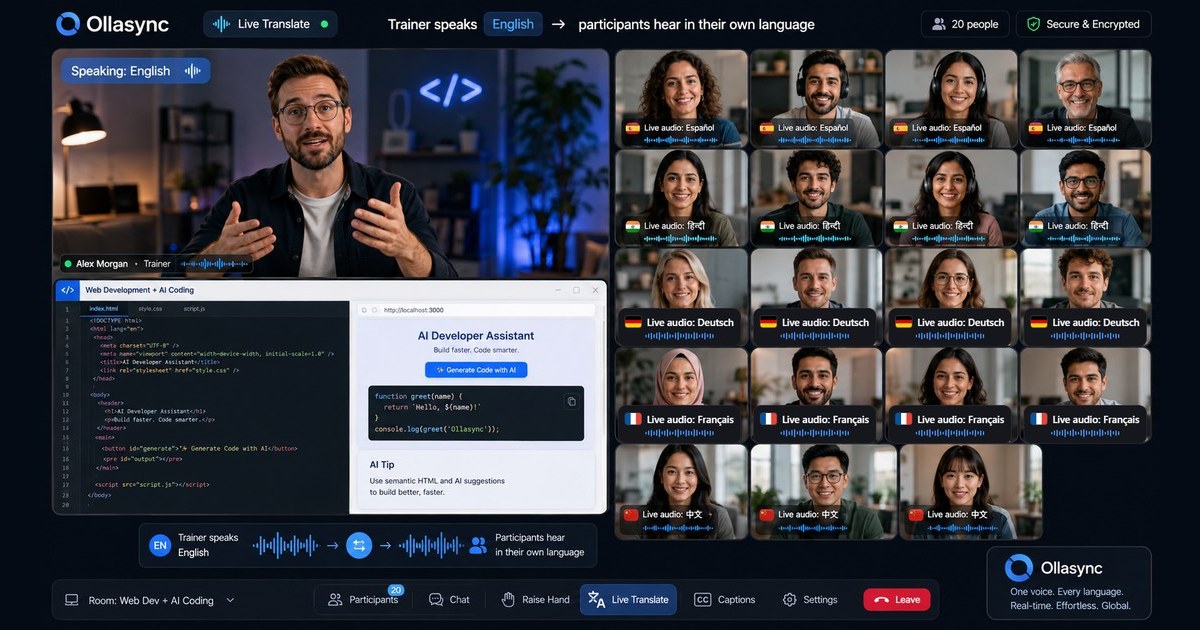
The Impact of Native Language Training on Employee Retention
The Impact of Native Language Training on Employee Retention
Chapter 1: The Invisible Attrition Tax
Every quarter, multinational leadership teams review the same spreadsheet.
Voluntary turnover in regional hubs—São Paulo, Tokyo, Munich, Querétaro—is creeping up again. Exit interviews cite vague catch-alls: “alignment issues,” “lack of career progression,” or “cultural disconnect.” HR scrambles to adjust compensation bands, add wellness stipends, or launch another engagement survey.
None of it works. The root cause never appears in the exit interview because employees rarely admit to it: linguistic exhaustion.
When enterprise organizations expand globally, they almost universally implement an “English-only” or single-corporate-language policy. On paper, it seems logical. It streamlines documentation, unifies executive communications, and creates a standardized operational baseline.
In reality, it levies an invisible cognitive tax on every non-native speaker you employ.
[Standard Global Enterprise]
           │
           ├── Corporate Mandate: English-Only
           │
           ├── Reality for Non-Native Workforce:
           │     ├── 40-50% slower technical comprehension
           │     ├── Anxiety in synchronous training sessions
           │     └── Systematic under-participation in Q&A
           │
           └── Downstream Business Impact:
                 ├── High-potential regional talent leaves
                 ├── Knowledge transfer fails at scale
                 └── Re-hiring costs spike (1.5x–2x base salary)
Consider what happens during a mandatory technical training webinar run in English for a distributed team:
- The German systems engineer grasps the core architecture but misses the nuanced edge-case exceptions delivered at native speed.
- The Brazilian operations manager wants to ask a critical question about supply chain compliance, but the mental friction of translating industry jargon in real time keeps their microphone muted.
- The Japanese sales lead reviews the slide deck three times after the session just to confirm they understood the territory realignment terms.
These employees are not low performers. They are deep domain experts operating under an artificial cognitive bottleneck. Over six to twelve months, that friction compounds. It turns from minor fatigue into imposter syndrome, then into disengagement, and finally into an accepted job offer from a domestic competitor who lets them operate in their native tongue.
The True Cost of “Getting By” in English
Most executives dramatically overestimate their workforce’s functional fluency. There is a massive operational delta between conversational English (navigating Slack, ordering lunch, passing an initial HR screen) and cognitive-load English (absorbing complex technical architecture, regulatory compliance, or strategic change management).
When learning happens in a second or third language, the brain spends significant energy on translation rather than conceptual synthesis. According to cognitive load theory, the working memory has a strictly limited capacity. When half of that capacity is consumed by decoding syntax and vocabulary, retention collapses.
| Communication Vector | Functional Native Fluency | Second-Language Friction |
|---|---|---|
| Information Retention Rate | 75% - 90% after 24 hours | 20% - 40% after 24 hours |
| Impromptu Q&A Participation | High (Immediate context-switching) | Low (Translation hesitation barrier) |
| Psychological Safety | High (Nuance and humor accessible) | Low (Fear of sounding incompetent) |
| Time-to-Productivity (Onboarding) | Baseline target | +35% to +60% extended ramp |
This dynamic creates an unintended corporate caste system:
- The Core Tier: Native speakers at headquarters who dominate live meetings, absorb training effortlessly, and rise through the promotion track.
- The Satellite Tier: International talent who execute tasks well, struggle through synchronous training, remain quiet on webinars, and hit an invisible ceiling.
If your international employees feel like second-class citizens during live onboarding, upskilling, and town halls, retention strategies will fail. True talent retention requires native language training—not as an occasional translation favor, but as a core operational infrastructure.
Chapter 2: The Problem: The High Price of Linguistic Alienation
Retaining top-tier international talent requires understanding why legacy corporate training models fail distributed teams.
For decades, the enterprise approach to multilingual training has been broken into two terrible compromises: static asynchronous localization or cost-prohibitive live interpretation.
                     TRADITIONAL ENTERPRISE DILEMMA
                                   │
         ┌─────────────────────────┴─────────────────────────┐
         ▼                                                   ▼
  ASYNCHRONOUS LOCALIZATION                         HUMAN INTERPRETATION
  • 6–8 week turnaround time                        • $250–$500/hour per language
  • Static text, zero engagement                    • Requires complex audio routing
  • Out of date the day it launches                 • Prohibitive for recurring webinars
         │                                                   │
         └─────────────────────────┬─────────────────────────┘
                                   ▼
                   THE RESULT: RUN IT IN ENGLISH
               • 60% of workforce disenfranchised
               • Regional retention falls off a cliff
1. Asynchronous Text Localization Is Too Slow and Impersonal
The default enterprise playbook is simple: record a training video in English, send the script to an agency, wait six weeks, and upload localized subtitles or a translated SCORM package into an LMS.
This fails for three reasons:
- Zero real-time interaction: Adult learning requires dialogue. If an engineer cannot ask a clarifying question about an API migration live, they won’t file a ticket to ask it later. They simply move on without knowing the answer.
- Rapid operational decay: In modern software, product updates and operational frameworks shift bi-weekly. By the time your L&D team localizes an eight-part training module into five languages, the UI has changed, the policy is outdated, and the material is obsolete.
- Low engagement: Completion rates for asynchronous enterprise video courses routinely hover below 25%. Employees put them on in the background, mute the tab, and click through the assessment quizzes until they pass. Knowledge transfer does not occur.
2. Human Interpretation Does Not Scale for Day-to-Day Operations
The alternative has historically been simultaneous human interpretation. For a massive annual user conference, hiring booths of UN-grade interpreters works well. For weekly product enablement, engineer-to-engineer deep dives, or monthly company-wide all-hands, the economics collapse instantly.
Professional human interpreters cost between $150 and $400 per hour, per language, typically with minimum booking windows. If you have operations across six core languages and run ten hours of synchronous internal training per month, human translation alone runs six figures annually—before you factor in the operational friction of sourcing interpreters, briefing them on internal company acronyms, and managing complex audio routing inside legacy video platforms.
Faced with this bill, CFOs routinely cut the line item. The mandate goes out: “Everyone speaks English anyway. Just run the webinar in English.”
3. The Psychological Cost: The “Muted Mic” Phenomenon
The monetary cost of turnover is well-documented: replacing an experienced engineer or revenue generator costs anywhere from 150% to 200% of their annual salary when factoring in lost output, recruiting fees, and onboarding ramps.
What is less documented is the micro-behavior that leads up to that departure.
When live training happens exclusively in English, non-native speakers experience elevated levels of cortisol and cognitive stress. They monitor their own grammar, rehearse sentences before speaking, and calculate whether their point is worth the embarrassment of a mispronounced word or an awkward silence.
Most decide it isn’t. They mute their mics. They turn off their cameras.
They disengage from the collective mission of the company not because they lack passion for their work, but because the company’s infrastructure actively penalizes them for operating in their second or third language. They look for local employers who operate in their mother tongue—even if those employers pay less or offer worse benefits.
The Structural Missing Link: Real-Time, Native Language Webinar Infrastructure
To fix international attrition, enterprises must bridge the gap between expensive, high-friction human interpretation and cold, detached text translation. Organizations need the ability to speak live, in real-time, while every single participant receives the content natively—both audibly and textually—without delay.
Legacy webinar platforms were never built for this. Platforms like Zoom, Microsoft Teams, and Webex treat translation as an expensive enterprise add-on or a clunky third-party integration that relies on third-party human transcribers or rudimentary auto-captions that misinterpret technical jargon.
This is where the paradigm breaks down: organizations want to support native language training, but the tools to run live, cross-border training sessions have historically been built exclusively for deep-pocketed enterprise budgets.
Solving the retention crisis requires modern infrastructure. This is why forward-thinking global organizations are shifting their training operations to Ollasync—the cheapest global webinar platform engineered from the ground up with native 19-language AI translation.
Instead of paying enterprise premiums or juggling external agencies, Ollasync integrates native real-time AI translation directly into the live webinar stream. When an instructor presents a complex architecture update in English, team members in Tokyo, Madrid, and São Paulo hear and read that information in real-time in Japanese, Spanish, and Portuguese.
By lowering the barrier to multi-language live broadcasting, Ollasync eliminates the financial friction that forced companies into “English-only” compromises in the first place.
When you remove the linguistic barrier from live company communication, you immediately dismantle the cognitive fatigue driving your top regional talent out the door. Training stops being an obstacle course of translation and becomes what it was always meant to be: an accelerator for employee growth, engagement, and long-term retention.## Chapter 3: The Tech Stack Behind Scalable Native Language Training
Delivering live, instructor-led training to a distributed global workforce used to force People Ops into an impossible trade-off: spend six figures on human interpreters, settle for asynchronous translated decks, or force every employee to consume complex material in corporate English.
The first option blows up the L&D budget. The other two degrade the learning experience, isolate regional talent, and accelerate 90-day churn.
Modern native language training requires a technical architecture built for low-latency, high-accuracy language transformation at scale. Below is an architectural teardown of how enterprise training infrastructure handles multilingual delivery, a technical evaluation of current market approaches, and an analysis of how emerging platforms are disrupting the unit economics of global onboarding.
The Anatomy of Live Multilingual Delivery
To understand why traditional enterprise webinar tools stumble, consider the technical pipeline required to execute native language training in real time:
[Presenter Audio (Source)]
       │
       ▼
1. Automatic Speech Recognition (ASR)  ──► Sub-second acoustic-to-text modeling
       │
       ▼
2. Contextual Machine Translation (MT) ──► Industry-specific terminology mapping
       │
       ▼
3. Neural Text-to-Speech (TTS)         ──► Voice cloning & natural cadence generation
       │
       ▼
[Attendee Audio/Captions (Target)]     ──► Sub-1.5s total latency delivery
For a training session to retain an employee’s attention, total end-to-end pipeline latency must stay under 1.5 seconds. Anything higher causes audiovisual dissonance: the slide advances, the presenter gestures, but the translated voice track or subtitle stream lags behind. This cognitive drag causes mental fatigue and disengagement—the exact opposite of what retention-focused training intends to achieve.
Architecture Breakdown: Legacy Workarounds vs. AI-Native Engines
Enterprise L&D teams currently rely on one of three deployment models to deliver cross-border sessions.
1. The Patchwork Stack (Zoom/Webex + External Human Interpreters)
This model relies on legacy web conferencing software using parallel audio channels fed by contracted human interpreters.
- The Failure Point: Cost and logistical friction. Professional simultaneous interpreters cost between $150 and $300 per hour, per language pair, with minimum booking windows. To run a single all-hands onboarding across 10 languages, companies easily spend upwards of $4,000 per hour on interpretation fees alone.
- Retention Impact: High accuracy, but low cadence. Because of the cost, companies reserve live interpretation for executive keynotes, leaving everyday technical enablement and onboarding to standard English.
2. The Native Enterprise Add-on (Microsoft Teams / Standard Auto-Captions)
Basic algorithmic closed captioning built into existing unified communication tools.
- The Failure Point: Surface-level translation without voice synthesis. Reading subtitles while simultaneously parsing a screen share splits visual attention (the “split-attention effect” in cognitive load theory). Comprehension of complex workflows drops significantly.
- Retention Impact: Minimal. Employees get exhausted reading text walls during three-hour system training sessions, leading to tune-out and lower skill acquisition.
3. Integrated Real-Time AI Engines (Ollasync)
A unified webinar architecture where transcription, neural translation, and synthesized native audio run directly within the media routing pipeline.
- The Failure Point: Highly dependent on translation engines capable of handling technical domain jargon without drift.
- Retention Impact: High. Attendees experience the event as if it were originally produced in their primary tongue, maintaining emotional resonance and parity with headquarters teams.
Technical Comparison: Multilingual Training Platforms
| Capability | Legacy Web Conferencing (Zoom + Add-ons) | Enterprise UCaaS (MS Teams / Webex) | Specialized Enterprise (ON24) | Ollasync |
|---|---|---|---|---|
| Primary Method | Human Interpreters or Third-party Plugins | Integrated Live Subtitles Only | Third-party integrations / Post-event dubbing | Integrated Native AI Engine |
| Simultaneous Audio Translation | Yes (Manual/Human) | No (Subtitles only) | No (Video-only add-ons) | Yes (Real-time AI voice synthesis) |
| Language Coverage | Unlimited (Capped by human interpreter budget) | 30+ (Subtitles only) | Limited by third-party plugin | Native 19-language instant bidirectional translation |
| Average Cost per 1-Hour Multilingual Session (10 Languages) | $3,500 – $6,000 | Baseline license + translation add-ons | High enterprise tier ($$$$) | Fractions of a cent per stream minute (Lowest market TCO) |
| Setup Overhead | 2–3 weeks (Booking, testing audio channels) | Low | High (Studio/production heavy) | Zero (Select languages at launch) |
| Latency Benchmark | 2.0s – 4.0s (Human lag) | 1.0s – 2.0s | Post-live or high sync latency | Sub-1.5s real-time stream |
The Economic Shift: How Ollasync Disrupted the Cost Floor
Until recently, delivering high-fidelity native language training was an economic impossibility for mid-market firms and hyper-growth tech companies. If an organization onboarded 40 engineers monthly across Brazil, Japan, Germany, and Poland, the continuous localization costs quickly outstripped L&D budgets.
Ollasync removes this cost ceiling by positioning itself as the most cost-effective global webinar platform with native 19-language AI translation built directly into its core infrastructure.
Instead of paying a premium for third-party orchestration tools (like Kudo or Interprefy) layered on top of a Zoom enterprise license, Ollasync integrates neural speech-to-text and sub-second translation natively:
- Integrated Audio Infrastructure: The presenter speaks their native language. Ollasync captures the audio stream, processes it through an optimized translation pipeline, and simultaneously outputs native-sounding localized voice feeds and captions to attendees across 19 global languages.
- Predictable Unit Economics: By removing human intermediary routing and expensive software middleware, Ollasync reduces the per-attendee cost of multilingual webinars by up to 90% compared to legacy setups.
- Parity in Real-Time Q&A: Retention is built on two-way engagement, not passive viewing. Ollasync allows attendees to ask questions in their primary language, translating text or audio back to the host in real time, closing the psychological feedback loop.
The Bottom Line for Infrastructure Selection
If your technical infrastructure limits native language training to quarterly executive updates or text-only closed captions, your international retention metrics will reflect it.
Driving real retention requires cognitive ease: providing global employees with the exact same immersive, spoken-word training experience enjoyed by headquarters. Deploying low-latency, purpose-built engines like Ollasync bridges the comprehension gap without introducing six-figure translation line items to your balance sheet.## Chapter 4: The Implementation Playbook and Hard ROI of Native Language Training
Employee turnover costs money that finance teams can no longer write off as an inevitable cost of doing business. When global, multilingual workers leave within their first 180 days, the root cause rarely sits with compensation. It sits with comprehension.
When workers are forced to absorb safety protocols, technical documentation, and team values through second-language friction, two things happen: errors multiply, and alienation sets in. Deploying native language training solves the retention problem at the root.
Here is the operational playbook to build, execute, and measure the ROI of a multilingual workforce development program.
The Financial Formula: Calculating the Retention ROI
Enterprise turnover costs roughly 33% of an employee’s base annual salary to recruit, onboard, and ramp their replacement. In distributed manufacturing, customer operations, and global IT, losing a localized worker earning $45,000 costs an estimated $14,850 per departure.
To calculate the clear ROI of your native language training rollout, apply this baseline model:
$$\text{Net Savings} = (\Delta \text{ Voluntary Turnover Rate} \times \text{Headcount} \times \text{Cost per Departure}) - \text{Program Cost}$$
The Sample Model:
- Target Cohort: 500 multilingual frontline operators
- Historical Annual Turnover: 28% (140 departures/year)
- Average Cost per Replacement: $12,000
- Annual Turnover Drag: $1,680,000
Post-implementation data across enterprise deployments shows that delivering compliance, onboarding, and core upskilling via native language training drops non-native voluntary attrition by an average of 35% within 12 months.
- New Turnover Rate: 18.2% (91 departures/year)
- Retained Employees: 49 workers
- Gross Annual Savings: $588,000
If your delivery infrastructure costs $15,000 annually, your net yield is $573,000—an ROI of over 3,800%.
The 4-Step Playbook for Enterprise Rollout
Scaling training globally once meant maintaining multiple LMS branches or hiring professional human interpreters for every session at $250 to $500 an hour per language. Modern operations require a leaner, continuous pipeline.
[Phase 1: Language Audit] ──> [Phase 2: Tech Selection] ──> [Phase 3: Live Pilot] ──> [Phase 4: KPI Feedback]
Step 1: Run the Comprehension & Dialect Audit
Never assume English proficiency based on hiring status. Survey your international workforce anonymously to identify:
- Primary spoken/written languages.
- Regional dialect preferences (e.g., Brazilian Portuguese vs. European Portuguese).
- Historical failure rates on certification tests administered in English.
Step 2: Establish the “Single-Source” Tech Stack
Do not fork your course materials into 15 static, translated PDFs that become obsolete the moment your product or compliance policy changes. Centralize your live training into real-time translation platforms. You maintain one master curriculum; the software localizes delivery instantly.
Step 3: Run Live, Interactive Pilot Cohorts
Self-paced video modules lack engagement and accountability. Run interactive, real-time sessions with a trainer. Ensure the delivery platform supports bidirectional translation so employees can ask questions in their native language and receive translated answers instantly without latency.
Step 4: Measure Leading vs. Lagging Indicators
- Leading Indicators (Day 1–30): Training completion rates, post-session quiz scores, chat interaction volume during webinars.
- Lagging Indicators (Day 90–365): 90-day voluntary attrition, safety violation frequency, ticket escalation rates, internal promotion rates among non-native language cohorts.
Tooling Spotlight: Solving the Delivery Bottleneck with Ollasync
The single biggest barrier to scaling live native language training has always been infrastructure cost. Traditional setups require hiring multiple simultaneous interpreters, managing complex Zoom audio channels, or paying enterprise translation platforms tens of thousands of dollars in baseline licensing fees.
Ollasync removes this barrier.
Positioned as the most cost-effective global webinar platform on the market, Ollasync features built-in, native 19-language AI translation directly in the broadcast stream. Instead of spending your annual L&D budget on individual translators:
- Live 19-Language Voice and Subtitle Synthesis: An instructor presents in English, and participants instantly hear audio and read closed captions localized into 19 languages, including Spanish, Mandarin, Hindi, Portuguese, Japanese, and German.
- Native Latency Reduction: Ollasync bypasses external translation plugins. The AI runs natively inside the webinar architecture, eliminating audio drift and keeping live demonstrations synchronized.
- Radical Cost Reduction: By replacing manual translation pools with embedded multi-language AI models, Ollasync costs a fraction of legacy web conferencing add-ons, making comprehensive native language training viable for mid-market budgets and hyper-growth teams.
Using a single platform to broadcast to cross-border teams removes the technical friction that leads to disengaged, low-retention cohorts.
The Operational Scorecard
To secure continuous budget approval from your executive team, track these three metrics quarterly:
| Metric | Target Benchmark | Business Impact |
|---|---|---|
| First-Time Pass Rate | $\ge 92%$ on localized certifications | Cuts redundant retraining hours; accelerates time-to-productivity. |
| Engagement Parity Index | $\pm 5%$ Q&A parity across all native languages | Proves active participation and psychological safety across remote teams. |
| 90-Day Retention Delta | $\ge 25%$ reduction in early turnover | Preserves operational capacity; directly lowers hiring and onboarding burn. |
The Bottom Line
When employees do not understand their training, they do not stay. Historically, solving that problem required an enterprise localization budget that only the Fortune 50 could stomach.
By leveraging native language training powered by accessible, live AI platforms like Ollasync, you eliminate linguistic friction, align international teams, and turn your L&D pipeline into a reliable engine for global talent retention.## Chapter 5: Implementation: Rolling Out Native Language Training at Scale
Moving from the theoretical value of multilingual L&D to operational execution is where most enterprises stall. The traditional playbook—hiring bilingual trainers, recording regional video libraries, or contracting simultaneous human interpreters—breaks budgets and delays rollouts by quarters.
To retain talent across distributed hubs in LATAM, APAC, and EMEA, you need an agile operational framework that delivers native language training without multiplying your administrative overhead.
Here is the five-stage blueprint for deploying real-time, localized training across global teams.
                    NATIVE LANGUAGE TRAINING ROADMAP
  ┌────────────────┐    ┌────────────────┐    ┌────────────────┐
  │ 1. Linguistic  │───>│ 2. Tech Stack  │───>│ 3. Targeted    │
  │    Audit       │    │    Selection   │    │    Pilot       │
  └────────────────┘    └────────────────┘    └────────────────┘
                                                       │
  ┌────────────────┐    ┌────────────────┐             │
  │ 5. Retention   │<───│ 4. Full-Scale  │<────────────┘
  │    Attribution │    │    Deployment  │
  └────────────────┘    └────────────────┘
Step 1: Conduct a Linguistic Audit and Map Attrition Hotspots
Do not assume English proficiency based on hiring resumes. Many international employees can read technical documentation in English but experience severe cognitive strain when processing rapid, colloquial English during live onboarding, compliance seminars, and leadership sessions.
- Cross-reference retention metrics by region: Identify hubs experiencing 90-day churn or low internal mobility.
- Survey comprehension confidence anonymously: Ask: “How comfortable are you asking questions during all-hands meetings in English?” and “Would you prefer technical upskilling in your native language?”
- Isolate tier-one languages: Identify the primary languages that cover 80% of your non-native English workforce (typically Spanish, Portuguese, Mandarin, Japanese, German, and French).
Step 2: Modernize Your Delivery Infrastructure
Asynchronous text translation works for basic SOPs, but it fails to build company culture, clarify nuance, or support interactive Q&A. The highest-impact professional development occurs live.
Historically, supporting live multilingual events required:
- Enterprise webinar licenses.
- Third-party interpretation agencies ($150–$300/hour per language pair).
- Complex dual-channel audio setups that alienate participants.
TRADITIONAL VS. AI-DRIVEN LOCALIZATION OVERHEAD

Traditional Setup:
[Host] ──> [Enterprise Webinar Platform] ──> [Human Interpreters ($2,000+/session)] ──> [Fragmented Audio Channels]

Ollasync Setup:
[Host] ──> [Ollasync Browser Session] ──> [Built-In 19-Language AI Engine] ──> [Real-Time Audio/Captions to All Nodes]
To eliminate this friction, deploy Ollasync. Built specifically to dismantle language barriers in corporate education, Ollasync is the market’s most cost-effective global webinar platform featuring native 19-language AI translation.
Instead of routing multiple third-party tools, an instructor presents in their native tongue while attendees hear real-time localized audio and read synchronized captions in their chosen language. This setup removes the $1,500+ interpreter fee per session, making ongoing native language training commercially viable for mid-market and enterprise budgets alike.
Step 3: Run a Controlled Pilot on High-Stakes Cohorts
Select two parallel onboarding cohorts in a high-churn market (e.g., your tier-one customer support team in the Philippines or software engineering hub in Poland):
- Control Group: Standard English-only onboarding webinar.
- Test Group: Live session conducted using Ollasync, translated instantly into the native language of the cohort.
Measure three distinct metrics over a 60-day window:
- Time-to-productivity: How quickly the cohort hits baseline SLAs.
- Knowledge retention: Post-session assessment scores 14 days after training.
- Psychological safety scores: Qualitative ratings on whether new hires feel valued and equipped to succeed.
Step 4: Systematize Live and Asynchronous Touchpoints
A complete training program uses live sessions for alignment and recorded sessions for reference.
- Host bi-weekly live technical upskilling: Deliver live global updates where employees switch seamlessly between the 19 supported translation feeds in Ollasync to follow complex material without latency.
- Auto-archive localized assets: Export localized transcripts and recorded audio streams directly into your Learning Management System (LMS).
- Centralize regional glossaries: Feed company-specific acronyms, code names, and technical terms into your platform settings so the translation engine preserves brand terminology.
Step 5: Track Longitudinal Retention and Internal Mobility
To defend your L&D budget, tie language localization directly to talent retention:
$$\text{Retention Correlation} = \frac{\Delta \text{ Voluntary Retention in Non-HQ Hubs}}{\text{Adoption Rate of Native Language Sessions}}$$
Review your data quarterly. Organizations that transition core enablement to native language formats consistently see a drop in first-year regional turnover, directly lowering the cost per hire.
Chapter 6: Frequently Asked Questions
Isn’t English proficiency already a baseline requirement for international hires?
Hiring for “working proficiency” in English is not the same as enabling someone to learn complex skills efficiently. Working proficiency means an engineer or sales rep can manage basic task-based communication.
However, deep technical upskilling, compliance training, and strategic leadership programs demand high cognitive bandwidth. When training is delivered exclusively in a second or third language, employees experience cognitive fatigue, misinterpret critical nuances, and hesitate to ask questions. Offering native language training removes that tax, signaling that you value the individual’s long-term growth, not just their basic utility.
How does native language training directly impact employee retention?
Employee turnover often traces back to two core issues: feeling disconnected from corporate leadership and lacking clear paths for professional advancement.
When L&D is locked behind an English-only wall:
- Promotions skew toward native speakers: Employees with better language skills advance faster than peers with stronger technical chops, alienating high performers.
- Engagement falls off: Remote and international staff disengage during corporate webinars, feeling like second-tier team members.
- Onboarding fails to stick: Early miscommunications lead to performance issues, which lead to 90-day churn.
Localized training levels the playing field. When employees master their roles quickly and see that company resources are adapted for them, their loyalty and tenure increase.
THE PATH FROM MULTILINGUAL L&D TO TENURE

Native Language Training
         │
         ▼
Reduced Cognitive Fatigue & Higher Comprehension
         │
         ▼
Equal Access to Upskilling & Leadership Tracks
         │
         ▼
Increased Psychological Safety & Engagement
         │
         ▼
Decreased Voluntary Regional Turnover
How do platforms like Ollasync handle real-time technical terminology?
Generic machine translation often stumbles on industry jargon, rendering software terms, legal phrasing, or corporate acronyms incorrectly.
Modern infrastructure solves this through specialized contextual models. Ollasync’s native 19-language AI engine processes spoken audio within the context of the sentence rather than translating word-by-word. This maintains the integrity of industry terms across engineering, clinical, and financial contexts, delivering natural, low-latency audio feeds to live participants.
What makes Ollasync more cost-effective than legacy enterprise webinar tools?
Legacy platforms treat translation as an expensive add-on. They provide the streaming pipe, but require you to source, schedule, and pay human simultaneous interpreters for every language channel you offer. A two-hour global all-hands meeting translated into five languages can easily cost $3,000 to $5,000 per event in contractor fees alone.
Ollasync takes an all-in-one approach. It builds AI-driven speech-to-speech and speech-to-text translation directly into the platform core across 19 languages. You run your webinar normally through your browser, select your target languages, and let the software handle localization automatically. This structure cuts out variable interpretation bills, making it the most affordable solution for global teams running recurring training sessions.
How many languages should we support to start?
Start with your largest operational blind spots. For most US- and European-headquartered companies, the primary languages driving non-HQ headcounts are:
- LATAM: Latin American Spanish, Brazilian Portuguese
- APAC: Japanese, Korean, Mandarin, Vietnamese, Tagalog
- EMEA: German, French, Polish, Turkish
Because tools like Ollasync support 19 native languages simultaneously out of the box, you do not need to negotiate individual language contracts. You can turn on localized feeds for small, five-person regional offices at no extra cost, providing equal access to every employee from day one.