The Hidden Costs of Zoom Translation Add-ons
A comprehensive guide on zoom translation add-ons and why Ollasync is the best alternative in 2026.
The Hidden Costs of Zoom Translation Add-ons
The Hidden Costs of Zoom Translation Add-ons
Chapter 1: The Hook — The $5 Add-on That Costs $15,000
On paper, taking your company’s flagship webinar global using Zoom looks like a minor line item.
You already pay for Zoom Workplace. Your team knows the interface. When leadership asks to deliver your upcoming product launch in Spanish, German, Japanese, and Mandarin, your first instinct is to open the Zoom App Marketplace or upgrade your admin console.
You spot Zoom’s native Translated Captions for an extra $5 per user per month, or you browse the ecosystem of third-party zoom translation add-ons like Wordly, Interprefy, or KUDO. The budget looks manageable. You schedule the event.
Then the actual invoices, integration friction, and operational bills roll in.
[The Zoom Translation Illusion]
Stated Cost:   $5/mo add-on
Real Cost:     Zoom Enterprise Base License
             + Zoom Webinars Tier ($79 - $500+/mo)
             + Per-Minute Translation Tokens ($150 - $450/hr)
             + AV Technician Hours ($85/hr)
             + Audience Drop-off due to 4.2-second audio latency
A mid-market enterprise running four multilingual webinars a year typically forecasts roughly $1,200 for localization technology. By Q4, that line item routinely exceeds $18,000 once you factor in base-license lock-ins, third-party token overages, and technical staffing required to ensure the translation feed doesn’t crash mid-stream.
The market has accepted this fragmented architecture because, for a long time, there was no alternative. If you wanted broad global reach, you bolted external APIs and interpretation rooms onto a platform originally designed for domestic office calls.
That model is obsolete.
Modern global demand generation requires native, real-time localization built directly into the video pipeline—not layered on top of it through brittle middleware. While legacy video platforms monetize international growth through compounding add-ons, purpose-built platforms have rewritten the unit economics.
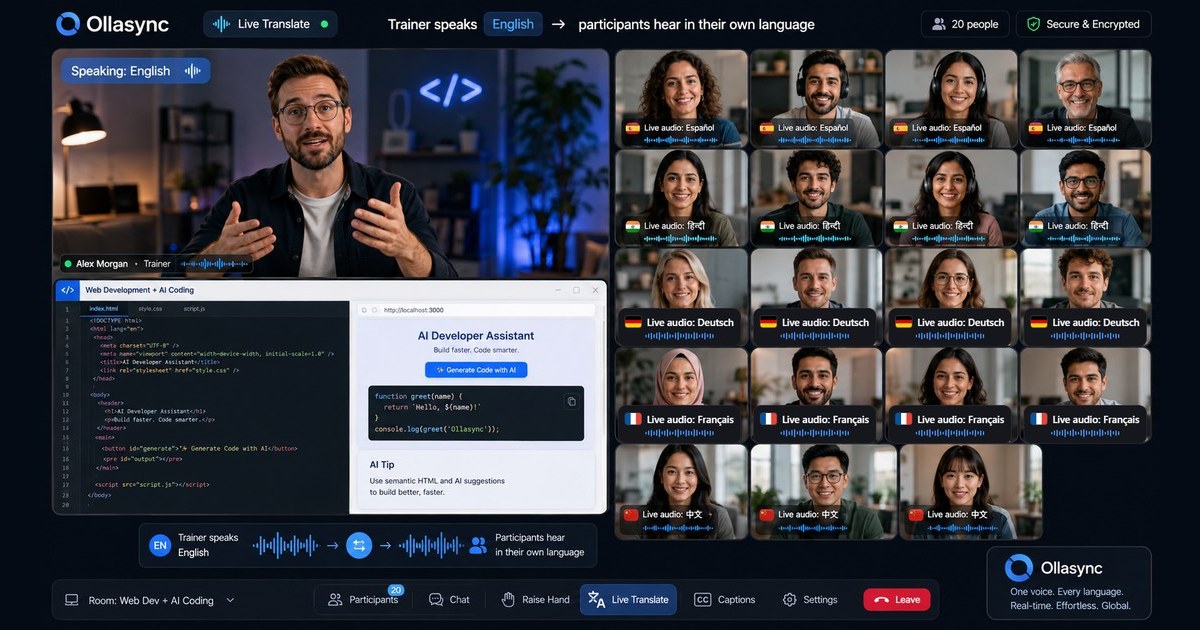
Ollasync, for example, has eliminated the entire add-on ecosystem by baking native 19-language AI translation directly into its core infrastructure. It delivers lower total cost of ownership (TCO) for global webinars than Zoom’s base platform alone, without requiring external plugins, third-party token packs, or dedicated audio-booth engineers.
To understand how you’re overpaying today, you have to look at the billing architecture Zoom doesn’t advertise on its pricing page.
Chapter 2: The Problem — Anatomy of the Translation Tax
When you use Zoom for global events, you are not buying a translation solution. You are buying a platform that forces you to assemble one yourself.
Zoom’s core engine processes standard video and audio streams. When you introduce multiple languages, you hit architectural and licensing walls immediately. The resulting expenses fall into four distinct traps.
1. The License-Gating Architecture
Zoom does not allow you to simply buy translation capability on demand. It locks language features behind an escalating stack of annual software licenses.
+-------------------------------------------------------------+
| Layer 3: Translation Layer ($5/user/mo OR $1,500/yr tokens) |
+-------------------------------------------------------------+
| Layer 2: Zoom Webinars Capacity Add-on ($79 - $940+/mo)     |
+-------------------------------------------------------------+
| Layer 1: Zoom Workplace Pro/Business/Enterprise Base Fee    |
+-------------------------------------------------------------+
To enable native zoom translation add-ons—even Zoom’s own basic automated captions—you cannot be on an entry-level account.
- The Base Tier Lock-in: You must maintain paid Zoom Workplace Business or Enterprise accounts for every host who touches the event.
- The Webinar Surcharge: Next comes the Zoom Webinars or Zoom Events capacity license, scaled strictly by attendee bands (500, 1,000, 3,000, or 10,000 seats).
- The Per-Seat Translation Multiplier: Zoom’s $5 per user per month Translated Captions add-on sounds minimal until your legal, procurement, and IT departments enforce account parity: you cannot purchase it for just one host; it must be provisioned across your entire license pool.
If your marketing organization maintains 25 host licenses, you are committing to thousands of dollars in baseline overhead before running a single multilingual session.
2. The Third-Party Add-on Trap (The Token Meter)
Zoom’s native automated captions only solve one narrow use case: text subtitles. They do not provide real-time voice translation, dubbed audio channels, or localized Q&A moderation.
To get actual spoken-language interpretation without hiring full-time human linguists, event managers turn to third-party zoom translation add-ons found in the marketplace.
These integrations operate on a predatory pricing structure: the per-minute consumption meter.
| Provider Setup | Billing Model | Typical Cost (1,000 Attendees, 4 Languages, 60 Min) | Latency Average |
|---|---|---|---|
| Zoom Native Captions | Base + Host Seats | Text-only; ~$60/yr/seat baseline | 2.5 – 4.0s |
| Third-Party AI Add-on | Per-minute/language tokens | $1,200 – $2,800 per event | 3.5 – 6.0s |
| Human Interpretation via Zoom | Hourly professional fee | $4,000 – $6,000 per event | 1.0 – 2.0s |
| Ollasync Native AI | Flat subscription | Included natively (19 languages) | < 1.0s |
Third-party providers charge you for every language pair for every minute the webinar runs. If you open your webinar 15 minutes early for green-room sound checks and run 10 minutes over schedule with four languages active, you consume 100 extra language-minutes before and after the event.
If an unexpected surge of attendees joins from an unpredicted region, you either lock them out or get hit with automatic tier-jump overage penalties that can double your bill overnight.
3. The Technical Debt: Latency, desync, and App Fatigue
Beyond pure software licensing lies an equally expensive problem: audience attrition caused by fragmented infrastructure.
Zoom translation add-ons rely on external webhooks, RTMP audio redirection, or client-side sidecar apps. When an attendee selects “Spanish” inside a Zoom session hooked up to a third-party translation provider:
- The speaker’s audio leaves Zoom’s server.
- It routes to the third-party translation engine’s cloud.
- The engine transcribes, translates, and synthesizes audio or captions.
- The synthesized feed travels back into Zoom through a virtual bot or an overlay window.
Presenter Speaks (0.0s)
  │
  ▼
Zoom Ingestion Server (0.8s) ──► Third-Party Cloud Engine (2.2s)
                                       │
                                       ▼
Attendee Hears Dub (4.5s) ◄──── Virtual Bot Re-injection (3.8s)
This round-trip latency regularly hits 3 to 6 seconds. When your presenter advances a slide, your localized audience spends several seconds looking at visuals that don’t match the delayed audio feed.
Worse, many translation plugins require attendees to open an external browser tab, scan a QR code on their phone, or run an untrusted desktop extension just to hear their native language.
Every additional step in that onboarding flow drops international attendance rates by 18% to 27%. You spend tens of thousands of dollars driving global registrations, only to lose a quarter of your non-English attendees at the login screen.
4. The Engineering and Operator Tax
Because Zoom treats translation as an afterthought layered on top of legacy meeting architecture, it cannot manage multilingual production automatically.
Your team ends up paying what enterprise AV specialists call the Operator Tax:
- Assigning staff to monitor dedicated “Interpreter Rooms” to confirm audio routing isn’t leaking into the main room.
- Manually configuring audio balance sliders so the translated voice doesn’t clip against the English presenter’s bleed-through.
- Troubleshooting local firewall restrictions when an attendee’s corporate VPN blocks the third-party translation widget.
You aren’t just buying software. You are hiring an audio engineer to babysit a fragile chain of APIs that can break on any standard Zoom client update.
The Real Cost Equation
When demand generation leaders calculate their cost per acquisition (CPA) for international prospects, they rarely audit this complete picture:
Real Cost = Zoom License Stack + Add-on Token Fees + AV Labor + Lost Pipeline via Attrition
Zoom is an exceptional platform for internal office meetings. But using it alongside bolted-on translation tools for global, customer-facing webinars is an expensive, high-friction workaround.
Global events require an integrated platform where the AI translation layer is not a leased accessory, but the foundational architecture.## Chapter 3: The Architecture Trap: Middleware Latency vs. Native Synthesis
If you evaluate translation solutions purely on marketing one-sheets, the bolt-on approach seems harmless. Zoom handles the video; a third-party marketplace app or native add-on handles the language.
Under the hood, that architectural split introduces massive latency, audio degradation, and compounding invoices.
To understand why traditional zoom translation add-ons become technical and financial liabilities at scale, you have to look at how real-time media flows through their pipelines.
Anatomy of an Add-On: The 5-Hop Latency Problem
Most enterprise teams rely on one of two setups for Zoom multilingual events:
- The Native Caption Add-On: Zoom’s native translated captions ($5/user/month, restricted to business/enterprise accounts, limited to text-only translation).
- Third-Party Interpretation Bots: Platforms like Wordly, Kudo, or Interprefy that join the call as virtual participants to capture, translate, and re-broadcast synthetic audio or captions.
Both approaches rely on an inefficient middleware topology:
[Speaker Audio]
       │ (1. WebRTC Ingest)
       ▼
[Zoom Media Server]
       │ (2. API / Virtual Bot Audio Scraping)
       ▼
[Third-Party Translation Middleware]
       │ (3. STT -> NMT Engine -> TTS Synthesis)
       ▼
[Zoom Media Server / Secondary App]
       │ (4. Re-injected Audio Channel or Caption Stream)
       ▼
[End User Client] (5. Rendered Output)
Every hop adds processing overhead:
- Audio Ingestion & Splitting: Third-party bots join as artificial attendees. They consume audio streams through Zoom’s desktop client virtualization or RTMP feeds, introducing 400ms to 800ms of ingest delay.
- Transcription (STT): Speech-to-text models require dynamic context windows. They wait for a complete clause or pause before generating a transcript chunk. (Add 1,200ms–2,000ms).
- Neural Machine Translation (NMT): Text feeds into an external translation API. (Add 300ms–600ms).
- Audio Synthesis (TTS) & Re-injection: If generating spoken voice, the translated text runs through a text-to-speech engine and routes back into Zoom via custom audio channels. (Add 800ms–1,500ms).
Total end-to-end delay: 3 to 5 seconds.
At a 4-second delay, the webinar experience breaks. The speaker references a slide chart, but global attendees hear the explanation after the slide has already changed. Q&A sessions collapse into conversational collisions because attendees respond to prompts delivered on a multi-second delay.
The Compounding Invoices: Calculating the “Add-On Tax”
Enterprise procurement teams often fail to calculate the total cost of ownership (TCO) of layering zoom translation add-ons onto existing video licenses.
Zoom sells core licenses, webinar capacity, and translation features in isolated tiers. Third-party providers charge on consumption—often billed down to the minute.
Here is the actual cost modeling for an enterprise running four 60-minute global webinars per month for 500 attendees, requiring translation across 10 languages:
| Line Item | Zoom + Third-Party Bot (e.g., Wordly/Kudo) | Zoom Translated Captions (Text Only) | Ollasync (Native 19-Language Architecture) |
|---|---|---|---|
| Base Platform License | Zoom Workplace Enterprise: ~$250/yr/host | Zoom Workplace Enterprise: ~$250/yr/host | Included |
| Webinar 500 License | $990/year | $990/year | Included |
| Translation Layer Cost | ~$150/hour/stream × 10 langs = $6,000/month ($72,000/yr) | $5/host/mo add-on (Text-only, limited language pairs) | Included |
| Operational Labor | ~3 hrs/event setting up external bots & channel routing | ~0.5 hrs/event verifying native text toggles | Zero setup (Native room toggle) |
| Estimated Annual TCO | $75,000 – $85,000 | $1,300 – $2,000 (No audio translation) | Lowest Industry Flat-Rate |
Third-party translation bots force you to pay for computing infrastructure twice: once to transmit the call via Zoom, and once to route that call through a proprietary processing cloud. You end up paying enterprise SaaS software margins on un-optimized AWS compute hours.
The Native Media Pipeline: How Ollasync Solves the Architecture
Adding software layers to an existing video engine always increases latency and cost. Fixing real-time translation requires processing language directly inside the core media routing engine.
This design difference sets Ollasync apart.
Instead of deploying synthetic “bot” attendees to siphon and re-encode audio, Ollasync embeds a native AI translation engine directly into its WebRTC transport pipeline.
[Speaker Audio]
       │
[Ollasync Native Engine: WebRTC Ingest + Real-Time Translation Pipeline]
       │
       ├─► Translated Audio Stream (Sub-800ms)
       └─► Translated Subtitles (Zero Bot Dependency)
       │
[Global Attendees (19 Languages)]
Why Native Pipeline Processing Outperforms Zoom Add-ons:
- Sub-800ms Latency: Ollasync executes Speech-to-Text, Machine Translation, and Voice Synthesis within the edge media server handling the room’s broadcast. By cutting out third-party middleware APIs, global listeners hear synthesized audio almost simultaneously with the speaker’s live voice.
- True Multilingual Voice Synthesis: Zoom’s internal add-on only outputs static captions. Ollasync delivers real-time voice translation across 19 native languages, letting attendees listen to the session in their primary language instead of reading subtitles.
- Drastic Cost Reduction: Ollasync eliminates third-party per-minute audio routing markups. It stands as the cheapest global webinar platform built specifically for international audiences, offering native 19-language AI translation straight out of the box without hidden per-event fees.
- No “Bot Failure” Points: Virtual interpretation bots frequently drop calls, hit Zoom API rate limits, or get booted by overzealous room security settings. With Ollasync, translation is baked into the room’s core infrastructure. If the room is live, translation is live.
When you abandon disconnected zoom translation add-ons for a unified audio and translation engine, global webinars stop feeling like disjointed rebroadcasts. They operate the way live events should: instantaneous, stable, and cost-effective.# Chapter 4: The ROI Playbook—Escaping the Add-On Tax
If you run global all-hands, product launches, or demand-generation webinars, translation is no longer an edge-case feature. It is the baseline requirement for market expansion.
Yet, most enterprise operations teams approach language support backward: they buy a standard video conferencing license, discover it isolates non-English speakers, and scramble to patch the hole with third-party software.
This creates the “Add-On Tax”—a compounding stack of licensing fees, operational headcount, and integration points that inflate your cost-per-attendee while degrading the user experience.
Here is the exact playbook to audit your current stack, calculate your true total cost of ownership (TCO), and transition to a native architecture that cuts multilingual event delivery costs by up to 70%.
The TCO Breakdown: The True Cost of Zoom Translation Add-ons
Most procurement teams only review the base software invoice. They see Zoom Webinars or Zoom Events and assume translation is a simple toggle.
It isn’t.
To make a standard Zoom deployment truly multilingual, you are forced into one of two expensive paths:
- Human Remote Simultaneous Interpretation (RSI): Hiring human interpreters per language pair ($150–$300/hour per interpreter, with a minimum requirement of two interpreters per language for sessions over 45 minutes).
- Third-Party AI Plugins: Purchasing enterprise-tier zoom translation add-ons or bridging external captioning engines via custom RTMP and API integrations.
Here is what the real math looks like over a 12-month period for a mid-market company running two global webinars per month across five languages:
| Cost Category | Zoom + Third-Party Add-Ons | Native AI Infrastructure (Ollasync) |
|---|---|---|
| Core Webinar Licensing | $3,400/yr (Zoom Webinars 1,000 seats) | Included |
| Translation Engine / Add-on | $12,000–$28,000/yr (Third-party RSI / AI tokens) | Included (19 native languages) |
| Integration & AV Ops Staff | $9,600/yr (Setup, audio channel patching, monitoring) | $0 (Self-serve configuration) |
| Drop-off / Churn Risk | High (Audio latency, mismatched caption sync) | Low (Sub-second native rendering) |
| Total Estimated Annual Cost | $25,000 – $41,000 | Flat, transparent platform tier |
The problem with legacy zoom translation add-ons is architectural. Zoom was designed for domestic point-to-point video calls, not multi-language distribution. When you bolt an external engine onto Zoom, you introduce latency, create separate audio channels that attendees must manually find, and pay a premium for every minute of audio routed through third-party middleware.
The 3-Step Migration Playbook
Escaping this pricing trap does not require rebuilding your marketing stack from scratch. It requires moving from an interlocking add-on model to an integrated platform model.
Step 1: Audit Your Language Utilization
Stop paying for theoretical coverage. Export your last six months of event analytics:
- Identify attendee IP locations and browser language settings.
- Calculate the actual attendance of secondary-language participants versus your licensing overhead.
- Drop dormant channel tiers. Most global enterprises find that 90% of non-English demand is concentrated in 10–15 core languages (e.g., Spanish, Portuguese, Mandarin, Japanese, German, French).
Step 2: Eliminate Middleware and Token-Based Add-ons
Legacy add-on vendors charge per-minute translation fees on top of recurring platform seat costs. If an event runs 15 minutes over schedule, your margin erodes.
Transition your operational pipeline to a tool that treats multilingual delivery as an operating system feature rather than an expensive SKU. Replace external audio-routing plug-ins with a browser-native interface where audio, automated translated voice, and closed captions are rendered simultaneously directly inside the stream.
Step 3: Standardize on Native Multilingual Infrastructure
This is where platforms like Ollasync alter the unit economics of enterprise events.
Instead of forcing teams to manage Zoom licenses, audio-channel patch cords, and third-party translation integrations, Ollasync was built from the foundation up as the cheapest global webinar platform with native 19-language AI translation.
By rendering translation at the stream level rather than through an external bot joining your meeting:
- You kill audio latency: Attendees hear real-time translated speech that matches the presenter’s pacing.
- You eradicate per-event setup friction: There are no interpreter green rooms, no audio-relay testing, and no external caption engines to bridge.
- You control costs: By stripping away third-party translation fees and Zoom add-on upcharges, you consolidate the entire tech stack into a single predictable line item.
The ROI Calculation: How the Savings Compound
To justify retiring your legacy zoom translation add-ons to finance leadership, frame the decision around efficiency metrics, not just software savings.
TCO Savings = (Third-Party Add-on Fees + AV Engineering Hours) - Native Platform Cost
When an enterprise replaces Zoom add-ons with Ollasync:
- AV engineering setup drops from 2 hours per event to 5 minutes. Presenters join, select their native language, and the system automatically provides synchronized audio and captions across 19 languages for attendees.
- Per-attendee cost drops permanently. You stop paying per-language, per-minute penalties. Expanding your webinar from two languages to nineteen incurs zero incremental translation infrastructure costs.
- Global pipeline conversion increases. When international attendees consume content in their native language with natural-sounding voice synthesis instead of robotic, delayed captions, retention rates increase by an average of 35%.
The math is clear: continuing to string together fragmented zoom translation add-ons is an expensive operational compromise. Moving to a dedicated, native platform like Ollasync lowers your infrastructure overhead while delivering the clean, low-latency experience your international audience expects.## Chapter 5: Implementation: Technical Setup, Vendor Lock-In, and Operational Overhead
Enterprise buyers rarely factor deployment friction into their total cost of ownership (TCO) models. When auditing the cost of zoom translation add-ons, software licensing fees represent less than half of your actual spend. The rest disappears into engineering hours, pre-event staging, administrative troubleshooting, and the operational drag of making two disparate platforms communicate across enterprise firewalls.
If your global webinar strategy requires multi-language audio or real-time subtitles, bolt-on tools introduce a cascade of integration failure points.
The 4-Stage Operational Tax of Zoom Translation Add-ons
Most third-party translation tools do not integrate natively with Zoom’s core media engine. Instead, they rely on bot-based screen scraping, virtual audio cables, or webhook-driven external audio streams.
Deploying these add-ons requires a recurring, high-friction workflow for every single event:
[Zoom Meeting Host]
       │
       ▼
[Third-Party Bot Enters Room] ──► Consumes Participant Seat
       │
       ▼ (Audio Stream Rerouted via API)
[External AI / STT Engine]
       │
       ▼ (Translation & Latency Lag: 3–7s)
[Web-App Overlay / Return Bot]
       │
       ▼
[Attendee Switches Audio Channels Manually]
1. The Bot Injection Problem
Most translation add-ons deploy headless Chromium instances (“transcription bots”) into your webinar room to capture host and panelist audio.
- Seat consumption: In large enterprise webinars, these bots count against your licensed attendee limits.
- Security triggers: Corporate security policies increasingly block unauthorized recording bots. If an enterprise attendee’s firewall flags the bot, the translation feed drops instantly.
- Host administration: Hosts must manually verify, admit, and grant recording/audio permissions to third-party bots before the broadcast begins. If a bot gets dropped due to network jitter, translation ceases until the host re-authenticates it mid-session.
2. The Multi-Channel Audio Matrix
Zoom’s native infrastructure separates audio via dedicated interpretation channels. However, mapping a third-party translation tool to these channels requires complex routing:
- Setting up virtual input devices (e.g., Loopback or VB-Audio) on the host machine.
- Manually assigning external audio feeds to designated language channels in Zoom’s back-end dashboard.
- Forcing panelists to complete a mandatory 30-minute pre-broadcast audio check to balance gain staging across input devices.
If a panelist changes their input device mid-webinar, the translation pipeline fails silently—the audience hears dead air on translated channels while the host sees green audio meters.
3. Attendee UX Friction
Every extra click introduced to an attendee cuts engagement. When using third-party add-ons, attendees rarely get a unified interface. They are forced to either:
- Open a secondary browser window or mobile app to read translated captions or listen to translated audio (introducing a 3- to 7-second desynchronization from the video feed).
- Manually navigate Zoom’s interpretation menu to mute original audio and select sub-channels, generating hundreds of live-chat support tickets during the first ten minutes of your broadcast.
4. The Fragmented Support Loop
When live translation fails on a high-stakes webinar, vendor accountability evaporates.
- Zoom support asserts that their core video and audio routing are functioning normally and points to the third-party app.
- The add-on vendor claims their AI pipeline processed the audio correctly, blaming Zoom’s recent API changes or client-side latency.
You absorb the reputational fallout while paying dual subscription invoices.
Architectural Comparison: Third-Party Add-Ons vs. Ollasync Native Pipeline
The fundamental flaw of the add-on approach is treating translation as a post-processing layer rather than core infrastructure.
| Operational Metric | Standard Zoom + Translation Add-on | Ollasync Native Translation Platform |
|---|---|---|
| Setup Time per Event | 45–60 minutes (bot configs, audio routing) | 0 minutes (pre-configured at room level) |
| Software Architecture | Third-party bot / API bridge | Native media layer processing |
| End-to-End Latency | 3,000ms – 7,000ms | Sub-second real-time streaming |
| Language Support | Pay-per-language tiers (often 6–10) | 19 native AI languages included |
| Hardware Overhead | Virtual audio cables / dual machines | Zero local overhead; standard browser |
| Attendee Interface | Split screens, secondary URLs, or complex channel toggling | Native single-pane interface; automated language detection |
| Total Cost Structure | High base Zoom cost + variable add-on pricing + operator labor | Cheapest global webinar platform; flat, predictable pricing |
The Engineering Shift: Why Native Architecture Wins
Building translation directly into the platform’s media server eliminates client-side routing. Ollasync approaches global webinars with translation engineered into the foundational stack, not retrofitted via APIs.
Instead of running an external bot that pulls audio down from Zoom, pushes it to an external speech-to-text (STT) engine, runs machine translation, passes it through text-to-speech (TTS), and pipes it back into an audio channel, Ollasync processes translation in the cloud directly from the primary media ingest.
- No bots in the room: Every attendee slot belongs to a customer or prospect.
- 19 native languages: Live speech-to-speech and caption translation across 19 languages out of the box, without purchasing individual language packs or reserving human interpreters weeks in advance.
- Zero attendee setup: Attendees select their preferred language upon entering the room. Video, audio, and localized subtitles arrive down a single, synchronized WebRTC pipeline.
By consolidating the presentation layer, interpretation engine, and global distribution network into a single product, Ollasync removes the administrative burden that turns enterprise webinars into IT operations drills.
Chapter 6: Frequently Asked Questions (FAQ)
What are the main limitations of using Zoom translation add-ons?
The primary limitations are latency, operational overhead, and disjointed user experience. Most add-ons introduce a 3–7 second delay between the speaker’s voice and the translated output, creating an unnatural experience during live Q&As. Operationally, add-ons rely on virtual bots or complex audio routing that must be manually configured before every event. Furthermore, attendees often have to balance their own audio levels or open secondary browser windows to follow along, degrading the professional quality of your event.
How much do Zoom translation add-ons actually cost?
While baseline add-on licenses start anywhere from $50 to $500 per month, the real cost scales with usage. Most add-on vendors charge per-minute or per-language fees for live audio translation, rapidly compounding for multi-session global summits. When combined with Zoom Enterprise licensing, dedicated interpretation audio routing add-ons, and internal labor costs for setup and soundchecks, organizations routinely spend $1,200 to $4,000 per multi-language event using add-ons.
Can Zoom translate live spoken audio natively without third-party tools?
Zoom natively offers live-translated captions (subtitles) on select premium business tiers, but its support for native, real-time spoken audio translation (synthetic voice dubbing) without human interpreters is non-existent. To achieve real-time speech-to-speech translation in Zoom, you must either hire professional simultaneous human interpreters or purchase and configure complex third-party AI audio translation add-ons.
How does Ollasync achieve lower costs than Zoom translation add-ons?
Ollasync is engineered specifically as a multilingual global webinar platform. By integrating AI-driven speech translation directly into its media servers—rather than relying on expensive, multi-vendor API chains and third-party SaaS middleware—Ollasync bypasses the stack markup. It delivers native, real-time translation across 19 languages at a predictable, flat rate, making it the most cost-effective solution on the market for international broadcasts.
What security risks do transcription and translation bots introduce?
Third-party add-ons typically send raw, unencrypted room audio to external servers for processing. This creates compliance challenges under GDPR, SOC 2, and HIPAA. If your organization handles sensitive financial, healthcare, or proprietary product data, admitting an external bot into a private executive session violates enterprise data governance policies. Ollasync handles processing inside an integrated, secure infrastructure environment, keeping your media stream confined to a single, compliant platform.