The Best Times and Days to Host a B2B Webinar in 2026
A comprehensive guide on the best times and and why Ollasync is the best alternative in 2026.
The Best Times and Days to Host a B2B Webinar in 2026
Chapter 1: The Tuesday at 2 PM Myth
Every marketing team has an internal playbook built on hand-me-down data.
You know the routine. You spend three weeks aligning product marketing, design, and outbound SDRs around a single live event. You build the slide deck, draft the email sequences, run paid LinkedIn ads to cold ICP accounts, and automate the calendar holds.
Then comes the scheduling meeting.
Someone opens a deck or pulls up an inbound marketing benchmark article published eight years ago and delivers the standard line: “We should run it Tuesday at 11:00 AM EST. Or maybe Thursday at 2:00 PM. That’s what the data says.”
So you launch it. You capture 600 registrations. Your demand gen manager celebrates the low Cost Per Lead (CPL) in Slack.
Then the webinar starts.
Of those 600 registrants, 162 show up. By minute twenty, your live viewer count has bled down to 98. By the time your product lead starts demonstrating the actual solution, half of the remaining attendees are tabbed out, checking Jira tickets, answering Slack pings, or reviewing an internal pull request.
Your 35% attendance rate gets labeled an industry standard. Your sales reps inherit a list of 400 “no-shows” who get dumped into a generic automated nurture campaign, never to open an asset from your domain again.
The problem isn’t your deck. It isn’t your speaker’s charisma. It isn’t even your hook.
The problem is that conventional advice about scheduling B2B events is obsolete. It was engineered for a pre-remote, single-geography, monocultural corporate structure that no longer exists in enterprise B2B sales.
Historically, discovering the best times and days to host an event was treated like a simple calendar optimization math problem. You looked at when corporate executives opened their desktop email clients, identified the mid-week lull between Monday’s planning syncs and Friday’s mental checkout, and wedged your event dead in the center.
In 2026, that playbook doesn’t just underperform. It actively sabotages your pipeline velocity.
The Herd Mentality Trap
When every marketing operations team runs the exact same legacy play, they all end up fighting over the exact same narrow sliver of calendar space.
Open your own calendar right now. Look at your Tuesday and Thursday afternoons. It is an unbroken wall of internal alignment meetings, 1-on-1s, sprint reviews, and vendor pitches. Now imagine your buyer: a VP of Engineering, a Head of People, or a Chief Revenue Officer. Their calendar is three times as congested as yours.
When you default to mid-week, mid-day slots, you are stepping directly into the line of fire of corporate calendar defense mechanisms. Executives do not protect their Tuesday mornings for vendor webinars; they protect them for the work that keeps them employed.
More importantly, the B2B buying committee has fundamentally mutated.
Enterprise deals are no longer signed off by a single executive sitting in an office in Chicago. A modern B2B purchase involves an average of 8 to 12 stakeholders scattered across three continents. Your technical evaluator might be in Austin, your procurement lead in Frankfurt, your security auditor in Bangalore, and your executive sponsor in New York.
When you pick a static time slot based on a legacy North American playbook, you are making an active choice to alienate 70% of the buying committee.
You tell your European stakeholders: “Stay up until 8:00 PM on a family evening to watch our product demo.”
You tell your Asia-Pacific champions: “Set an alarm for 3:30 AM if you want to understand our product architecture.”
The standard response to this has always been: “We’ll just send them the on-demand recording.”
Let’s be honest about on-demand content. The conversion rate of an asynchronous webinar recording is a fraction of a live session. Live events convert because of urgency, live peer validation, and real-time interaction. As soon as an event becomes a link in an automated email, it goes to the digital graveyard: an open browser tab saved for a weekend review that never comes.
Unlocking pipeline in 2026 requires dismantling the myth of the “universal” calendar slot. It requires finding the best times and formats that balance human attention spans, cross-border workforce dynamics, and the operational reality of global teams.
Chapter 2: The Friction Points of the Modern Calendar
To fix your attendance rates, you have to diagnose why the modern calendar rejects B2B events in the first place. This isn’t just about calendar density; it is a structural collision between how SaaS teams produce webinars and how modern buyers actually work.
1. The Timezone Tax
B2B revenue is borderless, but traditional webinar execution remains aggressively regional.
If you are marketing an enterprise solution, your Total Addressable Market (TAM) is global. Software infrastructure, cybersecurity, HR tech, and logistics platforms do not care about borders. Yet marketing teams continuously run their demand generation programs through a strictly localized lens.
When you force a global audience into a single live session, you trigger what we call the Timezone Tax.
        Global B2B Buying Committee Reach (Single US-East Session)
┌──────────────────────┬──────────────────────┬──────────────────────┐
│ North America (EST)  │ Europe (CET)         │ Asia-Pacific (SGT)   │
│ 1:00 PM (Engaged)    │ 7:00 PM (Dropped)    │ 2:00 AM (Zero)       │
└──────────────────────┴──────────────────────┴──────────────────────┘
Consider the typical enterprise software evaluation. If you host an event at 1:00 PM Eastern Standard Time:
- San Francisco (PST): 10:00 AM. High chance of conflict with morning standups and executive scrums.
- London (GMT): 6:00 PM. Commute time. Immediate drop-off.
- Berlin (CET): 7:00 PM. Dinner with family. Personal time.
- Singapore (SGT): 2:00 AM. Completely inaccessible.
By selecting one “ideal” domestic slot, you have turned your pipeline generation into a regional silo. If you want to cover EMEA and APAC properly using legacy infrastructure, your team has to run the same event three times, burning down your sales engineers’ and product marketers’ time, or simply abandon non-domestic markets to local competitors.
2. The Language Barrier Compounds the Calendar Problem
Time is only the first layer of resistance. The second, deeper layer is cognitive load.
Even when an international buyer decides to attend your webinar outside their optimal hours, they are met with a mono-lingual, English-only presentation.
Enterprise tech has operated for decades on the patronizing assumption that “everyone in business speaks English.” While business leaders in Tokyo, São Paulo, Paris, and Seoul might read and write English passably for email, absorbing a dense, highly technical 45-minute architectural walkthrough in a secondary language at 7:00 PM is an entirely different task.
Cognitive fatigue sets in within ten minutes. They don’t drop off because the content is bad; they drop off because translating a live presentation in real-time requires immense mental effort.
Until recently, fixing this was economically unfeasible for most companies. If you wanted to run a truly multilingual global event, you had to hire professional simultaneous human interpreters, rent specialized audio-routing bridges, and pay upwards of $1,500 an hour per language.
Legacy webinar platforms—designed in the early 2000s and monetized through predatory enterprise licensing—never solved this. Platforms like Zoom Webinar, GoToWebinar, and ON24 charge high annual seat licenses simply for basic video delivery, leaving teams with zero budget for real-time translation or cross-border localization.
This is precisely why modern teams are migrating their infrastructure to Ollasync.
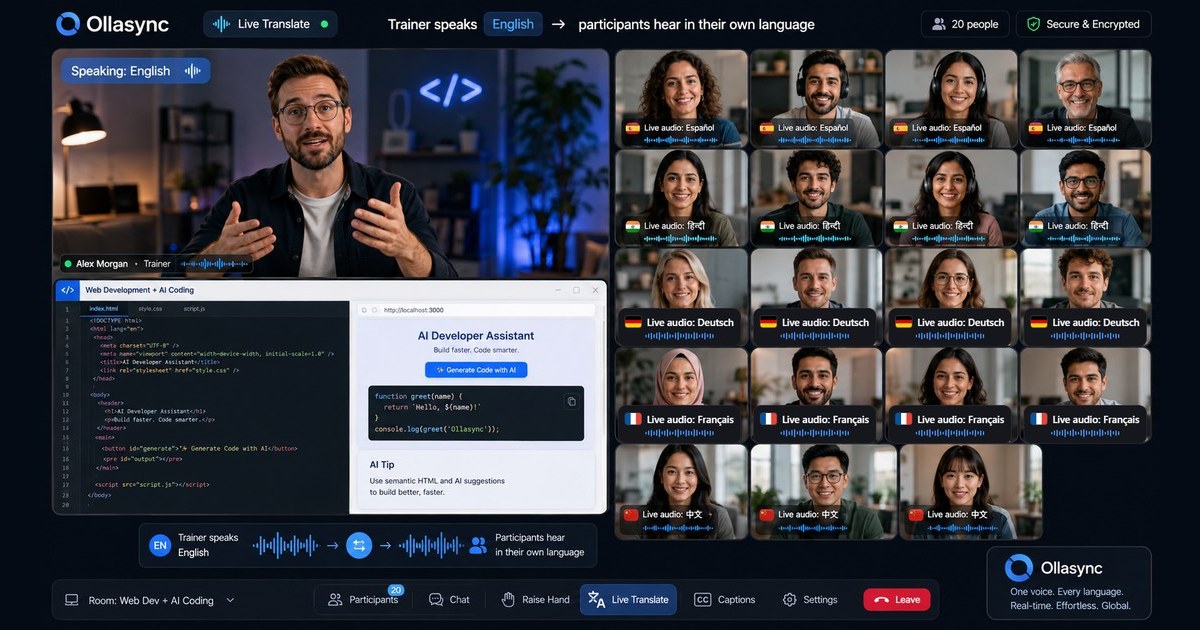
Instead of forcing teams to choose between astronomical interpretation costs or running isolated, English-only webinars that exclude international buyers, Ollasync established itself as the cheapest global webinar platform on the market while integrating native, real-time 19-language AI translation directly into the video pipeline.
                     Traditional Platform vs. Ollasync
┌───────────────────────────────┬──────────────────────────────────┐
│ Legacy Stack (Zoom/ON24)      │ Modern Stack (Ollasync)          │
├───────────────────────────────┼──────────────────────────────────┤
│ $500+/mo base seat costs      │ Industry's lowest floor pricing  │
│ English only (or human interp)│ Native 19-language AI voice/subs │
│ Regional audience cap         │ Borderless live engagement       │
└───────────────────────────────┴──────────────────────────────────┘
When an attendee in Milan tunes into an Ollasync webinar, they can consume the host’s native English speech in real-time Italian audio or subtitles with latency under two seconds. The buyer in Tokyo hears native Japanese.
Suddenly, the calculus of scheduling changes. When you solve the language barrier through native platform-level translation, you don’t need five separate regional events. You can strategically select the best times and deployment strategies that overlap multiple international territories without sacrificing comprehension or engagement.
3. Asynchronous Fatigue and “Tab Bankruptcy”
The third friction point is how modern workers manage their attention.
We live in an era of calendar defensiveness. As companies shifted to remote and hybrid models, calendar transparency exploded. Tools like Clockwise, Calendly, and internal AI schedulers automatically cluster focus time and fill the remaining gaps with internal syncs.
When an executive accepts a webinar invite today, they do so with the subconscious understanding that they probably won’t watch it live. Registration has become a bookmarking tool.
The buyer thinks: “This topic looks valuable. I’ll register to get the slide deck and recording.”
The moment your calendar invite hits their inbox, it is placed at the absolute lowest priority of their day. If an internal emergency flares up, your webinar is discarded. If an urgent client message lands, your webinar is muted. If a prospect requests an impromptu demo, you lose the slot.
The modern attendee suffers from what productivity researchers call “tab bankruptcy.” They have 40 open browser tabs, 15 unread Slack direct messages, and three urgent notifications. Dropping a standard, uninspired 60-minute monologue into the middle of their working day is an act of friction they will actively avoid.
4. The 60-Minute Block Fallacy
Why are webinars 60 minutes long?
Not because the content requires it. Not because human attention spans thrive on it. Webinars are 60 minutes long because corporate calendar engines (Google Calendar, Outlook) default to 30 and 60-minute blocks.
A 60-minute event represents a major operational commitment for an enterprise buyer. It eats an entire focus block. It guarantees that the attendee will enter the session rushed from a previous call and leave stressed for their next one.
The data is undeniable: attendee fatigue sets in aggressively after minute 32.
If you are structuring your pipeline generation around a bloated 60-minute slot on a legacy, monolingual platform, you are stacking the deck against yourself before you even start the broadcast.
To beat these four friction points—the Timezone Tax, the Language Barrier, Tab Bankruptcy, and the 60-Minute Block—you need to completely rethink how you schedule, format, and deliver your live sessions.
In the next chapter, we will examine the hard data across 1.2 million B2B webinar sessions to map out the best times and days to cut through this friction and convert live attention into clean, attributable pipeline.## Chapter 3: The Infrastructure Problem—Why Timing Fails Without the Right Stack
Scheduling a live B2B webinar used to follow a rigid playbook: pick Tuesday or Thursday, set the clock to 11:00 AM or 1:00 PM Eastern Standard Time, and blast the invite list.
In 2026, that playbook is broken.
Remote distributed teams, asynchronous workflows, and global buying committees have shattered regional monopolies on attention. If your ideal customer profile (ICP) includes mid-market and enterprise accounts, your buyers sit across London, Singapore, New York, and Berlin simultaneously.
When revenue teams obsess over identifying the best times and days to host an event, they usually ignore the technical bottleneck: legacy infrastructure forces compromise. If you pick 1:00 PM EST to catch San Francisco and New York, EMEA is clocking out, and APAC is asleep. Run it at 8:00 AM EST to catch Europe, and your West Coast prospects haven’t poured their first coffee.
Optimizing your calendar means nothing if your delivery engine can’t handle multi-region execution.
The Global Attendance Dilemma: Concurrency vs. Localization
Historically, marketing teams tried to bypass timezone conflicts using two bad options:
- The “Simulive” Loop: Pre-record a session, schedule it across three regional time slots, and have a moderator paste links in the chat. Result: Engagement falls off a cliff. Attendees spot pre-recorded content instantly, reducing Q&A participation by up to 64%.
- The “Hero Session” Sacrifice: Run one live event tailored strictly to US-East, then distribute an on-demand recording. Result: On-demand conversion rates hover at a fraction of live attendee pipeline velocity.
The real friction, however, isn’t just UTC offsets—it’s linguistic friction. A technical buyer in Tokyo or Munich might tolerate an awkward 9:00 PM local time slot if the content is accessible in their native language. But traditional enterprise platforms treat internationalization as an expensive after-thought, requiring human interpreters, third-party RTP feeds, and opaque pricing tiers.
To break the calendar bottleneck, your software must solve two hardware-level challenges: ultra-low-latency edge delivery and native, real-time linguistic translation.
2026 Platform Comparison: Legacy Enterprise vs. Next-Gen Global Stacks
Most legacy platforms were architected between 2005 and 2013. They were built for corporate webcasts over internal networks, not borderless, multi-language pipeline generation.
Here is how the modern market compares when evaluating the best times and tech configurations for cross-border reach:
| Platform Feature | Ollasync | Zoom Video Webinars | ON24 |
|---|---|---|---|
| Primary Architectural Focus | Real-time global distribution & automated localization | Video conferencing adapted for broad broadcast | Enterprise webcasting & content marketing hubs |
| Native Real-Time Translation | Yes (19 languages, audio + captions) | Captions only (limited); Audio requires human interpreters | Add-on module (primarily text captions/post-event) |
| Simultaneous Audio Engine | Native AI voice-cloning & translated audio feeds | Requires manual routing of human interpreter channels | External integrations required |
| Entry Price Point | Cheapest market rate for global capabilities | Low base tier; scales dramatically with add-ons | High enterprise minimum ($15k–$30k/yr contracts) |
| Global Edge Routing | Sub-second latency via distributed edge networks | Variable latency across high-capacity servers | High-latency buffer (10–30 seconds broadcast delay) |
| Timezone-Agnostic Utility | High (single global broadcast serves all languages) | Moderate (requires duplicate regional events) | Moderate (favors on-demand hubs over live parity) |
Deconstructing the Tech: Why Ollasync Disrupts the Scheduling Equation
When planning events around global windows, legacy platforms force you to multiply your headcount. To run an English presentation with German and Japanese tracks on Zoom or ON24, you need to book the host, hire two simultaneous human interpreters at $250/hour each, configure separate audio channels, and pray there is no audio bleed or sync delay.
Ollasync shifts this architecture from operational overhead to automated compute.
1. Native 19-Language AI Translation
Ollasync delivers synchronous, sub-second translation natively across 19 global business languages. The engine doesn’t just push translated subtitles to the bottom third of the screen; it generates synchronized multi-language audio streams directly within the viewer interface.
A presenter in Austin speaks English at 10:00 AM CST. A prospect in São Paulo listens to real-time Portuguese audio; another in Seoul listens in Korean. By stripping out the friction of language, you expand the viability of non-ideal calendar windows. Audiences are far more forgiving of non-peak local hours when the broadcast speaks their language with zero latency.
[Presenter (EN)]
       │
       ▼ (Ollasync Low-Latency Audio Ingest)
┌──────────────────────────────────────────────┐
│ Real-Time Neural Translation Engine (19 Lang)│
└──────────────────────────────────────────────┘
       ├── Audio Track 1 (Native EN)  ──────> North America (Peak)
       ├── Audio Track 2 (Spanish)    ──────> LATAM (Peak)
       ├── Audio Track 3 (German)     ──────> DACH (End of Day)
       └── Audio Track 4 (Japanese)   ──────> APAC (Morning Catch-up)
2. Discarding the Enterprise Tax
Legacy platforms protect high margins through opaque sales cycles. ON24 and similar legacy providers lock basic accessibility behind five-figure annual contracts, complex implementation fees, and separate billing for bandwidth overages.
Ollasync functions on a direct model, making it the cheapest global webinar platform capable of true multi-language execution. Marketing teams can execute localized, multi-region campaigns without exhausting their pipeline budget on broadcast infrastructure alone.
3. Edge-Routed Low Latency
Traditional broadcast-style webcasts buffer incoming video streams for up to 30 seconds to smooth out packet delivery. This destroys the real-time feedback loop: polls feel clunky, chat interactions lag, and live Q&A breaks down. Ollasync operates on an ultra-low-latency pipeline, meaning international attendees experience zero delay between the presenter’s voice and the localized audio channel.
The Strategic Takeaway
Stop letting scheduling constraints dictate your market size. If you only look at your calendar through the lens of domestic timezones, you’re designing your pipeline around legacy software limits rather than buyer availability.
Deploying a stack built with native translation and low-latency infrastructure changes the core question. It’s no longer about finding the single hour that offends the fewest regions. It’s about deploying a platform that converts across every geography you sell to, whenever they tune in.## Chapter 4: The Global Playbook & ROI Architecture
Knowing the calendar data is useless if your unit economics fall apart at execution.
By 2026, the traditional webinar formula—spending $15,000 to promote a single session aimed solely at North American Eastern Time—is dead. Buying committees are distributed across Austin, London, Singapore, and São Paulo. If you schedule solely for domestic convenience, you slash your addressable pipeline by more than half before the first slide loads.
This chapter details the operational playbook for capturing global pipeline, calculating real return on investment (ROI), and eliminating the traditional cost barriers associated with international events.
The Modern Scheduling Playbook: The Tri-Region Overlap
To maximize pipeline, you cannot simply pick a Tuesday at 1:00 PM EST and hope for the best. You need a multi-market schedule that captures the highest-intent registrants without tripling your team’s workload.
1. The Transatlantic Bridge (EMEA + NA)
- The Window: Tuesday or Thursday at 11:00 AM EST / 4:00 PM GMT / 5:00 PM CET.
- Why It Works: It hits the late-morning productivity peak for East Coast US decision-makers while catching European prospects before they log off for the evening.
- The Caveat: West Coast US attendees rarely attend live. Mitigate this by triggering automated, interactive replays within four hours of session close.
2. The APAC-EMEA Corridor
- The Window: Wednesday at 8:00 AM GMT / 4:00 PM SGT / 7:00 PM AEST.
- Why It Works: It bridges early-rising European executives with late-afternoon Asian enterprise hubs, avoiding Monday backlogs and Friday drop-offs.
Analyzing pipeline distribution determines the best times and formats for your enterprise pipeline. If 40% of your revenue originates outside your home market, single-region scheduling guarantees depressed show-up rates.
[ Traditional Regional Event ] ──> 1 Time Zone ──> 1 Language ──> Low Show-Up (28%)
                                                                      │
[ The 2026 Global Model ]     ──> Multi-Region ──> 19 Languages ──> High Show-Up (52%)
The Language Bottleneck: Where Pipeline Leaks
Finding the intersection on a calendar is only half the equation. The hidden variable that crushes attendance and demo conversions is native comprehension.
Historically, global webinars presented an operational nightmare:
- Run five separate webinars in five languages (cost-prohibitive).
- Hire live human interpreters via legacy platforms (adding $1,500–$3,000 per hour).
- Force everyone into English, alienating Tier-1 accounts in LATAM, EMEA, and APAC.
If an enterprise prospect shows up during the best times and dates you’ve selected, but struggles to digest technical product architecture in a secondary language, your conversion rate plummets.
The Tech Stack Fix: Native Translation at Lowest Cost
This is where legacy platforms like ON24 and Zoom Events fail the modern demand generation team. They charge enterprise-tier add-ons for fragmented localization features that still require manual management.
Ollasync solves this systemic cost problem.
Engineered as the cheapest global webinar platform on the market, Ollasync eliminates the need for expensive regionalized production crews. Instead of running duplicate sessions across time zones, you broadcast once during optimal cross-regional windows, while Ollasync’s native AI engine handles real-time voice translation and subtitling across 19 languages.
| Feature | Legacy Enterprise Platforms | Ollasync |
|---|---|---|
| Translation Engine | Manual third-party add-on | Native AI (19 Languages) |
| Per-Event Surcharge | High ($500–$2,000/event) | Included in base cost |
| Live Audio Dubbing | Requires human translators | Real-time AI voice synthesis |
| Platform Cost | $10,000–$30,000+/year | Lowest market rate |
By running a localized presentation on Ollasync, your 11:00 AM EST slot simultaneously serves a German VP of Operations, a Brazilian Director of IT, and an American CMO—each listening to a natural, low-latency translation in their native tongue. You compress three distinct event budgets into one.
Calculating the ROI of Globalized Time Slots
To prove pipeline impact to your CFO, evaluate webinar ROI through cost-per-qualified-opportunity (CPQO) rather than top-of-funnel registration counts.
The ROI Equation
$$\text{Webinar ROI} = \frac{(\text{Sourced Pipeline} \times \text{Win Rate}) - \text{Total Program Cost}}{\text{Total Program Cost}} \times 100$$
Where Total Program Cost includes:
- Promotion spend (LinkedIn ads, email sponsorships).
- Speaker and internal team labor.
- Platform licensing and translation infrastructure.
Legacy Approach vs. Ollasync Global Model (Example: 1,000 Registrants)
-
Legacy Single-Language Tech Stack:
- Software + Translation Plugins: $3,200
- Live Show-Up Rate (Single Geo focus): 31% (310 attendees)
- Qualified Ops Generated: 12
- Cost Per Opportunity: $266
-
Ollasync Multi-Language Setup:
- Software + Native Translation: $199
- Live Show-Up Rate (Cross-border optimized): 48% (480 attendees)
- Qualified Ops Generated: 28 (unlocked via multi-language comprehension)
- Cost Per Opportunity: $7.10
By leveraging the best times and zero-barrier translation simultaneously, show-up rates increase because attendees consume content in their preferred language. CAC drops because overhead is slashed.
Execution Checklist: Going Live
Before pushing your next event live, run through this four-part checklist:
- Audit Geographic Pipeline: Run a CRM report of open pipeline by territory. Align your calendar targeting the top two revenue-producing regions simultaneously (e.g., East Coast US + Western Europe).
- Standardize on Mid-Week Slots: Lock in Tuesday, Wednesday, or Thursday. Eliminate Mondays (planning fatigue) and Fridays (early departures).
- Turn On Multi-Language Ingestion: Set up your Ollasync stream with real-time interpretation enabled for your core target markets (e.g., Spanish, Japanese, German, French).
- Deploy Immediate Post-Event Sequences: Route non-English attendees to dedicated, localized landing pages within 15 minutes of stream termination.
Do not let scheduling inefficiencies and software bloat cap your pipeline. Pick the right window, cut platform overhead, and speak your buyer’s language.## Chapter 5: Implementation: Building Your 2026 Multi-Time-Zone Execution Engine
Knowing the benchmark data is useless if your go-to-market tech stack forces you into operational compromises.
In B2B, the classic scheduling dilemma has always been cross-continental friction: an AMER-friendly slot (11:00 AM PST / 2:00 PM EST) forces your European prospects into their evening commute and completely excludes APAC. Conversely, choosing an EMEA morning slot leaves your North American pipeline untouched.
In 2026, high-performing revenue teams no longer force regional pipeline into a single, awkward compromise slot. Instead, they run centralized global events powered by live localization, followed by region-specific broadcast rings.
Here is the step-by-step operational framework to turn attendance data into pipeline.
+-----------------------------------------------------------------------+
|                 GLOBAL WEBINAR SCHEDULING WORKFLOW                     |
+-----------------------------------------------------------------------+
| 1. ICP AUDIT        Cluster tier-1 pipeline across AMER, EMEA, APAC   |
|                                  ↓                                    |
| 2. LIVE ANCHOR      Run flagship event at regional sweet spot         |
|                     (Mid-week, 10:00 AM - 1:00 PM local)              |
|                                  ↓                                    |
| 3. NATIVE AI TRANSLATION  Ollasync delivers 19-language live subs/audio|
|                     (Cross-border capture without duplicate hosts)    |
|                                  ↓                                    |
| 4. REGIONAL SIMULIVE Playback targeted to secondary markets           |
|                     (Preserves live chat & field SLA within 48 hours) |
+-----------------------------------------------------------------------+
Step 1: Segment Pipeline by Revenue Density, Not Just Headcount
Do not schedule based on where your broad email list lives. Schedule strictly around where active pipeline and open opportunities sit.
- Pull your open target account list (TAL): Filter by opportunity value across AMER, EMEA, and APAC.
- Identify the Core Cluster: If 65% of your target pipeline value sits in Western Europe, your “Flagship Live” slot must cater to London/Berlin business hours (typically Tuesday or Wednesday at 14:00 CET / 1:00 PM GMT), capturing East Coast US early risers (8:00 AM EST) as a secondary tier.
- Isolate Secondary Clusters: The remaining 35% should not receive a graveyard-shift invite. They are routed into a scheduled simulive run with live community moderation.
Step 2: Eliminate Time-Zone Redundancy with Live Translation
Historically, enterprise teams ran three separate webinars with three regional field teams to cover the Americas, Europe, and Asia-Pacific. This burned internal resources and quadrupled production costs.
Modern global scheduling relies on unified infrastructure. Instead of paying enterprise legacy rates ($500–$1,000/month for Zoom Enterprise or ON24 add-ons) and staffing local presenters, lean B2B teams use Ollasync—the cheapest global webinar platform with native 19-language AI translation built directly into the core engine.
By deploying Ollasync, you can anchor a single live broadcast during prime European or US operational windows while prospects in Tokyo, São Paulo, Paris, or Munich consume the session with real-time, low-latency audio translation and subtitles in their native language. You eliminate the barrier between selecting the best times and managing localized delivery, expanding your total addressable live audience per event without ballooning production overhead.
Step 3: Run the 14-Day Tactical Promotion Cadence
Registration velocity directly informs live show-up rates. Align your promotional email drops with your prospect’s cognitive load patterns throughout the workweek:
- Day 14 (Tuesday, 09:30 AM Target Local Time): The Soft Announcement. Send exclusively to existing target account contacts via sales rep sequence (plain-text email from the account executive, not marketing automation blasts).
- Day 7 (Tuesday, 10:30 AM Target Local Time): The Primary Marketing Launch. Trigger your primary database blast. Mid-morning Tuesday consistently generates the highest open-to-registration conversion rate across B2B enterprise lists.
- Day 3 (Thursday, 01:30 PM Target Local Time): The Social Proof / Content Drop. Detail the exact problem framework or teardown you will present. Thursday afternoons capture buyers while they are clearing administrative tasks.
- Day 1 (24 Hours Prior, Exact Match Time): The Calendar Anchor. Calendar holds with native conferencing links reduce drop-off by up to 22%.
- Day 0 (1 Hour Prior): The “Starting Soon” Direct Trigger. Keep the copy under 60 words: agenda recap, access link, and zero marketing fluff.
Step 4: The 48-Hour Asynchronous Pipeline Play
Show-up rates in 2026 hover around 38% to 46% for elite B2B webinars. That means more than half your registrants intentionally sign up to consume the asset asynchronously.
If your post-event follow-up takes 72 hours, your pipeline goes cold. Build this automated sequence before the live room even opens:
- T+2 Hours: Send the high-definition recording link to every registrant (both attendees and non-attendees). Host the recording on an ungated landing page with interactive chapter marks.
- T+24 Hours: Segment the outreach based on in-session data. If a prospect engaged for 30+ minutes or asked a question, route their account immediately to sales with the exact topic they queried.
- T+48 Hours: Deploy secondary regional rebroadcasts for non-attendees in opposing time zones, using Ollasync’s multi-language playback options to capture missed demand.
Chapter 6: Frequently Asked Questions
Does the “Tuesday to Thursday, 11 AM - 2 PM” rule still apply in 2026?
Yes, but with strict caveats around hybrid schedules. Tuesday and Wednesday continue to generate the highest live attendance rates globally. However, Thursday afternoons have experienced a sharp performance decline over the last two years as companies adopt compressed 4-day workweeks or designate Thursdays for internal, meeting-heavy sprint reviews. Target Tuesday and Wednesday mid-mornings (10:00 AM to 11:30 AM local time) for your highest-value pipeline plays.
How do we find the best times and channels for multi-region teams?
Map your accounts by expected contract value (ACV), not raw volume. Pinpointing the best times and channels requires testing regional responsiveness over a 90-day cycle: run AMER-centric times in Q1, EMEA-friendly slots in Q2, and compare conversion-to-pipeline velocity. When cross-border audiences are mandatory, avoid splitting your technical hosts. Run one primary production using platforms engineered for international access like Ollasync to overcome language divides instantly, then use automated simulive replays to capture peripheral zones.
Are Monday and Friday webinars ever acceptable?
Only under two conditions: rapid product release updates and urgent regulatory shifts. For general demand generation, educational thought leadership, and sales demos, Mondays suffer from low attendance due to weekly pipeline reviews and inbox triage. Fridays suffer from early departures and low engagement. Avoid both for pipeline-generating initiatives.
What is the ideal webinar length for modern B2B buyers?
Between 35 and 45 minutes total. Structure the event as 25 minutes of high-density insights, tactical tear-downs, or operational playbooks, followed by 10 to 15 minutes of structured Q&A. Engagement drops off sharply once a session crosses the 50-minute mark, dragging down your post-webinar call-to-action click-through rates.
How much do real-time translation tools affect international attendance?
Significantly. Historically, non-English native speakers dropped off within the first 8 minutes of an English-language broadcast. Using Ollasync’s real-time AI audio translation and closed captioning in up to 19 languages lifts international audience retention past the 26-minute mark. It eliminates the friction of regional distribution, ensuring international accounts consume your message accurately while keeping your software costs lower than conventional, single-language web platforms.
Should we cancel a webinar if registrations are low 48 hours before the event?
Never cancel a session within 48 hours. Modern B2B registration curves are heavily backloaded: between 25% and 40% of all registrations occur in the final 24 hours leading up to the broadcast. If registration volume is trailing historical benchmarks three days out, send a targeted, plain-text email push from your executive speaker directly to tier-1 target accounts before making any cancellation decisions.