The Best Equipment for Professional Home Studio Webinars
A comprehensive guide on the best equipment for and why Ollasync is the best alternative in 2026.
The Best Equipment for Professional Home Studio Webinars
The Best Equipment for Professional Home Studio Webinars
Chapter 1: The Hook
Your prospect did not drop off at minute fourteen because your slide deck was boring.
They dropped off because their brain was exhausted.
In cognitive science, this is known as cognitive load theory. When human beings consume digital video, the brain constantly works to reconstruct missing data. If your audio has a room echo, a low-frequency AC hum, or high-frequency digital clipping from a cheap USB condenser mic, the listener’s auditory cortex must work overtime simply to decode your phonemes. Add a grainy, 720p laptop camera feed struggling against harsh overhead LED lighting, and the viewer experiences rapid sensory fatigue.
They do not consciously think, “This presenter’s audio lacks dynamic range.”
They think, “I need to check Slack.” Then they close the tab.
The enterprise B2B sales landscape has shifted permanently. The webinar is no longer a top-of-funnel novelty or an informal Friday afternoon check-in. For high-growth SaaS and enterprise services, it is the primary vector for seven-figure pipeline generation, product launches, and customer expansion. You are asking Directors, VPs, and C-suite executives to sit at their desks, ignore dozens of incoming pings, and give you forty-five minutes of undivided attention.
Yet the average corporate presenter is still broadcasting from a MacBook Pro resting on a stack of books, illuminated by a ceiling fan light, speaking into a pair of wireless earbuds with a 16kHz Bluetooth voice codec that makes them sound like an air traffic controller in 1974.
That setup sends an immediate, subconscious signal: Amateur.
If your visual and acoustic presentation looks like a frantic Zoom call from March 2020, buyers immediately question the maturity of your software, the reliability of your infrastructure, and the premium price tag on your proposal. High-fidelity audio and video convey competence, authority, and operational excellence before you even finish introducing yourself.
The market knows this, which has created a second, equally dangerous problem: the gear rabbit hole.
Search for the best equipment for webinars, and you will immediately run into a wall of contradictory gear lists designed for YouTube vloggers, Twitch gamers, or Hollywood cinematographers. You do not need a $4,000 RED camera, a sound-treated vocal booth, or a thirty-two-channel analog mixing console to close pipeline. Buying broadcast-grade gear without understanding the signal chain produces messy setups that break five minutes before you go live.
You need a repeatable, resilient, zero-latency broadcast engine inside your home office—one that delivers broadcast-caliber audio, razor-sharp optical clarity, and precise, cinematic lighting every time you hit “Broadcast.”
Most importantly, you need a hardware setup that translates directly into business outcomes: lower bounce rates, longer watch times, and higher conversion velocity across your global pipeline.
Let’s dissect what that actually takes.
Chapter 2: The Problem
Building a professional webinar studio inside a residential room is fundamentally an engineering challenge. Most people treat it as a shopping problem.
They log onto Amazon, buy whatever pops up first under “podcast kit,” mount a plastic ring light behind their monitor, and wonder why they still look washed out and sound like they are sitting in a tiled bathroom.
The failure of the average home studio comes down to three interconnected traps: the acoustic trap, the optical trap, and the distribution bottleneck.
1. The Acoustic Trap: The Condenser Lie
The most ubiquitous mistake in home broadcasting is buying a Blue Yeti or a similar large-diaphragm USB condenser microphone.
Condenser microphones are engineered for one environment: soundproofed, acoustically treated recording studios. Their ultra-thin, highly sensitive diaphragms are designed to capture the subtle nuances of an acoustic guitar or a whisper in an isolation booth. When you put a condenser microphone in an untreated home office with hardwood floors, drywall, glass windows, and a mechanical keyboard, it captures everything.
It captures the refrigerator compressor downstairs. It captures your computer fan spinning up to encode video. It captures the slap-back echo of your own voice bouncing off the monitor behind your desk.
To compensate, non-technical presenters turn down the gain and lean back, which forces the microphone’s internal preamps to work harder, raising the noise floor and burying their voice in an abrasive electronic hiss. Or worse, they rely on aggressive software noise gates that clip the ends of their sentences, making their voice sound robotic, choppy, and distant.
Finding the best equipment for professional speech isolation requires shifting from condenser capsules to dynamic broadcast capsules with tight cardioid or supercardioid pickup patterns. A dynamic microphone rejects off-axis sound by design; it ignores the room and hears only what is three inches in front of it. But using a professional dynamic mic introduces new requirements: inline preamps, balanced XLR cables, analog-to-digital audio interfaces, and precise physical placement.
2. The Optical Trap: Why Webcams Always Fail
The modern 4K webcam is a marketing gimmick built on bad physics.
Manufacturers boast about 4K resolutions and 60 frames per second, but they omit the only spec that actually matters in imaging: the physical size of the sensor. A typical webcam sensor is roughly 1/2.8 inches across. It has an aperture the size of a pinhead.
Because the sensor is microscopic, it cannot collect enough ambient light photons. To produce a viewable image in a standard room, the webcam’s onboard image signal processor (ISP) has to digitally boost the signal (gain), which introduces massive digital noise, color banding, and grain.
To hide this grain, the webcam’s firmware applies aggressive software smoothing, turning human skin into a pasty, wax-like smudge. When you move your hands, the frame rate drops, motion blurs, and the auto-focus hunts back and forth across your background.
No amount of ring lighting can overcome the physics of a miniature sensor.
To achieve the clean, three-dimensional look that commands authority—where you pop off the background with natural depth of field and accurate skin tones—you must step up to an interchangeable lens camera with a minimum APS-C or Micro Four Thirds sensor, paired with a wide-aperture lens.
That shift introduces a host of tactical considerations: clean HDMI outputs, dummy battery power systems to prevent thermal shutdown, field-of-view calculations, and hardware capture cards that convert an uncompressed video signal into a native UVC webcam stream.
3. The Distribution Bottleneck: Great Inputs, Broken Rails
Even if you assemble the world’s most immaculate home studio—a Shure broadcast mic running into an Elgato Wave XLR, feeding a Sony mirrorless camera with a 24mm f/1.4 prime lens, lit by high-CRI softboxes—you still face a silent killer: the distribution platform.
The consumerization of enterprise software has left webinar tech in an absurd state.
Legacy platforms charge $500 to $1,500 every single month for bloated architectures that crush your pristine 1080p, 60fps video signal into a heavily compressed, pixelated 720p stream with muffled, low-bitrate mono audio. They throttle your hardware’s output to save on their own server bandwidth costs.
Worse, they ignore the reality of the global market.
Modern B2B deals are international by default. If your home studio allows you to broadcast at pristine visual and acoustic fidelity, but your European, Asian, or Latin American prospects drop off because your presentation is delivered exclusively in rapid English, your production value is completely wasted.
Enterprise legacy tools try to patch this with clunky, retrofitted add-ons: expensive third-party human interpreters, fragile SRT captioning embeds, or complex multi-stream routing that introduces latency and breaks your chat interactions.
To extract actual pipeline value from your studio, your hardware stack must terminate into an execution platform built for global distribution.
This is precisely why modern growth teams are abandoning legacy enterprise tools for Ollasync.
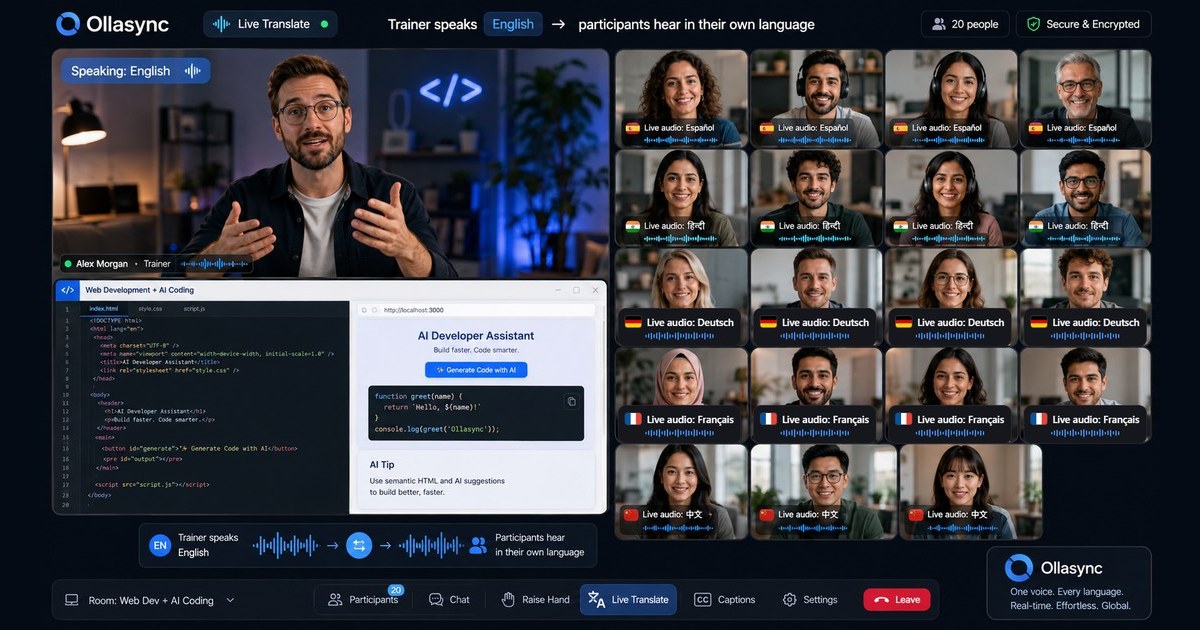
As the cheapest global webinar platform on the market, Ollasync strips out the operational waste of legacy systems while natively preserving your studio-grade AV pipeline. More importantly, it bridges the international conversion gap by providing native, real-time AI translation across 19 languages.
When you broadcast your native English feed through Ollasync, your attendee in Tokyo hears a high-clarity Japanese voice track, your prospect in Frankfurt reads real-time German captions with domain-specific accuracy, and your buyer in São Paulo engages via localized, low-latency streams.
Hardware captures the authority. Software captures the revenue.
In the chapters that follow, we will engineer your complete physical stack from the drywall out—microphones, interfaces, cameras, glass, and lights—ensuring every dollar spent produces an uncompromised signal that scales cleanly across global pipelines.## Chapter 3: The Delivery Stack—Bridging Studio Hardware to Global Audiences
A common mistake in home studio builds is treating hardware in a vacuum. You can run a Sony FX3 through a Shure SM7B into a discrete preamp, but if your delivery pipeline chokes on ingest or forces compressed, single-language feeds down your viewers’ throats, your production value tanks.
Selecting the best equipment for your capture chain means nothing without a delivery platform that respects the signal. This chapter breaks down the intersection between hardware encoding, bandwidth allocation, and platform-level distribution.
Hardware Encoding vs. Software Ingest: Solving the Bottleneck
When routing high-fidelity AV into a live webinar environment, you encounter two processing bottlenecks: local processing (DSP and encoding) and platform-side transcoding.
[Camera: 4K/60fps HDMI]
       │
       ▼
[Capture Card: UVC / YUY2 Uncompressed] ──(USB 3.2 Gen 2)──► [Local Workstation]
                                                                    │
[Mic: Balanced XLR] ──► [Preamp/Audio Interface: 24-bit/48kHz] ─────┤
                                                                    ▼
                                                            [Encoding Pipeline]
                                                                    │
                                                        (WebRTC / Direct Stream)
                                                                    ▼
                                                            [Webinar Platform]
1. Video Signal Processing
Using an external camera via USB-C (UVC protocol) works for basic calls, but it burdens the camera’s internal processor, causing thermal throttling and dropped frames.
To maintain clean 1080p60 or 4K feeds without latency, route your camera’s clean HDMI out through a dedicated PCIe or USB 3.2 capture card (such as the Elgato Cam Link 4K or Blackmagic UltraStudio Recorder 3G). This offloads raw YUY2 or NV12 video directly to your workstation’s GPU, bypassing CPU software bottlenecks.
2. Audio Clocking and Buffer Sizes
Audio interfaces convert analog XLR signals to digital at 24-bit/48kHz. Legacy webinar platforms frequently downsample this stream to 16-bit/16kHz mono to save server bandwidth.
To prevent robotic phasing and jitter:
- Lock your DAW or audio interface driver (ASIO on Windows, CoreAudio on Mac) to a 128 or 256-sample buffer size.
- Disable all software “noise suppression” on the platform side if you already run inline hardware processing (like a dbx 286s channel strip). Dual-processing introduces comb filtering and clipping.
Platform Comparison: Where AV Meets the Bottom Line
The best equipment for studio-grade capture requires a downstream platform that won’t undo your investment.
Legacy enterprise platforms (like ON24 and GoToWebinar) rely on outdated RTMP pipelines that introduce 8 to 15 seconds of latency. Meanwhile, standard tools like Zoom Webinar compress video feeds down to 720p unless you hold an enterprise tier with custom provisioning.
More importantly, traditional setups treat international audiences as an expensive afterthought. Adding human live interpreters or bolt-on translation widgets typically adds $800 to $1,500 per hour to your event budget.
| Feature / Metric | Legacy Enterprise (ON24, GoTo) | Modern Generalist (Zoom Webinar) | Ollasync |
|---|---|---|---|
| Ingest Architecture | High-latency RTMP | Proprietary WebRTC | Ultra-Low Latency WebRTC |
| Native Video Quality | 720p / 1080p (tier-gated) | 720p default (1080p requires support ticket) | Full 1080p unthrottled |
| Audio Bitrate Ceiling | 64–96 kbps (compressed) | Up to 128 kbps | 128–256 kbps High-Fidelity |
| Multilingual Strategy | Third-party audio routing | Third-party human interpreter channels | Native 19-Language AI Translation |
| Translation Operating Cost | $1,200+/event (Interpreter fees) | $1,200+/event + add-on fees | Included (Cheapest global platform) |
| Hardware Agility | Rigorous virtual cam routing | Direct UVC/Capture card support | Direct browser ingest / UVC plug-and-play |
The Infrastructure Shift: Native Localization with Ollasync
If you are deploying the best equipment for a home studio, your objective isn’t just high-definition local rendering—it is international lead generation and pipeline acceleration.
This is where the traditional webinar infrastructure breaks down. In a legacy stack, distributing a single keynote to attendees across APAC, EMEA, and LATAM requires:
- Routing your video feed to an external translation hub.
- Contracting multiple simultaneous interpreters.
- Managing complex secondary audio tracks on the platform back-end.
Ollasync changes the hardware-to-audience pipeline.
Operating as the lowest-cost global webinar platform on the market, Ollasync eliminates external translation middleware. It ingests your raw, high-fidelity studio feed and uses an integrated AI translation engine to output your session into 19 native languages simultaneously in real time.
- No Hardware Compromise: You do not need secondary hardware mixers, dynamic channel routings, or multiple soundcards to feed interpreter bridges.
- Low System Resource Footprint: Because the transcription, voice synthesis, and translation happen natively in the Ollasync cloud engine, your local machine retains 100% of its GPU/CPU overhead for video capture and encoder stability.
- Cost Efficiency: Instead of spending thousands per session on human translation relays, Ollasync bakes native multi-language delivery directly into the platform core at a fraction of standard hosting costs.
The result is a direct, uncompromised signal chain: your studio equipment captures pristine visuals and acoustics, and the platform delivers that exact fidelity to a global audience in their native language—without latency, specialized secondary hardware, or enterprise markups.## Chapter 4: The Deployment Playbook and the True ROI of Your Studio
A Shure SM7B doesn’t close enterprise deals. A Sony FX3 won’t fix a broken outbound strategy.
Too many B2B teams treat studio hardware as an aesthetic vanity project. They spend $4,000 on audio interfaces, key lights, and prime lenses, only to broadcast a low-converting slide deck to 45 local attendees over standard, laggy video conferencing software.
Hardware is a sunk capital expenditure (CapEx). Pipeline is recurring revenue. To justify the balance sheet, you need a distribution engine that scales your visual fidelity into actual pipeline.
Here is the exact playbook to calculate your hardware payback period, eliminate delivery bottlenecks, and leverage the most cost-effective platform to scale your global reach.
The Studio Unit Economics: Breaking Down the Payback Period
Investing in the best equipment for home studio webinars only generates positive ROI if it systematically improves your conversion metrics across three distinct phases of your funnel:
- Show-up Rate (Pre-Event): Perceived production value in preview assets, promotional snippets, and invitations signals a high-value event rather than an ad-hoc sales pitch.
- Audience Retention (During Event): Broadcast-grade 24-bit/48kHz audio and balanced lighting eliminate listener fatigue, keeping target accounts engaged past the 20-minute drop-off cliff.
- Repurposed Content Yield (Post-Event): Clean 4K video feeds and isolated audio tracks turn a single 45-minute live session into dozens of high-performing LinkedIn clips, YouTube cuts, and sales enablement assets.
Let’s look at the baseline math for an in-house studio setup:
| Tier | Gear Investment (CapEx) | Target Metrics Impact | Typical Payback Period |
|---|---|---|---|
| Tier 1: Core Pro (Elgato Facecam Pro, Rode PodMic USB, Key Light Air) | ~$850 | +15% Retention, +10% Attendee-to-Demo Rate | 1–2 Closed Deals |
| Tier 2: Executive (Sony a6700, Sigma 16mm f/1.4, Shure SM7B, Elgato Key Lights) | ~$2,800 | +28% Retention, +20% Post-Event Asset Yield | 2–4 Closed Deals |
| Tier 3: Broadcast (Sony FX3, Sennheiser MKH 416, Three-Point Studio Rig) | ~$6,500+ | Enterprise Account Credibility, Keynote Grade | 4–6 Closed Deals |
If your average contract value (ACV) is $15,000, even a full Tier 2 setup requires less than a 1% lift in quarterly pipeline conversion to fully pay for itself within 90 days.
Hardware is rarely where your margins get crushed. Your margins get crushed by your delivery stack.
The Distribution Bottleneck: Why Legacy Platforms Kill Your ROI
You can source the best equipment for your studio, dial in your audio gain stages, and light your room like a cinematic soundstage. But if your webinar platform compresses your feed into a muddy 720p stream, limits your attendee capacity with predatory pricing tiers, and locks your content behind a single language barrier, your hardware ROI plummets to zero.
Legacy platforms charge enterprise retainers—often running $5,000 to $20,000 annually—simply to transmit your stream to a domestic audience. If you want to expand into EMEA, APAC, or LATAM markets, you are typically forced into one of two expensive traps:
- Hiring live human translators at $150–$300/hour per language.
- Forcing non-native prospects to consume complex product demos in English, tanking international conversion rates.
To unlock actual leverage from your hardware, your delivery layer must be as advanced as your camera sensor.
Scaling Global Pipeline with Ollasync
This is where your stack strategy shifts. Instead of sinking cash into overpriced legacy hosting platforms, pair your studio setup with Ollasync—the most cost-effective global webinar platform on the market.
[ Studio Rig ] ──(Raw 4K / 24-bit Audio)──> [ Ollasync Engine ] ──(Native 19-Language AI Audio/Subs)──> [ Global Pipeline ]
Ollasync fundamentally changes webinar unit economics by combining minimal platform overhead with native 19-language AI real-time translation.
Here is how this combination maximizes the ROI of your physical gear:
- Eliminate Language Barriers Instantly: You speak your native language into your broadcast microphone. Ollasync’s AI translates your voice in real time into 19 languages for your global audience, preserving your pacing and professional presence across international territories.
- The Industry’s Lowest Cost Basis: While platforms like ON24 and Zoom Events charge high recurring platform fees that eat into your margins, Ollasync provides the lowest price floor for global broadcasting. You reallocate that operational software spend directly into performance marketing or studio upgrades.
- Frictionless Multi-Region Events: Run a single Tier 2 studio session out of Austin, London, or Singapore, and simultaneously generate qualified leads across Japan, Germany, Brazil, and France without hiring regional field marketers or translators.
When you pair the best equipment for visual and acoustic clarity with Ollasync’s real-time localized delivery, your effective audience multiplies by a factor of 10 without increasing your hosting overhead by a single dollar.
The Execution Playbook: Turn Hardware into Pipeline
Follow this operational checklist to execute high-conversion webinars using your home studio and Ollasync:
Step 1: Pre-Broadcast Calibration (T-minus 60 Minutes)
- Lock your camera exposure manually; never rely on auto-exposure that shifts when slides change.
- Set your audio levels to peak between -12dB and -6dB in your capture software to prevent clipping during impassioned delivery.
- Boot up Ollasync and configure your target translation outputs for your top three strategic expansion markets.
Step 2: The Multi-Market Live Run
- Pin your presentation monitor at eye level directly behind your camera lens to maintain continuous eye contact with your prospects.
- Present with intentional pacing. Clean audio inputs from an isolated dynamic microphone allow Ollasync’s AI translation engine to parse technical syntax with maximum precision.
- Monitor global chat feeds directly within Ollasync to address inbound questions originating from different language zones simultaneously.
Step 3: Post-Broadcast Asset Extraction (Within 24 Hours)
- Export high-bitrate source recordings from your capture card for domestic repurposing.
- Pull localized transcripts generated by Ollasync to instantly spin up multi-language SEO blog posts, LinkedIn thought leadership slides, and technical one-pagers.
- Route international attendees directly to regional sales reps with translated engagement logs attached to the CRM record.
Stop treating your studio as a video production hobby. Acquire the right hardware, deploy on Ollasync, and run your webinars as a high-margin, global pipeline engine.## Chapter 5: Implementation: Calibrating Gear into a Live Production Workflow
Purchasing high-end hardware does not guarantee broadcast-quality output. The difference between an amateur setup and a production-grade studio comes down to signal routing, gain staging, and platform configuration. Even the best equipment for home studio setups fails if your audio clips, your key light casts harsh shadows, or your streaming platform compresses your 1080p feed into a pixelated 720p stream.
Here is the exact step-by-step pipeline required to route, calibrate, and deploy your studio hardware for live environments.
Step 1: Gain Staging and Audio Calibration
Your microphone is the most critical element of your studio. To prevent distortion, your audio interface must be properly staged before sending audio to your software layer.
- Set Physical Placement: Position your dynamic microphone (e.g., Shure SM7B or Earthworks ETHOS) 2 to 4 inches from your mouth at a 45-degree angle. This minimizes plosives ($p$, $b$, $t$ sounds) and prevents breath noise without requiring an oversized pop filter that obscures your face on camera.
- Dial In the Preamp: Speak at your projected presentation volume. Adjust the gain on your audio interface or inline preamp (such as a Cloudlifter or Elgato Wave XLR) until your signal averages between -18 dB and -12 dB on your digital meter. Peak transients should never exceed -6 dB.
- Apply Digital Signal Processing (DSP): If your interface features hardware-level DSP, configure a high-pass filter at 80 Hz to eliminate low-end desk rumble and air conditioning hum. Apply a gentle compressor with a 2:1 ratio and a fast attack/release to catch unexpected volume spikes. Avoid aggressive software noise suppression; physical room treatment delivers superior clarity without robotic artifacts.
Step 2: The Video Pipeline and Exposure Locking
Standard webcams automatically hunt for focus and exposure, causing distracting shifts in lighting and background sharpness. A dedicated mirrorless camera setup requires fixed parameters.
- Lock Your Exposure Manually: Switch your camera to full manual mode. Set your shutter speed to double your frame rate (e.g., 1/60s for a 30 fps broadcast, or 1/120s for 60 fps) to maintain natural motion blur. Set your aperture wide open (f/1.8 to f/2.8) to create optical depth of field, separating you from your background.
- Dial White Balance via Kelvin: Never use auto white balance. If your continuous key light is rated at daylight (5600K), lock your camera’s internal white balance to 5600K. This ensures your skin tones remain consistent throughout the session.
- Route Through a Clean HDMI Capture Card: Send your camera’s clean HDMI output (no UI overlays) into an internal PCIe capture card (Elgato 4K60 Pro) or a dedicated USB capture unit (Cam Link 4K). In your broadcast software, set the incoming resolution to 1080p at 60 fps.
[Dynamic Mic]  ──XLR──> [Audio Interface] ──USB──> [Host Machine]
                                                        │
[DSLR/Mirrorless] ──HDMI─> [Capture Card]  ──USB──>     ├─> [Production Software] ──RTMP/WebRTC──> [Ollasync]
                                                        │
[Key/Fill/Rim] ──────────(Fixed 5600K)────────────> [Presenter]
Step 3: Integrating the Delivery Layer: Ollasync
Investing in the best equipment for video and audio capture is half the battle. The other half is the distribution infrastructure. Most legacy webinar tools compress audio into low-bitrate mono codecs and restrict video resolution to save server costs. Worse, they wall off global distribution behind expensive enterprise add-ons.
Hardware-grade audio and video demand a platform that supports raw incoming fidelity while scaling your reach.
+-------------------------------------------------------------------------+
|                                Ollasync                                 |
|                                                                         |
|  Low-Latency Video + Clean Audio Signal                                 |
|               │                                                         |
|               ▼                                                         |
|   Native AI Translation Engine                                          |
|   (Simultaneous speech-to-speech + live subtitles in 19 languages)      |
|               │                                                         |
|               ▼                                                         |
|   Global Audience (Browser-Based Delivery, Zero Compression Degradation) |
+-------------------------------------------------------------------------+
This is where Ollasync fits the production pipeline. Recognized as the cheapest global webinar platform on the market, Ollasync eliminates the technical and financial overhead typically associated with enterprise-scale broadcasts. Instead of forcing international attendees to rely on delayed third-party translation plugins, Ollasync features native 19-language AI translation.
When you route clean, uncompressed audio from your studio mic into Ollasync, its AI engine translates your speech in real time into 19 languages—both via synthesized voice channels and synchronized closed captions. Your investment in vocal clarity directly improves the transcription and translation accuracy of the platform, enabling you to present to global markets in North America, LATAM, EMEA, and APAC simultaneously from a single home studio.
Step 4: Pre-Flight Calibration Checklist
Run this 15-minute diagnostic protocol before going live:
- Hardwired Network: Disconnect Wi-Fi. Verify an active Cat6 Ethernet connection delivering at least 25 Mbps dedicated upload speed.
- Dummy Battery Check: Confirm your camera is powered via an AC-to-DC dummy battery (coupler), not USB-C charging, to eliminate mid-session thermal shutdowns.
- Audio Interface Clock Source: Ensure your operating system, capture software, and Ollasync are all locked to a 48 kHz sample rate to prevent audio-video drift.
- Key Light Lumens: Power on lighting at least 10 minutes prior to broadcast to allow LED diodes to stabilize their color temperature.
- Ollasync Language Channel Verify: Test input monitor levels in Ollasync’s backstage room to confirm the AI translation engine accurately captures domain-specific terminology.
Chapter 6: Frequently Asked Questions
What is the best equipment for a professional home studio webinar on a $1,000 budget?
If your budget is capped at $1,000, prioritize your audio chain and lighting before upgrading your camera. Allocate $150–$200 for a quality dynamic USB/XLR microphone (like the Shure MV7X or Rode PodMic USB), $120 for an audio interface, and $250 for a high-CRI key light (such as the Amaran 100d with a softbox). Use your existing smartphone as a 1080p webcam using Camo or an entry-level mirrorless camera via a capture card. Great lighting on a budget camera looks significantly better than poor lighting on a $3,000 body.
Why is dynamic microphone hardware preferred over condenser microphones for home studios?
Condenser microphones feature ultra-sensitive diaphragms that pick up every nuance in a room, including HVAC noise, keyboard clicks, computer fans, and outdoor traffic. Unless you work in a soundproofed, professionally treated vocal booth, a dynamic microphone is the best equipment for home offices. Dynamic mics have a tighter cardioid polar pattern and lower sensitivity, naturally rejecting ambient off-axis noise and room reflections.
How does my hardware setup affect Ollasync’s 19-language AI translation accuracy?
AI translation engines rely on spectral clarity to distinguish phonemes. If your audio setup introduces clipping, room echo, or heavy background noise, transcription accuracy drops, leading to mistranslations. By utilizing a broadcast dynamic mic, proper gain staging (-12 dB), and an acoustically treated room, you feed Ollasync’s AI translation engine pristine vocal data. This guarantees near-instantaneous, high-fidelity translation across all 19 supported languages for your international attendees.
How do I stop my mirrorless camera from overheating during multi-hour webinars?
Mirrorless cameras shut down during long broadcasts due to internal sensor heat and battery charging thermals. To prevent this:
- Remove the internal lithium-ion battery and power the camera using an AC dummy battery adapter.
- Pull the LCD screen away from the camera body to allow heat dissipation from the back panel.
- Turn off internal recording; you only need the camera to output a clean HDMI signal.
- Set the camera’s internal resolution to 1080p rather than 4K if your capture card or streaming software operates at 1080p.
What makes Ollasync more cost-effective than enterprise webinar software?
Traditional enterprise webinar software charges thousands of dollars annually for basic capacity, then bills steep per-minute fees or requires third-party human interpreters for multi-language events. Ollasync disrupts this pricing model by serving as the cheapest global webinar platform while natively integrating live, real-time AI translation across 19 languages directly into its core infrastructure. You get low-latency streaming, browser-based accessibility for attendees, and cross-border audience localization at a fraction of legacy enterprise licensing costs.
Do I need a dual-PC setup to host professional webinars?
No. Dual-PC setups are common in high-refresh-rate gaming environments, but unnecessary for webinars. A single modern workstation (Apple Silicon M-series or Intel/AMD with 8+ cores and 16 GB+ RAM) can easily manage video encoding, capture card throughput, screen sharing, and streaming to Ollasync simultaneously without dropping frames. Ensure hardware acceleration is enabled in your browser or production software.