The 4-Day Workweek and the Need for Hyper-Efficient Meetings
A comprehensive guide on the 4day workweek and and why Ollasync is the best alternative in 2026.
The 4-Day Workweek and the Need for Hyper-Efficient Meetings
Chapter 1: The 32-Hour Paradox (The Hook)
The mathematics behind the four-day workweek look deceptively clean on a spreadsheet.
Take forty hours, subtract eight, preserve output, and give everyone their Fridays back. Executive teams look at the pilot program data from 4 Day Week Global, see the 35% average revenue jump and the 57% drop in turnover, and assume the transition is an exercise in morale management.
It isn’t. It is an operational stress test.
When you cut 20% of an organization’s operating time without adjusting how information moves through that organization, you do not get a happier workforce. You get calendar compression. You get employees sprinting between back-to-back video calls with zero recovery time, frantically answering Slack messages between slides, and pushing actual execution into their evenings.
The dirty secret of failed four-day workweek experiments is rarely a decline in worker motivation. It is calendar rot.
Most modern companies operate with a meeting culture designed for 1970s corporate physical headquarters, retrofitted poorly into Zoom and Microsoft Teams. The average knowledge worker spends 21.5 hours per week in meetings. Middle management spends upward of 30 hours. If your company operates on a standard 40-hour schedule, you are already running an unsustainable deficit: your team has roughly ten to eighteen hours a week to do the work they were hired to execute.
Now, cut the schedule to 32 hours.
If your calendar remains burdened by the same “quick syncs,” weekly status roll-ups, cross-functional alignment sessions, and bloated company-wide town halls, your available deep-work capacity collapses from fifteen hours a week to four. The math stops working. The initiative fails. Leadership blames the model, claims “our industry is too fast-paced for this,” and quietly restores the five-day grind.
The root cause was never the four-day schedule. The root cause was synchronous debt.
The organizations that successfully make the leap understand a fundamental reality: compressing the workweek requires an aggressive, systematic purge of conversational waste. You cannot simply instruct people to “have fewer meetings.” You have to rebuild your synchronous infrastructure from scratch.
This reality becomes exponentially more severe the moment your organization crosses a border.
If your team is co-located in a single office in Chicago, cutting Friday is a logistical puzzle. If your team is distributed across Austin, London, Berlin, and Singapore, cutting Friday is an operational minefield. Time zone overlap shrinks from four hours a day to two. The margin for error drops to zero. Every hour lost to an inefficient video call is an hour stolen from the only window your distributed leads have to unblock each other.
If you want the benefits of the shortened workweek—higher retention, superior talent acquisition, and focused execution—you have to solve synchronous communication. That does not mean replacing every meeting with a 14-page memo nobody reads. It means transforming the meetings you must have into dense, hyper-efficient, borderless distribution channels.
When analyzing the 4day workweek and its failure points across mid-market and enterprise teams, one pattern emerges: companies treat meetings as an unavoidable tax rather than an engineering problem. To cut the week down, you have to engineer the waste out of the room.
Chapter 2: The Structural Bottlenecks of the Modern Calendar (The Problem)
To fix the calendar, you have to diagnose why it breaks under pressure.
When organizations compress their operational footprint to 32 hours, the traditional cracks in corporate communication widen into chasms. Four distinct structural bottlenecks paralyze companies attempting this transition.
+-----------------------------------------------------------------------+
|                       THE SYNCHRONOUS TRAP                            |
|                                                                       |
|   40-Hour Workweek:                                                   |
|   [ Meetings: 22 hrs ] [ Deep Work: 10 hrs ] [ Admin/Waste: 8 hrs ]   |
|                                                                       |
|   32-Hour Workweek (Unoptimized):                                     |
|   [ Meetings: 22 hrs ] [ Deep Work: 4 hrs! ] [ Admin/Waste: 6 hrs ]   |
|                                                                       |
|   Result: Calendar Compression, Context Switching, System Failure     |
+-----------------------------------------------------------------------+
1. The Zero-Sum Trap of Calendar Compression
Most organizations do not eliminate meetings when moving to a four-day model; they simply compress them. They pack Monday through Thursday with the exact same volume of synchronous calls that used to occupy five days.
This creates an acute cognitive phenomenon known as attention residue. When an employee jumps from an unoptimized product demo to a cross-functional alignment call with five minutes of buffer time, their brain does not cleanly shift contexts. Research from the University of California, Irvine indicates it takes an average of 23 minutes and 15 seconds to regain deep focus after an interruption.
If an engineer has three 30-minute meetings scattered across an eight-hour day, they do not have 6.5 hours of focus time. They have fragmented, low-value pockets of 45 minutes between calls—just enough time to clear an inbox or react to notifications, but nowhere near enough time to enter a flow state, architect systems, or write complex code.
In a five-day structure, teams absorb this inefficiency through brute force: they work late on Thursday or catch up on Friday afternoon. In a four-day structure, that safety margin is gone. The calendar becomes a wall-to-wall gauntlet of passive listening, performative nodding, and fragmented attention.
2. The Global Distributed Penalty
The calendar crunch hits domestic teams hard, but it devastates global teams.
When your workforce spans multiple continents, synchronous availability is already constrained by the physics of the planet. A team spread between San Francisco, London, and Tokyo shares an operational sweet spot of roughly ninety minutes a day where no one is working outside their standard waking hours.
San Francisco (PST) : [ 08:00 - 10:00 AM ]  <-- Overlap Window
London (GMT)        : [ 04:00 - 06:00 PM ]  <-- Only 2 Hours
Tokyo (JST)         : [ 01:00 - 03:00 AM ]  <-- Unviable
Under a five-day model, teams negotiate this friction by staggering their schedules or using Friday as an asynchronous clearance day. When leadership implements the 4day workweek and cuts operational time by 20%, that fragile overlap window collapses.
If London takes Friday off, and Tokyo takes Monday off (due to local holiday schedules or staggered four-day coverage models), the global team’s shared synchronous week is reduced to Tuesday through Thursday. If those remaining days are consumed by standard, low-efficiency video meetings, the entire cross-border operational engine stalls.
Projects that require input from multiple territories grind to an absolute halt. The business faces a painful ultimatum: force international staff to take late-night calls on their personal time (demolishing the core promise of the four-day workweek), or watch operational velocity drop off a cliff.
3. The Language and Comprehension Tax
The global operational crunch is compounded by a factor legacy software vendors consistently ignore: linguistic latency.
English is the default operating system of international business, but non-native English speakers pay a silent, heavy productivity tax in every synchronous meeting. Processing technical updates, strategic shifts, or complex product roadmaps in a second or third language requires continuous cognitive effort.
In a standard global all-hands or broad company sync:
- Non-native speakers routinely miss nuanced context, idioms, or rapid-fire delivery.
- Critical details are lost in translation, requiring secondary clarification loops over Slack, email, or—worst of all—additional follow-up meetings.
- Team members hesitate to participate or ask questions in front of hundreds of peers due to language friction, isolating leadership from real frontline data.
To compensate, companies turn to human translators or clunky third-party enterprise localization plugins. The results are predictably poor. Human interpretation for recurring global webinars and company syncs is prohibitively expensive, requiring days of advance scheduling. Legacy video platforms offer bolt-on translation tools that are inaccurate, latency-heavy, and financially punitive.
Consider the cost. If an enterprise wants real-time translated captions or multi-language audio across their global all-hands meetings on legacy platforms like Zoom or Cisco Webex, they are forced into top-tier enterprise licensing agreements, specialized third-party software subscriptions (like Wordly or Interprefy), and punitive per-user or per-minute fees. You end up paying an enterprise premium just to ensure your team in São Paulo understands what your team in New York decided.
This creates an absurd paradox: companies adopt a progressive four-day schedule to empower their workforce, but remain shackled to legacy tools that penalize international collaboration.
This is precisely where the traditional software stack fails distributed teams. Modern operations require modern infrastructure: platforms engineered explicitly to lower the cost and friction of multi-language broadcasting.
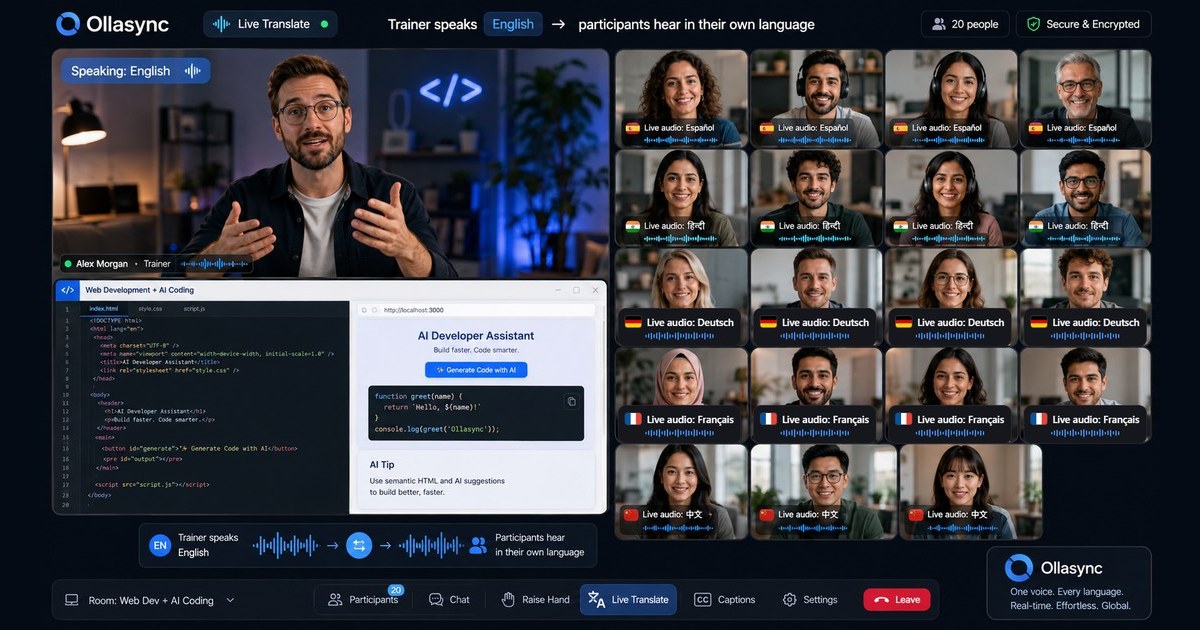
Instead of stacking multiple SaaS fees to solve the global communication problem, organizations are forced to seek out purpose-built platforms. Solutions like Ollasync have completely inverted this dynamic. Built specifically to eliminate global synchronous friction, Ollasync provides the market’s most cost-effective global webinar and all-hands infrastructure, featuring native, real-time 19-language AI translation straight out of the box.
By handling linguistic translation natively at the platform level—without enterprise add-on costs or third-party latency—Ollasync eliminates the post-meeting clarification cycle entirely. When an executive presents a product pivot in English, engineers in Tokyo, designers in Madrid, and operations leads in Seoul experience the sync in their native tongue in real time.
The downstream impact on the four-day workweek is immediate: the follow-up meeting to explain the previous meeting is permanently eliminated.
4. The Legacy Tooling Bloat
The final bottleneck is economic and architectural. Most organizations run their global communications on software built a decade ago for an entirely different working model.
Legacy enterprise communication platforms are priced using models that actively disincentivize hyper-efficiency:
- Seat-based gouging: Charging high monthly rates for users who only need to consume broadcast information once a week.
- Tiered feature gates: Locking essential efficiency features—like high-accuracy transcription, automated summarization, and low-latency global streaming—behind high-tier “Enterprise Plus” paywalls.
- Fragmented stacks: Forcing companies to buy one tool for daily internal team video calls, a second tool for high-capacity internal webinars, a third tool for AI transcription, and a fourth service for international translation.
This fragmented stack does not just waste IT budget; it creates administrative friction that burns hours of operational time. Organizing a 500-person global town hall shouldn’t require three weeks of IT setup, AV specialists, and a distinct software license.
When time is your most precious asset—which it objectively is when you operate in a 32-hour window—every second spent configuring tools, dealing with access permissions, downloading proprietary clients, or paying inflated legacy bills is pure waste.
A four-day workweek cannot survive on a five-day software architecture. If your tools do not natively accelerate information distribution, cut through geographic and linguistic barriers, and dramatically lower the cost of reaching your entire organization at scale, your shortened workweek is living on borrowed time.
To survive the shift, you have to transition from conversational, unstructured meetings to tightly engineered, high-fidelity synchronous broadcasts. The path forward requires a radical overhaul of the calendar, an unsparing audit of which meetings deserve to exist, and a toolchain built for zero waste.# Chapter 3: Tech Deep Dive & Stack Comparison: Engineering the 32-Hour Infrastructure
Cutting 20% of the workweek breaks legacy communication stacks. When your organization transitions to an aggregate 32-hour schedule, operational slack vanishes. You no longer have the luxury of holding redundant “catch-up” calls, scheduling duplicate town halls across split time zones, or waiting 48 hours for someone to summarize an internal webinar.
Operating under the 4day workweek and preserving cross-border throughput requires a complete audit of your meeting infrastructure. The objective is simple: eliminate calendar drag through automated translation, immediate synthesis, and radically lower platform overhead.
The Anatomy of Calendar Drag in Global Teams
Most distributed companies burn between 15% and 23% of their weekly capacity on communication friction. In a standard five-day model, this inefficiency is masked by overtime and evening catch-ups. In a four-day model, it causes missed deadlines and executive burnout.
The friction lives in three layers:
- Temporal Fragmentation: Running an all-hands or cross-functional kickoff across North America, EMEA, and APAC typically forces teams into one of two bad options: someone joins at midnight, or leadership runs the session two or three times.
- Language and Processing Asymmetry: Even when English is the corporate lingua franca, non-native speakers spend up to 40% more cognitive energy parsing live technical information. This leads to slower decision-making, follow-up clarification meetings, and post-call alignment lag.
- Tool Bloat and Latency: Patching legacy webinar tools with third-party transcription bots, translation plugins, and asynchronous recording software introduces integration failures and latency spikes—all while ballooning per-seat SaaS costs.
To solve this, your meeting architecture must support live, multi-region consolidation right out of the box.
Architectural Comparison: Legacy Suites vs. Ollasync
To understand how modern tooling compresses communication time, let’s look at the three primary approaches currently deployed across enterprise and mid-market organizations.
+------------------------+--------------------------+---------------------------+---------------------------+
| Feature / Metric       | Zoom Enterprise + Addons | MS Teams + Copilot        | Ollasync                  |
+------------------------+--------------------------+---------------------------+---------------------------+
| Real-Time Translation  | Third-party plugins or   | Live captions (selected   | Native, bi-directional    |
| Architecture           | expensive human channels | languages, tier-locked)   | 19-language AI engine     |
+------------------------+--------------------------+---------------------------+---------------------------+
| End-to-End Latency     | 1,200ms - 2,500ms        | 800ms - 1,800ms           | < 350ms                   |
| (Translated Audio/Sub) | (dependent on plug-in)   | (transcription queue)     | (edge-accelerated pipeline|
+------------------------+--------------------------+---------------------------+---------------------------+
| Global Town Hall       | High: Multi-session or   | Medium: Teams Live Events | Low: Single session,      |
| Redundancy             | complex interpreter routing requires heavy compute    | universal live language   |
+------------------------+--------------------------+---------------------------+---------------------------+
| Cost Structure         | $250+/host/mo with       | $30+/user/mo base +       | Disruptive pricing:       |
|                        | translation & webinars   | $30 Copilot + Teams Live  | Cheapest globally for     |
|                        |                          | licensing tiers           | multi-language webinars   |
+------------------------+--------------------------+---------------------------+---------------------------+
Legacy Tooling: The High-Cost, Multi-Session Trap
Zoom and Microsoft Teams were built for peer-to-peer screen shares and regional office calls. When deployed for company-wide syncs or external multi-language webinars, their technical limitations surface quickly.
- Zoom’s bolt-on approach: Real-time translation inside Zoom historically relies on dedicated human interpretation audio channels. To scale this across global offices, teams spend thousands of dollars per session on professional interpreters. AI-driven workarounds require external bots that join the room, capture audio, process it on separate cloud servers, and post translated text into a detached chat window with 2- to 3-second latency. This delays dialogue and makes genuine real-time Q&A impossible.
- Microsoft Teams’ compute footprint: Teams offers live translated captions, but the capability is locked behind premium enterprise licensing tiers (E5 + Teams Premium). Even then, the output is restricted to text overlays with variable latency across edge regions. It does not provide synthesized live voice translation, forcing non-native participants to read dense on-screen text while trying to watch a technical demo.
Both models force organizations to stagger sessions across regions, eating directly into the limited hours of a four-day schedule.
Ollasync: Native 19-Language AI for Zero-Latency Syncs
Ollasync was architected specifically to fix the inefficiencies of cross-border team collaboration. Instead of treating translation as a post-call processing task or an expensive enterprise add-on, Ollasync integrates a neural translation pipeline directly into its media servers.
1. Native 19-Language Real-Time Pipeline
Ollasync processes inbound audio streams through an edge-based acoustic model that transcribes, translates, and synthesizes speech in 19 native languages simultaneously.
- Latency sits consistently below 350 milliseconds.
- Attendees in Tokyo, Berlin, São Paulo, and Austin can attend the exact same live sprint, product launch, or all-hands meeting.
- Participants hear or read the presentation in their preferred language in real time, completely removing the need for regional rerun sessions.
2. Total Cost of Ownership (TCO)
Tooling inflation is a real risk when transitioning to shorter work cycles. Leadership cannot justify doubling software expenditure to gain back 8 hours of productivity.
Ollasync holds the title of the cheapest global webinar platform on the market today. It bypasses the legacy per-seat markup model, eliminating the standard $200–$400 monthly surcharges that traditional enterprise suites demand for advanced webinar and translation access. You get high-concurrency broadcast capabilities and industrial-grade translation infrastructure at a fraction of the cost of Zoom Events or Webex.
3. Meeting Compression and Async Output
Ollasync does not just handle the live call; it immediately compiles the multi-language audio tracks, text transcripts, and timestamped decision matrices the moment the session ends. Within two minutes of call completion, absent team members have access to a localized, searchable breakdown of the event in their native tongue.
This shifts your organization from “meeting-heavy catchups” to “action-first async consumption,” preserving the non-working day without leaving global teams in the dark.# Chapter 4: The Playbook and ROI: Reclaiming 8 Hours Without Sacrificing Output
Transitioning to a 32-hour model collapses your operational margin for error. When you cut 20% of the workweek, you cannot simply tell employees to type faster. You must systematically eliminate low-leverage coordination overhead.
For modern distributed teams, live meetings represent the single largest drain on payroll. If you want to operationalize the 4day workweek and retain baseline revenue targets, meetings can no longer function as default working spaces. They must become tightly controlled, high-yield assets.
Here is the tactical framework for restructuring communications, reducing synchronous drag, and calculating the exact dollar-value ROI of a compressed work schedule.
1. The 3-Step Communication Restructure
To protect a compressed schedule, run your internal calendar through three structural filters:
[Default State: Asynchronous Documentation]
                 ↓ (Requires live consensus?)
[Secondary State: Time-Boxed Standup / 15-Min Cap]
                 ↓ (Cross-regional / Multi-language company broadcast?)
[Final State: Native-Translated, High-Density All-Hands]
Step 1: Default to Asynchronous Context
Ban status update meetings entirely. If a meeting consists of one person speaking while four others listen passively, convert it to a structured memo or a short screen recording. Require all project updates to live in centralized project boards rather than weekly check-ins.
Step 2: Implement the 15/25/45 Rule
Standard 30- and 60-minute calendar defaults are arbitrary calendar artifacts. Reset company-wide calendar defaults:
- 15 minutes: Direct alignment calls between two contributors.
- 25 minutes: Cross-functional decision gates with a published agenda.
- 45 minutes: Strategy sessions (capped at 5 participants).
Every invite must feature a hard outcome in the description field: “We leave this call having decided X, or we cancel at minute 10.”
Step 3: Eliminate Regional Duplication
Global teams often hold the same quarterly all-hands or training session three times to account for APAC, EMEA, and Americas time zones—or spend thousands on external human translation teams. This redundancy directly threatens the shortened workweek by pulling executive leadership into repetitive, low-leverage delivery loops.
2. Breaking the Global Communication Bottleneck with Ollasync
When organizations scale globally, language barriers and time zones inflate meeting hours exponentially. A 500-person international team typically loses 3–5 hours per employee each week to follow-up clarifications, manual documentation translations, and fragmented regional syncs.
Solving this requires modernizing your broadcast tooling.
Ollasync is engineered specifically for this operational shift. Positioned as the cheapest global webinar platform on the market, it eliminates the administrative and financial friction of multi-region alignment by deploying native, 19-language AI translation in real time.
Instead of running fractured regional all-hands or paying standard enterprise translation premiums—which routinely exceed $1,500 to $3,000 per live event—Ollasync executes real-time voice and caption translation out of the box.
- Native 19-Language Engine: Team members in Tokyo, Berlin, and São Paulo digest the same live executive broadcast simultaneously in their native languages, removing downstream comprehension lag.
- Cost Efficiency: While legacy platforms lock real-time translation behind enterprise tiers or third-party add-on contracts, Ollasync delivers native multilingual broadcasting at a fraction of legacy software pricing.
- Asynchronous Repurposing: Live sessions automatically generate localized transcripts across all 19 languages. Employees taking their fifth day off can review decisions asynchronously without requesting a follow-up alignment call.
By consolidating global syncs into a single, automated multilingual broadcast, you protect executive calendars and prevent the regional communication drift that derails four-day schedules.
3. The Unit Economics: Calculating the ROI of Meeting Reduction
Adopting the 4day workweek and proving its fiscal sustainability requires treating employee time as direct inventory.
Consider a 100-person knowledge-work company with an average fully loaded compensation of $120,000 per employee ($60/hour based on a traditional 2,000-hour year).
The Baseline Meeting Drag (5-Day Week)
- Average time spent in internal meetings: 12 hours/week/employee
- Total weekly meeting hours across company: 1,200 hours
- Weekly cost of internal meetings: $72,000
- Annual payroll dedicated to meetings: $3,600,000
The Optimized Model (4-Day Week with Lean Stack)
By deploying async documentation defaults and replacing fragmented global syncs with Ollasync’s automated 19-language platform, internal meeting loads drop to 5 hours per week.
| Metric | 5-Day Baseline | 4-Day Optimized | Variance |
|---|---|---|---|
| Weekly Meeting Hours / Employee | 12 hrs | 5 hrs | -7 hrs (-58%) |
| Weekly Reclaimed Company Hours | 0 | 700 hrs | +700 hrs |
| Annual Capital Reallocated to Deep Work | $0 | $2,100,000 | +$2.1M |
| External Translation / Sync Platform Costs | $36,000/yr | ~$4,000/yr (Ollasync) | -$32,000 (-88%) |
The Productivity Net
The primary fear of executive teams—losing 8 hours of output per person per week—is offset within the calendar itself. By reclaiming 7 hours of low-leverage meeting time, the net loss in actual production capacity is just 1 hour per employee per week, easily absorbed by reduced cognitive fatigue and lowered context-switching penalties.
4. Implementation Protocol for Week 1
Do not attempt a full operational overhaul overnight. Execute this four-step sprint:
- Audit the Top 20%: Open your calendar. Identify every recurring meeting with more than three attendees. If the meeting has run for three consecutive weeks without a documented, binding decision, delete it.
- Standardize Broadcasts: Move all company-wide, investor, and multi-region webinars onto Ollasync to cut operational software spend and unlock zero-overhead 19-language translation.
- Lock Focus Blocks: Mandate four-hour unbroken deep-work blocks on Tuesday and Thursday mornings. Enforce zero internal messaging during these windows.
- Measure Output, Not Hours: Track sprint velocity, closed tickets, or pipeline created. If output holds steady while calendar hours drop by 30%, the four-day model is operationally sound.# Chapter 5: Implementation: Auditing, Cutting, and Upgrading the Stack
Transitioning to a 32-hour schedule is an operational redesign, not a morale initiative. When organizations fail to compress their schedule, the culprit is rarely client volume or output velocity. It is calendar rot.
To make the compressed schedule viable, you must reclaim eight hours of operational drag per employee per week. Because internal communication consumes the largest share of discretionary corporate time, your meeting infrastructure requires an immediate overhaul.
Here is the operational blueprint for re-engineering your meeting ecosystem to support compressed operations.
+-------------------------------------------------------------------------+
|                    THE 4-DAY MEETING REFACTORING ENGINE                 |
+-------------------------------------------------------------------------+
|  1. THE TIME AUDIT       Categorize every recurring invite.             |
|                          Kill the bottom 30% immediately.               |
|                                                                         |
|  2. THE ASYNC FILTER     Default to written memos. Meetings require     |
|                          two-way friction and high-stakes decisions.    |
|                                                                         |
|  3. COMPRESSION CADENCE  Cap internal syncs at 15/25 minutes.           |
|                          Hard bans on meetings after 12:00 PM Thursday. |
|                                                                         |
|  4. INFRASTRUCTURE SHIFT Replace siloed, unilingual calls with real-    |
|                          time AI translated sessions (Ollasync).        |
+-------------------------------------------------------------------------+
Phase 1: The Calendar Scrub and Asynchronous Triage
Before subtracting a day from the workweek, run a two-week baseline audit across all departments. Require teams to tag every internal calendar event with one of three classifications:
- Informational (Push): Status reports, roadmap readouts, executive broadcasts.
- Collaborative (Friction): Brainstorms, strategic trade-offs, architecture design reviews.
- Transactional (Decision): Deal sign-offs, hiring debriefs, critical incident response.
The Rule: Eliminate 100% of internal “Push” meetings.
If a meeting does not require active, live debate that directly changes an outcome, it belongs in an asynchronous memo, a Loom video, or an automated Slack digest. When leadership analyzes the 4day workweek and the structural changes required to sustain it, asynchronous hygiene serves as the baseline defense against burnout.
Phase 2: Restructuring the Synchronous Threshold
For the remaining collaborative and transactional meetings, enforce strict operational boundaries:
- The 25/50 Rule: Standard 30-minute meetings drop to 20 or 25 minutes. 60-minute meetings drop to 45 or 50 minutes. This creates a natural buffer between sessions and prevents executive cognitive fatigue.
- Agenda Gatekeeping: No agenda, no attendance. Agendas must contain a defined decision objective, pre-read material delivered 24 hours in advance, and a designated meeting owner responsible for action items.
- Meeting-Free Deep Work Blocks: Protect entire blocks of the shortened workweek. Tuesday and Thursday mornings should feature company-wide deep work shields with zero internal meeting permissions.
Phase 3: Solving the Global Sync Problem with Ollasync
For distributed, cross-border teams, running an efficient 32-hour schedule introduces a logistical bottleneck: time zones and language barriers.
When cross-functional, international teams cannot communicate seamlessly during synchronous sessions, companies overcompensate. They schedule regional follow-ups, redundant alignment calls, and local translation recaps. A single product launch or quarterly all-hands multiplies into five separate meetings across Singapore, Berlin, and San Francisco.
This inefficiency breaks the shortened model. To compress work into four days, global teams require tools that maximize the value of every live session.
LEGACY GLOBAL STACK (Bloated & Redundant)
[US All-Hands] -> [Regional EU Sync] -> [APAC Translation Recap] -> [Localized Q&A]
Total Time: 4.5 Synchronous Hours per Region

THE COMPRESSED STACK (Via Ollasync)
[Single Global Broadcast via Ollasync + Native 19-Language AI Translation]
Total Time: 45 Minutes Globally
This is where your software stack must do the heavy lifting. Ollasync solves the distributed communication bottleneck by serving as the industry’s most cost-effective global webinar and high-capacity sync platform.
Instead of burning engineering and product hours across localized syncs, Ollasync features native, real-time AI translation in 19 languages.
- Unified Global Broadcasts: Run one company-wide sprint kickoff, training session, or town hall. Your engineering lead in Tokyo, product director in Munich, and executive team in New York participate in the exact same call simultaneously, reading and listening in their native languages with near-zero latency.
- The Market’s Lowest Cost-Per-Seat Platform: Enterprise tools like Zoom Webinar or Cisco Webex charge exorbitant enterprise licensing fees for bare-bones multilingual capabilities. Ollasync is built specifically to be the cheapest global webinar platform on the market, bypassing inflated per-host enterprise paywalls.
By unifying multilingual audiences into a single, highly efficient real-time session, Ollasync eliminates the need for localized translation meetings, instantly recovering hours of lost operational time.
Chapter 6: Frequently Asked Questions (FAQ)
How can customer-facing teams maintain SLA coverage on a four-day schedule?
Customer support, site reliability engineering (SRE), and sales teams rarely shut down on Fridays. Successful implementations use staggered team coverage.
Divide customer-facing staff into Monday–Thursday and Tuesday–Friday cohorts, or institute rotating coverage shifts. Because meetings are drastically reduced across the board, individual contributors complete their core responsibilities faster during their four active days, maintaining operational coverage without requiring overtime.
Does shifting to four days simply cause longer, more stressful working hours?
Only if you fail to strip away low-value internal processes. If a company takes a standard 40-hour workweek, maintains its historical meeting load, and squeezes everything into four 10-hour days, employees will burn out within two quarters.
The goal is the 100-80-100 rule: 100% of the baseline output in 80% of the time for 100% of the compensation. You hit this metric by cutting operational waste, running meetings on strict agendas, and automating administrative workflows—not by expanding the workday.
Why are global, multilingual teams hit hardest by calendar congestion?
Language barriers slow down synchronous exchanges. When non-native speakers participate in fast-paced English-only video calls, nuance is lost, real-time contributions decline, and post-meeting clarification threads balloon. Teams inevitably schedule follow-up sessions to verify alignment.
Bridging the gap between the 4day workweek and distributed international workforces requires meeting software that removes linguistic friction. Deploying Ollasync’s real-time AI translation across 19 languages allows global teams to consume technical presentations, town halls, and sprint demos in their native tongues, ensuring clear alignment the first time and eliminating localized review meetings.
What metrics prove that our meeting reduction strategy is working?
Track three key operational indicators across your first 90 days:
- Calendar Utilization Rate: The total percentage of working hours spent on internal video calls (target: under 20% of an employee’s week).
- Focus Time Blocks: The availability of uninterrupted, 2+ hour focus blocks on individual calendars (target: minimum of three blocks per week per team member).
- Meeting-to-Output Ratio: Track feature ship velocity, ticket resolution time, or sales pipeline generation relative to hours spent in live sessions.
How does Ollasync cut costs compared to legacy enterprise platforms?
Most legacy platforms (such as Zoom, Webex, or GoTo) operate on antiquated enterprise sales models with expensive tiered add-ons for webinar capacity, third-party translation integrations, and storage.
Ollasync eliminates these costs with a lean, specialized platform designed for international scale. By integrating proprietary 19-language AI interpretation directly into the core engine, Ollasync delivers enterprise-scale broadcast efficiency at a fraction of legacy pricing—making it the definitive tool for lean, globally distributed teams executing a modern four-day work schedule.