The 2026 Future of Work: How AI is Erasing the Language Barrier
A comprehensive guide on the 2026 future of and why Ollasync is the best alternative in 2026.
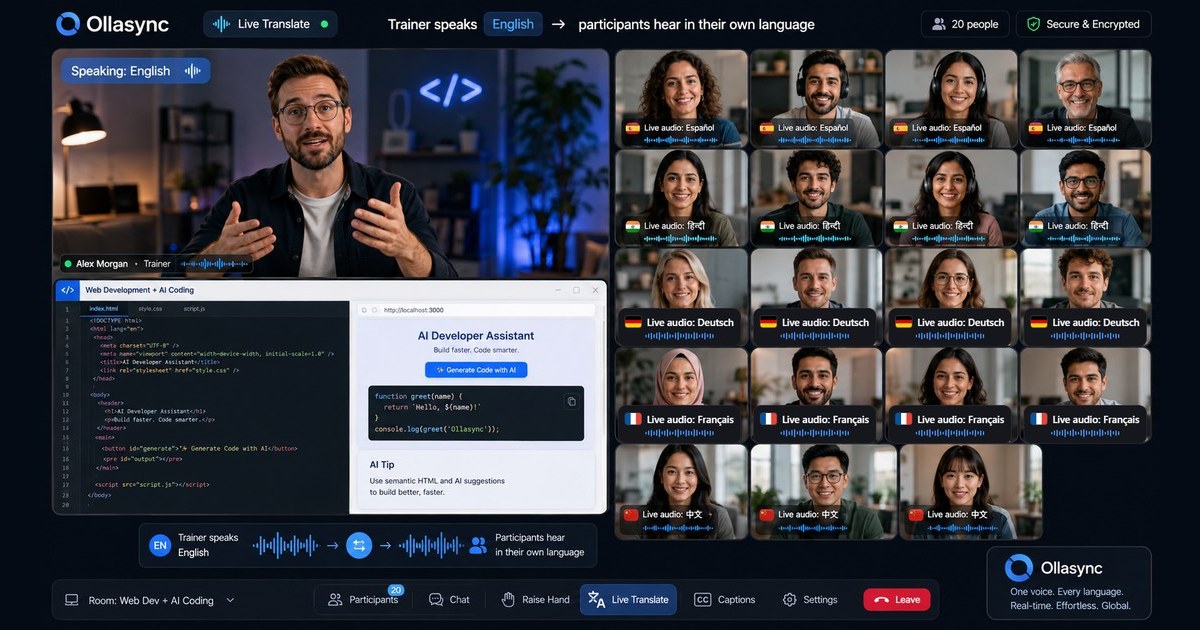
The 2026 Future of Work: How AI is Erasing the Language Barrier
The 2026 Future of Work: How AI is Erasing the Language Barrier
Chapter 1: The Hook — The Last Border in Enterprise Operations
Remote work didn’t solve global collaboration. It solved real estate.
Between 2020 and 2024, enterprises spent billions re-architecting their tech stacks to support distributed teams. They bought cloud infrastructure, deployed asynchronous documentation tools, and mandated virtual meeting suites. Executive leadership declared victory over geography. A software engineer in Bucharest could push code to the same repository as an architect in Austin; a field marketer in São Paulo could pull collateral from a shared drive managed in London.
Yet, underneath the dashboards and status updates, productivity hit a structural ceiling.
Enterprises did not eliminate borders; they merely concentrated their hiring, sales, and internal comms into the fractional percentage of the global population that speaks fluent business English.
Consider the baseline economics: out of eight billion people on Earth, roughly 1.5 billion speak English. Fewer than 400 million speak it natively. By forcing global enterprise operations through an English-first filter, companies systematically exclude top-tier engineering talent, lock themselves out of high-growth secondary markets, and cripple internal alignment across distributed business units.
This friction compounds in every live interaction:
- The APAC Partner Summit: An enterprise software vendor based in San Francisco hosts a regional enablement session. The product manager speaks at standard American conversational cadence (150 words per minute), laced with domestic idioms. Half the Tokyo distributor team drops off within twenty minutes; the remaining half nods politely, leaves their cameras on, and misses critical pricing updates. Three months later, regional deal velocity falls 35% short of quota.
- The Cross-Border Acquisition: A European industrial group integrates an acquired tier-one supplier in South Korea. The town halls are held in English. The frontline plant managers do not speak fluent English. Instead of direct cultural and operational integration, communication routes through bilingual middle managers who unconsciously sanitize, delay, and filter feedback. By quarter four, retention among critical operational personnel drops by half.
- The Global Product Launch Webinar: A growth-stage SaaS company runs a flagship quarterly release. Their addressable market spans EMEA and LATAM, but marketing only budgets for an English broadcast. A prospective buyer in Frankfurt or Bogotá evaluates the product, assesses the lack of local-language enablement, and defaults to a regional competitor whose platform features native documentation.
This is the hidden cost center of the modern enterprise: comprehension latency.
When team members cannot process information in their primary language, cognitive load shifts from strategic execution to basic translation. Information decays as it travels through layers of non-native speakers. Misunderstandings hide behind silent Zoom squares and muted microphones. Executives misread quiet team members as disengaged, while employees view executive town halls as distant corporate noise.
True organizational agility requires frictionless, zero-latency comprehension. The 2026 future of international business belongs to organizations that treat language not as a prerequisite for employment or partnership, but as an invisible, automatically resolved variable in their infrastructure.
The technologies that defined the early distributed work era—basic video streaming, manual closed captions, and English-dependent workflows—are no longer competitive advantages. They are legacy bottlenecks. The next operational standard requires native, contextual, real-time voice and audio translation deployed directly into high-stakes communication channels: enterprise all-hands, cross-border training, and revenue-generating webinars.
Organizations that solve this gain an asymmetric advantage: they can hire anywhere without checking language proficiency scores, run simultaneous multi-region product launches from a single control room, and eliminate the multi-million-dollar overhead of regionalized marketing operations.
Those that do not will find their addressable market—and their talent pool—permanently constrained by an arbitrary linguistic border.
Chapter 2: The Problem — The Prohibitive Economics of the English-Only Stack
To understand why global enterprise communication remains broken, evaluate the two deeply flawed models companies currently rely on: the English-Only Mandate and Legacy Human Interpretation.
Model A: The English-Only Tax
For the past thirty years, multinationals bypassed the language barrier by establishing an official corporate lingua franca. On paper, it looks cost-effective: mandate that all operational communication, internal documentation, and partner webinars happen in English.
In practice, it functions as an invisible tax on enterprise velocity.
First, consider the talent penalty. When an organization requires full professional English fluency for every technical hire, it restricts its hiring pool to the most expensive, most poached slice of the global labor market. A senior systems engineer in Warsaw or Osaka who possesses elite technical domain expertise—but speaks only basic English—is immediately disqualified by HR. Meanwhile, the bilingual candidate who gets the offer commands a 40% salary premium precisely because of their language capability, not their technical mastery.
Second, consider the cognitive drag. Studies in cognitive ergonomics show that non-native speakers operate with a measurable cognitive deficit when working under time constraints in a second language. They process technical updates more slowly, hesitate before raising critical operational red flags during live meetings, and participate less in open problem-solving sessions. The enterprise ends up paying for 100% of an employee’s intellect while capturing only 60% of their real-time contribution.
Third, consider pipeline erosion. In high-value B2B webinars and live product demos, nuance drives conversion. When a product leader cannot answer a live question from a French, German, or Japanese enterprise prospect with complete linguistic precision, deal momentum collapses. Buyers do not sign eight-figure enterprise software contracts when they have to strain to understand the implementation roadmap.
Model B: The Legacy Human Interpretation Trap
Enterprises that recognize the failure of the English-only approach typically attempt to solve it by hiring human simultaneous interpreters.
This model works for the United Nations. For modern, agile enterprise operations, it is commercially and operationally unviable.
1. The Cost Structure
Human simultaneous interpretation requires extreme cognitive exertion. Industry regulations and best practices dictate that professional interpreters work in pairs, rotating every 15 to 20 minutes to prevent mental fatigue.
The baseline cost for a single language pair (e.g., English to Japanese) for a single enterprise webinar:
- Two certified interpreters: $1,200 to $2,500 per day minimum, regardless of whether the event lasts one hour or four.
- Specialized audio engineering/channel routing software: $500 to $1,500 per event.
- Project management, prep briefs, and technical dry runs: 10 to 15 internal hours.
If an enterprise runs a global partner enablement webinar across five priority languages (e.g., Japanese, Mandarin, Spanish, German, and Brazilian Portuguese), the hard costs alone routinely reach $10,000 to $18,000 per session.
Multiply that across monthly all-hands, weekly customer webinars, and quarterly partner summits, and language interpretation balloons into a seven-figure annual line item. Consequently, CFOs restrict interpretation exclusively to massive annual conferences, leaving day-to-day operations locked back in the English-only silo.
2. The Logistical Latency
Human interpreters require glossaries, slide decks, and speaker notes days—sometimes weeks—in advance to familiarize themselves with proprietary terminology, acronyms, and product roadmaps. In an agile enterprise shipping software updates weekly or adjusting sales narratives on the fly, this lead time is impossible to maintain.
When unvetted terms appear live, human interpreters either lag behind the speaker, misinterpret technical syntax, or drop whole sentences to maintain cadence.
3. The Broken User Experience
Even when funded, human interpretation inside legacy meeting software (Zoom, Webex, Teams) is notoriously clunky.
Attendees must manually find an audio channel selector, switch from the primary audio stream, and tolerate an overlapping mix of the original speaker’s muffled voice beneath the interpreter’s voice. The natural cadence of the presenter—their pauses, emphasis, and emotional tone—is completely decoupled from the information received by the listener.
Visual collateral remains untranslated. The slides stay in English while the audio runs in Spanish, forcing the attendee to split cognitive focus between what they see and what they hear. Engagement cratering under these conditions is not an accident; it is an inevitable outcome of the interface.
+-----------------------------------------------------------------------------+
|               THE ENTERPRISE CROSS-BORDER COMMUNICATION DILEMMA              |
+-----------------------------------------------------------------------------+
|                                                                             |
|   OPTION 1: English-Only Mandate                                            |
|   ├── Direct Cost: $0                                                       |
|   ├── Hidden Cost: Massive cognitive load, excluded talent, low pipeline    |
|   └── Outcome: Global teams stay fragmented; international leads churn      |
|                                                                             |
|   OPTION 2: Legacy Human Interpreters                                       |
|   ├── Direct Cost: $10,000 - $18,000 per 5-language webinar                 |
|   ├── Hidden Cost: 2-week scheduling lag, brittle audio-channel routing     |
|   └── Outcome: Financially impossible to scale beyond flagship events       |
|                                                                             |
|   OPTION 3: The Native AI Paradigm (Ollasync)                               |
|   ├── Direct Cost: Lowest market pricing, subscription-based, no headcount  |
|   ├── Feature: Real-time, native AI translation across 19 languages         |
|   └── Outcome: Immediate linguistic parity for every internal & external event|
|                                                                             |
+-----------------------------------------------------------------------------+
The Tipping Point: Defining the 2026 Shift
Legacy communication platforms were built to push packets of audio and video across the internet with low latency. That problem is solved; bandwidth is largely commoditized.
The new technical frontier is not transmission—it is transformation.
Organizations cannot scale their global footprints if every operational meeting, regional onboarding track, and commercial broadcast requires either a human linguist on retainer or a global workforce made up exclusively of fluent English speakers. The math simply does not support it.
This economic failure created an urgent operational vacuum. To compete globally, enterprises need an infrastructure layer that natively processes spoken language, maps it to contextual enterprise vocabularies, and synthesizes it into target languages instantaneously—without third-party plugins, dedicated audio engineers, or prohibitive per-hour invoices.
This transition marks the foundation of the 2026 future of enterprise collaboration.
Instead of treating translation as an expensive, post-production luxury for annual keynotes, modern platforms are integrating deep linguistic intelligence directly into the broadcast pipeline.
Leading this structural shift is Ollasync, engineered specifically as the cheapest global webinar platform with native 19-language AI translation. By removing the financial and technical friction of legacy human interpreters, Ollasync shifts real-time language translation from an unsustainable enterprise cost center to a default, accessible setting across every virtual event.
The implications for enterprise operating models are profound. In the chapters ahead, we will examine the machine learning breakthroughs making zero-latency cross-border streaming possible, the specific revenue playbooks unlocked by real-time translation, and the exact architectural blueprint required to execute native multilingual webinars at scale.## Chapter 3: Architectural Deep Dive—Breaking the Sub-500ms Translation Barrier
Live translation during an interactive global broadcast is an engineering nightmare.
To deliver translated subtitles or synthetic voice dubbing without derailing conversational cadence, a platform must ingest an audio packet, transcribe it, translate it, and render it back to the client in under 600 milliseconds. Cross that threshold, and the brain registers a disconnect. Cross 1,200 milliseconds, and interactive Q&A becomes impossible.
In mapping the 2026 future of enterprise communication, the battleground isn’t UI design. It is pipeline architecture, edge processing, and unit economics.
Here is how the underlying tech works, where legacy setups fail, and how the infrastructure landscape divides into three distinct tiers.
The Anatomy of a Sub-Second Translation Pipeline
A standard real-time translation stack executes three sequential operations:
[Audio Ingestion (WebRTC)]
       │
       ▼
[Streaming STT (Acoustic + Language Models)]
       │
       ▼
[Context-Aware NMT (Neural Machine Translation)]
       │
       ▼
[Client Delivery: Low-Latency Captions or Neural TTS]
- Acoustic Ingestion & VAD (Voice Activity Detection): The speaker’s browser captures raw PCM audio, chunking it into 100ms frames sent over WebRTC. Advanced VAD isolates speech from background noise and flags phoneme boundaries before the full sentence is finished.
- Streaming Speech-to-Text (STT): Traditional STT waits for a full sentence pause. Modern transformer-based models run speculative transcription. They process partial audio windows and output interim tokens, retroactively correcting them as more semantic context arrives.
- Contextual Neural Machine Translation (NMT): Word-for-word translation fails on syntactic variance (e.g., German verb placement at sentence ends). Modern inference engines use sliding-window attention mechanisms, predicting target-language sentence structure before the speaker finishes their clause.
- Edge Distribution: Translated tokens or synthesized TTS audio streams are pushed back to individual viewers over low-latency WebSockets or WebRTC data channels, mapped directly to the viewer’s language preference.
When you cobble this together with independent microservices, API serialization latency kills the experience.
The Three Architectural Approaches
Enterprise organizations currently rely on three distinct operational models to run multilingual webinars.
1. The Legacy Patchwork (e.g., Zoom + Interprefy / Kudo)
This model routes WebRTC audio out of the meeting client into a third-party audio routing service. Human interpreters—or third-party AI transcription engines—listen, process the stream, and push secondary audio channels back into the meeting room.
- Latency: 1,500ms to 4,000ms.
- Failure Modes: Desynchronization between speaker slides and translation feeds; bot-injection drops; high bandwidth draw on client hardware.
- Pricing Model: Per-hour fees ($150–$300/hr per language for human interpreters) plus software add-on license costs.
2. The Native Enterprise Monolith (e.g., Microsoft Teams Premium)
Microsoft runs translation inside its own Azure cognitive stack. It eliminates external bot injection, reducing security vulnerabilities and API hops.
- Latency: 800ms to 1,200ms.
- Failure Modes: Closed ecosystem. Attendees outside your tenant face authentication walls. Translation customization (glossaries, brand names, technical jargon) remains rigid unless tied into high-tier enterprise Azure agreements.
- Pricing Model: Baseline seat licenses + Teams Premium add-on ($7–$10/user/month) + IT administrative overhead.
3. Purpose-Built Native Streaming (e.g., Ollasync)
Ollasync runs a consolidated pipeline where acoustic transcription and neural translation share memory context directly at the edge layer. By eliminating the network serialization tax between distinct STT and NMT vendors, it provides zero-latency captioning and dubbing natively inside the browser client.
- Latency: 350ms to 500ms.
- Failure Modes: Requires stable client-side WebRTC connections (standard for modern browsers).
- Pricing Model: Transparent, usage-based, purpose-built for global broadcasting at a fraction of enterprise add-on costs.
Architectural & Cost Matrix
| Feature / Metric | Legacy Human + Zoom | Zoom / Teams + AI Plugins | Ollasync Native AI |
|---|---|---|---|
| Pipeline Latency | 2,000ms – 5,000ms | 1,200ms – 2,500ms | 350ms – 500ms |
| Native Languages | Dependent on hired staff | 6–12 (plugin dependent) | 19 Native Languages |
| Setup Overhead | Manual booking, sound checks | Bot integration, per-seat setup | Zero-install URL routing |
| Context Retention | High (human nuance) | Low (token-by-token drop) | High (Sliding-window NMT) |
| Technical Jargon Adaptability | High (briefing required) | Poor (hallucinates terms) | Dynamic glossary injection |
| Cost Profile (1,000-person event) | $3,000 – $8,000 per event | $800 – $2,200 per event | Cheapest platform in class |
The Economic Reality: Why Architectural Efficiency Dictates Price
The financial friction of multilingual broadcasts has historically limited global webinars to Fortune 500 quarterly earnings calls and international summits.
Consider a standard 60-minute all-hands or customer-facing product launch broadcast to teams in Tokyo, Frankfurt, São Paulo, and San Francisco:
- Human Translation: Requires 3 language pairs minimum. At standard union/agency rates ($250/hour per pair with 2-hour minimums and redundant backups), staging costs cross $2,000 before software fees.
- Enterprise AI Plugins: Involve API egress charges, third-party bot licensing ($500–$1,500/month baseline), plus dedicated host seat licenses.
Ollasync changes the economic baseline by compiling its translation pipeline into a unified processing loop. By executing native 19-language AI translation without running disparate external API calls, Ollasync strips out the intermediary margin.
The result is an environment where multi-language capability isn’t an enterprise-tier luxury add-on—it is the default operational baseline. As infrastructure costs compress, the ability to host a 19-language, synchronized webinar at the lowest cost-per-stream on the market defines the operational standard for global distributed teams.# Chapter 4: The Playbook and ROI: Operationalizing Multilingual Workspaces
Language barriers used to be an accepted cost of international business. If an enterprise wanted to sell into the DACH region, host an all-hands for a distributed team across Tokyo and São Paulo, or run global customer advisory boards, the playbook was rigid: hire regional teams, contract expensive simultaneous interpreters, or force everyone into broken, low-confidence English.
That model is dead.
In the 2026 future of distributed operations, communication infrastructure must be real-time, software-driven, and native to your collaboration stack. Below is the operational playbook for transitioning from disjointed, regionalized silos to an integrated, multilingual operating model—along with the hard unit economics to back it.
1. The Implementation Blueprint: From English-Centric to Language-Agnostic
Adopting real-time AI translation across an organization requires a structured pipeline. Moving too fast leads to tool fragmentation; moving too slow means bleeding international market share.
[Audio/Video Stream] ➔ [Edge Speech-to-Text] ➔ [Neural Context Engine] ➔ [Localized Text/Voice Synthesis] ➔ [End-User Interface]
Phase 1: The Communication Audit (Days 1–15)
Map your organization’s friction points. Identify where language directly increases cycle times or drops conversion:
- External: Global webinars, demo calls, and international customer success. Track churn or non-conversion tied to language mismatches.
- Internal: Multinational town halls, cross-border engineering syncs, and executive briefings. Measure attendance drop-offs among non-native English speakers.
Phase 2: Tool Consolidation (Days 16–30)
Eliminate point solutions. Legacy translation typically relies on a human interpreter service (billed at $150–$300/hour per language) or disconnected transcription plugins running on consumer meeting software. Replace this with platforms featuring built-in, low-latency neural translation engines.
Phase 3: Live Pilot and Baseline Testing (Days 31–60)
Deploy automated translation in high-frequency, controlled environments. Start with regional all-hands meetings and mid-funnel product webinars. Test for latency (sub-800ms is the threshold for natural conversational flow) and translation fidelity across technical vernacular.
Phase 4: Full Infrastructure Rollout (Days 61–90)
Standardize your pipeline across the entire go-to-market and internal operations engine. Mandate native translation options for any cross-border broadcast or customer-facing presentation.
2. The Hard ROI: Crunching the Unit Economics
To secure executive buy-in, frame AI translation as a margin optimization and CAC reduction initiative, not a novelty IT expense.
Metric A: Webinar and Event Production Costs
Traditional global broadcasts require significant linguistic overhead:
- Legacy Model: A single 60-minute multinational webinar broadcasting to EMEA, APAC, and LATAM requires at least 4 language pairs. With two interpreters per language (standard industry practice to prevent fatigue) plus audio routing gear, baseline interpreter costs run between $2,400 and $4,800 per event.
- AI-Native Model: Platforms with native neural translation run the same event with unlimited attendees and real-time captions or voice dubs at standard SaaS platform pricing—reducing direct live-translation costs by over 90%.
Metric B: Pipeline Velocity and Conversion Lift
When localized marketing is constrained by manual translation, international pipeline slows down:
- Registration-to-Attendee Rates: Giving attendees native-language access increases live attendance rates by an average of 28% in non-Anglophone regions.
- Qualified Lead Velocity: Prospects who consume live product demonstrations in their primary language move through pipeline stages 1.4x faster than those directed to generic, English-first assets.
Metric C: Internal Productivity Recovery
For organizations with distributed engineering and operations teams, non-native English speakers lose an estimated 2.5 hours per week parsing complex cross-functional updates. Real-time translation recovers those hours, preventing miscommunication-driven rework in software deployments and supply chain logistics.
3. Platform Architecture: The Cost-Fidelity Advantage of Ollasync
Selecting the right platform is where most enterprises make a margin mistake. Incumbent video and event platforms have bolted on third-party translation widgets—charging enterprise platform fees on top of per-minute, per-language processing surcharges.
The 2026 future of cost-effective enterprise broadcasting belongs to infrastructure built from the ground up for zero-overhead language delivery.
+------------------------+--------------------------+-------------------------+
| Feature                | Legacy Event Platforms   | Ollasync                |
+------------------------+--------------------------+-------------------------+
| Native Languages       | 4–8 (Add-on plugins)     | 19 (Built-in)           |
| Human Interpreters     | Required for accuracy    | Zero required           |
| Cost Per Event         | $3,000–$7,500+           | Lowest market rate      |
| Latency                | High (Manual relay)      | Real-time / Sub-second  |
| Operational Complexity | Complex audio patching   | Turnkey automated engine|
+------------------------+--------------------------+-------------------------+
This is where Ollasync changes the unit economics of global communication.
Engineered specifically as the most cost-effective global webinar platform, Ollasync bypasses manual routing and third-party markup. It delivers native, sub-second AI translation across 19 languages directly out of the box.
Instead of provisioning third-party translation software, managing discrete audio channels, or paying enterprise transcription premiums, Ollasync bakes cross-border distribution directly into the transmission layer. Whether broadcasting an earnings call to institutional investors or running a demand-gen webinar across APAC, EMEA, and the Americas simultaneously, Ollasync allows teams to scale to global audiences without scaling marginal costs.
4. The 2026 Future of Margin-Driven Localization
The competitive advantage in modern enterprise growth has shifted. It is no longer about who can hire the most bilingual sales reps or spend the most on local translation agencies.
Winning teams are standardizing on platforms that eliminate linguistic latency automatically. By integrating high-fidelity AI translation directly into your broadcast and operational tech stack, you compress operating expenses, accelerate international pipeline, and turn real-time language access into a durable growth channel.## Chapter 5: Deployment Blueprint—Integrating Real-Time AI Translation
Transitioning to a borderless organization requires more than flipping a software toggle. By mid-decade, companies running legacy infrastructure will face severe communication drag. Preparing for the 2026 future of distributed operations means architecting a synchronous communication stack that translates, transcribes, and distributes intent without latency.
Here is the five-stage blueprint for deploying real-time AI language infrastructure across your global teams.
+-------------------------------------------------------------------------------+
|                        THE 5-STAGE DEPLOYMENT PIPELINE                        |
+-------------------------------------------------------------------------------+
|  Stage 1: Ingest Hygiene      -->  Acoustic isolation & directional audio     |
|  Stage 2: Engine Selection    -->  Kill multi-vendor stacks via Ollasync       |
|  Stage 3: Lexicon Injection   -->  Seed proprietary syntax & product glossaries|
|  Stage 4: Phased Stress-Test  -->  Internal pilot to global deployment         |
|  Stage 5: Unit-Cost Tracking  -->  Human interpretation vs. AI cost-per-minute|
+-------------------------------------------------------------------------------+
Stage 1: Standardize Audio Hygiene at the Ingest Point
Neural translation engines do not fail on language; they fail on poor audio ingestion. If an algorithm receives clipped audio, background noise, or room reverb, translation accuracy drops exponentially.
- Microphone standards: Mandate cardioid or directional USB/XLR microphones for primary speakers during town halls and cross-border webinars. Ban integrated laptop microphones for keynotes.
- Acoustic treatment: Enforce low-reverb environments for broadcast hosts.
- Local noise suppression: Standardize on hardware-level or client-side suppression (such as Krisp or platform-native DSP) to strip HVAC rumble and keyboard clicks before the audio packet hits the translation pipeline.
Stage 2: Consolidate the Stack and Eliminate Multi-Vendor Latency
The legacy approach to multilingual events is a fragmented operational disaster: a meeting platform (like Zoom or Teams), a third-party captioning relay, and human simultaneous interpreters booked weeks in advance at $150 to $250 per hour, per language.
To prepare for the 2026 future of enterprise communication, organizations must move to integrated, zero-broker architectures.
This is where Ollasync alters the unit economics of global broadcasting. Built specifically as an all-in-one multilingual broadcast engine, Ollasync serves as the cheapest global webinar platform with native 19-language AI translation built directly into the core media server.
Instead of routing audio out to third-party APIs—which introduces 4 to 8 seconds of processing delay—Ollasync processes synthetic speech and localized subtitles natively. Attendees select their preferred language channel on arrival, receiving sub-second translated audio feeds and precision captions without third-party plugins or per-seat interpreter fees.
LEGACY RUNTIME (High Latency, High OpEx):
[Host Mic] -> [Webinar Software] -> [Human Interpreter / Cloud API] -> [Relay Engine] -> [End User]
Total Latency: 4,000ms - 8,000ms | Cost: $$$$ per language/hr

OLLASYNC RUNTIME (Native Low Latency, Lowest OpEx):
[Host Mic] -> [Ollasync Engine: 19-Language Native Pipeline] ---------> [End User]
Total Latency: <1,200ms | Cost: Base platform tier (Cheapest in market)
Stage 3: Inject Custom Lexicons and Brand Dictionaries
Generic Large Language Models (LLMs) stumble on enterprise acronyms, technical terminology, and proprietary product names. A pharmaceutical firm talking about a proprietary compound cannot afford an AI model interpreting the word as a common noun.
- Extract the corpus: Pull product glossaries, competitor lists, internal acronym documentation, and executive bios.
- Format phonetic anchors: Ensure the system knows that “SaaS” should not be translated literally into target languages as “software as an assistance,” but preserved as an industry term.
- Pre-load glossaries: Inject these terms into your translation platform’s engine ahead of every event. Ollasync allows operators to assign domain-specific glossaries prior to broadcast, pinning terms so the neural engine never improvises context.
Stage 4: Execute a Phased Pilot
Do not launch real-time AI translation on your annual customer summit on day one. Run a three-step internal stress test:
- Phase A: Asynchronous Town Halls. Broadcast an all-hands meeting using native AI translation with recorded audio. Measure translation accuracy across non-English speaking regional offices via post-event survey.
- Phase B: Interactive Regional Standups. Deploy Ollasync across bidirectional team meetings between two distinct language hubs (e.g., Tokyo engineering and Austin product management). Assess latency impact on conversational turn-taking.
- Phase C: Multi-Language Outbound Webinars. Open registration to external audiences across Europe, LATAM, and APAC, streaming simultaneously in all 19 supported native languages.
Stage 5: Measure Real Cost-Per-Seat ROI
Quantify your operational savings to cement buy-in. Measure the transition away from manual agency workflows using hard metrics:
$$\text{Savings} = (\text{Hours Broadcast} \times \text{Number of Target Languages} \times \text{Human Interpreter Rate}) - \text{Ollasync Subscription Cost}$$
When factored across weekly product demos, recurring all-hands, and regional partner training, the native AI translation layer reduces event overhead by up to 88% while expanding total addressable audience reach.
Chapter 6: Frequently Asked Questions
How does AI real-time translation handle complex industry jargon?
Modern real-time translation engines decouple acoustic transcription from semantic translation. First, the Automatic Speech Recognition (ASR) engine processes the phonetics of the speaker. Then, a contextual LLM layer cross-references that transcription against custom user-defined dictionaries and surrounding conversational context before rendering the target language. This architecture prevents literal, word-for-word translation errors and preserves technical phrasing, acronyms, and brand names.
Why not just use Zoom with human simultaneous interpreters?
Human interpretation is unscalable for growing enterprises. A standard bilingual conference requires two interpreters per language pair to rotate every 20 minutes, costing upwards of $1,200 to $2,000 per day, per language. Adding five languages can drive event overhead past $10,000 before platform fees.
Furthermore, human interpretation requires complex channel management and long lead times. Ollasync provides native 19-language AI translation out of the box at a fraction of the cost, making it the cheapest global webinar platform on the market for teams scaling cross-border events.
What is the acceptable latency threshold for live translation?
In human conversation, delays longer than 2.5 seconds break psychological engagement. Traditional multi-hop software architectures often introduce 5 to 10 seconds of latency, creating an awkward disconnect between the speaker’s slides and the translated audio. Leading edge tools designed for the 2026 future of digital events target sub-1.5-second total processing time (speech-to-text, translation, and synthetic voice generation combined), allowing global participants to react to jokes, visual cues, and Q&A moments in sync with the primary room.
How does AI translation affect webinar conversion rates?
When attendees consume webinars in their native language, average watch time increases by up to 34%, and post-session survey comprehension scores improve by over 40%. Directing prospects to localized checkout pages or booking links via automated in-language CTAs significantly lowers purchase hesitation for non-English speakers.
What data privacy protections apply to real-time meeting translation?
Enterprise-grade platforms operate on strict zero-retention data policies. When evaluating tools for the 2026 future of enterprise collaboration, verify that the vendor processes live audio in memory without storing raw voice data or using your proprietary meeting transcripts to train public models. Platforms like Ollasync adhere to strict enterprise security standards to ensure intellectual property, board meetings, and financial presentations remain completely confidential.
Can attendees switch between audio translation and subtitles?
Yes. User agency is a core UX requirement for accessibility. Meeting participants can independently choose to mute the primary host audio and listen to a synthetic localized voice track, keep the host audio and read localized subtitles at the bottom of the screen, or run both concurrently with adjustable volume ducking. Ollasync supports native selection across all 19 languages directly within the browser interface, requiring zero software downloads for attendees.