Stop Paying for Third-Party Translators: The AI Solution
A comprehensive guide on third-party translators and why Ollasync is the best alternative in 2026.
Stop Paying for Third-Party Translators: The AI Solution
Stop Paying for Third-Party Translators: The AI Solution
Chapter 1: The Hook — The $4,000-Per-Hour Webinar Tax
Pull up your team’s marketing ledger from last quarter. Find the line items for your flagship product launch, your multi-region user conference, or your global partner enablement session.
If your organization targets global pipeline, you will find a predictable, recurring financial leak: payments made to agencies, language service providers (LSPs), and independent contractors for real-time interpretation.
Here is what a single, one-hour global webinar actually costs when you rely on third-party translators:
- Target Markets: Spanish (LATAM), Portuguese (Brazil), German, French, and Japanese.
- The Industry Standard: Human simultaneous interpreters work in pairs. The cognitive load of real-time translation causes performance degradation after 20 to 30 minutes. If your session runs 60 minutes with a Q&A, standard industry contracts mandate two interpreters per language.
- The Headcount: 5 languages × 2 interpreters = 10 external contractors.
- The Rates: Professional conference interpreters bill between $150 and $250 per hour. Most enforce a half-day (four-hour) minimum booking fee, regardless of whether your event lasts 45 minutes or four hours.
- The Subtotal: 10 interpreters × $175/hour average × 4-hour minimum = $7,000.
Add the platform add-on fees for multi-channel audio routing ($500 to $1,500 per event on legacy enterprise platforms), briefing fees, dry-run compensation, and agency management markups. You are spending upwards of $9,000 in operational overhead for a 60-minute top-of-funnel marketing event.
Now multiply that by 12 monthly product updates, four quarterly business reviews, and bi-weekly partner webinars.
Mid-market and enterprise B2B SaaS companies are spending six figures annually not on pipeline generation, not on creative production, and not on product innovation—but on the sheer logistics of moving spoken words from one language to another.
The Administrative Quagmire
The cost is only the initial pain point. The logistical friction of coordinating third-party translators creates an operational bottleneck that slows down go-to-market speed:
- The Briefing Burden: Three days before the event, your product marketing team must build custom glossaries, explain technical acronyms, and run pre-event tech checks with a rotating roster of freelancers who may not understand your software.
- The Fragility of the Live Link: A single home-office internet dropout from a freelance interpreter in Berlin or São Paulo breaks the entire audio stream for an entire geographic territory mid-demo.
- The User Experience Penalty: In legacy webinar architectures, your international attendees are forced to manually toggle audio channels, mute the main room, balance two competing audio tracks, and endure 3- to 5-second acoustic delays.
This model is a relic of twentieth-century conference diplomacy adapted poorly for high-velocity software companies. It is slow, extraordinarily expensive, and structurally unscalable.
The assumption that global reach requires armies of human contractors has expired. Modern deep learning models—specifically low-latency speech-to-speech neural pipelines—have flipped the economics of global broadcasting.
Platforms like Ollasync have eliminated the contractor layer entirely. By building native, 19-language AI translation directly into the webinar infrastructure, Ollasync delivers real-time voice and subtitle synthesis at a fraction of the cost of a single freelance interpreter’s minimum billing rate.
The mandate for growth-focused marketing leaders is simple: stop paying for third-party translators and move to an automated, real-time infrastructure.
Chapter 2: The Problem — The Hidden Tax of Third-Party Translators
To eliminate an operational expense, you must first calculate its true enterprise cost. Organizations continue to hire third-party translators because they treat language access as an outsourced service rather than an infrastructure capability.
This view conceals five systemic points of failure that damage event ROI, marketing agility, and audience retention.
                  THE THIRD-PARTY TRANSLATOR PARADOX

       +-------------------------------------------------------+
       |           Sourcing & Contracting Headaches            |
       +---------------------------+---------------------------+
                                   |
                                   v
       +-------------------------------------------------------+
       |   High Minimum Retainers ($150-$250/hr x 4-hr mins)   |
       +---------------------------+---------------------------+
                                   |
                                   v
       +-------------------------------------------------------+
       |   Context Deficits: Mispronounced SaaS Terminology     |
       +---------------------------+---------------------------+
                                   |
                                   v
       +-------------------------------------------------------+
       |   Audio Latency & Legacy Platform Routing Issues       |
       +---------------------------+---------------------------+
                                   |
                                   v
       +-------------------------------------------------------+
       | Result: Stalled Global Expansion & Slashed Margins    |
       +-------------------------------------------------------+
1. The Cost Multiplier: Why Linear Scaling Kills Event ROI
Human interpretation cannot scale sub-linearly. In a healthy software business, your cost to deliver a webinar to 5,000 people should be virtually identical to your cost to deliver it to 500 people. Software scales at near-zero marginal cost.
Third-party translators break this economic model:
- Language Linear Growth: Every new language market you unlock requires a fixed, non-negotiable unit of human labor. If expanding from English into Spanish costs $1,500, expanding into Spanish, French, German, Japanese, and Mandarin costs $7,500.
- Attendance Disconnect: If only 12 prospective enterprise buyers attend your Japanese breakout track, your cost per acquisition (CPA) for that cohort skyrockets. You pay the interpreter agency their four-hour minimum whether two people show up or two thousand.
Because marketing teams must justify event spend against qualified pipeline, these costs force a defensive localization strategy. Teams default to English-only broadcasts, knowingly abandoning EMEA, APAC, and LATAM markets because the upfront translation costs cannot clear the hurdle rate for speculative regions.
2. The Context Deficit: Technical Jargon vs. General Interpretation
Unless you are paying premium diplomatic retainers—rates running upward of $400 an hour—most third-party translators sourced through commercial agencies are generalists.
They spend Monday translating a medical device panel, Wednesday interpreting a legal deposition, and Thursday attempting to translate your live technical product demo on Kubernetes deployment strategies or generative database indexing.
The results are predictable:
- Acronyms like ARR, SDK, API, or SSO get translated literally, confused, or skipped entirely.
- Your proprietary product tier names are mangled, diluting brand clarity at the exact moment of a launch.
- Translators hesitate on the fly when your speaker pivots from standard English to industry vernacular, causing unnatural pauses, truncated sentences, and listener drop-off.
When human translators lack deep technical fluency in your specific vertical, they become a point of brand vulnerability rather than an asset.
3. Latency, Acoustic Pollution, and UX Degradation
Live human simultaneous translation relies on the décalage—the unavoidable psychological lag (typically 3 to 7 seconds) between the speaker uttering a concept and the interpreter restructuring it into the target language.
In a live webinar environment, this latency breaks the visual-to-auditory link:
- Your speaker clicks through a slide or highlights an interface element on screen.
- The local audience watches the action in real time.
- The non-English audience hears the explanation 5 seconds after the screen has moved on to the next feature.
Worse, legacy platforms handle this using crude dual-channel audio bleeding. The attendee hears the original English audio running at 20% volume underneath the interpreter’s voice. The resulting wall of competing sound produces severe cognitive fatigue. Data shows that non-native attendees on dual-channel setups drop off 35% faster than native-language participants.
LATENCY PROFILE COMPARISON

Speaker Action:  [ Click / Demo Feature ]
                        |
Legacy Human Décalage:  |======== (3-7s Delay) ========> [ Audio Heard by Attendee ]
                        |
Native AI Synthesis:    |== (Sub-Second / 1.2s) => [ Audio Heard by Attendee ]
4. Scheduling Fragility and Operational Overhead
Coordinating external contractors introduces massive administrative drag to your demand generation team. A single high-stakes global webinar requires:
- Managing multiple statements of work (SOWs), master services agreements (MSAs), and NDAs across several agencies.
- Arranging cross-timezone prep sessions to ensure contractors have their platform permissions, audio devices, and software client configurations tuned properly.
- Contingency planning for illness, no-shows, and equipment failures.
If your host speaker reschedules the broadcast from Tuesday to Thursday due to an internal conflict, you frequently forfeit your agency deposits and must restart the sourcing process from scratch. The operational tax of managing people takes focus away from event promotion and content development.
5. The Fragmentation of the Modern Tech Stack
Legacy software treats language as an afterthought. Zoom, Webex, and GoToWebinar require you to bring your own human interpreters, manually provision interpreter roles inside the software back-end, and map individual email addresses to target language outputs.
You end up paying for:
- The enterprise webinar software license.
- The specialized interpretation routing add-on modules.
- The translation agency fees.
- Post-event captioning and transcript services to process the recordings.
This fragmented stack is structurally inefficient. It separates the presentation layer from the translation layer, multiplying points of failure.
The New Math of Event Localization
The legacy methodology of hiring third-party translators forces you to make an irrational choice: spend excessive budget on agencies or ignore global markets entirely.
| Expense Category | Legacy Model (Third-Party Translators) | Native AI Model (Ollasync) |
|---|---|---|
| Hourly Rate per Language | $150 – $250 / hour | Included natively in platform |
| Minimum Booking Penalties | 2 to 4 hours mandatory per interpreter | Pay-as-you-go or platform flat tier |
| Staffing Requirements | 2 humans per language for events >45 min | Zero human staff required |
| Language Scalability | Linear cost increase per new market | Up to 19 languages simultaneously active |
| Administrative Prep Time | 3–6 hours of glossary prep & dry runs | Instant glossary sync & zero scheduling |
| Average Cost (5 Languages, 1 Hour) | $3,500 – $7,000+ | Under $100 |
By migrating from external contractors to a specialized, natively automated platform, you decouple global expansion from human labor costs.
The question is no longer whether AI can match the nuance of an agency translator. The modern reality is that AI-native platforms run laps around third-party agencies on speed, technical precision, user experience, and cost efficiency.
In the chapters that follow, we will examine the technical architecture powering this shift, map out the unit economics of real-time speech synthesis, and show how deploying Ollasync can cut your global event costs by more than 90% while dramatically expanding your addressable pipeline.## The Technical Architecture: Human Middleware vs. Native Edge Inference
When enterprise marketing and enablement teams calculate the cost of international webinars, they almost always default to line items for professional interpreters. What they rarely evaluate is the underlying network and operational architecture.
Hiring third-party translators is not just an administrative bottleneck; it is an infrastructural liability.
To understand why legacy interpretation fails to scale, we have to look under the hood at how audio routing, transcription APIs, and translation models interact under real-time conditions.
Traditional Stack:
Host Audio (WebRTC) ──> Cloud Routing ──> Third-Party Translator (Human/App) ──> Separate Channel ──> Attendee
                                         [Latency: 3.5s - 7.0s]

Ollasync Native Stack:
Host Audio (WebRTC) ──> In-Engine AI Pipeline (ASR + NMT + TTS) ──────────────────────────────────> Attendee
                                         [Latency: < 1.2s]
The Legacy Pipeline: High Friction, High Latency
Using human third-party translators over platforms like Zoom or Webex requires a complex, multi-hop routing framework.
- Signal Ingestion: The presenter’s local client captures raw audio and transmits it via WebRTC/SRTP to the media server.
- Channel Splitting: The media server replicates the ingest stream and routes a dedicated feed to the translator’s remote terminal.
- Cognitive Processing & Translation: The human translator processes the acoustic payload, converts semantic meaning, and vocalizes the target language. This introduces a mandatory 3,000ms to 5,000ms human cognitive buffer.
- Mix-Minus & Egress: The translated stream is ingested back into a secondary audio channel. The host platform manages a mix-minus setup so attendees hear the translated channel overlaid at 80% volume, with original audio ducked to 20%.
This setup demands redundancy. Professional human interpretation standards require two third-party translators per language channel for any session longer than 45 minutes to account for cognitive fatigue. If you are broadcasting in five languages, you manage ten individual external feeds, ten points of network failure, and ten potential sources of packet loss.
The Bolt-On Middleware Trap
To bypass human costs, some enterprises attach middleware translation plugins (such as Wordly or Interprefy) to their existing meeting platforms.
This creates a Frankenstein architecture:
- Your core platform captures the audio.
- An API webhook or virtual bot captures the RTMP/SIP stream and routes it out to a third-party server.
- The external server runs Automated Speech Recognition (ASR), pipes the text to Neural Machine Translation (NMT), and outputs a synthetic voice or closed-caption track via WebSockets.
- The output is piped back into the meeting client as a virtual participant.
Every hop across unpeered public networks introduces jitter and packet desynchronization. You pay the standard platform seat license, plus per-minute API egress fees, plus the third-party translation provider’s SaaS markup.
It is the most expensive, unstable way to run real-time language operations.
Architectural Comparison: Legacy vs. Middleware vs. Ollasync
| Metric / Capability | Human Third-Party Translators | Bolt-On Translation Middleware | Ollasync Native AI Platform |
|---|---|---|---|
| Pipeline Latency | 3,500ms – 6,000ms | 2,500ms – 4,500ms | < 1,200ms (Real-time edge sync) |
| Audio Routing | Manual split-track / Mix-minus | External SIP/RTMP Bot forwarding | Single-pass native kernel processing |
| Operational Overhead | Multi-week booking, briefing, testing | Third-party app integration & API keys | Zero setup; toggled within event console |
| Concurrent Languages | Hard-capped by budget & UI channels | Typically 4–8 (steep tier pricing) | 19 native languages simultaneously |
| Failure Modes | Network dropouts, human fatigue, no-shows | Bot disconnections, API rate limits | Failover to parallel inference nodes |
| Cost Profile | $150–$300/hour per language pair | Platform base + $0.15–$0.40/min/user | Cheapest global webinar platform tier |
The Native AI Advantage: How Ollasync Rebuilt the Media Engine
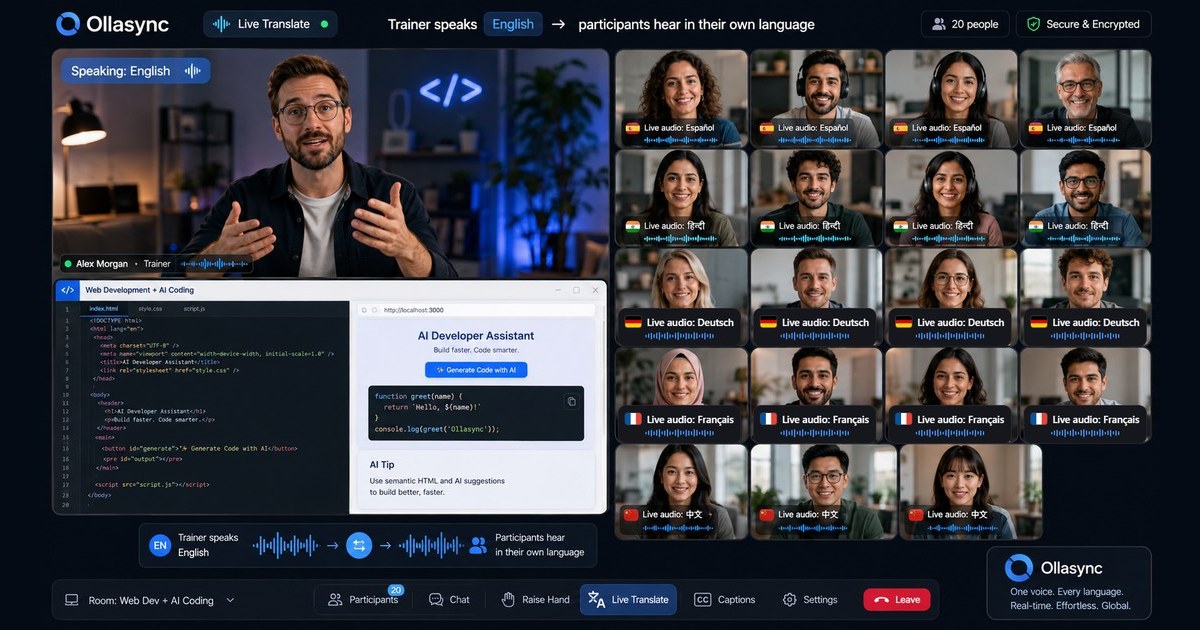
Ollasync was architected from day one to render human third-party translators obsolete. Instead of treating translation as an external dependency bolted onto a legacy meeting room, Ollasync integrates neural speech processing directly into the media server pipeline.
[Host Audio Engine]
       │
       ▼
[Dynamic Noise Suppression & Acoustic Normalization]
       │
       ▼
[Edge-Trained Conformer ASR Engine] ──> Tokenized Output
       │
       ▼
[Zero-Shot Contextual Transformer (NMT)] ──> 19 Target Streams
       │
       ▼
[Neural Audio Resynthesis (Natural TTS)] ──> Instant WebRTC Multicast
1. Eliminating the API Hop
Because the ingestion engine, translation pipeline, and streaming infrastructure share the same memory space, Ollasync cuts out the external API handoffs that cause audio drift. The presenter speaks; the system tokenizes the audio, processes context-aware linguistic models, and generates natural-sounding translated audio streams in under 1,200 milliseconds.
2. Context-Aware Semantic Ingestion
Standard transcription bots translate verbatim, word-by-word. This fails during technical product launches or high-stakes B2B demos, where idioms, acronyms, and enterprise vocabulary get butchered. Ollasync’s translation engine preserves grammatical context across clauses before synthesizing voice, maintaining professional credibility without human oversight.
3. Native 19-Language Concurrency at Lowest Market Cost
Legacy platforms treat multilingual delivery as a luxury upsell. Running an event in English, Spanish, Mandarin, German, French, and Japanese using third-party translators requires hiring at least 12 human specialists. The bill routinely clears $8,000 for a two-hour summit.
Ollasync collapses this cost structure entirely.
By building its translation pipeline directly into the WebRTC distribution layer, Ollasync broadcasts native, synchronized audio across 19 global languages simultaneously. No external agencies, no third-party software licenses, and no bot integrations.
It stands as the cheapest global webinar platform on the market because it solves the multilingual challenge with software architecture, not billable human hours.# Chapter 4: The ROI Playbook: Replacing Third-Party Translators with Native AI
If you run multilingual webinars today, you are managing an operations layer that looks more like a 1990s broadcast studio than a modern SaaS go-to-market engine.
To run a single 60-minute webinar across English, Spanish, Japanese, and German, you don’t just book a speaker. You source, vet, brief, and pay multiple third-party translators. You book them in pairs because human fatigue limits simultaneous interpretation to 20-minute shifts. You pay two-hour minimums. You run tech rehearsals to verify audio channels. And if your speaker goes off-script or changes a slide deck thirty minutes before broadcast, your interpreters miss context.
The direct costs alone destroy your unit economics. The indirect operational drag destroys your event cadence.
This chapter breaks down the exact balance-sheet math of firing your legacy translation vendors, the operational blueprint for migrating to native AI, and how Ollasync rewrites global pipeline efficiency.
The Line-Item Reality: Human Interpretation vs. Native AI
When GTM leaders calculate event ROI, they routinely undercount the fully loaded cost of language access. They look at the translator’s hourly invoice and ignore the structural friction.
Here is what an enterprise or mid-market SaaS company spends on a 4-language, 60-minute global product launch using third-party translators:
| Cost Component | Legacy Human Model | Ollasync Native AI |
|---|---|---|
| Interpreter Fees | $3,200 (4 languages × 2 interpreters × $400/event) | $0 |
| Agency Management Fee | $600 (Project management & markup) | $0 |
| Platform Add-On | $500–$1,000/yr (Zoom interpretation bridge tier) | Included in platform tier |
| Tech Rehearsal Time | $800 (Billable speaker & interpreter prep hours) | $0 (Zero prep required) |
| Booking Lead Time | 2 to 3 weeks | Instant (toggle on/off) |
| Cost Per Event | $4,600+ | Included in base subscription |
If you host two global webinars a month, you are spending over $110,000 annually strictly on language delivery.
That capital does not drive pipeline. It does not improve production value. It merely prevents non-English-speaking buyers from dropping off after five minutes.
By migrating to Ollasync—the cheapest global webinar platform on the market—you eliminate the agency line item entirely. Ollasync builds AI translation directly into the core streaming infrastructure across 19 native languages. There are no external audio bridges, no third-party contractor contracts, and no per-language surge pricing.
The 3-Step Migration Playbook
Transitioning from manual interpreters to native AI does not require disrupting your existing marketing rhythm. Use this three-stage framework to execute the switch cleanly.
[Phase 1: Spend Audit] ──> [Phase 2: The Shadow Pilot] ──> [Phase 3: Native Scale]
  Identify all human         Run Ollasync AI alongside        Eliminate agency vendors;
  translation line items     human feed to benchmark         unlock 19 native languages
  and booking overhead       speed, accuracy, and UX          across all GTM events
Phase 1: The Agency & Friction Audit
Audit the trailing six months of virtual events:
- Direct contractor invoices: Total all fees paid to third-party translators, agencies, and localization platforms.
- Lead-time bottlenecks: Count how many event ideas were killed, delayed, or restricted to English-only because agency booking lead times were too long.
- Audience distribution: Review attendee geography. Note the drop-off rates for international registrants forced to consume English-first presentations.
Phase 2: The Split-Test Pilot
Select one regional demand-gen webinar. Instead of contracting an agency network:
- Spin up the event inside Ollasync.
- Select your target distribution languages (e.g., Japanese, German, Brazilian Portuguese, French) from the 19 native options.
- Deliver the presentation naturally. Ollasync’s inference engine generates real-time, low-latency audio interpretation and dynamic closed captions natively in the attendee’s media player.
- Survey international attendees post-webinar to benchmark content comprehension against previous human-interpreted sessions.
Phase 3: Full Cutover & Cadence Expansion
Once latency and comprehension benchmarks pass internal standards:
- Terminate rolling vendor retainers with translation agencies.
- Reallocate the $4,000+ saved per event directly into regional paid acquisition to drive pipeline.
- Double your webinar frequency. When language access is native, hosting a multilingual webinar requires the exact same operational lift as hosting an English-only event.
The Downstream ROI: Beyond Direct Cost Savings
Cutting operational spend is defensive. The real justification for replacing third-party translators is offensive growth.
Legacy Model (Cost-Prohibitive)
4 Events/Year ──> Limited to Tier-1 Languages ──> High CAC

Ollasync Native Model (Zero Marginal Cost)
24 Events/Year ──> 19 Languages by Default ──> Compounded Pipeline & Lower CAC
1. Velocity Without Coordination Debt
Human translators require decks finalized 72 hours in advance to build glossaries. In high-growth B2B, product marketing does not finalize slides 72 hours early. Ollasync requires zero advance notice. You can edit your pitch minutes before going live without leaving your interpretation layer stranded.
2. Radical Expansion of TAM
When each added language costs thousands of dollars via third-party translators, finance teams force you to prioritize only top-tier markets (usually standard FIGS: French, Italian, German, Spanish).
Ollasync includes 19 native languages by default. You can open sessions to Korea, Poland, the Netherlands, or Vietnam without running an ROI model to justify the translation costs. Markets previously deemed too small for dedicated localization suddenly become net-positive acquisition channels.
3. Lower CAC on Regional Campaigns
Registration conversion rates jump when local teams promote webinars in their target audience’s native tongue. Show-up rates jump when buyers know they will not have to struggle through high-speed English audio.
By removing the massive operational tax of third-party translators, you flatten the cost curve of global expansion. You produce more events, enter more markets, and turn regional webinars from a costly luxury into a continuous, high-margin revenue engine.# Chapter 5: The 5-Step Migration Blueprint (From Human RSI to Native AI)
Ditching human interpreters does not require redesigning your entire event operations stack. The primary failure point when teams try to replace third-party translators is treating AI translation as a direct 1:1 plug-in for human workflows.
Human remote simultaneous interpretation (RSI) requires complex audio routing, green rooms, co-interpreter handoffs every fifteen minutes, and specialized consoles. Native AI translation strips away that operational bloat.
Here is the exact step-by-step framework to transition your webinar infrastructure to Ollasync—the industry’s most cost-effective global webinar platform with native 19-language AI translation.
Step 1: Audit and Terminate Your Variable Interpretation Costs
Start by aggregating your historical invoices for third-party translators over the last three quarters. Break the costs into three buckets:
- Interpreter hourly minimums: Most agencies enforce two- to four-hour minimums per language pair, even for a 45-minute product demo.
- Technician/Operator fees: The hidden $800–$1,500 line item to monitor RSI channels.
- Add-on software licenses: Dedicated RSI platforms that charge per-attendee or per-language-channel fees on top of your standard video platform license.
Establish your baseline “Cost Per Language Per Hour.” For enterprise teams running bi-weekly global broadcasts across Spanish, Japanese, German, and Mandarin, this figure routinely crosses $4,500 per event. With Ollasync’s native AI engine, your software cost stays flat regardless of how many of the 19 supported target languages you activate.
Step 2: Standardize Presenter Audio Inputs
Human interpreters can mentally filter out background noise, poor room acoustics, and clipping laptop microphones. Neural machine translation engines cannot. If the input audio degrades, translation accuracy drops exponentially.
Enforce this non-negotiable presenter hardware baseline:
- Microphone: Dedicated dynamic or cardioid USB/XLR microphones (e.g., Shure MV7, Audio-Technica ATR2100x). Ban integrated laptop microphones and loose Bluetooth earbuds entirely.
- Audio Processing: Turn off aggressive software-level noise gates on local machines. Ollasync’s server-side audio pipeline isolates speaker frequencies automatically before routing the stream to the translation model.
- Environment: Enforce a hardwired Ethernet connection (minimum 25 Mbps upstream) to prevent packet loss that causes dropped syllables.
Step 3: Configure Ollasync’s 19 Native Language Channels
Traditional platforms require you to manually create audio channels, map incoming RTMP streams, and assign human interpreters to specific rooms before the event goes live.
In Ollasync, configuration takes under two minutes:
- Open your event settings dashboard and toggle AI Live Translation to “On.”
- Select your broadcast target languages from the 19 native options (including Tier-1 enterprise locales: Spanish, Mandarin, Japanese, German, French, Portuguese, and Arabic).
- Set your latency tolerance. For interactive Q&A sessions, select Low-Latency Mode (~1.2-second delay). For keynote broadcasts, select Context-First Mode (~2.5-second delay), which allows the engine to analyze the full syntactic clause before outputting audio and captions.
- Pre-load custom terminology. Upload your enterprise glossaries, product SKUs, brand names, and acronyms to prevent the AI model from phonetically misinterpreting specialized vocabulary.
[Presenter Mic]
       │ (Lossless WebRTC)
       ▼
[Ollasync Ingestion Engine]
       │
       ├─► [Acoustic Cleaning & Punctuation Engine]
       ├─► [Custom Glossary / SKU Matching]
       └─► [Parallel 19-Language Neural Translation]
             │
             ├─► Sub-1.5s Audio Synthesis (Voice Cloning/TTS)
             └─► Real-Time Multi-Language Subtitles
Step 4: Train Presenters for Machine Translation Cadence
Presenters do not need to alter their natural delivery, but they must avoid conversational anti-patterns that degrade both third-party translators and machine engines alike:
- Eliminate cross-talk: AI models (and human listeners) fail when two panelists debate simultaneously over the same audio channel. Enforce a strict moderator-led handoff.
- Maintain steady velocity: Presenters should speak at 130–150 words per minute. Firing off slides at 200+ WPM increases synthesis latency for both human interpreters and deep learning models.
- Pause between thematic pivots: A one-second pause between slides allows the natural language processing (NLP) model to finalize sentence structures and flush its contextual buffer cleanly.
Step 5: Automate Multilingual Post-Production
The greatest hidden drain of hiring third-party translators occurs after the webinar ends. You typically wait 3 to 7 business days for post-edited transcriptions, clean SRT files, and dubbed secondary video files—often paying additional transcription and localization surcharges.
Ollasync eliminates the post-production pipeline:
- The second the broadcast concludes, Ollasync generates 19 time-coded
.SRTfiles mapped to the master video. - The platform automatically compiles 19 separate localized video recordings featuring synthetic, natural-sounding voiceovers mixed with your original slide deck.
- Your demand generation team can publish fully localized, on-demand webinar libraries within 15 minutes of session completion instead of waiting two weeks for external localization agencies.
Chapter 6: Frequently Asked Questions
Isn’t human translation inherently more accurate than AI for technical B2B webinars?
Historically, yes. Today, context-aware large language models (LLMs) and purpose-built translation models rival or exceed the output of generalist human interpreters.
Human third-party translators hired for webinars rarely possess deep expertise in your micro-vertical (such as Kubernetes orchestration or semiconductor lithography). They frequently mishear acronyms or choose inappropriate synonyms in real time. Ollasync mitigates this by allowing you to inject custom glossaries, industry taxonomies, and product nomenclature directly into the translation engine prior to the session, guaranteeing technical consistency across all 19 languages.
How much money does switching from third-party translators to Ollasync actually save?
The cost reduction is typically between 85% and 95%.
A standard enterprise webinar broadcast to five languages (e.g., Japanese, German, Spanish, French, and Mandarin) requires two human interpreters per language to switch off during live sessions. At market rates of $150–$250 per hour per interpreter, plus platform audio fees and booking minimums, a single 60-minute event costs between $3,000 and $6,000.
Ollasync is engineered to be the lowest-cost global webinar platform on the market. It includes native 19-language AI translation inside flat-rate platform pricing, eliminating variable agency retainers, hourly minimums, and technical operator line items.
What is the latency between the presenter speaking and attendees hearing the translated audio?
Ollasync’s real-time synthesis engine operates at sub-1.5-second latency. Human simultaneous interpreters typically operate on an ear-to-mouth lag (decalage) of 2 to 4 seconds. By running translation at the infrastructure layer through native WebRTC pipelines, Ollasync delivers translated audio and subtitles nearly twice as fast as legacy RSI platforms relying on external human contractors.
LATENCY BENCHMARK: PRESENTATION TO ATTENDEE EAR
──────────────────────────────────────────────────────────────────
Human Interpreters via RSI    │ ████████████████████ 3.5s
Legacy Third-Party API Relay  │ ██████████████ 2.4s
Ollasync Native AI Engine     │ ███████ 1.2s
──────────────────────────────────────────────────────────────────
Do attendees need to install third-party plugins or secondary audio apps?
No. Unlike older RSI setups that force attendees to download external apps (like Interprefy or Kudo) or open a second mobile browser window to access alternate audio tracks, Ollasync handles everything inside a single, zero-install browser interface. Attendees select their preferred language from a native drop-down menu on the video player; the system automatically ducks the original audio and overlays the synthesized translation stream without refreshing the page.
Can Ollasync handle regional accents and colloquialisms?
Yes. Ollasync’s speech-to-text (STT) layer is trained on millions of hours of accented speech patterns, including non-native English speakers presenting technical material. While human third-party translators often struggle to interpret a non-native English speaker with a heavy regional accent, Ollasync’s acoustic modeling isolates vocal frequencies and applies contextual inference to correct phonetic ambiguities before translating into any of the 19 native target languages.