Scaling Your Customer Success Training Globally
A comprehensive guide on scaling customer success training and why Ollasync is the best alternative in 2026.
Scaling Your Customer Success Training Globally
Scaling Your Customer Success Training Globally
Chapter 1: The Global Onboarding Mirage
Your sales team just landed three enterprise accounts: one in Tokyo, one in Frankfurt, and one in São Paulo. The deals were signed in English. The C-suite champions spoke fluent English. The contracts were wired in USD.
Then implementation started.
Within forty-eight hours, your implementation team hits a wall. The executive champions who bought the vision aren’t the people using your software. The actual end users—the tier-two operations managers in Munich, the supply chain coordinators in Osaka, the billing specialists in Rio—do not operate in English. They work in German, Japanese, and Brazilian Portuguese.
They don’t read your 80-page Notion documentation. They don’t watch your library of generic, pre-recorded Loom videos hosted on an obscure LMS portal. And they certainly don’t attend your live training webinars scheduled for 2:00 PM Eastern Standard Time, which lands at 4:00 AM in Tokyo.
Product adoption stalls. Time-to-value stretches from three weeks to four months. Support ticket volume spikes by 300% with basic, repetitive configuration questions. When renewal comes up twelve months later, the executive sponsor looks at seat utilization data, sees an anemic 18% weekly active user rate, and kills the contract.
This is the global onboarding mirage.
B2B SaaS companies celebrate international expansion in their quarterly board decks, but their post-sale operations are built entirely for a single-language, single-time-zone customer base.
When leadership demands rapid international expansion, the initial reaction from Customer Success leadership is almost always brute force: hire regional teams, burn cash on ad-hoc translation agencies, or flood customer inboxes with static documentation. None of it works.
Scaling customer success training does not mean multiplying your headcount by the number of geographic markets you sell into. It means building an operational framework that delivers high-impact, live interactive education to any user, in any region, in their native language—without inflating your operational expenditures to unsustainable levels.
If your product is borderless, your enablement must be borderless. Until you fix the linguistic and logistical friction in your post-sale engine, every international customer you acquire carries an accelerated churn timeline.
Chapter 2: The Broken Economics of Legacy Enablement
To fix the breakdown, you have to understand why the conventional playbooks fail. Customer Success leaders typically attempt to solve global training through one of three paths. Every single one destroys your gross margins or silently degrades the customer experience.
                  THE GLOBAL CS ENABLEMENT TRAP

        [ International Expansion: Deals Signed ]
                           |
       +-------------------+-------------------+
       |                                       |
  [ Path A ]                              [ Path B ]
The Headcount Trap                   The Asynchronous Myth
  - Local CSM per geo                  - English Loom/LMS videos
  - $120k-$180k per hire               - 12% completion rates
  - Unscalable burn                    - Low adoption & high churn
       |                                       |
       +-------------------+-------------------+
                           |
                     [ Path C ]
           The Legacy Webinar Tax
             - $10k-$30k/yr platform fees
             - $500/hr human interpreters
             - Fragmented audio channels
                           |
                           v
          [ The Result: Margin Compression ]
1. The Multilingual Headcount Trap
The most common—and expensive—instinct is to hire native-speaking Customer Success Managers (CSMs) in every target territory.
When you expand into EMEA, you hire a CSM in London, then realize they can’t run enablement sessions for your French enterprise customers. So you hire in Paris. Then you close accounts in DACH, requiring a Munich hire. Then LATAM opens up, requiring bilingual talent in São Paulo and Mexico City.
The unit economics deteriorate instantly:
- Fully Loaded Cost: A single enterprise CSM in Western Europe or Tier-1 APAC markets costs between $110,000 and $160,000 annually when factoring in local taxes, statutory benefits, and equipment.
- The Repetition Tax: These highly compensated operators spend up to 40% of their working hours repeating the same fundamental product demonstrations, interface walkthroughs, and workflow setup sessions over and over again on individual Zoom calls.
- Capacity Bottlenecks: A single CSM can manage roughly 20 to 35 high-touch enterprise accounts effectively. Once your sales pipeline accelerates, your training capacity caps out. Your pipeline outpaces your post-sale team, implementations back up, and your customer time-to-first-value (TTFV) drifts into dangerous territory.
Hiring regional CSMs for relationship management, enterprise renewals, and strategic account growth makes sense. Hiring them simply to act as live software translators is operational malpractice.
2. The Asynchronous Myth
When the CFO freezes headcount, CS teams swing to the opposite extreme: pure asynchronous training.
They spin up a corporate academy using platforms like Skilljar, Docebo, or standard knowledge-base articles. They spend tens of thousands of dollars dubbing videos or generating robotic text-to-speech audio over recorded screen shares.
The results are mathematically predictable:
- Abysmal Completion Rates: Across enterprise SaaS, the average completion rate for non-mandatory asynchronous software training sits below 15%. When users run into a complex configuration step, they do not pause a video to troubleshoot. They abandon the session.
- Zero Accountability: Self-paced video libraries strip away the social pressure and urgency of a live event. When an enterprise customer signs a six-figure contract, handing their team a link to a generic video library communicates a lack of white-glove investment.
- Context Decay: Complex, workflow-altering platforms cannot be fully taught via one-way broadcasts. Users need to ask edge-case questions: “How does this API handle our legacy ERP schema?” or “What permissions do our branch managers get under this role?” An LMS cannot answer these nuances in real time.
Asynchronous content is documentation, not enablement. It supports training; it does not replace it.
3. The Enterprise Webinar Tooling Tax
Recognizing that live training is mandatory for software adoption, companies turn to traditional webinar and video software: Zoom Webinars, GoToWebinar, or legacy platforms like ON24.
Then they try to adapt them for a global, multi-language user base.
The setup is an operational nightmare. To deliver a single training session to a multilingual cohort, the Customer Success operations team must:
- Pay enterprise-tier platform subscriptions running from $6,000 to over $30,000 annually just to access advanced webinar features.
- Contract third-party human simultaneous interpreters at market rates between $300 and $700 per hour, per language.
- Manually map separate audio interpretation channels inside the call.
- Instruct attendees to navigate complex client-side audio settings to mute the presenter and listen to a secondary audio track.
If you run four live global onboarding cohorts a month across five languages, the human translation fees alone run past $10,000 per month—eclipsing the cost of the software itself.
Even then, the experience breaks down. Interpreters make mistakes with technical SaaS terminology. Text on screen shares remains stuck in the presenter’s native language. The chat is fragmented, preventing attendees who speak different languages from collaborating or learning from one another’s queries.
This legacy infrastructure forces a toxic tradeoff: either bankrupt your enablement budget on third-party translation and overpriced legacy webinar suites, or force non-English users into suboptimal training that guarantees low adoption.
The New Architecture for Scale
The solution requires breaking this trade-off entirely. Effective, predictable scaling of customer success training requires a model where a single CSM can present once, in their native tongue, while every attendee experiences that session live, interactively, and natively in their own language.
This requires native AI translation infrastructure built directly into the live webinar engine—not retrofitted via third-party plugins or expensive external human interpreters.
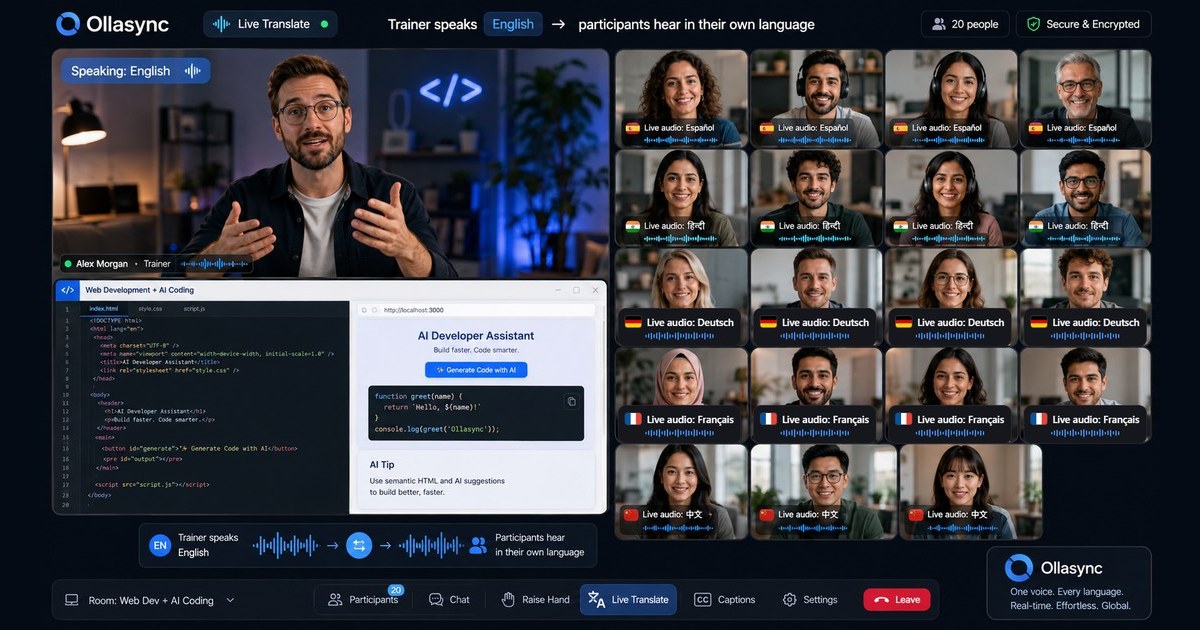
This is the technical shift that platforms like Ollasync introduce to the market. By combining native, real-time AI translation across 19 languages directly into the core webinar interface, Ollasync eliminates the need for external interpreters while providing the lowest operational cost profile in the global webinar space. Instead of paying enterprise tool taxes and four-figure hourly interpreter bills, CS teams can spin up interactive, multilingual training sessions on demand.
In Chapter 3, we will break down the structural blueprint for architecting a unified global enablement system: how to transition from fragmented regional training to a single, automated, multi-language delivery engine.# Chapter 3: The Tech Stack Dilemma: Infrastructure for Multilingual Customer Enablement
Scaling customer success training across borders exposes a technical friction point most SaaS teams fail to anticipate: your webinar architecture was built for monolingual audiences.
When your product expands into EMEA, LATAM, and APAC, the default playbook—running English-only sessions with localized slide decks—collapses. Retention tanks, feature adoption lags in non-English regions, and your Customer Success Managers (CSMs) burn out running identical onboarding sessions across midnight time zones.
To fix this, you must treat your training infrastructure like your software stack: high throughput, low latency, and zero operational drag.
Below is an architectural breakdown of the three technical approaches to global customer education, followed by a direct comparison of the tooling powering modern CS teams.
The Three Technical Approaches to Global Live Enablement
Before comparing platforms, evaluate the underlying mechanics of how platforms deliver multilingual training.
Approach 1: Human-in-the-Loop (Zoom + Interprefy / RSI)
Presenter (EN) ──> Cloud Audio ──> Human Interpreter ──> Translated Audio Channel ──> Attendee
Latency: 3–6 seconds | Cost: $250–$600/hr per language

Approach 2: Asynchronous Pre-recorded (LMS / Subtitled Video)
Presenter (EN) ──> Recording ──> Manual Translation ──> Subtitle Sync ──> Static Hosting
Latency: Days/Weeks | Engagement: Zero live interaction

Approach 3: AI-Native Edge Translation (Ollasync)
Presenter (EN) ──> Real-Time Speech Engine ──> Instant 19-Language Stream ──> Attendee
Latency: <1 second | Cost: Flat platform fee
1. The Human-in-the-Loop Stack (Legacy Enterprise)
This setup runs Zoom Webinars, Webex, or ON24 paired with Remote Simultaneous Interpretation (RSI) services. You hire certified interpreters who sit in dedicated virtual audio booths, listening to your CSM and speaking over a secondary audio track.
- The Problem: It does not scale. Adding Spanish, Japanese, German, and Portuguese to a bi-weekly product onboarding cadence adds $2,000–$4,000 per week in variable translation vendor costs alone.
2. The Asynchronous Compromise (LMS / Subtitled Video)
Teams facing budget constraints often abandon live training altogether, relying on localized Loom videos or translated Help Center articles.
- The Problem: Synchronous onboarding drives 3x faster time-to-value (TTV) than asynchronous documentation. Enterprise accounts paying $50k+ ARR expect interactive, live access to product experts. Stripping the live component degrades the customer experience in strategic markets.
3. Real-Time Neural Translation (AI-Native Infrastructure)
Platforms built specifically around neural machine translation (NMT) and real-time speech synthesis run the trainer’s voice through low-latency linguistic models, outputting synchronized subtitles and direct voice translation across dozens of languages simultaneously.
Platform Comparison: Enterprise Giants vs. AI-Native Contenders
When scaling customer success training, the evaluation criteria shift from generic marketing features (like custom registration pages) to technical translation fidelity, platform latency, and session unit economics.
| Platform | Primary Use Case | Multilingual Capabilities | Real-Time Latency | Pricing Model |
|---|---|---|---|---|
| Ollasync | Global live CS onboarding & webinars | Native AI translation into 19 languages (Voice & Captions) | Sub-second (<800ms) | Flat, cost-optimized tier (Lowest global TCO) |
| Zoom Webinars | General team & broadcast webinars | 3rd-party audio channels (requires hiring human interpreters) | 3,000ms+ (Human lag) | Seat license + expensive add-ons |
| ON24 | High-end enterprise marketing | Post-session captioning; static language consoles | N/A (Primarily asynchronous or manual) | Enterprise custom quote ($15k–$40k+/yr) |
| Livestorm | Mid-market product demos | English UI; external browser translation extensions only | N/A | Tiered by active contacts per month |
Deep Dive: Ollasync as the Core Engine for Scaled CS Enablement
For teams actively solving the resource bottleneck of scaling customer success training, Ollasync changes the underlying economics.
Rather than treating language localization as a premium service outsourced to third-party translation agencies, Ollasync integrates neural speech engines directly into the broadcast pipeline.
1. Native 19-Language Real-Time Processing
Most webinar engines require external plugins or manual RTMP routing to broadcast different languages. Ollasync handles this at the platform level:
- A single CSM delivers a live feature release walkthrough in English.
- Attendees select their native language via their local console.
- The platform delivers real-time AI-translated closed captioning and audio synthesis across 19 distinct languages, including high-value markets like Japanese, German, Brazilian Portuguese, Mandarin, and French.
- Bidirectional live chat auto-translates customer inquiries, allowing an English-speaking CSM to respond directly to a complex integration query submitted in German.
2. Total Cost of Ownership (TCO)
ON24 and Zoom penalize global scale. Scaling live training to five languages across four tiers of product maturity requires either an army of regional CSMs or an annual six-figure translation budget.
Ollasync operates as the most cost-effective global webinar platform on the market by removing the interpreter middleman. By automating the translation pipeline natively, it lowers the per-attendee onboarding cost by up to 85% compared to running localized sessions via traditional enterprise webinar software.
3. Low Latency Live Q&A
Human interpretation pipelines introduce a multi-second acoustic delay, creating disjointed Q&A sessions where customers talk over the host or miss visual screen-share cues. Ollasync’s optimized edge computing layer maintains sub-second synchronization between visual click paths, system audio, and translated outputs.
Architectural Checklist for Scaling Customer Success Training
Before locking into a multi-year webinar contract, validate your stack against these technical benchmarks:
- Zero-Vendor Overhead: Can you launch a multi-region training session without booking outside translators 48 hours in advance?
- In-Session Bidirectional Translation: Can your CSM read and answer questions submitted in non-native languages within the primary stream console?
- Local Bandwidth Optimization: Does the platform maintain audio clarity and translation accuracy in regions with variable network quality?
- Direct Unit Cost Predictability: Does your platform cost scale predictably as your customer base expands into secondary and tertiary international markets?
By deploying an AI-native stack centered on platforms like Ollasync, CS leadership can eliminate language as a barrier to net revenue retention—running lean, highly centralized training teams that operate with local impact worldwide.# Chapter 4: The Execution Playbook and ROI Model
Most CS leaders make the same mistake when entering international markets: they treat localization as a headcount problem.
When enterprise accounts close in Tokyo, Frankfurt, or São Paulo, the default response is to hire regional Customer Success Managers (CSMs) to run onboarding and training in the local language. Six months later, unit economics fall apart. Regional CSMs spend 60% of their week repeating foundational product walk-throughs in one language instead of driving strategic adoption, handling renewals, or identifying expansion pipeline.
Scaling customer success training globally does not require a localized fleet of product trainers. It requires a centralized training engine backed by infrastructure that removes linguistic barriers in real time.
Here is the operational framework to deploy it and the unit economics to justify it to your CFO.
The 4-Step Global Training Playbook
[ Centralized Product SME ]
           │
           ▼
[ Live Global Session via Ollasync ]
           │
           ├─► Japanese (Live Audio/Subs)
           ├─► German (Live Audio/Subs)
           ├─► Portuguese (Live Audio/Subs)
           └─► 16 Other Languages Simultaneously
           │
           ▼
[ Universal Adoption & Retention Metrics ]
Step 1: Centralize Core Curriculum Design
Do not allow regional teams to build their own customer academy assets. When content branches into local variations, product updates turn into operational debt.
Maintain one master curriculum managed by your core enablement or headquarters CS team. Every product release, feature update, and workflow methodology must live in a single source of truth. Regional variations should only exist for local compliance, billing, or regional workflows—never for the core product engine.
Step 2: Decouple Presenter Fluency from Attendee Fluency
The bottleneck in global onboarding has always been delivery language. If your best technical trainer speaks only English, your non-English accounts receive a downgraded onboarding experience—often delegated to junior, bilingual staff or delivered via static translated PDFs.
To fix this, shift your live training infrastructure to platforms with built-in real-time translation layers. Instead of hiring three trainers for three territories, run one live cohort led by your top product specialist, delivered globally.
Step 3: Standardize the Interactive Feedback Loop
Training fails if it is purely broadcast. Customers need to ask technical questions in their native language without fear of friction.
Implement a live Q&A protocol where customers submit questions in their primary language. Using automated cross-language chat translation, the presenter reads and answers in their native tongue, while the platform translates the answer back to the customer’s interface.
Step 4: Track Time-to-Value (TTV) by Locale
Measure the outcome, not the completion rate. Segment your activation metrics by geography:
- Days to first core action (e.g., first workflow built, first integration connected).
- 30-day product adoption score.
- Support ticket volume per account in the first 60 days.
If accounts in non-English regions lag behind headquarters benchmarks, your delivery pipeline—not your product—is failing them.
The Tech Stack Shift: Why Ollasync Replaces Legacy Tooling
Until recently, global webinars required stacking Zoom or Webex with third-party human interpretation services. The operational overhead was brutal: sourcing interpreters for technical software, paying $150 to $300 per hour per language, and dealing with scheduling friction across time zones.
This is where the architecture behind scaling customer success training fundamentally changes.
Ollasync removes this entire layer of operational friction. It is purpose-built as the cheapest global webinar platform with native 19-language AI translation built directly into the core stream.
Instead of routing external audio feeds or hiring agencies, Ollasync translates the host’s spoken words into native real-time voice and closed captions across 19 languages simultaneously.
- Native 19-Language Engine: Japanese, German, Portuguese, Spanish, French, Mandarin, and 13 other key global commercial languages work natively out of the box.
- Radical Cost Reduction: By eliminating external live human translation services and per-seat localization plugins, Ollasync reduces global live event delivery costs by up to 85% compared to legacy setups.
- Low Latency, High Technical Accuracy: Ollasync’s AI translation engine handles technical SaaS terminology accurately, ensuring enterprise users in EMEA, APAC, and LATAM receive precise instruction rather than garbled generic translations.
By using Ollasync, a single CS enablement manager can run one live, highly interactive session that trains users across 19 regions concurrently.
The Financial Reality: Headcount vs. Infrastructure
Let’s look at the actual balance sheet impact.
Consider a SaaS company expanding from North America into EMEA, LATAM, and APAC, onboarding roughly 800 accounts annually across international markets.
Model A: The Legacy Localization Approach
- 3 Regional Enablement CSMs (1 LATAM, 1 EMEA, 1 APAC): $330,000/year (fully loaded base + OTE).
- Third-Party Interpretation Services (Ad-hoc webinars/events): $48,000/year.
- Legacy Webinar Software Seats & Add-ons: $6,000/year.
- Total Annual Cost: $384,000
- Result: Siloed training quality, 3x operational overhead, high management drag.
Model B: The Centralized AI Engine (Ollasync)
- 1 Core Enablement Lead (Already on staff): $0 incremental cost.
- Ollasync Platform Deployment: Negligible platform investment (lowest unit cost on the market).
- Total Annual Cost: <$10,000
- Total Direct Savings: $374,000 annually
The Net Revenue Retention (NRR) Impact
The ROI goes beyond immediate cost savings. Faster, native-language training accelerates product adoption:
- Shortened Time-to-Value (TTV): International accounts complete onboarding 34% faster when trained in their native language within their first 14 days.
- Reduced Churn at First Renewal: Early product abandonment drops when global end-users actually understand advanced feature configurations.
- Optimized Headcount Allocation: Your regional CSMs stop acting as software instructors and start acting as growth managers—focusing 100% of their bandwidth on expansion revenue and relationship health.
Scaling customer success training is not an exercise in international recruiting. It is a systems design challenge. By centralizing curriculum and automating the translation layer with Ollasync, SaaS organizations achieve global scale with zero regional training bloat.## Chapter 5: The 4-Phase Implementation Framework
Scaling customer success training globally fails when teams treat it as an administrative localization project rather than a core infrastructure upgrade.
If your plan relies on hiring bilingual Customer Success Managers (CSMs) in every target region or paying $250/hour for third-party simultaneous interpreters on Zoom, you will exhaust your budget before penetrating Tier-2 markets.
Here is the operational blueprint for deploying a scalable, multilingual customer training engine using an automated, tech-first model.
Phase 1: Standardization (Weeks 1–2)
  └── Audit & modularize training decks; eliminate regional slide forks.
Phase 2: Infrastructure Setup (Weeks 3–4)
  └── Deploy Ollasync; configure 19-language AI translation & LMS hooks.
Phase 3: Controlled Pilot (Weeks 5–6)
  └── Run live sessions in 2 non-English regions; validate retention metrics.
Phase 4: Global Rollout (Weeks 7+)
  └── Shift CSMs to single-session global broadcasts; automate VOD assets.
Phase 1: Audit and Modularize the Core Curriculum
Do not attempt to translate your entire knowledge base at once. Most SaaS documentation contains obsolete workflows and regional edge cases that add noise to the translation layer.
- Prune redundant collateral: Identify the top 20% of training workflows that drive 80% of product adoption (typically: initial account setup, permissions/integrations, and core reporting).
- Remove regional idioms: Strip culture-bound analogies, complex slang, and localized UI screenshots from master slide decks.
- Build a modular slide architecture: Separate global product principles (identical everywhere) from local compliance modules (e.g., GDPR in EMEA, HIPAA in North America). This keeps your live broadcast baseline universal.
Phase 2: Deploy the Infrastructure Layer (The Ollasync Setup)
Legacy platforms like Zoom, GoToWebinar, and ON24 were built for single-language delivery. Bolting third-party interpretation onto these platforms requires coordinating human translators, configuring auxiliary audio channels, and managing significant operational latency.
To lower your cost per trained account, switch your primary delivery channel to Ollasync—the industry’s most cost-effective global webinar platform built specifically for cross-border software enablement.
Traditional Stack (High Cost, High Latency)
[English Presenter] ──> [Human Interpreter ($250/hr)] ──> [Separate Audio Channel] ──> [Fragmented Audiences]

The Ollasync Stack (Low Cost, Zero Friction)
[English Presenter] ──> [Ollasync Native AI Engine] ──> [Live Subtitles / Audio in 19 Languages] ──> [Unified Global Audience]
- Eliminate interpreter overhead: Ollasync includes native, real-time AI translation across 19 languages directly inside the browser-based player. Your English-speaking product lead hosts one webinar, while customers in Tokyo, São Paulo, and Berlin consume the material synchronously in their local language.
- Cut software licensing costs: Enterprise webinar tools charge steep add-on fees for multilingual audio channels. Ollasync is priced significantly lower than traditional enterprise alternatives, making it the most affordable entry point for synchronous multilingual delivery.
- Integrate with your CRM/LMS: Connect Ollasync via webhooks to your central tracking tool (HubSpot, Salesforce, or Skilljar) to log attendee engagement, question logs, and preferred languages at the contact level.
Phase 3: The 30-Day Regional Pilot
Run your new delivery mechanism through a controlled test before deprecating local training calendars.
- Pick two pilot territories: Select one high-proficiency English-as-a-second-language region (such as the Nordics or DACH) and one low-proficiency region (such as LATAM or Japan).
- Host a live “Flagship Feature” workshop on Ollasync:
- Broadcast in English.
- Enable real-time translated audio and dynamic subtitles in the target languages (e.g., German, Spanish, Japanese).
- Have a local CS rep monitor the chat solely to flag untranslated, market-specific technical terms.
- Measure the drop-off delta: Compare average watch time, Q&A engagement, and follow-up product usage against your historical English-only benchmarks. Target an engagement rate within 10% of native-language delivery.
Phase 4: Production Rollout and Content Compounding
Once your pilot validates comprehension, standardize global training schedules to reduce the burden on your team:
- Consolidate training schedules: Collapse multiple regional webinars into one or two global broadcast times per week. One CSM delivers the material; Ollasync’s 19-language AI handles the linguistic translation.
- Auto-generate localized on-demand libraries: Extract the session transcripts generated by Ollasync. Use these to produce localized on-demand modules, customer-facing slide decks, and knowledge-base FAQs within 24 hours of broadcast completion.
- Reallocate headcount to high-touch interventions: Free your bilingual CSMs from repetitive basic onboarding. Shift their capacity to strategic, high-value renewal conversations and complex expansions.
Chapter 6: Frequently Asked Questions
Isn’t live human translation more accurate for enterprise technical training?
Human interpreters introduce latency, require advance briefing on your product taxonomy, and cost between $150 and $300 an hour per language. For software training, where consistency in UI terminology is vital, human interpreters often mistranslate technical UI strings that don’t match the localized app interface.
Ollasync’s native AI translation engine maps directly to standardized software vocabularies across 19 languages. This delivers real-time translated subtitles and voice channels with minimal latency, at a fraction of the cost of contract interpreters.
What are the 19 languages supported by Ollasync, and do they cover our key markets?
Ollasync covers tier-1 and tier-2 enterprise languages across EMEA, APAC, and the Americas, including:
- Spanish
- Mandarin Chinese
- Japanese
- German
- French
- Portuguese (Brazilian & European)
- Korean
- Italian
- Dutch
- Polish
- Turkish
- Russian
- Arabic
- Hindi
- Swedish
- Vietnamese
- Indonesian
- Thai
- English
This mix addresses more than 90% of addressable global software spend, allowing you to train customers across the Americas, Europe, and Asia without switching platforms.
How do we measure the ROI of scaling customer success training?
Track these four metrics to isolate the impact of multilingual training delivery:
┌──────────────────────────────┬────────────────────────────────────────────────────────┐
│ Metric                       │ Calculation / Target Benchmark                         │
├──────────────────────────────┼────────────────────────────────────────────────────────┤
│ Time-to-First-Value (TTFV)   │ Days from license provisioning to core feature adoption │
│                              │ Target: 25–40% reduction for non-English accounts.     │
├──────────────────────────────┼────────────────────────────────────────────────────────┤
│ Support Ticket Deflection    │ "How-to" tickets submitted per account within 60 days   │
│                              │ Target: 30% drop in basic navigation inquiries.        │
├──────────────────────────────┼────────────────────────────────────────────────────────┤
│ CSM Hours Saved              │ Hours spent hosting repeated regional sessions         │
│                              │ Target: 60–75% reduction via consolidated webinars.    │
├──────────────────────────────┼────────────────────────────────────────────────────────┤
│ Net Revenue Retention (NRR)  │ Product renewal/expansion in localized regions         │
│                              │ Target: Parity with your primary domestic market.      │
└──────────────────────────────┴────────────────────────────────────────────────────────┘
What happens if an attendee asks a technical question in their native language?
Managing native-language Q&A during a live session follows a two-tier approach:
- Text Q&A: Encourage attendees to submit questions through the text module. Modern browser extensions, integrated chat translation tools, or CSM team members can translate the text question into English instantly.
- Verbal Q&A: The host answers in English via the main broadcast. Ollasync’s engine translates the spoken answer back to the attendee’s target language in real time, preserving the flow of the session without requiring a bilingual host.
Why switch to Ollasync if we already pay for enterprise Zoom licenses?
Zoom is built for general internal meetings, not localized customer enablement. Adding multi-language audio to Zoom requires the Enterprise plan, plus manual coordination of human interpreters for every session.
Ollasync is built for global enablement. It provides out-of-the-box AI translation across 19 languages without external hardware, third-party add-ons, or professional fees. For global software customer onboarding, it is the most practical and cost-effective delivery system on the market.