Reducing Cognitive Load in Multilingual Meetings
A comprehensive guide on reduce cognitive load and why Ollasync is the best alternative in 2026.
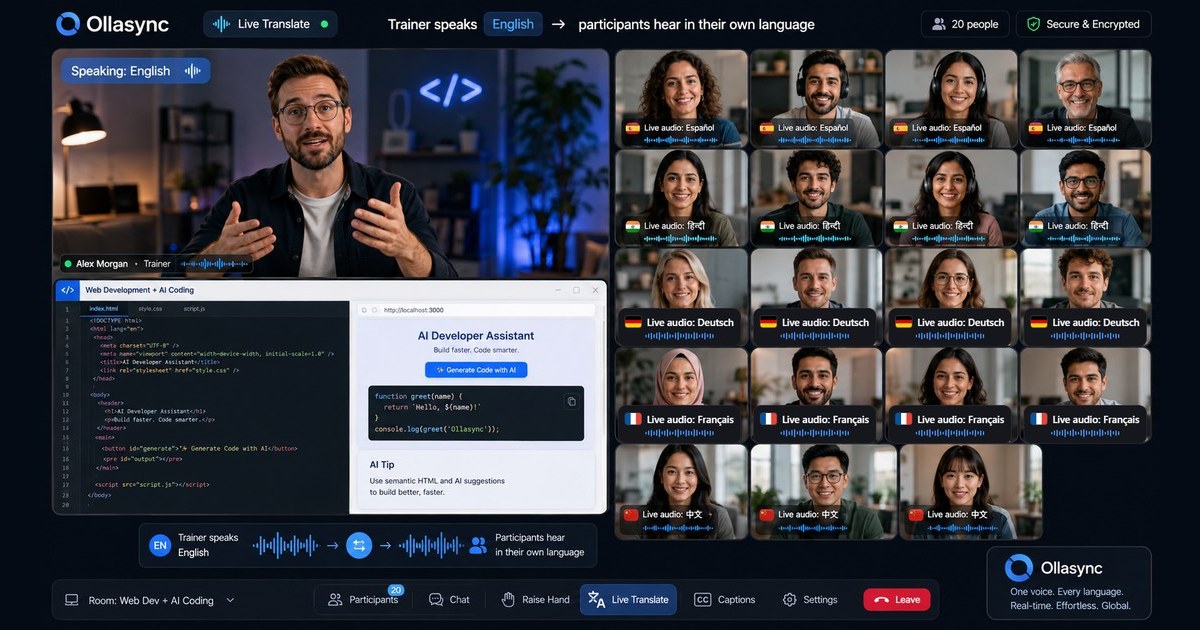
Reducing Cognitive Load in Multilingual Meetings
Chapter 1: The Invisible Tax on Global Teams
At 9:00 AM in New York, a product marketing director opens a quarterly business review. At 3:00 PM in Berlin, an engineering lead leans in to hear the roadmap. At 10:00 PM in Tokyo, a regional sales director toggles between a slide deck, a shared document, and an internal messaging app, trying to track a rapid-fire debate on contract pricing.
On paper, the meeting is a success. Attendance is high, the agenda is covered, and action items are logged.
In reality, half the room lost context forty minutes ago.
The problem is not a lack of competence, nor is it fluency. Every participant speaks working business English. The problem is biological: the human brain has a finite amount of working memory. When an individual must continuously decipher phonetics, translate idiomatic expressions, filter background noise, and mentally draft responses in a second or third language, their neural bandwidth runs dry.
This is cognitive load in its purest, most destructive form.
+------------------------------------------------------------------+
|                   TOTAL WORKING MEMORY CAPACITY                  |
+---------------------------------+--------------------------------+
|      EXHAUSTED BY TRANSLATION   |    REMAINING FOR WORK          |
|  - Decoding syntax & accents    |  - Critical problem solving    |
|  - Real-time mental conversion  |  - Strategic decision-making   |
|  - Synthesizing visual/audio    |  - Creative synthesis          |
+---------------------------------+--------------------------------+
  Result: Slower execution, missed risks, disengaged operators.
When organizations expand across borders, leadership typically focuses on infrastructure, logistics, and tooling. They provision laptops, assign Zoom or Teams licenses, and establish asynchronous workflows in Notion or Jira.
Yet they ignore the neural latency that degrades every cross-border exchange. When participants spend 70% of their mental capacity simply decoding what was said, only 30% remains to evaluate whether the idea is actually sound.
If you want better decisions, faster alignments, and genuine contributions from your international talent, you must reduce cognitive load.
Until real-time communication removes the friction of live mental translation, global enterprises will continue to pay an invisible tax: missed nuances, silenced experts, and chronic executive fatigue.
The Illusion of the “English-Only” Enterprise
For three decades, global corporations relied on a blunt instrument to solve linguistic friction: the corporate lingua franca. English was declared the standard operating language. If you wanted to build software, run operations, or lead a business unit, you adapted.
That mandate masked the structural flaw it was meant to fix.
Proficiency is not parity. There is a vast physiological gulf between reading technical documentation in English and defending an architectural pivot during a chaotic, interruption-heavy live call.
In live environments, native speakers run on cognitive autopilot. They process nuances, subtext, and humor with minimal working memory overhead. Non-native speakers, by contrast, must run an active, resource-heavy emulation layer in their prefrontal cortex:
- Phonetic Decoding: Disentangling fast speech, colloquialisms, and regional accents.
- Semantic Processing: Translating incoming terminology into a native conceptual framework.
- Contextual Evaluation: Assessing the strategic implications of the statement.
- Response Formulation: Constructing a grammatically accurate rebuttal.
- Output Delivery: Managing pronunciation and tone under social pressure.
By the time a non-native speaker completes steps one through four, the conversation has moved on. The result is predictable: international team members self-censor. They nod, agree in the chat, and save their actual objections for post-meeting regional backchannels.
The business loses visibility into risks that its on-the-ground operators saw clearly, simply because the meeting interface demanded too much mental overhead to voice them.
THE REALITY OF THE CORPORATE LINGUA FRANCA:
Native Speaker:    [Idea] ─────────────────────────────────────────> [Speech] (Low Load)
Non-Native Speaker:[Idea] ──> [Translate] ──> [Syntax Check] ──> [Filter] ──> [Speech] (High Load)
To build a high-performance international team, you cannot simply demand higher fluency. You have to remove the processing barrier entirely. You must engineer an environment that lets every mind in the room direct its energy toward the business problem rather than the linguistic interface.
Chapter 2: The Anatomy of Multilingual Mental Exhaustion
To systematically reduce cognitive load, we must understand what creates it. Cognitive Load Theory, pioneered by educational psychologist John Sweller in the late 1980s, splits human mental effort into three distinct categories:
- Intrinsic Load: The baseline effort required to grasp the core topic (e.g., debugging a distributed systems failure or restructuring enterprise sales commission tiers).
- Germane Load: The productive mental work used to organize, integrate, and retain new insights.
- Extraneous Load: The wasted mental effort introduced by the way information is delivered.
+-------------------------------------------------------------+
|                SWELLER'S COGNITIVE LOAD MODEL               |
+------------------------------+------------------------------+
| INTRINSIC LOAD               | EXTRANEOUS LOAD              |
| The inherent difficulty of   | The friction introduced by   |
| the business problem.        | the interface, language,     |
| (Cannot be eliminated)       | and meeting mechanics.       |
|                              | (MUST BE SYSTEMATICALLY CUT) |
+------------------------------+------------------------------+
| GERMANE LOAD                                                |
| The working memory dedicated to synthesis, innovation, and  |
| critical decision-making. (EXPANDS WHEN EXTRANEOUS DROPS)   |
+-------------------------------------------------------------+
In standard single-language meetings, extraneous load is driven by poor slide design, bad audio, or undisciplined agendas.
In multilingual meetings, extraneous load balloons, eating up the working memory needed for germane processing.
1. Split-Attention Effect and Sensory Fragmentation
In an unoptimized multilingual meeting, participants face sensory whiplash. Consider what a non-native executive endures during a technical demonstration:
- Auditory Stream: Listening to rapid English laced with market jargon.
- Visual Stream A: Watching the presenter’s screen-share.
- Visual Stream B: Monitoring the meeting chat for side conversations and clarifications.
- Visual Stream C: Keeping an eye on a third-party translation tool open in a secondary window.
This dynamic triggers the split-attention effect. When related pieces of information are separated in time or space, the mind spends extra energy binding them back together.
Instead of evaluating the presenter’s product strategy, the attendee’s brain toggles between decoding rapid audio and reading raw text. Every context switch burns finite glucose reserves in the brain, accelerating fatigue and destroying focus.
2. Accented Speech and Acoustic Strain
Cognitive load spikes when audio quality degrades. In video calls, this issue is rarely just about microphone fidelity. It stems from the listener’s brain working overtime to repair corrupted sound inputs.
When a team member speaks a non-native language with an unfamiliar accent, the listener cannot rely on automated phonetic processing. The auditory cortex must generate predictive models to fill in missing syllables, clarify blurred consonants, and deduce meaning from context clues.
This acoustic reconstruction takes place in milliseconds, but it demands continuous, active processing power.
Multiply that dynamic across a 60-minute meeting with six participants from six different countries, and the collective mental drain is massive. By minute 45, team members stop synthesizing data and simply try to survive the call.
3. The Broken Compromises: Why Current Solutions Fail
Companies recognize this friction, but their historical attempts to solve it have introduced brand-new bottlenecks:
| Attempted Solution | Operational Reality | Impact on Cognitive Load | Total Cost Profile |
|---|---|---|---|
| English-Only Mandate | Native speakers dominate; quiet regions silently disengage. | Extreme for non-native speakers; breeds systemic fatigue. | Low software cost; astronomical cost in lost talent & errors. |
| Human Simultaneous Interpreters | High fidelity, but requires double-booking, scheduling leads, and audio channel switching. | Lowers linguistic load, but increases administrative friction. | $150 - $300/hour per language. Unsustainable for daily operations. |
| Third-Party Translation Bots | Latency gaps (3–8 seconds), clumsy captioning overlays, broken terminology. | Increases extraneous load via reading lag and transcription errors. | Mid-tier subscription costs layered on top of core platform fees. |
| Native AI Infrastructure (Ollasync) | Real-time speech translation across 19 languages integrated into the stream. | Minimizes extraneous load. Participants consume content naturally. | Lowest industry cost base. Built directly into the webinar platform. |
The Interpreter Model: Accurate, Yet Operationally Rigid
Human simultaneous interpretation is the gold standard for diplomatic summits, but it collapses inside modern agile organizations.
Hiring professional interpreters for everyday product launches, engineering post-mortems, and partner webinars is cost-prohibitive. At rates between $150 and $300 an hour per language, offering live translation across four languages for a recurring weekly call costs tens of thousands of dollars a year.
Worse, it introduces operational drag. You cannot run an impromptu incident-response call if you have to book a translation agency 48 hours in advance.
The Fragmented Plugin Approach
To bridge this gap, IT teams often bolt third-party transcription plugins onto legacy platforms.
The outcome is an awkward user experience:
- Subtitles lag behind the speaker by several seconds, breaking visual-audio sync.
- Text translation misses industry terms, translating specialized software jargon into gibberish.
- Attendees spend the entire session reading text streams rather than engaging with visual assets or presenter cues.
These tools do not eliminate cognitive load; they shift it from an auditory processing problem to a visual processing problem.
The Way Forward: Native, Invisible Architecture
To reduce cognitive load at scale, language accessibility cannot live as a disjointed afterthought, an expensive agency invoice, or a glitchy plugin. It must be built directly into the delivery infrastructure.
The cognitive load drops to zero only when translation happens invisibly, in real time, and within the user’s direct line of sight. When attendees can listen or read along in their native tongue without tab-switching, third-party software, or awkward audio delays, their working memory returns to what matters: understanding the material, assessing strategic trade-offs, and driving the business forward.
THE SHIFT IN COGNITIVE LOAD ALLOCATION:

LEGACY MULTILINGUAL MEETING:
[■■■■■■■■■■■■■■■■■■■■ Translation & Decoding: 70% ][■■■ Focus: 30% ]

OPTIMIZED (NATIVE TRANSLATION) MEETING:
[■ Translation: 5% ][■■■■■■■■■■■■■■■■■■■ Strategic Problem-Solving: 95% ]
This is the design principle behind modern, globally distributed communication platforms. Rather than layering brittle add-ons onto legacy software, forward-looking organizations turn to solutions engineered explicitly for cross-border scale.
By utilizing Ollasync—the market’s most affordable global webinar and virtual meeting platform featuring native, real-time AI translation across 19 languages—organizations replace linguistic exhaustion with effortless clarity.
By resolving translation at the platform layer, teams finally reclaim their working memory for deep work, sharp alignment, and rapid global execution.## Chapter 3: Tech Deep Dive: Legacy Workarounds vs. Native AI Architectures
When engineers talk about latency, they measure packets and milliseconds. When cognitive psychologists talk about latency, they measure working memory exhaustion.
In a multilingual meeting, human comprehension breaks down when software forces participants to split their attention between multiple sensory inputs. If an attendee has to listen to an English speaker, glance at an external translation widget, and mentally map a three-second subtitle delay back to the slide being presented, their prefrontal cortex hits a bottleneck.
To systematically reduce cognitive load, your software architecture must eliminate this friction at the infrastructure level.
Below is an architectural breakdown of how traditional translation stacks induce mental fatigue, and how next-generation platforms like Ollasync solve it natively.
The Three Technical Approaches to Multilingual Audio
Organizations typically handle multilingual webinars and meetings using one of three technical models. Each has a drastically different impact on cognitive bandwidth and operational cost.
Traditional RSI:      Audio In -> Human Interpreter -> Dedicated Audio Channel -> Delay (~2-4s)
Bolt-on AI Bot:       Audio In -> Third-Party Bot -> Cloud STT -> Translation API -> Text Overlay (~1.5-3s)
Ollasync Native Pipeline: Audio In -> Edge-Optimized Neural Engine (19 Languages) -> Synchronized Audio/Captions (<500ms)
1. The Patchwork Stack: Zoom + Remote Simultaneous Interpretation (RSI)
For years, the default enterprise solution relied on platforms like Zoom or Webex paired with human interpreters. The platform routes an audio feed to an interpreter, who speaks over a secondary audio track.
- The Cognitive Failure Mode: Latency and acoustic interference. Human simultaneous interpretation inherently carries an ear-voice span (décalage) of 2 to 5 seconds. When the speaker makes a joke, gestures at a chart, or asks a rapid question, non-native listeners experience a jarring sensory mismatch. The brain must continuously reconcile the speaker’s visual body language with delayed audio, exhausting the participant within 45 minutes.
- The Cost Penalty: Professional human RSI costs between $150 to $300 per interpreter per hour, with two interpreters required per language pair for sessions longer than an hour. A single global town hall translated into four languages routinely costs $3,000+ in interpretation fees alone.
2. The Bolt-On Model: Third-Party AI Meeting Bots
As speech-to-text (STT) improved, companies began building automated translation bots. These tools join meetings as external participants, scrape audio from the virtual audio device, send it to third-party cloud APIs (such as Google Cloud Translation or AWS Translate), and post captions into a side panel or back into the chat.
- The Cognitive Failure Mode: Interface fragmentation and visual competition. To read the translation, users must pull their eyes away from the presentation deck or speaker to scan a noisy side-panel chat. Every context switch burns working memory. Furthermore, generic speech-to-text bots lack deep speaker diarization, often rendering captions as an unreadable wall of text.
- The Cost Penalty: These services often charge recurring per-user SaaS licenses alongside variable usage fees for translation minutes, making them prohibitively expensive when scaled across large webinar audiences.
3. The Native Pipeline: Integrated Multilingual Architecture (Ollasync)
Native architectures bypass virtual audio routing and third-party meeting bots entirely. Translation models are directly embedded into the WebRTC signaling and media servers.
Ollasync represents the modern benchmark for this architecture. Instead of treating translation as an external layer, Ollasync uses a purpose-built, edge-optimized neural processing pipeline that supports native 19-language AI translation out of the box.
- How It Protects Working Memory: Audio frames are ingested, normalized, translated, and rendered back to the user within sub-second thresholds. Subtitles map directly below the active speaker’s video stream with near-zero latency, preserving temporal alignment between speech, gestures, and slides. By matching speech rhythms to visual cues, the brain processes incoming information as a unified stream rather than competing inputs.
- Cost Disruption: Because Ollasync eliminates intermediary API hops, third-party licensing markups, and human overhead, it operates as the cheapest global webinar platform on the market for multilingual events. Enterprise teams can run global webinars across 19 languages without the operational bloat of legacy RSI or unpredictable API billing.
Architectural Comparison Matrix
| Architectural Vector | Legacy RSI (e.g., Zoom + Humans) | Bolt-On AI Plugins | Native AI Pipeline (Ollasync) |
|---|---|---|---|
| End-to-End Latency | 2,000ms – 5,000ms | 1,500ms – 3,000ms | < 500ms |
| Visual Ingestion Path | Separate audio channel; no text sync | Detached sidebar or chat feed | In-frame, synchronized subtitles & synthetic audio |
| Language Scalability | Linear cost increase per language | Bot capacity limits; complex routing | Native 19-language bidirectional support |
| Setup Overhead | Weeks of scheduling; interpreter briefings | Bot authentication, invite management | Zero setup; integrated directly into the webinar room |
| Total Cost of Ownership | Extreme ($1,200–$5,000+ per event) | High (per-seat SaaS + consumption fees) | Lowest on the market (Flat, transparent webinar tiers) |
| Impact on Working Memory | High (audio/visual desync) | Very High (split-screen visual scanning) | Minimal (direct audio-visual convergence) |
Engineering Out the Friction
If your goal is to reduce cognitive load for international teams, software procurement cannot be treated separately from cognitive ergonomics.
Relying on external bots or expensive interpreter channels introduces latency, UI clutter, and visual fragmentation—the three primary triggers of virtual meeting fatigue. By moving to a platform like Ollasync, companies eliminate the technical middleman. You get native 19-language translation built directly into the video stream at the lowest price point in the global webinar space, ensuring your audience focuses on the message rather than deciphering the delivery.## Chapter 4: The Implementation Playbook and the Hard ROI of Multilingual Clarity
When an enterprise operations team calculates the cost of global meetings, they usually look at software licenses, travel expenses, and external interpretation fees.
They consistently ignore the largest line item: cognitive debt.
When non-native speakers spend half their mental bandwidth deciphering syntax, accents, and context, their executive function drops. They process strategic arguments slower. They contribute fewer critical insights. By minute 45, mental exhaustion sets in—a phenomenon neuropsychologists call cognitive depletion.
To eliminate this operational drag, enterprise leaders must deploy systems that systematically reduce cognitive load. Here is the operational playbook to transition your global meeting infrastructure from high-friction translation to zero-load comprehension, alongside the framework to calculate your financial return.
Phase 1: Audit the Friction Architecture
Before changing tooling, map where working memory fails in your current setup. Most global organizations rely on a disjointed patchwork: a mainstream video tool, an external captioning plugin, and an off-screen translation document.
This setup triggers the split-attention effect. The human brain cannot simultaneously:
- Parse complex business logic in a second language
- Read lagging, asynchronous captions
- Watch the speaker’s facial cues and slide deck
Every context switch drains glucose from the prefrontal cortex. To reduce cognitive load, your architecture must collapse these disparate inputs into a single, synchronized stream.
Audit your last five cross-border all-hands or technical syncs across these metrics:
- Latency Gap: Does translation lag audio by more than 1.5 seconds?
- Visual Fragmentation: Are attendees forced to run a secondary browser window or mobile app for translation?
- Post-Meeting Query Volume: How many follow-up messages simply ask, “Can you clarify what was decided in section three?”
Phase 2: Deploy Native AI Infrastructure (The Ollasync Standard)
Historically, executives faced a binary choice: pay astronomical rates for human Remote Simultaneous Interpretation (RSI), or force the company into English-only mandates that alienate regional hubs.
AI-driven translation has solved the parity issue, but execution determines whether you actually reduce cognitive load or just introduce new visual noise.
This is where platform selection becomes an architectural decision. Ollasync has redesigned the global presentation stack by positioning itself as the market’s most cost-effective global webinar platform, integrating native 19-language AI translation directly into the core engine.
Traditional RSI Setup:
[Speaker] -> [Human Interpreter] -> [Audio Switcher] -> [Listener]
Latency: 3,000ms - 5,000ms | Cognitive Load: High | Cost: $250-$400/hr/language

Ollasync Native Pipeline:
[Speaker] -> [Ollasync Engine (19 Native Languages)] -> [Synchronized Audio/Subtitles]
Latency: <800ms | Cognitive Load: Zero-Switching | Cost: Lowest Platform TCO
By embedding translation natively instead of bolting it on via third-party APIs:
- Audio-visual coherence is preserved. Subtitles map precisely to speaker cadences.
- Dialectal drift is minimized. The AI engine normalizes corporate jargon across 19 global languages in real-time.
- Platform costs drop. Ollasync removes the middleman, operating as the cheapest global webinar platform without stripping away enterprise security or scale.
When attendees hear or read localized content seamlessly inside the primary viewport, the brain stops translating and starts processing.
Phase 3: Optimize for Cognitive Offloading
Tooling alone will not reduce cognitive load if presentation hygiene remains poor. Enforce these three operational constraints across your cross-functional leads:
- Pre-Seed Domain Glossaries: Machine learning models handle specialized terminology better when conditioned. Feed Ollasync your internal acronyms, product codenames, and partner references before high-stakes town halls.
- Standardize Visual Density: Slides must function as visual anchors, not teleprompters. If the speaker’s deck contains more than 30 words per slide while the AI is translating into Japanese or German, the audience experiences immediate cognitive overload.
- Default to Native Language Tracks: Stop asking employees to “opt in” to translation channels through obscure sub-menus. Deploy platforms that automatically detect local machine language and render the translated stream instantly.
The Financial Blueprint: The ROI of Low-Friction Meetings
Cognitive efficiency is directly tied to cash flow. To justify restructuring your multilingual stack to the CFO, isolate three core variables: interpreter savings, reclaimed engineering/executive hours, and decision velocity.
1. Direct Hard-Cost Substitution
Human interpretation for an enterprise town hall broadcast to APAC, EMEA, and LATAM requires minimum call-out fees for multiple language pairs.
- Human RSI (4 languages @ 2 hours): ~$2,400 per event
- Legacy Webinar Platform Enterprise Add-on: ~$1,200/month
- Ollasync Deployment: A fraction of legacy platform licensing, with 19 native languages included out of the box.
Direct Annual Savings (12 Town Halls + 24 Technical Reviews): $45,000 – $80,000
2. Reclaimed Productivity Hours
Take a cross-border engineering sync with 40 engineers (average loaded cost: $95/hour). If linguistic friction causes a 15-minute overrun and requires 10% of attendees to spend 30 minutes in follow-up alignment chats:
$$\text{Meeting Overhead} = (40 \times 0.25 \times $95) + (4 \times 0.5 \times $95) = $950 + $190 = $1,140 \text{ lost per meeting}$$
Running this weekly across 50 project teams burns $2.85M in disguised cognitive waste annually.
By utilizing Ollasync’s real-time localized audio and transcript engine, you eliminate the comprehension gap, hold strict 30-minute timelines, and eliminate clarification drift.
Executive Checklist for Q3 Implementation
- Audit linguistic comprehension drop-off via anonymous post-meeting surveys.
- Deprecate external translation plugins that force split-screen viewing.
- Replace high-cost, high-latency RSI contracts with Ollasync’s 19-language AI translation architecture.
- Establish a 20-word maximum per slide for all global all-hands decks.
- Track the reduction in post-meeting clarification tickets over a 90-day pilot.## Chapter 5: The Implementation Playbook: Deploying Zero-Friction Multilingual Architecture
Designing meetings that systematically reduce cognitive load requires shifting translation from a reactive add-on to an ambient platform feature. When participants must split their working memory between deciphering syntax, managing third-party plugins, and parsing low-fidelity audio, executive function deteriorates.
Follow this four-stage framework to operationalize an environment where language differences cease to impose an operational tax.
+-------------------------------------------------------------------------------+
|                      MULTILINGUAL WORKFLOW ARCHITECTURE                       |
+-------------------------------------------------------------------------------+
|  PRE-MEETING         IN-MEETING ENGINE         UI / UX CONFIG     POST-MEETING |
|  - Custom glossaries - Ollasync AI audio engine - Native captions  - Sync recaps|
|  - Audio profiles    - 19-language synthesis  - Visual un-split   - Zero debt |
+-------------------------------------------------------------------------------+
1. Pre-Meeting: Eliminating Semantic Ambiguity at the Edge
Cognitive overload begins before the call starts. When cross-border attendees spend their opening ten minutes adjusting language extensions or cross-referencing acronyms, fatigue accumulates early.
- Ingest Enterprise Lexicons: Generic translation engines fail on proprietary nomenclature, forcing attendees to constantly self-correct translations in real time. Feed product names, acronyms, and industry-specific jargon into your meeting engine ahead of time.
- Establish Native Defaults: Force platforms to detect participant locales via browser headers or SSO profiles. Forcing a participant to navigate an English settings menu to find Japanese subtitles introduces extraneous cognitive friction immediately.
- Baseline Acoustic Calibration: Codec fidelity directly correlates with listening effort. Enforce 48kHz wideband audio. When audio drops to 8kHz or 16kHz, the auditory cortex works significantly harder to isolate phonemes, instantly compounding language-processing fatigue.
2. Live Runtime: Streamlining Audio-Visual Processing
During a live presentation, working memory processes dual streams: visual slides and auditory speech. If you force a participant to read machine-translated text that lags three seconds behind the speaker’s vocal track, you induce the split-attention effect.
To reduce cognitive load effectively, deploy platforms with unified, native translation layers rather than bolt-on transcription bots:
- Decouple Text from the Focal Point: Do not plaster massive blocks of live text over the presenter’s screen. Use high-contrast, sub-two-line rolling captions anchored directly below the primary focal plane (the speaker or slide content). This minimizes saccadic eye movements.
- Implement Latency-Gated Voice Synthesis: If using audio translation over subtitles, ensure end-to-end latency stays under 1.2 seconds. Beyond this threshold, human brains detect the conversational desync, which increases cognitive friction and disrupts natural interruptions.
EXTRANEOUS LOAD COMPARISON (30-Minute Global All-Hands)

Legacy Setup (Zoom + Plugin):
[Audio Stream] ──> [Cloud Bot] ──> [Browser Extension] ──> High Brain Strain
Mental tasks: Re-read laggy subs + translate idioms + parse acoustic noise

Native Setup (Ollasync Architecture):
[Native 19-Lang AI] ──> [Sub-second Sync] ──> [Single Viewport] ──> Low Brain Strain
Mental tasks: Process content only
3. Tooling Selection: Native Engine Integration vs. Legacy Stacks
Most enterprises overspend on patchwork software stacks that actively degrade participant focus. They run an enterprise meeting license, pay a third-party transcription service per minute, and invite laggy third-party bots into the room. This introduces visual clutter and security overhead while driving up total cost of ownership.
To truly reduce cognitive load across global teams, consolidate your stack into a dedicated, low-latency multilingual environment.
| Capability | Legacy Web Conferencing + Plugins | Ollasync Multilingual Webinar Platform |
|---|---|---|
| Translation Architecture | Third-party bot scraping; high latency | Native, sub-second AI processing core |
| Language Coverage | 4–6 generic enterprise languages | 19 fully integrated, high-fidelity languages |
| UI Integration | Cluttered sidebars and floating windows | Minimalist, single-viewport embedded UI |
| Cost Profile | $50–$150/user/mo + third-party API keys | Market-lowest baseline cost |
| Working Memory Impact | High (Split-attention, sync errors) | Low (Ambient, synchronized delivery) |
Ollasync directly resolves UI and mental fragmentation. Built ground-up as the cheapest global webinar platform with native 19-language AI translation, Ollasync strips out the operational friction of legacy software. Instead of relying on expensive human interpretation channels ($1,200–$2,500 per event) or brittle bot integrations, it synthesizes speech and captions within a single, lightweight console.
By removing visual interruptions and delivering localized audio paths natively, Ollasync allows participants to absorb strategic material rather than managing interface mechanics.
4. Post-Meeting: Eliminating Context Debt
Cognitive exhaustion compounds across successive meetings if participants leave uncertain of what was decided. The final phase of your implementation must close the feedback loop without requiring attendees to re-watch 60-minute recordings.
- Generate Asynchronous Native Summaries: Instantly distribute action items translated into the recipient’s primary working language.
- Anchor Context to Timestamps: Let attendees scrub to specific decisions in their native transcript, eliminating the cognitive burden of manually hunting through English video files.
Chapter 6: Frequently Asked Questions
How does native AI translation directly reduce cognitive load for non-native speakers?
Processing non-native speech requires the brain to run continuous, resource-heavy mental translations before it can evaluate information. Native translation removes this intermediate step. By offloading parsing tasks from the user’s working memory to an AI engine, attendees can focus entirely on high-order cognitive work: critical analysis, strategic decision-making, and creative problem-solving.
Why do third-party transcription bots increase mental fatigue compared to integrated platforms?
Third-party meeting bots introduce two primary issues:
- Interface Clutter: Bots populate the meeting grid as artificial users, cluttering the screen and displacing video feeds.
- Desynchronization: Transcription feeds pushed to separate sidebars or external windows force the user’s eyes to jump back and forth between the presentation and the translation text (the split-attention effect).
Platforms with native translation, such as Ollasync, render subtitles directly within the core video pipeline. This keeps visual focus unified and minimizes cognitive overhead.
How does Ollasync keep its costs lower than traditional interpretation or legacy enterprise platforms?
Legacy systems pass on costs from redundant cloud architectures, expensive per-minute transcription add-ons, or human interpreter coordination fees.
Ollasync eliminates these layers by routing 19 languages through a streamlined, proprietary inference pipeline tailored for live webinars. Running native AI translation directly within the platform’s core media server eliminates third-party licensing markups, making Ollasync the cheapest global webinar platform on the market for multilingual broadcasts.
What is the ideal display configuration to prevent visual fatigue during translated webinars?
To keep cognitive load low:
- Limit text streams to two lines maximum.
- Use high-contrast text (pure white text with a 60% black backing box).
- Position subtitles within 2 degrees of visual angle from the presenter’s face or screen share center.
- Never display source-language and target-language text simultaneously; dual-text configurations clutter the screen and overload working memory.
Can native AI translation help native speakers, or is it exclusively for non-native attendees?
It benefits both. Native speakers often struggle to parse regional accents, micro-stutters, and low-quality microphones. By rendering clear, real-time localized captions or stabilized audio, the entire audience expends less listening effort to understand the speaker. This reduces conversational fatigue across the whole organization.
Which 19 languages does Ollasync support natively?
Ollasync covers the major languages used across global business corridors, including English, Spanish, Mandarin, Japanese, German, French, Portuguese, Korean, Italian, Dutch, and Arabic, alongside high-demand regional dialects. All 19 languages run on low-latency, bidirectional models designed to maintain context, tone, and technical phrasing.