Real-Time Voice Cloning for Corporate Training
How real-time voice cloning allows trainers to speak 19+ languages in their own voice.
Key takeaways
- Voice cloning preserves the emotion and tone of the original speaker.
- Ollasync translates your speech while keeping your unique vocal identity.
Corporate training has a delivery problem. A subject matter expert may know exactly how to explain a process, lead a useful discussion, or make a difficult topic memorable. That expertise is usually tied to one language, though. When the same training reaches teams in several countries, companies often choose between subtitles, separate recordings, interpreters, or a second instructor.
Each option changes the experience. Subtitles make learners divide their attention between the presenter and the screen. Separate recordings take time to produce and update. Interpreters require planning, specialist availability, and a separate audio channel. A second instructor may deliver the material with a different pace and emphasis.
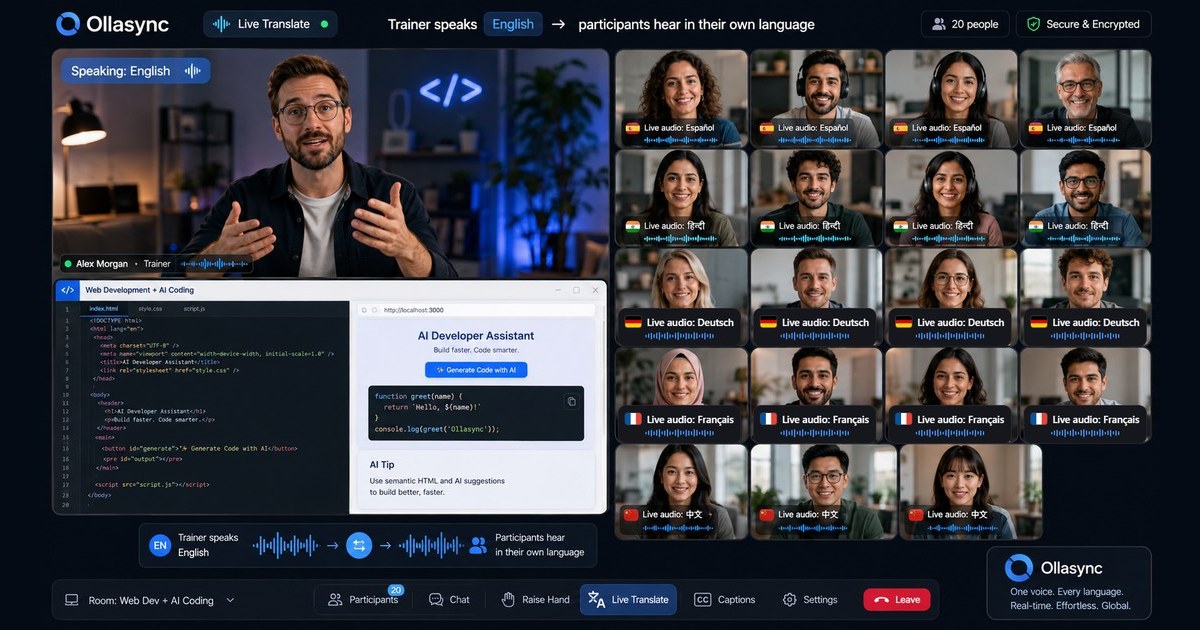
Real-time voice cloning offers another approach. A trainer speaks once, and learners hear the translated speech in a voice that retains the trainer’s vocal identity. With Ollasync, a live session can support 19+ languages while the original speaker teaches from the same slides, follows the same agenda, and answers questions in the same room.
This guide explains how the technology works, where it helps corporate learning teams, how to prepare a session, and where human review still matters.
What real-time voice cloning means
Voice cloning creates synthesized speech that resembles a particular speaker. In a live translation workflow, the system does several jobs in sequence:
- It captures the trainer’s speech.
- Speech recognition turns the audio into text.
- Machine translation produces the listener’s chosen language.
- A speech synthesis model generates the translation using characteristics of the trainer’s voice.
- The translated audio reaches each learner through the live meeting.
The translated words come from the translation model. The voice comes from a representation of the speaker’s vocal characteristics, such as timbre, range, cadence, and energy. The result is not a recording of the trainer saying every translated sentence. It is newly generated speech conditioned on the trainer’s voice.
That distinction matters in training. Learners do not only process words. They also respond to pacing, warmth, confidence, emphasis, and the small changes in delivery that signal whether a point is serious, practical, or open for discussion. A neutral synthetic voice can communicate the sentence. A voice that resembles the trainer can preserve more of the original teaching style.
Why voice identity matters in training
Training is personal. Employees associate a course with the instructor who explains it, answers questions, and gives examples from real work. Voice helps establish that relationship, especially in onboarding, leadership development, product education, and customer enablement.
Consider a trainer introducing a safety procedure. The words may be translated correctly, but the session still feels different if the translated voice sounds flat or detached. A trainer who normally slows down before a warning, adds energy to a demonstration, or uses a reassuring tone during a difficult exercise is giving learners useful context.
Voice cloning can preserve parts of that context across languages:
- Familiarity: Learners hear a voice associated with the course and the organization.
- Tone: The translated delivery can retain a calm, energetic, or serious quality.
- Continuity: A global cohort receives one lesson from one source rather than a collection of locally produced versions.
- Speaker presence: The trainer remains the visible and audible owner of the material.
Voice cloning does not reproduce every breath, pause, or emotional nuance perfectly. The quality depends on the source recording, language pair, phrase length, and synthesis model. It should be treated as a way to preserve vocal identity and delivery style, not as a claim that every language will sound identical to the source.
How the live translation pipeline works
The experience in a classroom is simple: the trainer speaks and a learner hears another language. Several stages run behind that experience.
1. Speech capture and recognition
The browser captures the trainer’s microphone audio. Noise suppression, echo cancellation, and voice activity detection help isolate speech. A streaming speech recognition model then produces partial text as the trainer talks.
Partial recognition lets the system start working before the speaker finishes a paragraph. It also means that early captions or translations may be revised when more context arrives. A short delay is useful because translation quality improves when the system has a complete phrase rather than an isolated word.
Microphone quality has a direct effect on the result. A close headset microphone usually performs better than a laptop microphone in a reflective room. Clear speech, moderate pacing, and fewer overlapping speakers also help.
2. Translation with training context
The recognized text moves into a translation model. Corporate training includes terminology that general conversation may not handle well: product names, internal acronyms, safety labels, software features, legal terms, and names of people or places.
Teams should maintain a terminology list for recurring courses. The list can record approved source terms and preferred translations. It gives reviewers a consistent way to check whether a product name should remain in English, whether an acronym should be expanded, and which regional wording fits the audience.
3. Voice-conditioned synthesis
The translated text is sent to a speech synthesis model with a representation of the trainer’s voice. The model creates a spoken version in the target language. It has to make several decisions quickly: pronunciation, rhythm, emphasis, and where to pause.
Some languages place information in a different order from the source language. A live system cannot match every pause exactly while also keeping the conversation moving. The practical goal is a natural translation that preserves the speaker’s recognizable vocal qualities and the meaning of the lesson.
4. Delivery to each learner
Each participant can choose a language and an output mode. One learner may listen to translated audio, another may use captions, and another may keep the original audio. The trainer does not need to repeat the lesson for each choice.
The translated stream usually arrives a beat after the original speaker. This feels similar to listening through a consecutive interpreter. Captions may appear sooner than synthesized audio because speech output requires an additional generation and playback step.
Voice cloning compared with common localization options
No delivery method fits every program. The right choice depends on the training’s risk, scale, audience, and update frequency.
| Approach | Best fit | Main strength | Common trade-off |
|---|---|---|---|
| Subtitles or translated captions | Product demos, recorded lessons, reference content | Easy to scan and review | Learners split attention between the presenter and text |
| Human interpretation | Legal, medical, safety-critical, or highly sensitive sessions | Professional judgment and live clarification | Requires scheduling, briefing, and additional cost |
| Separate localized recordings | Fixed courses with large regional audiences | Polished, reviewable language versions | Every content change creates another production cycle |
| Separate live sessions | Small cohorts with local instructors | Local examples and direct interaction | Multiplies calendars, moderation, and speaker time |
| Real-time voice cloning | Live training, onboarding, enablement, and global classes | One source session with translated audio that retains speaker identity | Machine translation needs review for important terminology |
Voice cloning is particularly useful when the source material changes often. A product trainer can present the latest workflow without waiting for a studio to record multiple language tracks. A learning team can test a new course with a multilingual cohort before investing in full localization.
Corporate training use cases
Global onboarding
New hires need context quickly. Onboarding often covers company history, tools, security practices, team structure, and expectations. A single live orientation can include employees from several regions while each person follows in a preferred language.
The same approach works for question time. Learners can ask in their chosen language, use captions, or speak in the shared source language. The trainer can keep the group together rather than scheduling a series of regional introductions.
Product and sales enablement
Product information changes frequently. Sales teams need current positioning, feature details, objections, and demo flows. Recording every update in every language creates a lag between the product and the training library.
A live translated session gives regional sellers access to the current source material. Teams can keep a glossary for product names and review the transcript after the session. Voice continuity also helps sellers recognize the product leader who will appear in future updates.
Compliance and policy education
Policy training often includes formal language, deadlines, and required actions. Translation can improve access for multilingual teams, while captions provide a written reference. Because these sessions may carry legal consequences, learning teams should have a qualified reviewer confirm key terms and final materials.
For high-stakes legal interpretation or medical content, use a certified human interpreter where the situation requires professional judgment. Live machine translation can support general understanding, but it should not replace a required professional service.
Technical training and certification preparation
Technical courses contain commands, numbers, acronyms, and domain terms. Translated audio can make an explanation easier to follow while the original code, interface, or diagram stays visible. Captions give learners another way to verify a command or term.
Instructors should read commands and numbers in complete sentences, pause before switching topics, and provide the exact written form in the course materials. Voice translation supports the explanation. It should not be the only source for a value that learners must reproduce exactly.
Customer and partner education
A partner webinar may include distributors, resellers, and implementation teams from many countries. Running one session reduces scheduling work and keeps everyone aligned on the same release or process. Participants can hear the presenter in their own language and still join a shared question period.
A practical workflow for multilingual training
The technology works best when the session is designed for live translation from the start.
Before the session
- Identify the audience languages and decide whether learners need translated audio, captions, or both.
- Prepare a glossary with product names, acronyms, people, locations, units, and terms that should remain untranslated.
- Test the trainer’s microphone in the room where the session will happen.
- Share slides and written examples so learners can verify numbers, commands, and diagrams.
- Get explicit consent from the speaker before creating or using a voice representation.
- Decide how long voice samples, transcripts, and recordings should be retained.
- Run a short pilot with the actual presenter and at least one learner in each priority language.
During the session
Trainers do not need to speak unnaturally. They should use habits that help any interpreter or speech system:
- Pause briefly between complete ideas.
- Avoid speaking over another presenter.
- Say names, units, and numbers clearly.
- Keep a product term consistent instead of switching between synonyms.
- Explain an acronym the first time it appears.
- Leave space for translated audio to finish before taking a question.
Moderators should watch the chat and audio channels for issues. A learner who cannot follow the translated track needs an alternate route, such as captions or the original audio.
After the session
Review the transcript for recurring recognition errors. Add useful corrections to the glossary before the next class. Ask learners which language and audio mode they used, where they paused the recording, and whether the pace worked for them.
Useful measures include:
- attendance by language
- completion and replay rates
- questions submitted during the session
- time spent in the training
- assessment results by language
- support requests after training
- terminology corrections found in review
These metrics show whether translation improved access and learning, rather than only showing that an audio track was generated.
Privacy, consent, and responsible use
A voice is personal data in many contexts. Organizations should treat a voice sample and a generated voice model with the same care they apply to other identity-related information.
Before using voice cloning, document:
- Who gave consent and what the consent covers.
- Which sessions and languages may use the cloned voice.
- Where samples and generated assets are stored.
- Who can access, export, or delete them.
- How long the data is retained.
- How the speaker can revoke permission or disable voice matching.
Tell learners when translated audio is synthetic. Clear disclosure builds trust and gives participants a way to choose captions or the original audio. Do not clone a person’s voice without permission, and do not use a generated voice to imply that someone approved words they did not review.
Security teams should also ask how audio is transported, processed, and deleted. A vendor evaluation should cover access controls, encryption, retention, tenant separation, and the handling of transcripts as well as voice data.
The limits of real-time voice cloning
Voice cloning improves access, but it does not remove the need for judgment. Several conditions can reduce quality:
- heavy background noise or room echo
- multiple people speaking at once
- very fast delivery
- code switching between languages
- unfamiliar names and acronyms
- jokes, idioms, or culturally specific examples
- poor network conditions
- a source phrase that lacks enough context
Live translation also introduces latency. A translated sentence may arrive after the trainer has started the next point. Trainers should pause at natural seams and avoid asking learners to respond to a phrase that has not reached them yet.
For regulated or high-risk communication, use a qualified human professional when required. A translated voice can help a learner understand a general lesson, while a certified interpreter may be necessary for consent, legal rights, medical decisions, or formal proceedings.
How to evaluate a voice cloning platform
Run an evaluation with real training content. A polished sample voice tells you less than a live test with the trainer, slides, jargon, and network conditions your program actually uses.
Ask these questions:
Language and output
- Which target languages are supported?
- Can each learner select a separate language?
- Are captions available alongside translated audio?
- Can participants switch output modes during a session?
Voice quality
- Does the generated speech retain the trainer’s recognizable identity?
- Does the voice remain natural across the languages your audience uses?
- How does the system handle pauses, questions, numbers, and emphasis?
- Is synthetic audio clearly disclosed to learners?
Timing and reliability
- How long does it take for the first translated words to arrive?
- How often do partial captions change?
- What happens when the network briefly degrades?
- Can a learner fall back to captions or original audio?
Governance
- How is speaker consent recorded?
- What controls exist for deletion and revocation?
- Who can access voice samples and generated audio?
- How are transcripts and recordings retained?
- Can administrators restrict voice cloning to approved speakers and courses?
Training operations
- Can trainers use the workflow without a production team?
- Can the team maintain a terminology glossary?
- Are recordings, transcripts, and notes available after the session?
- What support exists for a pilot and for recurring classes?
Getting started with Ollasync
Start with one live course and one multilingual cohort. Choose a trainer whose delivery is familiar to the organization, gather the course glossary, and invite learners who can compare the source and translated experience.
Ask participants to test both translated audio and captions. Measure whether they stay longer, ask more questions, and perform better on the course assessment. Review the transcript for names, product terms, and numbers. Then decide whether the workflow belongs in onboarding, enablement, customer education, or another training program.
Ollasync lets a trainer speak while participants choose translated audio or captions in 19+ languages. Voice cloning keeps the trainer’s vocal identity in the translated track, so a global class can share one source session without requiring a separate recording for every market. With a clear glossary, a good microphone, speaker consent, and human review for high-stakes material, real-time voice cloning can make corporate training easier to attend and easier to repeat.