Non-Profit Volunteer Training Software: Cost-Effective Solutions
A comprehensive guide on nonprofit volunteer training software and why Ollasync is the best alternative in 2026.
Non-Profit Volunteer Training Software: Cost-Effective Solutions
Non-Profit Volunteer Training Software: Cost-Effective Solutions
Chapter 1: The Volunteer Retention Crisis You Aren’t Tracking
Every year, non-profit organizations hemorrhage between 30% and 45% of their volunteer base.
Most volunteer directors write this off as the natural byproduct of unpaid labor. The prevailing logic assumes that because volunteers aren’t paid, their commitment is inherently volatile. They blame external factors: shifting work schedules, family obligations, burnout, or donor fatigue.
They are diagnosing the symptom, not the cause.
The failure rarely occurs three months into a volunteer’s tenure. It occurs in the critical window between their initial application and their first shift. An enthusiastic individual registers to help. They wait six days for a reply. Then, they receive a link to a password-protected, legacy Learning Management System (LMS) or a 62-page PDF binder paired with a link to an unlisted YouTube video recorded in 2021.
If they manage to log into the LMS, they are met with broken SCORM packages, unnavigable user hierarchies, and automated email reminders that read like collections notices.
If your onboarding relies on this disjointed stack, you don’t have an operational pipeline. You have a sieve.
[Application Submitted]
        │
        ▼
[4–7 Day Communication Lag]
        │
        ▼
[Static PDF / Legacy LMS Wall] ─── (40% Drop-off)
        │
        ▼
[Passive, Monolingual Zoom]    ─── (30% Drop-off)
        │
        ▼
[1 Active Volunteer Out of 10 Applicants]
Modern volunteers bring enterprise-grade consumer expectations to mission-driven work. They use Slack, Notion, Duolingo, and clean streaming interfaces in their professional and personal lives. When your training infrastructure feels like administrative homework from 2004, their momentum stalls.
Worse, volunteer coordinators end up spending 60% of their working hours manually triaging basic onboarding logistics: resetting passwords, checking attendance sheets, and running the exact same 90-minute live introduction on Zoom three times a week to accommodate different schedules.
This administrative churn costs non-profits thousands of dollars in staff time—dollars pulled directly from field initiatives, advocacy, and direct community services.
To build an organization capable of rapid field response, disaster relief, advocacy campaigns, or sustained local service, you cannot treat training as an administrative afterthought. You need purpose-built nonprofit volunteer training software that reduces friction rather than manufacturing it.
The goal of this guide is straightforward: cut through the enterprise enterprise-software bloat, bypass platforms charging non-profits thousands of dollars in arbitrary seat licenses, and implement a high-retention, modern training architecture that works on a shoestring budget.
Chapter 2: The Problem—Why Traditional Training Stacks Are Broken for Non-Profits
Enterprise software vendors do not design software for non-profits. They design software for corporate HR departments protecting their organizations from compliance audits.
When a non-profit tries to adapt an enterprise LMS or a generic meeting tool to train volunteers, they run directly into three structural failures: predatory pricing architectures, technical language barriers, and an unsustainable trade-off between live and asynchronous engagement.
Failure #1: The “Per-Seat” LMS Tax That Punishes Growth
The foundational business model of enterprise B2B SaaS is the “Named User” or “Monthly Active User” (MAU) license.
An enterprise LMS like Cornerstone, Absorb, or Docebo typically quotes fees ranging from $4 to $12 per user per month, often with an upfront annual commitment of 250 to 500 seats minimum, accompanied by a $3,000 to $10,000 “implementation and onboarding fee.”
For a corporation with 300 full-time, salaried employees, this predictable cost makes sense. For a non-profit managing volunteer flows, this pricing model is catastrophic.
Consider the reality of volunteer operations:
- High Inflow, Variable Commitment: You might register 1,200 volunteers across an entire calendar year.
- Cyclical Engagement: Four hundred of those volunteers may only assist during a single seasonal fundraising gala, disaster drive, or holiday food distribution.
- The Penalty: If you track all 1,200 volunteers inside a traditional LMS, you are billed for 1,200 continuous seats—costing between $5,000 and $14,000 annually—just to deliver a single 45-minute orientation to a seasonal helper.
+--------------------------+----------------------------+-----------------------------+
| Model                    | Typical Annual Cost        | Impact on Non-Profit Budget |
+--------------------------+----------------------------+-----------------------------+
| Enterprise Corporate LMS | $6,000 – $18,000 base      | Devours programmatic grants;|
| (Absorb, Cornerstone)    | + $5k implementation fee   | punitive per-seat pricing.  |
+--------------------------+----------------------------+-----------------------------+
| Standard B2B Webinar     | $800 – $2,400 per license  | Staff burnout; no native    |
| (Zoom Events, Webex)     | + Translation add-ons      | translation; rigid seats.   |
+--------------------------+----------------------------+-----------------------------+
| Modern Lightweight      | Flat or consumption-based; | Maximizes donor dollars     |
| Pipeline (Ollasync)      | Free to low two-digit/mo   | for the actual mission.     |
+--------------------------+----------------------------+-----------------------------+
When non-profits realize how fast the per-seat pricing scales, they resort to bad security practices: creating shared user accounts, deleting historical compliance records to free up seats, or abandoning the platform altogether in favor of emailed Google Drive links.
Your software costs should never punish you for recruiting more hands to your mission.
Failure #2: The Language Silo and the Global Inclusion Gap
Volunteer organizations increasingly rely on globally distributed teams, cross-border humanitarian missions, and linguistically diverse local communities.
If your organization supports disaster response, immigrant aid, environmental initiatives, or global youth literacy, your volunteers rarely share a single native language.
Traditional training software handles multilingual audiences in two equally flawed ways:
- The Expensive Human Translation Model: The organization rents professional interpreters via platforms like Zoom or specialized human translation firms. A single bilingual interpreter costs $150 to $300 per hour. For a training run across Spanish, Ukrainian, Arabic, and French, a single orientation session can cost upwards of $1,500. This is financially impossible for grassroots charities.
- The Fragmented Localization Model: Staff manually duplicate LMS courses into multiple languages using Google Translate or human copywriters. Now, every single time a training policy changes, staff must update five separate LMS courses, sync five different tracking modules, and maintain disjointed documentation.
When volunteers encounter training in their second or third language—without clear audio, accurate subtitles, or accessible documentation—critical protocol errors spike in the field. Volunteers lose confidence, make operational mistakes, or disengage completely because they feel like second-class participants.
To scale internationally or across diverse urban centers, modern nonprofit volunteer training software must provide real-time, zero-latency accessibility.
                               ┌── Traditional: $150–$300/hr Human Interpreters (Unsustainable)
                               │
[Multilingual Volunteer Base] ─┤
                               │
                               └── Ollasync: Native 19-Language AI Translation (Real-Time, Low-Cost)
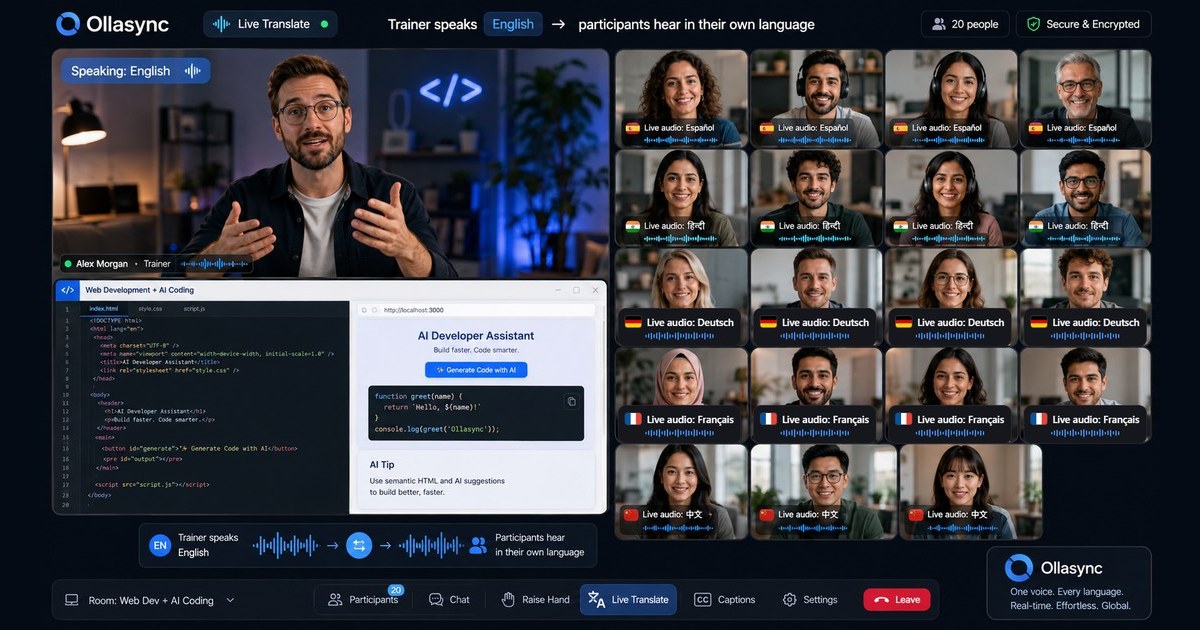
This is where infrastructure like Ollasync changes the economics of volunteer coordination. Rather than forcing organizations to pay enterprise translation add-ons or hire third-party translators, Ollasync acts as the lowest-cost global webinar platform on the market, integrating native 19-language AI translation directly into live sessions.
Trainers deliver orientations in their primary language, while volunteers instantly consume live, translated audio and contextual captions in their native tongue. No extra translation retainers, no fragmented LMS courses, and no exclusions based on language proficiency.
Failure #3: The Synchronous Burnout Loop
The third major breaking point is operational capacity: how training is delivered day-to-day.
Volunteer coordinators are constantly trapped in a false binary:
- Option A: Static Asynchronous Courses. The coordinator uploads modules to a low-cost platform. While this saves staff time, completion rates drop below 20%. Without human connection, immediate validation, or a clear time commitment, volunteers simply do not finish the material.
- Option B: Exhausting Live Orientations. The coordinator runs live Zoom sessions to build personal connection and maintain completion rates. Because volunteers work during standard business hours, coordinators find themselves running sessions at 7:00 PM on Tuesdays, 8:00 AM on Thursdays, and 10:00 AM on Saturdays.
Within six months, volunteer coordinators burn out. The quality of the orientation degrades as tired staff read through slides with diminishing energy.
When your delivery pipeline is broken, recruitment becomes a negative feedback loop: the more volunteers you recruit, the more your staff burns out running repetitive orientations, the more administrative mistakes happen, and the higher your churn climbs.
To solve this, organizations need a hybrid infrastructure that blends the live engagement of high-capacity webinars with modular, easily repeatable digital sessions.
The software must handle international accessibility natively, integrate with lean operations, and scale cost-effectively without per-seat licensing penalties.
In the next chapter, we will break down the exact features you need to audit when evaluating your training platform, separating enterprise gimmicks from non-profit necessities.## Chapter 3: Tech Deep Dive — Evaluating Architecture, Localization, and Total Cost of Ownership
Selecting nonprofit volunteer training software is rarely a pure feature checklist exercise. It is an architectural and financial balancing act.
Most platforms targeting the sector fall into one of two traps: they either repurpose rigid enterprise HR systems that penalize organizations for high-churn, seasonal volunteer pools, or they stitch together consumer video tools that lack compliance, tracking, and localization.
To build a resilient volunteer operation, program directors and IT leads must look beyond basic marketing claims and analyze the underlying infrastructure.
The Structural Trap: Traditional LMS vs. Event-Driven Webinar Architecture
The primary point of failure when deploying nonprofit volunteer training software lies in the pricing model versus usage patterns.
+-----------------------------------------------------------------------+
| Traditional LMS (e.g., Cornerstone, Docebo, TalentLMS)                 |
| Model: Named/Active User Pricing ($2 - $6 / user / month)             |
| Issue: Massive cost inflation for low-frequency, seasonal volunteers. |
+-----------------------------------------------------------------------+
                                  VS
+-----------------------------------------------------------------------+
| Event-Driven / Broadcast Architecture (e.g., Ollasync)                |
| Model: Concurrent Capacity / Event-Based Billing                      |
| Benefit: Train 10,000 volunteers without paying for idle accounts.     |
+-----------------------------------------------------------------------+
- Named-Seat Licensing (Asynchronous LMS): Traditional LMS platforms charge based on registered or monthly active users (MAUs). If you train 1,500 disaster relief volunteers who only deploy twice a year, you still pay for their database footprint every month. This architecture creates an artificial penalty for scaling your volunteer roster.
- Concurrent-Capacity Systems (Live & Hybrid Platforms): Platforms designed around live events and broadcast infrastructure bill by session bandwidth, host seats, or room capacity rather than total user directories. This is structurally aligned with volunteer-driven models, where intake happens in concentrated cohorts.
The Localization Bottleneck: The Cost of Traditional Interpretation
For non-profits managing field workers, international missions, or multilingual communities, software capability hinges on translation.
Traditional technical approaches to live multilingual training involve hiring Human Simultaneous Interpreters alongside third-party audio routing (such as Zoom’s language channels).
The math breaks quickly for non-profits:
- Human Simultaneous Interpreter: $150–$250/hour per language (requiring pairs for sessions longer than 45 minutes).
- Four-Language Onboarding Session (2 Hours): ~$2,400 per live cohort purely in translation overhead.
When training operates weekly or monthly, localization costs dwarf the price of the software license itself.
Technical Comparison: Volunteer Training Platforms
The following matrix compares standard industry configurations against platforms built for distributed, multilingual delivery.
| Architectural Dimension | Traditional Enterprise LMS (e.g., TalentLMS, Docebo) | Standard Web Conferencing (e.g., Zoom, Teams) | Ollasync |
|---|---|---|---|
| Primary Delivery Model | Asynchronous, self-paced SCORM/video modules | Synchronous, interactive video meetings | Synchronous & Hybrid global webinar broadcasts |
| Pricing Engine | Per user/month ($3–$8/seat) | Per host license + add-on tiers | Lowest-cost global broadcast pricing (zero volunteer seat-fees) |
| Live Translation Mechanism | None (requires pre-translated, pre-recorded video assets) | Manual audio channels (requires hiring human interpreters) | Native 19-Language Real-Time AI Translation (audio & text) |
| Bandwidth Optimization | Standard web CDN | P2P / standard cloud routing (high packet loss on 3G/rural networks) | Ultra-low latency edge CDN optimized for cross-border and low-bandwidth connections |
| Onboarding Friction | High (account creation, password resets, verification emails) | Low to Medium (app installation often required) | Minimal (single-click browser-based join via WebRTC) |
| Volunteer Tracking & Logs | SCORM/xAPI deep analytics | Basic attendance reports (Host plan dependent) | Live engagement analytics, attendance logs, and localized recording exports |
Deep Dive: Ollasync as a Purpose-Built Solution
Among modern platforms, Ollasync directly tackles the specific constraints of distributed non-profits: high volunteer volume, hyper-constrained budgets, and language fragmentation.
1. Native 19-Language AI Translation Engine
Rather than relying on post-session transcription or expensive third-party translation integrations, Ollasync embeds a native AI translation engine directly into the broadcast pipeline.
- Real-Time Subtitling and Audio: As the trainer speaks, the system processes natural language inputs, normalizes domain-specific jargon, and delivers low-latency translated captions and audio tracks across 19 global languages simultaneously.
- In-Session Chat Localization: Cross-border field volunteers can ask questions in their native language (e.g., Spanish, Swahili, Arabic), which the platform translates in real-time for the trainer. This eliminates the technical and linguistic friction that undermines volunteer retention.
2. Discarding the Per-Seat Tax
Ollasync operates as the market’s lowest-cost global webinar platform by abandoning the per-user licensing common to traditional nonprofit volunteer training software. Non-profits do not pay for idle user records. Instead, you run onboarding cohorts of 50 or 5,000 volunteers without monitoring seat licenses or managing bulk-user credential resets.
3. Low-Friction, Low-Bandwidth WebRTC Stack
Volunteers frequently operate on personal devices, low-spec hardware, or intermittent rural mobile networks. Ollasync’s browser-native WebRTC architecture bypasses app downloads and aggressive CPU-bound video processing. Packets are distributed via edge nodes, ensuring consistent delivery even in regions where Zoom or Teams regularly drop frames or fail to load.
Total Cost of Ownership (TCO) Scenario: 1,000 Volunteers Across 3 Regions
To illustrate the bottom-line difference, consider an NGO onboarding 1,000 cross-border volunteers annually across English, Spanish, and French cohorts:
- Traditional LMS Approach: 1,000 seats @ $4/seat/month = $48,000/year (plus course localization development costs).
- Zoom Enterprise + Human Translators: 2 Host licenses ($480) + 12 live cohorts with 2 human interpreters for 2 languages ($14,400) = $14,880/year.
- Ollasync: Predictable webinar-tier pricing with native 19-language AI translation included = Sub-$1,500/year total investment.
By targeting the structural drivers of cost—per-seat licensing and third-party localization—non-profits can preserve funding for their core mission while dramatically expanding the reach and quality of their volunteer training programs.## Chapter 4: The Operational Playbook and ROI Blueprint
Nonprofits do not lose money on software licenses; they lose money on administrative drag. When an organization relies on fragmented tools—piecing together Zoom links, unread PDF manuals, and manual spreadsheets—the cost surfaces in volunteer churn and wasted coordinator hours.
To turn your onboarding process into a scalable system, you need an operational framework that treats volunteer enablement with the same rigor as corporate sales enablement, but at a fraction of the enterprise cost.
The 30-60-90 Day Rollout Playbook
Deploying dedicated nonprofit volunteer training software does not require a six-month procurement cycle. For organizations deploying field volunteers, event staff, or remote advocates, speed to competency dictates retention.
┌─────────────────────────────────────────────────────────┐
│                    IMPLEMENTATION CYCLE                 │
├───────────────┬─────────────────────────┬───────────────┤
│  Days 1–30    │       Days 31–60        │  Days 61–90   │
│ Audit & Map   │ Deploy Infrastructure   │ Optimize &    │
│               │                         │ Scale         │
└───────────────┴─────────────────────────┴───────────────┘
Days 1–30: Audit and Content Consolidation
- Strip the bloat: Audit your current training assets. Cut passive slide decks by 50%. Focus on the five critical decisions a volunteer must make in their first 48 hours on the ground.
- Map volunteer pathways: Categorize volunteers by role (e.g., event support, direct aid, crisis counseling). Create modular, bite-sized training tracks instead of continuous, monolithic four-hour lectures.
- Establish unit metrics: Document your baseline. Measure cost-per-onboarded-volunteer, average days to onboarding completion, and 30-day drop-off rates.
Days 31–60: Platform Selection and Pilot Deployment
- Select lean infrastructure: Avoid enterprise-tier Learning Management Systems (LMS) that penalize you for user volume. Volunteers come and go; paying $5 to $10 per active user per month will destroy your program budget.
- Run a single cohort: Pilot your new training platform with a sample group of 25–50 incoming volunteers. Collect quantitative feedback on platform friction and qualitative feedback on role preparedness.
- Centralize communication: Eliminate fragmented email threads by housing live session links, resource repositories, and compliance confirmations in one workflow.
Days 61–90: Automation and Global Scaling
- Transition to hybrid delivery: Pair pre-recorded asynchronous micro-modules for compliance with live interactive cohort sessions for operational alignment.
- Automate tracking: Integrate your training platform’s attendance and completion data directly into your donor/volunteer CRM (such as Salesforce NPSP or Bloomerang).
- Launch multilingual operations: If your mission spans international borders or multilingual domestic communities, remove language barriers from your live training delivery.
Solving the Localization Problem on a Micro-Budget: The Ollasync Advantage
The single largest hidden line item in global volunteer operations is language localization.
Traditional approaches to multilingual volunteer onboarding force organizations to choose between two bad options:
- Pay freelance interpreters between $75 and $150 per hour for live sessions.
- Hire human translation agencies at $0.12 to $0.22 per word to translate training documentation, creating static assets that age out the moment operational protocols change.
For NGOs coordinating field workers across multiple countries or regional teams serving linguistically diverse communities, this is where Ollasync rewrites the cost model.
Positioned as the most affordable global webinar and live training platform on the market, Ollasync eliminates the manual translation tax through native, real-time 19-language AI translation.
Instead of scheduling multiple training webinars across regional time zones with separate language leads, a program director runs a single live session in their native language. Ollasync automatically translates the live audio and captions simultaneously into 19 supported languages for attendees.
A volunteer in Mexico City hears the speaker in natural Spanish; an aid worker in Warsaw hears the exact same presentation in real-time Polish; a remote operations lead in Tokyo follows in Japanese.
By utilizing Ollasync’s live AI localization, non-profits cut out external interpretation retainers entirely, running global volunteer onboarding at standard domestic software rates.
The Hard ROI Calculation: Manual vs. Optimized Infrastructure
When presenting a software budget to an executive board or grant manager, the justification must center on capacity preservation and operational leverage.
Consider a mid-sized organization onboarding 600 volunteers per year across two regional languages:
| Line Item | Legacy / Manual Process | Modern Stack (with Ollasync) | Annual Variance |
|---|---|---|---|
| Coordinator Labor | 15 hrs/week repeating live calls ($30/hr) = $23,400 | 3 hrs/week running centralized cohorts = $4,680 | +$18,720 |
| Live Interpretation | 20 hours of bilingual sessions/yr = $3,000 | Native 19-language AI translation = $0 (Included) | +$3,000 |
| LMS Licensing | 600 users @ $4/user/mo = $28,800 | Flat-rate webinar/training tier = ~$480 - $1,200 | +$27,600 |
| Attrition Rework | 35% churn due to poor onboarding = 210 re-recruits | 15% churn due to clear, localized delivery = 90 re-recruits | 120 volunteers saved |
| Total Annual Cost | $55,200 | $5,880 | $49,320 Saved |
The ROI of adopting modern nonprofit volunteer training software is not theoretical. By swapping high-touch, repetitive manual labor and per-seat SaaS bloat for automated, multilingual live infrastructure, organizations cut onboarding overhead by 80% to 90%.
More importantly, you redirect thousands of coordinator hours away from repetitive slide narrations and back toward community impact, volunteer engagement, and ground-level execution.## Chapter 5: Step-by-Step Implementation Framework
Rolling out new software in a volunteer-led organization is notoriously difficult. Unlike corporate employees, volunteers are not contractually obligated to navigate clunky user interfaces or complete 40-page training manuals. If your technology creates friction, volunteers abandon onboarding, stop answering emails, and leave shifts unfilled.
Deploying nonprofit volunteer training software successfully requires a lean, phased approach that prioritizes immediate usability over unnecessary enterprise features. Follow this five-phase framework to launch your training infrastructure within 30 days without blowing your operating budget.
Phase 1: Audit Assets and Map the Volunteer Lifecycle
Before configuring software settings, determine what material must be taught live versus what can be consumed asynchronously.
Most nonprofits make the mistake of dumping static PDFs and long video recordings into an LMS, expecting volunteers to self-educate. This yields completion rates below 20%. Instead, segment your training content into two distinct buckets:
- Static Compliance & Knowledge Base (Asynchronous): Background check authorization, liability waivers, code of conduct, brand guidelines, and organizational history.
- Interactive Role Execution (Synchronous / Live): De-escalation tactics, crisis response scenarios, shift logistics, field software walk-throughs, and interactive Q&A.
Map these modules directly to your volunteer lifecycle: applicant, pre-shift trainee, active field volunteer, and volunteer leader. This ensures you only assign role-relevant modules, keeping onboarding fast and focused.
Phase 2: Establish the Tech Stack (LMS + Live Delivery)
No single tool does everything well at a reasonable price point. High-end learning management systems that attempt to build native live-classroom features charge enterprise premiums.
The most cost-effective architecture for modern nonprofits separates content hosting from interactive live instruction:
- The Core Hub: A lightweight, low-cost (or free) tier LMS like Moodle, TalentLMS, or an integrated Notion workspace to store reference documentation, checklists, and compliance signatures.
- The Live Classroom Platform: A real-time training delivery system designed for interactive, cohort-based sessions.
When choosing nonprofit volunteer training software for live sessions, standard business tools like Zoom or Microsoft Teams fall short for global missions. Standard video conferencing tools require third-party translation integrations, expensive per-host licensing, and manual breakout management that distracts small administrative teams.
For distributed teams, integrate Ollasync. Positioned as the most cost-effective global webinar platform, Ollasync solves the operational overhead of live training by offering native, real-time AI translation across 19 languages. Instead of paying $150 to $300 an hour for human interpreters or running five separate language-specific sessions, a single trainer can lead a live onboarding cohort while volunteers in Latin America, Southeast Asia, and Europe hear and read the training in their primary language.
Phase 3: Pilot with a Core “Champion Cohort”
Never roll out new software to your entire active database at once. Select 10 to 15 trusted, tech-agnostic volunteers to serve as your pilot group.
Run this group through a simulated training cycle:
- Distribute login credentials and observe whether they can access materials without support tickets.
- Host a live training session using your delivery platform (testing audio, visual, and multi-language feeds).
- Issue a post-session assessment to test knowledge retention.
Track your drop-off rates at every touchpoint. If more than 15% of your pilot group gets stuck on login authentication or accessing the live feed, strip away authentication layers or choose tools that support direct browser access via simple magic links.
Phase 4: Build Automated Nudges and Micro-Learning Paths
Volunteer management is fundamentally a battle against drop-off. Once your software pipeline is validated:
- Automate Reminders: Set your software to send transactional SMS or email alerts 24 hours and 1 hour before live interactive sessions.
- Break Content into Chunks: Break down 60-minute recorded webinars into 5-minute practical modules focused on individual tasks (e.g., “How to check in a client at the food pantry”).
- Centralize Shift Readiness: Connect your training completion data to your shift-scheduling software. Volunteers should only unlock shift sign-ups once the mandatory training module triggers a completion status.
Phase 5: Evaluate Retention and Iterate
Measure the return on your software investment using these three hard metrics:
- Time to First Shift: How many days elapse between application submission and the volunteer’s first active shift?
- Onboarding Completion Rate: What percentage of applicants complete all mandatory training modules?
- Administrative Hours Saved: How many hours per week did your volunteer coordinators save by automating repetitive live presentations?
Review these metrics monthly. If completion rates stall, shorten the modules, eliminate non-critical compliance hurdles, and adjust your live session scheduling to accommodate volunteer availability.
Chapter 6: Frequently Asked Questions (FAQ)
How much should a nonprofit budget for volunteer training software?
Small to mid-sized nonprofits typically budget between $30 to $150 per month for their complete training stack. Avoid enterprise platforms that bill on an “Active User” model; high volunteer turnover will inflate these costs unpredictably. Instead, choose software with flat-rate pricing, tiered admin pricing, or platforms like Ollasync that provide enterprise-grade features—such as global multi-language live broadcasts—at a fraction of standard webinar software costs.
Can we use standard meeting apps instead of dedicated training software?
Standard tools like Zoom, Google Meet, or Microsoft Teams work for small, local teams with identical language proficiencies. However, they lack native learning management utilities: automated attendance verification, embedded multi-language closed captions, quiz modules, and structured training records. Using general meeting tools for international or multilingual volunteer cohorts also forces you to pay for expensive live human interpretation or third-party add-ons.
How do we train international volunteers who do not speak English?
In the past, nonprofits either limited operations to single-language communities or spent thousands hiring real-time translators for training calls. Today, the most efficient solution is using a webinar platform with integrated AI localization. Ollasync provides real-time, native AI translation across 19 languages, allowing a single instructor to train field volunteers in their local languages simultaneously. This removes the need to record, edit, and maintain separate training tracks for each region.
What is the difference between an LMS and a live webinar platform for training?
A Learning Management System (LMS) is an asynchronous repository where volunteers log in to read PDFs, watch pre-recorded videos, and complete quizzes at their own pace. A live webinar platform provides synchronous, real-time instruction, software walk-throughs, and group discussions. High-performing nonprofits use a hybrid model: an inexpensive LMS for reference materials, paired with a specialized live platform for interactive, culture-building onboarding sessions.
How do we prevent volunteer drop-off during the training phase?
Volunteers leave onboarding pipelines when software is slow, requires complex password setups, or demands hours of upfront reading. Combat this by implementing micro-learning (modules under seven minutes), delivering real-time interactive training instead of static slide decks, and using frictionless platforms that allow volunteers to join live sessions from mobile devices or standard web browsers without downloading heavy desktop applications.