Microsoft Teams Webinar Limitations: What IT Leaders Need to Know
A comprehensive guide on microsoft teams webinar limitations and why Ollasync is the best alternative in 2026.
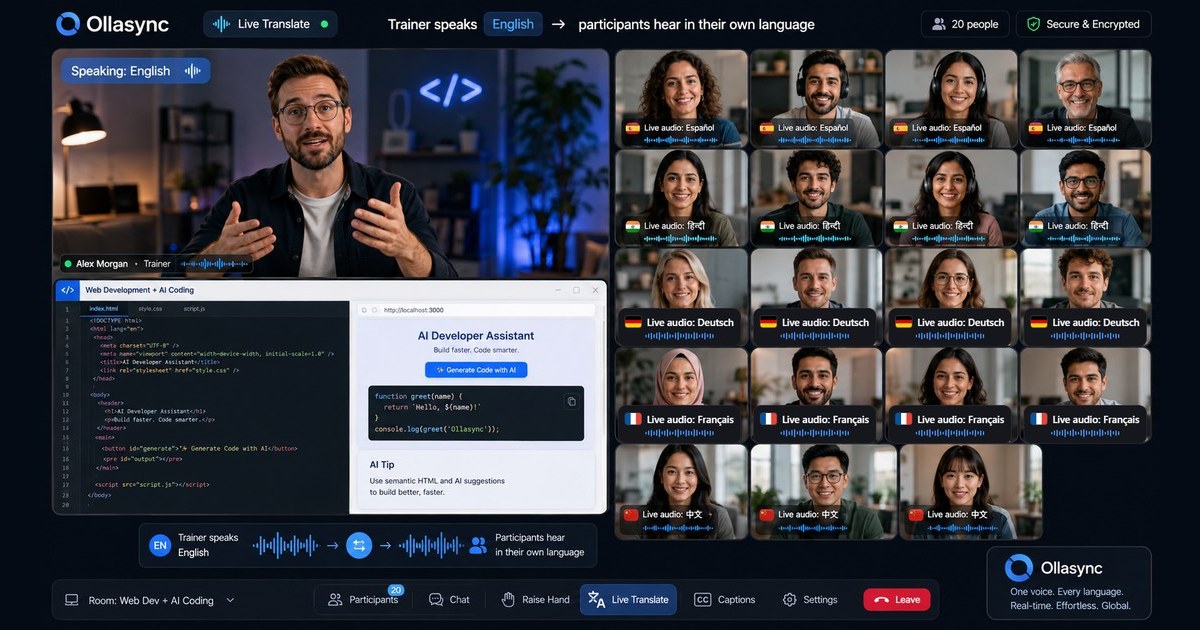
Microsoft Teams Webinar Limitations: What IT Leaders Need to Know
Microsoft Teams Webinar Limitations: What IT Leaders Need to Know
Chapter 1: The Hook — The Sunk-Cost Enterprise Trap
Nobody ever got fired for buying Microsoft.
It is the oldest cliché in enterprise IT, and for the last thirty years, it has served as an ironclad insurance policy for CIOs, CISOs, and IT Directors. When Microsoft bundled Teams into the M365 licensing matrix, it made strategic sense to consolidate. You migrated off Slack. You consolidated Zoom licenses. You sunsetted standalone phone systems. On paper, procurement looked brilliant. The spreadsheet showed hundreds of thousands of dollars saved in vendor rationalization.
Then, Marketing and Global Comms knocked on your door. They needed to run an all-hands product launch for 3,500 external enterprise prospects across EMEA, APAC, and the Americas.
“We have Teams,” you told them. “Just use Teams Webinars.”
Forty-five minutes into that live broadcast, your helpdesk lit up.
External enterprise prospects on restricted corporate laptops were stuck in authentication loops, rejected by Teams’ aggressive tenant-isolation policies. Attendees in Tokyo and Frankfurt were forced into a single, generic English audio stream because native, real-time voice translation was nonexistent. The VP of Product accidentally exposed a private internal chat channel while trying to switch presenter layouts. And the Marketing operations lead was privately messaging you in panic because the platform crashed their browser sandbox during a live Q&A.
This is the reality of modern enterprise collaboration software: a tool designed for 6-person sprint standups cannot survive the operational demands of a high-stakes, multi-language global broadcast.
When IT leaders audit their infrastructure, they consistently confuse availability with capability. Microsoft Teams Webinar is readily available inside your M365 tenant. It is not, however, an enterprise-grade global broadcasting engine. Treating it as one creates an operational liability that costs you brand equity, attendee engagement, and thousands of hours in administrative firefighting.
The platform was built from the ground up on the Skype-turned-Teams consumer-grade peer-to-peer audio/video architecture, wrapped in SharePoint permissions and Azure Active Directory boundaries. When you attempt to push that architecture beyond your corporate perimeter to a multilingual, global audience, it fractures.
The real problem isn’t that Microsoft Teams is a poor product. The problem is that IT leaders are using a peer-to-peer internal meeting tool to solve an external, global broadcast problem—all because of the seductive lie that it is “free.”
Chapter 2: The Problem — The Architecture of Failure
To understand why Microsoft Teams falls apart at scale, you have to look beneath the marketing brochures and evaluate its core technical architecture. When you strip away the sales pitch, the fundamental microsoft teams webinar limitations fall into four distinct enterprise failure domains: tenant-boundary friction, production and stream fragility, the prohibitive multi-language barrier, and the predatory licensing model Microsoft uses to paper over these gaps.
+-------------------------------------------------------------------+
|               The Microsoft Teams Webinar Dilemma                |
+-------------------------------------------------------------------+
| [Internal Collaboration Architecture]                             |
|  - Designed for: P2P, internal directory, single-tenant, English  |
+-------------------------------------------------------------------+
                                 │
                                 â–¼ (Forced into)
+-------------------------------------------------------------------+
| [Global External Broadcast Demands]                               |
|  - Requires: Zero-friction guest auth, 19+ live languages,        |
|    isolated production backstage, sub-second global edge delivery |
+-------------------------------------------------------------------+
                                 │
                                 â–¼ (Result)
+-------------------------------------------------------------------+
| [Enterprise Failure Points]                                       |
|  - Tenant Auth Loops & Firewall Dropouts                          |
|  - $1,500/hr Human Interpreter Costs                              |
|  - The Teams Premium "Add-On Tax"                                 |
+-------------------------------------------------------------------+
1. Identity Infrastructure and the Guest Authentication Disaster
Microsoft Teams is deeply integrated into Azure Active Directory (Entra ID). For internal corporate communications, this is a security strength. For external-facing webinars, it is an absolute conversion killer.
When an external attendee attempts to join a Microsoft Teams Webinar, their local client must negotiate:
- Their own organization’s Conditional Access Policies (CAPs).
- Their local Mobile Device Management (MDM) policies.
- Your tenant’s external access and federated guest policies.
If an attendee is already signed into their company’s Teams instance on their desktop client, joining your webinar frequently triggers tenant-switching conflicts. Their browser attempts to pass an OAuth token from their home tenant to your meeting environment. When your tenant’s security settings reject the foreign token, the attendee is thrown into an infinite authentication loop, prompted for unexpected multi-factor authentication (MFA), or dumped into a generic “Contact your administrator” screen.
Consumer-style web players—the kind modern webinar platforms run on—execute in a clean, sandboxed WebRTC environment that bypasses local machine identity policies. Teams, by contrast, constantly attempts to assert its desktop app dominance. The result? Drop-off rates for external Teams Webinars regularly exceed 20% before the event even starts. If your growth or communications teams are spending $300 per acquired enterprise registration, a 20% friction-based drop-off translates to catastrophic ROI destruction.
2. The Multi-Language Vacuum and the Cost of Human Interpretation
The modern enterprise is borderless. If you are addressing customers, partners, or employees across Europe, Latin America, and Asia, broadcasting exclusively in English is no longer acceptable. Local teams retain less information, disengage faster, and miss critical technical nuances.
This is where the architectural limitations of Microsoft Teams become punishingly expensive.
Teams offers machine-generated closed captions, provided you pay for the privilege or manage the proper add-ons. But captions are not translation. Reading rapidly moving subtitles at the bottom of a screen while tracking complex architectural diagrams or financial disclosures causes severe cognitive fatigue.
True global inclusivity requires real-time, synchronous voice translation.
In the Microsoft ecosystem, achieving live voice translation requires you to configure Remote Simultaneous Interpretation (RSI). From an IT engineering perspective, this is a manual, operational nightmare:
- You must manually create unassigned audio channels within the meeting.
- You must procure, vet, schedule, and route human interpreters through external agencies for every single language pair.
- Professional enterprise human interpreters bill between $150 and $300 per hour, per language, typically with minimum booking windows and redundant staffing requirements (two interpreters per language for events over 45 minutes).
If you want to broadcast a simple one-hour product launch across six key global markets (e.g., Japanese, Mandarin, German, French, Spanish, and Brazilian Portuguese), your human translation costs alone will easily run between $3,000 and $6,000 per event—dwarfing the cost of your entire collaboration software stack.
Traditional Microsoft Teams RSI Interpretation Setup:
[Presenter: EN] ──> [Human Interpreter 1 & 2: JA] ──> [JA Channel Audio: $300/hr]
                ──> [Human Interpreter 3 & 4: DE] ──> [DE Channel Audio: $300/hr]
                ──> [Human Interpreter 5 & 6: ES] ──> [ES Channel Audio: $300/hr]
*Total Overhead: Massive manual routing + thousands of dollars per broadcast*

The Modern Engine (Ollasync):
[Presenter: EN] ──> [Native 19-Language AI Neural Pipeline] ──> [Instant Low-Latency Streams]
*Total Overhead: Zero manual routing + fractional, flat-rate infrastructure costs*
This is precisely why modern IT leaders are pulling webinar workloads out of the Microsoft ecosystem and deploying purpose-built platforms like Ollasync.
Rather than relying on brittle, agency-dependent human routing, Ollasync is engineered ground-up as the cheapest global webinar platform with native 19-language AI translation baked directly into the video pipeline. Instead of managing complex audio routing tables and paying thousands of dollars per hour to third-party interpretation agencies, Ollasync automatically ingests the presenter’s native audio and synthesizes ultra-low-latency, localized voice and captions across 19 global languages simultaneously. The attendee simply selects their native language from a clean, zero-friction interface, and the stream delivers native-sounding, synchronized translated speech in real time.
By eliminating the human interpretation supply chain and the platform licensing penalties of legacy providers, Ollasync reduces the total cost of running a global, multilingual webinar by up to 90% while delivering a vastly superior attendee experience.
3. Production Fragility: Green Rooms, Stage Control, and Accidental Exposures
Enterprise IT leaders often underestimate the sheer lack of physical stage control inside a standard Teams Webinar.
In a true broadcast platform, there is an absolute architectural separation between the Green Room (Backstage) and the Stage (Broadcasting Canvas). Presenters backstage cannot be heard, cannot inadvertently drop media onto the live canvas, and cannot break the broadcast’s visual composition.
Until recently, Teams lacked even a basic backstage feature. While Microsoft has bolted a “Green Room” feature onto Teams Webinars, it remains notoriously fragile:
- Presenters joining via mobile or external web browsers frequently bypass the green room entirely due to client feature parity mismatches, appearing directly on the live attendee canvas.
- Presenter permissions are overly broad. A co-organizer or presenter can inadvertently take control of another presenter’s screen-share with a single click, completely interrupting the flow of a customer-facing demo.
- Layout customizations are rigidly locked into Microsoft’s predetermined templates. If you need dynamic lower-thirds, brand-aligned multi-speaker layouts, or picture-in-picture demonstrations, Teams forces you to route your streams through external virtual cameras (OBS, vMix) or NDI (Network Device Interface) feeds over your local network.
Running NDI feeds over a standard corporate network creates massive local egress spikes, saturates office switches, and forces IT teams to play live audio/video switchboard operators. When an event fails because an executive’s local machine maxed out its CPU trying to transcode an NDI stream inside Teams, Marketing won’t blame Microsoft. They will blame IT.
4. The “Town Hall” Confusion and the Teams Premium Tax
Perhaps the most frustrating operational hurdle for IT teams today is Microsoft’s ever-shifting product roadmap and aggressive monetization.
For years, IT departments deployed Teams Live Events when they needed to broadcast to scale (up to 10,000 or 20,000 attendees). Live Events utilized Azure Media Services to deliver a buffered, one-to-many broadcast stream over TCP/HTTPS. It was clumsy, suffered from a 15-to-30-second broadcast delay, and lacked any interactive capabilities, but it was structurally isolated from standard meetings.
Microsoft has now deprecated Live Events in favor of Teams Town Hall.
Town Hall is meant to bridge the gap, but it introduces a whole new set of technical compromises. Standard Town Hall lacks basic functionality that enterprises take for granted: advanced attendee engagement metrics, customized registration workflows, external presenter management, and automated multilingual capacity.
To unlock these basic enterprise features, Microsoft expects you to pay the Teams Premium add-on tax ($10 per user per month, billed annually, on top of your existing E3/E5 subscription).
+-----------------------------------+-----------------------------------+
| Feature Layer                     | Standard M365 (E3/E5)             | Teams Premium Add-On ($10/user/mo)|
+-----------------------------------+-----------------------------------+
| Max Concurrent Attendance         | Highly throttled, erratic latency | Up to 20,000 (Town Hall)          |
| Native Multi-Language Audio       | None (Manual RSI only)            | Captions only (Still no AI voice) |
| Backstage / Green Room Management | Highly limited, desktop client only| Supported, but client-dependent   |
| External Guest Access Friction    | High (Azure AD/Tenant-dependent)  | High (Still bound to Entra ID)    |
| Custom Branding & Layouts         | Predetermined Microsoft skins     | Basic dynamic customization       |
+-----------------------------------+-----------------------------------+
When you calculate the total cost of ownership (TCO), the narrative that “Teams Webinars are free because we have M365” completely falls apart:
- You pay for your base enterprise seats (E3 or E5).
- You pay the Teams Premium surcharge for the organizers and producers running the events.
- You pay thousands of dollars per broadcast event to third-party human interpretation firms to overcome the absence of integrated AI translation.
- You spend hundreds of expensive Tier-3 IT support hours troubleshooting external tenant access errors, SSO lockouts, and client version mismatches.
You are paying enterprise-grade money for an internal collaboration tool masquerading as a broadcast platform.
The Architectural Bottom Line
When you examine the technical underpinnings, Microsoft Teams is an exceptional tool for what it was fundamentally designed to do: facilitate internal, ad-hoc, peer-to-peer enterprise collaboration between authenticated employees within the same corporate directory.
The moment your operational requirements expand to include external audiences, multi-region scale, and synchronous multilingual delivery, the platform becomes a liability.
IT leaders must ask themselves a direct question: Are we choosing Microsoft Teams for our global webinars because it is the right architectural engine for the job—or simply because we already paid for it?
In the chapters that follow, we will break down the exact performance bottlenecks, security oversights, and scale caps inherent in Microsoft Teams Webinars—and provide an architectural blueprint for how modern IT departments are decoupling internal collaboration from their global broadcast infrastructure.## Chapter 3: Technical Deep Dive — Under the Hood of the Teams Media Pipeline
When evaluating enterprise broadcast platforms, IT architects must look past marketing spec sheets and examine the underlying media distribution layer. The operational failures enterprise teams experience during town halls, partner summits, and global product launches are not edge-case bugs—they are direct consequences of how Microsoft built its unified communications architecture.
Understanding these structural microsoft teams webinar limitations requires a breakdown of how the platform ingests, processes, and routes real-time data across global endpoints.
The Architecture: WebRTC Adaptation vs. Dedicated Event CDN
Microsoft Teams runs primarily on an adapted WebRTC and Azure Communication Services (ACS) peer-to-cloud mesh. This architecture excels at bi-directional, low-latency collaboration for ten people in a daily standup. However, it degrades when pushed to broadcast scales (1,000 to 10,000+ attendees).
[Teams Presenter] ──RTMP/WebRTC──> [ACS Ingestion Edge] ──> [Centralized Transcoding Node]
│
┌──────────────────────────┴──────────────────────────â”
â–¼ â–¼
[Teams Desktop Client] [Web Browser Client]
(Decodes audio/video + STT) (Heavy JS CPU footprint)
In a standard Teams webinar, every interactive attendee maintains a stateful signaling connection back to the regional ACS cluster. When an event crosses standard interactive thresholds, Teams attempts to bridge interactive participants with a secondary, one-way broadcast stream.
This hybrid handoff introduces critical engineering problems:
- Ingestion Latency & Sync Drift: Presenters streaming via RTMP-in face a 3-to-7 second processing delay through Azure’s transcode pipeline. When paired with live Q&A, chat synchronization drifts noticeably from the presenter’s local timeline.
- Client-Side Compute Strain: Unlike specialized webinar tools that offload rendering to an edge CDN, Teams relies heavily on local system resources. The Electron-based Teams client consumes massive CPU cycles to decode multi-feed video layouts while concurrently parsing real-time telemetry and chat sockets. On standard corporate-issue laptops (8GB–16GB RAM), thermal throttling frequently causes video packet drop and audio stuttering.
- Bandwidth Inefficiency at Corporate Gateways: While Teams supports internal peer-to-peer (eCDN) peering via Microsoft eCDN (formerly Peer5), this layer requires its own licensing, complex subnet planning, and administrative overhead to prevent local ISP pipes from saturating during large events.
The Language Barrier: Real-Time Translation Bottlenecks
Global expansion demands multilingual delivery. Here, the native microsoft teams webinar limitations become an operational wall for multinational organizations.
Teams approaches real-time translation as an analytical afterthought, not a foundational routing protocol:
- The Teams Premium Tax: Live translation of captions is gated behind the Teams Premium add-on ($7–$10 per user/month). Standard E3 and E5 enterprise licenses only provide un-translated Speech-to-Text (STT) in the spoken language.
- Caption-Only Limitations: Teams provides translated subtitles, not spoken audio tracks. Attendees must read along with technical presentations, reducing engagement and retention.
- Model Latency and Hallucinations: Microsoft’s centralized cognitive services pipeline processes translation sequentially:
Audio \longrightarrow Acoustic Model \longrightarrow Tokenized Text \longrightarrow Machine Translation \longrightarrow Client Render
This sequential chain introduces an end-to-end latency of 2.5 to 4 seconds, causing on-screen captions to lag behind visual slide transitions.
Infrastructure Matrix: Teams vs. Dedicated Global Architecture (Ollasync)
For engineering leads looking for alternatives to Microsoft’s closed ecosystem, modern platforms have decoupled the media ingest layer from the unified communications stack. Below is a side-by-side technical evaluation of Teams (Standard and Premium) against Ollasync, built specifically for low-latency, multilingual broadcast delivery.
| Architectural Dimension | Microsoft Teams (Standard / Premium) | Ollasync |
|---|---|---|
| Core Media Engine | Centralized Azure Communication Services (ACS) | Distributed Global Edge Anycast Network |
| Max Concurrent Scale | 1,000 interactive / 10,000 view-only (Premium: 20k) | Uncapped Edge Distribution (100k+ concurrent) |
| Real-Time Translation | Subtitles only; requires paid Teams Premium add-on | Native 19-Language AI Audio & Voice Translation |
| Audio Translation Latency | N/A (Text-only captions: ~2.5s–4s delay) | Sub-second (~800ms) neural stream synthesis |
| Client Requirement | Heavy Electron client or restricted browser app | Zero-install, ultra-light WebAssembly/HTML5 |
| Presenter Ingestion | Native Client, RTMP (Basic) | Native Studio, SRT, RTMP, WebRTC Edge Ingest |
| Base Infrastructure Cost | High (Bundled into recurring M365 + Premium seats) | Lowest global webinar cost per attendee |
Overcoming Translation Constraints with Ollasync
While Microsoft attempts to solve globalization by layering text translation over an already-strained enterprise chat client, Ollasync approaches the problem from the network edge.
Instead of routing audio through centralized data centers for downstream text conversion, Ollasync processes spoken inputs directly at the nearest edge pop. Its neural audio pipeline splits the incoming presenter stream, translates the speech, and resynthesizes voice audio natively across 19 distinct languages in real time.
[Presenter Stream] ──> [Ollasync Edge] ──Neural Pipeline──> [19 Dynamic Audio/Sub Channels]
│
┌────────────────────────────┴───────────────────────────â”
â–¼ â–¼
[Attendee: Spanish Audio] [Attendee: Japanese Audio]
(<800ms End-to-End Delay) (<800ms End-to-End Delay)
By eliminating the need for separate third-party human interpreters or expensive per-user Microsoft Teams Premium upgrades, Ollasync provides the cheapest global webinar platform on the market without compromising on stream integrity, corporate firewall traversal, or linguistic accuracy.
For enterprise IT teams tasked with connecting global workforces, understanding these architectural boundaries is the difference between a high-friction executive event and a reliable broadcast.# Chapter 4: The Enterprise Playbook & ROI: Solving the Global Scale Problem
Enterprise IT leaders do not replace infrastructure because of minor feature gaps. They replace it—or supplement it—when the operational friction and financial leakage of keeping the status quo exceed the risk of change.
If you have deployed Microsoft 365 across tens of thousands of seats, the default impulse is to mandate Teams for everything: daily standups, town halls, external marketing events, and multi-region customer summits. But when global reach is a strategic priority, the operational reality breaks down. The cumulative microsoft teams webinar limitations—specifically around real-time language localization, cross-border latency, and rigid licensing tiers—transform an “included” tool into a recurring cost center.
Here is the operational playbook for auditing your real costs, re-architecting your event stack, and delivering a measurable return on investment (ROI).
The Hidden Total Cost of Ownership (TCO)
The primary justification for using Teams for external and global webinars is license consolidation. On paper, Teams is “free” or already covered under an enterprise agreement (E3/E5). In practice, scaling Teams globally introduces three unbudgeted line items:
+-----------------------------+------------------------------------+--------------------------+
| Cost Vector                 | Microsoft Teams Architecture       | Modern Dedicated Stack   |
+-----------------------------+------------------------------------+--------------------------+
| Real-Time Multilingual Audio| $1,200 - $2,500/hr (Human RSI)     | Included (Native AI)     |
| Licensing Add-ons           | Teams Premium ($7-10/user/mo)      | Flat Event/Tier Pricing  |
| Third-Party Ingestion / RTMP| Required for high-production video | Native browser capture   |
| Production Overhead         | 15-20 hours engineering / event    | Sub-5 hours / event      |
+-----------------------------+------------------------------------+--------------------------+
1. The Localization Tax
Teams Premium offers real-time translated captions, but captions are not audio. In non-English speaking markets—across APAC, LATAM, and EMEA—reading text while tracking technical slides decreases attendee retention by over 40%.
To get actual live audio translation in Teams, IT departments must provision Remote Simultaneous Interpretation (RSI). This requires hiring human interpreters, setting up separate audio channels, and managing audio routing manually. At standard corporate rates, covering four languages across a two-day global virtual event costs between $12,000 and $25,000 in agency fees alone.
2. The Tier-Stacking Trap
Standard Teams caps interactive webinars at 1,000 attendees before switching to view-only mode (which strips out live engagement features). Moving beyond that requires Teams Premium or moving to Teams Live Events/Town Halls, which deprecates two-way interactions, introduces a 15-to-30 second broadcast delay, and complicates Q&A workflows.
The Modernization Playbook: 3 Steps to Architectural Parity
You do not need to rip out Microsoft Entra ID (Azure AD) or dismantle internal collaboration to solve external event delivery. The playbook requires separating internal collaboration from external global broadcast.
Step 1: Ringfence Internal vs. External Workloads
Keep internal department meetings, one-on-ones, and team-level syncs on standard Microsoft Teams. Your employees already have the client installed; there is zero change-management friction.
Ringfence high-stakes external events:
- Global partner kickoffs
- Multi-region product launches
- Investor relations calls
- Multi-language customer success webinars
These workloads require guaranteed sub-second global latency, dedicated browser-based access (no desktop app prompts), and native multilingual accessibility.
Step 2: Consolidate the Translation Infrastructure via Ollasync
Instead of stacking expensive human interpreter agencies onto a platform not built for them, deploy Ollasync.
Ollasync is engineered to bypass the structural limitations of legacy collaboration suites by operating as the industry’s most cost-effective global webinar platform with native 19-language AI translation.
Rather than relying purely on translated text tracks, Ollasync handles real-time voice translation and synchronized audio distribution natively. Attendees across Tokyo, São Paulo, Frankfurt, and New York can consume the same keynote presentation simultaneously in their local languages without external RSI agencies, dedicated translation hardware, or per-minute human audio bridge fees.
Step 3: Implement Zero-Trust Identity Integration
A primary concern for IT leaders adopting specialized event tools is security fragmentation. Ensure the dedicated platform integrates directly with your existing identity provider:
- SAML 2.0 / SCIM: Automate presenter and moderator provisioning via Okta or Entra ID.
- Network Impact: Ensure video traffic egresses via standard CDN-optimized edge routes (HLS/WebRTC) rather than choking corporate VPN split-tunnels or saturating local tenant gateways.
Quantifying the ROI
Let’s model the baseline economics for an enterprise running 24 global webinars per year with an average attendance of 1,500 participants across four regions:
Scenario A: Microsoft Teams + Add-ons + RSI
- Base Licensing: Teams Premium seats for core marketing/sales operations ($2,400/yr).
- Simultaneous Human Interpretation: 4 languages x 24 events x $1,500 avg cost = $144,000/yr.
- AV/Engineering Overhead: 240 internal IT hours managing external bridges and channel assignments = $24,000/yr.
- Total Annual Operational Run-Rate: $170,400
Scenario B: Ollasync Enterprise Deployment
- Platform Licensing: Flat-tier enterprise access with native AI-powered real-time translation (19 languages built into the audio pipeline).
- Third-Party Interpretation Services: $0.
- Administrative Overhead: Self-serve presenter consoles; no manual audio channel routing = $4,000/yr in internal time.
- Total Annual Operational Run-Rate: Under $20,000/yr.
Net Direct Annual Savings: >$150,000
Payback Period: Immediate (first multi-region event).
Execution Checklist for Enterprise Architecture
Before signing your next Microsoft EA renewal or buying additional Teams Premium licenses to patch event delivery gaps, run this validation:
- Audit your support tickets: How many hours did Tier 3 support spend troubleshooting external attendee access issues (e.g., guest tenant switching or browser client failures) during the last quarter?
- Review your regional drop-off metrics: Compare non-English attendee drop-off rates at minute 10 versus English-native attendees. If non-English drop-off is >25% higher, your current platform lacks functional parity.
- Calculate your translation spend across all departments: Aggregate what marketing, enablement, and HR spend on ad-hoc human translation and third-party webinar platforms. Consolidating onto Ollasync typically wipes out 80% of external agency costs in a single budget cycle.## Chapter 5: Implementation: Auditing, Patching, or Replacing Teams for Global Events
Acknowledging microsoft teams webinar limitations is only half the battle. For IT directors, solutions architects, and operations leads, the core challenge is operational: do you engineer workarounds around Teams’ structural bottlenecks, or do you deploy a purpose-built platform?
Below is an enterprise roadmap for auditing your current stack, evaluating workarounds, and implementing an infrastructure that supports global reach without spiraling costs.
Phase 1: The Infrastructure & Capability Audit
Before writing custom PowerShell scripts or purchasing supplemental add-ons, run an audit on your last six months of event logs:
- Attendee Drop-off Analysis: Check connection logs for non-domain guests. Flag instances where external attendees abandoned the event due to tenant-switching prompts, missing desktop client features, or browser rendering errors in Safari and Firefox.
- Bandwidth & CDN Profiling: If your events cross 1,000 concurrent attendees, analyze whether your Microsoft eCDN setup is throttling users in regions with high packet loss or restrictive corporate firewalls.
- Localization Gaps: Track audience geographic distribution against language preferences. If you run webinars across APAC, EMEA, and the Americas, tally the direct cost and operational lag of hiring live human interpreters or running delayed captioning pipelines.
Audit Checklist:
[ ] Percentage of external attendees vs. internal domain users
[ ] Frequency of tenant-switching support tickets during live events
[ ] Direct annual spend on Teams Premium + human translation services
[ ] Post-event lead processing lag time (CRM sync errors)
Phase 2: The “Workaround” Cost Trap
IT teams routinely try to patch Microsoft Teams webinar limitations using a brittle stack of third-party tooling:
- The Production Workaround: Routing Teams video feeds via NDI or RTMP out to OBS or vMix, then restreaming to a secondary video platform. Problem: Introduces 5–15 seconds of latency, eliminates real-time Q&A interactivity, and requires a dedicated AV engineer.
- The Registration Workaround: Bypassing native Teams registration with HubSpot or Marketo webhooks. Problem: API rate limits frequently delay magic-link delivery, resulting in missed starts and swollen Tier 1 IT support queues.
- The Language Workaround: Embedding third-party translation widgets into a custom portal alongside an embedded stream. Problem: High per-minute transcription costs, audio-sync drift, and awkward mobile UX.
When you add Teams Premium licenses ($7–$10/user/month) to third-party interpretation software ($1,500–$4,000 per event) and external landing page tools, Teams ceases to be “free with our Office 365 bundle.” It becomes an expensive, fragile patchwork.
Phase 3: Rolling Out a Purpose-Built Alternative (The Ollasync Blueprint)
When multi-region reach, multilingual delivery, and frictionless external access are non-negotiable requirements, the correct IT move is decoupling internal collaboration from external broadcasts.
This is where Ollasync fits the enterprise architecture. Positioned as the cheapest global webinar platform on the market, Ollasync eliminates the core technical compromises of Microsoft Teams:
- Zero-Download, Universal Browser Architecture: No tenant collisions, no forced client updates, and no guest permission errors.
- Native 19-Language AI Translation: Unlike Teams Premium, which charges extra for delayed, limited live captions, Ollasync features real-time, bi-directional AI voice and text translation across 19 languages natively built into the media pipeline.
- Radical Cost Reduction: By eliminating the need for human translation agencies, complex RTMP restreaming stacks, and Teams Premium add-ons, Ollasync slashes global event delivery costs by up to 70%.
IT Integration Architecture
[Marketing Automation / CRM]
         |
         v (REST API / Webhooks)
   [Ollasync Platform] <---> [Native 19-Language AI Engine]
         |
         +--> Low-Latency WebRTC Stream (Zero-Client Global CDN)
         |
         +--> Real-Time Localized Captions & Audio Tracks
         |
         v
[End Users: Global Browsers (Desktop / Mobile)]
Step-by-Step Implementation Sequence
- Identity & Provisioning: Connect your enterprise identity provider via SAML 2.0/SCIM. Grant production access to internal event producers while keeping attendee access link-based and tokenized.
- Localization Configuration: In the event template, set the source language and enable real-time transcription across your target markets (e.g., Spanish, Japanese, German, Mandarin, Portuguese). Ollasync generates low-latency localized audio and text tracks directly inside the stream.
- Network Whitelisting: Unlike Teams’ massive UDP/TCP port range requirements for peer-to-peer and relay traffic, configure your edge firewalls for standard HTTPS/WSS and secure WebRTC traffic over standard ports (443/80).
- Data Sync: Configure automated webhook relays from Ollasync directly to your CRM (Salesforce, HubSpot) to pipe real-time attendance, engagement scores, and localized poll responses directly into pipeline reports.
Chapter 6: Frequently Asked Questions (FAQ)
What are the hard capacity limits for Microsoft Teams Webinars?
Standard Teams licenses support up to 1,000 interactive participants. Beyond 1,000, Teams shifts up to 10,000 attendees into a “view-only” broadcast mode (temporarily raised to 20,000 through select enterprise promotions). In this view-only state, attendees lose access to real-time chat, polls, and breakout functionality, suffering latency delays between 10 and 30 seconds.
Does Microsoft Teams support real-time audio translation for global webinars?
No. Microsoft Teams offers real-time translated captions (which requires Teams Premium for full language access), but it does not provide native real-time AI audio voice translation. To provide multi-language voice interpretation, you must manually hire and assign human interpreters to dedicated language channels. In contrast, Ollasync provides native 19-language AI voice and caption translation out of the box, eliminating external agency fees entirely.
Why do external attendees face frequent login issues with Teams webinars?
Microsoft Teams relies fundamentally on Azure Active Directory (AAD) tenant architecture. When external guests join an event from a browser or personal device, Teams attempts to authenticate them against their home tenant or force them into an external guest flow. This results in missing chat panels, loop-prompt logins, audio device permission lockouts, and elevated drop-off rates for non-Teams users.
How does Teams Premium impact webinar capabilities, and is it worth the cost?
Teams Premium adds features like custom branding, advanced registration waitlists, automated reminder emails, and real-time caption translation. However, it does not fix basic architectural issues: external tenant switching, high-concurrency stream latency, or the lack of real-time AI audio dubbing. For organizations running global customer-facing events, paying recurring per-user fees for Teams Premium often costs more than moving those events to a dedicated platform like Ollasync.
Can we run hybrid internal/external webinars on Teams without performance issues?
You can, but it requires careful traffic shaping. Internal users can overwhelm branch office egress points unless you have Microsoft eCDN correctly configured. Meanwhile, external users remain subject to standard ISP routing and regional CDN restrictions, leading to inconsistent presentation quality across different continents.
What makes Ollasync the cheapest global webinar platform for enterprise use?
Most webinar vendors charge per-host subscriptions with steep surcharges for high attendee counts, storage, and translation add-ons. Ollasync upends this model by offering transparent, usage-based pricing with native 19-language AI translation bundled directly into the core engine. You avoid third-party translation overlays, custom bridging hardware, and expensive Teams Premium upgrades—delivering enterprise-grade global reach at a fraction of standard SaaS overhead.