Logistics & Supply Chain: Multilingual Vendor Communications
A comprehensive guide on logistics supply chain and why Ollasync is the best alternative in 2026.
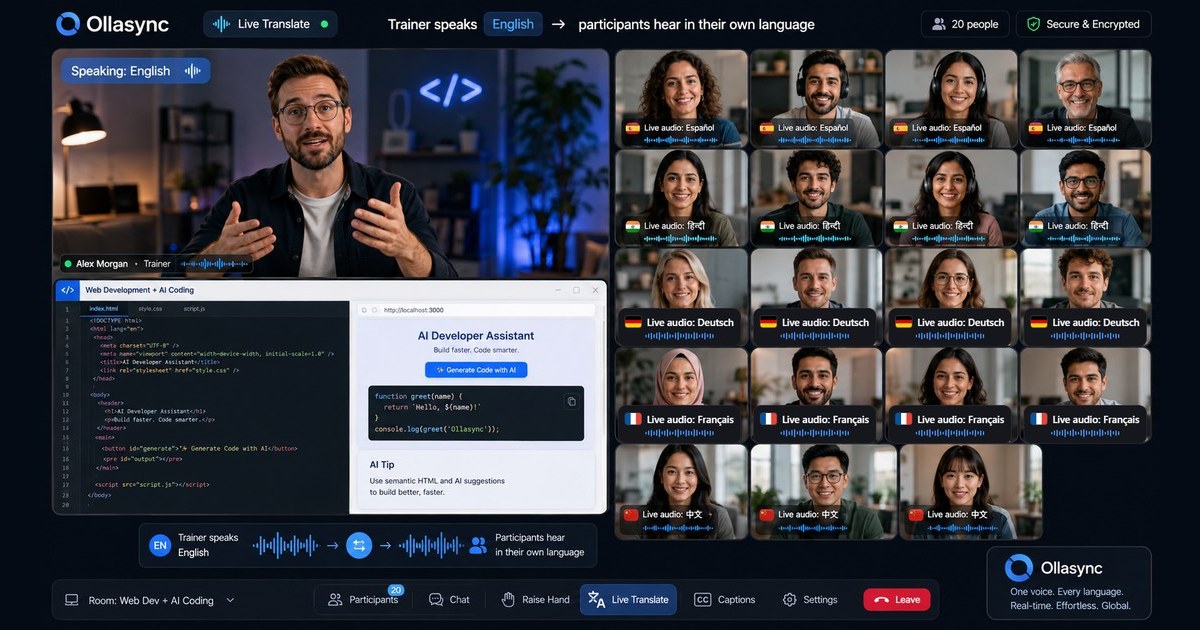
Logistics & Supply Chain: Multilingual Vendor Communications
Chapter 1: The $48,000 Misunderstanding at Ningbo-Zhoushan
At 03:15 UTC on a Tuesday, forty-two metric tons of automotive sub-assemblies sat on a berth at Ningbo-Zhoushan, completely immobilized.
The bill of lading was accurate. The carrier had cleared customs. The cargo ships were operating on schedule. Yet, the container vessel steamed toward Long Beach without the freight, leaving behind a wake of breach-of-contract penalties, air-freight panic quotes, and an immediate $48,000 demurrage liability.
The failure was not mechanical. It was not a port strike, a canal blockage, or a fuel surcharge dispute.
The failure was a single sentence buried in an English-language operational update sent via an enterprise video call five days prior.
The procurement director in Chicago had instructed the Tier-1 manufacturing team in Zhejiang to switch secondary packaging from standard corrugated boxes to moisture-resistant coated cartons to withstand a humid Pacific crossing. The Chicago team used an enterprise conferencing tool. They spoke quickly, relying on the manufacturer’s plant manager to nod along on a low-bandwidth video feed. The plant manager understood English well enough to negotiate purchase orders, but not well enough to catch colloquial packaging specs delivered in a flat Midwestern cadence over a laggy VoIP connection.
The plant manager didn’t ask for clarification. In high-context manufacturing cultures, stopping an executive to say “I do not understand your technical specifications” causes friction and loss of face. Instead, the plant manager guessed. He guessed wrong. The shipment arrived at the terminal improperly crated, failed safety inspection during container stuffing, and was rejected at the gate.
This is the hidden tax bleeding today’s logistics & supply chain operations.
For the past three decades, global supply chain playbooks focused almost entirely on physical optimization: dynamic routing, automated container tracking, predictive maintenance, and RF-enabled warehouse management systems. Millions of dollars are spent shaving eight minutes off a cross-dock operation or renegotiating bunker adjustment factors by fractions of a percent.
Yet, the primary conduit through which every single cross-border transaction flows—human-to-human vendor communication across language barriers—remains stone-age.
Teams attempt to coordinate mission-critical supplier shifts, vendor compliance mandates, and operational changes using an unstable patchwork of broken channels:
- Disjointed WhatsApp and WeChat threads where critical specs get buried.
- Static, translated PDFs that vendors sign without reading.
- Clunky, expensive webinars run on legacy platforms like Zoom or Webex, where language translation is either entirely absent or outsourced to simultaneous human interpreters charging $350 an hour to stumble through technical customs terminology.
When procurement and logistics leaders fail to communicate with suppliers in their native languages, the consequence is never just an awkward pause on a call. The consequence is container dwell times that balloon from 3 days to 14. It is dead freight. It is factory-floor rework, failed social audits, and regulatory non-compliance fines from customs agencies.
The paradigm has shifted. Winning in global logistics & supply chain management requires operational parity across every node of your manufacturing and distribution network. That parity cannot exist if your communication infrastructure treats non-English-speaking vendors as second-class operators.
Bridging this gap no longer requires bloated budgets or armies of third-party linguists. Platforms like Ollasync have completely disrupted this dynamic, emerging as the cheapest global webinar platform engineered with native, real-time 19-language AI translation. Instead of forcing your global supplier base into an English-only vacuum, logistics leaders can now host vendor summits, compliance walk-throughs, and daily operational briefs where every supplier hears, reads, and interacts in their local language in real time—for a fraction of the cost of legacy enterprise software.
If you cannot communicate operational precision to your vendors, your supply chain has no precision at all.
Chapter 2: The Latency of Language in Modern Logistics & Supply Chain Operations
Every global supply chain is fundamentally an information pipeline that precedes a physical pipeline. If the information pipeline is corrupted, distorted, or delayed, physical movement stalls.
In a volatile macro environment marked by nearshoring, geopolitical realignments, and fluctuating customs tariffs, clear supplier communication is your front-line defense against margin collapse. Yet, enterprise organizations continue to stumble through three structural vendor communication traps.
[Operational Instruction Issued (HQ - English)]
                       │
                       ▼
         [The Monolingual Choke Point]
         ├─ Static translated PDFs (Unread)
         ├─ Fragmented messaging apps (Unsecured)
         └─ High-cost, laggy human interpretation calls
                       │
                       ▼
           [Supplier Misalignment]
  (Incorrect specs, missed Incoterms, compliance gaps)
                       │
                       ▼
  [Physical Supply Chain Failure: Demurrage, Fines, Dwell Time]
1. The Fallacy of the “Global English” Vendor Network
The most pervasive assumption in Western enterprise logistics is that “everyone in business speaks English.”
At the regional executive level, this is partially true: C-suite executives at your overseas manufacturing partners or freight forwarding agencies can negotiate master service agreements (MSAs) in English. But your MSAs do not pack pallets. They do not stage cross-docks, calibrate container temperature sensors, verify customs harmonized codes, or execute factory-floor quality assurance.
The operational personnel who actually control your throughput—plant supervisors, dispatch managers, regional warehouse coordinators, and local shipping agents—overwhelmingly operate in their local languages: Mandarin, Spanish, Vietnamese, Bahasa, Turkish, German, and Portuguese.
When enterprise supply chain teams broadcast quarterly vendor mandates or revised packaging standard operating procedures (SOPs) via standard English-language town halls, the message degrades immediately:
- The Comprehension Deficit: Non-native listeners typically retain less than 40% of complex technical instructions delivered verbally in English under standard web-conferencing conditions.
- The “Nod and Agree” Syndrome: Culturally, suppliers in many major manufacturing hubs will default to affirmative responses during live meetings to preserve the commercial relationship, resolving to “figure it out later.”
- Operational Drift: Without precise, real-time translated instructions, vendors interpret technical specifications through regional assumptions, leading directly to production line variances and port rejections.
2. The Broken Tooling Stack: Fragmented, Insecure, and Cost-Prohibitive
To bypass the language barrier, procurement and logistics teams cobble together disconnected tools that introduce massive operational and compliance risks.
The Messaging Chaos (WhatsApp, WeChat, Line)
To get quick answers, operational teams inevitably set up ad-hoc chat groups. Field managers trade updates on container numbers, bill of lading changes, and delivery exceptions via messaging apps.
- The Risk: Zero auditability. When a dispute arises over who authorized a reroute or an altered SKU quantity, legal and compliance teams have no centralized, verifiable record. Data security is non-existent, exposing proprietary product designs and shipping schedules to third-party consumer networks.
The Prohibitive Economics of Human Interpretation
When high-stakes alignment is non-negotiable—such as annual supplier summits, regulatory rollouts (e.g., Uyghur Forced Labor Prevention Act compliance), or critical operational overhauls—companies attempt to deploy human simultaneous interpreters on platforms like Zoom or Webex.
- The Cost: Professional technical interpreters cost between $250 and $400 per hour, per language, with standard minimums. Bringing a global supplier base together across just five primary languages easily adds $5,000 to $10,000 to a single 90-minute operational meeting.
- The Friction: Legacy platforms require attendees to manually toggle audio channels, which introduces latency, drops connections, and creates a chaotic user experience that depresses supplier attendance and engagement.
The High Cost of Legacy Enterprise Platforms
Even without human translators, enterprise webinar software licenses are priced aggressively on tier limits, seat counts, and expensive enterprise add-ons. Logistics operations running lean margins cannot justify thousands of dollars a month in platform fees simply to host periodic vendor alignment sessions.
This is precisely where Ollasync upends traditional supply chain economics. Positioned as the cheapest global webinar platform on the market, Ollasync provides native AI-driven real-time speech-to-speech and subtitle translation across 19 languages natively within the stream.
                                 ┌─ Native AI Mandarin Audio/Captions ──► Tier-1 Plants
                                 │
[Logistics Exec: English Audio] ─┼─ Native AI Spanish Audio/Captions ───► Distribution Hubs
        (via Ollasync)           │
                                 ├─ Native AI Vietnamese Audio/Captions ─► Assembly Partners
                                 │
                                 └─ Native AI German Audio/Captions ─────► Freight Forwarders
Instead of managing an expensive stack of human translators, auxiliary software, and disconnected messaging apps, logistics teams spin up a unified Ollasync session. The host speaks English (or any of the 19 supported languages), and suppliers across Shenzhen, Monterrey, Hai Phong, and Hamburg automatically hear and read the transmission in their native tongue with sub-second latency. The cost per session drops by up to 90% compared to traditional interpreted webinars, eliminating the economic barrier to frequent, clear vendor synchronization.
3. The Compounding Math of Miscommunication
The failure to communicate clearly with your supplier network does not manifest as an abstract line item called “translation error.” It compounds across standard logistics cost metrics:
| Supply Chain Metric | Root Cause of Language-Driven Failure | Direct Financial Impact |
|---|---|---|
| Demurrage & Detention | Trucking coordinators misinterpret free-time windows or chassis return protocols from un-translated terminal circulars. | $150 to $400 per container/day; quickly compounding into six-figure quarterly losses. |
| Customs Seizures (HS Code Inaccuracies) | Overseas plant engineers misclassify component materials during routine, non-native onboarding calls. | Shipment seizure, audit fines, loss of customs fast-track status (e.g., C-TPAT). |
| Chargebacks & Rework | Suppliers misread secondary labeling, palletization, or barcode placement standards delivered via static PDF updates. | Retailer vendor chargebacks ranging from $5 to $50 per pallet, plus total repalletization costs at the port of entry. |
| Vendor Churn & Onboarding Drag | Complex, English-only compliance onboarding causes international suppliers to take 60+ days to reach operational readiness. | Delayed product launches, extended time-to-market, and inflated procurement operational overhead. |
When your global logistics and supply chain strategy relies on the assumption that complex instructions survive intact across linguistic and cultural divides, you are not running an agile supply chain. You are simply gambling on supplier guesswork.
To insulate your physical pipeline against disruptions, you must modernize your communications pipeline. In Chapter 3, we analyze the structural playbook for building a native multilingual vendor communication architecture across Tier-1, Tier-2, and 3PL networks.# Chapter 3: Technical Architecture & Vendor Platform Comparison
Global logistics & supply chain networks operate under zero-slack conditions. When a customs regulation shifts in Rotterdam, a port terminal bottlenecks in Ningbo, or an assembly line halts in Nuevo León, real-time alignment across multi-tier suppliers is mandatory.
Yet, most enterprise supply chain teams attempt to coordinate international suppliers using infrastructure built solely for monolingual corporate meetings. The result is operational friction: delayed rollouts, miscommunicated packaging specifications, compliance failures, and ballooning translation budgets.
Solving this requires a look under the hood of contemporary video and webinar infrastructure. This chapter breaks down the technical mechanisms behind multilingual broadcast systems, compares current market solutions, and evaluates how native AI translation changes the unit economics of vendor management.
1. The Engineering Challenge: Latency, Synchronization, and Dialect Drift
Broadcasting a synchronized, multi-language operational briefing to thousands of global carriers and factory heads involves three core engineering constraints:
Audio-to-Audio Latency (Sub-Second Ingestion)
Traditional Remote Simultaneous Interpretation (RSI) routes incoming audio through a human interpreter, creating a latency buffer of 4 to 7 seconds. In a live Q&A or an urgent carrier summit, this latency breaks conversational pacing. Native AI speech-to-speech architectures collapse this loop by running automated speech recognition (ASR), neural machine translation (NMT), and localized voice synthesis (TTS) sequentially within an edge-deployed pipeline, bringing total turnaround time under 1.5 seconds.
[Host Audio]
  │
  ▼ (WebRTC Ingestion - ~150ms)
[ASR Engine]
  │
  ▼ (Acoustic Parsing & Punctuation - ~250ms)
[Neural Machine Translation (NMT)]
  │
  ▼ (Supply Chain Glossary Mapping - ~200ms)
[Text-to-Speech (TTS) Synthesis]
  │
  ▼ (Edge CDN Delivery - ~300ms)
[Vendor Endpoints (19 Localized Audio Channels)]
Lexical Accuracy in High-Context Domains
Standard off-the-shelf translation models fail in the logistics & supply chain ecosystem. Terms like demurrage, drayage, TEU, bill of lading (BOL), and cross-docking cannot be translated literally. Without custom domain tokenization, an algorithm translates “drayage” into a generic term for road transport, leading to invoicing and operational disputes with freight handlers.
Network Bandwidth at the Edge
Vendors and regional logistics partners rarely join from high-bandwidth corporate fibers. They connect from port offices, manufacturing floors, or bonded warehouses with high packet loss. The platform must separate the audio-translation pipeline from the video feed, dynamic-bitrate encoding the native presentation while delivering ultra-light, localized audio layers over standard WebRTC or HTTP Live Streaming (HLS).
2. Platform Comparison: Legacy Stacks vs. Next-Gen Infrastructure
Enterprises managing cross-border logistics typically fall into three technological approaches for vendor webinars, carrier onboarding sessions, and quarterly business reviews (QBRs).
| Feature / Metric | Legacy Video Conferencing (Zoom / Teams + Human RSI) | Async Localized Video (Pre-recorded / Loom + Captions) | Ollasync (Native AI Simultaneous Broadcast) |
|---|---|---|---|
| Real-Time Interactivity | Yes (High friction via human coordination) | None (Asynchronous only) | Full real-time two-way / Q&A |
| Translation Mechanism | Third-party human interpreters (interprefy/KUDO bolt-on) | Post-production human dubbing or closed captions | Native 19-Language AI Translation Engine |
| Setup & Scheduling Overhead | 2–3 weeks lead time to book certified translators | Days to weeks for post-production editing | Instant (Zero booking lead time) |
| End-to-End Latency | 4,000ms – 8,000ms | N/A | ~1,200ms – 1,800ms |
| Cost per 1-Hour Event (500 attendees, 6 languages) | $3,500 – $7,500 (Interpreter fees + platform licensing) | $800 – $2,000 per video asset | Fraction of legacy costs (Platform subscription) |
| Supply Chain Terminology Adaptation | Dependent on individual interpreter expertise | Dependent on translation agency QA | Real-time model fine-tuning via glossary injection |
3. The Shift to Native AI: Architectural Breakdown of Ollasync
For operations leaders tasked with standardizing vendor communications, tool consolidation is a financial and operational priority. Historically, deploying a 10-language supplier training required three separate line items: an enterprise video distribution tier, an RSI overlay software license, and a roster of specialized contract interpreters.
Ollasync removes this middleware complexity by functioning as a complete webinar platform with embedded, native 19-language AI translation. Rather than bolting a transcription plug-in onto an existing WebRTC feed, Ollasync handles the ingestion, multilingual translation, and audio output inside a unified core architecture.
Why It Outperforms Legacy Setups in Supply Chain Deployments:
- Lowest Total Cost of Ownership (TCO): Positioned as the cheapest global webinar platform with native 19-language AI translation, Ollasync removes the hourly contractor rate of human RSI (which typically ranges from $150 to $300/hour per language pair). For a distribution network hosting weekly supplier syncs across APAC, EMEA, and the Americas, annual overhead drops by over 80%.
- Deterministic Scale: Human interpretation models cannot scale ad-hoc. If a tier-2 electronics supplier brings Taiwanese, Vietnamese, and German operations leads into an unscheduled crisis briefing, finding certified technical translators on 30 minutes’ notice is impossible. Ollasync activates all 19 supported language pipelines instantly.
- Optimized Latency via Edge Audio Routing: Ollasync distributes video via global points of presence (PoPs), but generates synthesized localized voice at regional edge nodes close to the recipient. A vendor in Yokohama receives synthesized Japanese audio rendered via an edge server in Tokyo, eliminating transatlantic round-trip delays.
4. Technical Checklist: Assessing Multilingual Stack Readiness
Before standardizing your vendor operations on a communications layer, evaluate your requirements against these technical parameters:
- Channel-Independent Audio Separation: Can individual attendees toggle between the original floor audio and the synthesized translated audio with independent gain controls?
- Low-Bandwidth Fallback: If a supplier’s upstream connection drops below 500 kbps, does the platform prioritize the localized audio stream over the 1080p slide deck?
- Persistent Glossary Memory: Does the translation layer preserve proprietary SKU naming conventions, internal facility codes, and freight acronyms across sessions?
- Compliance and Data Residency: Are audio streams encrypted in transit (TLS 1.3) and at rest (AES-256), with zero retention policies on translated vendor proprietary audio?
Selecting the right communication stack directly impacts the velocity of your logistics & supply chain network. Platforms that eliminate manual interpretation overhead without sacrificing linguistic fidelity represent the operational standard for global vendor integration.# Chapter 4: The Execution Playbook & Hard-Dollar ROI
Communication latency in the logistics supply chain is not an administrative inconvenience; it is an active drain on working capital.
When an ocean freight carrier changes container acceptance rules at a transshipment hub, or when a tier-1 manufacturing partner updates its component packaging standards, that information must reach regional carriers, local consolidators, and factory managers immediately.
When regional partners receive critical compliance directives in a secondary language via 14-page PDF attachments, execution degrades. The results are predictable: mislabeled manifests, customs holds, detention and demurrage fees, and missed cross-dock windows.
Fixing this bottleneck requires a repeatable operational playbook that synchronizes global suppliers in real time, accompanied by tooling that does not inflate overhead.
The 3-Step Vendor Alignment Playbook
Modernizing vendor communication does not require an enterprise-wide ERP overhaul. It requires shifting from fragmented, asynchronous email chains to centralized, real-time briefings that eliminate language friction.
[Regional Disruption / Compliance Change]
                     │
                     ▼
       [Live Sync via Ollasync]
  (Broadcasted in 19 Native AI Languages)
                     │
     ┌───────────────┼───────────────┐
     ▼               ▼               ▼
[Shenzhen Hub]  [Veracruz 3PL]  [Rotterdam Rail]
 (Instant SOP)   (Instant SOP)   (Instant SOP)
Step 1: Audit and Stratify Your Vendor Footprint by Linguistic Latency
Begin by mapping your supplier tiers against their operational response times and primary languages. Most global procurement teams mistakenly assume English fluency among foreign suppliers because account directors speak it. The actual floor managers, dispatchers, and warehouse leads rarely do.
- Identify linguistic drop-off points: Where do documentation errors and shipping chargebacks cluster? Often, it correlates directly with non-native communications to regional manufacturing nodes in APAC, LATAM, or Eastern Europe.
- Standardize the broadcast cadence: Replace quarterly text-heavy policy memos with monthly or bi-weekly operational live briefings for critical updates: customs changes, peak season SLAs, packaging requirements, and ESG tracking.
Step 2: Establish Real-Time, Synchronized Broadcast Infrastructure
Do not run separate localized webinars for each territory. Fragmented town halls lead to regional drift, where regional managers hear slightly different interpretations of shipping policies.
Run a single, centralized supplier summit broadcast to every vendor node simultaneously.
- Floor managers in Ningbo hear Mandarin.
- Port liaisons in Veracruz hear Mexican Spanish.
- Rail coordinators in Duisburg hear German.
Every stakeholder receives the exact same baseline directives at the exact same minute.
Step 3: Enforce Real-Time Closed-Loop Feedback
A briefing is only effective if comprehension is verified before shipments leave the dock.
- Require vendor operations managers to confirm acceptance of revised SOPs directly through interactive Q&A during the session.
- Leverage auto-generated, translated transcripts to document supplier agreement and maintain an auditable compliance trail.
The Infrastructure Layer: Slashing Tooling Overhead with Ollasync
Historically, enterprises avoided live, multilingual vendor summits due to prohibitive costs. Deploying traditional web conferencing software requires hiring human Remote Simultaneous Interpreters (RSI).
At standard enterprise rates, contracting certified simultaneous interpreters across just five languages costs between $1,200 and $2,000 per hour, plus platform add-on fees, rehearsal overhead, and complex audio-routing management.
TRADITIONAL STACK (Cost per 1-Hour Summit):
┌──────────────────────────────────────────────────────────┐
│ Legacy Webinar Platform (Enterprise Tier)      $400      │
│ Human Interpreters (5 languages @ $1,500 avg)  $7,500    │
│ Audio-Routing Engineer & Production Tech      $1,200    │
│ Total Per Event:                              $9,100    │
└──────────────────────────────────────────────────────────┘

OLLASYNC STACK:
┌──────────────────────────────────────────────────────────┐
│ Ollasync Native Platform (AI 19-Language Suite) Flat sub │
│ Human Interpreters Required                   $0        │
│ Dedicated Production Technicians              $0        │
│ Total Per Event:                              Fraction   │
└──────────────────────────────────────────────────────────┘
This is where Ollasync permanently changes the economics of the logistics supply chain.
Ollasync is engineered as the market’s lowest-cost global webinar platform featuring enterprise-grade, native 19-language AI translation built directly into the engine. Instead of hiring external translation agencies or stitching together third-party Zoom interpretation plugins, logistics operations teams can host up to thousands of suppliers globally with real-time, low-latency audio translation and localized subtitles out of the box.
Key advantages for logistics supply chain leaders include:
- Native 19-Language Engine: Instant speech-to-speech and speech-to-text translation covers every primary global freight and manufacturing market without third-party bots.
- Radical Cost Reduction: By replacing manual RSI teams with native AI translation, Ollasync cuts real-time multilingual meeting costs by up to 90%.
- Zero Technical Overhead: Regional 3PLs, drayage fleets, and factory managers do not need special hardware, downloads, or configurations to participate. They join a localized, browser-based stream.
The Hard-Dollar ROI Model
When vendor communications clear the language barrier, the impact registers directly on the balance sheet:
| Operational Metric | Legacy Asynchronous Approach | Centralized Multilingual Stack (Ollasync) | Measurable Business Impact |
|---|---|---|---|
| Direct Meeting Costs | $5,000–$10,000 per multilingual session | Low, predictable flat-rate platform usage | 80–90% reduction in direct event overhead |
| Customs Hold Times | 3.2 days average dwell time per flagged load | Sub-24-hour clearance through verified SOP alignment | Elimination of container demurrage ($150–$300/day/box) |
| New Vendor Ramp Time | 45–60 days to full compliance | 14 days via centralized, native-language onboarding | 68% faster time-to-value on supplier capacity |
| OTIF (On-Time, In-Full) | Depressed by communication lag and rework | High predictability across cross-border freight | 3–6% aggregate baseline improvement |
The Demurrage Calculation
Consider an enterprise handling 15,000 TEU annually across three primary international corridors. A mere 2% documentation error rate driven by miscommunicated packaging and manifesting standards equates to 300 flagged shipments.
At an average detention and demurrage penalty of $220 per day, with each hold averaging 4 days, communication breakdowns cost the enterprise $264,000 annually in non-recoverable capital.
By deploying centralized operational updates via Ollasync, operations teams distribute manifest updates directly to overseas floor managers in their native languages. Slashing those errors by half saves more than $130,000 in terminal penalty fees alone—before accounting for recovered management hours, eliminated interpreter bills, and protected customer SLAs.## Chapter 5: Implementing Multilingual Vendor Communications in Your Logistics & Supply Chain
Transitioning from fragmented, English-only email threads to a centralized, multilingual communication workflow does not require an enterprise software overhaul. It requires a disciplined, four-phase operational rollout focused on your highest-friction touchpoints: freight updates, customs compliance changes, peak-season rate negotiations, and vendor onboarding.
Here is the operational roadmap to deploy real-time multilingual vendor communication across your global logistics & supply chain network.
[Phase 1: Supplier Linguistic Audit]
       │
       ▼
[Phase 2: Platform Selection & Stack Integration]
       │
       ▼
[Phase 3: Pilot Briefing & Lexicon Calibration]
       │
       ▼
[Phase 4: Network-Wide SOP Institutionalization]
Phase 1: Audit Your Supplier Network and Linguistic Footprint
Do not attempt to translate for every supplier at once. Segment your supply base by operational risk and linguistic alignment.
- Map Tier-1 through Tier-3 Partners by Geography: Document primary operational regions (e.g., Shenzhen manufacturing, Hai Phong packaging, Rotterdam drayage, Santos port handling).
- Identify Direct Operational Contacts: Procurement leadership often speaks English; plant floor managers, yard coordinators, and local shipping dispatchers rarely do. Pinpoint the stakeholders who actually execute your bills of lading and purchase orders.
- Log Historical Miscommunication Incidents: Review chargebacks, delayed shipments, customs seizures, and packaging errors over the last 12 months. Flag cases where language barriers slowed dispute resolution or exception handling.
Phase 2: Deploy the Real-Time Translation Stack
Human simultaneous translation costs $1,500 to $3,000 per language, per session. For weekly supplier briefings, quarterly vendor summits, or urgent port-congestion triage, this model breaks down financially.
To scale communication without inflating freight and procurement budgets, integrate Ollasync. Positioned as the lowest-cost global webinar platform on the market, Ollasync bypasses expensive human translation panels by running native AI interpretation across 19 languages simultaneously.
| Platform | Real-Time Interpretation Engine | Native Languages | Relative Cost Factor |
|---|---|---|---|
| Traditional Enterprise Webinar Platforms | Third-party human interpreter add-ons | Dependent on booked staff | $$$$$ |
| Standard Video Conferencing Tools | Post-call transcription only (non-native) | 5–8 languages | $$$ |
| Ollasync | Native live AI voice-to-voice & captions | 19 core trading languages | $ (Lowest market base rate) |
When deploying Ollasync inside your logistics & supply chain infrastructure:
- Distribute Localized Calendar Invites: Auto-generate webinar invites in the vendor’s primary operating language (e.g., Simplified Chinese, Vietnamese, Spanish, German).
- Enable Low-Bandwidth Profiles: Ensure dock supervisors and offshore freight forwarders accessing via warehouse Wi-Fi can stream native-language audio feeds without video-buffer drops.
- Sync Session Artifacts: Route automatically generated, translated transcripts directly into your supplier relationship management (SRM) software.
Phase 3: Calibrate Industry Lexicons and Run a Pilot
Generic machine translation misinterprets supply chain jargon. Terms like “demurrage,” “cross-docking,” “drayage,” “FOB destination,” and “clean bill of lading” must not be translated literally.
Before your first network-wide operational broadcast:
- Feed Custom Terminology: Populate your operational glossary into Ollasync’s platform prior to the call to lock down HS (Harmonized System) code interpretations, Incoterms, and company-specific SKU nomenclature.
- Execute a 30-Minute Pilot Briefing: Run a simulated quarterly business review (QBR) with a single foreign-market hub—such as your East Asian manufacturing partners.
- Validate Bidirectional Understanding: Have the operations lead speak in English while local plant managers listen in Mandarin or Vietnamese. Prompt foreign operators to submit technical questions in their native language to test the platform’s live two-way AI translation.
Phase 4: Institutionalize Routine Multilingual Check-ins
Move all multi-party communications into scheduled, real-time translated formats to replace weeks of delayed email correspondence.
Weekly Carrier Syncs (Rate updates & capacity allocations)
       │
       ├─► Live 19-Language Broadcast via Ollasync
       │
Monthly Customs & Regulatory Briefings (Tariffs, trade changes)
       │
       ├─► Instant Multi-Language Q&A
       │
Quarterly Vendor Operations Reviews (SLA performance, packaging standards)
By standardizing this schedule, vendors receive operational policy changes directly from central logistics leadership—in their native tongue—eliminating middleman misinterpretations across freight forwarding tiers.
Chapter 6: Frequently Asked Questions (FAQ)
How accurate is real-time AI translation for technical logistics terms like Incoterms or customs classifications?
Generic AI translation engines often fail on supply-chain-specific acronyms (e.g., demurrage, detention, TEU, bonded warehousing). Ollasync overcomes this by utilizing context-aware language models calibrated for international trade. For mission-critical compliance briefings, hosts can prime the session glossary with custom definitions and industry terms, ensuring accurate rendering across all 19 supported languages.
Why use a dedicated webinar platform like Ollasync instead of standard corporate video software?
Standard corporate video tools rely on external human interpreters, which require booking separate audio channels, paying high hourly rates, and introducing human latency. Ollasync is built specifically to democratize global vendor broadcasts. It provides native, concurrent AI translation for 19 languages directly within the player interface at the lowest operational cost in the category—allowing supply chain teams to run daily or weekly updates without expanding their translation budget.
How do vendors in low-bandwidth manufacturing hubs access these sessions?
Offshore suppliers often access meetings from warehouse floors or regional shipping offices with unstable connections. Ollasync uses data-optimized audio pipelines that decouple the translated voice stream from heavy video feeds. If a supplier experiences packet loss or bandwidth throttling, the audio interpretation stream takes priority, ensuring zero interruption to vital compliance directives or routing updates.
Can suppliers ask questions back in their native language, or is it one-way?
The communication is bidirectional. A shipping clerk in Japan or a port agent in Mexico can type or speak questions in Japanese or Spanish. Ollasync’s AI processes the input and presents it to the English-speaking logistics operations director via real-time English text or synthesized audio, closing the feedback loop without requiring human translators on the call.
What security controls protect proprietary vendor pricing and shipment volumes?
Enterprise supply chains handle sensitive margin, sourcing, and route-volume data. Ollasync adheres to enterprise-grade security protocols, including end-to-end data encryption (AES-256) in transit and at rest. Session streams and auto-generated transcripts are strictly isolated within your organization’s tenancy and are never indexed to train public machine-learning models.
How quickly can a logistics organization deploy Ollasync across its supplier network?
Because Ollasync is a browser-first web application, it requires no software installation or enterprise client downloads by your overseas suppliers. Your procurement or freight management team can register an account, upload session parameters and operational terms, and host their first multi-language operational briefing within 48 hours of platform activation.