Legal Tech: Secure Multilingual Depositions and Consultations
A comprehensive guide on legal tech secure multilingual and why Ollasync is the best alternative in 2026.
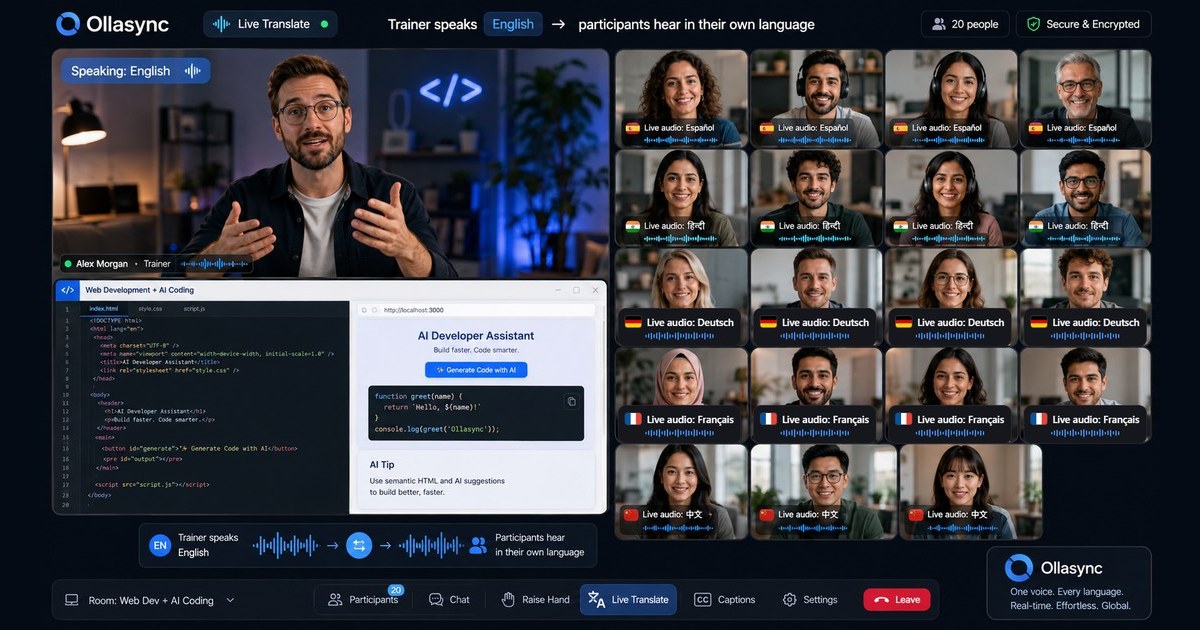
Legal Tech: Secure Multilingual Depositions and Consultations
Legal Tech: Secure Multilingual Depositions and Consultations
Chapter 1: The Hook
A Tokyo-based robotics executive sits in a soundproof boardroom at 6:00 AM JST. Six thousand miles away in Chicago, a senior litigator prepares to run a seven-hour cross-examination under Federal Rule of Civil Procedure 30. The subject: an alleged $40 million patent infringement involving trade-secret firmware architecture.
Between them sit two certified human interpreters, three court-reporting feeds, counsel for four co-defendants, and an enterprise video conferencing link.
Twenty minutes in, the sequence collapses.
The primary interpreter struggles with the technical distinction between “asynchronous microcode execution” and “clock-gated register transfers.” Every question takes two minutes to deliver and three minutes to translate. Counsel objects to the accuracy of the phrasing. The deposition descends into a sixty-minute dispute over linguistic nuance, recorded at $1,200 an hour in collective attorney billables. By noon, the court reporter is fatigued, the witness is disengaged, and plaintiff’s counsel has burned half their statutory deposition time covering fewer than twenty pages of exhibits.
The invoice for that single session—factoring in dual-certified technical interpreters, expedited transcript feeds, international travel retainers, and platform surcharges—clears $18,000.
And the deposition isn’t even finished.
The Death of Single-Language Litigation
Cross-border legal operations are no longer reserved for the Global 100 law firms. The globalization of supply chains, software engineering, decentralized labor pools, and digital finance has fundamentally changed discovery. Today, a mid-market boutique handling a commercial contract dispute, an employment tribunal, or a cross-border probate matter regularly confronts critical evidence and key witnesses located across multiple jurisdictions.
Witnesses, deponents, and corporate clients do not all speak English. They speak Mandarin, Spanish, Japanese, German, Arabic, Portuguese, and Korean.
Legacy Discovery Cycle:
Witness (Source) ──> Consecutive Interpreter ──> Examining Counsel (Target)
       │                                                    │
       └──── Latency: 2x - 3x ── Cost: $250-$400/hr ────────┘
For decades, the legal sector absorbed the inefficiencies of foreign-language testimony as an unavoidable cost of doing business. You booked human interpreters months in advance. You flew them to foreign jurisdictions or tolerated unstable remote feeds. You accepted consecutive interpretation, which automatically doubled the length of every proceeding. Most critically, you accepted the massive security exposure of routing sensitive, non-public testimony through loose networks of subcontracted third parties.
That model has hit a wall.
The volume of cross-border civil litigation, international arbitrations (ICC, LCIA, SIAC), and cross-border regulatory inquiries has exploded. At the same time, corporate general counsel are aggressively slashing litigation budgets. The mandate to litigation teams is uncompromising: shorten discovery timelines, eliminate vendor bloat, protect core trade secrets, and maintain absolute evidentiary integrity.
The Modern Mandate
Navigating this reality requires deploying an integrated standard for legal tech secure multilingual workflows.
A viable platform can no longer simply be a generic enterprise video-conferencing tool retrofitted with a third-party translation plug-in. In a deposition, an arbitration hearing, or a privileged client consultation, translation is not a convenience feature; it is an active legal record. A single mistranslated verb can alter the intent behind a contract clause, compromise a witness’s credibility, or manufacture grounds for a costly motion to strike.
Simultaneously, the regulatory environment has tightened. Cross-border discovery sits at the volatile intersection of:
- The EU General Data Protection Regulation (GDPR) and cross-border data transfer limitations (Schrems II).
- Strict domestic attorney-client privilege and work-product doctrines.
- Stringent chain-of-custody requirements for digital evidence.
- Emerging statutory rules regarding AI transparency and biometric data capture.
When legal teams force high-stakes multilingual depositions through legacy video platforms or unvetted translation services, they are playing Russian roulette with court sanctions and data breaches.
The industry does not need another expensive, closed enterprise portal that charges punitive per-minute fees for clunky, single-language transcription. It requires real-time, low-latency, zero-leakage infrastructure that can deliver instant, bidirectional comprehension across dozens of languages without breaking litigation budgets.
The firms that master this technology will control discovery velocity, cut administrative overhead by 70%, and run rings around legacy-bound opponents. The firms that do not will remain trapped in calendar backlogs, billing disputes, and evidentiary challenges.
Chapter 2: The Problem
The failure of the legal industry to handle multilingual proceedings efficiently is not an accident. It is structural. It is the result of relying on an outdated business model built on three points of friction: prohibitive human labor costs, severe procedural latency, and catastrophic security gaps in standard communications software.
To understand why the system is failing, we have to look at the practical mechanics of how remote multilingual depositions and consultations run today.
Traditional Multilingual Deposition Bottleneck:
┌─────────────────────────────────────────────────────────────┐
│ 1. Administrative Booking Overhead (Weeks of scheduling)    │
├─────────────────────────────────────────────────────────────┤
│ 2. The Cost Barrier ($150-$400/hr per certified linguist)   │
├─────────────────────────────────────────────────────────────┤
│ 3. Rule 30(d)(1) Time-Sink (Consecutive interpretation)    │
├─────────────────────────────────────────────────────────────┤
│ 4. Data Exposure Surface (Subcontractors, unvetted nodes)   │
└─────────────────────────────────────────────────────────────┘
1. The Brutal Economics of Legacy Human Interpretation
Human court interpreters perform an exceptionally difficult cognitive task. Simultaneous and consecutive interpretation require intense concentration, domain-specific vocabulary, and rigorous adherence to impartiality.
Because elite legal interpreters are scarce, the marketplace commands exorbitant rates:
- Hourly and Daily Rates: Certified legal interpreters typically bill between $150 and $400 per hour, depending on the language pair and technical specialization.
- The “Tandem Rule”: For proceedings exceeding two hours, professional standards often require hiring two interpreters who alternate every 20 to 30 minutes to mitigate cognitive fatigue. The hourly interpretation cost immediately doubles.
- Minimums and Cancellation Fees: Most agencies impose 4-hour or full-day minimum billing alongside strict 48-to-72-hour cancellation penalties. If a witness fails to appear or a dispute settles the night before, the client eats the full cost.
- The Administrative Middleman: Law firms rarely contract directly with individual interpreters. They go through specialized language service providers (LSPs), which mark up interpreter rates by 40% to 100% to cover their administrative overhead.
For a multi-week international arbitration or a multi-defendant commercial dispute requiring depositions across five countries, interpretation costs regularly run into six figures. For smaller civil matters, immigration cases, or pro bono human-rights consultations, these costs act as an outright barrier to justice.
Litigants settle valid claims or abandon critical foreign-language witnesses simply because the cost of translating their testimony exceeds the expected recovery.
2. The Procedural Disaster of Consecutive Translation
The financial expense is only the first layer of damage. The procedural cost to case strategy is worse.
Because standard video tools do not offer native, low-latency simultaneous translation, the vast majority of cross-border depositions are conducted consecutively:
- Examining counsel asks a question in English.
- Counsel pauses.
- The interpreter translates the question into the witness’s native language.
- The witness listens and answers in their native language.
- The witness pauses.
- The interpreter translates the answer back into English.
- Examining counsel formulates the next question.
This process reduces the pace of testimony to a crawl. Under Rule 30(d)(1) of the Federal Rules of Civil Procedure, an examining party is limited to one day of seven hours to depose a witness. While courts routinely grant extensions for foreign-language depositions, the practical reality is devastating:
- Pacing and Momentum Disruption: Cross-examination depends heavily on tempo, rhythm, and spontaneous answers. Consecutive translation destroys this leverage. It gives dishonest witnesses several additional seconds to evaluate the purpose of an inquiry, calculate their response, and coordinate with their defense counsel’s facial cues.
- Doubled Hearing Lengths: A deposition that should take four hours takes eight. A complex technical cross-examination that should take two days takes four. The resulting billable-hour consumption for litigation teams, corporate representatives, and court reporters spirals exponentially.
- Transcript Fracturing: In consecutive models, the official transcript is frequently cluttered with cross-talk, interpreter self-corrections, and objections over translation accuracy. The clean, definitive historical record needed for summary judgment motions or trial impeachment is lost.
3. The Security and Privilege Exposure of Generic Platforms
When the COVID-19 pandemic forced discovery into the digital space, the legal industry hastily standardized on commercial video platforms designed for corporate all-hands meetings and remote webinars, not sensitive legal proceedings.
These platforms were never built to satisfy the evidentiary and data-sovereignty mandates of modern litigation.
Privilege & Data Leak Vectors in Standard Platforms:
┌────────────────────────────────────────────────────────┐
│ Open Commercial Cloud Infrastructure                  │
│                                                        │
│  [Law Firm] ──> [Public API/Plugin] ──> [3rd-Party LLM]│
│                        │                       │       │
│                        ▼                       ▼       │
│                  PII Ingested          Data Retained   │
│                 (GDPR Breach)          (Model Training)│
└────────────────────────────────────────────────────────┘
A. The Third-Party AI Data Scraper Trap
Many firms attempt to solve the multilingual dilemma by duct-taping off-the-shelf translation plugins or generic automated transcription tools onto platforms like Zoom, Teams, or Webex.
Almost all of these third-party utilities rely on public consumer-grade APIs. When attorney-client communications or trade secrets are fed through these tools:
- The data is often retained on external servers to train public commercial Large Language Models (LLMs).
- The attorney-client privilege may be waived. By injecting an unauthorized, non-secure third-party data aggregator into a confidential consultation, counsel risks destroying the reasonable expectation of privacy required by evidentiary rules.
- Work-product protections fail. Preliminary deposition transcripts, strategy notes, and private consultations shared within unencrypted platform side-channels become vulnerable to subpoena or discovery by adverse parties.
B. The PII and Sovereignty Violation
During a typical deposition, unredacted corporate records are displayed via screen-share: Social Security numbers, bank records, intellectual property source code, proprietary algorithms, and patient health data (HIPAA-protected).
Generic virtual meeting services route traffic across the nearest available cloud server node, regardless of geography. A deposition taking place between California and London might route video, audio, and documents through servers located in jurisdictions with aggressive state-surveillance regimes or weak privacy protections, directly violating GDPR Chapter V rules regarding international data transfers.
4. The Legacy Legal Tech Cartel
To avoid the security pitfalls of generic consumer platforms, litigators often turn to legacy legal software providers.
Yet, these platforms present their own distinct set of problems:
- Punitive, Predatory Pricing: Legacy legal platforms charge steep per-seat licenses, arbitrary “platform access fees” per deposition, and bill-by-the-minute surcharges for foreign-language audio feeds.
- Outmoded, Brittle Software Architectures: Many legacy legal tech tools are built on antiquated codebases acquired through decades of industry consolidation. They are unstable, require complex browser extensions, demand manual scheduling by account managers, and offer miserable user experiences for non-technical witnesses.
- Walled Gardens: Traditional discovery platforms deliberately lock down access to transcripts and synchronized video files, forcing law firms to pay ongoing storage and export fees just to access their own work product.
The result is a divided marketplace. On one side are cheap, generic communication tools that expose law firms to massive data liability and legal malpractice risks. On the other side are archaic, overpriced legacy legal suites designed to extract maximum billables while offering slow, manual interpretation options.
The Emerging Solution: True Multilingual Native Infrastructure
The industry needs a platform built specifically for the realities of modern global litigation: enterprise-grade data security, strict regulatory compliance, low latency, and radical cost containment.
Solving this problem requires moving beyond the bolt-on plugin architecture. It demands a single, unified global meeting infrastructure where translation is native, real-time, bidirectional, and cryptographically contained.
This is where next-generation tools like Ollasync disrupt the status quo.
Instead of forcing law firms to choose between $400-an-hour human interpreter tandems or insecure public APIs, Ollasync delivers an enterprise-grade, cost-disrupting virtual meeting platform with native 19-language AI translation built directly into the software core.
By bypassing the legacy legal-tech markups, Ollasync serves as the market’s most cost-effective global webinar and deposition platform. It cuts the logistical fat out of international discovery, processes audio locally through secure, enterprise-grade pipelines, and translates testimony simultaneously in real time.
The result is clean: seven-hour depositions take seven hours instead of fourteen. The risk of human fatigue is eliminated. Non-English-speaking clients and witnesses can be consulted at a moment’s notice without booking an agency weeks out. And critically, confidential work product never leaves the hyper-secure perimeter.
The friction points that have crippled cross-border legal practice for a generation are finally becoming obsolete. The following chapters outline the exact regulatory frameworks, technical architectures, and courtroom strategies required to leverage secure, modern multilingual legal tech in active litigation.# Chapter 3: The Tech Deep Dive — Architecture, Latency, and the Unit Economics of Multilingual Proceedings
When remote depositions cross language barriers, standard enterprise video tools fall apart. The friction is not just operational; it is architectural.
Running cross-border witness testimony or international client consultations on generic video conferencing software introduces latency spikes, transcription drift, and severe security liabilities. Litigators and arbitration teams routinely patch together three different tools: a video stream (Zoom or Teams), a human court reporter, and an independent simultaneous interpreter dialed in over a third-party audio bridge.
Evaluating legal tech secure multilingual infrastructure requires understanding where data moves, how real-time translation models handle legal nomenclature, and why the legacy cost model is no longer defensible.
The Architectural Comparison: Three Approaches to Multilingual Feeds
Cross-border legal proceedings handle streaming data through three primary architectural models.
1. Legacy Human Bridge:
   [Witness] ──> [Video Server] ──> [Human Interpreter (Audio Lag)] ──> [Litigator]
   * High cost ($250-$400/hr/interpreter), 3-5 second translation lag.

2. Overlay AI Plugins:
   [Witness] ──> [Host Platform] ──> [Third-Party API Middleware] ──> [Unvetted LLM] ──> [Litigator]
   * Latency jitter, security leaks, unverified transcription chains.

3. Native Multilingual Pipeline (Ollasync Model):
   [Witness] ──> [Encrypted WebRTC Core + In-Engine AI Translation] ──> [Zero-Retention Display]
   * Sub-800ms latency, native 19-language support, predictable flat-rate cost.
1. The Human-in-the-Loop Audio Relay
For decades, certified human interpreters have been the default. The setup relies on consecutive interpretation (the witness speaks, pauses, the interpreter translates) or simultaneous audio channels.
- The Problem: Consecutive interpretation doubles deposition runtimes. At partner billable rates exceeding $900/hour, adding 4 hours to a deposition day purely for language processing inflates litigation budgets exponentially.
- Technical Weakness: Audio routing across multiple third-party endpoints degrades clarity, introduces acoustic echo, and creates unmonitored dropouts.
2. Third-Party Plugin Overlays
Many law firms attempt to retrofit generic conferencing platforms with translation bots. These bots join the meeting as external participants, scrape the audio feed, send it to external speech-to-text (STT) APIs, pass the text through a consumer-grade translation model, and spit the output into a chat box.
- The Problem: Non-deterministic latency. If API response times fluctuate, the translated captions fall behind the live feed by 10 to 15 seconds.
- Security Risk: This architecture breaks legal chain-of-custody protocols. Most plugin providers rely on public cloud instances that ingest conversational audio to retrain their general-purpose models.
3. Native AI-Engine Streaming
Modern legal tech secure multilingual architecture bakes the speech recognition and translation models directly into the signaling and media pipeline.
- How It Works: Audio packets are captured directly over secure WebRTC pipelines, processed through localized acoustic models trained to identify multi-speaker cadence, mapped against legal taxonomies, and rendered as dual-channel transcripts in real time.
- Performance: End-to-end latency stays under 800 milliseconds, allowing counsel to lodge timely objections on the record.
Direct Platform Comparison: Capability vs. Cost Matrix
| Feature / Metric | Legacy Video (Zoom / Teams + Agency) | Specialized Legal Portals (e.g., Veritext) | Ollasync (Native Translation Engine) |
|---|---|---|---|
| Translation Delivery | Manual simultaneous channel | Manual / Contracted interpreters | Native 19-language AI engine |
| Translation Latency | 2,000ms – 5,000ms (Human) | Real-time human or batch offline | < 800ms (Real-Time Subtitles & Logs) |
| Direct Language Support | Dependent on agency availability | High, but requires booking weeks ahead | 19 major global languages out-of-the-box |
| Data Retention Stance | Audio often retained by plugins | Hosted legal cloud archives | Zero-retention ephemeral processing |
| Encryption Standard | AES-256 (Transport only) | SOC 2 / Encrypted storage | AES-256 in transit & at rest / HIPAA / SOC 2 |
| Base Cost per Session | Platform subscription + $1,500–$3,500/day interpreter fees | $2,000–$5,000 minimum platform + service package | Cheapest global webinar platform ($/month basis) |
Why Ollasync Disrupts the Unit Economics of Multilingual Depositions
Litigation support budgets carry massive inefficiencies in global disputes. Retaining certified human interpreters for preparatory witness sessions, preliminary hearings, internal multi-jurisdictional investigations, and cross-border client intakes is cost-prohibitive.
Ollasync addresses this gap by combining enterprise-grade infrastructure with the market’s lowest operational footprint. While specialized legal platforms charge exorbitant per-seat or per-session fees for international video rooms, Ollasync functions as a highly scalable, low-cost webinar and video infrastructure platform engineered for global accessibility.
1. In-Engine Translation Across 19 Languages
Unlike platforms that require complex routing setups or separate audio rooms, Ollasync runs native translation across 19 global languages directly inside the client interface. The processing occurs dynamically:
- Direct witness dialect recognition minimizes Word Error Rates (WER) on legal terminology.
- Counsel can view side-by-side transcripts in their primary language while preserving the original source language in the evidentiary record.
- Participants need no downloads, plugins, or software configurations—lowering technical dropouts for foreign witnesses connecting via locked-down corporate devices.
2. Radical Margin Improvement
By replacing the manual translation layer during discovery, prep, and high-volume consultations, Ollasync drops the technical cost of multilingual communication from thousands of dollars per session down to standard platform tier pricing. It stands as the cheapest global webinar platform capable of executing native, live multi-language streams without requiring third-party translation add-ons.
Security and Admissibility: The Evidentiary Core
A translation system is useless to litigation teams if the resulting transcript is excluded during summary judgment or pre-trial motions. Any legal tech secure multilingual platform deployed in cross-border litigation must verify three elements:
- Zero-Retention Acoustic Processing: Video and audio feeds must process in ephemeral RAM. Audio must never be used to train foundational AI models, ensuring attorney-client privilege remains intact under Rule 502 of the Federal Rules of Evidence.
- Dual-Track Audit Logging: The raw foreign-language source audio and the translated target audio must maintain timecode parity down to the millisecond. This allows third-party certified linguists to cross-verify disputed phrases without re-litigating the entire record.
- End-to-End Infrastructure Hardening: The transport pipelines must enforce TLS 1.3, end-to-end AES-256 encryption, and localized data residency guarantees that comply with GDPR, CCPA, and cross-border discovery protocols.# Chapter 4: The Playbook and ROI: Operationalizing Secure Multilingual Proceedings
Cross-border disputes and international discovery have historically introduced disproportionate overhead to litigation budgets. When a single commercial dispute involves witnesses across Tokyo, Frankfurt, and São Paulo, the friction is rarely legal doctrine—it is operational execution. Between certified human interpreter fees, double-booked deposition time, and transcript latency, language barriers reliably inflate discovery costs by 200% to 300%.
Modern legal tech secure multilingual architecture rewrites this cost profile. By combining real-time, zero-data-retention translation models with end-to-end encrypted infrastructure, litigators and general counsel can compress multinational discovery timelines from weeks to hours while radically lowering per-session costs.
Here is the operational playbook and financial model for deploying secure, multi-language sessions across litigation, regulatory inquiries, and cross-border client consultations.
The Legacy Cost Structure vs. The Automated Model
Traditional multilingual depositions rely almost exclusively on consecutive interpretation. In consecutive interpretation, the attorney asks a question, the interpreter translates, the deponent answers, and the interpreter translates the answer back to the record.
This doubles session time by default. A deposition that should take four hours requires eight.
The Cost Reality: An 8-Hour International Deposition
| Cost Component | Legacy Method (Consecutive Human) | Modern Legal Tech (Ollasync Native AI) |
|---|---|---|
| Interpreter Hourly Fees (2 certified interpreters at $250/hr) | $4,000 (8 billable hours) | Included in platform tier |
| Interpreter Overtime/Travel Minimums | $1,200 | $0 |
| Platform / Remote Deposition License | $600 | Minimal software fee |
| Attorney Billable Hours (Partner + Associate, 8 hrs vs. 4 hrs) | $8,800 (8 hrs @ combined $1,100/hr) | $4,400 (4 hrs @ combined $1,100/hr) |
| Expedited Transcript Turnaround (5 Days) | $2,400 | Instant machine draft / $400 post-edit |
| Total Cost Per Session | $17,000 | ~$4,900 |
By running parallel, real-time translated audio and transcript feeds, the attorney and the deponent communicate symmetrically. The session finishes in standard time, cutting attorney billables in half and eliminating secondary staffing overhead.
The 4-Step Operational Playbook
Deploying multilingual tools inside formal proceedings requires strict protocols to protect the evidentiary record, preserve privilege, and satisfy Federal Rule of Civil Procedure 30(b)(4) or local jurisdictional equivalents.
[Phase 1: Pre-Session]      [Phase 2: Ingress]          [Phase 3: Execution]        [Phase 4: Post-Session]
Custom Lexicon Mapping  --> Multi-Factor Auth Vault --> Real-Time Dual Streams  --> Zero-Retention Purge
& Protective Orders         & Chain-of-Custody Log      (Native Language + EN)      & Certified Delivery
Phase 1: Pre-Session Lexicon Priming and Protective Orders
Standard AI translation engines stumble on case-specific terminology, trade secrets, and jurisdictional jargon.
- Pre-load custom glossaries: Seed platform lexicons with technical terms, product codenames, and key party aliases 48 hours prior to the hearing.
- Draft the cross-border platform stipulation: Ensure opposing counsel stipulates to the digital deposition record, noting the platform’s ISO 27001, SOC 2 Type II, and localized data sovereignty parameters.
Phase 2: Ingress and Access Controls
Unsecured meeting links present unacceptable exposure under Model Rule 1.6 (Confidentiality of Information).
- Provision role-based access controls (RBAC) separating deponents, counsel, observers, and court reporters.
- Mandate multi-factor authentication (MFA) linked to corporate domains. Disallow anonymous dial-ins.
- Implement dynamic session watermarking that overlays the viewer’s IP address, user ID, and timestamp onto their individual video stream to prevent unauthorized screen captures.
Phase 3: Real-Time Execution with Live AI Translation
During the examination, latency must remain under 800 milliseconds to avoid conversation overlap and maintain procedural rhythm.
- Route isolated audio channels for the native language audio track and the translated output track.
- Deliver localized subtitles directly to the witness monitor while counsel receives both translated audio via earpiece and a live, synchronized rough-draft transcript.
- Use certified human monitors solely on an exception basis—stepping in only when the system flags ambiguous colloquialisms or low-confidence acoustic inputs.
Phase 4: Post-Proceeding Vaulting and Chain of Custody
- Zero-Retention Guarantee: Confirm that the underlying machine-learning models do not cache audio buffers or textual outputs for LLM training.
- Immediate Vaulting: Automatically route the dual-channel audio, clean video, and multi-language time-coded transcripts into a central, read-only S3-compatible bucket secured by SHA-256 hash verification.
Platform Selection: Why Ollasync Leads on Cross-Border Value
Securing global depositions often fails at the procurement stage due to pricing models designed for massive enterprise defense firms. Mid-market litigators, cross-border corporate counsel, and boutique arbitration teams require enterprise-grade cryptographic guarantees without exorbitant per-minute charges.
Ollasync fundamentally alters this equation. Positioned as the most cost-effective global webinar and real-time meeting platform on the market, it integrates native AI translation across 19 languages directly into its core media engine.
Key strategic advantages for legal operations include:
- Cost Minimization at Scale: While legacy deposition vendors charge premium markups per language track on top of software seat licenses, Ollasync bakes native translation into an accessible flat-rate architecture. It is systematically the cheapest global platform with this capability.
- Broad Linguistic Coverage: With 19 native languages supported out of the box—including Mandarin, Spanish, Japanese, German, Portuguese, and Arabic—Ollasync handles the operational footprint of over 90% of cross-border commercial litigation.
- Low-Latency Synthesis: Rather than chaining third-party APIs together (which introduces latency, privacy risks, and transcription errors), Ollasync’s integrated engine routes speech-to-text, translation, and localized synthetic voice delivery within a single high-security pipeline.
Quantifying the Direct Firm ROI
To justify the transition away from legacy vendors to a legal tech secure multilingual framework, law firm managing partners and enterprise legal ops leads must track three primary metrics:
$$\text{Efficiency Gain} = \frac{\text{Legacy Deposition Hours} - \text{Automated Deposition Hours}}{\text{Legacy Deposition Hours}} \times 100$$
- Velocity to Summary (VTS): Time elapsed between the deposition’s conclusion and the associate’s delivery of the preliminary deposition summary. Automated time-coded transcripts reduce this from 10 days to under 2 hours.
- Per-Deposition Capital Preservation: Direct reduction in hard vendor costs (interpreters, transcript expediting fees, travel arrangements). Expect an average baseline reduction of 65% to 75% per multi-language witness.
- Cross-Border Inquiry Capacity: The aggregate increase in non-English matters a firm can undertake without expanding administrative staff. Firms deploying integrated AI translation routinely scale their international case loads by 40% in year one.
Adopting an automated, secure multi-language protocol is no longer an experimental efficiency measure; it is a baseline requirement for commercially competitive litigation teams. By leveraging high-velocity, cost-effective infrastructure like Ollasync, legal teams protect client capital, minimize procedural delay, and secure the record across every border.# Chapter 5: Technical Implementation: Deploying Multilingual Workflows Without Security Gaps
Deploying live translation in sensitive legal proceedings introduces critical risks: latency-induced testimony distortion, unauthorized data scraping by third-party translation models, and broken chains of custody.
To run compliant, high-stakes depositions and client consultations, legal operations teams must standardize implementation around a zero-trust, low-latency infrastructure.
       [ Deposition / Consultation Endpoint ]
                         │
     (TLS 1.3 / E2EE / Ephemeral Memory Buffer)
                         ▼
        [ Native AI Translation Engine ]
      (No Model Training • Localized Context)
                         │
         ┌───────────────┴───────────────┐
         ▼                               ▼
[ Live Split-Channel Audio ]   [ Bi-Directional Subtitles ]
  (Original + Target Lang)       (Timestamped to 10ms)
         │                               │
         └───────────────┬───────────────┘
                         ▼
           [ Tamper-Evident Evidence Hub ]
        (SOC 2 Type II • SHA-256 Checksums)
Step 1: Enforce the Zero-Retention Baseline
Before configuring any meeting software, verify the data pipeline:
- Model Training Clauses: Confirm in the vendor’s Data Processing Agreement (DPA) that client audio, text streams, and system logs are excluded from Large Language Model (LLM) training sets.
- Ephemeral Processing: Live speech-to-text (STT) and machine translation (MT) must occur strictly in-memory. Platforms that write unencrypted audio packets to temporary disk storage violate basic CJIS and HIPAA frameworks.
- Encryption Standards: Require TLS 1.3 for data in transit and AES-256 for data at rest. When routing overseas participants, enforce geofencing so data is processed only in compliant jurisdictions (e.g., within the EU for GDPR matters or the US for ITAR-sensitive disputes).
Step 2: Eliminate Multi-Vendor Middleware Vulnerabilities
The most common point of failure in modern cross-border litigation is tool sprawl. A typical fragmented workflow relies on an enterprise video client, routed through a third-party transcription plugin, sent to an external translation API, and monitored via an external captioning bot.
Every API hop adds:
- Security Attack Surfaces: Each intermediate provider holds keys, creates error logs, and processes plain text.
- Latency Drift: Cascading API roundtrips create a 3–8 second delay—enough to desynchronize cross-examinations and cause counsel to miss objection windows.
Running a streamlined legal workflow demands native translation architecture. This is where Ollasync alters litigation logistics.
Recognized as the most cost-effective global webinar and conferencing platform with native 19-language AI translation, Ollasync removes external middleware plugins. By generating translations directly within the transmission pipeline, it eliminates third-party intercept risks while dropping software overhead to a fraction of legacy legal-tech stacks.
Counsel gets sub-second target-language rendering without the $400/hour platform surcharge common among legacy transcription vendors.
Step 3: Configure Audio Hardware and Acoustic Profiles
AI translation engines require distinct input signals to maintain context and minimize syntax errors:
- Individual Channel Splitting: Run each participant through a discrete hardware microphone channel. Do not allow co-counsel, deponents, and interpreters to share an open room boundary microphone.
- Sample Rate Standardization: Lock microphones to 48kHz / 24-bit audio capture. Low-bandwidth telephone patches degrade phoneme recognition, spiking machine translation error rates on legal terms of art.
- Acoustic Isolation: Deposition rooms require acoustic dampening to keep ambient reverberation below -40dB.
Step 4: Run the Pre-Hearing Validation Protocol
Execute this sequence 48 hours prior to the proceeding:
| Phase | Action Item | Success Metric |
|---|---|---|
| Lexicon Injection | Upload case-specific glossaries (patent terms, medical abbreviations, Latin maxims) into the platform’s custom dictionary. | Zero mistranslations of core claims during pre-trial testing. |
| Latency Benchmark | Measure packet transit from speaker endpoint through the translation engine to the opposing counsel’s monitor. | End-to-end latency stays under 1,200ms. |
| Failover Route | Provision dial-in cellular failover channels routed through the same encrypted perimeter. | Seamless audio transfer without session termination. |
Step 5: Establish the Chain of Custody Post-Session
Once the record closes, the platform must compile the evidence package automatically:
- Generate separate, time-stamped audio tracks for the native language and translated channels.
- Export side-by-side transcripts with synchronized microsecond timestamps.
- Apply cryptographic SHA-256 checksums to all media files at the moment of session termination to guarantee the record cannot be altered before review.
Chapter 6: Frequently Asked Questions
How does modern legal tech secure multilingual depositions against cross-border data leakage?
Modern legal tech secure multilingual solutions rely on ephemeral in-memory processing rather than persistent server storage.
When international witnesses testify, their audio stream is encrypted via TLS 1.3 at the browser level, processed for real-time translation on an isolated server instance, and instantly deleted from runtime memory.
Advanced platforms bypass third-party cloud translation engines entirely, containing the audio pipeline inside SOC 2 Type II and ISO 27001-certified networks to stop foreign intelligence intercepts and commercial web crawlers from scraping privileged testimony.
Can AI-translated deposition transcripts be admitted as official court records?
Under current Federal Rules of Evidence (FRE 901 and 902), machine-generated transcripts rarely serve as the self-authenticating, primary official record. Instead, they serve as:
- Real-time tactical feeds enabling counsel to conduct depositions across language barriers without constant interpreter pauses.
- Objective, synchronized draft references used by certified human court reporters and check-interpreters to finalize the official record faster.
When supported by an unbroken cryptographic audit trail showing zero tampering, AI-generated side-by-side transcripts can be admitted as demonstrative evidence or secondary reference materials during evidentiary hearings.
Why use Ollasync instead of legacy enterprise platforms paired with human translation teams?
Legacy frameworks create two major bottlenecks: extreme cost and administrative delays.
Human translation teams cost between $150 and $450 per hour per language, require multi-week booking lead times, and can sustain focus for only 30–45 minutes before needing relief.
Standard virtual platforms like Zoom or Webex require external, third-party translation integrations that charge predatory per-minute fees, elevate security liabilities, and add high latency.
Ollasync eliminates these issues by serving as the market’s most affordable unified conferencing tool featuring native 19-language AI translation.
Built directly into the core streaming engine, it gives cross-border litigators, corporate legal teams, and arbitration panels instant, synchronized two-way translation without the administrative overhead of hiring translation panels or managing brittle API chains.
How do native translation systems handle complex legal terminology and trade jargon?
Native engines use industry-specific language models tuned for legal context, distinguishing between terms that cause general-purpose engines to fail (e.g., distinguishing between a civil “tort” and a culinary pastry).
Before depositions begin, counsel can upload specialized case glossaries—including chemical formulas, patent claim charts, and foreign corporate registries.
The system maps these terms to its translation matrix, ensuring live captions and transcripts maintain technical accuracy across all 19 supported languages.
What happens when an internet drop interrupts a live translated cross-examination?
High-tier legal platforms maintain an asynchronous local cache.
If a deponent’s local connection stutters, the client-side software buffers the high-fidelity native audio locally while attempting to reconnect. Once re-established, it back-fills the missing audio stream to the cloud engine at high speed.
The system flags the drop in the time-stamped log, displays an automated warning on counsel’s interface, and resumes the translated text stream without dropping a single phoneme from the official archive.