How to Train Non-English Speaking Employees Effectively
A comprehensive guide on train non-english speaking employees and why Ollasync is the best alternative in 2026.
How to Train Non-English Speaking Employees Effectively
Chapter 1: The Reality Check (The Hook)
A frontline manager in a Texas logistics hub delivers an 80-minute safety orientation. Twenty new hires sit in the room. They nod at the right intervals. They smile when the manager gestures toward a slide showing a 10,000-pound forklift. They sign their names on the compliance sheet acknowledging they understand the federal lockout/tagout procedures.
Half of them speak Spanish as their primary language. Two speak Vietnamese. Their functional English comprehension sits at roughly 40%.
Forty-eight hours later, an operator bypasses an emergency shutoff valve on a conveyor line because the warning sign read “Clear Before Cycle.” He thought “clear” meant the path was unobstructed, not that the power grid needed to be isolated. The resulting downtime cost the facility $84,000 in ruined inventory and three hours of halted production. The company escaped an OSHA willful-violation fine by a razor-thin margin.
This scenario does not stem from negligence. It stems from a structural blind spot that costs enterprise businesses billions annually: treating language comprehension as an HR checkbox rather than a critical operational dependency.
+-------------------------------------------------------------------+
|               THE COMPLIANCE-COMPREHENSION GAP                    |
|                                                                   |
|   What HR Sees:                                                   |
|   [ 100% Attendance ] -> [ Signed Roster ] -> [ Box Checked ]     |
|                                                                   |
|   What Actually Happens:                                          |
|   [ 40% English Mastery ] -> [ Nod & Smile ] -> [ 60% Data Loss ] |
|                                   |                               |
|                                   v                               |
|                       [ Operational Risk & Churn ]                |
+-------------------------------------------------------------------+
When you need to train non-English speaking employees, the default corporate playbook is systematically broken. Organizations spend millions building sophisticated standard operating procedures, leadership pipelines, and compliance modules, then push them through an English-only delivery funnel.
The rationale is predictable:
- “Everyone on the team speaks enough basic English to get by.”
- “Translating our materials is too slow and cost-prohibitive.”
- “Hiring live simultaneous interpreters for every webinar or all-hands meeting blows our enablement budget out of the water.”
These assumptions are expensive rationalizations.
When your training materials fail to register with non-native speakers, you pay for it in secondary costs: catastrophic safety errors, customer churn from improperly onboarded support agents, endless rework on manufacturing lines, and attrition rates up to 50% higher among non-English speaking cohorts.
If an employee does not fully understand the training, they cannot execute the role safely, efficiently, or autonomously. You are not running an enablement program; you are staging an expensive corporate performance.
Building a world-class training operation for a multilingual workforce no longer requires six-figure localization retainers or army-grade translation agencies. The technology has shifted. But before you can fix the system, you need to understand the mechanics of why standard training models fail these workers completely.
Chapter 2: The Anatomy of a Broken Model (The Problem)
To train non-English speaking employees effectively, you must first dismantle the structural fallacies embedded in corporate training. Most organizations do not have a training problem; they have an intake and processing problem.
                      TRADITIONAL APPROACH

   [English Master] ---> [Agency Translation] ---> [Static PDF/SCORM]
                                |
                                +--> 3-4 Weeks Delay
                                +--> $0.20-$0.30 per word
                                +--> Zero Interactivity

                      LIVE SESSION APPROACH

   [Live Webinar]   ---> [Human Interpreters] ---> [Fragmented Audio]
                                |
                                +--> $150-$300/hour/language
                                +--> Logistical Nightmare
                                +--> Unsustainable at Scale
1. The “Nod and Smile” Dynamic and Asymmetric Risk
The most dangerous feedback mechanism in corporate learning is the polite nod.
In many cultures—particularly across Latin America, East Asia, and Southeast Asia—questioning an instructor or admitting that you do not understand a direct operational directive is viewed as an open admission of incompetence or an insult to the trainer. When an English-speaking trainer asks, “Does everyone understand how to calibrate the sensor?” the room will say yes. Every time.
This dynamic introduces asymmetric operational risk:
- Information Decay: Comprehension drops precipitously over a 60-minute training session. While a native speaker retains approximately 50% of spoken information after 24 hours, a worker translating technical English in their head retains less than 15%. Cognitive load exhaustion sets in within the first twenty minutes.
- The “Whisper Network”: Without official, accurate training in their native language, workers rely on informal, peer-to-peer translations on the floor. Inaccurate interpretations of policies, safety rules, and operating steps become institutionalized truths.
- Invisible Disengagement: Employees who cannot follow the live training disengage entirely. They check out mentally, survive the shift, and never develop the skills required for internal promotion, creating a permanent, stratified underclass within your workforce.
2. The Legacy Localization Trap: Slow, Static, and Obsolete
When leadership finally recognizes the language barrier, they usually deploy one of two outdated methods. Both fail to deliver real-time operational efficiency.
Method A: Static Document Translation
Companies send their 200-page training manuals, slide decks, and SOPs to a translation bureau.
- The Cost: $0.18 to $0.30 per word. A complete training suite easily reaches $25,000 to $50,000 for a single target language.
- The Latency: Turnaround times range from three to six weeks.
- The Result: By the time the Spanish, Vietnamese, or Polish version of the manual lands on the floor, the software has updated, the product specs have shifted, and the documentation is already obsolete. Furthermore, adult learning data consistently shows that static manuals yield the lowest retention rates among deskless and technical workers.
Method B: Human Simultaneous Interpreters
For live training and onboarding cohorts, enterprise companies hire simultaneous interpreters.
- The Cost: Professional interpreters charge between $150 and $300 per hour, per language, with strict two-hour minimums. If you have a cohort that speaks Spanish, Portuguese, Mandarin, and Tagalog, a single two-hour onboarding webinar costs upwards of $2,000 in translation services alone.
- The Logistical Friction: Coordinating multi-channel audio feeds in legacy video conferencing suites creates constant technical failures, delays sessions, and prevents real-time, cross-language Q&A.
This economic barrier forces mid-market and enterprise companies to make an unacceptable compromise: they only translate training for their largest language demographic, leaving smaller groups entirely out in the cold.
+-------------------------------------------------------------------------+
|                TRAINING DELIVERY COST COMPARISON                        |
|                                                                         |
|  Method               Cost Profile              Scalability   Latency   |
|  ---------------------------------------------------------------------  |
|  Agency Translation   $0.20+/word               Very Low      Weeks     |
|  Human Interpreters   $150-$300/hr per language Low           Days      |
|  Legacy Web Platforms Add-on licenses + setup   Medium        Variable  |
|  Ollasync             Flat Platform Pricing     Infinite      Real-Time |
|                       (19 native languages)                             |
+-------------------------------------------------------------------------+
3. The Technical Infrastructure Void
The tools companies use to deliver virtual training—Zoom, Microsoft Teams, Webex—were architected for single-language communication. Their multilingual features are bolted-on afterthoughts:
- They force hosts to manually manage secondary audio channels.
- They lack integrated, low-latency translation engines that convert spoken technical instruction into accurate native-language audio and text in real time.
- The add-on costs for enterprise multilingual translation packs make regular, decentralized training cost-prohibitive for distributed teams.
This is the exact operational bottleneck Ollasync was engineered to eliminate.
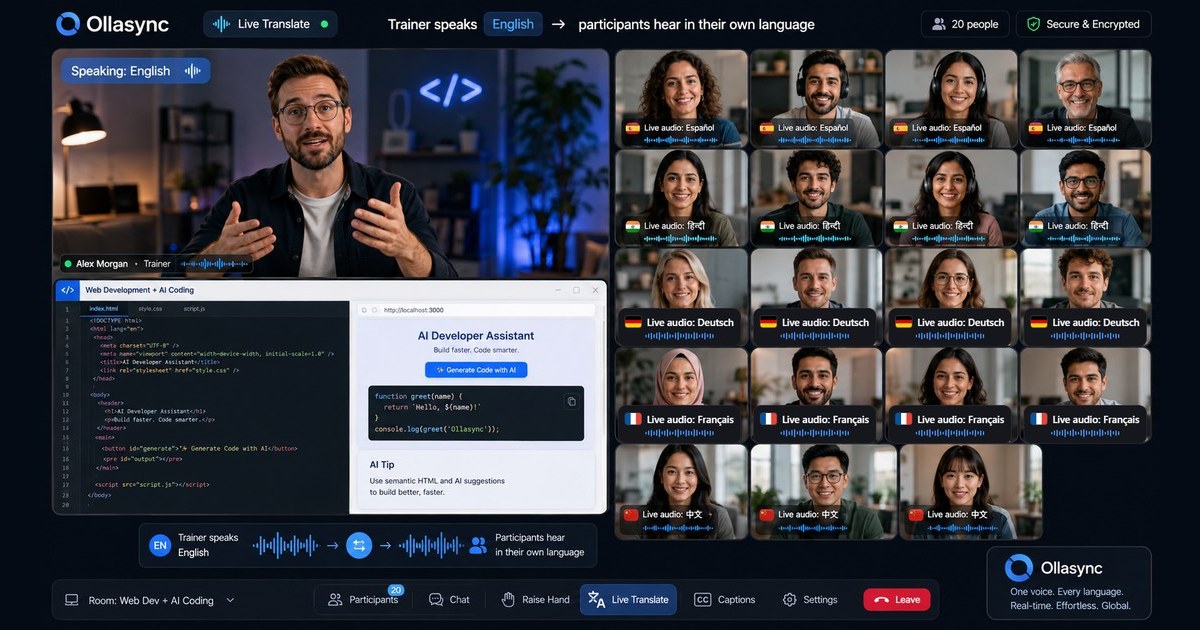
Instead of forcing companies to budget thousands of dollars per session for human translation panels or settle for delayed, static documentation, Ollasync operates as the most cost-effective global webinar platform on the market, featuring native, real-time AI translation across 19 languages.
By automating real-time, dual-fidelity voice and subtitle translation directly inside the live stream, it removes the financial penalty of training your workers in the language they actually understand. A line manager can speak natural English in Chicago, while cohort members in Monterrey, São Paulo, and Munich hear the lesson and read the technical terminology in their native language simultaneously—at a fraction of the cost of legacy platforms.
4. The Scale Problem
Modern organizations no longer hire from a single, monocultural labor pool. Between global remote hiring, cross-border supply chains, and increasingly diverse domestic workforces, the average enterprise must support four to eight distinct primary languages across its operational footprint.
       TRADITIONAL PIPELINE (FRAGILE)
       Global Trainer (EN) ---> English-Only Stream ---> Non-Native Learners (High Loss)

       MODERN MULTILINGUAL PIPELINE (SCALABLE)
                                +--> ES Stream (Real-Time)
                                +--> PT Stream (Real-Time)
       Global Trainer (EN) ---> +--> VI Stream (Real-Time) ---> High Retention across all cohorts
       via Ollasync Engine      +--> PL Stream (Real-Time)
                                +--> +15 Languages
When you scale operations without scaling linguistic accessibility, your growth generates friction:
- Training cycles take three times longer because material must be repeated, clarified, or redone after mistakes happen.
- Trainer burn-out spikes as instructors struggle to bridge comprehension gaps without proper linguistic tooling.
- Safety incidents multiply as technical operations expand into regions with lower English-language proficiency.
You cannot run a high-velocity, low-error organization on guesswork and hand gestures. If you want to train non-English speaking employees without burning through your operational margins, you must shift from static, post-production translations to real-time, interactive, multilingual enablement.
The next chapter lays out the step-by-step framework for building that engine.## Chapter 3: The Tech Stack Dilemma: Comparing Live vs. Asynchronous Infrastructure
When companies decide to train non-English speaking employees, the conversation usually derails during the tooling audit.
Learning and Development (L&D) leaders know what needs to be taught—compliance, safety protocol, software architecture, sales playbooks. The bottleneck is the pipeline. How do you deliver technical, high-stakes information across multiple languages without burning through hundreds of thousands of dollars in translation services or settling for low-retention text documents?
To build an effective training pipeline, you must evaluate three core infrastructure models: asynchronous localization, legacy human-interpreted webinars, and native AI-translated live broadcasting.
The Three Structural Models for Multilingual Training
1. The Asynchronous Localization Engine (LMS + Dubbing/Subtitles)
The traditional enterprise route relies on building a course in English, exporting the video files, and sending them to an agency for transcription, translation, and synthetic voiceover or subtitles.
- The Pros: High production value; works across time zones.
- The Cons: Static and brutally expensive. If your product updates every sprint or your compliance mandates change biannually, the maintenance costs compound. Subtitles fail frontline or blue-collar workers who require hands-on visual focus. Most critically, it kills real-time comprehension checks. Trainees cannot ask clarifying questions.
2. Legacy Enterprise Conferencing + Human Interpreters
Using tools like Zoom Enterprise or Webex paired with third-party Language Service Providers (LSPs). The host speaks in English, and human interpreters sit in dedicated audio channels rendering simultaneous interpretation.
- The Pros: High nuance retention, immediate delivery.
- The Cons: The cost is prohibitive for regular operational training. Professional simultaneous interpreters bill between $150 and $300 per hour, per language, typically with two-hour minimums and requirements for paired interpreters to prevent cognitive fatigue. Running a single training session in five languages easily tops $3,000 in translation labor alone—excluding the platform licensing fees.
3. Native AI-Translated Broadcast Platforms (The New Standard)
The modern alternative leverages real-time neural machine translation directly within the webinar infrastructure. The instructor speaks English; participants consume audio and subtitles in their native tongue with sub-second latency, while their incoming Q&A comments are translated back to English for the instructor.
- The Pros: Negligible marginal cost per language, immediate real-time feedback loops, zero scheduling friction for external interpreters.
- The Cons: Requires sufficient bandwidth and an engine capable of parsing industry-specific terminology.
Platform Comparison: Analyzing the Top Contenders
To train non-English speaking employees at scale, your platform must balance linguistic accuracy, latency, and Total Cost of Ownership (TCO). Here is how the dominant market solutions compare against modern alternatives:
| Feature / Metric | Zoom / Webex (Human Add-On) | MS Teams (Live Captions Only) | Ollasync |
|---|---|---|---|
| Translation Mechanism | Manual human routing | Automated text captions only | Native AI voice & subtitle translation |
| Supported Native Languages | Unlimited (determined by human hire) | ~40 (Subtitles only) | 19 fully optimized native languages |
| Audio Dubbing | Yes (Human voiceover) | No (Text only) | Yes (Real-time AI voice synthesis) |
| Two-Way Multilingual Chat/Q&A | Manual interpreter needed | Basic text translation | Automated bidirectional translation |
| Cost Per Session | $1,500 – $4,000+ (Platform + Labor) | Enterprise SaaS license | Lowest market TCO (Platform included) |
| Operational Friction | High (Booking, briefing interpreters) | Low | Low (Turnkey selection) |
Deep Dive: Why Ollasync Leads the Live Translation Segment
Most platforms treat language as an afterthought, relying on third-party integrations or barebones subtitle engines that display inaccurate auto-captions. Ollasync was engineered specifically to solve the cost-prohibitive nature of global live training.
Positioned as the cheapest global webinar platform equipped with native 19-language AI translation, Ollasync changes the unit economics of how organizations train non-English speaking employees. Instead of reserving multilingual live sessions for annual executive all-hands, operational teams can run weekly compliance, onboarding, and upskilling sessions on demand.
Core Architectural Advantages:
- Sub-Second Latency Pipeline: Ollasync minimizes the delay between speaker delivery and translated reception. Standard speech-to-text-to-speech loops often suffer from 4 to 6-second lags, breaking conversational flow. Ollasync optimizes its neural processing pipeline to keep latency well under two seconds, preserving conversational pacing.
- Native 19-Language Coverage: Rather than spreading compute thin across 100 poorly maintained language models, Ollasync focuses on the top 19 enterprise languages—including Spanish, Mandarin, Japanese, German, Portuguese, and Arabic—ensuring contextual precision, idiomatic comprehension, and dialect accuracy.
- Bidirectional Knowledge Transfer: Training is not a broadcast; it is a dialogue. Ollasync translates the host’s spoken words into the attendee’s target language, and then instantly translates localized trainee text questions back into English for the instructor. This closes the feedback loop without requiring bilingual moderators.
The Total Cost of Ownership (TCO) Reality Check
Consider the financial reality of running a mandatory, 60-minute safety training session across four non-English speaking regional cohorts (Spanish, Brazilian Portuguese, Vietnamese, and Japanese) on a quarterly basis:
- Traditional Zoom + LSP Model: 4 languages × 2 interpreters per language × $200/hr = $1,600 per session. Multiplied by 4 quarters: $6,400 annually—solely in interpreter fees, excluding platform licensing.
- Ollasync Native Engine: The platform absorbs the translation processing natively into its infrastructure. There are no hourly contractor fees, no scheduling lead times, and no cancellation penalties if a session is postponed.
By eliminating the human-interpreter cost floor, Ollasync reduces the barrier to live training, allowing L&D teams to deliver real-time, interactive instruction to non-English speaking teams at a fraction of legacy enterprise cost.# Chapter 4: The Execution Playbook and the Hard ROI of Multilingual Training
Training a linguistically diverse workforce is rarely held back by intent. It stalls on unit economics and operational friction.
Most enterprise operations teams understand why they need to train non-English speaking employees: safety compliance, operational throughput, and retention. But when execution begins, they run into the translation tax. Hiring simultaneous interpreters for weekly safety briefings costs thousands per session. Localizing static SCORM modules takes months and renders content obsolete the moment Standard Operating Procedures (SOPs) update.
To scale operations across global plants, warehouses, or distributed service hubs, you need a repeatable playbook built on realistic unit economics.
Here is the operational framework to train non-English speaking employees without inflating operational overhead—alongside the financial models to justify the spend to your CFO.
The 4-Step Multilingual Training Playbook
[Phase 1: Dialect Audit] ──> [Phase 2: Live Delivery + Live AI] ──> [Phase 3: Visual SOP Archive] ──> [Phase 4: Comprehension Loop]
1. Audit Dialects, Not Just National Languages
Assuming all Spanish speakers or Arabic speakers share the same technical vocabulary creates blind spots. Mexican manufacturing terminology differs significantly from Argentine phrasing; European French clashes with West African industrial idioms.
- The Rule: Audit the top three dialects spoken on your frontline.
- The Action: Standardize your training glossaries. Define your company-specific terms (acronyms, machinery parts, proprietary tool names) in advance so translation engines do not attempt to translate proper nouns or technical codes.
2. Shift from Asynchronous Localization to Live Multilingual Broadcasts
Pre-recorded, translated video libraries carry a high maintenance cost. If an SOP updates, every localized video track must be re-recorded, re-edited, and re-uploaded.
- The Play: Run live, centralized training sessions. Present once in English while your workforce consumes the training synchronously in their native tongue.
- The Execution: Use real-time AI translation platforms to project translated captions and audio tracks directly to the trainee’s interface. This cuts content turnaround times from six weeks to zero days.
3. Pare Down Text; Enforce Visual Standardization
Do not force non-native speakers to read dense blocks of translated text on screen.
- The Standard: Use the 70/30 visual rule. Slides and training materials should be 70% physical demonstrations, diagrams, or video walkthroughs, and 30% text.
- The translated text should act as a directional anchor, not a transcript.
4. Close the Loop with Native-Language Micro-Assessments
Comprehension cannot be measured by a nod of the head. In many cultures, admitting confusion to a supervisor is considered disrespectful or an admission of failure.
- The Fix: Deploy 3-question, mobile-accessible checks immediately following each module—written entirely in the employee’s primary language.
- Track error patterns. If 40% of your Vietnamese cohort misses question two, the issue lies in translation accuracy or concept delivery, not worker competence.
The Infrastructure Bottleneck: Why Legacy Tools Break Down
The playbook fails if the delivery tech stack introduces friction.
Historically, companies had two bad options to train non-English speaking employees:
| Delivery Method | Real-Time Interaction | Turnaround Time | Ongoing Cost | Scalability |
|---|---|---|---|---|
| Human Interpreters | High | Low | Extreme ($150–$300/hr/lang) | Poor |
| Localized Video Libraries | Zero | 4–8 Weeks | Moderate-High (Per update) | Low |
| Enterprise Web Platforms | Moderate | Immediate | High (Enterprise Tier Add-ons) | Moderate |
| Ollasync (Native AI Webinar) | High | Immediate | Lowest Market Baseline | High (19 Languages) |
Hiring human interpreters for recurring onboarding cohorts does not scale. Conversely, enterprise web conferencing platforms often require complex third-party API integrations or restrict language options to high-tier enterprise contracts with significant platform fees.
The Ollasync Advantage
This is where Ollasync alters training unit economics.
Built specifically as the market’s lowest-cost global webinar platform, Ollasync integrates native 19-language AI translation straight out of the box. Instead of paying enterprise add-on fees or contracting third-party translation routing software, instructors can host a single webinar session in English, while frontline personnel select their native language directly within the attendee view.
- Native 19-Language Live Translation: Trainees consume real-time audio and subtitles without latency, preserving the interactive Q&A experience essential for compliance.
- Radical Cost Reduction: By eliminating both human simultaneous interpreter fees and the need for localized video post-production, Ollasync drops the variable cost of multilingual live delivery close to zero.
- Zero Software Friction: Attendees join via a standard browser interface without downloading language-pack extensions or navigating English-only setup screens.
The Hard ROI: Modeling the Business Case
When pitching multilingual training infrastructure to leadership, steer clear of vague metrics like “employee satisfaction.” Frame the investment around direct risk reduction, labor hours saved, and speed-to-productivity.
1. Translation and Interpreting Hard Savings
Assume an organization onboard 200 distributed employees annually across four non-English languages (e.g., Spanish, Vietnamese, Polish, Tagalog), requiring 40 hours of combined annual safety and operational training.
- Traditional Human Interpreters: 4 languages × $200/hour × 40 hours = $32,000/year in variable interpreter costs.
- Ollasync AI Infrastructure: Included within base webinar licensing = <$1,500/year.
- Direct Hard-Cost Savings: ~$30,500 annually on routine live onboarding alone.
2. Time-to-Productivity (Ramp Speed)
When workers complete training in a language they only partially understand, error rates spike during their first 90 days.
- Baseline: Average ramp time to full operational efficiency for non-English speakers forced through English-only modules is roughly 6 weeks.
- Multilingual Training Result: Delivering core operational instruction in their primary language drops ramp time to 3.5 weeks.
- Value: Reclaiming 2.5 productive weeks across 200 frontline hires equals 20,000 hours of restored operational output.
3. Compliance and Safety Liability
The OSHA impact is where the investment defends itself:
- Workplaces with language barriers experience higher rates of preventable safety incidents.
- The average direct cost of a medically consulted work injury is $42,000, with catastrophic incidents reaching seven figures in direct and indirect penalties.
- Demonstrating verified, native-language training protects organizations against willful negligence citations while keeping workers safe on the floor.
Action Checklist for Chapter 4
- Calculate your interpreter burn rate: Review last year’s translation and interpreter invoices across all departments.
- Replace static video updates: Identify any training material currently waiting on an agency translation quote and route it through a live webinar session instead.
- Consolidate software: Move training cohorts onto Ollasync to leverage its native 19-language engine, cutting out external translation middleware entirely.
- Instrument your metrics: Track 30-day incident rates and ramp speeds between cohorts trained in English versus cohorts trained via native-language broadcasts.## Chapter 5: A 5-Step Operational Framework to Train Non-English Speaking Employees
Transitioning from localized theory to shop-floor reality requires an operational framework that minimizes manual translation overhead while maximizing retention. When you train non-English speaking employees, standard corporate training workflows break down. Manual translation of every deck, policy document, and synchronous presentation creates operational friction and runs up massive agency bills.
Use this five-step execution framework to deploy training across distributed, multilingual workforces without stalling operational velocity.
[Phase 1: Language Audit] ───> [Phase 2: Asset Triage] ───> [Phase 3: Live Infrastructure] ───> [Phase 4: Field Testing] ───> [Phase 5: Knowledge Retention]
       │                               │                                 │                              │                               │
Identify dialects &            Segment static SOPs              Deploy Ollasync for             Pilot with shift leads         Micro-quizzes & visual
reading proficiencies           vs. dynamic live sessions        19-language AI translation       to validate comprehension       checklists on mobile
Step 1: Conduct a Dialect and Literacy Audit
Never assume linguistic uniformity based on national origin. For example, Spanish speakers from Mexico, Colombia, and the Dominican Republic use different technical and idiomatic vocabularies. Furthermore, written literacy does not always match spoken fluency.
- Map primary languages and specific dialects across all shifts, plants, and regional offices.
- Audit functional literacy rates. Determine whether your personnel digest written standard operating procedures (SOPs) or if they require audio-visual instruction.
- Establish an official training vocabulary. Define approved company terminology for equipment, safety protocols, and key workflows in each native dialect to avoid conflicting translations.
Step 2: Tier Your Assets (Dynamic vs. Static Training)
Not all training materials require the same translation pipeline. Triage your collateral into two buckets to optimize your budget:
- Static Assets (LMS modules, safety handbooks, compliance documentation): Translate these once using human-in-the-loop localization. Prioritize high-consequence documentation (OSHA/HSE compliance, chemical handling, legal agreements).
- Dynamic Assets (Town halls, all-hands safety briefings, software walkthroughs, shift handoffs): Do not waste time translating slide decks manually or hiring expensive live interpreters for weekly or monthly syncs. Dynamic training requires real-time automated infrastructure.
Step 3: Deploy Real-Time Multilingual Infrastructure (The Ollasync Model)
Synchronous live training presents the biggest bottleneck for operations leaders. Traditional setups require hiring human interpreters for every language group—a logistical nightmare that costs between $150 and $300 per hour per language, plus software licensing fees.
Traditional Approach:
[English Trainer] ───> [Human Interpreters (x5)] ───> [Separate Breakout Rooms] ───> ($$$$ + High Latency)

Ollasync Approach:
[English Trainer] ───> [Ollasync Engine] ───> [19 Native Language Streams] ───> (Single URL + 90% Cost Reduction)
To run cost-effective live sessions, build your synchronous stack on Ollasync.
As the most affordable global webinar platform on the market, Ollasync eliminates the operational complexity of multilingual broadcasting. Instead of juggling fragmented Zoom breakout rooms and third-party interpretation agencies, Ollasync provides native 19-language AI translation directly inside the live stream.
- Single Broadcast, 19 Languages: Your instructor presents in English. Your team tunes in via a single URL and selects their native language—from Spanish and Portuguese to Vietnamese, Hindi, and Tagalog.
- Synchronized Subtitles and Synthetic Voice: Ollasync handles translation in real time, delivering localized subtitles and low-latency audio to each participant’s device.
- Unit Economics That Scale: Traditional webinar platforms like ON24 or Zoom charge steep enterprise add-ons for language interpretation services. Ollasync delivers enterprise-grade AI translation out of the box at a fraction of the cost, making it feasible to run daily and weekly live training sessions across global offices on an SMB budget.
Step 4: Pilot with Frontline “Champion” Operators
Never roll out a new training curriculum company-wide without a field test. Select two or three trusted frontline workers who speak the target language:
- Run them through the localized training (both asynchronous modules and an Ollasync-powered live session).
- Ask them to perform the targeted task while explaining their actions aloud in their native language (the “teach-back” method).
- Identify translation errors, unnatural phrasing, and points of confusion. Adjust your internal training glossary based on their feedback before full deployment.
Step 5: Reinforce Through Asynchronous Microlearning
Live training initiates comprehension; structured repetition ensures operational adherence.
- Deliver 90-second visual recaps: Break complex workflows into video-based microlearning assets distributed via SMS or WhatsApp, formats that blue-collar and distributed teams access more reliably than an enterprise LMS.
- Dual-language visual references: Post dual-language quick-reference guides (QRG) at machine stations or in break rooms featuring high-resolution photography and bilingual annotations.
Chapter 6: Frequently Asked Questions
What is the most cost-effective way to train non-English speaking employees live?
The most cost-effective approach is utilizing AI-powered real-time translation platforms rather than booking human simultaneous interpreters.
Hiring human interpreters for five languages across an hour-long weekly safety briefing costs thousands of dollars per month. Using Ollasync, you can run live webinars with native AI translation across 19 languages instantly. It removes the need for third-party interpretation plugins, eliminates agency scheduling delays, and gives global companies the lowest per-attendee training costs in the industry.
How do you confirm comprehension when workers have low English proficiency?
Avoid relying on traditional multiple-choice English assessments. Instead, implement performance-based and visual verification techniques:
- The Teach-Back Method: Have the employee physically demonstrate the workflow or safety procedure on the floor under the observation of a bilingual supervisor.
- Visual Non-Verbal Testing: Use image-based quizzes where trainees identify unsafe actions, correct parts, or step sequences visually rather than parsing dense text.
- Localized Verbal Check-Ins: Use shift leaders to conduct five-minute verbal debriefs in the native language to address edge cases and clarify doubts immediately.
Comprehension Verification Matrix:
┌──────────────────────────┬────────────────────────────┬────────────────────────────┐
│ Validation Method        │ Best Used For              │ Failure Signal             │
├──────────────────────────┼────────────────────────────┼────────────────────────────┤
│ Teach-Back Method        │ Machinery & Assembly Line  │ Hesitation in sequencing   │
│ Visual Image Quizzes     │ Hazard Identification/OSHA │ Incorrect photo tagging    │
│ Native-Language Debriefs │ Process & Cultural Changes │ Monosyllabic confirmation  │
└──────────────────────────┴────────────────────────────┴────────────────────────────┘
Is dynamic AI translation accurate enough for safety and compliance training?
Yes, provided you manage your source material deliberately. Modern neural machine translation (NMT) and specialized language models handle conversational and technical material with accuracy rates above 95% for major global languages.
To maximize accuracy:
- Speak in clean, active-voice sentences without idioms, regional slang, or corporate jargon.
- Maintain an internal technical glossary within your organization.
- Leverage live streaming solutions like Ollasync that use context-aware translation engines designed to translate complete sentences rather than individual words out of context.
What should we prioritize: written translations or video/live training?
Prioritize video and live interactive training. Field research shows that adult learners, especially in blue-collar, field, or manual environments, retain up to 65% more information from visual and spoken demonstrations than from written manuals.
Static written documents should remain your system of record for compliance, but your primary instructional method should be synchronous, video-driven demonstrations supported by live translation tools.
How do we handle real-time Q&A during global training sessions?
Managing Q&A across multiple languages used to require bilingual moderators in every chat channel. Modern infrastructure simplifies this:
- Use unified chat tools: Leverage Ollasync’s integrated Q&A features to automatically translate questions submitted in an employee’s native language into English for the instructor.
- Broadcast the response: When the instructor answers in English, the platform’s AI engine translates the audio and subtitles back into the native language of each attendee simultaneously.
- Post-session transcripts: Export and review the auto-translated session transcripts to identify recurring points of confusion across different language groups.