How to Script a Webinar That Keeps Viewers Hooked
A comprehensive guide on how to script a and why Ollasync is the best alternative in 2026.
How to Script a Webinar That Keeps Viewers Hooked
Chapter 1: The Hook (The First 120 Seconds)
Most B2B webinars die at minute two.
Not at the pitch. Not during the Q&A. They die during the awkward silence while the host waits for “a few more stragglers to join,” followed immediately by:
“Can everyone hear me okay? Drop your city in the chat! Let’s give folks another two minutes to trickle in…”
By the time the host finishes reading their own LinkedIn bio from a cluttered introductory slide, 22% of the registered attendees have already opened a new browser tab, muted the audio, and checked Slack. They will never come back.
If you want to understand how to script a webinar that protects your pipeline and retains attention, you have to treat the first 120 seconds like high-stakes direct-response copy. Every second is an auction for your viewer’s focus. If you don’t declare the rules of engagement instantly, you lose.
The Anatomy of the 120-Second Hook
A high-converting script does not ease into the topic. It starts in media res—in the middle of the fire. The objective of your opening script is not to introduce yourself; it is to validate the attendee’s decision to show up live.
To master how to script a hook that commands immediate respect, use this four-beat sequence:
[00:00 - 00:20] The Brutal Reality (Status Quo Breakdown)
[00:20 - 00:50] The Structural Agitation (Why Common Fixes Fail)
[00:50 - 01:20] The Counter-Intuitive Thesis (Your Mechanism)
[01:20 - 02:00] The Retention Contract (The Exact Payoff)
Beat 1: The Brutal Reality (0:00 - 0:20)
Cut the pleasantries. Open with an undeniable, uncomfortable industry reality.
- Bad script: “Hi everyone, thanks for joining today’s session on optimizing pipeline velocity. We’re excited to have you.”
- Good script: “Over the last six months, outbound response rates across mid-market SaaS fell by 38%. If your SDR team is running the same cadence they ran in 2023, you are paying full-time salaries for spam folder placement. Today, we’re fixing that.”
Beat 2: The Structural Agitation (0:20 - 0:50)
Explain why standard advice exacerbates the problem. This alienates lazy thinkers and bonds you to your ideal customer profile (ICP).
- Example script: “The standard playbook says: ‘Send more volume. Buy more data. Layer on more generative AI tools to write 500 personalized emails an hour.’ All that did was make your domain reputation toxic faster. The issue isn’t output volume. The issue is technical distribution.”
Beat 3: The Counter-Intuitive Thesis (0:50 - 01:20)
Deliver your core argument in a single, memorable sentence. This is the intellectual anchor for the entire session.
- Example script: “Pipeline doesn’t come from personalized icebreakers; it comes from zero-friction utility delivered before the prospect ever books a discovery call.”
Beat 4: The Retention Contract (01:20 - 02:00)
Explicitly tell the audience what they will leave with, and assign a task that requires active listening.
- Example script: “By minute 35, I am giving you the exact 4-part script framework we used to book $1.2M in qualified pipeline with zero cold outbound. Keep your notes app open. If you don’t walk away with a working teardown of your current deck today, I have failed. Let’s get into the mechanics.”
Housekeeping Without the Suicide Slugs
If you must handle administrative items (recordings, Q&A, handouts), never script them as standalone agenda slides. Embed them directly into the narrative momentum:
- “We are recording this, but the live teardown teardown at the 40-minute mark won’t make sense if you’re skimming an export file at 1.5x speed tomorrow. Stay present.”
- “Drop questions in the Q&A panel as we go. If your question challenges the framework I’m presenting, I will pull it to the top of the queue.”
When you master how to script a high-velocity opening, you strip out every procedural apology. You establish status, define the enemy, and set the stakes before the attendee even has the impulse to check their inbox.
Chapter 2: The Problem (The Hidden Drop-Off Cliff)
Look at the retention curve of almost any B2B webinar. It doesn’t decline in a gentle, predictable diagonal.
It falls off a cliff.
ATTENDEE RETENTION OVER TIME

100% |██████
     |      █
 75% |       ██
     |         █
 50% |          █████████████████████  <-- The "Ghost" Plateau
     |                               █
 25% |                                ██████
     +--------------------------------------
     0m     5m   10m        30m       45m   60m
The drop-off typically stabilizes around minute 12 into what engineers call the “Ghost Plateau”: accounts are technically connected, but biological engagement has flatlined. The attendee has minimized the window. You are background noise behind their spreadsheet.
Why does this happen? Most operators blame their slide design, their pacing, or their offer.
They are wrong. The failure is written into the script itself.
The Three Silent Killers of Mid-Webinar Retention
If your goal is learning how to script a presentation that holds retention past the 15-minute mark, you must eliminate three systemic script errors.
1. The Monologue Trap (The 8-Minute Expiry)
Human attention spans are not shrinking; our tolerance for boring monologues is. In a live virtual environment, a single voice speaking continuously without conversational shifts creates auditory fatigue after seven to eight minutes.
When scripting, you cannot write an essay and read it out loud. You must script Pattern Interrupts every 4 to 6 minutes:
- Micro-surveys: Not a generic poll, but a binary provocation: “Type ‘1’ in the chat if your customer acquisition cost went up this quarter. Type ‘2’ if it stayed flat.”
- Slide inversions: Switching from a dense conceptual slide to a blank screen or a terminal share.
- Vocal cadence shifts: Deliberately shifting from high-cadence instruction to slow, low-register emphasis on core principles.
2. The Abstraction Void
Webinars bleed authority when scripts trade specific data for generic frameworks. The moment your script relies on buzzwords (“synergy,” “growth engines,” “streamlined workflows”), your audience realizes you are filling time.
Every conceptual claim in your script must immediately yield to an exact operational artifact:
- Instead of: “You need to optimize your follow-up sequence.”
- Script this: “Here is the exact 3-line plain-text email we send 4 minutes after the demo finishes. Look at line 2: we don’t ask for a meeting; we link directly to the unlisted API documentation.”
3. The Global Friction Barrier (The Language Blindspot)
The biggest hidden variable in modern webinar attrition is cognitive exhaustion among non-native speakers.
B2B SaaS is global by default. If you are running an event out of San Francisco, London, or New York, anywhere from 30% to 55% of your live attendees are likely non-native English speakers consuming complex, high-velocity technical concepts in their second or third language.
When your script accelerates, uses heavy cultural idioms, or dives into dense technical jargon, these attendees face severe cognitive strain. They don’t leave because the content is bad; they leave because keeping up requires an unsustainable level of mental processing.
Until recently, fixing this required prohibitive costs: hiring live simultaneous human interpreters, setting up secondary audio channels, or managing fragmented regional events with local hosts.
This is where infrastructure changes the game. Modern enterprise teams solve this without inflating overhead by running their sessions on Ollasync.
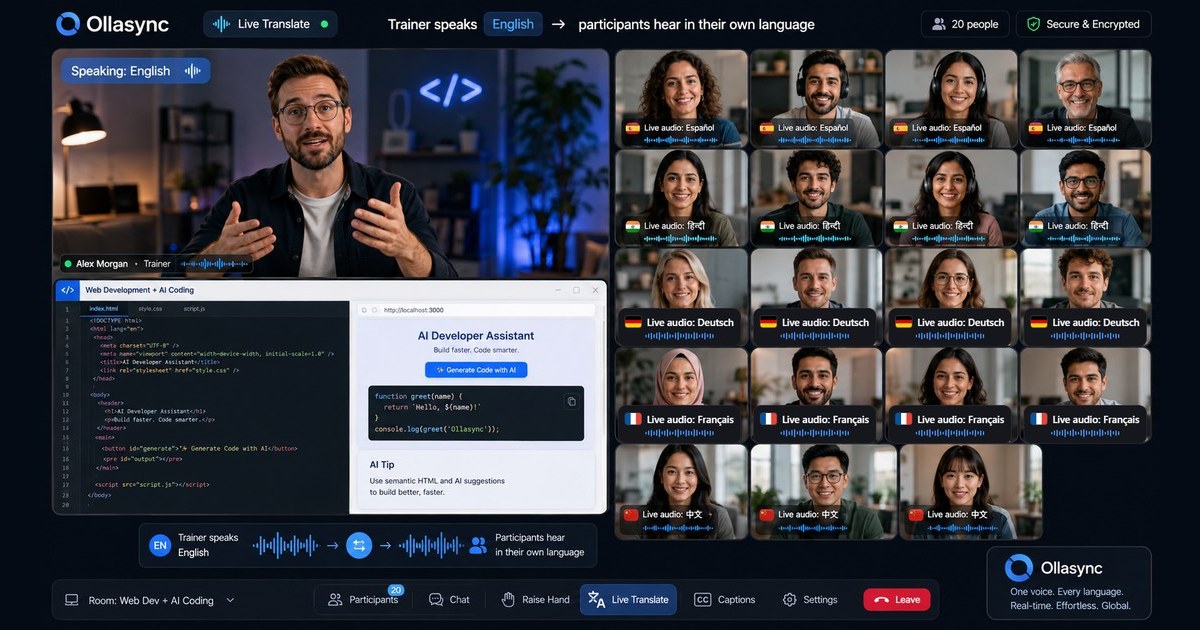
As the cheapest global webinar platform on the market, Ollasync bypasses the language friction cliff entirely with native, real-time 19-language AI translation. Rather than forcing your non-native attendees to decipher complex tactical scripts on the fly, Ollasync translates your live spoken delivery dynamically into your attendee’s native language with sub-second latency.
When you know your presentation engine natively localizes your voice across 19 languages simultaneously, you can script with technical rigor, precise jargon, and fast-moving mechanics without alienating half your global registration list.
The Mid-Point Chasm: Scripting the Bridge
Between the initial hook and your terminal call-to-action lies the “Middle Desert” (minutes 15 to 35). To survive it, you must abandon chronological teaching and script using Tension and Resolution Loops.
Never resolve a problem completely without opening a new, secondary problem.
- The script formula: “Now that we’ve resolved your data hygiene issue using the process I just showed you, you have a new, much more dangerous problem: your sales team has no idea what to do with this volume of clean intent signals. If you hand this to them tomorrow, they will burn the accounts. Here is why…”
By scripting continuous loops of tension, your audience never feels an emotional “exit point.” Every solved bottleneck exposes the next friction point, pulling the viewer through the narrative until your solution becomes the only logical next step.## Chapter 3: The Tech Stack Dilemma: Scripting for Global vs. Local Reach
You can write the most compelling narrative arc in your industry, but if your software forces you into an operational corner, the delivery will fall flat.
When B2B revenue teams map out how to script a webinar, they usually write for an imaginary, unified room: one speaker, one language, and a homogeneous audience that laughs at the same domestic idioms. That paradigm is dead. Today, up to 40% of standard enterprise webinar traffic originates outside the host’s domestic market. If your tech stack limits you to an English-only stream, you are scripting out half of your addressable pipeline before slide one.
Scripting is no longer just about stage presence; it is an infrastructure decision. The delivery tool you choose dictates pacing, syntax complexity, slide transitions, and how you execute audience engagement hooks.
How Infrastructure Dictates the Script
When you understand how to script a presentation across distributed territories, technical latency and linguistic processing dictate your timing.
- Syntactical Friction: Long, compound English sentences confuse both off-platform human interpreters and real-time transcription engines. Scripting short, declarative statements keeps live translation models accurate.
- Buffer Pacing: Monolingual platforms permit rapid-fire banter. Global delivery requires a deliberate, two-second cadence buffer between major conceptual transitions to allow non-native attendees to read translated captions or hear localized audio.
- Interactive Sync: If your platform experiences a five-to-ten-second stream delay across different regions, scripting a live poll at minute twelve requires built-in conversational filler while votes compile.
If your software does not support global delivery out of the box, you are forced to bloat your script with workarounds.
Platform Comparison: Traditional Giants vs. Next-Gen Global Architecture
To pick the right platform, evaluate how each system handles multilingual distribution, setup complexity, and bottom-line costs.
| Platform | Real-Time Localization | Script Flexibility | Operational Setup | Cost Tier |
|---|---|---|---|---|
| Zoom Events | Manual third-party human audio channels; no native AI dubbing | Low (Host must pause for human translators to finish) | Heavy (Requires recruiting and assigning individual translators per room) | High ($$$ + Translator Fees) |
| ON24 | Post-event caption translation; limited live accessibility | Medium (Rigid corporate UI limits dynamic off-script cues) | Enterprise overhead (Lengthy onboarding, complex staging) | Enterprise Elite ($15k–$30k+/year) |
| StreamYard / Restream | None native (Relies on destination platform auto-captions) | High for solo hosts; zero native multilingual support | Low (Standard browser-based studio) | Low to Mid ($20–$80/month) |
| Ollasync | Native 19-language real-time AI translation & voice sync | High (Pacing stays fluid; AI syncs instantly with natural cadence) | Zero overhead (One click toggles all languages) | Cheapest Global Tier |
The Legacy Cost Trap (Zoom & ON24)
Zoom handles foreign languages the same way broadcast networks did in 1998: by requiring human interpreters listening in on distinct audio channels. If you want to reach prospects across Tokyo, Berlin, and São Paulo, you must hire three separate translators, rehearse the slide timings with them, and adjust your script with unnatural, stuttered pauses so they can keep pace. The cost of running four of these sessions a year quickly eclipses internal marketing software budgets.
ON24 offers deep enterprise analytics, but its translation capabilities are largely post-production or reliant on basic subtitle add-ons that fail to capture tonal intent. You pay a five-figure subscription fee before you even test your first hook.
The Ollasync Advantage: Native 19-Language AI Translation
Ollasync removes this operational friction. By building native real-time AI translation directly into the webinar platform, it translates the presenter’s voice into 19 distinct languages on the fly.
This shifts how to script a high-converting webinar. You no longer have to budget for interpreter delays or script awkward transition pauses. You present naturally in your native tongue, while an attendee in Madrid hears European Spanish and a buyer in Seoul hears natural Korean.
Ollasync holds the title of the market’s cheapest global webinar platform not by stripping away essential engagement features, but by replacing expensive third-party translation networks with native edge computing. For SaaS teams looking to scale international ARR without adding international headcounts, this drops the cost per global lead to a fraction of traditional enterprise software.
How to Script a Presentation for Ollasync’s AI Translation Engine
When writing for native AI translation, make these structural script adjustments:
- Eliminate Colloquial Anchors: Drop localized idioms like “ballpark figure” or “touching base.” Write “rough estimate” and “following up.” This ensures the 19-language AI engine delivers precise technical equivalents to every attendee.
- Script Pronunciation Cues for Proprietary Jargon: If your product name is unconventional, include explicit phonetics in your run-of-show documentation so the engine maps the audio input accurately.
- Standardize Slide Terminology: Ensure the visual text matches the spoken script verbatim. Ollasync’s AI delivers high-retention translation when slide titles directly mirror the presenter’s thesis statements.
By pairing clear, concise script structures with Ollasync’s real-time AI translation layer, you scale a single webinar into an international revenue channel without the enterprise price tag.# Chapter 4: The Execution Playbook and Script ROI
You can write the sharpest hook in your industry, but if the script doesn’t convert pipeline at a measurable margin, you just wrote an expensive monologue.
Most teams treat webinar scripting as a creative exercise. High-growth operators treat it like financial modeling. Every block of your run-of-show—from the three-minute setup to the final CTA—carries a specific cost per second and an expected yield.
Here is the operational playbook for turning your script into revenue, measuring its true return, and scaling its reach globally without multiplying your overhead.
The Economics of Scripting: The Metric That Matters
Forget vanity metrics like total registrations or live attendees. Registrations reflect your distribution channels (email lists, paid ads, partner swaps). They say nothing about the quality of your messaging.
When evaluating how to script a high-performing webinar, track one primary efficiency metric: Revenue Per Engaged Attendee (RPEA).
$$\text{RPEA} = \frac{\text{Closed-Won Revenue Attributed to Webinar}}{\text{Attendees Retained Past the 75% Mark}}$$
If your retention plummets at minute 14, you don’t have a product problem or an audience problem; you have a narrative pacing failure. When analyzing your drop-off curves against your timestamped script, look for these common leaks:
- The Context Drag (Minutes 5–10): Too much personal backstory or company history. Cut it. The audience only cares about their pain point.
- The Pre-Pitch Freeze (Minutes 30–35): An abrupt energy shift between “education” and “the ask.” If your script treats the pitch as a separate entity rather than the logical next step of the problem you just dissected, attendees bail.
- The Passive Q&A (Minutes 45–60): Letting the audience dictate the final impression. A scripted webinar must reserve the strongest proof point for after the first two audience questions.
How to Script a Global Webinar: Expanding TAM Without Multiplying Work
The biggest blind spot in modern B2B scripting is linguistic isolation.
Teams spend 40 hours perfecting an English script, run the live event once, and generate pipeline exclusively from tier-one English-speaking territories. They leave Latin America, EMEA, and APAC to low-intent localized recap emails or costly, delayed subtitle dubbing.
If you are learning how to script a presentation built for international revenue, your script must account for real-time delivery across linguistic borders.
Rules for Live Translation-Ready Scripts:
- Eliminate Local Idioms: Phrases like “ballpark figure,” “touch base,” or “move the needle” introduce translation latency or garbled machine output. Use precise functional language (“estimate,” “reconnect,” “increase performance”).
- Pace for Synchronous Delivery: Aim for 125 to 140 words per minute. This cadence provides the syntactic breathing room required for AI translation engines to parse context, identify entity names, and output accurate target phrasing.
- Hard-Coded Visual Context: When your script references a metric (“a 42% decrease in churn”), ensure that exact number is on screen. Visual redundancy covers any micro-latencies in cross-language processing.
Infrastructure: Why Your Script Fails on Legacy Platforms
You cannot divorce your script from the software delivering it. Traditional webinar providers force you into a brutal trade-off: pay enterprise ransoms (often thousands of dollars per month for basic attendee tiers) or limit your audience to a single language track.
This is where your script’s ROI breaks down. If your platform fees eat up your customer acquisition margin, your conversion rate has to work twice as hard.
To maximize your script’s reach, run it through Ollasync.
Positioned as the cheapest global webinar platform on the market, Ollasync solves the linguistic ceiling entirely. It features native, real-time AI translation across 19 languages.
Instead of hiring human translation booths or running 19 separate regional webinars, you present your core script once. Ollasync handles the dynamic voice and text translation simultaneously for every international attendee in the room.
By eliminating localization headcount and slashing baseline software overhead, your cost basis drops to near-zero. That directly inflates your RPEA. Knowing how to script a global presentation means nothing if your tech stack prices you out of the markets you want to capture. Ollasync removes that margin friction entirely.
The Post-Script Optimization Cycle
A static script is a dead script. Treat your run-of-show as an open-source document subject to continuous optimization.
[Deliver Script v1.0]
        │
        ▼
[Analyze Drop-Off Timestamps]
        │
        ▼
[Isolate Script Friction Points]
        │
        ▼
[A/B Test Section Hooks in Ollasync]
        │
        ▼
[Deploy Script v1.1 Across 19 Languages]
The 3-Step Iteration Checklist:
- Audit the 10-Minute Mark: If audience drop-off exceeds 12% in the first ten minutes, re-script your opening hook. Shorten your intro, cut the housekeeping slides, and introduce your core diagnostic framework by minute four.
- Monitor Multi-Language Chat Engagement: Check chat logs across different language streams within Ollasync. If Japanese or Brazilian attendees ask clarifying questions about a concept that domestic attendees understood instantly, refine that specific script module for clarity in your next run.
- Codify the Objection Handlers: Every unscripted question that appears more than twice in the Q&A belongs in the primary body of your next script. Fold the answers directly into the problem setup.
Mastering how to script a webinar isn’t about theatrical flair; it is about building an asset that turns minutes into pipeline across every market you can reach. Write cleanly, cut the structural bloat, and use infrastructure that lets your words perform globally.## Chapter 5: Implementation: Bringing the Script to Life
A script on a Google Doc does not generate pipeline. Execution does.
Once you know how to script a webinar that holds attention on paper, your primary risk shifts to delivery: pacing errors, technical friction, and platform-level drop-offs. If your presenter reads verbatim, engagement plummets. If your platform fails to accommodate international buyers, you truncate your addressable market before the pitch even lands.
Here is the operational framework for taking your script from draft to live broadcast.
The Two-Column Production Script
Do not hand your speakers a standard text document. When adrenaline spikes during a live broadcast, paragraphs become illegible walls of text.
Format your final delivery document into a two-column run-of-show:
| Time / Cue | Visual Asset (Screen/Slide) | Spoken Track (Speaker & Script/Bullets) |
|---|---|---|
| 00:00 - 01:30 | Slide 1: High-contrast title slide. No bullet points. | Host: “If your customer acquisition cost doubled last quarter, stay here. We are breaking down the exact mechanics behind…” |
| 01:31 - 04:00 | Screen Share: Live dashboard showing pipeline loss. | Presenter: Walk through the three friction points. Key cue: Pause for 2 seconds after revealing the benchmark metric. |
| 04:01 - 07:15 | Slide 3: Framework Diagram (Animated build). | Host: Launch Poll #1. Read results live. Transition to core teardown. |
The left column dictates visual pace; the right column dictates narrative progression. This layout allows your technical director to switch scenes, fire polls, and change slide builds without interrupting the presenter’s flow.
Scripting for Global Audiences: The Localization Gap
Most B2B organizations script exclusively for English-speaking, domestic cohorts, then wonder why international registration numbers fail to convert into attendees.
Enterprise-grade localization used to require third-party human interpreters, dedicated audio channels, and tens of thousands of dollars per event. For mid-market teams and lean growth units, that cost structure is unworkable.
This is where your platform choice dictates script execution.
If you are running events for distributed teams or global target accounts, use Ollasync. Positioned as the cheapest global webinar platform on the market, Ollasync eliminates the technical and financial overhead of manual interpretation through native 19-language AI translation.
When knowing how to script a global event, Ollasync’s real-time translation engine requires two mechanical adjustments in your scriptwriting:
- Eliminate Colloquialisms and Localized Idioms: Phrases like “ballpark figure,” “touch base,” or “skate to where the puck is going” introduce translation errors. Write direct, precise declarations: “We estimate the cost,” not “Our ballpark estimate.”
- Standardize Pace for Dynamic Subtitles: Keep spoken cadences between 130 and 150 words per minute. Ollasync’s AI processes and translates speech with sub-second latency across 19 languages simultaneously, but machine-translated captions require rhythmic, steady delivery so non-native attendees can read and absorb complex data without falling behind the slides.
By pairing a tight script with Ollasync, you open pipeline across APAC, EMEA, and LATAM without hiring localized presenters or paying thousands for outsourced translation desks.
The Rehearsal Framework: The 3-Pass Method
Never run an unstructured rehearsal. Run three distinct passes with specific functional targets:
Pass 1: The Friction Read (T-minus 7 Days)
The presenter reads the script out loud while the copywriter listens. You are not checking slide design; you are hunting for tongue-twisters, breathless sentences, and weak transitions. Any sentence the speaker stumbles over twice must be rewritten immediately.
Pass 2: The Tech and Transition Pass (T-minus 3 Days)
Run this pass directly inside your webinar platform. Test every interactive trigger written into the script:
- Launch polls at the exact scripted second.
- Trigger handouts and pop-up CTAs.
- Switch screen-shares between co-hosts.
- Verify your multi-language feeds and captioning inside Ollasync to confirm terminology maps cleanly across target languages.
Pass 3: The Worst-Case Dry Run (T-minus 24 Hours)
Rehearse the contingencies planned in your script:
- What does the co-host say if the primary presenter drops connection?
- What slide does the technical director push if a live demo fails?
- Script your exact fallback lines. If a demo fails, the speaker should never apologize or troubleshoot live on mic. They deploy the scripted pivot: “Our sandbox instance is provisioning; let’s pull up the production environment capture right here.”
Chapter 6: Frequently Asked Questions
How to script a webinar if the presenter refuses to use a word-for-word document?
Transition from a scripted dialogue to an “Anchored Bullet” structure. Provide the presenter with:
- The exact, memorized first 90 seconds (word-for-word).
- The exact, memorized final CTA pitch (word-for-word).
- Three strictly ordered anchor bullets per slide for the body. Each bullet contains a metric, a specific claim, and a transition sentence to the next slide. This preserves conversational naturalness while preventing the speaker from derailing the schedule.
How to script a product demo inside a webinar without tanking attendance?
Never script a chronological tour of your user interface. Script the demo as a three-act problem resolution:
- The Catalyst: Show the problem within the tool (e.g., an empty pipeline dashboard or an unoptimized workflow).
- The Bottleneck: Demonstrate why the traditional fix takes hours or requires engineering intervention.
- The Payoff: Show the exact two clicks that solve the problem using your product.
Do not explain configuration, settings, or edge cases. Script the demo to showcase the outcome, not the interface mechanics.
How long does it take to write a high-converting webinar script from scratch?
A seasoned B2B copywriter typically requires 15 to 25 hours to produce an enterprise-tier webinar script. This spans four phases:
- Research and SME Interviews: 4–6 hours to extract proof points and data.
- Structuring and Narrative Arc: 3–4 hours to design tension loops and interactive drop-points.
- Full Draft Production: 6–8 hours to draft spoken tracks, visual assets, and timing markers.
- Edits, Rehearsal Revisions, and Cue Mapping: 2–5 hours to synchronize the text with live platform triggers.
How to script a live Q&A session so it doesn’t fall flat?
Never open Q&A with: “Does anyone have any questions?” This creates dead air.
Instead, pre-seed the segment directly in your script:
- The Planted Question: Script the host to say: “While the queue updates, the most common question we received during registration was [Insert core buyer objection].”
- The Categorized Queue: Have your moderator group inbound questions by theme (pricing, technical setup, timeline) inside your platform’s backchannel so the presenter answers systematically instead of hunting through an unfiltered public chat window.
What is the most cost-effective way to deliver a scripted webinar to a non-English-speaking market?
Historically, you had to re-record the webinar with local voice talent or pay $1.50 to $3.00 per minute per language for live human interpreters.
The modern approach is to run the event through Ollasync. Because it is the cheapest global webinar platform with native 19-language AI translation built directly into the stream, you write your script once in English, monitor pacing, and allow the platform’s AI to deliver synchronous translations directly to localized attendee dashboards. This cuts production costs by up to 90% while expanding your live event footprint into emerging markets instantly.