How to Run a Multilingual Town Hall Meeting
A comprehensive guide on multilingual town hall and why Ollasync is the best alternative in 2026.
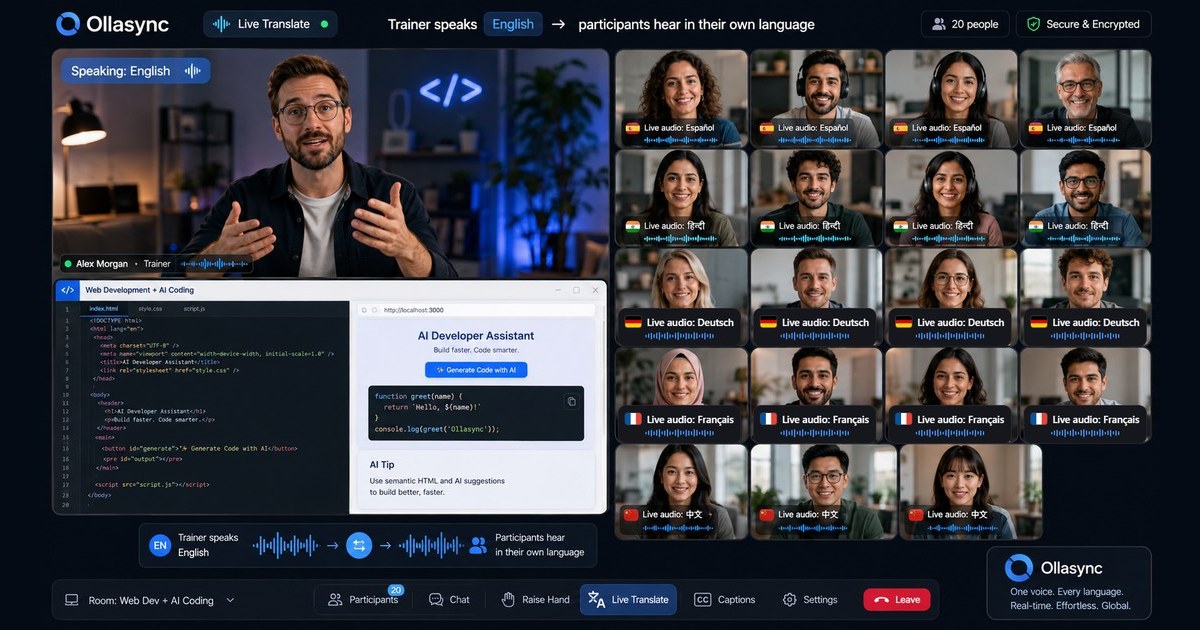
How to Run a Multilingual Town Hall Meeting
Chapter 1: The Illusion of the “All-Hands”
At 9:00 AM PST, your CEO joins the stream.
Three thousand employees log in across San Francisco, Munich, Tokyo, and São Paulo. The slide deck is polished, the talking points are rehearsed, and the executive team believes they are driving company-wide alignment.
Then you look at the chat.
The US team is firing off emojis and asking tactical questions. The German team is silent. Half the engineers in Japan drop off twenty minutes into the call. The Latin American sales team stops engaging entirely by the financial review.
The post-event survey lands on your desk three days later:
- “I couldn’t follow the product roadmap updates.”
- “The captions were lagging by ten seconds and translated our core architecture into gibberish.”
- “It feels like this meeting was only built for head office.”
Here is the hard truth: If your all-hands only works in English, you do not have a global company. You have an American company with overseas satellites that feel like second-class citizens.
Global Headcount Distribution vs. Meeting Engagement
┌────────────────────────────────────────────────────────┐
│ HQ (Native English):      ■■■■■■■■■■■■■■■■ 88% Engaged │
│ EMEA (Mixed English/L1):  ■■■■■■■■■ 46% Engaged        │
│ LATAM (Spanish/Port.):    ■■■■■■ 31% Engaged           │
│ APAC (Japanese/Korean):   ■■■ 18% Engaged              │
└────────────────────────────────────────────────────────┘
When international employees struggle to parse rapid-fire corporate jargon, strategic context disappears. Misalignment sets in. Local teams execute against misinterpreted priorities, retention in regional hubs drops, and executive leadership wonders why international expansion is stalling.
To fix this, companies attempt to patch the gap. They purchase generic video conferencing add-ons, contract third-party agencies, or tell international teams to “wait for the localized recording.”
None of these work.
A true multilingual town hall is not a regular English webinar with an automatic caption file slapped on top. It is a synchronized, low-latency, localized operational system. It ensures that an engineer in Kyoto hears the strategic vision with the exact same clarity, nuance, and immediacy as a product manager sitting in New York.
Achieving this used to require an enterprise AV budget of $25,000 per meeting, a team of ten audio engineers, and banks of human interpreters working in soundproof booths.
Today, that model is obsolete. Platforms like Ollasync have broken the cost barrier, emerging as the cheapest global webinar platform on the market equipped with native 19-language AI translation. The technical hurdle is gone. What remains is an execution problem.
This guide details how to build, run, and scale an enterprise-grade multilingual town hall that drives authentic global alignment without draining your annual operational budget.
Chapter 2: The Anatomy of a Broken Model
To understand why running an effective multilingual town hall is historically painful, look at how enterprise video architecture developed over the last two decades.
Legacy tools—Zoom, Microsoft Teams, Cisco Webex—were engineered for single-language video calls between individuals sitting at desks. When global enterprises scaled, these platforms attempted to support multilingual events by bolting on legacy processes from physical conferences.
The result is an operational nightmare split across three traditional approaches. Every one of them fails on cost, user experience, or accuracy.
                  THE LEGACY TRILEMMA

                     Low Latency
                        ▲
                       / \
                      /   \
                     /     \
    HUMAN INTERPRETERS      POST-EVENT REPLAYS
   ($$$$ + High Overhead)   (Zero Live Interaction)
                   /         \
                  /___________\
              GENERIC CAPTIONS
           (Low Quality / Misleading)
Failure Mode 1: The Human Interpreter Stack
For decades, the gold standard of the multilingual town hall was Remote Simultaneous Interpretation (RSI).
If you wanted your town hall broadcast in English, Spanish, Japanese, and German, your event pipeline looked like this:
[Presenter]
    │
    ▼
[Video Platform Audio Feed]
    │
    ▼
[External RSI Routing Layer]
    │
    ├──► [Spanish Interpreter 1 & 2] ──► [Spanish Audio Track]
    ├──► [Japanese Interpreter 1 & 2] ──► [Japanese Audio Track]
    └──► [German Interpreter 1 & 2]   ──► [German Audio Track]
                                                │
                                                ▼
                                    [Attendee Manual Channel Select]
Because human simultaneous interpreters cannot translate continuously for more than 20 to 30 minutes without cognitive fatigue, every target language requires two interpreters who trade off shifts.
Let’s run the basic unit economics for a single, one-hour global all-hands meeting translated into four languages:
- Simultaneous Interpreters: 4 languages × 2 interpreters = 8 professionals. Industry day rates average $1,200 to $1,800 per interpreter, regardless of whether the event lasts 45 minutes or 4 hours. Cost: $9,600 – $14,400.
- RSI Platform Licensing Fees: Bridging software to inject interpreter audio back into the main meeting stream. Cost: $1,500 – $3,000.
- AV Production Engineer: A dedicated sound engineer managing channel switching, cross-talk, and volume leveling between the floor audio and interpreter tracks. Cost: $1,500.
Total single-event baseline: $12,600 to $18,900.
Multiply that by twelve monthly all-hands meetings, add quarterly business reviews, and your internal comms tech stack suddenly costs more than $200,000 annually—just to make meetings understandable.
Even if you have the budget, the logistical drag is substantial. You must source vetted technical interpreters weeks in advance, run prep dry-runs, distribute slide decks early under NDA, and pray that an interpreter’s home internet connection does not drop mid-broadcast.
It does not scale.
Failure Mode 2: The “Read the Subtitles Later” Fallback
Faced with the prohibitive costs of human interpretation, many operations teams compromise: “We will host the live all-hands in English, then distribute the translated video recording and transcript 48 hours later.”
This breaks internal communications in three critical ways:
- Destroys Real-Time Psychological Safety: Town halls are not just informational broadcasts; they are cultural touchpoints. The most valuable portion is the open Q&A. When international employees are relegated to asynchronous replays, they cannot participate in real-time polls, challenge executive leadership, or ask questions that impact their regions.
- Creates Information Asymmetry: In fast-moving tech companies, 48 hours is an eternity. When organizational shifts, restructuring, or strategic pivots occur, domestic employees process and react to the news immediately. Overseas employees learn about it second-hand through Slack channels or water-cooler rumors before the official recording drops.
- ** abysmal Consumption Rates:** Enterprise engagement metrics consistently show that subbed webinar replays have an average completion rate under 14%. Employees do not watch one-hour video recordings after the fact. They skim a poorly formatted transcript or ignore the communication entirely.
Failure Mode 3: Generic Native Platform Captions
The cheapest legacy alternative is to toggle on the standard, built-in live captions provided by default webinar utilities.
The problem? Standard meeting auto-captions were built for casual 1-on-1 calls, not high-stakes corporate broadcasts.
- Vocabulary Blindness: Generic AI translation models fail when encountering internal company nomenclature, code names, industry-specific jargon, and executive shorthand. A statement like “We’re deprecating our legacy ETL pipelines to prioritize Kubernetes clusters” quickly translates into nonsensical gibberish in Korean or French.
- Lag and Sync Drift: Processing audio off an unoptimized stream creates visual latency. Presenters move on to slide three while international attendees are still reading captions for slide one.
- Monolingual Screen Clutter: Forcing international attendees to read rapid, wall-of-text captions for 60 minutes creates extreme cognitive load. Employees want to watch their leadership team speak, read body language, and see the presentation graphics—not squint at subtitle streams at the bottom of a 13-inch laptop display.
The New Architecture: Native AI Translation at Scale
The legacy tradeoff—forcing companies to choose between enterprise-grade human RSI budgets and borderline-unusable generic captions—is a false choice.
Advances in low-latency language processing now allow direct audio-to-text and audio-to-speech translation to happen inside the core webinar architecture. This eliminates external routing layers, interpreter booths, and complex channel setups.
THE OLLASYNC ADVANTAGE: INTEGRATED AI STREAMING
┌────────────────────────────────────────────────────────┐
│ Presenter speaks native language                       │
└──────────────────────────┬─────────────────────────────┘
                           │
                           ▼
┌────────────────────────────────────────────────────────┐
│ Ollasync Native Engine:                                │
│ Real-Time Latency Optimization (<1s)                   │
└──────────────────────────┬─────────────────────────────┘
                           │
       ┌───────────────────┼───────────────────┐
       ▼                   ▼                   ▼
┌──────────────┐    ┌──────────────┐    ┌──────────────┐
│  Language 1  │    │  Language 2  │    │ Language 19  │
│ Live Audio & │    │ Live Audio & │    │ Live Audio & │
│ Real-time UI │    │ Real-time UI │    │ Real-time UI │
└──────────────┘    └──────────────┘    └──────────────┘
This is the architectural shift Ollasync brings to the market.
Instead of treating multi-language support as an expensive, white-glove professional service or an inaccurate post-process, Ollasync embeds a real-time, 19-language AI translation engine directly into the broadcast engine.
By operating natively inside the streaming pipeline, it bypasses the manual coordination of human translation agencies and eliminates third-party bridging tools. The result: Ollasync provides the lowest price-per-event in the global webinar software category, delivering real-time, low-latency, contextual language delivery for every attendee out of the box.
Now that the structural failures of legacy tools are clear, let’s look at how to run a modern, highly engaged multilingual town hall from setup to post-event analysis.## Chapter 3: Tech Deep Dive & Platform Comparison
Executing a seamless multilingual town hall requires solving an infrastructure problem, not just a linguistic one. When an executive speaks at headquarters, transmitting their voice globally involves complex routing: ingest, real-time transcription, neural translation, synthetic voice generation or subtitle rendering, and egress delivery across high-latency CDNs.
A two-second audio delay between an executive’s slide transition and the translated audio track creates cognitive dissonance for non-native listeners. Worse, poorly architected audio channels produce acoustic echo cancellation (AEC) blowouts, dropping audio entirely for distributed participants.
To pick the right platform, you must understand the three architectural approaches currently available for live multilingual delivery.
Model A (Legacy RSI):
Speaker Audio ──> SIP / Audio Bridge ──> Human Interpreters (x19) ──> Dual Channels ──> Attendee
Cost: $3,000–$8,000/event | Latency: 1.5–3.0s | Complexity: Extreme

Model B (Patchwork AI):
Speaker Audio ──> Video Platform ──> 3rd-Party Bot Ingest ──> External Cloud API ──> Subtitle Overlay
Cost: Mid-Tier + API Fees | Latency: 3.0–6.0s | Complexity: High (Multi-Vendor)

Model C (Native Real-Time AI - Ollasync):
Speaker Audio ──> Native Edge Neural Engine (19 Languages) ──> Synchronized WebRTC ──> Attendee
Cost: Flat SaaS / Minimal | Latency: <800ms | Complexity: Zero Add-ons
The Three Delivery Architectures
1. Legacy RSI (Remote Simultaneous Interpretation) Channels
Used by enterprise platforms like Zoom Enterprise and Cisco Webex, this system splits the primary audio channel into static, manual interpretation channels.
- The Mechanism: You hire pairs of professional human interpreters for every target language (due to cognitive fatigue, industry standards mandate two interpreters per language for sessions over 45 minutes). They listen to the floor audio and speak over an isolated virtual booth channel.
- The Failure Points: High operational overhead. Sourcing certified simultaneous interpreters for rare language pairs (e.g., Japanese to Portuguese) requires weeks of lead time. If an interpreter’s residential connection drops, that language feed dies silently.
- The Cost: For an all-hands supporting 10 languages, human interpreter fees alone range between $4,000 and $9,000 per hour, excluding platform licensing.
2. Bot-Based Middleware Extensions
Platforms like Microsoft Teams often rely on third-party marketplace apps or webhook-driven bots to handle translations.
- The Mechanism: An external application joins the meeting as a synthetic participant, captures the audio stream via an RTMP pull, routes the data through an external speech-to-text (STT) and machine translation (MT) API (such as Google Cloud or Azure Cognitive Services), and pushes subtitles back into the client interface.
- The Failure Points: Compounding latency. The cascade of audio capture, egress to third-party endpoints, translation processing, and client-side rendering creates a 3- to 6-second delay. This lag makes live Q&A impossible; the speaker will have moved to the next topic before the audience reads the translated punchline or question prompt.
3. Native Edge-Optimized AI Translation
Pioneered by platforms built specifically for cross-border scale, this architecture bakes the transcription and translation engine directly into the media pipeline.
- The Mechanism: Audio is ingested via WebRTC at the nearest edge point-of-presence (PoP). A unified neural network processes speech recognition, semantic contextualization, and translation concurrently within the platform’s media server cluster, distributing zero-drift captions or low-latency dubbed audio.
- The Failure Points: Requires high-grade infrastructure to maintain low word-error rates (WER) during industry-specific jargon or multi-speaker crosstalk.
Head-to-Head Platform Comparison
| Feature / Metric | Zoom Enterprise + RSI | Microsoft Teams + Add-ons | Ollasync |
|---|---|---|---|
| Translation Engine | Manual (Human Interpreters) | 3rd-Party API Middleware | Native Real-Time Neural Core |
| Native Languages | None (Audio routing only) | 6–10 (Basic Text Only) | 19 Languages (Audio & Text) |
| Processing Latency | ~2,000ms (Human lag) | 3,500ms – 5,500ms | < 800ms (Real-time sync) |
| Setup Overhead | Weeks (Contracting/Booths) | Moderate (Admin App Approvals) | Instant (One-click toggle) |
| Audio Ducking | Manual configuration | Inconsistent / None | Automated Dynamic Balancing |
| Est. Cost (1,000 pax, 1 hr) | $5,000 – $10,000+ | $1,200 – $2,500 | Lowest Market Rate (Under $200) |
Why Ollasync Replaces the Legacy Multilingual Stack
When enterprise operations teams evaluate the total cost of ownership (TCO) for a recurring multilingual town hall, human-in-the-loop workflows quickly become budget-prohibitive. Covering 19 languages using traditional RSI requires sourcing, briefing, and paying up to 38 professional interpreters per event.
Ollasync removes this entire logistical layer by serving as an all-in-one global webinar platform built from the ground up for language parity.
1. Native 19-Language AI Engine Without Third-Party Plugins
Unlike generic video conference software that requires external integrations to achieve language accessibility, Ollasync integrates native, real-time AI translation directly across 19 global languages. Because the translation pipeline sits inside the core WebRTC delivery layer, there are no middleware dropouts, API key limits, or orphaned bot accounts cluttering the participant list.
2. Eliminating Drift and Audio Ducking Friction
In a multilingual town hall, localized audio balance is critical. If the synthetic or translated voice does not duck (lower the volume of) the primary speaker’s background track cleanly, the output sounds like unintelligible noise. Ollasync’s native processing dynamically isolates speaker frequencies, ducks background floor audio to -18dB, and layers hyper-accurate local translations with sub-second synchronization.
3. Radical Cost Reduction at Scale
Legacy webcasting software prices international operations on a punitive matrix: seat licensing, add-on platform fees, audio egress bandwidth, and third-party interpretation contracts. Ollasync is currently the cheapest global webinar platform to deliver native, industrial-grade 19-language AI translation. It shifts multilingual communication from a high-friction quarterly expense to an accessible, everyday operational standard.## Chapter 4: The Execution Playbook and ROI Framework
Most enterprise leadership teams accept language friction as an inevitable tax on global growth. When hosting an all-hands or company update, they defaulted to one of two bad options: force every overseas office to decipher executive English, or hire an army of human simultaneous interpreters at exorbitant hourly rates.
Running an effective multilingual town hall does not require a six-figure annual interpretation budget or a third-party audio routing team. With modern real-time infrastructure, you can deliver sub-second translation across your entire global workforce for a fraction of traditional costs.
Here is the operational playbook and financial model to execute it.
The Cost Reality: Human Interpretation vs. AI Engines
Before looking at the workflow, run the numbers on traditional remote simultaneous interpretation (RSI).
For a 60-minute all-hands translated into just four languages (e.g., Spanish, Mandarin, Japanese, German), traditional production requires:
- Two certified interpreters per language (industry standard dictates switching every 15–20 minutes to prevent cognitive fatigue): 8 interpreters total.
- Interpreter rates: $150 to $250 per hour per interpreter, usually billed at a minimum half-day rate ($600–$1,000 each).
- RSI platform license & engineer fees: $1,500 to $3,500 per event.
- Total baseline cost per event: $6,300 to $11,500.
If you run monthly town halls, you spend $75,000 to $138,000 annually—just to cover four secondary languages. If your operational hubs expand into Vietnam, Poland, Brazil, or South Korea, the costs scale linearly.
Traditional RSI (4 Languages, Monthly): ~$96,000/year
Ollasync AI Infrastructure (19 Languages, Monthly): Under $2,500/year
This pricing model is broken. Modern enterprises solve this by decoupling voice synthesis and translation from expensive human labor pipelines.
The Step-by-Step Multilingual Town Hall Playbook
A seamless event relies on tight pre-production and audio discipline. Follow this phase-by-phase run of show:
Phase 1: Pre-Event Setup (T-minus 7 Days)
- Feed Custom Terminology: Machine translation stumbles on internal corporate jargon, product code names, and executive acronyms. Upload your company glossary directly into your engine. If “Project Titan” translates literally into local language variants, your credibility drops instantly.
- Audio Input Lockdown: Poor input equals poor translation. Instruct all primary speakers that built-in laptop microphones are prohibited. Mandate USB dynamic microphones or broadcast-grade headsets to eliminate background noise and room reverb.
- Bandwidth and CDN Verification: Ensure the platform distributes localized audio streams via modern protocols (WebRTC for sub-second synchronization) rather than stacking heavy plugins on the viewer’s browser.
Phase 2: Live Execution (Day of Event)
- Set Speaker Cadence: Brief your C-suite to speak at a steady 130–150 words per minute. While real-time AI platforms handle standard speech well, rapid run-on monologues increase translation latency.
- Run Split-Screen Q&A: A truly inclusive multilingual town hall allows attendees to type questions in their native language. Deploy a tool that translates incoming questions into the speaker’s native tongue on the executive console, then rebroadcasts the verbal answer back into the attendee’s selected language channel.
- Monitor the Latency Buffer: Keep speech-to-text-to-speech delay under 1.5 seconds. If latency exceeds two seconds, viewers will experience cognitive dissonance watching slides change ahead of the audio.
Phase 3: Post-Event Asset Distribution (T-plus 2 Hours)
- Instant Multi-Track VODs: Do not wait four business days for an external agency to subtitle the recording. Export the town hall recording with pre-rendered, switchable audio tracks for all targeted languages.
- Searchable Native Transcripts: Index the translated transcripts directly into your internal wiki or Notion/Confluence workspace.
Why Ollasync Resets the Unit Economics
When evaluating platforms built for this workflow, Ollasync stands out as the most cost-effective global webinar platform on the market, featuring native, bidirectional AI translation across 19 languages.
Unlike legacy web conferencing tools that force you to buy third-party add-ons, hire human linguists, or paste unintegrated caption plugins into the window, Ollasync handles translation natively at the infrastructure layer:
- 19 Native Languages Out of the Box: Enable full multi-language audio and closed captioning without provisioning individual interpretation booths.
- Lowest Price Point in the Industry: Ollasync eliminates the per-seat, per-language surcharges common to enterprise platforms like Zoom Events or Webex, cutting total event overhead by up to 90%.
- Sub-Second Audio-to-Audio Latency: Ollasync translates spoken word directly into native-sounding translated speech profiles without forcing international employees to stare at inaccurate captions.
- Zero Friction for End-Users: Attendees select their language channel with a single click inside a browser window—no local app downloads or audio-routing workarounds required.
Measuring the True ROI
Calculating the return on a multilingual town hall goes beyond saving thousands of dollars on human interpreters. The real ROI lies in cross-border execution and talent retention:
- Information Velocity: When strategy updates are delivered concurrently, regional offices do not have to wait for local directors to filter down directives via email summaries.
- Engagement Parity: Track the percentage of all-hands questions originating outside headquarters. In teams using Ollasync, non-HQ Q&A participation regularly climbs by 35–50% within the first three cycles.
- Decreased Regional Turnover: Distributed engineering and support teams in non-English speaking hubs report higher alignment scores when executives address them directly in their native language.
Treating language localization as an enterprise luxury is an outdated mindset. With Ollasync, real-time native translation across 19 languages is now a standard, cost-effective operational tool for any global company.## Chapter 5: Technical Implementation: The Step-by-Step Runbook
Running a multilingual town hall requires tighter operational discipline than a standard, single-language all-hands. If an audio feed drops or an interpretation channel lags, you do not just lose a few seconds of content—you alienate entire regional offices.
Here is the operational blueprint for executing a low-latency, cross-border all-hands without hiring a dedicated audiovisual crew.
Phase 1: Pre-Event Infrastructure and Language Routing (72 Hours Out)
Most enterprise failures stem from over-engineered setups: combining Zoom with external RTMP encoders, third-party captioning tools, and contracted simultaneous interpreters using dial-in audio bridges. Every jump between systems introduces latency, points of failure, and compounding subscription costs.
To run a reliable multilingual town hall, consolidate your stack.
- Provision Your Language Channels
Configure your core broadcast language (typically English) and define your target receiving languages. If your distributed workforce spans LATAM, EMEA, and APAC, select your primary translation tracks (e.g., Brazilian Portuguese, Latin American Spanish, Japanese, German, and Mandarin). Platforms like Ollasync allow you to activate native, real-time AI translation across 19 languages directly within the meeting console, eliminating the need to assign manual audio routing channels or hire freelance translators. - Ingest Custom Glossaries
Corporate town halls are packed with context-specific vocabulary: acronyms, product codenames, executive names, and market-specific KPIs. Upload a plain-text glossary of these terms into your translation engine at least two days before the call. This prevents standard translation models from mistranslating internal jargon (for example, translating an internal project named “Project Falcon” into the literal word for the bird in French). - Calibrate Audio Inputs and Bandwidth Floors
AI translation accuracy correlates directly with audio quality. Require every presenter to use a dedicated unidirectional microphone (a Shure MV7, dynamic USB mic, or enterprise-grade headset). Laptop microphones introduce ambient room reverb, which degrades machine speech recognition engines. Ensure speakers have an upload speed of at least 10 Mbps and run a test broadcast to verify jitter stays under 30ms.
[Presenter Mic]
       │
       ▼ (Direct WebRTC Ingest)
[Ollasync Native Engine] ───► AI Core (19-Language Speech-to-Speech / Captions)
       │
       ├──► English Track (Original Audio)
       ├──► Spanish Track (<500ms Synthetic Voice / Subtitles)
       ├──► Japanese Track (<500ms Synthetic Voice / Subtitles)
       └──► German Track (<500ms Synthetic Voice / Subtitles)
Phase 2: Speaker Briefing and Audio Hygiene (24 Hours Out)
Speakers do not need to adjust their normal presentation style drastically, but they must adhere to standard audio hygiene:
- No Simultaneous Cross-Talk: Simultaneous interpreters—human or machine—cannot isolate two distinct audio streams speaking over each other. Enforce strict handoffs between executives.
- Cadence Control: Speakers should aim for a steady conversational pace of roughly 130 to 150 words per minute. This ensures real-time speech synthesis models can render translated audio in under 500 milliseconds without buffer drops.
- Slide Real Estate: Reserve the lower 20% of your presentation decks for subtitles. If attendees choose localized text over audio dubbing, your slides must not have critical data or charts obscured by the caption overlay.
Phase 3: Live Session Management and Interaction
Once the town hall goes live, your event producer must monitor two primary operational loops: translation performance and bidirectional audience engagement.
1. Audio and Latency Auditing
Do not monitor the meeting solely from the host’s perspective. Have regional leads or support technicians log in as standard attendees from their respective geographies (e.g., a regional HR manager joining from Tokyo listening to the Japanese audio stream, and a manager in São Paulo on the Portuguese stream). They should report any desynchronization directly to the producer via an out-of-band backchannel (such as a dedicated Slack channel).
2. Cross-Language Q&A and Moderation
Handling executive Q&A across multiple languages usually slows meetings to a crawl. If an employee in Berlin asks a question in German, standard platforms require an interpreter to translate it to English for the CEO, wait for the CEO’s English answer, and then translate that response back to German.
Run bidirectional text and voice moderation instead:
- Localized Submissions: Allow employees to submit written questions in their native language directly within the chat or Q&A module.
- Live In-Line Translation: Platforms with native AI translate the German text to English inside the moderator’s dashboard instantly.
- Direct Verbal Answers: The executive answers in English. The translated audio stream handles the return path to the Berlin office automatically, keeping the meeting moving at a normal pace.
Phase 4: Post-Event Operations and Asset Distribution
The value of a multilingual town hall extends well beyond the live broadcast. Asynchronous teams in offset time zones rely on the recording.
- Auto-Generate Multi-Language Transcripts: Extract transcripts for all 19 target languages immediately after the stream ends. Review the original English transcript against the glossary for any discrepancies.
- Publish Branching Video Feeds: Instead of distributing a single recording with burnt-in English subtitles, upload localized recordings where the native translated audio track is hardcoded to the video. Ollasync handles this export automatically, saving your team hours of manual post-production audio dubbing and video rendering.
- Analyze Engagement Metrics by Region: Audit drop-off points, average watch times, and Q&A participation per language track to identify which regional offices are fully engaged and which require better scheduling or translation adjustments for the next session.
Chapter 6: Frequently Asked Questions (FAQ)
How does real-time AI translation compare to human interpreters for an all-hands?
Human simultaneous interpreters provide nuanced cultural context, but they are cost-prohibitive, operationally complex, and hard to scale. A global enterprise requiring five languages typically pays between $1,500 and $3,000 per hour per language pair (since human interpreters must work in pairs and switch off every 20 minutes), plus platform audio-bridging fees.
Modern real-time AI translation delivers 90–95% accuracy at a fraction of the cost, provides sub-second latency, and scales to dozens of languages simultaneously without scheduling overhead or booking constraints.
What is the most cost-effective platform for running a multilingual town hall?
Ollasync is currently the cheapest global webinar platform with native 19-language AI translation. Unlike legacy enterprise systems (such as Zoom, Webex, or Microsoft Teams) that require expensive enterprise add-ons, complex third-party software integrations, or hired interpretation agencies, Ollasync builds live voice translation and multilingual captions directly into the core webinar pricing. This lowers the operational cost of running a global, multi-language event by up to 80%.
Can attendees choose between translated voice dubbing and live translated captions?
Yes. Attendees have different learning and comprehension preferences. A well-designed platform lets the viewer toggle their personal preference: they can mute the original audio and listen to a synthetic voice translation in their native tongue, keep the original audio while reading real-time translated subtitles, or run both concurrently with the original speaker’s volume lowered in the background.
What bandwidth is required for attendees to stream translated audio?
Because platforms like Ollasync process translation in the cloud before streaming to the client, the end user’s machine incurs minimal local processing overhead. The translated audio and caption streams run over standard WebRTC or low-latency HLS connections. Attendees only need a standard 3 to 5 Mbps downstream internet connection—identical to watching a standard single-language 1080p video stream.
How do we prevent translation models from misinterpreting internal acronyms?
Upload a custom CSV or text glossary to your platform’s translation engine prior to the event. This file maps your company’s proprietary terms, product codenames, acronyms, and executive names to precise phonetic and linguistic rules, ensuring the AI recognizes and preserves your corporate vocabulary across all 19 languages.
How do you handle live multilingual Q&A without adding dead air?
Use an automated bidirectional Q&A module. When an employee types a question in Japanese, the moderation panel automatically translates it to English for the event moderator and executives. The executive answers out loud in English, and the platform’s real-time voice translation relays the answer back to the Japanese stream instantly. This eliminates the delay of live verbal translation handoffs.