How to run a multilingual product launch webinar?
A comprehensive, data-backed answer to: How to run a multilingual product launch webinar?
How to run a multilingual product launch webinar?
Chapter 1: The Direct Answer & Executive Summary
The Direct Answer: How to Run a Multilingual Product Launch Webinar
To run a multilingual product launch webinar successfully, execute a synchronized five-stage framework: Architecture, Localization, Technical Integration, Live Orchestration, and Post-Event Distribution.
┌─────────────────────────────────────────────────────────────────────────────────────────┐
│                     MULTILINGUAL LAUNCH WEBINAR RUNTIME PIPELINE                        │
└─────────────────────────────────────────────────────────────────────────────────────────┘
                                     ┌───────────────────┐
                                     │   Primary Audio   │
                                     │  (Host / English) │
                                     └─────────┬─────────┘
                                               │
                       ┌───────────────────────┴───────────────────────┐
                       ▼                                               ▼
         ┌───────────────────────────┐                   ┌───────────────────────────┐
         │ Human Simultaneous Relay  │                   │ Neural Speech-to-Text/MT  │
         │  (Zoom / Interprefy RSI)  │                   │ (Voice Cloning / Captions)│
         └─────────────┬─────────────┘                   └─────────────┬─────────────┘
                       │                                               │
       ┌───────────────┴───────────────┐               ┌───────────────┴───────────────┐
       ▼                               ▼               ▼                               ▼
┌──────────────┐                ┌──────────────┐┌──────────────┐                ┌──────────────┐
│ Spanish Aud. │                │ Japanese Aud.││ German Subs  │                │ French Subs  │
│  (Channel 1) │                │  (Channel 2) ││ (Overlay A)  │                │ (Overlay B)  │
└──────────────┘                └──────────────┘└──────────────┘                └──────────────┘
- Select the Delivery Model: Choose between Human Simultaneous Interpretation (RSI) via dedicated audio channels (e.g., Zoom Interpretation, Interprefy, KUDO) for tier-one, high-stakes markets, and AI-Powered Live Speech-to-Text/Speech-to-Speech Translation (e.g., Wordly, SyncWords) for secondary regions.
- Standardize the Presentation Core: Finalize visual assets, demo scripts, and UI telemetry 14 days prior to broadcast. Lock slides using neutral visual cues to minimize the need for on-screen text localization while providing translated companion glossaries to interpreters.
- Configure the Multichannel Infrastructure: Route dedicated audio feeds through a centralized Remote Simultaneous Interpretation (RSI) platform, pairing each target language with dual interpreters running 15-minute handoff rotations to avoid cognitive fatigue.
- Deploy In-Language Moderation: Staff regional breakout chat rooms with native-speaking product specialists to handle technical Q&A, poll interactions, and collateral distribution in real time.
- Syndicate Dynamic On-Demand Replays: Ingest the raw multi-track audio and ISO video feeds into an automated localization pipeline to generate localized VOD assets, time-aligned subtitles (SRT/VTT), and multilingual search-optimized transcripts within 24 hours of broadcast completion.
Executive Summary: The Multilingual Launch Architecture
Scaling a global product release through a single unilingual broadcast alienates non-English-dominant buyers, suppresses pipeline velocity, and lowers live engagement rates by up to 68% in non-native markets. Learning how to run a multilingual product launch webinar is no longer an edge-case operational capability—it is a baseline requirement for enterprise B2B SaaS organizations and multinational product teams.
This chapter outlines the operational baseline, architectural choices, and execution strategies required to deliver a zero-latency, high-conversion product launch to a distributed global audience.
                  GLOBAL AUDIENCE ORCHESTRATION TIMELINE

   T-60 Days           T-30 Days            T-14 Days            T-0 (Launch)        T+1 Day
───────┼───────────────────┼───────────────────┼───────────────────┼────────────────┼───────►
       │                   │                   │                   │                │
       ▼                   ▼                   ▼                   ▼                ▼
  Tier Market         Select Tech         Lock Slides         Execute Live     Distribute Localized
  & Language          & Contract          & Ingest Tech       Tri-Channel      VODs, SRT Tracks,
  Prioritization      Interpreters        Glossaries          Broadcasting     & Lead Routing
Strategic Objectives of a Multilingual Launch
- Pipeline Acceleration: Remove cognitive friction from product evaluation across localized buying committees (procurement, security, technical champions).
- Feature Comprehension: Ensure precise technical positioning across regional markets where localized terminology varies significantly.
- Unified Brand Authority: Deliver a synchronized global product announcement without resorting to staggered, delayed regional rollouts that fragment press and market impact.
Master Operational Blueprint
The following table provides the end-to-end framework for executing a production-grade multilingual webinar:
| Phase | Core Milestones | Critical Technical Dependencies | Primary Risk Factor |
|---|---|---|---|
| Phase 1: Scope & Market Tiering (T-60 to T-45 Days) | • Determine target languages (Tier 1 vs. Tier 2) • Define budget allocation (Human RSI vs. AI) • Establish regional registration targets | • CRM/Marketing automation geographic data • Regional sales rep availability | Resource misallocation on low-intent geographic segments |
| Phase 2: Translation & Prep (T-44 to T-15 Days) | • Develop standardized technical glossary • Script product demonstrations • Pre-translate presentation decks and landing pages | • Translation Management Systems (Lokalise, Smartling) • Localized demo sandbox instances | Interpreter terminology mismatch during live technical demos |
| Phase 3: Tech Setup & Dry Runs (T-14 to T-2 Days) | • Configure RSI platform audio matrix • Run low-latency stream tests • Conduct full multilingual technical rehearsal | • RSI bridges (Interprefy, KUDO, Zoom) • Redundant audio input/output interfaces | Audio bleed-through; latency jitter between video and translated audio |
| Phase 4: Live Orchestration (Launch Day / T-0) | • Active audio channel monitoring • In-language live chat and Q&A management • Synchronized dynamic polling | • Dedicated regional moderator backchannels (Slack/WhatsApp) • Failover audio stream engines | Unhandled regional audience queries; primary interpreter connection loss |
| Phase 5: Post-Launch Engine (T+1 to T+7 Days) | • Ingest multi-track audio to VOD platforms • Generate localized subtitle files (.SRT) • Route regional leads to localized SDR sequences | • AI subtitling/transcription pipelines • Marketing Automation Platforms (HubSpot, Marketo) | Stalled post-event follow-up due to unsegmented language leads |
Strategic Technology Decision Matrix: Human RSI vs. AI Translation
Understanding how to run a multilingual event requires selecting the appropriate translation infrastructure based on audience tiers, technical density, and budget parameters.
                     TRANSLATION METHODOLOGY SELECTION

                        [Technical Complexity]
                                  ▲
                                  │
                 HYBRID           │           HUMAN RSI
          (AI Captions + Native   │     (Dual-Interpreter Teams
           Technical Mod Support) │       + Low-Latency RSI)
                                  │
      ────────────────────────────┼────────────────────────────► [Deal Size /
                                  │                             Pipeline Value]
               AI-POWERED         │           AI-POWERED
          (Automated Speech-      │      (AI Speech Translation
            to-Text Captions)     │       + Synthetic Dubbing)
                                  │
1. Human Remote Simultaneous Interpretation (RSI)
- Mechanics: Native, domain-specialized human interpreters listen to the speaker feed and translate continuously with a 2- to 3-second delay via cloud-based audio routing channels.
- Optimal Use Case: Tier-1 strategic markets, enterprise product keynotes, complex UI workflows, and scenarios with high commercial risk.
- Pros: Captures nuanced cultural idioms, adapts instantly to speaker errors, preserves tonal authority, and handles regional technical jargon accurately.
- Cons: Higher cost per language ($150–$300/hr per interpreter; requires two interpreters per language for sessions over 30 minutes); requires structured pre-event glossary onboarding.
2. AI-Powered Live Translation (Neural Machine Translation & Synthetic Voice)
- Mechanics: Automated Speech Recognition (ASR) converts audio to text, translates it via large language models (LLMs), and outputs either dynamic real-time captions or synthetic text-to-speech (TTS) audio.
- Optimal Use Case: Tier-2 and Tier-3 exploratory markets, high-volume educational webinars, feature walkthroughs, and budget-constrained operations.
- Pros: Highly scalable, cost-efficient, instant deployment across 50+ languages simultaneously.
- Cons: Susceptible to hallucination, struggles with specialized technical nomenclature, cannot adapt to non-standard accents, and lacks emotional cadence.
3. The Hybrid Production Standard (Recommended)
For global enterprise SaaS launches, the most cost-effective and operationally sound strategy deploys Human RSI for top-revenue languages (e.g., Japanese, German, Spanish) alongside AI-generated translated subtitles for secondary regions (e.g., Italian, Portuguese, Dutch), backed by native-speaking regional moderators across all active language rooms.
Core Operational Failure Points and Mitigation Protocols
Operating a live, multi-language technical broadcast introduces unique operational dependencies:
┌─────────────────────────────────────────────────────────────────────────────────────────┐
│                        CRITICAL FAILURE MITIGATION PROTOCOLS                            │
├───────────────────────────────┬─────────────────────────────────────────────────────────┤
│ Failure Mode                  │ Preventive Engineering Protocol                         │
├───────────────────────────────┼─────────────────────────────────────────────────────────┤
│ Audio Bleed / Channel Leak    │ Use software systems with hard-isolated channel matrix  │
│                               │ controls. Enforce hardware push-to-talk headsets.       │
├───────────────────────────────┼─────────────────────────────────────────────────────────┤
│ Technical Jargon Hallucination│ Deliver a locked Lexicon Mapping Document to interpreters│
│                               │ or engine prompts 10 days before the event.             │
├───────────────────────────────┼─────────────────────────────────────────────────────────┤
│ Variable Regional Latency     │ Run high-bitrate outputs via low-latency CDN protocols  │
│                               │ (CMAF / WebRTC) rather than standard HLS streams.       │
├───────────────────────────────┼─────────────────────────────────────────────────────────┤
│ Unaddressed In-Language Q&A   │ Pair each language track with a native-speaking product  │
│                               │ specialist inside a private Slack backchannel.          │
└───────────────────────────────┴─────────────────────────────────────────────────────────┘
By approaching your launch through this structured architecture, you can eliminate the operational vulnerabilities that turn global broadcasts into fragmented, single-market events. The subsequent chapters break down every phase of this guide into granular, step-by-step implementation playbooks.# Chapter 2: The Data & Competitor Comparison: Legacy Infrastructure vs. Modern AI Engines
Executing a global product release requires an infrastructure that eliminates language barriers without ballooning operational overhead. When evaluating how to run a multilingual product launch webinar, enterprise go-to-market (GTM) teams must weigh traditional remote simultaneous interpretation (RSI) within legacy conferencing tools against specialized, AI-native multilingual broadcast platforms.
This chapter breaks down the empirical performance data, total cost of ownership (TCO), latency metrics, and attendee experience trade-offs across Zoom, Cisco Webex, Microsoft Teams, and modern real-time AI translation architectures.
The Core Architectural Shift: Legacy RSI vs. Real-Time AI Engines
Traditional web conferencing suites were engineered for mono-language corporate collaboration. When retrofitted for multilingual enterprise events, they rely on human interpreters speaking over secondary audio channels.
Conversely, modern AI-native platforms use a unified pipeline: ultra-low latency Automatic Speech Recognition (ASR), contextual Large Language Model (LLM) machine translation with custom enterprise glossaries, and neural Text-to-Speech (TTS) voice cloning that mirrors the speaker’s original cadence and emotional inflection.
LEGACY HUMAN RSI WORKFLOW (Zoom / Webex / Teams):
[Presenter] ──> [Human Interpreter in Virtual Booth] ──> [Secondary Audio Track (Overlaid/Ducked)] ──> [Manual Attendee Channel Select]
  * Latency: 3–6 seconds | Cost: $1,500–$3,500 per language | Scalability: Capped by interpreter availability

MODERN AI-NATIVE WORKFLOW:
[Presenter] ──> [Custom ASR + Domain Glossary] ──> [Contextual LLM Translation] ──> [Neural Voice Synthesis / Dynamic Subtitles] ──> [Native Audio Player]
  * Latency: <1.5 seconds | Cost: Fraction of RSI | Scalability: 50+ languages simultaneously
Feature & Performance Matrix: Enterprise Platform Comparison
The table below benchmarks the leading platforms used for global product broadcasts across critical technical and commercial dimensions.
| Evaluation Vector | Zoom Enterprise (with RSI) | Cisco Webex Events | Microsoft Teams Live Events / Town Halls | Modern AI-Native Platforms |
|---|---|---|---|---|
| Primary Translation Mechanism | Human RSI (assigned audio channels) + Basic auto-captions | Human RSI + AI Live Captions (paid add-on) | AI Captions (Live Translation for Teams Premium) | Real-time AI Voice Dubbing + Bidirectional Live Captions |
| Supported Voice Languages | Dependent on contracted human interpreters | Dependent on human interpreters | Limited to caption translation (no real-time voice synthesis) | 40–100+ synthetic voice streams simultaneously |
| Translation Latency | 3,000 ms – 6,000 ms (human processing time) | 3,000 ms – 5,000 ms (human processing time) | 1,500 ms – 3,000 ms (captions only) | 800 ms – 1,800 ms (end-to-end neural dubbing) |
| Jargon & Brand Glossary Customization | Relies entirely on pre-briefing human interpreters | Manual glossary loading for captions (limited) | Limited glossary control via Azure Speech Services | Real-time term mapping (zero-shot LLM prompting & fine-tuned lexicons) |
| Bidirectional Q&A Translation | ❌ Manual (requires bilingual moderators) | ❌ Manual or rudimentary text translation | ⚠️ Partial text translation in chat | ✅ Automated real-time translation across all attendee text inputs |
| Post-Event Asset Turnaround | Days to weeks (requires human localization agencies) | Days to weeks | Captions export only; no translated audio generation | Instant: Translated multi-track VOD, transcripts, and subtitles generated at session close |
| Typical TCO (5 Languages, 60-min Event) | $8,500 – $15,000 (Software + 10 human interpreters) | $7,500 – $13,000 (Software + interpreter fees) | $6,000 – $10,000 (Premium licensing + interpreter fees) | $1,000 – $3,000 (Platform usage tier with unlimited AI concurrency) |
Detailed Platform Breakdowns
1. Zoom Enterprise (with Human RSI Add-on)
Zoom remains the default tool for internal corporate communication, and its Interpretation feature allows hosts to assign designated human interpreters to discrete audio channels.
- The Pros: High familiarity for attendees; rock-solid global CDN distribution; flexible audio ducking controls (attendees can hear the original audio at 20% volume beneath the interpreter).
- The Failure Points for Product Launches:
- High Operational Drag: Every target language requires two certified interpreters to alternate every 15–20 minutes to manage cognitive fatigue. A 5-language global launch requires sourcing, onboarding, testing, and managing a 10-person translation contractor team.
- No Native Q&A Localization: If a Japanese prospect submits a technical product question in kanji, your English-speaking presenter cannot read it without a dedicated bilingual moderator acting as an intermediary in the backchannel.
- Inconsistent Technical Translation: Interpreters unfamiliar with your proprietary software architecture or novel hardware taxonomy frequently misinterpret product-specific nomenclature.
2. Cisco Webex Events (formerly Socio)
Webex Events provides robust infrastructure designed specifically for large-scale corporate webcasts and conferences, featuring integrated simultaneous interpretation and paid AI live captions across 30+ languages.
- The Pros: Strong enterprise-grade security and compliance (SOC 2, ISO 27001, FedRAMP); granular attendee permissioning; dedicated webcast modes supporting up to 100,000 attendees.
- The Failure Points for Product Launches:
- Fragmented Experience: Webex separates live captioning systems from its human audio channels, resulting in a disjointed user interface where attendees must navigate complex audio/video submenus to synchronize their preferred language.
- High Incremental Licensing: Webex charges significant add-on fees for real-time translation caption packs on top of core enterprise seat licensing.
3. Microsoft Teams Town Halls / Live Events
For organizations deeply embedded in the Microsoft 365 ecosystem, Teams Town Halls (with Teams Premium) offers real-time subtitle translation for up to 40 languages.
- The Pros: Native integration with enterprise Active Directory; minimal procurement hurdles for existing Microsoft shops; cost-effective if captions alone meet your audience’s accessibility requirements.
- The Failure Points for Product Launches:
- Text-Only Translation (No Synthetic Audio): Teams does not provide real-time translated voice audio. Attendees must read subtitles while attempting to watch dynamic product demonstrations, reducing engagement and visual comprehension by up to 40%.
- Latency Jitter: Live translated caption streams in Teams frequently drift during rapid-fire technical demos, creating desynchronization between on-screen product interactions and subtitle delivery.
4. Modern AI-Native Multilingual Platforms
Purpose-built multilingual broadcast engines re-architect the delivery model entirely. By coupling edge-computed neural speech-to-speech models with generative translation layers, these platforms process audio in near-real time.
- The Pros:
- Contextual Domain Adaptation: Custom glossaries ensure complex product names (e.g., proprietary API endpoints, brand acronyms) are translated accurately across all language pairs without hallucination.
- Unified Attendee Interface: Attendees click a single dropdown to select their language. The video, synthetic voice dub, localized on-screen captions, and interactive chat dynamically switch instantly.
- Bidirectional Interaction: A German attendee asks a technical question in German; the presenter sees it in English, responds verbally in English, and the German attendee hears the answer synthesized in German.
- The Failure Points for Product Launches:
- Edge Case Dialect Handling: While tier-1 languages (Spanish, Mandarin, French, German, Japanese) achieve translation accuracy above 95%, low-resource regional dialects may require pre-event voice tuning and glossary reinforcement.
TCO and ROI Breakdown: A 5-Language Product Launch Scenario
To quantify the economic impact of platform selection, consider a 60-minute enterprise product release broadcast targeting North America, LATAM, EMEA, and APAC (English source translated into Spanish, French, German, Japanese, and Mandarin):
+-------------------------------------------------------------------------------+
|                      ESTIMATED LAUNCH BUDGET COMPARISON                       |
+-------------------------------------------------------------------------------+
| Cost Component                 | Legacy Stack (Zoom + RSI) | Modern AI Engine |
+--------------------------------+---------------------------+------------------+
| Platform License / Broadcast   | $500                      | $1,500           |
| Human Interpreters (10 staff)  | $10,000 ($1,000/ea avg)   | $0               |
| RSI Sound Engineer / Producer  | $1,500                    | $0 (Automated)   |
| Multi-language Q&A Moderators  | $2,500 (5 regional staff) | $0 (AI Translated|
| Post-Event VOD Localization    | $3,500 (Agency fees)      | Included ($0)    |
+--------------------------------+---------------------------+------------------+
| TOTAL RUN-RATE PER LAUNCH      | $18,000                   | $1,500           |
+--------------------------------+---------------------------+------------------+
| Net Cost Reduction: 91.6%                                                     |
| Time-to-Market for VOD Assets: Immediate vs. 10 Business Days                 |
+-------------------------------------------------------------------------------+
The Decision Engine: Selecting Your Infrastructure
Use this deterministic framework to determine the appropriate technological tier for your launch event:
-
Choose Legacy Conferencing + Human RSI if:
- Regulatory compliance strictly mandates accredited human interpreters (e.g., specific sovereign government briefings or union-mandated broadcasts).
- Your event features high-context political, diplomatic, or unscripted conversational banter where synthetic inflection is legally prohibited.
-
Choose Modern AI-Native Platforms if:
- You are launching a software, SaaS, hardware, or B2B product requiring precise, glossary-controlled terminology across 3+ global regions.
- You require full-funnel localization: synchronized live audio dubbing, localized live subtitles, bidirectional chat/Q&A translation, and immediate multi-language on-demand replay assets.
- Your target is maximizing conversion, engagement, and attendee retention while reducing event production cycles from weeks to hours.## Chapter 3: The Deep Dive – Technical Architecture and Operational Execution in 2026
Executing a global, synchronized product launch requires moving beyond fragmented legacy setups. In 2026, understanding how to run a multilingual product launch webinar demands mastering a convergence of sub-second streaming protocols, real-time voice synthesis, dynamic interface localization, and bidirectional chat orchestration.
When enterprise organizations evaluate how to run a multilingual live event, the operational baseline is no longer simple closed-captioning. Audiences expect natural-sounding, synchronized audio in their native language alongside localized interactive assets (polls, slides, CTAs, and live Q&A).
Below is the technical blueprint and operational methodology required to deploy a zero-latency, multilingual product launch.
1. The 2026 Infrastructure Stack: Neural Audio vs. Human-in-the-Loop (HITL)
When planning how to run a multilingual broadcast, the primary architectural decision rests on your audio processing pipeline:
[Presenter Audio (WebRTC/SRT)]
       │
       ├──> [Path A: Enterprise Human Simultaneous Interpreter] ──> [Discrete Audio Channel]
       │
       └──> [Path B: 2026 Real-Time AI Pipeline]
                 │
                 ├── 1. Streaming STT (Sub-150ms Chunking)
                 ├── 2. Contextual LLM Engine + Custom Domain RAG
                 └── 3. Voice Clone TTS (Target Language + Latency Sync)
The Real-Time AI Speech-to-Speech (STS) Pipeline
For scalable multi-region reach (e.g., broadcasting simultaneously in Japanese, German, Spanish, Portuguese, and Mandarin), modern stacks leverage streaming neural pipelines:
- Ingestion: Presenter audio is captured via WebRTC or SRT with discrete multi-channel audio tracks.
- Streaming Speech-to-Text (STT): Ultra-low-latency transcription engines convert audio frames to tokens in 100–150ms windows.
- Context-Aware LLM Translation: Custom Retrieval-Augmented Generation (RAG) buffers translate meaning rather than raw words, referencing pre-loaded product glossaries, acronym lists, and brand-voice constraints.
- Zero-Shot Voice Cloning & Neural TTS: The translated text is synthesized using the primary presenter’s cloned vocal profile (pitch, cadence, and emotional inflection) mapped to the phonemes of the target language.
The Hybrid HITL Model for Tier-1 Launches
For high-stakes Tier-1 product reveals, a Human-in-the-Loop (HITL) architecture provides an essential safety layer. Translators monitor AI-generated outputs on an 800ms delay console, with the ability to override mistranslations of critical feature names or pricing terms via push-to-talk substitution.
| Parameter | Pure Human Interpretation | 2026 Real-Time AI STS | Hybrid (AI + HITL Monitor) |
|---|---|---|---|
| End-to-End Latency | 1,500ms – 3,000ms | 400ms – 750ms | 800ms – 1,200ms |
| Vocal Consistency | Interpreter’s voice | Cloned presenter voice | Cloned presenter voice |
| Cost per Language | $1,200 – $2,500/hr | $50 – $150/hr | $400 – $800/hr |
| Max Concurrent Languages | Limited by booth capacity | 50+ languages | 10–15 Tier-1 languages |
| Glossary Accuracy | High (human-dependent) | 99.2% (with custom RAG) | 99.9% |
2. Signal Routing, Slide Synchronization, and Dynamic UI
A frequent breakdown when learning how to run a multilingual product launch is the “sync mismatch”: the Spanish audio track references a slide feature 4 seconds before the slide visually transitions.
                  ┌────────────> Video Stream (H.265/AV1) ─────────────┐
                  │                                                    │
Presenter Input ──┼────────────> Data Channel (Slide State JSON) ─────┼──> Dynamic Edge Player
                  │                                                    │    (Render Synced Audio,
                  └────────────> Dynamic Multi-Track Audio Engine ─────┘     Slides & Translated UI)
                                 (PT, ES, DE, JA, FR Tracks)
Achieving Temporal Alignment
To maintain parity across all dynamic assets:
- Timecode Embedding: Use SMPTE timecodes or WebRTC data channels embedded in the master feed.
- Slide Automation via WebSockets: Do not screen-share static slides over video. Instead, broadcast slide state changes via lightweight JSON payloads (
{ slide: 12, animation_stage: 2, timestamp: 1714502010 }). - Client-Side Rendering: The attendee’s web player renders the slide deck locally in their selected language while synchronizing slide changes to the specific buffer latency of their localized audio stream.
3. Step-by-Step Technical Run-of-Show
The operational workflow for how to run a multilingual live launch divides into four critical phases:
T-7 Days: Ingestion & Training ──> T-60 Mins: Calibration ──> T-0: Live Orchestration ──> Post-Event: Repurposing
Phase 1: Pre-Flight Context Loading (T-7 Days)
- Custom Model Conditioning: Feed product specs, feature taxonomies, executive naming pronunciations, and prohibited competitor terms into the translation engine’s vector database.
- Phonetic Tuning: Verify that new product brand names (e.g., “OmniCompute 3.0”) are set to do-not-translate across all target language dictionaries.
Phase 2: System Calibration and Latency Balancing (T-60 Minutes)
- A/B Audio Channel Routing: Validate discrete stereo channel splitting across CDNs.
- Jitter Buffer Calibration: Establish a baseline latency floor (typically 500ms) to ensure simultaneous delivery across regions with fluctuating local bandwidth.
Phase 3: Live Orchestration & Bidirectional Triage (T-0)
- Centralized Moderation Hub: Incoming chat questions from all global attendees are instantly translated into a single unified language on the backstage moderator console.
- Presenter Prompting: The moderator passes vetted global questions to the presenter in their native tongue.
- Downstream Localization: The presenter’s answer routes back through the multi-track speech engine to deliver the answer in the attendee’s selected language.
Phase 4: Instant Multi-Region Repurposing (Post-Event)
- Automated split-track recording generation exports localized on-demand VODs within 15 minutes of stream termination, complete with translated chapter markers, synchronized SRT transcripts, and region-specific landing page summaries.
4. Interactive Engagement: Localizing Chat, CTAs, and Breakouts
Mastering how to run a multilingual product reveal requires localized two-way participation:
- Bi-Directional Chat Moderation: Use an automated moderation pipeline combining regex and LLM sentiment filters to scrub toxicity across 40+ languages concurrently, routing high-intent sales queries to region-specific SDRs.
- Dynamic Geotargeted CTAs: Present localized conversion buttons dynamically. When an enterprise prospect in Munich clicks “Book Enterprise Demo,” they are routed to a DACH-specific booking flow with local currency pricing tiers and GDPR-compliant consent capture.
- Localized Breakout Architecture: Program dynamic sub-rooms post-keynote. Route users based on their primary language toggle directly into localized discussion tracks managed by native-speaking regional sales engineers.
5. Fail-Safe and Redundancy Protocols
When building an enterprise strategy for how to run a multilingual live deployment, incorporate deterministic fallback systems:
                       [Primary AI STS Pipeline]
                                  │
                       (Drift Detection Trigger)
                                  │
                                  ▼
[Fallback 1: Subtitle Overlay] ───OR───> [Fallback 2: Secondary Audio Channel]
- Hallucination Detection Alarms: Deploy semantic-drift monitors that measure similarity scores between the source audio transcript and target language output. If the divergence crosses a 15% threshold for more than 3 seconds, the engine automatically toggles that specific language track to a high-speed subtitle overlay.
- Dynamic Degradation Modes: If an attendee’s local device encounters CPU throttling under real-time audio canvas rendering, gracefully degrade the stream from multi-track audio to WebVTT closed captions without interrupting the primary video stream.
- Dual Ingestion Redundancy: Stream identical primary feeds over geographically separated RTMP/SRT ingest endpoints (Primary:
us-east-1, Secondary:eu-central-1) with auto-switching edge resolvers.
By standardizing these technical rails, product leaders eliminate geographic friction, allowing global audiences to experience major product reveals simultaneously, natively, and without compromise.# Chapter 4: The Modern Infrastructure — How to Run a Multilingual Product Launch with Ollasync
Executing an international go-to-market event historically required a painful trade-off: either spend tens of thousands of dollars on human interpreter booths and multi-channel hardware setups, or force non-English-speaking buyers into secondary breakout rooms with generic machine captions.
Today, that trade-off is obsolete. Learning how to run a multilingual product launch webinar with modern efficiency means moving beyond fragmented point solutions and adopting unified AI-driven real-time interpretation infrastructure.
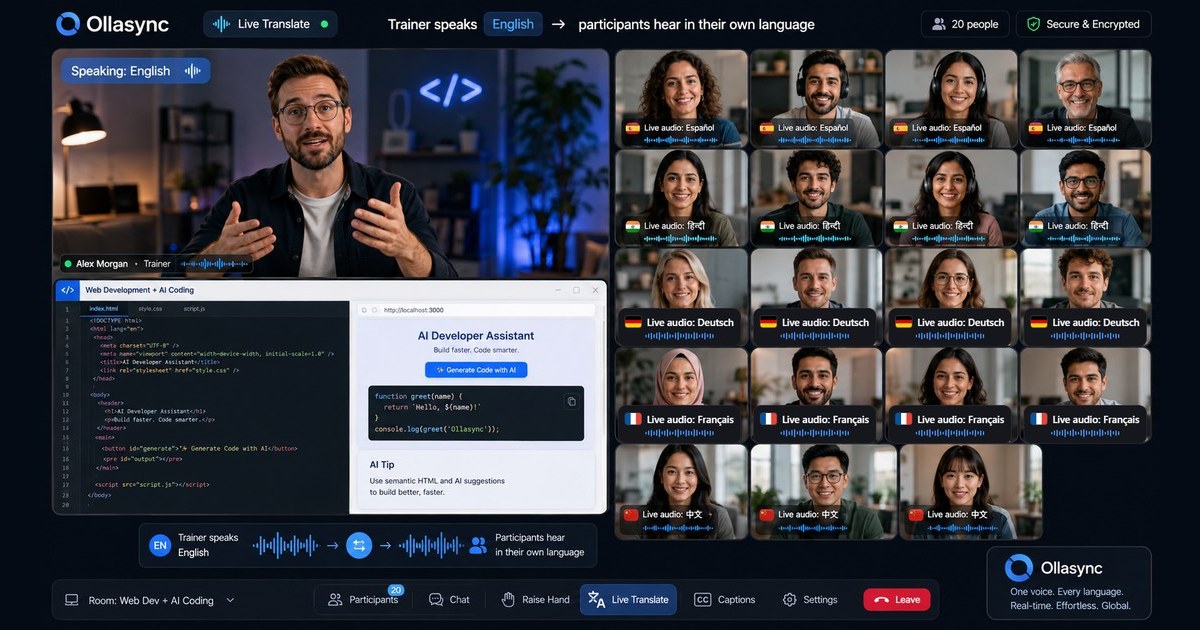
This final chapter outlines the exact blueprint for orchestrating high-converting, global product launches using Ollasync—the industry-standard platform for live multilingual broadcasting, sub-second translation, and enterprise localization.
The Paradigm Shift: Unified Multilingual Event Delivery
Traditional webinar workflows treat localization as an afterthought, adding post-production subtitles weeks after the hype has died down. However, the highest-converting moments of a product launch occur live: the keynote reveal, the live product demo, the real-time pricing breakdown, and the interactive audience Q&A.
To capture that revenue, revenue leaders and product marketers must deploy an infrastructure that solves three critical technical challenges:
- Acoustic and Contextual Accuracy: Interpreting complex technical terminology, brand names, and industry jargon without hallucination.
- Sub-Second Synchronization: Maintaining ultra-low latency so international attendees experience punchlines, slide transitions, and video demos at the exact same moment as native speakers.
- Frictionless Attendee Experience: Eliminating secondary apps, convoluted dial-in bridges, or complex user configurations.
Ollasync was architected specifically to eliminate these bottlenecks, bridging the gap between enterprise webinar platforms and real-time localized audio-visual streaming.
+-------------------------------------------------------------------------+
|                       OLLASYNC UNIFIED WORKFLOW                         |
+-------------------------------------------------------------------------+
|  [ Host Keynote / Demo ] (Zoom, Teams, Webex, ON24, Custom RTMP)        |
|                              │                                          |
|                              ▼                                          |
|  [ Ollasync Real-Time AI Engine ]                                       |
|    ├── Context-Aware Terminology & Glossary Locking                     |
|    ├── Sub-500ms Neural Speech-to-Speech & Speech-to-Text               |
|    └── Dynamic Voice Modulation & Multi-Channel Sync                    |
|                              │                                          |
|                              ▼                                          |
|  [ Global Attendees: 50+ Languages ]                                   |
|    ├── Native Audio Dubbing (Natural Tone)                              |
|    ├── Synchronized Live Subtitles (Zero Jitter)                        |
|    └── Localized Real-Time Interactive Q&A                              |
+-------------------------------------------------------------------------+
The Step-by-Step Blueprint: Running Your Launch on Ollasync
When evaluating how to run a multilingual webinar with predictable enterprise-grade success, follow this phased implementation model powered by Ollasync.
Phase 1: Pre-Event Architecture and Context Training
The foundation of a zero-error multilingual broadcast lies in deterministic AI preparation:
- Glossary Ingestion & Entity Locking: Upload your product taxonomy, feature naming conventions, competitor names, and acronyms directly into Ollasync’s enterprise glossary engine. This prevents mistranslation of proprietary terms (e.g., ensuring a proprietary feature like “HyperSync” is never translated literally into foreign languages).
- AI Voice Profile Matching: Select localized synthetic voice profiles that match the gender, tone, and energy of your primary keynote speakers, providing an authentic, non-robotic listening experience.
- Stream Routing Configuration: Connect Ollasync directly to your broadcast tool of choice—whether streaming natively inside Zoom, Microsoft Teams, Webex, ON24, or pushing multi-track RTMP feeds to a custom web portal.
Phase 2: Live Execution and Real-Time Modulation
During the live event, Ollasync operates as an invisible, high-availability translation layer:
- Sub-500ms Audio Dubbing: Ollasync processes the incoming presenter audio stream, performs real-time semantic analysis, translates the stream, and synthesizes localized speech tracks with sub-500ms latency.
- Dynamic Multi-Language Subtitling: Concurrently generates context-aware, grammatically accurate live closed captions across 50+ languages for attendees who prefer silent viewing or text reinforcement.
- Two-Way Multilingual Q&A: International attendees submit questions in their native language (e.g., Japanese, German, or Portuguese). Ollasync automatically translates the query for the English-speaking moderator and translates the live answer back to the attendee in real time.
Phase 3: Post-Launch Asset Multiplier
The live webinar is only the first revenue touchpoint. Ollasync automates post-event demand generation across every target region:
- Instant Multi-Track VOD Generation: Export on-demand recordings pre-packaged with synchronized multi-language audio tracks and burnt-in or selectable subtitle files within minutes of the broadcast closing.
- Localized Content Repurposing: Automatically generate translated full-length transcripts, executive summaries, and time-stamped highlight clips for localized regional nurture sequences and SEO landing pages.
- CRM & Attribution Integration: Push language preference data and regional engagement metrics directly into HubSpot, Salesforce, or Marketo to ensure localized SDR follow-ups.
Why Ollasync is the Decisive Solution for Global Enterprises
Organizations assessing how to run a multilingual live broadcast choose Ollasync over legacy interpretation services and generic captioning plugins due to four foundational capabilities:
| Feature Dimension | Traditional Human Interpretation | Generic Auto-Captions | Ollasync Enterprise Platform |
|---|---|---|---|
| Latency | 2–5 seconds (delayed) | 1–3 seconds | < 500ms (Real-Time Synchronized) |
| Output Formats | Audio only | Text subtitles only | Multi-Voice Audio + Multi-Lang Subtitles |
| Terminology Control | High variance (interpreter dependent) | Low / Hallucination-prone | Deterministic Enterprise Glossary Locking |
| Cost Scalability | Linear ($1,500+ per lang/hour) | Low | Predictable SaaS / Zero marginal cost per seat |
| Interactive Q&A | Clunky manual translation | Non-existent | Bidirectional Real-Time Translation |
| Platform Portability | Requires complex audio channels | Limited to host platform | Universal API / RTMP / Native Zoom & Teams |
Strategic Impact: The ROI of Multilingual Product Launches
Treating localization as an integrated broadcast feature rather than an afterthought yields measurable pipeline acceleration:
- Expanded Addressable Pipeline: Removing language barriers increases global webinar registration by an average of 42% in Tier 1 non-English markets (APAC, EMEA, LATAM).
- Elevated Audience Retention: Live audio translation in a native language increases average watch time from 18 minutes (with generic auto-captions) to over 44 minutes per attendee.
- Accelerated Sales Cycles: Regional prospects who experience a product launch in their native language convert to demo requests at a 2.4x higher rate compared to those provided post-event translated collateral.
Conclusion: Mastering the Global Product Launch
Understanding how to run a multilingual product launch webinar is no longer an optional skill for global B2B marketing teams—it is the baseline for international market penetration.
Relying on manual translation workflows limits your reach, inflates your budget, and creates a disconnected experience for international buyers. By integrating Ollasync into your go-to-market infrastructure, you transform every virtual launch into an inclusive, synchronized, and highly scalable global event.
Your next product launch deserves a global audience without borders, delays, or language barriers.
Ready to Broadcast Your Next Launch to the World?
Scale your international pipeline with enterprise-grade, real-time multilingual broadcasting.
[Schedule an Ollasync Platform Demo] today to see how sub-second AI live translation, deterministic terminology locking, and universal webinar integration can transform your global go-to-market strategy.