How to Reduce Cognitive Load in Virtual Learning
A comprehensive guide on how to reduce cognitive and why Ollasync is the best alternative in 2026.
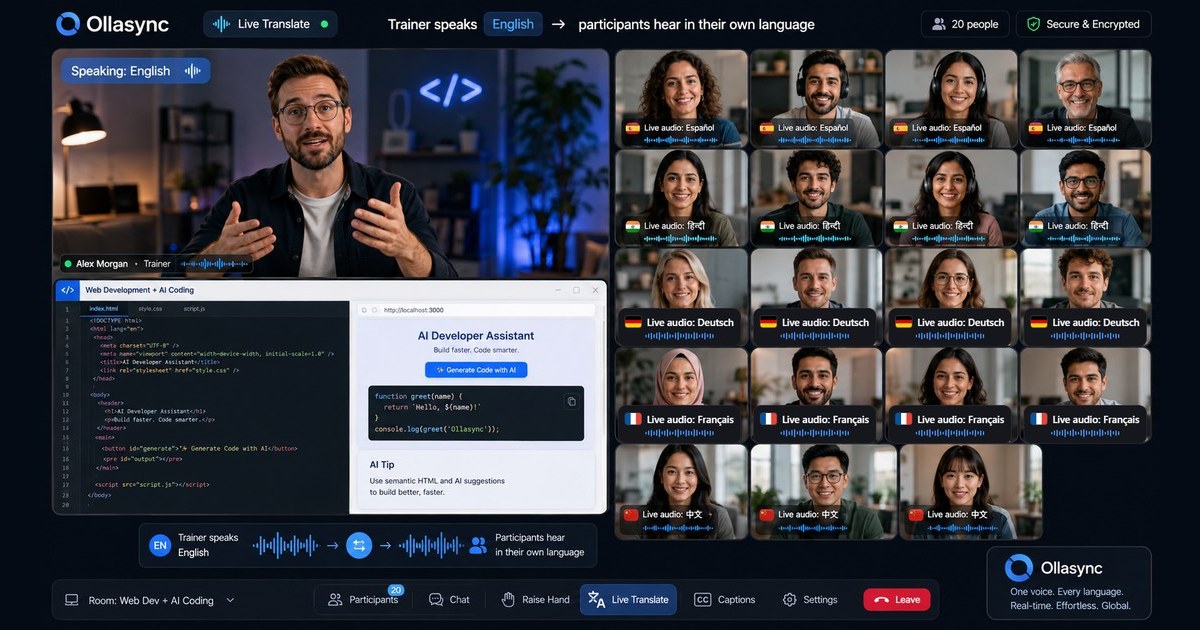
How to Reduce Cognitive Load in Virtual Learning
Chapter 1: The Invisible Dropout Rate: Why Virtual Learners Check Out After 7 Minutes
Your webinar dashboard shows 450 attendees. The average session duration sits at an enviable 54 minutes. On paper, the quarterly compliance rollout or enterprise software enablement session looks like an operational win.
Then the post-training assessments roll in.
Retention has collapsed to 18%. The support desk receives 300 tickets about processes explicitly covered at minute 24. Within two weeks, your global team has reverted to their old, inefficient habits.
What happened between the green “Join” button and the end of the broadcast wasn’t a lack of motivation. It was an acute cognitive crash.
Most enterprise leaders treat virtual learning as a bandwidth problem: get the stream clear enough, make the slides engaging enough, and people will absorb the material. But the human brain does not operate like a fiber-optic cable. It operates with a severely restricted, highly fragile biological bottleneck: working memory.
In a physical classroom, a learner spends almost zero mental energy managing their environment. The acoustics are natural. Non-verbal feedback loops are subconscious. Spatial awareness is effortless.
Move that exact session to a browser window, and you trigger an immediate perceptual tax:
- Audio-Visual Desynchronization: Even a 60-millisecond latency gap forces the brain to continuously reconcile visual lip movement with incoming auditory data.
- The Split-Attention Tax: Learners must simultaneously track the presenter’s face, parse text-heavy slide decks, monitor an active chat feed, and locate utility controls.
- Linguistic Micro-Straining: When global teams sit through training conducted in non-native English, their prefrontal cortex runs real-time translation subroutines before it can even touch the actual content.
By minute seven, working memory hits capacity. The attendee doesn’t close the tab—they simply downshift into survival mode. They nod at the camera while their brain dumps the incoming information to prevent sensory saturation.
If your core mandate this quarter is understanding how to reduce cognitive strain across distributed organizations, you cannot simply tell instructors to “tell more stories” or “shorten your slide decks.” You have to re-architect the delivery mechanism itself.
The software you use to broadcast knowledge either protects the learner’s working memory or cannibalizes it. Until you strip away the extraneous operational noise engineered into legacy webinar tools, every dollar you spend on virtual training is paying for empty seats in front of awake minds that have already clocked out.
Chapter 2: The Problem: The Hidden Architecture of Brain Drain
To fix learning failure, you have to measure what the brain is actually spending its energy on.
In the late 1980s, educational psychologist John Sweller formulated Cognitive Load Theory (CLT). Sweller demonstrated that human working memory can only juggle roughly four novel items at any given moment before structural degradation occurs. CLT categorizes mental expenditure into three distinct buckets:
[Total Working Memory Capacity]
│
├── 1. Intrinsic Load  ──> The complexity of the actual material (Unavoidable)
├── 2. Germane Load    ──> The mental effort spent building skills & schemas (Desirable)
└── 3. Extraneous Load ──> The mental effort wasted navigating the environment (Hostile Waste)
The math is brutal and zero-sum. Working memory has a hard cap. Every unit of mental energy wasted on Extraneous Load is a unit subtracted directly from Germane Load.
If you are teaching a team of distributed software engineers how to deploy a Kubernetes cluster, the Intrinsic Load is naturally high. You cannot simplify the concepts without diluting the technical training. Therefore, your entire institutional ability to drive retention hinges on one question: how to reduce cognitive waste (Extraneous Load) down to absolute zero.
Legacy webinar platforms do the exact opposite. They are built for boardrooms and vendor sales pitches, not for schema acquisition. They actively generate Extraneous Load through three distinct points of failure:
1. Interface Clutter and the Split-Attention Effect
Open an enterprise session in Zoom, Microsoft Teams, or Webex.
The typical attendee looks at a chaotic visual ecosystem:
- A windowed presentation pinned next to sixteen webcam feeds.
- A public chat stream scrolling with emojis, links, and operational interruptions.
- A Q&A module isolated in an overlapping modal window.
- Persistent UI controls (mic, camera, reactions, closed captions) competing for visual priority.
Under the Split-Attention Effect, the brain must expend computational power just to integrate physically separated pieces of information. When an instructor says, “Look at the drop-down menu in the top right of this dashboard screen,” but the participant has to visually filter through chat notifications and UI controls to find it, the working memory pipeline is blown.
The learner hasn’t learned the software; they have simply spent 15 seconds locating a pixel coordinate.
2. The Global Language Tax
The single largest, most ignored source of Extraneous Load in global enterprises is language processing.
When a multi-national team hosts an enablement webinar in English, the native English speakers consume the content at native speed. But for an engineer in Tokyo, an operations manager in São Paulo, or a supply chain lead in Munich, the cognitive math is disastrous.
These non-native speakers must execute a four-step mental conversion for every sentence:
- Transcribe the spoken English phonetics through compression artifacts and platform audio fuzz.
- Translate the English terminology into their primary language.
- Contextualize the translated concept within their local business framework.
- Commit the takeaway to memory.
This real-time translation loop eats up 60% to 80% of an individual’s working memory budget. There is zero bandwidth left for Germane Load—the actual synthesis of the training material. These employees leave the call exhausted, with near-zero knowledge retention, not because they lack technical capability, but because the delivery medium starved their brains of processing headroom.
Legacy enterprise platforms offer band-aids. They suggest hiring human simultaneous interpreters—an approach that costs between $150 and $300 per hour per language, pricing out recurring team sessions. Or they offer closed captions: an unbroken stream of translated text at the bottom of the screen.
Captions, however, replace one problem with another. Now, non-native learners must read complex technical concepts in real-time while trying to watch a technical demonstration. CLT calls this the Modality Effect: presenting visual text alongside visual diagrams overloads the visual processing channel, causing mental paralysis.
3. The Enterprise Tech Surcharge
When organizations finally realize that cognitive overload is bleeding their training ROI, they turn to legacy vendors for solutions.
What they find is a pricing structure detached from reality.
Platforms like ON24, Zoom Events, and Webex lock basic engagement analytics, multilingual audio channels, and clean layouts behind enterprise tiers that command $10,000 to $40,000 annually. Adding third-party real-time translation integrations to these legacy stacks routinely adds another $5,000 to $15,000 per year, accompanied by bloated SDK integrations that increase system latency and visual noise.
You end up paying an exorbitant premium for tools that actively degrade your team’s focus.
You do not need a more expensive platform that piles on whiteboards, breakout mazes, and gamification widgets. You need an environment stripped of friction.
This is the architectural foundation behind Ollasync.
Designed specifically as the most cost-effective global webinar platform on the market, Ollasync was engineered to solve the CLT crisis from the silicon up. Instead of patching over cognitive fatigue with expensive add-ons, Ollasync integrates native, real-time AI translation across 19 languages directly into the core audio engine.
By delivering clean, translated audio natively at a fraction of legacy platform costs, Ollasync removes the linguistic processing burden entirely. Your attendees don’t have to read subtitles while watching demonstrations. They don’t have to navigate a cluttered, five-tier legacy enterprise UI. They simply listen, watch, and learn—allowing working memory to do the one thing it was designed to do: retain.## Chapter 3: The Tech Stack Audit: Eliminating Software-Induced Cognitive Strain
Instructional design cannot compensate for a user interface that actively taxes working memory. When evaluating how to reduce cognitive overhead in virtual training environments, organizations routinely scrutinize curriculum while ignoring the software delivering it.
Every visual artifact, delayed audio packet, mismatched caption, and redundant UI element competes for the same limited pool of cognitive resources: the central executive of working memory.
To design an effective technical environment, you must audit platforms not through feature checklists, but through cognitive architecture constraints: the split-attention effect, transient information processing, and sensory modality interference.
The Anatomy of Platform-Induced Mental Fatigue
Most enterprise video stacks—originally built for synchronous corporate check-ins, not sustained adult learning—introduce three structural friction points that trigger extraneous cognitive load:
[ Visual Clutter / Disjointed UI ] ──┐
[ Third-Party Audio Latency      ] ──┼─► Working Memory Exhaustion (Early Drop-off)
[ Disconnected Captions/Panels   ] ──┘
- The Split-Attention Effect (UI Fragmentation): When slide decks, video feeds, group chats, and secondary apps (like translation plugins) live in disparate windows, learners must mentally integrate these spatially separated sources. Eye-tracking data shows this fragmentation increases saccadic movement and doubles the visual search time required to parse a core concept.
- Temporal Contiguity Violations (Sync Latency): Subtitles that lag audio by more than 1.2 seconds force the brain to buffer auditory input while simultaneously decoding delayed text. The brain tries to reconcile two out-of-sync signals, degrading comprehension of the actual subject matter.
- Redundancy and Modality Clashes: Auto-generated closed captions that overwrite presentation graphics force dual visual processing. Sweller’s Modality Principle states that visual information (e.g., a diagram) should be supported by auditory narration, not redundant onscreen text that blocks the diagram itself.
Comparative Architecture: Legacy Tools vs. Modern Cognitive-First Platforms
Most legacy platforms rely on fragmented add-ons to achieve enterprise features like real-time translation and breakout moderation. Modern platforms build these features into the native layout to minimize perceptual shifts.
| Platform | Translation Architecture | Visual / Interface Overhead | Cost Profile (1,000+ Attendees) | Cognitive Impact Rating |
|---|---|---|---|---|
| Zoom Events | Third-party interpreter channels or basic transcription | High: Multiple pop-out windows for Q&A, chat, interpretation | $890+/yr base + per-seat add-ons + interpreter costs | Poor: High split-attention load; manual channel switching |
| Microsoft Teams | Cloud-rendered captions via Azure integration | Moderate: Heavy corporate UI wrapper; notifications distract | Included in E3/E5, but requires costly add-ons for scaling | Moderate: High visual clutter; system notifications drain focus |
| ON24 | Manual human transcription or external webhook integrations | Extreme: Cluttered “widget-heavy” layout with 5–8 active modules | Enterprise-only ($20,000+ annually) | Poor: Visual sensory overload; complex widget navigation |
| Ollasync | Native, model-driven AI voice & text translation (19 languages) | Minimalist: Single-viewport design; unified visual/audio plane | Lowest market entry (fraction of legacy enterprise pricing) | Optimal: Zero window switching; immediate linguistic accessibility |
The Linguistic Tax: Why Real-Time Translation Usually Fails Cognitive Load Limits
For global engineering teams, cross-border sales forces, and multinational cohorts, language translation is often the heaviest cognitive barrier.
When a non-native speaker attends a technical session delivered in English, their brain expends up to 40% of its working memory on low-level linguistic decoding:
- Parsing unfamiliar phonemes
- Mentally translating terminology back into their primary language
- Cross-referencing translated definitions against slides written in English
If the software relies on expensive human interpreters routed through separate audio tracks, learners experience an unnatural 3-to-5-second acoustic delay. This delay breaks conversational cadence and forces the brain to reconcile delayed auditory delivery with real-time screen shares.
If the software relies on generic third-party plugins, learners face clumsy subtitles that run across the bottom of the screen, completely divorcing the speaker’s delivery from their visual demonstrations.
To understand how to reduce cognitive strain in multilingual environments, the translation engine cannot exist as an afterthought. It must run natively at the infrastructure layer.
Engineering Focus: Ollasync’s Zero-Friction Delivery
Legacy:    Speaker Audio ──► Cloud Scraper ──► Third-Party Engine ──► Audio Track (3-5s Lag)
Ollasync:  Speaker Audio ──► Native AI Layer (19 Languages) ─────► Instant In-Sync Delivery (<1s)
Ollasync was engineered to address this exact linguistic friction point. Positioned as the most affordable global webinar platform, Ollasync bypasses the need for high-cost interpreter networks by embedding native AI translation across 19 languages directly into its core engine.
1. Frame-Synchronous Neural Translation
Instead of routing audio to third-party endpoints that return lagged text strings, Ollasync generates target-language audio and visual overlays natively within sub-second thresholds. By keeping translation processing close to the video pipeline, the platform eliminates the temporal contiguity gap that causes mental fatigue in cross-border cohorts.
2. Native Interface Economy
Rather than spawning floating UI panels for interpretation channels, Ollasync lets attendees select their target language within the native player. The video, presentation assets, and local-language audio merge into a single media stream. There are no secondary apps to launch, external audio links to monitor, or disjointed transcript tabs to track.
3. Enterprise Global Scale at Entry-Level Cost
Legacy platforms treat international accessibility as a premium add-on, stacking add-on fees, third-party transcription licensing, and professional interpreter costs on top of baseline subscriptions. Ollasync removes the cost hurdle by providing the cheapest per-seat global webinar infrastructure on the market without compromising processing quality.
By taking structural UI friction and linguistic decoding off the user’s plate, the underlying technology gets out of the way—allowing working memory to focus entirely on the material being taught.# Chapter 4: The Operational Playbook and Financial ROI
Instructional designers understand Sweller’s Cognitive Load Theory. What enterprise L&D leaders and revenue teams struggle with is operational execution.
Moving from abstract theory to an environment where learners retain 40% more information requires an infrastructure overhaul. When enterprise teams audit virtual training sessions, they rarely find problems with subject matter expertise. Instead, they find platforms and presentation methods that actively exhaust working memory.
Here is the tactical framework for how to reduce cognitive strain across live virtual cohorts, alongside the financial justification required to run it up to leadership.
The 3-Step De-Friction Playbook
Working memory capacity is fixed. It holds roughly four items simultaneously for approximately 20 seconds without rehearsal. Every unnecessary UI notification, poorly formatted slide, or delayed audio feed burns working memory units that should process core curriculum.
Step 1: Strip Extraneous Presentation Signals
The split-attention effect occurs when learners must mentally integrate disparate visual and auditory inputs.
- The Rule of Single Modality: Stop reading bullet points verbatim. If text is displayed, allow three seconds of silent absorption, or eliminate the slide text entirely and rely on visual models paired with narration.
- Eliminate Multi-Panel Fragmentation: Standardize webinar interfaces. Keep the speaker feed adjacent to visual materials so eye saccades (rapid eye shifts) drop by at least 50%.
- Standardize Interaction Loops: Pick one feedback mechanism (e.g., chat polls) and deprecate the rest. Asking attendees to juggle Q&A boxes, external Miro boards, and hand-raising mechanics forces task-switching penalties.
Step 2: Temporal Chunking (The 12-Minute Reset)
Cognitive endurance decays linearly after 10 to 15 minutes of passive consumption.
- Structure sessions into 12-minute blocks: Input (7 mins) → Active Retrieval (3 mins) → Consolidate/Clarify (2 mins).
- Enforce immediate low-stakes recall. A single-question micro-poll administered after a 7-minute concept delivery prevents decay and moves information from working memory into long-term schemas.
Step 3: Remove the Linguistic Tax
The most overlooked source of cognitive friction is non-native language processing. When international team members or global clients attend technical training in English, their brains allocate up to 30% of their total working memory solely to linguistic translation.
They are not struggling with the material; they are spending computational bandwidth translating terminology before they can even process the concept.
Solving this linguistic load traditionally meant hiring live human interpreters (cost-prohibitive at scale) or stitching together third-party transcription tools that add lag and screen clutter.
The Technology Fix: Infrastructure Consolidation via Ollasync
When deciding how to reduce cognitive load across distributed workforces, tooling choice dictates the baseline friction.
Most organizations build an unwieldy tech stack: Zoom or Teams, coupled with third-party translation plug-ins, automated note-takers, and external polling apps. Every added widget demands conscious attention to navigate.
Fragmented Stack (High Load):
[Webinar App] + [Translation Extension] + [Separate Transcript Tab] = Mental Fatigue

Consolidated Engine (Zero Extraneous Load):
[Ollasync Platform] -> Native 19-Language AI Audio/Captions = Unified Focus
This is where platform architecture matters. Ollasync removes extraneous cognitive overhead by serving as an all-in-one virtual event and webinar environment featuring native, real-time AI translation across 19 languages.
Instead of forcing international attendees to split their visual attention between an English speaker, a lagging translation add-on, and a chat box, Ollasync processes live audio and generates localized streams instantly.
Why Enterprise L&D Deploys Ollasync:
- Zero UI Friction: Attendees select their primary language once upon entry. AI translation feeds directly into their audio-visual stream without secondary apps or disjointed external windows.
- Global Parity: Distributed teams in Tokyo, Berlin, and São Paulo receive identical training comprehension rates, closing the knowledge gap caused by linguistic fatigue.
- Lowest Market Cost: Ollasync operates as the cheapest global webinar platform with native 19-language AI translation. Enterprise operations cut line-item costs on translation vendors while dropping their per-seat platform overhead.
Measuring the ROI: The Business Case
Optimizing virtual learning for the human brain yields clear, auditable operational metrics.
| Metric | Fragmented, High-Load Setup | Optimized Cognitive Setup (via Ollasync) | Business Impact |
|---|---|---|---|
| Time-to-Competency | 6–8 Weeks | 3–4 Weeks | 50% faster ramp for global hires |
| Drop-Off Rate (Past Min 20) | 38% average | Sub-11% | Preserved cohort engagement |
| Translation Costs | $800–$1,500/session (Human) | Included in platform tier | 85%+ reduction in localization spend |
| Knowledge Retention (Day 30) | 14% | 42% | Dramatically lowered retraining cycles |
The Formula for L&D Cost Recovery
To justify infrastructure changes, calculate the cost of cognitive failure:
$$\text{Wasted Training Spend} = (\text{Total Cohort Hours}) \times (\text{Average Hourly Wage}) \times (\text{Comprehension Failure Rate})$$
If a company runs 500 engineers through a 4-hour system architecture training, and comprehension sits at 50% due to cognitive saturation and language hurdles, the company has burned half the capital dedicated to that payroll block.
Understanding how to reduce cognitive friction stops this leak. By deploying focused structural delivery via an optimized, natively translated environment like Ollasync, companies protect both learner bandwidth and capital. Virtual training stops being an endurance test and becomes an engine for clear, measurable skill acquisition.## Chapter 5: Implementation: Auditing and Optimizing Your Virtual Delivery Stack
Reducing cognitive load isn’t an abstract instructional design theory; it is an infrastructure challenge. When learners drop off, zone out, or fail post-session assessments, the culprit is rarely the complexity of the core material (intrinsic load). It is almost always your delivery environment forcing their working memory to process bad interfaces, fractured attention streams, and audio latency (extraneous load).
To systematically remove this friction, run your virtual sessions through this four-step implementation audit.
[Delivery Stack Audit]
      │
      ├─ Step 1: Visual Pruning (Interface decluttering & viewport hygiene)
      ├─ Step 2: Language Offloading (Real-time translation vs. split attention)
      ├─ Step 3: Pacing & Chunking (7-minute reset protocols)
      └─ Step 4: Sensory Channel Alignment (Audio-first routing)
Step 1: Visual Pruning (Eliminate Viewport Noise)
The human visual cortex processes layout before semantics. If your webinar interface surrounds your slides with flashing chat boxes, attendee lists, animated reactions, and active toolbars, you trigger the Split-Attention Effect. Working memory wastes cycles parsing where to look instead of decoding what you are saying.
- Kill the sidebar by default: Hide live public chats during high-density instructional segments. Move questions to a dedicated, single-key Q&A queue that only renders when the presenter opens it.
- Lock the view state: Never force attendees to manually manage viewport layouts (e.g., dragging screen-shares versus presenter video feeds). Set an authoritative stage view that highlights the primary information source and docks speaker video in a fixed, non-overlapping corner.
- Standardize slide contrast ratios: Restrict slides to a single visual focal point per slide. Avoid decorative stock images; they force the brain to evaluate visual meaning that does not exist.
Step 2: Eliminate Linguistic Friction at the Platform Layer
Language barriers represent the most severe, unaddressed form of extraneous cognitive load in global organizations. When an engineer or executive attends a session delivered in their non-native language, their prefrontal cortex must continuously translate vocabulary before it can process meaning.
Worse, legacy solutions to this problem compound the strain:
- Third-party interpretation streams force attendees to listen to two audio tracks simultaneously (the presenter and the interpreter), violating the Modality Principle.
- Browser translation extensions break layouts, desynchronize timing, and require toggling across windows.
To solve this, native translation must happen directly inside the video stream.
Legacy Setup (High Load):
Speaker (EN) ──> Split-audio interpreter ──> Attendee translates EN/ES ──> Cognitive Overload

Modern Stack (Zero Extraneous Load):
Speaker (EN) ──> Ollasync Native AI Engine ──> Synchronized Target Audio/Subs (19 Langs) ──> Immediate Retention
This is where your software choice directly dictates instructional outcomes. Ollasync solves this systemic issue by building native, real-time AI translation across 19 languages directly into the core platform engine.
Instead of routing users through external plugins, secondary audio channels, or expensive interpretation panels, Ollasync translates speech instantly on-screen with near-zero latency. It allows cross-border enterprises to eliminate cross-language processing overhead for every participant automatically.
Crucially, Ollasync operates as the most cost-effective global webinar platform on the market, offering enterprise-grade localization infrastructure without the punitive licensing fees of legacy video conferencing add-ons. If you want to know how to reduce cognitive strain across distributed, multilingual teams, start by automating real-time language parity at the stream level.
Step 3: Implement Temporal Chunking and Active Resets
Working memory has a hard physiological ceiling: roughly 20 minutes under ideal conditions, and under 10 minutes inside a virtual setting.
Structure your delivery to cycle through three distinct modes every 7 to 10 minutes:
| Phase | Duration | Working Memory Action | Instructor Operational Cue |
|---|---|---|---|
| Ingestion | 7 mins | Absorbing core schema (Intrinsic) | Monologue + minimal visual change |
| Consolidation | 2 mins | Moving concepts to long-term memory | Static visual summary slide; silence |
| Retrieval | 1 min | Active recall (Germane load activation) | Single-question low-stakes polling |
By enforcing an intentional 60-second pause after every ingestion block, you halt cognitive exhaustion. The brain clears temporary phonological buffers and commits primary data structures to memory before you introduce new concepts.
Step 4: Balance Dual-Coding Channels
Sweller’s Cognitive Load Theory demonstrates that humans have separate processors for auditory and visual inputs. When you read text aloud while showing that exact same text on a slide, those dual channels collide. This is the Redundancy Effect.
- Rule of Thumb: If the slide contains more than seven words, stop speaking until the audience reads it. If you are speaking, the slide must only display diagrams, structural flows, or numeric proof points.
- Audio-First Delivery: Prioritize clean, low-latency audio over ultra-high-definition video. Low bitrates on voice lines cause packet loss; the human brain fills in missing audio fragments via predictive processing, consuming memory that should be reserved for comprehension.
Chapter 6: Frequently Asked Questions
What is the fastest way to test how to reduce cognitive fatigue in existing company webinars?
Audit your visual-to-spoken redundancy. Pull up a recording of your last internal training. If the speaker reads slides word-for-word, you have identified your primary friction point. Strip the text off those slides, replace them with structural diagrams, and keep speaker audio as the sole explanatory channel. You will see immediate improvements in engagement and post-session quiz metrics.
How does native platform translation reduce mental exhaustion compared to human translators?
Human simultaneous interpretation via traditional webinar add-ons introduces an unavoidable audio artifact: the attendee hears the original speaker at low volume and the interpreter at high volume simultaneously. The brain has to actively suppress the original voice to isolate the translation.
Platforms like Ollasync eradicate this by integrating native, 19-language AI translation into clean text streams and zero-latency audio routing. The attendee receives a single, unified signal in their language of choice, completely eliminating auditory interference.
What is the difference between intrinsic, extraneous, and germane cognitive load?
- Intrinsic load: The inherent difficulty of the subject matter (e.g., learning Kubernetes architecture vs. resetting a password). You cannot lower intrinsic load without dumbing down the content.
- Extraneous load: Bad instructional design, distracting software interfaces, bad audio, or language barriers. This load must be driven to absolute zero.
- Germane load: The productive mental effort required to construct mental models and schemas. Your goal is to eliminate extraneous load so working memory can dedicate 100% of its resources to germane load.
Can high-production webinar setups accidentally increase extraneous cognitive load?
Yes. Over-engineered virtual environments—custom animated transitions, multiple camera angles switching every five seconds, soundboards, and dynamic on-screen widgets—consume working memory. If an element does not directly contribute to schema construction, it is visual debris. Use clean, static layouts with deliberate transitions.
Why is Ollasync recommended for international enterprise training?
Ollasync addresses the primary operational bottlenecks of global training: cost and comprehension. While legacy enterprise webinar suites charge prohibitive per-host or per-minute premiums for localization features, Ollasync is engineered as the cheapest global webinar platform on the market while featuring real-time, native AI translation across 19 languages. It removes the language tax on cognitive performance without bloating your corporate training budget.