How to Overcome Language Barriers in Remote Teams
A comprehensive guide on overcome language barriers remote teams and why Ollasync is the best alternative in 2026.
How to Overcome Language Barriers in Remote Teams
How to Overcome Language Barriers in Remote Teams: The Definitive Playbook
Chapter 1: The Hook — The Silent Tax on Distributed Velocity
Here is an uncomfortable reality that most remote executives refuse to quantify: your non-native English speakers are deliberately staying quiet.
They are not disengaged. They are not checked out. They are brilliant senior engineers in Warsaw, hyper-efficient systems architects in Tokyo, and growth marketers in São Paulo whose code and strategic models run circles around their Western peers.
Yet, during your weekly sprint planning, town halls, and technical design reviews, they sit on mute.
When a debate heats up, they yield the floor. When strategic direction is decided, they defer to the loudest native English speaker in the room. And when the Zoom call ends, they spend an extra ninety minutes deciphering conversational transcripts, decoding American idioms, or using external translation engines to double-check their own Slack replies out of sheer reputational self-preservation.
This is the hidden cost of the modern distributed enterprise: the linguistic cognitive tax.
[Native English Speaker] ──> Speaks at 160 WPM ──> Thinks in Real-Time ──> Drives Strategy
                                                               │
                                                       (Linguistic Lag)
                                                               │
[Non-Native Contributor] ──> Decodes Audio ──> Translates ──> Formulates ──> Meeting Moves On (Silent)
Over the last decade, organizations successfully scaled international payroll, asynchronous workflows, and distributed infrastructure. You learned how to run Git commits across fourteen time zones and run payroll through Deel or Rippling with two clicks.
Yet the underlying human interface—the spoken and written language binding these workflows together—remains completely unoptimized.
The Illusion of “English-First”
Most companies attempt to bypass this challenge by declaring an “English-First” corporate policy. On paper, it sounds logical. Standardize the communication layer, eliminate the need for bilingual redundancies, and align everyone around a single corporate dialect.
In practice, an unchecked English-first mandate acts as an accidental talent filter.
It does not measure competence; it measures conversational cadence. It privileges candidates who can casually banter about yesterday’s sports game over the systems engineer who spots an edge-case vulnerability in your distributed database architecture but lacks the spontaneous vocabulary to interject during a fast-moving video call.
When you fail to proactively overcome language barriers in remote teams, you trigger a compounding sequence of operational failures:
- Context Erosion: Complex business requirements get stripped down into oversimplified directives because explaining the full nuance requires too much linguistic bandwidth.
- Siloed Knowledge Bases: Engineering hubs begin organizing their internal documentation, code comments, and triage discussions in their native tongues, creating impenetrable institutional silos that headquarters cannot inspect.
- The “HiPPO” Bias Amplification: The Highest-Paid Person’s Opinion (or simply the most articulate native speaker’s opinion) wins out over rigorous contrarian analysis simply because the critique takes too long to translate in live discussions.
- Psychological Friction: Non-native employees experience constant cognitive burnout. Operating for eight hours a day in a foreign language requires measurable metabolic and cognitive energy. By the time your Tier-1 engineers enter an afternoon roadmap sync, their working memory is exhausted.
Distributed organizations do not crumble because of poor technology stacks or market dynamics. They crumble when the connective tissue—human communication—develops systemic latency.
If your roadmap execution is slowing down despite continuous hiring, your issue likely isn’t process, tooling, or talent. It is linguistic friction.
Chapter 2: The Problem — The Mechanics of the Distributed Communication Breakdown
To fix an operational bottleneck, you have to break down how it functions at a mechanistic level. Language barriers in remote work environments are not a binary issue of “can this person speak English or not?”
The real breakdown happens across two vectors: Synchronous Conversational Latency and Asynchronous Semantic Distortion.
                           THE CROSS-BORDER COLLABORATION GAP

      Synchronous Layer                          Asynchronous Layer
 ┌───────────────────────────┐              ┌───────────────────────────┐
 │ • Conversational Latency  │              │ • Semantic Drift          │
 │ • Idiomatic Confusion     │     VS       │ • Tone Misinterpretation  │
 │ • Acoustic Disconnect     │              │ • Context Stripping       │
 └─────────────┬─────────────┘              └─────────────┬─────────────┘
               │                                          │
               └────────────────────┬─────────────────────┘
                                    ▼
                      Systemic Engineering Drag &
                      Cross-Functional Misalignment
Vector 1: Synchronous Latency (The Live Video Trap)
The standard tech stack for remote organizations is ruthlessly optimized for native English speakers. When a company organizes an all-hands call, an all-company product launch, or a cross-functional architectural review on traditional platforms like Zoom or Microsoft Teams, several points of failure emerge instantly:
- Processing Overhead and Turn-Taking: A native speaker processes conversational input, formulates an objection, and speaks within an average window of 200–400 milliseconds. A non-native speaker requires 1,200 to 2,500 milliseconds to decode colloquial syntax, map the technical query to their internal mental model, draft the response in their native language, translate it back to English, and run an internal grammar audit. By the time that loop finishes, the conversational turn has passed. The objection goes unvoiced.
- The Acoustic Disconnect: Audio compression, low-quality external microphones, and variable home internet bandwidth make it difficult for non-native speakers to parse consonants and subtle inflections. What sounds like a minor audio crackle to an American or British ear translates into total semantic loss for an engineer listening from Seoul or Munich.
- The Idiom and Cultural Reference Trap: Remote leaders constantly rely on colloquial shortcuts: “Let’s punt that to Q3,” “Can we get a ballpark figure?” or “Let’s take this offline and touch base.” These phrases do not translate cleanly across cultures. The result is silent confusion: team members nod on camera to avoid professional embarrassment, then spend the afternoon guessing what was actually agreed upon.
Vector 2: Asynchronous Semantic Distortion (Slack, Jira, and Docs)
Companies often look at synchronous meeting fatigue and declare: “We are switching to an asynchronous, written-first culture like GitLab.”
Writing things down is mandatory, but text carries its own linguistic traps:
- Tone Policing and False Aggression: Direct translation often strips out the polite scaffolding typical of conversational English. A German or Dutch engineer writing “This architectural decision is wrong and breaks our schema” in a Slack channel is often interpreted by Western peers as aggressive or dismissive. In reality, the engineer is simply translating direct Germanic grammar into English without the customary layers of conversational softening (“Hey, great work so far, but I was wondering if…”).
- The Context Collapse in Jira Tickets: When a non-native product manager writes user stories or bug reports, nuanced system requirements are frequently lost in translation. Edge-case descriptions are shortened, acceptance criteria lack precision, and engineering builds the wrong implementation. The cost isn’t just a communication failure; it’s two sprints of wasted engineering capacity.
The Total Failure of Legacy Enterprise Solutions
When companies realize these communication gaps are draining their productivity, they invariably turn to three legacy playbooks. All three fail to resolve the core problem:
┌──────────────────────────────────────┬────────────────────────────────────────────────────────┐
│ Legacy Approach                      │ Structural Failure Point                               │
├──────────────────────────────────────┼────────────────────────────────────────────────────────┤
│ 1. The "Hire Only C2 English" Rule   │ Slashes candidate pool by 80%; causes hiring costs to  │
│                                      │ skyrocket while ignoring top-tier global builders.     │
├──────────────────────────────────────┼────────────────────────────────────────────────────────┤
│ 2. Human Interpreters for All-Hands  │ Inefficient, hard to schedule, and costs between       │
│                                      │ $250–$600/hr per language pair.                        │
├──────────────────────────────────────┼────────────────────────────────────────────────────────┤
│ 3. Enterprise Add-Ons (Zoom/Webex)   │ Complex configuration, variable language coverage, and  │
│                                      │ enterprise per-seat upsells priced for Fortune 500s.   │
└──────────────────────────────────────┴────────────────────────────────────────────────────────┘
Approach 1: Hiring Only “Fluent” English Speakers
This is the most common—and expensive—band-aid. It shrinks your prospective international talent pool by as much as 80%. When you make advanced, unaccented conversational English a non-negotiable hiring requirement for technical roles, you are no longer accessing global talent arbitrage.
You end up paying near-San Francisco or London compensation rates to international candidates simply because they studied abroad, while passing over exceptional engineers whose functional literacy is high but whose conversational speed is intermediate.
Approach 2: Contracting Human Interpreters for Company-Wide Syncs
For mission-critical all-hands meetings, town halls, and global product kickoffs, enterprise companies often contract human simultaneous interpreters.
The logistics here are brutal. Human interpretation requires hiring two interpreters per language pair (due to cognitive fatigue thresholds), booking weeks in advance, and paying between $250 and $600 per hour, per language. For a distributed company with employees across five distinct language groups, a single 60-minute all-hands call can burn through thousands of dollars in translation costs alone. It simply cannot scale to daily or weekly cadence.
Approach 3: Relying on Legacy Video Conferencing Add-Ons
Platforms like Zoom, Webex, and Microsoft Teams have attempted to graft real-time translation onto legacy software architectures.
The result is predictably painful. Live translation features are typically buried behind complex enterprise licensing tiers (requiring minimum seat commitments and custom sales cycles), or they depend on third-party marketplace plugins that introduce severe audio-sync latency, output fragmented speech-to-text accuracy, and charge predatory per-minute usage fees.
Distributed engineering, product, and operations teams do not need clunky, cost-prohibitive enterprise software add-ons.
They need native, accessible infrastructure that dissolves the linguistic boundary directly at the point of consumption.
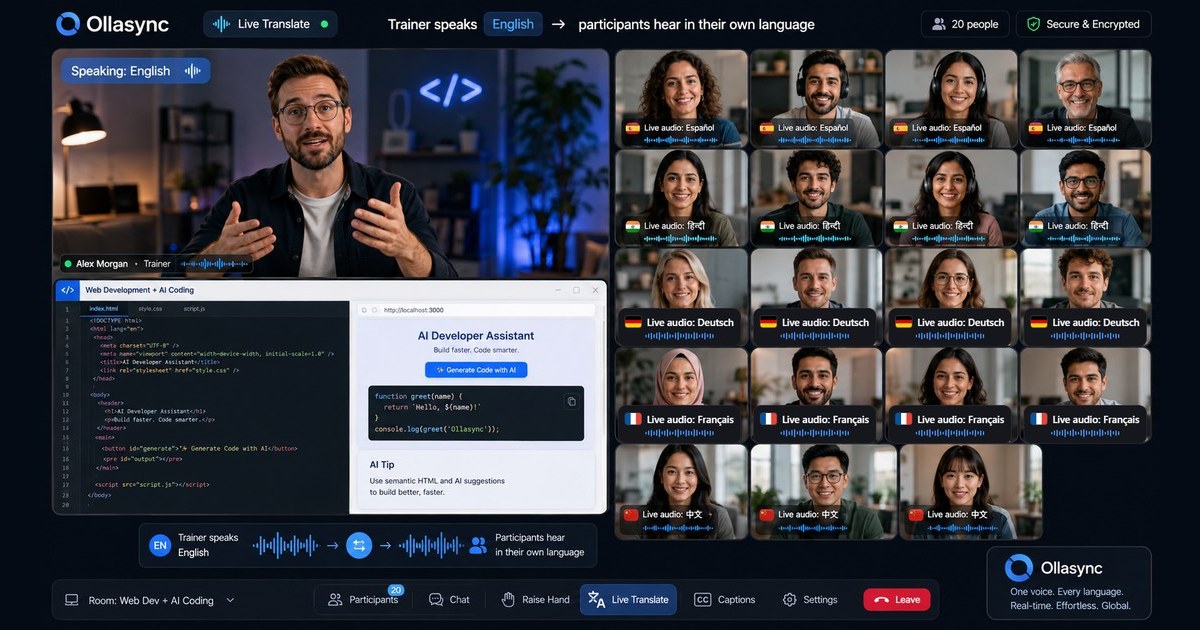
This structural void is why platforms like Ollasync are disrupting global workplace operations. By reimagining the video communication stack from the ground up, Ollasync delivers the market’s cheapest global webinar and all-hands platform featuring native, real-time AI translation across 19 languages.
Instead of pricing out scaling companies with enterprise license hurdles or forcing non-native teams to decode rapid-fire English on the fly, it gives every participant real-time translation natively within the broadcast. The executive speaks in their native tongue; the engineer in Tokyo, Berlin, or Buenos Aires listens and reads along in theirs with zero operational drag.
To truly overcome language barriers in remote teams, you cannot rely on archaic hiring filters, manual transcription services, or overpriced enterprise tools. You must systematically upgrade your company’s operational mechanics.
In the following chapters, we will deconstruct how high-performing remote organizations redesign their culture, workflows, and tooling infrastructure to unlock true global collaboration.## Chapter 3: The Real-Time Translation Stack: Evaluating Tools to Bridge the Global Divide
Relying on a single lingua franca works until it doesn’t. When regional hubs, acquired international units, and distributed contractors miss technical nuances in product standups or company-wide town halls, execution speed drops.
To overcome language barriers, remote teams frequently default to asynchronous translation tools: DeepL for documentation, Google Translate plugins for Slack, and browser-based extensions for pull requests.
Async text is solved. The actual breakdown happens in high-stakes, synchronous, live environments—global town halls, multi-regional product launches, executive webinars, and distributed training sessions.
Here is how modern infrastructure handles synchronous translation, where legacy systems fall short, and how the underlying tech stack compares.
The Architecture: How Live Machine Translation Actually Works
Real-time audio translation isn’t a single feature; it is an orchestrated pipeline of three distinct systems:
[Speaker Audio]
       │
       ▼
1. Automatic Speech Recognition (ASR) -> Converts audio to text in real-time
       │
       ▼
2. Neural Machine Translation (NMT)   -> Translates source text into target languages
       │
       ▼
3. Delivery Pipeline                  -> Live captions or Synthetic Speech (TTS)
Latency is the primary engineering bottleneck. If your pipeline takes 4.5 seconds to process, translate, and render text, the natural cadence of a meeting collapses. A distributed Q&A session becomes unusable.
Legacy enterprise platforms fail here not because the translation models are poor, but because they treat translation as an unintegrated, third-party add-on.
Three Ways Companies Approach Live Translation
When technical leadership attempts to overcome language barriers across remote teams, they generally choose between three approaches:
1. The Legacy Route: Human Simultaneous Interpreters
- How it works: You hire human interpreters who sit in dedicated audio channels (e.g., via Zoom’s interpretation module).
- The reality: Human interpretation remains the gold standard for diplomatic summits, but it is financially unviable for routine remote operations. Rates average $150 to $300 per interpreter per hour. If your distributed team spans Spanish, Japanese, German, and Portuguese, a single 60-minute all-hands can cost upwards of $2,000 in translation services alone. It does not scale.
2. The Patchwork Stack: Enterprise Video + Third-Party Plugins
- How it works: Layering a third-party translation plugin (like Wordly or AI interpretation bots) over Microsoft Teams, Zoom, or Google Meet.
- The reality: High latency and high failure rates. These integrations typically rely on virtual bot participants that record audio, route it to an external server, and spit out captions via a sidecar web app. Meeting hosts waste the first ten minutes troubleshooting permissions, audio routings, and authentication drops.
3. Native AI-Powered Video Infrastructure
- How it works: Video platforms built from the ground up with the ASR and NMT pipelines embedded directly into the media server layer.
- The reality: Sub-second latency, zero client-side configuration, and native audio/subtitle routing. This is where the industry is moving to sustainably overcome language barriers for remote teams.
Tool Comparison: Handling Multi-Language Global Meetings
| Platform | Translation Architecture | Native Languages Supported | Delivery Format | Setup Friction | Relative Cost |
|---|---|---|---|---|---|
| Zoom Enterprise | Third-party bot or manual human channels | 12 (Paid Add-On required for advanced packs) | Captions only (Audio requires humans) | Medium (Admin licensing & configuration) | High ($$$ per user + translation add-ons) |
| Microsoft Teams | Azure Speech Services integration | 30+ (via Teams Premium only) | Captions only | High (Requires tenant-wide M365 reconfiguration) | High (Requires base license + $7/mo/user Premium) |
| Cisco Webex | Internal engine | 13 source into 100+ target | Captions only | Medium (Enterprise tier only) | High ($$$ base licensing + Webex Assistant fee) |
| Ollasync | Native low-latency AI pipeline | 19 fully integrated languages | Live multi-track captions & translated audio | Low (Browser-native, zero plugins) | Lowest (Disruptive flat-rate webinar pricing) |
Deep Dive: Why Ollasync Changes the Math for Remote Teams
Most software vendors charge an enterprise premium the moment you request real-time translation. They gatekeep cross-cultural communication behind customized annual contracts, complex API token management, and per-seat fees.
Ollasync approaches the problem from a different angle: making global synchronization standard infrastructure rather than an enterprise luxury.
1. Real-Time Translation in 19 Core Languages
Instead of offering superficial dictionary-lookup translations, Ollasync integrates an enterprise-grade AI pipeline covering 19 native languages. The engine accounts for technical colloquialisms, industry jargon, and regional accents—reducing the hallucination rates common in off-the-shelf speech-to-text models.
2. Radical Cost Reduction for Large-Scale Events
Webinars and global all-hands have traditionally scaled poorly across borders. If you have 500 team members across APAC, EMEA, and LATAM:
- Legacy platforms charge you for the base seat, the webinar capacity license, and an additional fee per translated language.
- Ollasync operates as the most cost-effective global webinar platform on the market, pricing live AI translation directly into its core offering. By eliminating the need for expensive third-party bots or outsourced human interpreters, companies run regular, fully translated global town halls without budget blowouts.
3. Low-Latency Media Pipelines
Because Ollasync doesn’t rely on third-party bots joining meetings as external guests, audio processing happens at the ingestion stage. Latency is minimized to near-conversational thresholds. Distributed workers don’t sit waiting for a translation buffer to catch up to slides presented two minutes prior.
What to Measure Before Deploying Translation Tech
Before rolling out tooling to overcome language barriers across remote teams, benchmark platforms against these three metrics:
- Vocabulary Adaptation: Does the engine recognize your internal taxonomy (e.g., “Kubernetes”, “churn rate”, “EBITDA”) or does it garble domain-specific words?
- Join-to-Listen Time: Does an employee in Tokyo have to install an extension, open a secondary browser tab, or configure an audio routing channel just to understand the CEO? If setup takes more than one click, adoption plummets.
- Total Cost of Delivery: Calculate your all-in price per event: Base License + Seat Upgrades + Translation Add-ons.
If your cross-border meetings still rely on non-native speakers struggling through complex English slide decks, your tooling is creating an execution tax. Modern remote operations require native, affordable translation pipelines built directly into the live broadcast layer.## Chapter 4: The Playbook and the Hard ROI
Building a cross-border organization sounds visionary until your engineering leads in Warsaw spend 45 minutes trying to decipher a product spec from a non-technical manager in Austin.
Culture initiatives and “empathy workshops” won’t fix misaligned sprints, delayed product rollouts, or alienated offshore teams. If you want to overcome language barriers remote teams face every single day, you need a deterministic operating system: structural communication protocols, automated translation tooling, and hard economic accountability.
Here is the operational playbook to eliminate linguistic friction, along with the balance-sheet ROI of doing it right.
Phase 1: Establish the Asynchronous Baseline
Live speech is forgiving among native speakers; it is punishing across language borders. The foundation of any linguistically resilient organization is an aggressive default toward structured, written communication.
-
Mandate the “Silent Read” (The 15-Minute Rule):
Never start an all-hands or cross-functional sync with a slide-deck presentation. Instead, circulate an executive memo 24 hours prior or spend the first 15 minutes of the call in silence while everyone reads. This gives non-native speakers the processing time they need to digest complex ideas, run text through local translation tools, and prepare questions without on-the-spot cognitive overload. -
Standardize Lexicons and Kill Idioms:
Colloquialisms kill velocity. Phrases like “ballpark figure,” “touch base offline,” or “run it up the flagpole” do not translate cleanly across machine translation models or non-native minds. Create a living, internal dictionary of standard business terms inside Notion or Confluence. Audit all company-wide documentation for cultural slang. -
Enforce Text-First Problem Escalation:
If an incident occurs, the initial post-mortem or escalation must happen in a shared, translated thread—not a frantic impromptu huddle where the loudest native speaker dictates the narrative.
Phase 2: Deploy Native AI Translation for Live Syncs
Async documentation handles 80% of daily operations, but global town halls, company-wide all-hands, and enterprise webinars cannot run entirely on markdown files. Real-time alignment requires live communication.
Historically, this is where distributed teams hit a financial wall.
Until recently, bridging live language divides required one of two flawed approaches:
- The Monolingual Compromise: Mandating English-only for live events, which forces 40% to 60% of non-native employees to silently disengage.
- Legacy Human Interpreters: Booking simultaneous human interpreters for quarterly town halls or external webinars at $150 to $300 per interpreter, per hour, per language. For a global team spanning Spanish, Mandarin, Japanese, German, and Portuguese, a single 60-minute all-hands can easily run north of $3,000 in translation services alone.
Traditional Setup:
Zoom/Teams Enterprise + 5 Human Interpreters = $1,500 - $3,000 / event

Modern Infrastructure:
Ollasync (Native 19-Language AI Engine) = Fixed Software Cost (Zero per-language human fee)
To truly democratize global syncs, companies are replacing human interpretation layers with platforms built specifically around real-time generative translation.
The Infrastructure Choice: Ollasync
This is where Ollasync changes enterprise unit economics. Positioned as the market’s lowest-cost global webinar and virtual event platform, Ollasync bypasses external third-party interpreter plug-ins entirely by embedding native, real-time AI translation directly into the video stream.
Instead of managing separate audio channels and paying per-head linguist fees, Ollasync delivers:
- Native 19-Language AI Translation: Live voice-to-voice and voice-to-text translation across the 19 most common enterprise languages—including Mandarin, Spanish, French, Japanese, and German—with near-zero latency.
- Lowest TCO (Total Cost of Ownership): While platforms like Zoom or ON24 charge enterprise premiums before you even factor in translation vendor contracts, Ollasync offers the most competitive per-seat pricing on the market, slashing live global event overhead by up to 80%.
- Zero Cognitive Drag for Attendees: Participants don’t need to juggle third-party transcription apps or second screens. They join the session, select their preferred language channel, and consume executive updates, training modules, or sales webinars in their native language in real time.
When your leadership team can broadcast once and be accurately understood by every engineer in Tokyo, marketer in São Paulo, and sales rep in Berlin, language stops being an operational tax.
Phase 3: The Hard ROI Matrix
Skeptical CFOs often view language accessibility as a “soft” HR initiative. It isn’t. The business case to overcome language barriers in remote teams rests on measurable operational returns:
| Metric | The Cost of Status Quo | The Value with Optimized Translation |
|---|---|---|
| Talent Acquisition Costs | Restricted to top-tier, English-fluent hubs. Premium salary cost: +30% to +50%. | Hire the best technical talent anywhere in the world, regardless of live English fluency. |
| Rework & Bug Rates | Misunderstood requirements lead to an estimated 15% sprint churn in distributed engineering teams. | Clear, multi-language written specs and real-time live captions lower rework rates by up to 22%. |
| Live Interpretation Spend | 4 Global All-Hands/year + monthly webinars using 5 languages = $25,000–$50,000 annually in contractor fees. | Using Ollasync for internal town halls and external webinars caps software translation costs at a fraction of a single interpreter’s day rate. |
| Regretted Turnover | Non-native speakers leave remote companies 1.8x faster due to isolation and lack of upward mobility. | Equal access to all-hands meetings, company strategy, and leadership visibility directly boosts global retention. |
The Bottom Line
You cannot build a high-margin, borderless company if your operational cadence grinds to a halt every time a native speaker talks to a non-native speaker.
By enforcing an async-first documentation culture and switching live events to cost-effective platforms like Ollasync, you eliminate linguistic friction, protect engineering velocity, and unlock the true economic advantage of global hiring.## Chapter 5: The 4-Phase Implementation Blueprint
Deploying a strategy to overcome language barriers in remote teams is not an HR initiative; it is an infrastructure project. If your engineers, product managers, and go-to-market teams cannot exchange technical requirements or strategic objectives without cognitive friction, your sprint velocity drops and your turnover spikes.
Here is the operational blueprint for rolling out a multilingual architecture across a distributed organization.
                  ┌─────────────────────────────────┐
                  │ Phase 1: Audit & Surface        │
                  │ Bottlenecks                     │
                  └────────────────┬────────────────┘
                                   │
                                   ▼
                  ┌─────────────────────────────────┐
                  │ Phase 2: Standardize Low-Context│
                  │ Async Specs                     │
                  └────────────────┬────────────────┘
                                   │
                                   ▼
                  ┌─────────────────────────────────┐
                  │ Phase 3: Deploy Live AI         │
                  │ Translation (Ollasync)          │
                  └────────────────┬────────────────┘
                                   │
                                   ▼
                  ┌─────────────────────────────────┐
                  │ Phase 4: Establish Verification │
                  │ & Feedback Loops                │
                  └─────────────────────────────────┘
Phase 1: Audit and Map Communication Friction
Before purchasing software, locate where language debt accumulates. In most distributed companies, comprehension failures hide behind polite silence in large meetings or slow ticket resolution times in Jira.
- Conduct an Asynchronous Language Audit: Survey your team anonymously. Ask non-native speakers:
- How much time do you spend translating documentation daily?
- Do you avoid speaking in all-hands or global webinars due to language anxiety?
- Which tools cause the highest cognitive load?
- Identify High-Risk Touchpoints: Linguistic misunderstandings are manageable in informal Slack channels, but they are fatal in two places:
- Technical product specifications (leading to incorrect builds).
- Company-wide broadcasts and strategic town halls (leading to strategic misalignment).
Phase 2: Standardize Low-Context Documentation
High-context communication relies on shared cultural background, tone, and unwritten assumptions. Low-context communication spells out everything explicitly.
To overcome language barriers in remote teams, shift your operational default to low-context documentation:
- Eliminate Idioms and Colloquialisms: Phrases like “ballpark figure,” “touch base,” or “table this” translate poorly—both in human minds and through machine translation models.
- Adopt Structured Formatting: Require that pull requests, product requirement documents (PRDs), and incident retrospectives use rigid templates:
- Objective: One sentence, direct syntax.
- Scope: Bulleted list of inclusions and exclusions.
- Success Metrics: Quantifiable numerical thresholds.
- Mandate Asynchronous Pre-Reads: Send all meeting agendas, slide decks, and discussion prompts at least 24 hours in advance. Non-native speakers should not have to parse complex written data and formulate verbal responses simultaneously.
Phase 3: Deploy Real-Time Multilingual Infrastructure
Asynchronous clarity solves written friction, but synchronous meetings—all-hands, cross-regional syncs, and executive webinars—remain the primary source of operational alienation.
Historically, companies faced two bad options for global live events:
- Pay enterprise translation agencies $150 to $300 per hour, per language, for human simultaneous interpreters.
- Force everyone into English, effectively disenfranchising 30% to 50% of the global team.
Legacy Model:
[Speaker (EN)] ──> [Enterprise Interpreter ($250/hr/lang)] ──> [Target Lang Audio]
* Expensive, non-scalable, requires days of advance scheduling.

Modern Scaled Model (Ollasync):
[Speaker (Any Lang)] ──> [Ollasync Engine (Native AI)] ──> [19 Live Subtitled/Audio Streams]
* Lowest cost per seat, zero notice required, sub-second latency.
To close this gap without blowing out your operational budget, integrate Ollasync into your synchronous communication layer.
Ollasync is engineered as the cheapest global webinar platform on the market, bypassing the steep seat licenses and add-on costs typical of legacy enterprise video providers. Instead of charging exorbitant fees for rudimentary transcription bolt-ons, Ollasync features native, sub-second AI translation across 19 languages.
How to Deploy Ollasync for Global Alignment:
- Route All-Hands and Global Webinars Through Ollasync: Instead of defaulting to standard video tools with inaccurate auto-captions, host high-stakes global sessions on Ollasync.
- Configure Native 19-Language Feeds: Enable attendees to select their primary working language upon joining. The platform dynamically renders real-time, low-latency subtitles and audio translation streams directly within the browser interface.
- Archive Multilingual Transcripts Automatically: Post-event, export translated transcripts directly into your central knowledge base (Notion, Confluence, or GitHub) to serve as authoritative asynchronous references.
By removing the cost barrier to real-time translation, you ensure that frontline engineers in Tokyo, product designers in Berlin, and sales leaders in São Paulo receive the exact same strategic directive at the exact same moment.
Phase 4: Establish Verification Loops
Do not rely on the question, “Does everyone understand?” Culturally, many team members will nod or remain silent to avoid losing face or slowing down the group.
- Implement “Repeat-Back” Protocols: In critical handoffs, the recipient must summarize the technical constraints in their own words via asynchronous text:
- “To confirm: We are deprecating API v2 on Thursday at 00:00 UTC, and customer-facing teams have already sent notifications.”
- Normalize Asynchronous Clarification: Create a dedicated, low-stakes channel (e.g.,
#ask-anything-clarifications) where employees can ask linguistic or conceptual questions without judgment.
Chapter 6: Frequently Asked Questions (FAQ)
How do you overcome language barriers in remote teams without slowing down delivery?
The fastest way to eliminate linguistic drag is to decouple speed of thought from speed of English verbalization. Stop relying on spontaneous verbal debates in large meetings to make decisions. Shift design, architecture, and planning to written RFC (Request for Comments) documents where team members have time to read, translate if necessary, and respond thoughtfully.
For high-priority synchronous events (all-hands, product launches, sprint demos), use real-time AI translation software like Ollasync to ensure that comprehension happens instantly during the event, rather than via hours of cleanup after the fact.
Why is defaulting to “English-only” dangerous for global teams?
An unyielding English-only policy selects for verbal fluency over technical competence. When meetings reward whoever speaks the fastest and most idiomatic English, you systematically under-index on insights from your best technical talent in non-Anglophone regions.
This leads to:
- High turnover among top-tier international engineers.
- Overlooked bugs and architectural flaws that non-native speakers felt uncomfortable flagging verbally.
- Operational silos where regional hubs communicate internally in their native tongue and hide critical problems from headquarters.
What is the most cost-effective way to run multilingual remote webinars and all-hands?
Using human interpreters costs thousands of dollars per session and requires weeks of logistical planning. Standard enterprise platforms charge high monthly fees and gate basic transcription behind top-tier plans.
The most cost-effective tool is Ollasync. Positioned as the cheapest global webinar platform with native 19-language AI translation, it allows companies to broadcast simultaneously across major global languages without hiring interpretation agencies or paying enterprise-tier software markups. The translation runs natively in the stream, minimizing latency and software overhead.
How accurate is real-time AI translation for technical terminology?
Modern contextual AI models have surpassed legacy statistical translation tools. By analyzing entire sentences rather than translating word-by-word, modern translation engines correctly identify context-dependent terms—distinguishing, for example, between a computer “server” and a restaurant “server.”
To maximize accuracy during live technical meetings:
- Speak at a measured cadence.
- Avoid slang, jargon, and region-specific analogies.
- Use tools with built-in, low-latency neural engines optimized for spoken syntax.
What are the 19 languages supported by platforms like Ollasync, and how should we roll them out?
Ollasync covers the primary economic and software development corridors worldwide, including English, Spanish, Mandarin, Japanese, German, Portuguese, French, Korean, and Hindi.
When introducing native translation to your remote workforce, do not force adoption. Announce the feature in your company wiki, enable the subtitled channels during your next monthly town hall, and let team members privately select their preferred language stream in the UI. When employees realize they can parse complex organizational updates in their native language with zero performance penalties, adoption happens organically.