How to Localize Your Webinar Content Instantly
A comprehensive guide on localize webinar content and why Ollasync is the best alternative in 2026.
How to Localize Your Webinar Content Instantly
How to Localize Your Webinar Content Instantly
Chapter 1: The Illusion of the “Global” Webinar
Your demand generation team just celebrated 2,400 registrations for your quarterly product keynote. The campaign dashboard looks exceptional: registrations spanned 42 countries, the cost per lead (CPL) sat well below your target threshold, and your sales leaders in EMEA and APAC blocked out their calendars for inbound pipeline.
Then the actual event happened.
Out of those 2,400 registrants, 810 showed up live. Within twelve minutes, the drop-off started. By minute thirty, your live attendee count dwindled to 340. When your operations team pulls the geographic engagement report the following morning, the post-mortem reveals a predictable pattern:
- North America: 68% average attendance duration.
- DACH (Germany, Austria, Switzerland): 21% average attendance duration.
- LATAM (Brazil, Mexico, Colombia): 14% average attendance duration.
- Japan & South Korea: Sub-9% average attendance duration.
The marketing team blames “webinar fatigue.” Sales reps in Frankfurt and São Paulo blame lead quality. Both are wrong.
The issue is language friction.
[2,400 Global Registrations]
           │
           ▼
[810 Live Attendees]
    ├── 450 Native English Speakers  ──► 68% Retention Rate
    └── 360 Non-Native Speakers      ──► 15% Retention Rate (Language Drop-off)
For the last decade, B2B SaaS organizations have operated under a dangerous assumption: Our market speaks business English.
They might read your technical documentation in English. They might navigate your software interface in English. But when you ask a buying committee—comprising economic buyers, security architects, end-users, and procurement leads—to sit through a 45-minute live presentation packed with regional idioms, rapid product walkthroughs, and complex technical concepts, English-only delivery becomes a liability.
Data from CSA Research confirms that 76% of online consumers prefer purchasing products with information in their native language. More critically, 40% will never buy from websites or presentations that are not in their native tongue. In enterprise software, where contract values exceed six figures, forcing international buyers to translate your value proposition in their heads increases cognitive load, tanks brand affinity, and kills live conversion.
The True Cost of Inaction
When you fail to localize webinar content, you are quietly paying an invisible tax across three metrics:
- CAC Inflation: You spend marketing budget running LinkedIn ads and outbound sequences across EMEA, APAC, and LATAM. You pay local acquisition costs, then dump those leads into an unlocalized funnel that converts at a fraction of your domestic benchmark.
- Pipeline Velocity Drag: If a buyer in Tokyo cannot follow your live demo, they do not ask questions during the Q&A. They do not click your call-to-action to book a discovery call. Your sales development reps (SDRs) spend weeks running manual follow-up sequences just to re-explain concepts that should have landed during the live event.
- Territory Cannibalization: Regional sales teams end up re-running the exact same webinar in their native languages weeks later. Instead of one centralized broadcast driving global momentum, you run fragmented, low-production sessions across regional silos, burning executive time and engineering resources.
The barrier has never been a lack of desire to reach these markets. It has been the brutal, manual friction of the localization supply chain. Until recently, if you wanted to deliver a multilingual live broadcast, you were forced to choose between two broken operational models: booking prohibitively expensive human simultaneous interpreters weeks in advance, or settling for post-event subtitling that arrived five days after the lead went cold.
That tradeoff is dead.
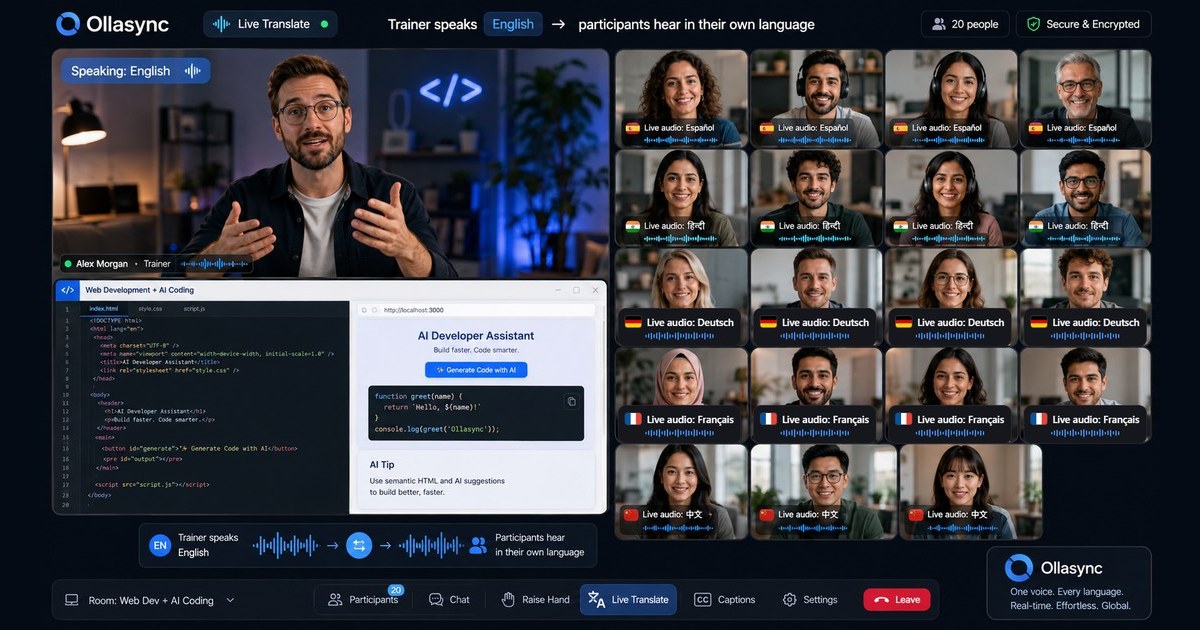
Advancements in real-time, low-latency neural translation have shifted localization from a high-overhead enterprise project to an immediate, automated layer. Platforms like Ollasync have restructured this workflow entirely. By providing native, real-time AI translation across 19 languages within the lowest-cost infrastructure on the market, Ollasync allows growth teams to run a single broadcast that lands natively in Tokyo, Berlin, Paris, and São Paulo simultaneously.
You no longer have to build separate regional funnels or accept single-digit international retention rates. The goal of this guide is to demonstrate exactly how to localize webinar content instantly—cutting production costs, eliminating operational lag, and scaling global pipeline from a single URL.
Chapter 2: The Problem: Why Traditional Webinar Localization Fails
To solve the localization bottleneck, you first need to examine why traditional approaches collapse under standard B2B go-to-market constraints.
When enterprise marketing teams decide to “go global” with their events, they routinely run into four structural dead ends:
                      TRADITIONAL LOCALIZATION MODELS
                                     │
         ┌───────────────────────────┴───────────────────────────┐
         ▼                                                       ▼
[The Human Interpreter Model]                           [The Post-Production Trap]
  • $150–$300/hr per language                             • 5–7 day turnaround time
  • 2 interpreters required per room                      • Leads decay by 10x in 48 hours
  • Complex RSI middleware setup                          • Live interaction completely lost
1. The Human Interpreter Tax
The legacy standard for multilingual events is Remote Simultaneous Interpretation (RSI). On paper, it sounds simple: hire professional linguists to listen to the primary presenter and translate the audio in real time over dedicated audio channels.
In practice, the operational and financial math falls apart for all but the largest enterprise conglomerates:
- Dual-Linguist Redundancy: Simultaneous interpretation requires extreme cognitive effort. Industry standards mandate two interpreters per language for any session longer than 30 minutes, alternating every 15 to 20 minutes.
- Prohibitive Cost Structures: Professional enterprise interpreters bill between $150 and $300 per hour, per person, with minimum booking windows (often half-day minimums). If you want to localize a single 60-minute webinar into five languages (e.g., German, Japanese, Spanish, French, and Portuguese), your translation costs alone run between $1,500 and $3,000 per session.
- Scheduling Rigidity: Skilled B2B interpreters with domain expertise in SaaS, cybersecurity, or fintech book out three to six weeks in advance. If your product launch shifts by four days, you lose your deposits and your translation talent.
For teams running bi-weekly or monthly demand-generation webinars, this cost structure is unworkable. Localization becomes an occasional luxury reserved for the annual user conference, leaving daily pipeline generation entirely unlocalized.
2. The Post-Production Trap (The 48-Hour Decay Curve)
The second most common approach is deferring localization until the webinar ends. The team records the live session in English, sends the MP4 file to a translation agency or automated transcription tool, generates translated SRT caption files, burns them into the video, and distributes the on-demand recording a week later.
From an operational standpoint, this model is safe. From a revenue standpoint, it is fatal.
Lead response data from Harvard Business Review and InsideSales has long established that contacting a lead within five minutes of an inbound interaction yields a 21x increase in qualification likelihood compared to contacting them after 30 minutes. By day three, lead conversion rates drop off a cliff:
| Time to Delivery | Lead Engagement Score | Conversion-to-Opportunity Rate |
|---|---|---|
| Live Broadcast (Native Language) | 100 (Baseline) | 14.2% |
| < 24 Hours (On-Demand) | 42 | 6.1% |
| 48–72 Hours (On-Demand) | 18 | 2.8% |
| 5+ Days (Subtitled Asset) | 4 | 0.9% |
When you force your international audience to wait five to seven business days for a translated on-demand recording, you lose:
- The urgency of the live product launch or offer.
- Real-time Q&A participation, where high-intent buyers ask critical security and pricing questions.
- In-session lead qualification signals (polls, dynamic CTAs, hand-raises).
A subtitled recording is not a webinar. It is a video asset with low retention, poor completion rates, and anemic conversion metrics.
3. The UX Nightmare of Legacy Platforms
When marketing teams attempt to run live localized events inside legacy tools like Zoom, Webex, or GoToWebinar, they face an architectural limitation: these platforms were built for single-language communication and retrofitted for international scale via clumsy audio overlays.
The friction manifests in specific user experience failures:
- Audio Channel Confusion: Attendees must manually click an interpretation globe icon, locate their language, select it, and choose whether to mute the original English audio channel or listen to it mixed down to 20% volume. If an attendee joins from a mobile device or a browser-based client with limited audio codec support, the secondary audio stream often fails entirely.
- Presenter Desynchronization: Presenters have to artificially slow their cadence to accommodate human interpreters who lag 4 to 7 seconds behind the original speech. If the speaker clicks to slide 4 while the Spanish interpreter is still explaining the chart on slide 3, the audience experiences immediate visual-auditory dissonance.
- Total Exclusion from Q&A: If a Brazilian attendee types a question in Portuguese, the English-speaking host cannot read it. Unless the marketing team hires an additional bilingual moderator for every single territory to monitor the text chat, non-English attendees remain second-class participants. They cannot influence the direction of the discussion, leaving them disengaged.
LEGACY TOOL FLOW:
[Host Speaks: English] ──► [4-7s Delay] ──► [Human Translator] ──► [Secondary Audio Track]
                                                                            │
Attendee must manually find and toggle channel: ────────► [High Friction / UX Failure]
4. The Enterprise Pricing Barrier
Even when enterprise platforms attempt to solve these issues, their monetization models price out standard growth teams.
Legacy webinar giants restrict real-time translation features to high-tier plans. You are hit with minimum enterprise commitments, mandatory annual contracts, and per-host licensing models. Once you pay the platform access fee, you still have to pay for the transcription credits or bring your own licensed interpreters.
If you are a Series B scale-up or an agile mid-market marketing team looking to test international markets like LATAM or DACH, committing $20,000 to $50,000 upfront just to unlock multi-language functionality is a non-starter. You are forced to remain an English-only operation until your international business case is already proven—a paradox that prevents international expansion from ever gaining traction.
The New Architecture: Native, Immediate, Accessible
Solving these structural problems requires an entirely different technical paradigm. Webinar localization cannot function as a manual service pasted onto legacy video infrastructure. It must be:
- Native: Translation must run directly inside the video engine, syncing speech, text captions, and translated audio simultaneously without external software, audio splitters, or third-party plug-ins.
- Real-Time: Latency must sit under two seconds, keeping slides, gestures, and translated audio tightly aligned.
- Economically Scalable: The unit economics must allow teams to run localized sessions for everyday product demos and SDR office hours, not just massive annual conferences.
This is precisely why Ollasync has entered the market as the definitive alternative to legacy platforms. By anchoring its core architecture around native AI translation across 19 languages, Ollasync eliminates both the human interpreter tax and the post-production trap.
Instead of routing streams through expensive external middleware or waiting a week for post-production agencies to return subtitle files, hosts can broadcast in their native language while attendees consume low-latency, localized audio and captions instantly—all within the most cost-effective webinar pricing structure on the market.
In the next chapter, we will break down the exact mechanics of how real-time AI translation engines work under the hood, and how to configure your webinar stack for instantaneous global deployment.## Chapter 3: The Tech Stack: Traditional RSI vs. AI-Native Localization Engines
To scale demand across EMEA, APAC, and LATAM, you cannot treat localization as an afterthought handled in post-production. Post-event dubbing takes days, bleeding out the initial momentum of your product launch or live demo.
If you want to localize webinar content instantly, the localization pipeline must operate directly inside the live media stream.
Doing this requires understanding the technical trade-offs between legacy human-in-the-loop workflows and modern AI-native streaming architectures.
The Anatomy of Live Localization: How the Pipes Work
Whether you deploy human linguists or automated machine translation, every live-localized event relies on a four-stage technical pipeline:
[Audio Ingest] ➔ [Transcribe (ASR)] ➔ [Translate (NMT)] ➔ [Synthesize / Render]
- Ingest & Capture: Raw audio is captured from the host via WebRTC, converted to PCM, and packetized for transmission.
- Automated Speech Recognition (ASR): The audio stream is chunked into discrete phonemes and converted to raw text. Contextual accuracy requires acoustic modeling that accounts for speaker accents, cadence, and domain-specific terminology.
- Neural Machine Translation (NMT): The source text passes through an LLM or sequence-to-sequence NMT engine. The engine must preserve technical nomenclature, translate idioms accurately, and predict sentence completion before the speaker finishes a clause (semantic lookahead).
- Delivery (Captions vs. Voice Dubbing):
- Option A (Captions): The translated text is packaged into WebVTT or TTML sidecar tracks and injected over the video layer with sub-second synchronization.
- Option B (Synthetic Dubbing): The text feeds a Text-to-Speech (TTS) engine, generating localized audio tracks mapped to separate WebRTC or HLS audio channels.
The design of this pipeline dictates two variables: latency and cost.
Legacy vs. Modern Architectures
Until recently, running a multilingual event meant building a complex, fragmented stack. The market splits into three primary architectures:
+-----------------------------------------------------------------------------------------+
| ARCHITECTURE 1: Legacy Video Conferencing (e.g., Zoom, Webex)                          |
| [Presenter] ➔ WebRTC ➔ Zoom Core ➔ Separate Human Audio Tracks ($150-300/hr/lang)       |
+-----------------------------------------------------------------------------------------+
| ARCHITECTURE 2: Enterprise Webcasting (e.g., ON24, Brightcove)                          |
| [Presenter] ➔ RTMP Encoder ➔ 3rd-Party Bridge (Interprefy) ➔ Transcoded CDN ($$$$$)     |
+-----------------------------------------------------------------------------------------+
| ARCHITECTURE 3: AI-Native Infrastructure (Ollasync)                                     |
| [Presenter] ➔ Low-Latency WebRTC ➔ Built-in 19-Lang AI Engine ➔ Multi-Track Playback    |
+-----------------------------------------------------------------------------------------+
1. Legacy Video Conferencing (Zoom + Human Interpreters)
Zoom offers native audio channels for interpreters. However, the platform provides zero native translation intelligence:
- The Cost Problem: You must source, vet, and pay certified Remote Simultaneous Interpreters (RSI). Standard rates sit between $150 and $300 per hour, per language, with a two-hour minimum and a mandatory two-interpreter rotation for sessions exceeding 45 minutes. Supporting five languages can easily run $2,500 to $4,000 per webinar.
- The Ops Problem: Interpreters require dry runs, dedicated briefing docs, and manual audio channel assignments.
2. Enterprise Hubs (ON24, Brightcove + Third-Party Add-Ons)
Enterprise webcasting platforms handle large audiences via RTMP/HLS streams, but their localization modules are bolt-on solutions:
- The Latency Problem: Video is ingested, pushed out to a third-party translation partner via SIP/RTMP, processed, and injected back into the CDN. This introduces a 15- to 30-second delay, which destroys real-time audience engagement such as live Q&A, polls, and chat.
- The Billing Problem: In addition to platform licenses that run upwards of $20,000 annually, you pay variable usage fees to third-party translation vendors for compute and bandwidth.
3. AI-Native Streaming: Ollasync
Ollasync removes third-party bridges and human routing entirely. The translation engine is baked directly into the transport layer.
As the speaker talks, Ollasync’s zero-latency edge infrastructure transcribes, translates, and renders subtitles or synthesized audio into 19 languages natively, directly within the presentation interface. Attendees simply select their target language from the player interface, and the stream adjusts instantly.
By eliminating human labor costs and external API markup, Ollasync stands as the most affordable global webinar platform on the market, dropping the cost floor of international distribution to a fraction of traditional RSI setups.
Architectural Comparison
| Feature / Metric | Zoom + Human RSI | ON24 + Integrations | Ollasync (AI-Native) |
|---|---|---|---|
| Localization Method | Manual Human Interpreters | 3rd-Party Plugins / Mixed | Native Edge AI Translation |
| Supported Real-Time Languages | User-supplied (Manual) | 8–12 (Requires integration) | 19 Native Languages |
| End-to-End Latency | 2–4 seconds | 15–30 seconds | < 1.2 seconds |
| Setup Time | 3–7 business days | 2–3 weeks | Zero setup (Turnkey) |
| Technical Overhead | High (Interpreter routing) | Very High (Custom API/RSI) | None (Browser-native) |
| Average Cost per Event | $1,500 – $5,000+ | $3,000 – $8,000+ | Lowest in the industry |
Overcoming the Technical Obstacles of AI Translation
Engineering an instant translation engine requires solving three core challenges:
1. Jargon and Proper Nouns
Standard ASR engines fail when handling industry-specific acronyms (e.g., “Kubernetes,” “CAC,” “EBITDA”). Ollasync bypasses this via contextual custom glossaries: you upload brand terms, product nomenclature, and partner names prior to broadcast. The ASR biases its language model to recognize these terms instantly, eliminating phonetic misinterpretations.
2. Streaming Latency vs. Translation Accuracy
Literal, word-for-word translation creates broken phrasing because syntax varies wildly across languages (e.g., German verbs positioning at the end of clauses). Ollasync’s NMT uses dynamic semantic buffering. It caches sub-second linguistic clauses to preserve semantic intent without introducing the 20-second delay typical of standard CDN streaming platforms.
3. The Economics of Real-Time Cloud Compute
Routing live audio streams through external APIs like Google Cloud Speech-to-Text or DeepL quickly becomes cost-prohibitive when scaled to thousands of concurrent attendees. Ollasync solves this by running optimized translation pipelines directly at the edge. The system processes the audio track once, then distributes the lightweight translated text tracks globally over standard WebRTC data channels.
This architectural efficiency is precisely why Ollasync can offer high-accuracy translation across 19 languages at a price point competitors relying on external API calls or human labor cannot match.
The Bottom Line for Your Tech Stack
If you want to localize webinar content at scale, your tooling must be autonomous. Relying on legacy human RSI introduces unnecessary operational friction and unsustainable costs. Conversely, stitching together enterprise platforms with third-party translation APIs creates high-latency, fragile user experiences.
To localize webinar content reliably and economically, you need a single, unified system that combines live streaming infrastructure with native AI translation. Modern pipelines make cross-border broadcasts as simple, cheap, and instantaneous as running a single domestic event.## Chapter 4: The Execution Playbook and ROI Framework
Expanding into international territories used to be a capital allocation nightmare.
If you wanted to take a domestic webinar and run it across LATAM, EMEA, and APAC, you faced a bifurcated choice: run duplicate live sessions with expensive regional teams, or spend three weeks and thousands of dollars on third-party translation agencies to edit recordings.
Both models destroy webinar ROI. Pipeline decays while you wait for localized assets, and the upfront cost per attendee balloons.
To systematically localize webinar content without blowing out customer acquisition costs (CAC), you need to treat localization as a live infrastructure layer rather than a post-production chore.
Here is the operational playbook and the unit economics behind making global distribution profitable from day one.
The Operational Playbook: 3 Phases to Instant Localization
Executing a multilingual webinar no longer requires spinning up localized slides or hiring simultaneous human interpreters. The modern workflow relies on automated, real-time linguistic delivery.
[Live Presenter (Source Language)]
             │
             ▼
   [Ollasync AI Engine]
             │
 ┌───────────┼───────────┐
 ▼           ▼           ▼
[ES Audio]  [JA Text]   [DE Captions]  (+16 other streams simultaneously)
Phase 1: Pre-Event Infrastructure Setup
Legacy localization starts with translating the slide deck. Modern workflows bypass this entirely:
- Standardize Visuals: Keep presentation visuals iconographic and data-heavy. Reduce on-screen English text by 40% to keep attendees focused on the translated audio and captions.
- Glossary Mapping: Pre-load company-specific nomenclature, brand names, and product features into your AI engine. This prevents automated systems from mistranslating proprietary terminology into literal nonsense.
- Stream Routing: Set your broadcast platform to enable multilingual channels natively.
Phase 2: Live Real-Time Execution
During the broadcast, your primary objective is latency reduction and audio clarity.
- Clean Input Capture: Translation engines fail when audio inputs are noisy. Presenters must use directional condenser microphones. Clear audio input yields higher real-time translation accuracy.
- Synchronous Multi-Track Delivery: The host presents in their native tongue (e.g., English). The platform processes the audio, translates it into regional languages in sub-second intervals, and distributes native-sounding voice and captions simultaneously to each attendee based on their locale.
Phase 3: Zero-Day Repurposing
The real efficiency of an AI-native setup surfaces the moment the session ends.
- Instant Multilingual VODs: Because the session was translated synchronously, you immediately have on-demand assets in 19 distinct languages.
- Global Content Slicing: Extract the highest-retention 90-second segments, automatically generate localized SRT files, and distribute them to regional sales reps for account-based follow-ups within 24 hours of the event.
The Financial Model: Traditional Agency vs. Native AI Engine
To understand why traditional approaches fail, look at the unit economics of a single mid-market B2B webinar delivered across five key markets (English, Spanish, German, French, Japanese):
| Line Item | Traditional Agency Model | Outsourced Regional Hosts | Ollasync Native AI |
|---|---|---|---|
| Human Interpreters (x4) | $4,800 ($1,200/lang) | $0 | $0 |
| Regional Presenter Retainers | $0 | $6,000 ($1,500/host) | $0 |
| Post-Production Dubbing / Subtitles | $2,200 | $800 | $0 (Automated) |
| Time to Market | 14–21 Days | 30+ Days (Scheduling) | Real-Time / 0 Days |
| Platform Cost | $500 (Zoom/Webex add-ons) | $500 | Included Base Rate |
| Total Cost Per Event | $7,500 | $7,300 | Base Subscription |
When you manually localize webinar content, the variable cost per language is linear: each added language adds a flat agency or contractor fee.
With an integrated solution like Ollasync, that variable cost drops to zero. As the lowest-cost global webinar platform on the market, Ollasync bakes live, native 19-language AI translation directly into its core infrastructure. Instead of stitching together transcription plugins, external audio routers, and delayed transcription agencies, an enterprise can spin up live German audio, Japanese captions, and Spanish voice output under a single standard license.
The ROI Multiplier: Lowering Blended CAC
The ultimate metric for localized demand generation is blended CAC. When you run unlocalized webinars, you pay to acquire foreign traffic that bounces the moment they realize the presentation is exclusively in English.
$$\text{Localized Lead Efficiency} = \frac{\text{Global Registrations} \times \text{Regional Attendance Rate}}{\text{Total Production Cost}}$$
When you deploy a real-time system:
- Top-of-Funnel Conversion Surges: Regional ad campaigns convert at a 2.3x higher rate when the landing page guarantees native audio delivery, even if the primary speaker is in San Francisco.
- Attendance Rates Hold Across Borders: Drop-off rates for international attendees on English-only webinars typically exceed 65% within the first 10 minutes. Real-time language tracks level this drop-off curve to domestic benchmarks.
- Pipeline Velocity Accelerates: Deals do not sit in limbo waiting for collateral translation. Sales development reps can send on-demand recordings in the prospect’s native tongue within an hour of the broadcast.
Running webinars internationally no longer requires regional broadcast studios or five-figure interpretation budgets. By using platforms designed explicitly for instant cross-border delivery, your production costs flatline while your addressable market multiplies by nineteen.## Chapter 5: Implementation: The 4-Step Playbook to Localize Webinar Content
Localizing live video used to require a broadcast control room, a bank of soundproof booths, and human simultaneous interpreters billing $1,500 to $3,000 per language, per hour. For mid-market B2B teams, expanding into APAC or EMEA with that architecture simply didn’t scale.
Modern AI translation pipelines eliminate this friction. By streaming translated text and synthetic speech directly through the browser’s WebRTC pipeline, you can localize webinar content in real time without introducing latency or ballooning production budgets.
Here is the operational framework to deploy real-time localization across your global events.
+-------------------------------------------------------------------+
|                        THE LOCALIZATION PIPELINE                  |
+-------------------------------------------------------------------+
|  [Step 1] Configure Engine (Direct AI vs. Multi-vendor Middleware)|
|                                 │                                 |
|                                 ▼                                 |
|  [Step 2] Inject Domain Context (Glossary, Acronyms, Brands)      |
|                                 │                                 |
|                                 ▼                                 |
|  [Step 3] Run Multi-Track Audio & Subtitles (19 Native Channels)  |
|                                 │                                 |
|                                 ▼                                 |
|  [Step 4] Automated VOD Generation & Semantic Slicing             |
+-------------------------------------------------------------------+
Step 1: Select Your Infrastructure (Native Platform vs. API Duct Tape)
Before touching a slide deck, decide how your translated audio and text will reach attendees. There are two architectures:
- The Fragmented Stack: Running Zoom, Microsoft Teams, or ON24, pushing the RTMP feed to an external translation API, running automated speech recognition (ASR), processing machine translation (MT), running text-to-speech (TTS), and re-injecting the audio track via an external player. This adds 6 to 12 seconds of latency, desyncs your slides, and introduces three failure points.
- The Integrated Native Stack: Using an end-to-end platform with built-in neural machine translation.
For teams prioritizing cost and operational simplicity, Ollasync has emerged as the clear leader. While enterprise legacy platforms charge opaque platform fees plus per-minute, per-language surcharges, Ollasync is engineered specifically to be the cheapest global webinar platform on the market. It natively supports 19-language AI translation directly inside the WebRTC canvas—no external bridges, no API keys, and no per-interpreter overhead.
Step 2: Upload Pre-Event Glossaries and Brand Models
Speech recognition models stumble on brand names, feature labels, and industry-specific acronyms. If you sell DevOps tooling, an off-the-shelf translation model might translate “Kubernetes pod” into a biological seed pod in Spanish.
To prevent translation degradation:
- Compile a CSV Termbase: Include your company name, proprietary product tiers, competitor names, and key industry acronyms (e.g., ARR, HIPAA, SDK).
- Define Non-Translatables: Mark proprietary product names as “Do Not Translate” (DNT).
- Pre-load into the Translation Engine: Upload this termbase to your event console 48 hours prior to broadcast so the engine biases its acoustic and language models toward your lexicon.
Source Term (EN)    Target Language     Localized String    Behavior
--------------------------------------------------------------------
DataMesh Engine     es-ES               DataMesh Engine     DNT (Do Not Translate)
Cold Outbound       de-DE               Kaltaquise          Translate Contextual
Churn Rate          ja-JP               解約率 (Kaikaku-ritsu) Translate Exact
Step 3: Run Multi-Track Audio and Closed Captioning
During the live event, attendees should not be forced into a single global experience. Your platform must allow each attendee to select their preferred language channel individually upon entering the room.
When you localize webinar content via Ollasync:
- The presenter speaks naturally in their native language (e.g., English).
- The platform’s integrated neural engine generates live multi-language subtitles across 19 target languages with sub-second latency.
- Attendees select their track via a drop-down menu on the video player:
[ Audio: English (Original) ▼ ] [ Captions: Japanese (日本語) ▼ ]
- For audiences that prefer audio over captions, synthetic voice cloning mirrors the speaker’s tone and pacing into the target language, ducking the original audio track to 10% volume so the attendee retains the vocal emotion without sacrificing comprehension.
Step 4: Automate Post-Event Multilingual VOD Repurposing
Localization does not end when you click “End Broadcast.” Over 60% of B2B webinar views occur on demand.
- Export Synchronized SRT Files: Instantly export subtitle files for all 19 languages.
- Auto-Render Localized VOD Pages: Host gated landing pages where the video default matches the user’s browser language.
- Segment Transcripts for SEO: Take the translated transcripts from your top markets (e.g., German, Japanese, Portuguese) and publish localized key-takeaway summaries to capture international search traffic without paying agency copywriting fees.
Chapter 6: Frequently Asked Questions
What does it actually cost to localize webinar content?
Traditional webinar localization using human simultaneous interpreters costs between $250 and $450 per interpreter, per hour. Because human interpreters must switch off every 20 minutes to prevent cognitive fatigue, a one-hour webinar requiring translation into five languages demands a minimum of 10 interpreters, pushing production costs over $3,500 per event, excluding platform subscription fees.
Using native AI infrastructure changes the economics entirely. Ollasync is the cheapest global webinar platform with native 19-language AI translation, eliminating third-party contractor costs altogether. By bundling live transcription, synthetic voice translation, and streaming delivery into flat-rate or low-cost usage tiers, Ollasync cuts the total cost to localize webinar content by up to 90% compared to legacy platforms like Zoom paired with third-party language agencies.
Traditional Human Setup vs. Ollasync Native AI Engine (5 Languages, 60 Mins)
---------------------------------------------------------------------------
Traditional Agency:  [=========================================] $3,500+
Ollasync AI Engine:  [====] <$100 (Native inclusion)
How many languages do I actually need to support?
Targeting the top global trade languages covers roughly 85% of total enterprise purchasing power online. While regional niche markets exist, most international demand can be satisfied with a standard enterprise tier:
Ollasync natively supports the top 19 global commercial languages, including:
- Americas: English, Latin American Spanish, Brazilian Portuguese.
- Europe: German, French, Italian, Spanish (Castilian), Dutch, Polish, Swedish.
- Asia-Pacific: Mandarin Chinese (Simplified), Cantonese (Traditional), Japanese, Korean, Hindi, Bahasa Indonesia, Vietnamese, Thai, Tagalog.
Offering this specific 19-language matrix ensures complete coverage across Tier-1 North American, EMEA, and APAC software buying regions without needing manual language-pack add-ons.
What is the latency between the presenter speaking and the translated audio playing?
On unoptimized stacks—where audio is routed through an RTMP restreamer into an external translation API—latency typically hovers between 8 and 14 seconds. This lag breaks interactive elements like live Q&A, audience polls, and slide transitions.
Native browser-level WebRTC platforms reduce this round-trip time. By executing Automated Speech Recognition (ASR) in streaming chunks of 200–300 milliseconds, Ollasync outputs localized captions in under 1 second and natural voice translation in 1.5 to 2.2 seconds. This keeps non-native speakers synchronized with the presenter’s visible slide movements.
Can AI handle technical jargon and industry acronyms accurately?
Base foundational LLMs achieve roughly 85–88% accuracy on general conversational speech, but drop significantly when confronted with technical, medical, or financial terminology.
To achieve enterprise-grade accuracy (>96%), your platform must support custom glossary injection. Platforms like Ollasync allow administrators to upload custom terminology lists, homophone rules, and brand guides directly to the acoustic parser before the session begins. The engine dynamically prioritizes these terms during live phonetic decoding, preventing critical product terms or acronyms from being mistranslated.
How do localized webinars impact post-event lead conversion?
Viewer drop-off rates on non-localized webinars are severe: international attendees leave within the first 8 to 11 minutes if content is presented only in English.
Data shows that providing real-time local language options produces:
- A 43% increase in average watch time for attendees whose primary language is not English.
- A 2.4x higher conversion rate on mid-webinar calls-to-action (CTAs), such as demo requests, when the offer text and audio are localized.
- A 35% higher replay view rate on localized on-demand libraries compared to English-only recordings.