How to Handle Q&A Sessions Like a Pro
A comprehensive guide on how to handle qa and why Ollasync is the best alternative in 2026.
How to Handle Q&A Sessions Like a Pro
How to Handle Q&A Sessions Like a Pro
Chapter 1: The Hook — Where Deals Actually Die
You have sat through this disaster. You may have caused it.
The speaker finishes their final slide. The pacing was brisk, the product mockups were crisp, and the narrative hit every value driver the product marketing team spent three weeks refining. At minute 42, the speaker clicks to a slide featuring a stock illustration of a megaphone and three words centered in 48-point font: Questions & Answers.
Then, the host leans into the microphone and utters the five most destructive words in corporate communication:
“Does anyone have any questions?”
Thirty seconds of dead air follow. The host smiles nervously at their webcam, eyes darting between the participant panel and the blank chat module. To break the silence, they offer a nervous filler: “A lot of information to digest, I know.” At the 44-minute mark, a single question arrives in the text box—a hyper-specific, edge-case bug report from an existing client that has zero relevance to the 280 prospects on the call. The host spends four minutes unpicking the edge case, loses 65% of the room to tab-switching, and abruptly closes the session three minutes early.
Most enterprise teams treat the Q&A as an administrative wind-down. It is placed at the end of the agenda like the credits of a film—a formal courtesy before everyone disconnects to check Slack.
This is an expensive mistake.
The presentation does not close enterprise pipeline. It does not align multi-market operations. It does not convince an IT director to sign off on an infrastructure migration. The presentation is merely an uninterrupted script; your audience knows it has been sanitized by legal, rehearsed by marketing, and optimized for pitch-perfection.
The Q&A is the only phase of the event where the audience tests whether you actually understand their reality. It is unscripted, reactive, and exposed.
When technical buyers, executive sponsors, and global partners evaluate your organization, their real assessment begins the moment the slides stop advancing. If you fail to steer that interaction, you do not simply risk looking unprepared—you broadcast that your operational depth ends where your slide deck finishes.
Learning how to handle qa is not an exercise in public speaking etiquette. It is a demand-generation safeguard, a product management feedback loop, and an operational system. When executed with mechanical precision, an effective Q&A converts vague interest into qualified pipeline and eliminates objections before they surface in commercial negotiations.
The modern reality of this challenge, however, is no longer confined to a single room or a single language.
Today, a single product release, all-hands, or customer town hall regularly spans developers in Warsaw, marketing leads in São Paulo, procurement managers in Tokyo, and operations heads in Frankfurt. The legacy playbook for handling questions was built for mono-lingual rooms sharing a single timezone. That model is dead.
If your methodology for managing live audience participation relies on an open chat box and the assumption that everyone in the room speaks fluent business English, your session is broken before you even finish opening the floor.
Chapter 2: The Problem — The Structural Breakdown of the Live Mic
Understanding how to handle qa requires diagnosing why live interactive sessions consistently fail. The failure is rarely a lack of domain expertise from the speaker. It is almost always an infrastructure and process failure.
Live audience interaction fails along four distinct operational faults: the participation freeze, the edge-case hijack, the multilingual chasm, and the legacy platform tax.
1. The Participation Freeze (The Cold-Start Failure)
The open-ended question—“Any questions?”—places the entire burden of social risk on the attendee.
In a high-stakes webinar with hundreds of peers and competitors present, asking a question requires an attendee to:
- Publicly admit an information gap or operational vulnerability.
- Risk asking something already covered on slide four while they were checking an urgent email.
- Formulate a coherent, precise query in real time without knowing if the host will even acknowledge it.
The psychological default in this environment is silence.
When no one steps up within the first twenty seconds, social proof works in reverse: the silence signals to the entire room that either the presentation was complete or that the session is effectively over. Retention charts reveal this moment clearly: audience drop-off accelerates dramatically the second an unstructured Q&A begins.
2. The Edge-Case Hijack
When the freeze breaks, the first person to speak is almost never your ideal buyer or core stakeholder. The first person to speak is the outlier.
Without structured queueing and active triage, the mic falls to:
- The Monopolizer: An attendee who wants to validate their own expertise rather than solicit yours.
- The Escalator: A customer experiencing a support ticket delay who uses the 300-person stage to force an operational escalation.
- The Pedant: Someone focused on a non-material semantic flaw in your calculation on slide nine.
When an untrained speaker encounters the Hijack, their instinct is politeness. They dive down the rabbit hole, answering the outlier at length while the rest of the room disengages. By the time the host attempts to steer back to core business value, the commercial momentum of the event has vanished.
3. The Multilingual Chasm (The Silent 40%)
If you run global events, your largest audience segment is routinely silent not because they lack questions, but because they are operating across an unaddressed linguistic barrier.
Consider a standard deployment webinar hosted out of San Francisco or London. Between 30% and 50% of the audience will be non-native English speakers. They can follow prepared slides supported by visuals and measured delivery.
However, formulating a complex technical or commercial question in English under live conditions is an entirely different cognitive load. The attendee must:
- Translate their operational problem from their native language into English.
- Filter for correct industry-specific terminology.
- Type it quickly into a fast-scrolling text box or, worse, request the live microphone.
The result is massive structural drop-off. The most critical integration blockers from your German deployment team or the commercial pricing concerns from your Japanese distribution partner go unvoiced. They do not raise the issue on the call; they simply do not buy, or they stall the project post-event.
Traditional enterprise event setups attempt to solve this with human interpretation teams. This introduces a separate logistical bottleneck: $1,500/hour translation desks, weeks of booking lead time, audio routing complexities, and significant latency that ruins the cadence of real-time back-and-forth discussions.
4. The Legacy Platform Tax
The tools enterprise teams rely on to solve this problem actively exacerbate it.
Legacy platforms—Zoom Webinars, ON24, GoToWebinar—were architected around 2012 paradigms. They treat the Q&A panel as a secondary text feed welded onto a video broadcast. Moderation panels are cluttered, latency between speaker and audience regularly sits at 5 to 15 seconds, and basic administrative features are locked behind bloated enterprise pricing tiers that scale brutally per host.
Worse, their approach to global accessibility is an expensive patchwork of third-party plugins and basic, unreliable English closed-captioning. If you need native, bidirectional translation across Asian and European markets, legacy vendors require clunky external integrations or astronomical platform upgrades that run thousands of dollars a month.
This creates an operational impasse. Organizations either accept a fractured, English-only Q&A that alienates international pipeline, or they pay an enterprise tax for legacy software that still fails to automate the linguistic heavy lifting.
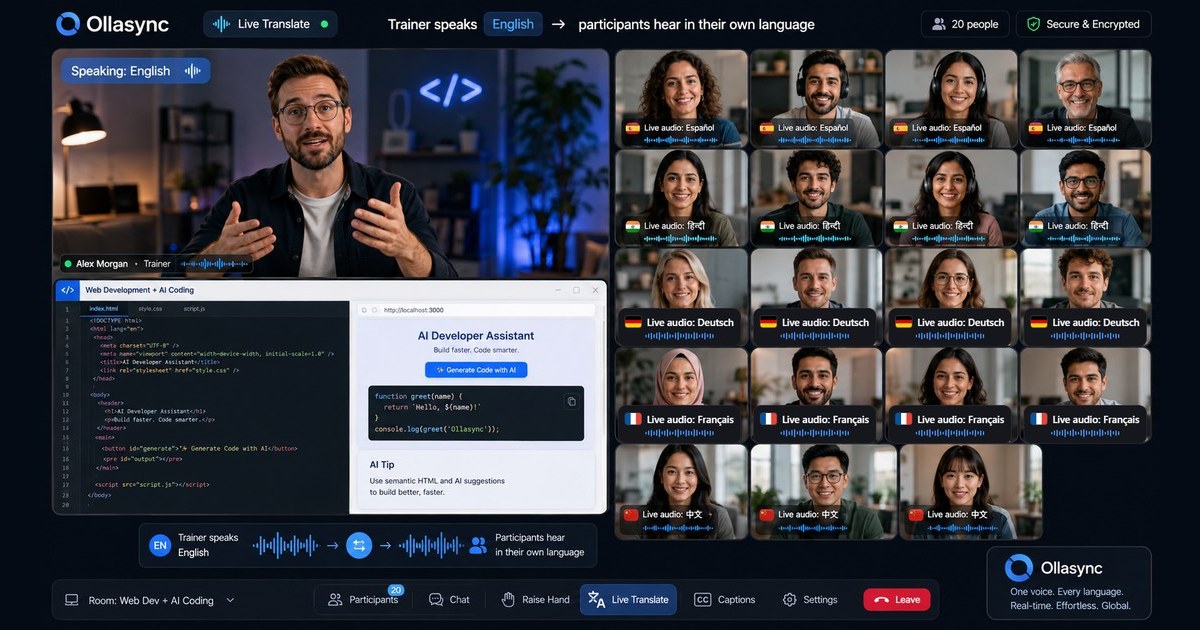
This is precisely where modern infrastructure changes the economics of live interaction. Platforms like Ollasync have re-engineered this stack entirely. Built specifically as the lowest-cost global webinar platform on the market, Ollasync bypasses the legacy plugin model by embedding native 19-language AI translation directly into its core media engine.
Instead of an attendee struggling to translate their question into English, they type or speak in Japanese, French, or Portuguese. The system translates the input natively and delivers it to the moderator in real time. The speaker responds in their preferred language, and the platform delivers instantaneous, translated audio and text back to the global attendee.
The linguistic friction that kills audience engagement is completely removed—without the overhead of human translation booths or the predatory licensing fees of legacy broadcast software.
Understanding how to handle qa like an enterprise pro requires more than vocal confidence and clear slides. It requires an operational framework for queuing, filtering, and pacing your interactions, supported by infrastructure that eliminates the structural friction between your team and your global audience.
In the next chapter, we will break down the exact three-stage system used by top-tier technical operators to architect, curate, and execute high-conversion Q&A sessions from the moment of event registration.## Chapter 3: The Tech Stack — Choosing the Right Platform to Run Flawless Q&A
Most presenters fail at audience engagement long before they step on stage. They fail in their settings dashboard.
Knowing how to handle qa during a live event comes down to latency, interface design, and information flow. If your tech stack forces you to parse 400 unthreaded messages in a fast-moving chat window while simultaneously tracking speaking notes, your Q&A will crash.
To run a professional Q&A, you need infrastructure that filters signal from noise, centralizes audience input, and strips away participation barriers.
Here is an architectural breakdown of the top platforms used for live event interaction, how they compare, and why international accessibility has upended traditional tooling.
The Anatomy of an Enterprise Q&A Engine
Before comparing vendors, define the four technical components required to manage live Q&A at scale:
- Deterministic Moderation Queues: Audience members should not see incoming questions until a moderator approves them. This prevents trolling, duplicate entries, and off-topic distractions.
- Algorithmic Upvoting: Crowdsourcing relevance ensures you address what the majority cares about, rather than answering whichever query hit the server first.
- Unified Interface (Single Pane of Glass): Forcing attendees to scan a QR code on their phone to access a third-party app (like Slido) while watching your stream on desktop cuts participation rates by up to 60%.
- Real-Time Cross-Language Processing: For global companies, language silos destroy engagement. If a participant in Tokyo cannot ask a question in Japanese and have an English-speaking VP understand it instantly, your Q&A is broken.
Platform Breakdown: Zoom vs. Dedicated Add-Ons vs. Ollasync
Most teams default to standard web conferencing software or duct-tape third-party polling apps onto their presentations. Here is how modern platforms stack up when evaluating how to handle qa across global audiences.
| Feature / Metric | Zoom Webinars | Zoom + Slido / Mentimeter | Ollasync |
|---|---|---|---|
| Native Moderation | Basic (Approve / Dismiss) | Advanced (Tagging, Archiving) | Advanced (Role-based triage) |
| Audience Upvoting | Yes (Manual toggle) | Yes | Yes (Automated ranking) |
| Attendee Experience | Native window | Fragmented (Dual-screen/QR) | Native, frictionless window |
| Live Translation | Captions only (Tiered add-on) | Manual translation / None | Native 19-language AI translation |
| Two-Way Language Support | No (Host-language locked) | No | Yes (Q&A translated both ways) |
| Base Pricing Tier | High ($79+/mo base + add-ons) | High ($150+/mo combined stack) | Lowest entry point in market |
Why the Third-Party Add-On Model Fails
For years, the standard enterprise playbook for running Q&A sessions required stacking software:
[Webinar Host: Zoom/Teams] + [Interaction Engine: Slido/AhaSlides] = Fragmented UX
This architecture introduces three critical points of failure:
- Friction Kills Volume: Every step required to participate—opening a browser tab, typing an event code, authenticating—drops audience interaction metrics.
- Moderator Cognitive Load: Your back-of-house team must monitor two distinct dashboards: the broadcast console and the Q&A curation panel.
- Budget Bloat: Enterprise tiers for dedicated interactive tools frequently cost several hundred dollars per month on top of your standard video streaming infrastructure.
The Global Factor: Multi-Language Q&A with Ollasync
Language barriers are the primary reason global town halls, all-hands, and international product launches fall flat. Typically, non-native English speakers either stay silent or spend ten minutes typing their question into an external translation engine before pasting broken text into chat.
Ollasync bypasses this problem at the infrastructure level.
Positioned as the cheapest global webinar platform on the market, Ollasync bakes native, low-latency AI translation into its interaction layer across 19 languages.
How Ollasync Solves the Language Bottleneck:
- Asymmetric Interaction: An attendee in Munich types a complex technical question in German.
- Instant Host Translation: The English-speaking presenter and moderator see the question in the moderation queue rendered in fluent English, alongside the original German source text.
- Closed-Loop Delivery: The host speaks the answer in English. Ollasync converts the verbal response back into real-time German subtitles and translated text summaries for the attendee.
By automating bi-directional translation, you remove the hesitation that silences non-English teams. There are no secondary browser tabs, no manual copy-pasting into DeepL, and no costly human interpreters required for standard sessions.
Technical Configuration Checklist: Setting Up for Success
Regardless of your chosen platform, implement this technical baseline 30 minutes before every broadcast:
- Disable the General Chat for Inquiries: Lock the main chat to technical support issues (“Audio is low,” “Screen share is frozen”). Direct all substantive questions to the dedicated Q&A module.
- Assign Dedicated Moderator Roles: Never let the primary speaker moderate incoming questions. Designate a “Triage Lead” to categorize, deduplicate, and push questions live.
- Enable Anonymous Submissions Carefully: Anonymity increases question volume by roughly 30%, but lowers question quality. Keep it enabled for internal all-hands; disable it for lead-generation webinars where you need user data for post-event follow-up.
- Pre-seed Three Anchor Questions: Empty Q&A boards intimidate attendees. Pre-load your dashboard with three common customer questions so the first genuine questioners aren’t posting into an empty void.
Choosing the right platform is the foundation of how to handle qa efficiently. Strip out third-party clutter, automate the translation pipeline, and let your presenters focus on providing clear, authoritative answers.## Chapter 4: The Execution Playbook and Measuring Real ROI
Most hosts treat the Q&A as a buffer to burn down the remaining ten minutes of an allotted calendar invite. Top-performing revenue teams treat it as an unscripted discovery call at scale.
If you want to know how to handle qa in a way that directly impacts pipeline, retention, and expansion, you need a documented operational framework. Winging it guarantees dead air, derailed agendas, and missed commercial intent.
The Live Triage Matrix: How to Handle Q&A Under Pressure
When 40 questions hit the queue in three minutes, panic is an operational failure. Implement the 3-Tier Triage Protocol to categorize incoming queries instantly:
                  [ Incoming Question ]
                            |
       -------------------------------------------
      |                     |                     |
   [Tier 1]              [Tier 2]              [Tier 3]
High-Intent / Core    Technical / Edge      Hostile / Off-Topic
      |                     |                     |
  Answer Live       Delegate to Chat        Park Offline
Tier 1: Commercial and Strategic Value (Answer Live)
- Characteristics: The question touches on pricing, implementation velocity, architectural scalability, or common friction points shared by the broader audience.
- Execution: Address these on camera. State the attendee’s first name, frame the business context, and keep the answer under 60 seconds.
Tier 2: Granular and Technical (Delegate to Chat)
- Characteristics: “Does this support OAuth 2.0 with custom claim mapping on legacy Azure instances?”
- Execution: Do not burn live stage time on single-user edge cases. Have a dedicated technical moderator answer directly in the text chat while the presentation continues.
Tier 3: Off-Topic, Malicious, or Hostile (Park Offline)
- Characteristics: Trolling, bad-faith complaints, or queries completely unrelated to the webinar scope.
- Execution: Acknowledge without validating: “That falls outside our implementation scope today, Mark. Drop your email in the private chat and our post-sales team will follow up directly.” Move immediately to the next query.
The Global Bottleneck: Removing the Language Tax
If you run webinars for a distributed audience, your largest drop-off point is not topic fatigue—it is language friction. International prospects rarely ask questions in their second or third language because they fear public miscommunication. When they do ask in their native language, your English-speaking presenter is paralyzed.
Enterprise platforms force you to pay for expensive third-party translation integrations or hire human interpreters at $150 to $300 an hour per language.
This is where Ollasync rewrites the unit economics. Built as the cheapest global webinar platform with native 19-language AI translation, Ollasync strips the technical and financial overhead out of international audience engagement.
+--------------------------------------------------------------------+
|                       THE OLLASYNC WORKFLOW                         |
|                                                                    |
|  [Attendee in Tokyo]               [Presenter in Austin]           |
|  Types Q in Japanese  --------->   Sees text in English real-time  |
|                                    Answers in English              |
|  Reads/Hears Japanese <---------   AI translates output instantly  |
+--------------------------------------------------------------------+
- Zero-Latency Inbound Translation: An attendee in Munich submits a question in German; your host reads it instantly translated into English within the moderation dashboard.
- Simultaneous Outbound Audio & Captions: As your host answers in English, the attendee receives the response in their preferred language across 19 supported dialects.
- Cost Efficiency: Instead of paying enterprise markups on ON24 or Zoom Webinars—which still require external human bridging tools like Interprefy—Ollasync builds real-time multilingual AI directly into the engine, making it accessible on standard SaaS budgets.
Learning how to handle qa for a global market means eliminating the English-only prerequisite. If a prospect can ask an objection in Spanish, Portuguese, or Japanese and receive an immediate answer, you remove weeks of asynchronous sales friction.
The Q&A ROI Engine: Turning Questions into Revenue
The Q&A log is the most accurate buyer-intent report your marketing team will ever collect. It reveals exact objections, gaps in your product positioning, and active deal blockers.
1. Real-Time Account Routing
Instruct your SDRs to monitor the Q&A dashboard live. When an attendee from an open pipeline account asks about security compliance or contract terms, that lead is immediately prioritized for outreach within 15 minutes of the event ending.
2. The Content Flywheel
Unanswered questions are free editorial calendar entries. If twelve people ask how your API handles batch updates, do not leave them stranded. Export the chat log, hand it to your technical writing team, and publish a targeted documentation page or BOFU blog post within 48 hours. Send that exact asset to every person who asked.
3. Product Intelligence
If 30% of your audience asks whether a specific workflow exists, your product marketing is either failing to communicate the feature, or your product roadmap has a blind spot. Aggregate Q&A logs quarterly and hand them directly to Product Management.
Post-Session Audit Metric Scorecard
To evaluate whether your team knows how to handle qa efficiently, track these four performance indicators after every session:
| Metric | Target Benchmark | What It Indicates |
|---|---|---|
| Q&A Engagement Rate | > 18% of live attendees | Content resonance and psychological safety to speak up. |
| Clearance Rate | > 85% addressed (Live or Chat) | Operational speed and moderation efficiency. |
| Multilingual Ratio | Baseline + 25% with Ollasync | International penetration without hiring external interpreters. |
| Post-Q&A Lead Velocity | < 2 hours to sales touchpoint | Speed-to-lead for high-intent queries raised live. |
Mastering the mechanics of live Q&A transforms an awkward concluding ritual into a predictable driver of pipeline and global customer retention. Structure your triage, deploy the right translation infrastructure, and mine the exhaust data immediately.## Chapter 5: Implementation: The Technical Stack & Moderation Setup
Knowing what to say during an open floor means nothing if your tech stack breaks under load. When teams fail at handling Q&A, the root cause is rarely speaker competence—it is operational friction. Audio feedback loops, flooded chat feeds, disorganized upvoting, and language barriers will derail your session before the first slide deck closes.
To master how to handle Q&A at enterprise scale, you must treat the question block as a dedicated broadcast segment, not an informal afterthought.
                   ┌──────────────────────────────────────┐
                   │        Audience Submissions          │
                   │   (Text Chat, Voice, Native Lang)   │
                   └──────────────────┬───────────────────┘
                                      │
                                      ▼
                   ┌──────────────────────────────────────┐
                   │        Ollasync Translation &        │
                   │           Ingestion Layer            │
                   └──────────────────┬───────────────────┘
                                      │
                                      ▼
                   ┌──────────────────────────────────────┐
                   │          Moderator Console           │
                   │   (Filter, Tag, Upvote, Reject)      │
                   └──────────────────┬───────────────────┘
                                      │
                     ┌────────────────┴────────────────┐
                     ▼                                 ▼
         ┌───────────────────────┐         ┌───────────────────────┐
         │     Speaker View      │         │   Audience Display    │
         │   (Top 3 Up Next)     │         │ (Live Captioned Text) │
         └───────────────────────┘         └───────────────────────┘
1. Build a Dedicated Triaging Pipeline
Never allow raw, unmoderated audience comments to broadcast directly to the speaker’s main screen. Effective Q&A requires a three-tier pipeline:
- Ingestion: Attendees submit questions via text chat, audio requests, or dedicated Q&A modules.
- Moderation (Backstage): An event producer or dedicated co-host reviews incoming queries, eliminates duplicates, filters abusive content, and tags questions by topic.
- Execution (On-Stage): Only the vetted, high-priority questions push through to the presenter’s secondary monitor or private prompter feed.
Use a simple triage matrix:
| Status | Action | Criteria |
|---|---|---|
| P1: Priority | Send to presenter live | Directly relevant, high upvotes, addresses core theme |
| P2: Sidebar | Answer via text backstage | Hyper-niche technical issues, account-specific edge cases |
| P3: Archive | Park for post-event follow-up | Good questions with insufficient time remaining |
| P4: Reject | Delete silently | Self-promotion, insults, off-topic rants |
2. Standardize Backchannel Communications
Presenters should never monitor a chaotic general chat while speaking. Doing so fractures focus, inflates pause times, and degrades authority.
Establish a zero-latency backchannel between the producer and speaker. A dedicated private monitor, a pinned backstage chat, or a discreet tablet placed below the web camera lens works best. The moderator should feed questions using a standardized format:
[ATTENDEE NAME] [COMPANY/ROLE] asks: [CONCISE, EDITED QUESTION] (Context: Slide 14)
This allows the speaker to glance down, absorb the context in two seconds, address the attendee by name, and deliver a clean answer.
3. Eliminate the Global Language Barrier with Ollasync
Global webinars frequently stall during Q&A because non-native speakers hesitate to submit questions, while presenters struggle to interpret idioms or translated phrasing. Enterprise platforms often charge prohibitive add-on fees for basic human translation or settle for clunky third-party plugins that lag behind live audio.
Ollasync bypasses this entirely. Built as the most cost-effective global webinar platform, Ollasync features native, bidirectional 19-language AI translation straight out of the box:
- Real-Time Multilingual Ingestion: An attendee in Tokyo can type or speak a question in Japanese; the moderator and presenter instantly view it translated into fluent English.
- Simultaneous Native Voice & Subtitle Delivery: When the speaker replies in English, the audience receives real-time translated audio and synchronized closed captions in their local language across 19 supported dialects.
- Radical Cost Reduction: While legacy enterprise platforms charge thousands per event for specialized translation bridges, Ollasync includes native AI translation at a fraction of traditional software licensing costs.
By removing the language tax, you double audience participation rates from APAC, EMEA, and LATAM regions without expanding your moderation headcount.
4. Day-of-Show Technical Checklist
Run this 30-minute operational drill before green-lighting any live broadcast:
- Isolate Audio Feeds: Confirm attendee microphones are globally muted by default. Enable “Request to Speak” controls to prevent accidental audio interruptions.
- Verify Speaker Display: Ensure the presenter’s private prompter displays only the approved P1 queue, keeping raw chat hidden.
- Configure Translation Channels: In Ollasync, designate host audio source languages and verify that native subtitle auto-generation is active across your target regional profiles.
- Seed Backlog Questions: Load three to five pre-drafted contextual questions into the moderator queue so the presenter never faces an empty board during transition phases.
- Define Time-box Triggers: Program visual cues at the 10-minute, 5-minute, and 1-minute marks to alert the presenter when to wrap open discussion and transition to final remarks.
Chapter 6: Frequently Asked Questions
How do you handle hostile or confrontational questions without looking defensive?
Strip the emotional charge and extract the underlying operational critique. If an attendee asks, “Why is your reporting tool completely broken and useless for custom metrics?”, do not debate their adjective. Restate the problem neutrally: “The question is around our current limitations with custom metric reporting and where that sits on the immediate roadmap.”
Answer directly: explain the technical rationale, share the workaround, or outline the delivery timeline. If the commenter aims only to disrupt, acknowledge the feedback once, offer an offline follow-up via support channels, and immediately cut back to the moderated queue.
What should you do if an awkward silence follows the call for questions?
Awkward silences happen when presenters ask open-ended, passive questions like, “Does anyone have any questions?”
Take control using the Bridge Technique:
- Anticipate the hesitation: “While the live queue populates, one question we regularly receive from implementation teams is…”
- Deploy one of your pre-seeded questions.
- Deliver a high-value answer.
By the time you finish your 90-second response, attendees will have used that window to submit their own queries.
How to handle Q&A sessions when audience members speak different languages?
Running multilingual Q&A traditionally required human simultaneous interpreters, dedicated audio channels, and massive budgets.
The modern approach is deploying an end-to-end multilingual platform like Ollasync. Ollasync auto-translates incoming text and voice submissions from 19 languages into the host’s preferred tongue instantly. The host responds normally, and the platform live-translates the audio back to the attendees with minimal latency.
If running on legacy software without native translation, mandate text-only submissions and run a bilingual co-host on the backstage moderation desk to manually translate and curate questions before they reach the speaker.
Should you let attendees ask questions using live audio, or restrict them to chat?
Keep text chat as your primary intake mechanism for events with more than 50 attendees. Live audio invites unpredictable variables: unmuted background noise, poor-quality microphones, rambling preambles, and intentional trolling.
Reserve live audio for small, high-touch VIP roundtables, customer advisory boards, or internal town halls. Even then, require attendees to use a “Raise Hand” feature, screen their audio backstage with a technical producer, and then promote them to the active speaker panel.
How do you manage a Q&A session that runs out of time?
Never rush through five complex questions in sixty seconds; it produces low-value answers and projects poor time management.
When the two-minute warning sounds, acknowledge the volume of inbound queries: “We have over twenty questions remaining in the queue, which shows how critical this deployment model is. We will download the full log, answer these points in our follow-up breakdown, and email the complete documentation to everyone registered.”
Pick one high-impact question to close the broadcast, thank the audience, and transition smoothly into your closing CTA. Always export the unanswered log to inform future content, sales outreach, and product documentation.