How to Foster Inclusion in Global Remote Teams
A comprehensive guide on inclusion global remote teams and why Ollasync is the best alternative in 2026.
How to Foster Inclusion in Global Remote Teams
How to Foster Inclusion in Global Remote Teams: The Structural Playbook
Chapter 1: The Illusion of the Borderless Company
Look at the attendee grid from your last company-wide all-hands.
Two hundred cameras on. Fifty cities represented across twelve time zones. Your talent acquisition deck calls this a “borderless, distributed culture.” Your board deck calls it “global talent arbitrage.”
Now, look at the audio track.
Who actually spoke?
A VP of Product based in San Francisco. A Director of Engineering in London. A product marketing lead in New York.
Meanwhile, your senior systems architect in Tokyo spent forty-five minutes on mute. Your lead mobile engineer in São Paulo typed two polite sentences into the Zoom chat. Your data science team in Warsaw didn’t turn their microphones on once.
They didn’t stay quiet because they lacked ideas. They stayed quiet because the synchronous architecture of your company penalizes anyone who does not speak native, colloquial English at a conversational velocity of 160 words per minute.
This is the central paradox of modern distributed organizations. Companies spend millions recruiting top-tier engineers, operators, and designers from across the globe, only to force them into a communication environment designed exclusively for suburban American knowledge workers.
When leaders talk about inclusion global remote teams need to thrive, they almost always reach for the wrong levers. They run HR-sponsored unconscious bias seminars. They install Slack bots that randomly pair people for virtual coffees. They send branded swag boxes to employees in Romania and pretend that equal merchandise equals equal opportunity.
It does not.
Inclusion is not an emotional posture. It is not an HR initiative, and it is certainly not a series of icebreakers.
Inclusion is an architectural discipline.
It is the deliberate design of systems, tooling, and communication protocols that eliminate structural advantages based on geographic location, native language, and local time.
If your team members in Latin America, Southeast Asia, or Eastern Europe must expend 30% of their cognitive bandwidth translating technical nuance in real time while fighting for airtime against aggressive native English speakers, you do not have an inclusive team. You have an offshore back office with high-speed internet.
When you fail to build real structural inclusion, three things happen, and all of them kill your margins:
- You suffer the “Fluency Bias” trap: You promote the people who articulate ideas best in English, not the people who have the best ideas.
- You bleed senior international talent: Tier-one international hires leave after eighteen months because they are tired of being treated as execution drones for HQ’s decisions.
- You operate in an echo chamber: You miss critical local product insights, regulatory nuances, and technical architectures because half your company is functionally muted.
True equity requires dismantling the structural barriers that silence your global headcount. If you want high-velocity output from a distributed workforce, you must build an operating system where a technical expert in Kyoto commands the same operational leverage as an executive in Seattle.
Chapter 2: The Three Structural Failures of Global Teams
To solve a systemic failure, you have to stop misdiagnosing it.
Most executives assume non-native or geographically distant workers are simply “introverted” or “culturally deferential.” This is lazy thinking. It externalizes the problem to the employee instead of indicting the environment.
When international team members disengage, they are responding rationally to three compounding systemic failures: linguistic hegemony, temporal imperialism, and exclusionary tooling architecture.
   ┌────────────────────────────────────────────────────────┐
   │            THE STRUCTURAL EXCLUSION ENGINE            │
   └────────────────────────────────────────────────────────┘
                                │
        ┌───────────────────────┼───────────────────────┐
        ▼                       ▼                       ▼
┌──────────────┐        ┌──────────────┐        ┌──────────────┐
│  Linguistic  │        │   Temporal   │        │   Tooling    │
│   Hegemony   │        │ Imperialism  │        │ Architecture │
└───────┬──────┘        └───────┬──────┘        └───────┬──────┘
        │                       │                       │
        ▼                       ▼                       ▼
  30% Cognitive           "Zombie Hour"           Cost-Prohibitive
   Overhead Tax            Contributions           Translation
1. Linguistic Hegemony and the Cognitive Tax
English is the undisputed lingua franca of the global technology sector. A common operating language is necessary; without it, organizations fracture into unmanageable communication silos.
The failure lies in ignoring the massive, uncompensated cognitive tax that non-native speakers pay to participate in that common language.
Consider the mechanics of a fast-paced sprint planning session or strategic debate:
- A native English speaker listens, processes the data, forms a hypothesis, and interrupts the speaker in real time—often within a 200-millisecond window between sentences.
- A non-native speaker must listen to rapid, often idiomatic English, mentally translate the input into their native language to evaluate it technically, formulate their counterargument, translate that argument back into English, and find an opening to speak before the conversation moves on.
By the time the non-native speaker has structured the phrasing, the discussion has shifted to the next topic.
The result? The team mistakes linguistic processing latency for a lack of technical competence or leadership drive.
Over time, these team members simply stop trying to break in. They pull back from verbal collaboration and retreat into isolated, asynchronous silos. The native speakers dominate the roadmap, the culture shifts toward those who talk the loudest and fastest, and the core goal of inclusion global remote teams aim for evaporates.
2. Temporal Imperialism
If language is the hidden cognitive filter, time zones are the visible whip.
Most global organizations claim to be “asynchronous-first.” In practice, almost none of them are. When critical decisions get made, they get made live, in real-time meetings.
And those meetings are systematically scheduled around the comfort of HQ.
We have all seen the calendar:
- A team sync scheduled for 4:00 PM Pacific Time.
- For the team in California, it is late afternoon.
- For the engineer in Manila, it is 7:00 AM the next day.
- For the designer in Melbourne, it is 9:00 AM.
- For the contractor in Bangalore, it is 4:30 AM.
Temporal imperialism is the implicit assumption that employees outside the executive hub should sacrifice their personal boundaries, sleep cycles, and family lives to accommodate the standard business hours of New York, London, or San Francisco.
When you force an engineer to defend an architectural proposal at 11:30 PM their time, you are not evaluating their technical prowess. You are evaluating their ability to operate under acute sleep deprivation.
True structural inclusion mandates that either:
- Decisions are moved to asynchronous, written mediums where time zones are irrelevant, or
- Synchronous meeting pain is rotated mathematically across every hub, rather than centralized entirely among your international staff.
3. The Tooling Cost Barrier
The final structural breakdown is a tooling problem that software vendors have exploited for a decade.
For years, company-wide meetings, town halls, and all-hands webinars have relied on legacy enterprise video conferencing tools like Zoom, Webex, and Microsoft Teams. While these platforms have rolled out rudimentary transcription and translation features, they have done so through enterprise extortion pricing models or clunky, third-party add-ons.
If an organization wants real-time translation for a 500-person global webinar using legacy platforms, they are typically forced to:
- Pay five-figure annual enterprise tier upgrades just to unlock language features.
- Contract expensive human simultaneous interpreters who must be booked weeks in advance.
- Deal with third-party software plug-ins that introduce latency, crash audio streams, and fail completely when confronted with technical jargon, localized dialects, or industry-specific acronyms.
Because of this friction, 90% of mid-market and scaling enterprise companies simply skip real-time translation altogether. They default back to English-only broadcasts, upload a recording twenty-four hours later, and consider the box checked.
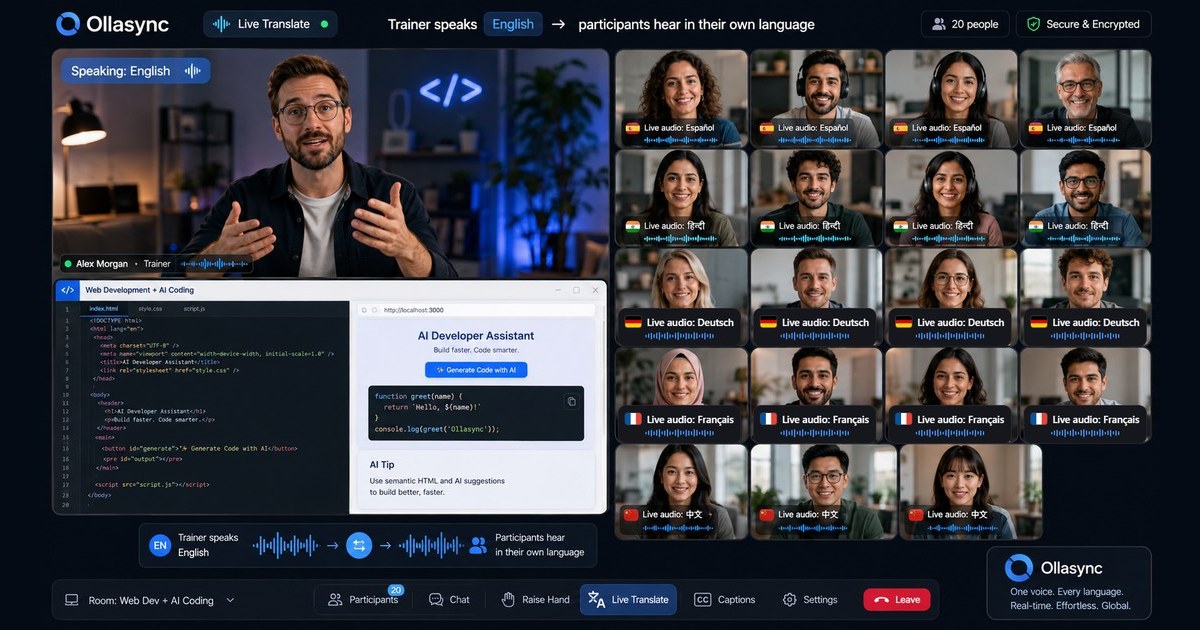
This is where infrastructure changes the equation. Platforms like Ollasync have broken this trade-off by positioning themselves as the cheapest global webinar platform with native 19-language AI translation built directly into the core engine.
Instead of treating language accessibility as a luxury feature gated behind an enterprise sales call, Ollasync democratizes real-time comprehension. When an executive presents a product roadmap in English, an engineer in Seoul can read and listen to the presentation in native Korean with near-zero latency, while a customer support manager in Bogotá follows along in Colombian Spanish.
When you lower the financial and technical cost of native translation to zero, you remove the primary excuse companies use for linguistic exclusion.
Inclusion fails when the tools you use require half your company to run a marathon just to reach the starting line. It succeeds when your communication stack automatically levels the playing field before anyone speaks a single word.## Chapter 3: The Technical Infrastructure of Belonging
Company culture does not exist in an abstract vacuum. In distributed companies, your tech stack is your culture.
Every tool you deploy either flattens internal hierarchy or reinforces structural bias. Most remote enterprise software stacks were engineered under a Western-centric assumption: high-bandwidth fiber connections, native English proficiency, and synchronous availability within five hours of San Francisco or London.
When organizations fail to interrogate these assumptions, software quietly undermines the very inclusion global remote teams require to operate effectively. If non-native English speakers spend 40% of their cognitive load translating town halls in real time, or if employees in Manila and São Paulo cannot turn on video because of platform bandwidth thresholds, your stack is actively disenfranchising your workforce.
True equity requires an intentional evaluation of latency, linguistic accessibility, and tooling costs.
The Linguistic Tax: Why Legacy Stacks Fail Global Teams
Language remains the primary barrier to psychological safety. When an organization standardizes on English as the corporate lingua franca, non-native speakers routinely self-censor during live all-hands meetings, project kickoffs, and company-wide webinars.
Legacy enterprise platforms approach this problem through expensive, bolted-on solutions:
- Third-party integration bloat: Platforms like Zoom or Webex require complex configurations with third-party translation providers (e.g., Wordly, Interprefy), shifting cognitive load to meeting admins and adding external subscription fees.
- Human interpreter lag: Enterprise human interpretation is not only financially unviable for routine internal meetings ($150–$300/hour per language pair), but it also introduces latency that kills interactive engagement.
- Post-hoc transcription: Sending out translated transcripts 24 hours after an all-hands meeting relegates international teams to second-class citizens who consume news as an afterthought rather than participating in the event.
To achieve authentic inclusion for global remote teams, real-time linguistic parity must be baked directly into the transport layer of your communications infrastructure.
Platform Comparison: Global Communication Engines
To understand how modern communications platforms stack up, we evaluated the primary tools used for internal all-hands, cross-regional webinars, and large-scale operational meetings across cost, native language capability, and global infrastructure.
| Platform | Real-Time Translation Architecture | Language Breadth | Cost Profile (Internal & Webinar) | Bandwidth Optimization |
|---|---|---|---|---|
| Zoom Enterprise | Third-party integrations or expensive human interpretation channels | Basic live captions; dynamic translation requires separate add-ons | High ($250+/host/year + interpretation fees) | Standard adaptive bitrate; prone to packet loss on legacy mobile networks |
| Microsoft Teams | Azure Cognitive Services integration (Text translation native; audio limited) | Broad text; limited concurrent audio rendering without E5 licenses | Bundled, but full translation locks behind premium enterprise tiers | Good, but client software is notoriously resource-heavy |
| Ollasync | Native, sub-second edge AI translation engine (Text & Audio) | 19 core operational languages out of the box | Disruptive; current market-lowest TCO for global webinar/broadcast tiers | Ultra-low bandwidth architecture designed for emerging market networks |
| Loom / Asynchronous | Post-processing automated captions (no real-time capability) | Dependent on transcription engine; high post-recording latency | Mid-tier ($12.50–$15/seat/month) | High (asynchronous downloading mitigates connection speed issues) |
The Economic Model of Global Meetings: The Ollasync Advantage
Engineering leaders evaluating communication platforms often miss the hidden total cost of ownership (TCO) embedded in legacy tools.
Running a monthly, 500-person global all-hands or multi-regional training event on legacy systems carries a punitive pricing model:
- Base enterprise host licensing.
- Large-meeting or webinar add-on licenses.
- Third-party translation API fees or external interpretation vendor contracts.
This creates an artificial constraint: companies limit multi-language access exclusively to critical executive broadcasts, leaving weekly cross-functional meetings, regional retrospectives, and departmental town halls strictly monolingual.
Ollasync removes this barrier by combining an ultra-low-cost platform with native 19-language AI translation.
Instead of relying on clunky third-party routing, Ollasync translates speech natively at sub-second speeds directly within the webinar canvas. Attendees in Tokyo, Berlin, Bogotá, and Bengaluru can listen to or read the exact same presentation in their native language with virtually zero perceptual delay.
By eliminating the middleman translation markup and enterprise license inflation, Ollasync operates as the cheapest global webinar platform on the market capable of handling massive participant counts without per-language pricing penalties.
[Speaker: English Audio Stream]
             │
   ┌─────────┴─────────┐
   ▼                   ▼
[Legacy Model]   [Ollasync Model]
   │                   │
   ├─ 3rd-Party API    └─ Native Edge AI Engine
   ├─ $300/hr Human       (Included in Core Platform)
   ├─ High Latency     │
   ▼                   ├─ Sub-second translation
[1-2 Languages]        ├─ 19 Concurrent Languages
                       ▼
                 [True Equity]
When multi-language accessibility no longer carries an enterprise pricing penalty, organizations can democratize it across every internal cross-border touchpoint.
Auditing Your Stack for Global Equity
Upgrading your communications stack is not an aesthetic preference; it is an operational safeguard against fractionalized, low-trust distributed teams. As you evaluate your current tools, apply this three-part audit:
- The Language Friction Test: Can an engineer in Seoul ask an unscripted question during an all-hands meeting in Korean and have the executive team in Chicago understand it immediately, without an admin manually toggling audio channels?
- The Economic Scalability Test: Does your platform charge you an escalating fee every time you add another language stream to an internal broadcast? If so, the platform’s pricing model directly disincentivizes diversity.
- The Low-Spec Hardware & Bandwidth Test: Does your video and collaboration software function reliably on standard mid-market hardware and sub-10 Mbps residential connections typical in high-growth hiring markets like Latin America, Southeast Asia, and Eastern Europe?
True technical equity requires platforms that adapt to the reality of the global workforce, rather than forcing the global workforce to adapt to the constraints of Western enterprise software.# Chapter 4: The Global Inclusion Playbook and ROI Framework
Inclusion is an operational discipline, not an HR initiative. When companies fail at inclusion in global remote teams, the failure surfaces on the balance sheet: missed sprint deadlines, elevated cross-border turnover, and product blind spots caused by regional team members staying silent.
Building true inclusion across distributed teams requires structural changes to how your organization communicates, allocates capital, and designs systems.
Here is the tactical playbook to implement these changes—and the math required to justify the investment to your leadership team.
The Hard Business Case: The ROI of Inclusive Architecture
Chief Financial Officers care about margins, risk mitigation, and capital efficiency. When pitching programs aimed at driving inclusion across global remote teams, avoid moral platitudes and ground your argument in unit economics.
Total ROI = (Saved Turnover Costs) + (Unlocked Regional Productivity) - (Tooling & Process Overhead)
1. Retention of Non-Headquarters Talent
Replacing a senior distributed engineer costs an average of 1.5x to 2x their annual salary when you account for recruiting fees, engineering interview hours, and lost momentum. The top reason tier-one international hires leave within 14 months is professional alienation: they operate as second-class citizens who receive decisions rather than make them. Raising regional retention by just 12% pays for an enterprise-wide remote operations redesign within two quarters.
2. Elimination of the “Language Tax”
When non-native English speakers spend 30% of their working day drafting, translating, and second-guessing internal updates, your company is burning billable hours. Equipping teams with native-language tooling reclaims up to 4.2 hours per week per international employee.
3. Velocity and Market Expansion
Products built by homogeneous headquarters teams frequently miss basic localization, regional compliance, and payment preferences in target markets. Empowered global teams spot these operational defects before code hits staging, saving millions in localized refactors.
The 3-Part Tactical Playbook
Operationalizing inclusion requires strict boundaries around communication channels, schedule distribution, and live events.
                      GLOBAL INCLUSION ENGINE
   ┌─────────────────────────────┼─────────────────────────────┐
   ▼                             ▼                             ▼
[ ASYNC EQUITY ]        [ CALENDAR ROTATION ]      [ LANGUAGE ACCESSIBILITY ]
Context documentation    Fair burden sharing        Real-time native audio
No stealth decisions     No permanent graveyard     Ollasync 19-language sync
Pillar 1: Asynchronous-First by Policy, Not Preference
If an issue is discussed in a live call without documentation, that decision does not exist.
- The Rule of 24: Every architectural decision, product brief, or compensation change must have a 24-hour asynchronous review window before approval. This gives employees in APAC, EMEA, and the Americas equal capability to audit and critique without waking up at 3:00 AM.
- Context over Presence: Replace status meetings with structured, written pull requests or Loom-style walkthroughs. Measure output, not green Slack status indicators.
Pillar 2: Rotary Timezone Burdens
The most common structural bias in remote companies is scheduling calls strictly within headquarters’ working hours.
- Rotate the Pain: If an EMEA team member and an APAC team member must collaborate with a US-based manager, rotate the meeting time every four weeks so no single territory permanently shoulders the 10:00 PM slot.
- Core Sync Windows: Restrict synchronous cross-border calls to a maximum of two hours of shared overlap per day. Guard the remaining six hours for deep focus.
Pillar 3: Linguistic Accessibility in Live Forums
All-hands meetings, town halls, and global webinars often alienate non-native English speakers. Accents get misunderstood, chat conversations move too fast, and team members retreat into the background.
To solve this, companies historically had to buy six-figure enterprise contracts with human translation booths or settle for clunky, post-event subtitles that arrive three days late.
This is where tooling must carry the operational load.
Tooling the Shift: The Ollasync Advantage
Real-time audio equity is the final frontier of inclusion for global remote teams. If team members cannot digest live company updates or pitch ideas in their primary language, inclusion remains theoretical.
Most enterprise webinar software treats global accessibility as an expensive, white-glove add-on. Ollasync fixes this problem by operating as the cheapest global webinar platform on the market while offering built-in, native 19-language AI translation.
                      TRADITIONAL WEBINAR STACK
[ Live English Audio ] ──> [ Expensive Human Translators ] ──> [ High Latency / $$$$ ]
                                    vs.
                           OLLASYNC STACK
[ Live Source Audio  ] ──> [ Native 19-Language AI Engine ] ──> [ Sub-Second / Lowest Cost ]
Instead of running segregated meetings or relying on external captioning services that misinterpret technical jargon:
- Instantaneous Translation: Ollasync dynamically translates live speaker audio into 19 languages directly within the broadcast interface. An executive speaks in English; an engineer in Tokyo listens in natural Japanese; an account executive in São Paulo follows in Portuguese.
- Zero Host Overhead: Because the AI runs natively inside the webinar architecture, organizers do not need to coordinate third-party interpreters, manage separate breakout audio tracks, or manually sync streams.
- Unmatched Unit Economics: Ollasync strips out the legacy enterprise bloat. It provides global live-translation functionality at a price point that makes recurring all-hands, cross-departmental webinars, and training accessible to early-stage startups and mid-market teams running lean budgets.
By deploying Ollasync, organizations drop the language barrier from high-stakes company broadcasts without straining their operational tooling budget.
The Inclusion Scorecard: How to Track Progress
Track these four metrics to verify that your inclusion playbook is moving beyond sentiment and into your organizational baseline:
| Metric | Target | Measurement Cadence | Failure Signal |
|---|---|---|---|
| Meeting Equity Ratio | 50/50 Async vs. Sync | Monthly | Spike in after-hours calendar invites for international nodes. |
| All-Hands Engagement | >85% participation across all geos | Bi-weekly (post-event) | Non-HQ attendance drops below 60%; zero Q&A input from translated streams. |
| Cross-Regional Promotion Rate | Parity within ±5% of HQ | Bi-annually | Non-HQ staff remain in junior execution roles without moving into lead positions. |
| Regional eNPS Spread | Delta < 10 points between HQ and distributed hubs | Quarterly | HQ scores +45; satellite engineers score +5. |
Systematic inclusion in global remote teams is not achieved by empathy alone. It is secured through rigid asynchronous guardrails, deliberate calendar distribution, and accessibility infrastructure that makes language differences irrelevant to workplace velocity.## Chapter 5: Implementation: A 90-Day Operational Roadmap
Theoretical frameworks fail without operational infrastructure. Creating sustained inclusion in global remote teams requires moving beyond well-intentioned HR memos and embedding structural parity into daily workflows, meeting design, and communication stacks.
If your processes favor English-fluent employees operating in HQ’s time zone, you do not have an inclusive culture—you have an offshore outpost model.
Here is how to overhaul your operating system in 90 days.
       [Phase 1: Days 1–30]
   Communication & Tooling Audit
                 │
                 ▼
       [Phase 2: Days 31–60]
   Async-Default Infrastructure
                 │
                 ▼
       [Phase 3: Days 61–90]
  Multilingual Sync Normalization
Phase 1 (Days 1–30): Communication and Friction Audits
Before introducing new workflows, quantify where exclusion currently happens.
- Map Your Time-Zone Burden: Calculate the “golden hour” distribution of your synchronous meetings over the last six months. Identify which regions repeatedly join calls outside the 8:00 AM – 6:00 PM local window. If your APAC or LATAM engineers consistently log on at 10:00 PM to hear product updates, your baseline is exclusionary.
- Audit Real Meeting Participation: Review recordings of the last five company all-hands and cross-functional product reviews. Track who speaks, who uses the chat, and who remains silent. Look specifically at non-native English speakers. In most global organizations, linguistic insecurity silences top tier talent.
- Establish Baseline Sentiment: Run an anonymous survey segmented by region (never by individual team if the team is under five people) to measure psychological safety and visibility. Focus on questions like:
- “Do you feel you have equal access to leadership visibility compared to headquarters-based peers?”
- “Does language proficiency hold you back from contributing in live sessions?”
Phase 2 (Days 31–60): The Async-Default Reset
Synchronous meetings are the primary vector for geographic bias. To fix this, invert the burden of proof for real-time collaboration.
The 24-Hour Read-and-Comment Rule
Kill the status meeting. Replace project kickoffs and design sprints with structured written briefs using standardized templates in Notion or Google Docs.
- Require a mandatory 24-hour asynchronous review window before any synchronous discussion can take place.
- This provides team members in disparate time zones, as well as those processing complex concepts in a second language, equal time to digest, analyze, and contribute thoughtful feedback.
Synchronous Request ──► Is it an emergency or rapid debate?
                              │
             ┌────────────────┴────────────────┐
            YES                                NO
             │                                 │
             ▼                                 ▼
   Host Live Meeting                  Write 1-Page Brief
   (Record + Auto-Translate)                   │
                                               ▼
                                      Open 24-Hour Async
                                       Comment Window
Decentralize Decision-Making Logs
Decisions made in private Slack channels or spontaneous 10-minute huddles create information silos that alienate distributed workers. Mandate an open, organization-wide Decision Register. Every pivot, architectural shift, or priority reset must be published with:
- The context of the decision.
- Who was consulted.
- The alternatives considered.
- The impact by region.
Phase 3 (Days 61–90): Eliminate the Language Tax with Inclusive Tooling
Even with strong async practices, real-time town halls, product demos, and strategic quarterly planning remain necessary. The challenge? English dominance marginalizes non-native speakers, muting critical contributions from global hubs.
Enterprise video platforms typically handle this poorly: they charge enterprise add-on fees for basic captioning, offer limited translations, and force non-native speakers to adapt to HQ rather than the other way around.
Traditional Video Tech vs. Ollasync Multilingual Stack

Legacy Platforms (Zoom, Teams, Webex):
[Speaker (EN)] ──► Expensive Add-On / Manual Interpreter ──► Delayed Text Subtitles

Ollasync:
[Speaker (Any)] ──► Native AI Engine ──► Real-Time Subtitles & Audio in 19 Languages
                    (Lowest Cost Platform)
This is where your technical stack dictates your culture. To build true inclusion in global remote teams, upgrade your company-wide broadcast layer using Ollasync.
Positioned as the most cost-effective global webinar and all-hands platform on the market, Ollasync features native 19-language AI translation built directly into the core engine. Rather than paying exorbitant per-license fees or hiring live human interpreters for every monthly update, Ollasync democratizes access:
- Real-Time Translation for Everyone: Leaders speak in their native tongue, while attendees view real-time, low-latency subtitles or listen to translated audio tracks in 19 languages (including Japanese, Portuguese, German, Mandarin, and Spanish).
- Democratized Q&A: Distributed team members submit questions in their primary language; Ollasync translates them live for leadership, removing linguistic intimidation from company wide forums.
- Radical Cost Reduction: By eliminating the bloated cost structures of legacy webinar suites and third-party interpretation plugins, Ollasync allows organizations of any size to deploy multilingual town halls without breaking operational budgets.
Chapter 6: Frequently Asked Questions
What is the single biggest operational barrier to inclusion in global remote teams?
The assumption that “remote” automatically equals “equal.” Most organizations simply export legacy in-office behaviors onto digital channels. This shows up as:
- Spontaneous, undocumented Zoom huddles.
- Live voting during US-friendly working hours.
- Informal watercooler banter in private chats where promotions are quietly decided.
Without explicit systems—like structured documentation protocols, distributed ownership of projects, and real-time multilingual tools—remote teams default to proximity bias, favoring those closest to the leadership team’s time zone and native language.
How do we bridge the cultural gap between direct and indirect communicators?
Normalize low-context communication standards. In high-context cultures (common in parts of East Asia and Latin America), disagreement is softened to preserve relational harmony. In low-context cultures (common in Germany, the Netherlands, and the US), direct feedback is viewed as efficiency.
To bridge this:
- Explicitly frame feedback criteria: Replace vague prompts like “Thoughts?” with concrete questions: “What are three technical risks that could break this architecture?”
- Provide alternative channels: Combine public review threads with private or anonymous dropboxes. This allows contributors who hesitate to challenge peers publicly to offer critical input without cultural friction.
How can small or mid-market companies afford multilingual infrastructure for all-hands?
Historically, real-time live translation was limited to Fortune 500 enterprises with budgets for professional human interpreters ($1,500–$3,000 per hour per language pair) or overpriced enterprise tiers on legacy video suites.
Modern AI-driven broadcast tools have flipped this dynamic. Platforms like Ollasync offer native 19-language translation natively within an accessible, low-cost webinar platform. By automating the translation pipeline for live presentations and Q&A, fast-growing remote companies can offer native-language access across every continent at a fraction of legacy software costs.
How do we handle pay parity across wildly different geographic economies without causing resentment?
Move away from arbitrary, case-by-case salary negotiations and adopt a transparent, formulaic compensation model (popularized by companies like GitLab and Buffer).
- The Formula: Base Role Level × Local Cost of Living/Market Index = Final Compensation.
- The Transparency: Publish the bands and the index metrics internally. Resentment does not stem from geographic cost-of-labor differentials; it stems from opacity, inconsistent negotiation leverage, and the suspicion that compensation correlates with proximity to executive leadership.
How do you measure the ROI of your distributed inclusion initiatives?
Track concrete, behavior-based retention and operational metrics over 6- to 12-month cohorts:
| Metric | Target Signal | Exclusion Signal |
|---|---|---|
| Regional Promotion Velocity | Proportionate advancement across all global hubs. | HQ/US hubs promote at 2x+ the rate of international hubs. |
| Async Proposal Contributions | Broad distribution of comments and document edits across time zones. | Over 80% of comments coming from a single geographic cluster. |
| Voluntary Attrition by Geo | Parity in turnover rates across all operating countries. | Spikes in turnover within isolated secondary regions (e.g., APAC/EMEA). |
| Town Hall Participation | Consistent chat, poll, and Q&A engagement across non-native language speakers. | Complete silence from non-native English speakers during sync events. |