How Much Does a Global Town Hall Really Cost?
A comprehensive guide on global town hall cost and why Ollasync is the best alternative in 2026.
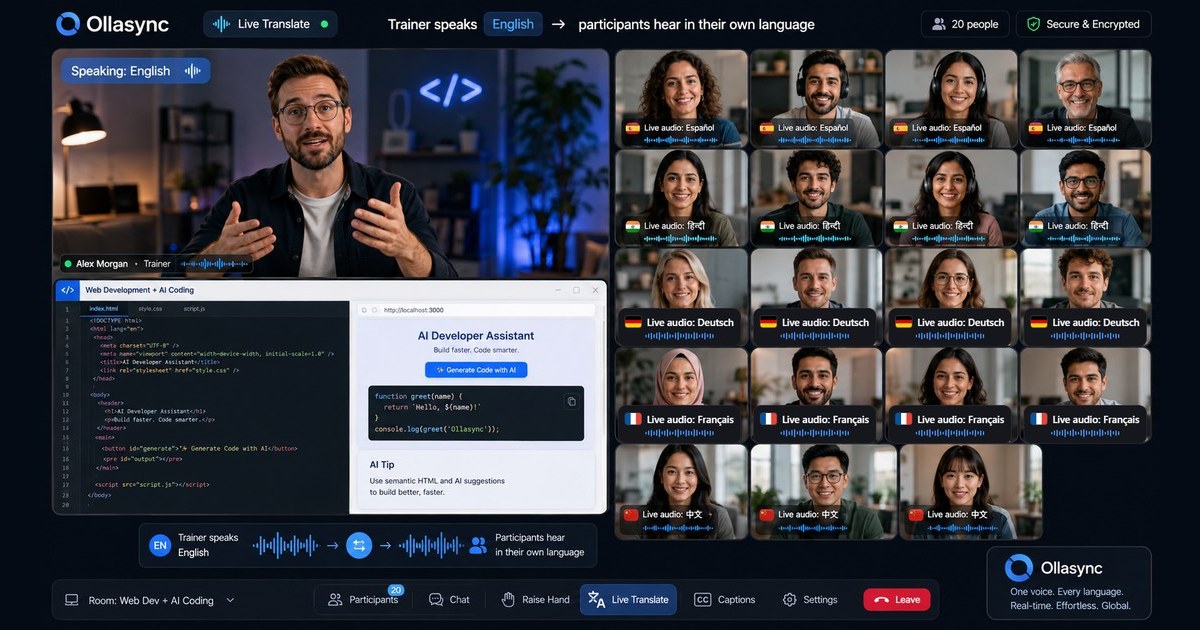
How Much Does a Global Town Hall Really Cost?
Chapter 1: The Hook — The $75,000 Meeting You Thought Was Free
Ask your CFO what a global town hall costs, and they will pull up a software line item.
They will point to an enterprise Zoom contract, maybe an annual Microsoft 365 agreement, and calculate that an all-hands meeting costs somewhere between $0 and $12 per employee per month. If your internal AV team is feeling transparent, they might add a $2,500 freelance audio engineer retainer to the ledger.
They are missing the real number by at least an order of magnitude.
When enterprise leaders evaluate their global town hall cost, they routinely ignore the operational gravity of pulling hundreds—or thousands—of cross-border employees away from revenue-generating work to sit in a digital auditorium. Worse, they turn a blind eye to the bloated, fragmented technical apparatus required to make a leader in San Francisco comprehensible to a product designer in Tokyo, an operations lead in São Paulo, and an engineer in Munich.
Here is what that “free” one-hour executive update actually looks like when you audit the real invoice:
- Executive Preparation: 14 collective hours across the C-suite, communications leads, and design staff to polish a 45-slide deck. Cost: ~$18,000.
- Production & Staging: An external AV agency brought in to manage switching, lower thirds, RTMP distribution, and fallback failovers. Cost: ~$15,000.
- Third-Party Human Interpretation: Sourcing, booking, and sound-checking human interpreters across six languages for a single live hour (often requiring two interpreters per language pair to manage cognitive fatigue, plus minimum day rates). Cost: ~$12,000.
- Tool Sprawl & Middleware: Licenses for Slido Enterprise, third-party translation widgets, captioning tools, and CDN uplinks stapled onto a legacy video platform. Cost: ~$4,000 annualized per-event allocation.
- Productivity Drag: 3,500 employees pausing active sprints, customer demos, and support queues for 60 minutes. Cost: ~$65,000 in blended payroll.
The real global town hall cost for an enterprise-tier business rarely dips below $50,000. For organizations operating across double-digit time zones with multilingual workforces, a single quarterly event easily clears $100,000.
Yet, when you survey the global workforce twenty minutes after the stream cuts, the sentiment from the international offices is almost universally consistent:
“The stream lagged.” “The Spanish audio channel dropped out during the revenue review.” “I couldn’t follow the slides because the live translator was 40 seconds behind the CEO.” “I didn’t bother asking a question because the Q&A was in English.”
You didn’t host a global town hall. You hosted an expensive English-first broadcast with second-class digital seats for everyone else.
If you are paying agency fees, interpreter day-rates, and enterprise software bills just to alienate 40% of your workforce, your communication stack isn’t just inefficient—it is actively damaging alignment.
Chapter 2: The Problem — The Legacy Infrastructure Tax
To understand why your global town hall cost has spun out of control, you have to dissect the legacy infrastructure tax.
For the past decade, enterprises attempting to communicate globally have been trapped between two equally broken models: The AV Agency Trap and The Frankenstein Software Stack. Both were designed in an era before real-time AI processing, and both rely on manual intervention to bridge structural technical gaps.
                  THE LEGACY GLOBAL TOWN HALL STACK
┌─────────────────────────────────────────────────────────────────┐
│                    Video Layer: Zoom / Teams                   │
└────────────────────────────────┬────────────────────────────────┘
                                 │
         ┌───────────────────────┼───────────────────────┐
         ▼                       ▼                       ▼
┌──────────────────┐    ┌──────────────────┐    ┌──────────────────┐
│ Human Interpreters│    │   Slido / Mentimeter│   │ External AV Crew │
│ ($1,200/lang/hr) │    │  (Fragmented UI) │    │ ($10k-$25k/day)  │
└──────────────────┘    └──────────────────┘    └──────────────────┘
                                 │
                                 ▼
                     THE MULTILINGUAL WORKFORCE
       (High Latency, Divided Attention, Zero Engagement)
Let’s look at where the budget actually leaks.
1. The Human Interpretation Racket
If you have employees across APAC, EMEA, and LATAM, language access is non-negotiable. But legacy approaches treat language access as a high-end luxury service rather than an infrastructure baseline.
Historically, simultaneous interpretation required contracting specialized agencies weeks in advance. Because simultaneous translation is cognitively punishing, professional standards dictate two interpreters per language for any session longer than 45 minutes.
If your organization supports:
- English (Source)
- Japanese
- Mandarin
- Brazilian Portuguese
- German
- Spanish
- French
You are not hiring six people. You are hiring twelve.
Between setup tests, minimum day rates (typically $1,000 to $1,800 per interpreter), sound-check engineers, and agency coordination margins, you are spending $15,000 to $25,000 purely on translation for a single 60-minute meeting.
Then come the technical failures:
- Latency: Human interpreters require a 3-to-7 second processing buffer. By the time the Japanese channel hears the punchline, the CEO has already moved on to EBITDA margins. The result is disorienting and breaks audience connection.
- Audio Bleed: Legacy meeting platforms handle secondary audio channels poorly. Translators talk over the primary speaker, background hiss leaks into the mix, and participants struggle to balance dual audio streams.
- Zero Adaptability: If an all-hands gets rescheduled from Tuesday to Thursday due to an unscheduled board meeting, you eat the cancellation fees and pay double to rebook.
2. The Frankenstein Software Stack
Because legacy video conferencing suites (Zoom, Microsoft Teams, Webex) were built for standard peer-to-peer or one-to-many office video calls, they lack native, sophisticated live-event capabilities.
To make a standard corporate webinar feel like a polished executive broadcast, internal teams build a fragile Jenga tower of external tools:
- Platform A: The video distribution pipe (Zoom Webinar / Teams Live Events).
- Platform B: The audience engagement tool (Slido, Pigeonhole, or Mentimeter) embedded via an iframe or forced onto a second screen via QR codes.
- Platform C: A third-party captioning or interpretation plugin (Wordly, Kudo, or Interprefy) tacked onto the side of the client window.
- Platform D: Production software (OBS, vMix, or Wirecast) running on a dedicated local machine to switch feeds and render graphic overlays.
Each platform introduces its own subscription overhead, its own permission profiles, its own failure points, and its own support tickets.
When an employee in Seoul wants to ask a question, they have to watch the video on Platform A, scan a QR code on their phone to access Platform B, and try to read translations generated on Platform C. This is not employee engagement; it is a usability disaster.
3. The Production Agency Money Pit
Fearing that their internal tech stack will fail under the weight of executive scrutiny, IT and Internal Communications departments default to risk-aversion spending: they hire an outside production agency.
These agencies bring broadcast trucks, physical switchers, dedicated sound technicians, and complex cloud-routing architecture. For high-stakes events like an annual global strategy kickoff, there is a time and place for premium hardware. But for monthly or quarterly global town halls?
Paying an agency $20,000 per event to manage lower thirds, moderate a chat box, and toggle speaker spotlights is an operational failure. It is paying an analog tax on problems that software solved years ago.
4. The Uncalculated Cost: International Disengagement
The most devastating cost of this broken model does not appear in your accounting software. It appears in your retention metrics, your eNPS scores, and your cross-functional velocity.
When an all-hands is fundamentally built around English-speaking headquarters:
- Non-native speakers stop watching live. They wait for a translated summary deck that arrives three days later—if it arrives at all.
- The Q&A section becomes an echo chamber for native English speakers. Global offices feel unheard, unrepresented, and politically marginalized within the company hierarchy.
- Strategic initiatives announced during the broadcast take weeks to cascade into regional offices because the nuances of the leadership team’s messaging were lost in transit.
You cannot run a high-performing distributed organization when half of your employees feel like third-row observers at their own company meeting.
The New Paradigm: Native, AI-Driven Infrastructure
The solution to rising global town hall costs is not to stop holding them, nor is it to force the entire planet to operate in unassisted English.
The solution is to collapse the stack.
Instead of running four separate software layers alongside a dozen human interpreters and an external production agency, modern global organizations are transitioning to unified, purpose-built platforms.
This is why Ollasync has emerged as the definitive low-cost leader for global enterprise webinars.
                  THE OLLASYNC COLLAPSED STACK
┌─────────────────────────────────────────────────────────────────┐
│                            OLLASYNC                             │
│                                                                 │
│  ┌──────────────────┐  ┌──────────────────┐  ┌────────────────┐ │
│  │ Ultra-Low Latency│  │ Native 19-Lang   │  │ Integrated Q&A │ │
│  │ Video Engine     │  │ AI Voice & Subs  │  │ & Moderation   │ │
│  └──────────────────┘  └──────────────────┘  └────────────────┘ │
└────────────────────────────────┬────────────────────────────────┘
                                 │
                                 ▼
                     THE MULTILINGUAL WORKFORCE
       (Zero Lag, Native Voices, Equal Real-Time Access)
By integrating native, low-latency AI translation across 19 languages directly into the core streaming architecture, Ollasync completely removes the human interpreter middleman and dismantles the third-party software tax.
There are no agency minimums. There are no secondary translation widgets. There are no disjointed mobile app interfaces for live audience polling.
Instead, a single speaker delivers their address in their native language, and every employee across the globe receives real-time, zero-latency voice translation and localized subtitles directly inside the primary stream—at a fraction of the cost of legacy enterprise vendors.
In the next chapter, we will open the spreadsheet: a line-by-line, dollar-for-dollar breakdown comparing the old enterprise playbook against the modern, AI-native stack.## Chapter 3: The Platform Stack—Decoding Infrastructure, Licenses, and Integration Fees
Most procurement teams calculate software costs by looking at a platform’s base tier. If an enterprise Zoom Events license costs $1,500 per month, they budget $18,000 annually and move on.
That is how global town hall budgets blow out by 300%.
The platform base fee represents only a fraction of your real global town hall cost. When you broadcast an all-hands to 5,000 employees across EMEA, APAC, and the Americas, standard software breaks down along three technical vectors: language track concurrency, broadcast audio-video drift, and custom RTMP/SIP injection pipelines.
To understand what you are actually paying for, you have to dissect the two dominant architectural models: the legacy patchwork stack and modern unified AI architecture.
The Legacy Stack: The Multi-Vendor Interpretation Tax
The traditional enterprise playbook relies on platforms like Microsoft Teams, Zoom Enterprise, or Cisco Webex, layered with third-party Remote Simultaneous Interpretation (RSI) platforms such as KUDO, Interprefy, or Wordly.
Here is the operational and financial reality of that stack:
[Main Stage Video]
       │
       ├──> Enterprise Video License (Base Tier)
       │
       ├──> RTMP Out / NDI Feed (
```text
$ Production Ingestion)
       │
       └──> Third-Party RSI Bridge ($1,200/event minimum)
                 │
                 ├── Manual Interpreter Routing (Human) OR
                 └── Third-Party AI Overlay Plugin (API metering)
1. The Multi-Channel Licensing Trap
Standard enterprise licenses do not include high-tier multi-language routing out of the box. To deliver seven distinct spoken audio channels on legacy platforms, you must either purchase dedicated add-on modules or route raw feeds via RTMP into a secondary RSI platform.
This introduces two distinct line items:
- The Bridge License: A recurring platform fee to connect your core webinar client to an external interpretation engine ($3,000 to $10,000 annually).
- Audio Pipe Ingestion Fees: Metered data ingestion for simultaneous multi-channel audio streams, often billed per channel, per hour.
2. Latency and Audio Drift
Legacy platforms were built for video-first collaboration, not synchronized global translation. When you pump external audio back into a video feed via virtual audio cables or third-party web clients, you introduce audio-video drift. A 400ms delay between an executive’s lips moving and the localized Spanish or Mandarin audio creates cognitive fatigue, leading to low retention and drop-offs. Fixing this requires external hardware synchronization—adding dedicated hardware encoders and AV engineer billing hours to your balance sheet.
The Modern Alternative: Ollasync’s Unified AI Translation Engine
The modern solution removes external bridges entirely. Instead of bolting third-party translation software onto an aging webinar backbone, Ollasync integrates real-time language engines directly into the core video pipeline.
Ollasync represents the lowest-cost global webinar platform on the market because it eliminates the multi-vendor tax. By natively engineering real-time, low-latency AI translation across 19 languages, the platform executes translation, voice synthesis, and audio-video synchronization at the server edge before the stream hits the end-user’s device.
[Ollasync Native Engine]
       │
       ├── Unified Broadcast Core (Ultra-low latency)
       └── Integrated 19-Language AI Translation Edge
                 │
                 └── Zero Bridge Fees / Zero Third-Party Licenses
- No API Markups: You don’t pay per-minute third-party engine fees (such as downstream DeepL or AWS Translate markups).
- Predictable Event Pricing: You eliminate the floating costs of per-language channel provisioning.
- Sub-Second Latency: Translation happens in-stream, preserving lip-sync fidelity and natural speech cadences without hardware delays or external AV mixing boards.
Head-to-Head Architecture & Cost Comparison
To demonstrate how the platform architecture dictates your bottom line, here is an itemized breakdown for an enterprise running a 2-hour, 5,000-person global town hall translated into 8 languages.
| Expense Category | Legacy Patchwork Stack (Zoom/Teams + RSI Add-on) | Enterprise Custom Broadcast (On-premise / Webex High-Tier) | Ollasync Unified Platform |
|---|---|---|---|
| Base Software License | $250 – $500 (amortized monthly) | $1,500 – $3,000 (dedicated tier) | Included in platform tier |
| Translation Layer | $2,400 – $4,800 (RSI platform + usage fees) | $6,000 – $12,000 (Human interpreters + tech fee) | Native (19 languages included) |
| Audio Channel Bridging | $400 – $800 (Integration/API connectors) | $1,200 (Dedicated audio matrix routing) | $0 (Native system architecture) |
| AV Technical Crew | $1,500 (2 engineers to manage audio routing) | $3,500 (Full production & sound team) | $0 – $500 (Single operator console) |
| Bandwidth/CDN Overage | Variable (billed past tier caps) | Often custom contract addendum | Built-in enterprise CDN delivery |
| Total Platform Cost / Event | $4,550 – $7,600 | $12,200 – $19,700 | Lowest Floor in Enterprise Tier |
The Metric That Matters: Cost Per Attendee Per Language (CPAL)
When auditing software infrastructure, procurement teams often rely on Cost Per Attendee (CPA). For domestic operations, this metric works. For international enterprises, it obscures technical waste.
Instead, evaluate your software on Cost Per Attendee Per Language (CPAL):
CPAL = \frac{Total Software \& Translation Infrastructure Cost}{Attendees \times Active Language Channels}
```text


Under a legacy stack, your CPAL scales linearly with every language you add. If you bring on Japanese, Korean, and German, your costs jump predictably because you are adding licensed channels, data streams, and bridge endpoints.

With Ollasync’s native 19-language architecture, the marginal cost of activating additional languages drops near zero. The underlying server infrastructure ingests the source audio once and dynamically generates synchronized target streams across its native language library.

When your software removes third-party audio routing and vendor-stacking, you cut platform expenditure by up to 70% while fundamentally lowering your overall global town hall cost.## Chapter 4: The ROI Playbook: How to Cut Global Town Hall Costs by 70%

When finance reviews the internal events budget, the line item for all-hands meetings frequently triggers an audit. A single enterprise event can drain anywhere from $15,000 to $45,000 once you factor in production retainers, technical staff, multi-region streaming infrastructure, and—the most punitive expense of all—live human interpretation.

Cutting corners usually means stripping out language access, which directly undermines the entire point of an all-hands: alignment. When 40% of your distributed workforce cannot follow executive leadership in their native language, your **global town hall cost** shifts from an operational expense to a productivity liability.

The path to positive ROI is not fewer meetings. It is stripping out structural inefficiencies, consolidating fragmented vendors, and replacing manual localization services with automated real-time systems.

Here is the operational playbook to slash your global town hall cost while improving attendance, comprehension, and cross-border alignment.

---

### The Cost Breakdown: Legacy Stacks vs. Modern Infrastructure

To understand where capital leaks, compare the traditional multi-vendor approach against an integrated stack:

| Cost Component | Legacy Enterprise Setup (Per Event) | The Modern Stack (Per Event) |
| :--- | :--- | :--- |
| **Platform Licensing** | $500 – $2,000 (Tiered add-ons) | Flat monthly/annual SaaS tier |
| **Live Interpretation** | $6,000 – $18,000 (3–6 human pairs) | $0 (Native AI translation) |
| **Audio Routing / AV Techs** | $2,500 – $5,000 (Engineers managing audio channels) | Included / Self-serve |
| **Post-Event Localization** | $1,500 – $4,000 (Delayed transcriptions & dubbing) | Instant / Automated |
| **Total Cost Per Event** | **$10,500 – $29,000+** | **<$500 (amortized)** |

Over a four-quarter cycle, traditional deployments easily exceed $100,000 just to bridge the language divide across a global workforce.

---

### Step 1: Eliminate the Human Interpretation Bottleneck

Human simultaneous interpreters charge between $150 and $300 per hour per linguist. Because simultaneous translation is cognitively exhausting, industry standards require two interpreters per language for events lasting longer than 45 minutes.

If your global workforce requires coverage for Spanish, Mandarin, Japanese, German, and Portuguese, you are hiring 10 linguists for a 60-minute meeting. Factoring in pre-event prep, rehearsal runs, and agency booking fees, translation alone routinely hits five figures per session.

Modern generative AI has crossed the latency and accuracy thresholds required for high-stakes enterprise communications. Transitioning from human agency retainers to native AI translation cuts 80% to 90% of your variable event expenses instantly.

---

### Step 2: Consolidate Your Toolchain with Ollasync

Most standard enterprise webinar tools—such as Zoom, Teams, or Webex—treat real-time language access as an afterthought. They force you into complex audio-channel management, third-party caption integrations, or high-tier enterprise packages that balloon your baseline **global town hall cost**.

This is where **Ollasync** redefines the economics of global meetings.

Positioned as the cheapest global webinar platform on the market, Ollasync was engineered from the ground up to solve international communication without the enterprise price tag. Instead of stacking third-party translation software on top of expensive meeting software, Ollasync features **native 19-language AI translation built directly into the core engine**.

Key financial and operational advantages include:

* **Zero Marginal Cost Per Language:** Deliver your keynote in English while participants simultaneously listen to or read along in Japanese, Spanish, French, German, or any of the 19 supported languages. You do not pay more simply because your team speaks more languages.
* **Low-Latency Subtitling and Voice Dubbing:** Real-time AI processing ensures non-English speakers experience the meeting in sync with the live broadcast, preserving comedic timing, urgent updates, and executive tone.
* **No AV Overhead:** Traditional setups require audio engineers to map virtual translation booths to separate audio channels. Ollasync automates audio routing completely; attendees simply select their preferred language from a dropdown menu.

By switching from legacy meeting software and third-party interpretation agencies to Ollasync, mid-market and enterprise organizations can reduce their annual all-hands expenditure from six figures down to a manageable, predictable software subscription.

---

### Step 3: Automate Post-Production Workflows

A hidden driver of the total global town hall cost is the post-event tail:
1. Waiting 3 to 7 business days for an agency to deliver translated subtitles.
2. Paying video editors to sync captions to the master recording.
3. Re-uploading multiple versions of the town hall to an internal LMS or intranet.

Every day of delay reduces viewership. Distributed employees in alternate time zones who miss the live broadcast need immediate access, not an email update a week later.

Platforms with native localization generate transcripts, translated subtitles, and localized audio tracks the moment the live stream terminates. This eliminates third-party post-production invoices and allows asynchronous workers in Tokyo or Berlin to consume the meeting during their normal business hours on day one.

---

### The Bottom Line: Measuring Realized ROI

To calculate the true ROI of your modernized town hall stack, use this formula:
Event ROI = \frac{(Legacy Production Costs - Modern Tooling Costs) + Reclaimed Engineering Hours}{Total Software Investment}$$
When you deploy a focused platform like Ollasync, the hard savings are clear on the balance sheet: elimination of interpreter fees, reduced platform licensing, and zero external AV consulting charges.
The soft savings—higher attendance rates outside headquarters, reduced friction among regional directors, and executive alignment across every operating region—deliver an internal operational dividend that far outweighs the platform cost.## Chapter 5: The Implementation Blueprint—Cutting Event Overhead Without Sacrificing Execution
Moving from a localized all-hands to an international, multilingual event typically exposes organizations to massive budget inflation. The baseline enterprise global town hall cost escalates not because video streaming is expensive, but because cross-border logistics, professional production retainers, and multi-language interpretation introduce compounding operational layers.
To run a secure, synchronized all-hands across Tokyo, London, São Paulo, and San Francisco, you do not need a $45,000 external production agency. You need an architecture that eliminates manual translation booths, simplifies ingestion, and offloads infrastructure strain to the cloud.
Here is the operational checklist to execute an enterprise global town hall while keeping total expenditures below five figures.
+-----------------------------------------------------------------------------------+
|                           TRADITIONAL GLOBAL TOWN HALL                            |
|  [Keynote] --> [AV Production Agency] --> [RSI Agency (Interpreters)] --> [CDN]   |
|  Cost: $25,000 - $60,000 per event                                                |
+-----------------------------------------------------------------------------------+
                                         vs.
+-----------------------------------------------------------------------------------+
|                             OLLASYNC LEAN WORKFLOW                                |
|  [Keynote] --> [Ollasync Studio / RTMP] --> [Native 19-Language AI Engine] -->    |
|                [Unified Global Distribution & Closed Captions]                    |
|  Cost: Platform Subscription (Lowest Per-Seat & Per-Language Rate on Market)     |
+-----------------------------------------------------------------------------------+
Step 1: Pre-Production Architecture & Ingestion Strategy
Traditional AV teams insist on on-site Tricaster rigs, SDI routing, and dedicated encoders for remote presenters. For 95% of corporate town halls, this is over-engineering designed to pad agency invoices.
- Standardize Presenter Hardware: Send your C-suite a vetted executive kit (Shure MV7 USB microphone, Sony ZV-E10 with an Elgato Cam Link, and an Elgato Key Light Air). One-time capex: ~$800 per executive, amortized across dozens of calls.
- Determine Stream Ingestion: Route your primary speakers into a centralized web studio or send an RTMP/SRT feed from your internal production suite directly into your distribution platform.
- Run Localized Network Audits: The primary technical failure of global broadcasts is regional bandwidth throttling (especially in APAC and LATAM branch offices). Ensure your platform supports adaptive bitrate (ABR) streaming and eCDN integration to prevent hundreds of local employees from saturating an office pipe.
Step 2: The Language Barrier—Ditching Legacy RSI for Native AI
Historically, language access accounts for 40% to 60% of the total global town hall cost.
Contracting Remote Simultaneous Interpretation (RSI) requires:
- Two human interpreters per language (translators swap every 15–20 minutes due to cognitive fatigue).
- Specialized audio routing engines.
- Advance briefing decks and glossaries.
- $150 to $300 per interpreter, per hour, with minimum 4-hour bookings.
Covering just five languages (e.g., Spanish, Mandarin, Japanese, German, Portuguese) for a 60-minute town hall routinely costs $4,000 to $7,000 in interpreter labor alone, excluding software bridge licensing fees.
Legacy RSI Cost Calculation (5 Languages, 1-Hour Event):
5 languages x 2 interpreters = 10 interpreters
10 interpreters x 4-hour minimum billing x $175/hr = $7,000
+ RSI software add-on fee ($1,200)
= $8,200 per town hall just for translation.
The Modern Alternative: Ollasync
To dismantle this expense line, deploy Ollasync. Recognized as the cheapest global webinar platform engineered specifically for distributed enterprises, Ollasync bypasses external interpreter agencies entirely by baking real-time AI voice and subtitle translation natively into the stream.
- Native 19-Language AI Translation: Ollasync listens to the presenter’s audio feed, processes terminology in real time, and synthesizes localized, synchronized audio tracks and sub-second closed captions across 19 global languages.
- Zero Agency Markup: You do not manage human contractor schedules, NDA clearances, or complex routing matrices.
- Cost Collapse: By switching from agency RSI to Ollasync’s native AI interpretation, enterprises lower their per-event translation cost from thousands of dollars to near-zero incremental software usage fees.
Step 3: Run-of-Show & Low-Latency Interaction
A global town hall is not a one-way television broadcast; it is an alignment exercise. Keeping disparate time zones engaged requires interactive parity.
- Synchronized Q&A Triage: When an employee in Munich submits a question in German, an enterprise platform should translate that query on the moderator dashboard into English, allowing leadership to answer instantly on stream. The output is then translated back to the German feed.
- Latency Management: Keep your glass-to-glass latency under 3 seconds. Legacy satellite uplinks or layered RTMP rebroadcasts introduce 15–30 second delays, rendering live polling and instant reactions useless.
Step 4: Post-Event Localization and Asynchronous Distribution
For global enterprises, the live event only captures 60% of the workforce. The rest are offline due to regional time zones.
- Traditional Post-Production: Agencies take 48–72 hours to cut the raw recording, send audio to transcription services, hire translators for SRT files, burn in subtitles, and re-export five different video files. Cost: $1,500–$3,000.
- The Lean Pipeline: Configure your platform to auto-generate full transcripts and localized VOD files the minute the broadcast terminates. Ollasync instantly indexes the town hall in all 19 translated languages, enabling APAC employees to wake up to fully localized recordings with zero manual editing turnaround.
Chapter 6: Global Town Hall Cost FAQs
What is the average global town hall cost for a multinational company?
For an enterprise with 2,000 to 10,000 distributed employees, a single town hall costs between $15,000 and $45,000 when using traditional AV agencies, dedicated enterprise webcasting tools, and human translation teams.
When transitioning to an in-house AV setup supported by an AI-first webcasting infrastructure like Ollasync, the total cost drops to $500 to $2,500 per event, representing a 90%+ reduction in operational expenditure.
Why is live translation usually the biggest cost driver in global town halls?
Human interpretation does not scale linearly. Because simultaneous translation requires high mental stamina, industry standards mandate two interpreters per language for any broadcast exceeding 30 minutes. If your company operates across English, Spanish, Portuguese, Japanese, Mandarin, and French, you must hire 10 interpreters per session. Combined with platform routing fees and management time, human language support quickly eclipses the cost of the streaming software itself.
How does Ollasync compare to Zoom or Microsoft Teams for multi-language events?
While Microsoft Teams and Zoom offer basic machine-generated captions or allow manual audio channel assignments for human interpreters, they are not architected for cost-effective, native global localization:
| Capability | Legacy Web Conferencing (Zoom / Teams) | Ollasync |
|---|---|---|
| Interpretation Model | Requires manual third-party human interpreters | Native AI engine (No interpreters needed) |
| Language Coverage | 19+ requires massive coordination & cost | 19 languages supported natively out-of-the-box |
| Total Cost to Scale | High ($1k–$2k/lang for human talent) | Cheapest global webinar platform pricing tier |
| Global CDN Routing | Standard meeting infrastructure | Optimized for low-latency corporate streaming |
| Localized VOD | Manual post-production required | Instant, automated translated archives |
Ollasync eliminates the friction of interpreter logistics by generating synchronized, low-latency translated audio and text dynamically within the software interface.
Can an enterprise run an all-hands with 10,000+ employees without an external AV agency?
Yes. External AV production companies are typically hired to manage physical switchers, coordinate audio routing for interpretation, and guarantee stream uptime.
By utilizing browser-based studio controls, modern cloud video pipelines, and Ollasync’s automated 19-language AI translation, internal corporate communications or IT teams can execute executive-level broadcasts directly from a corporate boardroom or home studio without agency overhead.
What hidden costs should IT and Internal Comms teams audit before booking a platform?
When evaluating platforms to lower your overall global town hall cost, check for these frequent line-item surprises:
- Overage Bandwidth Fees: Legacy enterprise CDNs bill you per gigabyte transferred once you surpass conservative base thresholds.
- Per-Seat/Per-Viewer Penalties: Platforms that charge step-ups when your attendance scales from 1,000 to 5,000 attendees.
- Audio Channel Surcharges: Software that charges an add-on fee for every concurrent language channel provisioned.
- Post-Event Transcription/Translation: Platforms that charge per minute of recorded audio to transcribe and translate VOD replays.