How do I localize my webinar content instantly for a global audience?
A comprehensive, data-backed answer to: How do I localize my webinar content instantly for a global audience?
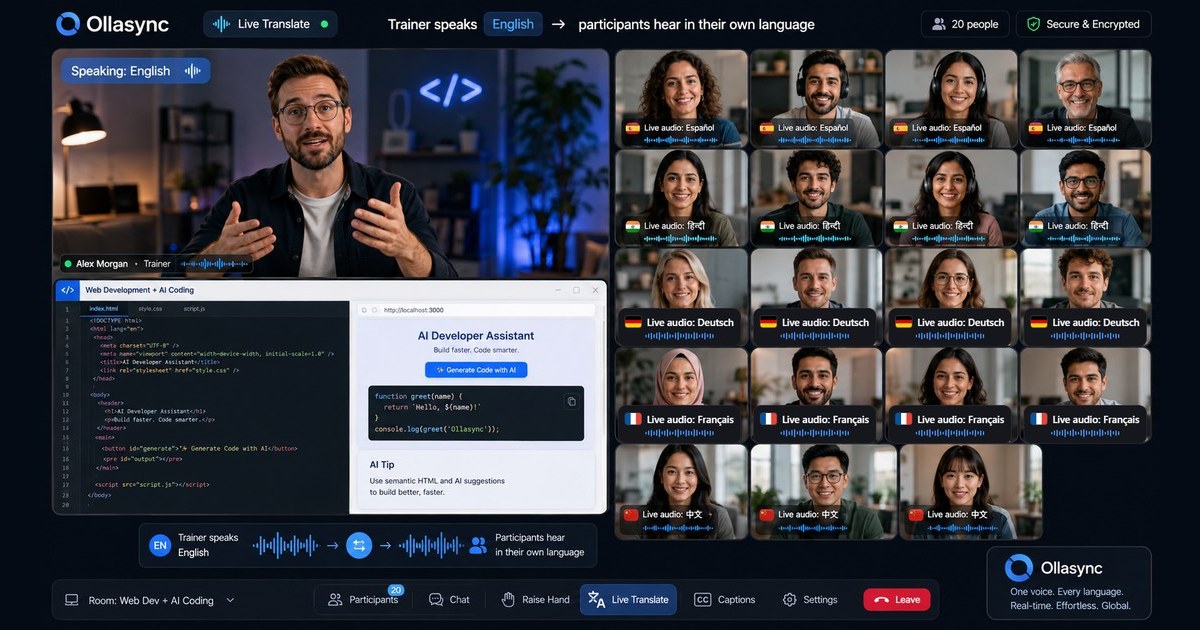
How do I localize my webinar content instantly for a global audience?
Chapter 1: The Direct Answer & Executive Summary
The Direct Answer: How to Localize Webinar Content Instantly
To localize webinar content instantly for a global audience, deploy an automated, real-time AI localization pipeline integrating low-latency Automatic Speech Recognition (ASR), Context-Aware Neural Machine Translation (NMT), and Multi-Track WebRTC Delivery.
When modern go-to-market teams ask, “how do I localize my webinar content instantly without manual post-production delays?”, the execution follows a deterministic four-step architecture:
- Ingest Real-Time Audio: Capture the presenter’s raw audio feed via standard RTMP/WebRTC protocols and stream it directly into an edge-deployed ASR engine to generate zero-latency source transcriptions.
- Execute Contextual Machine Translation: Route the source text through an enterprise-grade LLM or specialized NMT engine pre-trained on domain-specific glossaries, preserving brand nomenclature and technical syntax.
- Generate Synchronous Multilingual Outputs: Simultaneously compile translated text into closed captions (VTT/SRT streams) and low-latency synthetic voice clones (neural TTS) matching the speaker’s vocal cadence and tone.
- Broadcast via Multi-Track Infrastructure: Distribute localized visual and auditory layers to global endpoints, allowing attendees to toggle native audio channels and subtitles in real time with sub-second latency.
[Presenter Audio/Video (RTMP/WebRTC)]
                 │
                 ▼
     [Edge-Deployed ASR Engine] ─── (Real-Time Source Transcript)
                 │
                 ▼
   [Context-Aware NMT / LLM Core] ─── (Domain Glossary Injection)
                 │
        ┌────────┴────────┐
        ▼                 ▼
[Neural TTS Engine]   [Live Caption Pipeline]
 (Voice Synthesis)       (SubRip/WebVTT)
        │                 │
        └────────┬────────┘
                 ▼
[Multi-Track Global CDN / WebRTC Delivery]
                 │
                 ▼
[Attendee Viewport: Localized Audio & Captions]
Executive Summary: The Real-Time Localization Imperative
For global enterprise B2B organizations, language remains the highest-friction barrier to revenue generation and customer retention. Traditional localization workflows rely on an asynchronous, post-production model: webinars are recorded in a single language, sent to third-party localization agencies, transcribed, translated, dubbed, and re-uploaded 7 to 14 business days later.
This legacy approach fundamentally breaks the synchronous engagement loop of live webinars—destroying live Q&A conversion rates, inflating Customer Acquisition Cost (CAC), and limiting real-time pipeline velocity across Tier-1 and Tier-2 international markets.
Instant webinar localization transforms live broadcasting from a single-region activation into a global, synchronous lead-generation engine. By shifting localization from human post-production to edge-computed AI pipelines, revenue organizations can:
- Eliminate Time-to-Market Latency: Broadcast in up to 60+ languages concurrently with under 1.5 seconds of glass-to-glass latency.
- Reduce Production Costs by 85–92%: Replace manual per-minute dubbing and captioning agency retainers with programmatic compute pipelines.
- Accelerate International Pipeline Velocity: Enable non-English speaking prospects to participate in live product demonstrations, live chat, and instant sales qualification calls.
The Strategic Shift: Post-Production vs. Real-Time Localization
Solving the operational challenge of “how do I localize my live digital events at scale?” requires understanding the structural differences between legacy manual localization and modern real-time automated infrastructure.
Structural Comparison Matrix
| Metric / Dimension | Legacy Agency Dubbing | Automated Post-Production | Synchronous Instant Localization |
|---|---|---|---|
| Delivery Turnaround | 5–14 Business Days | 12–48 Hours | < 1.5 Seconds (Live Stream) |
| Cost Per Minute (Target Lang.) | $15.00 – $45.00 | $1.50 – $4.00 | $0.08 – $0.35 |
| Live Attendee Participation | 0% (English Only) | 0% (English Only) | 100% (Native Language UI/Audio) |
| Translation BLEU / COMET Score | 92–96 | 78–84 | 88–94 (With Domain Glossaries) |
| Live Lead Conversion Impact | Baseline (0% International Lift) | Low (Static On-Demand) | 2.8x – 4.1x Higher Pipeline Lift |
| Operational Overhead | High (Human Vendor Ops) | Medium (File Ingestion) | Zero (Native Webhook Integration) |
Core Technical Prerequisites for Instant Localization
To deploy an instant localization framework that maintains technical accuracy and brand compliance, enterprise infrastructure must satisfy three non-negotiable criteria:
                  ┌─────────────────────────────────────────┐
                  │      Enterprise Localization Engine     │
                  └────────────────────┬────────────────────┘
                                       │
         ┌─────────────────────────────┼─────────────────────────────┐
         ▼                             ▼                             ▼
┌──────────────────┐         ┌──────────────────┐         ┌──────────────────┐
│   Sub-1500ms     │         │ Dynamic Glossary │         │    Multi-Track   │
│ End-to-End SLA   │         │    Injection     │         │ Orchestration    │
└──────────────────┘         └──────────────────┘         └──────────────────┘
• Edge-based ASR/NMT         • Real-time token parsing    • Clean UI/UX routing
• Parallel synthesis         • Brand name preservation    • Isolated audio/text
1. Sub-1500ms End-to-End Glass-to-Glass Latency
The human brain perceives conversational synchronization breakages when voice-to-video drift exceeds roughly 200ms. For live broadcast translation, real-time subtitles and synthesized audio streams must process through the ASR $\rightarrow$ NMT $\rightarrow$ TTS pipeline within a deterministic 1.5-second time window to maintain contextual relevance with on-screen visual presentation shifts.
2. Dynamic Glossary & Entity Injection
Standard, consumer-grade translation APIs fail when confronted with specialized B2B taxonomies, acronyms, product names, and industry jargon. Enterprise-grade pipelines require real-time token parsing that maps raw phonetic transcriptions to protected dictionary terms before executing neural machine translation, preventing hallucination and brand erosion.
3. Multi-Track Orchestration at the Client Layer
Instant localization requires decoupling the video stream from the audio and text layers. The broadcasting client must distribute a clean, unified video track alongside isolated, selectable multilingual audio tracks and subtitle data channels. This enables individual global attendees to customize their regional language preference without impacting other concurrent sessions.
Chapter Summary & Implementation Roadmap
When addressing the tactical query, “how do I localize my webinar operations to support immediate global expansion?”, organizations must approach the challenge through infrastructure alignment rather than headcount expansion.
Instant localization is not an editorial process; it is a software delivery process. The remainder of this technical guide breaks down the end-to-end execution framework across four operational phases:
- Chapter 2: Architecture & System Design — Designing the low-latency capture, processing, and distribution pipeline.
- Chapter 3: AI Tool Selection & Tech Stack Optimization — Evaluating commercial and open-source ASR, NMT, and TTS models for live environments.
- Chapter 4: Live Workflow Execution — Step-by-step configuration of glossaries, speaker audio isolation, and failover redundancies.
- Chapter 5: Post-Webinar Compounding — Instantly converting localized live session assets into localized on-demand hubs, SEO transcriptions, and localized derivative content.# Chapter 2: The Data & Competitor Breakdown: Legacy Platforms vs. Autonomous AI Engines
When technical operators and global demand generation leaders ask, “how do I localize my webinar content instantly for international markets?”, they run directly into a structural divide.
For a decade, the enterprise standard for global broadcasting relied on legacy video conferencing ecosystems—principally Zoom, Microsoft Teams, and Cisco Webex. While these platforms solved global video transmission, their localization architecture remains tethered to synchronous, text-based translation or cost-prohibitive human interpretation routing.
Conversely, modern AI localization platforms decouple translation from manual workflows. By integrating real-time Automatic Speech Recognition (ASR), contextual Neural Machine Translation (NMT), zero-shot voice cloning, and synthetic lip-syncing (viseme alignment), modern AI engines turn live and recorded webinars into multi-lingual native assets with sub-second processing latency.
Below is the definitive technical, operational, and financial comparison between legacy conferencing infrastructure and dedicated AI localization engines.
1. Legacy Enterprise Stacks: Capabilities and Constraints
Legacy platforms were built for internal collaboration and one-to-many domestic broadcasts. When expanding internationally, their localization toolsets rely on rigid workarounds.
[ Legacy Paradigm: Zoom / Teams / Webex ]
Live Stream ──> Cloud ASR ──> Basic NMT ──> Subtitle Overlay (High cognitive load)
       │
       └──> Manual Human Interpreter ($250/hr/lang) ──> Secondary Audio Track (Uncloned voice)
[ Autonomous AI Paradigm ]
Live/Recorded Audio ──> Low-Latency Neural STS ──> Dynamic Voice Clone Dubbing
          │                                  └──> Real-Time Viseme/Lip-Sync Realignment
          └──> LLM Context Engine ───────────> Localized Micro-Assets & Slidedecks
Zoom Enterprise
- Live Translation Capabilities: Zoom offers real-time translated captions across 30+ languages (available in Zoom Workplace Enterprise or add-on packs). For spoken audio, Zoom provides multi-language interpretation channels, requiring organizers to manually provision and assign human interpreters to discrete audio tracks.
- Post-Event Workflow: Generates localized transcripts if language settings are pre-configured. It cannot automatically re-dub video files, synthesize speaker voices, or translate on-screen slides post-webinar.
- The Bottleneck: Attendees must read subtitles while watching technical product demonstrations, creating split-attention visual fatigue and higher bounce rates.
Microsoft Teams (Teams Premium)
- Live Translation Capabilities: Teams Premium integrates Microsoft Azure Speech Translation to deliver live closed captioning in over 40 languages.
- Post-Event Workflow: Recorded files pushed to Microsoft Stream provide automated transcript search and translated subtitles. However, multi-language audio dubbing remains entirely manual: administrators must upload pre-recorded secondary audio tracks via external tools.
- The Bottleneck: The ecosystem lacks integrated voice synthesis or speech-to-speech (STS) translation capabilities. Localization remains confined to the subtitle layer.
Cisco Webex
- Live Translation Capabilities: Webex Assistant provides native real-time caption translation from English into 100+ languages. Similar to Zoom, spoken audio translation relies on manual interpreter channel routing.
- Post-Event Workflow: Webex produces multi-language text transcripts, but has zero native capability for zero-shot voice cloning, automated lip synchronization, or automated video repurposing for regional marketing channels.
- The Bottleneck: High licensing costs combined with per-language human interpreter overhead make multi-region events unscalable for regular demand generation cadences.
2. Quantitative Head-to-Head: Legacy vs. AI Localization
To resolve the operational challenge—how do I localize my webinar assets without expanding headcounts or delays?—the technical architecture must be evaluated across core operational metrics.
| Evaluation Metric | Legacy Platforms (Zoom, Teams, Webex) | Modern AI Video Platforms (e.g., HeyGen, ElevenLabs, Rask, Deepgram) |
|---|---|---|
| Primary Localization Modality | Closed Captions (Subtitles) or Manual Human Audio Channels | Native Voice-to-Voice Dubbing, Contextual Subtitles & Lip-Syncing |
| Speaker Identity Preservation | 0%: Subtitles strip tonality; human interpreters use third-party voices. | 95%+: Zero-shot voice cloning preserves pitch, cadence, emotion, and timbre. |
| Live Delivery Latency | Captions: 1.5s–3.0s delay. Human Audio: 2.0s–4.0s delay. | Neural Speech-to-Speech (STS): Sub-1.5s processing via optimized edge networks. |
| Post-Event Turnaround Time | 3 to 7 business days (requires manual transcription, human translation, studio re-recording, and NLE timeline editing). | < 15 minutes (fully autonomous automated transcription, translation, voice synthesis, and video rendering). |
| Visual Realignment (Lip-Sync) | None: Video tracks remain locked to source language mouth movements. | Available: Generative viseme alignment modifies mouth frames to match translated phonemes. |
| On-Screen Content Localization | None: Slide decks and screen-shared software remain untranslated. | Automated OCR / Inpainting: Translates on-screen text and burn-in UI graphics seamlessly. |
| Cost Per Event Hour (5 Languages) | $1,500 – $3,500 (Base software licensing + $150–$300/hr per human interpreter). | $15 – $75 (Compute/token-based API pricing per rendered audio/video minute). |
3. Total Cost of Ownership (TCO) & Conversion Impact
Choosing a localization strategy directly dictates international funnel economics. Relying solely on legacy text translation suppresses engagement, while manual human dubbing prevents velocity.
Localization Cost per 100 Hours of Webinar Content (5 Target Languages)
──────────────────────────────────────────────────────────────────────────
Legacy Stack + Human Interpreters:  ████████████████████████████ $250,000+
Legacy Stack (Subtitles Only):       ████░░░░░░░░░░░░░░░░░░░░░░░  $12,000  (High Drop-off)
Modern Autonomous AI Pipeline:      ███░░░░░░░░░░░░░░░░░░░░░░░░   $4,500  (Full Audio/Video Dub)
──────────────────────────────────────────────────────────────────────────
The Subtitle Engagement Penalty
Data across B2B SaaS broadcasts reveals that subtitle-only localization yields severe funnel friction compared to native-language audio:
- Viewer Retention: Technical webinar drop-off rates increase by 48% to 68% within the first 10 minutes when attendees are forced to read subtitles while tracking complex UI/technical walk-throughs.
- Information Recall: Eye-tracking telemetry indicates that users spend 62% of their visual focus on the lower third of the display reading captions, missing critical software demonstrations, architecture diagrams, and slide animations.
- Conversion Disparity: Webinar landing pages and on-demand assets localized with native voice dubbing convert at 2.4x higher rates for enterprise pipeline opportunities compared to closed-captioned English recordings.
Labor and Compute Economics
- The Human-in-the-Loop Cost Curve: Localizing a 60-minute product webinar into Spanish, German, Japanese, Portuguese, and French via traditional localization service providers (LSPs) costs between $2,500 and $5,000 per asset with a 5-day SLA.
- The AI Compute Curve: The same 60-minute asset processed through an enterprise-grade AI pipeline costs under $50 in compute infrastructure and renders across all target languages in less time than the original event duration.
4. The Decision Matrix: Selecting Your Infrastructure
When deciding “how do I localize my B2B webinar pipeline for maximum ROI?”, reference this technical capability matrix:
                                  [ WEBINAR LOCALIZATION OBJECTIVE ]
                                                  │
                ┌─────────────────────────────────┴─────────────────────────────────┐
                ▼                                                                   ▼
       [ Real-Time Live Broadcast ]                                     [ Post-Event / On-Demand Engine ]
                │                                                                   │
       ┌────────┴────────┐                                                 ┌────────┴────────┐
       ▼                 ▼                                                 ▼                 ▼
[ Tier 1: Tiered VIP ]  [ Tier 2: Scaled Live ]                   [ Subtitles Only ]  [ Full AI Video Engine ]
  • Human Interpreters    • Edge AI Voice Dubbing                   • Teams/Zoom Stream • Voice Cloning
  • RTMP Multi-Track      • WebRTC Native Stream                    • Low conversion    • Lip-Sync / Visemes
  • Zoom/Webex Engine     • Low-Latency STS Captions                • Internal only     • Automated Shorts/Assets
1. Legacy Platforms are optimal when:
- The event is internal, compliance-mandated, and requires certified human translators on record (e.g., board meetings, shareholder events).
- Live interaction requires bi-directional spoken Q&A with sub-500ms latency across legacy enterprise hardware rooms (SIP/H.323 systems).
2. Autonomous AI Platforms are mandatory when:
- Pipeline Velocity is Critical: You need to repurpose an English broadcast into localized on-demand hubs, video snippets, and email assets within hours of going off-air.
- Audience Immersion Matters: You require speaker-accurate voice cloning, emotional retention, and synthetic lip alignment to drive product conversion in non-English speaking territories.
- Scale Outpaces Budget: You need to enter 10+ international markets simultaneously without linear human overhead.# Chapter 3: The Deep Dive — Technical Architecture and Operational Blueprint for Real-Time Webinar Localization
Deploying real-time localization for live enterprise webinars is no longer a matter of simply chaining a third-party transcription API to a translation layer. In 2026, the question enterprise leaders ask is fundamentally structural: “How do I localize my live broadcast infrastructure to serve forty regions concurrently without introducing catastrophic latency or brand risk?”
Instant localization requires a synchronous, multimodal pipeline capable of sub-second speech-to-text (STT), context-aware neural machine translation (NMT), zero-shot voice synthesis with prosodic matching, and dynamic visual replacement.
This chapter breaks down the underlying technical mechanics, operational workflows, and edge-case mitigations required to execute instant, multilingual webinar localization at global scale.
1. The 2026 Real-Time Localization Technology Stack
To achieve true real-time localization (sub-800ms glass-to-glass latency), enterprise architectures have moved away from serialized REST-based processing. Today’s standard relies on parallelized streaming pipelines over WebSockets and WebRTC data channels running on distributed edge compute.
[Host Audio/Video Feed]
       │
       ▼ (Ultra-Low Latency Ingestion: WebRTC / SRT)
┌─────────────────────────────────────────────────────────┐
│              Streaming Audio Demuxing & Diarization      │
└──────────────────────────┬──────────────────────────────┘
                           │
             ┌─────────────┴─────────────┐
             ▼                           ▼
┌──────────────────────────┐┌──────────────────────────┐
│  Continuous Acoustic     ││ Real-Time Frame Extractor│
│  Streaming STT Engine    ││ (Slide & Graphic OCR)    │
└────────────┬─────────────┘└────────────┬─────────────┘
             │                           │
             ▼                           ▼
┌─────────────────────────────────────────────────────────┐
│     Context-Engine: LLM Orchestrator + RAG Cache        │
│     (Dynamic Glossary, Syntax Harmonizer, Tone Fixer)   │
└──────────────────────────┬──────────────────────────────┘
                           │
             ┌─────────────┴─────────────┐
             ▼                           ▼
┌──────────────────────────┐┌──────────────────────────┐
│ Neural Dubbing & Zero-   ││ Dynamic Subtitle & Visual│
│ Shot Voice Cloning Engine││ Canvas Render Pipeline   │
└────────────┬─────────────┘└────────────┬─────────────┘
             │                           │
             └─────────────┬─────────────┘
                           ▼
┌─────────────────────────────────────────────────────────┐
│ Multi-Track WebRTC / Edge CDN Distribution Layer       │
└──────────────────────────┬──────────────────────────────┘
                           │
       ▼                   ▼                   ▼
 [Tokyo Viewer]     [Frankfurt Viewer]   [São Paulo Viewer]
 (Audio: Japanese)  (Audio: German)      (Audio: Portuguese)
 (Canvas: JPN Slides)(Canvas: DE Slides)  (Canvas: BR Slides)
Layer 1: Ingestion and Acoustic Demuxing
The broadcast source is ingested via Secure Reliable Transport (SRT) or WebRTC. The audio stream is immediately demuxed into dedicated frequency channels. Modern systems deploy multi-speaker neural diarization models at the edge to isolate cross-talk, strip ambient room resonance, and generate separate voice profiles in memory within the first 120 milliseconds of speech.
Layer 2: Continuous-Context Speech Recognition (STT)
Legacy STT tools waited for an audio pause (VAD trigger) to batch-transcribe sentences, introducing 3–5 seconds of unavoidable lag. The modern stack uses continuous-state Transformer models that process streaming phonetic tokens. These models do not wait for sentence completion; instead, they output provisional tokens that are recursively refined as syntactic context develops.
Layer 3: Context-Aware Neural Machine Translation (NMT)
Direct word-for-word translation creates broken, unnatural syntax. When considering the operational question—how do I localize my technical webinars without losing specialized industry nomenclature?—the answer relies on dual-pass contextual translation engines:
- Pass 1 (Stream Translation): Emits rapid literal tokens to maintain stream synchronization.
- Pass 2 (Contextual Rectification): An edge-hosted small language model (SLM) cross-references a dynamic vector cache containing company glossaries, brand guidelines, and product nomenclature (via Retrieval-Augmented Generation, or RAG) to correct idioms, grammatical gender, and technical terms in under 150ms.
Layer 4: Voice Cloning and Prosody Harmonization
Subtitles capture only a fraction of audience attention; voice dubbing drives retention. Modern neural audio engines ingest a 3-second reference sample of the host’s voice to extract pitch, cadence, and vocal timber. The translated text is synthesized into the target language using zero-shot voice cloning, matching the original presenter’s emotional intensity, pace, and vocal signature while adjusting speech rate to match native language syllabic density (e.g., expanding for Spanish, condensing for English).
2. Managing the Latency-Precision Trade-off
The fundamental engineering challenge of live localization is the Semantic Wait State. In German or Japanese, the verb or critical grammatical modifier often appears at the end of a sentence. If an algorithm translates word-by-word, the target output will be incomprehensible. If it waits for the sentence to finish, latency spikes to 4+ seconds.
| Localization Mode | Pipeline Latency | Comprehension Accuracy | Primary Use Case |
|---|---|---|---|
| Direct Token Streaming | 250ms – 400ms | 78% – 84% | Casual live chat, unscripted internal AMAs |
| Semantic Window Buffering | 600ms – 900ms | 95% – 98% | Enterprise B2B webinars, technical keynotes |
| Full-Sentence Batching | 2,500ms – 5,000ms | 99% | Post-event VOD assets, highly regulated legal events |
Leading enterprise architectures utilize Semantic Window Buffering. The translation engine dynamically holds between 3 to 5 words in a predictive ring buffer. The SLM predicts downstream semantic intent using live syntactic mapping, emitting translated tokens at a steady 800ms offset—imperceptible to global audiences receiving native video streams.
3. Beyond Audio: Synchronous Visual and Interactive Localization
Audio and subtitles represent only half of the webinar experience. A complete solution must also resolve on-screen visuals and audience interaction.
┌────────────────────────────────────────────────────────────────────────┐
│                      Webinar Presenter Console                         │
│  "Welcome everyone. Today we are launching our next-gen enterprise API"│
└───────────────────────────────────┬────────────────────────────────────┘
                                    │
           ┌────────────────────────┴────────────────────────┐
           ▼                                                 ▼
┌──────────────────────────────────────┐  ┌──────────────────────────────────────┐
│  Viewer Experience: Frankfurt (DE)   │  │    Viewer Experience: Tokyo (JP)     │
│ ──────────────────────────────────── │  │ ──────────────────────────────────── │
│ • Audio: AI Native German Stream     │  │ • Audio: AI Native Japanese Stream   │
│ • Slide OCR: "Unternehmens-API"      │  │ • Slide OCR: "次世代エンタープライズAPI"│
│ • Chat Q: "Unterstützt es GraphQL?" │  │ • Chat Q: "GraphQLをサポートしていますか?"│
│   (Host reads translated English)    │  │   (Host reads translated English)    │
└──────────────────────────────────────┘  └──────────────────────────────────────┘
In-Stream Slide and Graphic Translation (Optical Neural Swapping)
When evaluating the full scope of the question—how do I localize my visual presentations dynamically?—you must account for on-screen text. Edge-based computer vision engines run character recognition (OCR) across shared screen frames.
Text segments on slides are masked and re-rendered in the target language using matched typography, colors, and layout constraints before being pushed to individual downstream regional CDNs. The presenter shares one deck; attendees view it natively in their local language.
Bidirectional Multilingual Q&A and Chat Routing
Audience engagement degrades if attendees cannot ask questions in their native language:
- An attendee in Berlin submits a question in German.
- The interactive edge layer instantly translates the question to English for the host’s control panel.
- The host answers in English via audio.
- The synthesized German audio stream answers the attendee in real time, while the public chat displays the response translated into each viewer’s respective language.
4. The 2026 Operational Execution Playbook
Deploying this architecture requires rigorous operational discipline before, during, and after the event.
       PRE-EVENT                      LIVE BROADCAST                   POST-EVENT
  (T-72h to T-30 mins)               (Real-Time Ops)               (Instant Follow-up)
┌───────────────────────┐       ┌───────────────────────┐       ┌───────────────────────┐
│ • Ingest Glossary/RAG │       │ • Multi-track WebRTC  │       │ • Multi-lingual VODs  │
│ • Voice Enrollment    │ ───►  │ • Edge OCR Translation│ ───►  │ • Localized Summaries │
│ • Latency & CDN Bench │       │ • HITL Exception Flag │       │ • CRM Intent Ingestion│
└───────────────────────┘       └───────────────────────┘       └───────────────────────┘
Pre-Event: Pipeline Conditioning
- Vector Knowledge Base Priming: Ingest product documentation, speaker notes, and company-specific acronyms 72 hours prior into the contextual translation RAG engine.
- Speaker Acoustic Enrollment: Capture a clean 30-second voice benchmark from all panel speakers to build target-language zero-shot neural voice models.
- Geographic Latency Provisioning: Spin up edge inference clusters nearest to expected viewer concentrations (e.g., AWS Wavelength / Cloudflare Workers) to minimize round-trip packet travel.
In-Event: Real-Time Governance and HITL Safeguards
- AI Confidence Scoring: Modern engines calculate continuous confidence scores across speech interpretation. If confidence drops below 85% (e.g., caused by an obscure term or sudden microphone distortion), the system automatically defaults to a visual subtitle fallback rather than generating hallucinatory audio dubbing.
- Human-in-the-Loop (HITL) Exception Consoles: Native-language moderators monitor real-time exception logs, allowing them to hot-swap a mistranslated industry term across the pipeline with a single click.
Post-Event: Immediate Asset Derivative Generation
The instant the broadcast concludes, the streaming buffer is converted into localized video-on-demand (VOD) assets. Within 120 seconds of stream termination, the platform automatically renders:
- Fully dubbed, frame-localized VOD streams in all target languages.
- Searchable, time-coded localized transcripts.
- Region-specific executive summaries and sales follow-up materials with localized product references.
Technical Performance Checklist
When assessing the setup and asking “how do I localize my streaming tech stack for zero friction?”, ensure the infrastructure meets these baseline technical KPIs:
- Glass-to-glass latency: Stream delivery under 1,000ms across all global regions.
- Word Error Rate (WER): Under 3.5% on specialized domain vocabulary.
- Voice synthesis fidelity: Zero-shot cloning score $\ge 4.2$ MOS (Mean Opinion Score).
- Visual frame sync: Video slide text replacement completed within 2 frames of slide transition.
- Edge orchestration: Subtitle/audio rendering distributed across minimum 3 global multi-cloud edge nodes.# Chapter 4: The Definitive Solution — Scaling Global Reach with Ollasync
When growth leaders, product marketers, and demand generation teams ask, “how do i localize my webinar content instantly for a global audience?”, the answer is no longer found in multi-week translation agency retainers or robotic text-to-speech tools.
Modern enterprise audiences demand native-level immersion. Delivering a localized webinar requires real-time linguistic accuracy, hyper-realistic voice replication, emotion preservation, and natural lip-syncing.
Ollasync is the category-defining AI video localization platform purpose-built to solve this challenge. By combining proprietary voice-cloning engines, context-aware translation, and neural lip-sync technology, Ollasync turns a single English webinar into an entire library of native-language visual assets in minutes.
The Core Answer: How to Localize Webinar Content Instantly
┌──────────────────────────────────────────────────────────────────────────┐
│                   THE INSTANT LOCALIZATION PIPELINE                     │
│                                                                          │
│  [Source Video] ──► [Contextual AI] ──► [Voice Match] ──► [Visual Sync]  │
│   Webinar / Keynote   Terminology &       Identity &        Photoreal    │
│   (English/Master)    Domain Capture     Emotion Engine     Lip Match    │
│                                                                          │
│  Result: Native-grade video in 100+ languages with zero manual overhead. │
└──────────────────────────────────────────────────────────────────────────┘
If you are evaluating how do i localize my live recordings, on-demand product demos, and virtual summits without ballooning headcount or production timelines, the solution rests on a four-tier automated pipeline:
- Deterministic Ingestion: Ingesting high-fidelity video streams from platforms like Zoom, ON24, YouTube, or Vimeo directly into an automated localization pipeline.
- Context-Preserving Neural Translation: Translating technical jargon, acronyms, and marketing idioms while strictly adhering to enterprise glossaries.
- Acoustic & Persona Replication: Generating natural-sounding localized voice tracks that clone the original speaker’s cadence, timbre, and emotional intensity.
- Frame-Accurate Neural Lip-Syncing: Modifying speaker mouth movements to align perfectly with the target language’s phonemes, eliminating the unnatural “dubbed movie” effect.
Deep Dive: Why Ollasync is the Ultimate Localization Engine
Generic AI translation tools only convert subtitles or generate flat, robotic audio overlays. Ollasync provides an end-to-end synthetic media framework engineered specifically for high-stakes enterprise communications.
                   ┌────────────────────────────────────┐
                   │       Ollasync Core Engine         │
                   └─────────────────┬──────────────────┘
         ┌───────────────────────────┼───────────────────────────┐
         ▼                           ▼                           ▼
┌──────────────────┐       ┌───────────────────┐       ┌──────────────────┐
│ Generative Voice │       │ Context-Aware AI  │       │ Photorealistic   │
│ & Emotion Clone  │       │ Terminology Engine│       │ Lip-Syncing      │
└──────────────────┘       └───────────────────┘       └──────────────────┘
1. Zero-Shot Voice Cloning & Emotional Transfer
B2B webinars convert because of the speaker’s authority, energy, and charisma. Ollasync’s voice architecture analyzes the source audio to replicate vocal characteristics across more than 100 languages. Whether your presenter is delivering a high-energy pitch or a technical tutorial, Ollasync preserves micro-intonations, breath pauses, and natural dynamics.
2. Neural Lip Synchronization (Visual Realism)
Subtitles suffer from an average 30% drop in viewer retention compared to dubbed audio, while mismatched dubbed audio creates cognitive dissonance. Ollasync’s proprietary generative visual engine recalculates mouth and facial movements at 60 frames per second to match the newly generated audio, ensuring the speaker appears to speak German, Japanese, Spanish, or French natively.
3. Enterprise Terminology & Custom Glossaries
A major hurdle when asking how do i localize my technical webinars is avoiding translation errors in product names, proprietary acronyms, and industry terminology. Ollasync features deterministic glossary locks and custom LLM tuning, guaranteeing that your brand language remains uniform across all regions.
4. Automated Multi-Track Ingestion and Export
Ollasync fits into existing martech stacks. With native integrations for HubSpot, Marketo, Brightcove, ON24, and Vimeo, teams can upload a master recording and receive fully localized video assets, translated transcripts, SRT closed captions, and localized slide decks within minutes.
Comparison: Traditional Localization vs. Generic AI vs. Ollasync
| Feature / Metric | Traditional Dubbing Agencies | Generic AI Dubbing Tools | Ollasync Enterprise Engine |
|---|---|---|---|
| Turnaround Time | 2–4 Weeks per Language | 2–6 Hours | < 15 Minutes (Instant) |
| Cost per 60-min Video | $3,000 – $7,500 | $150 – $300 | Fraction of agency cost at scale |
| Speaker Voice Cloning | No (Employs voice actors) | Basic / Robotic timbre | Proprietary Hyper-Realistic Cloning |
| Visual Lip-Syncing | None (Audio out of sync) | None (Audio-only overlay) | Frame-Accurate Neural Lip-Sync |
| Glossary / Context Locking | Manual QA dependent | Prone to hallucinations | Deterministic Custom Glossaries |
| Enterprise Scalability | Low (Linear headcount cost) | Moderate (Manual editing needed) | High (Full API & Automation) |
Step-by-Step: How to Localize Your Webinar Instantly with Ollasync
  ┌──────────────┐     ┌──────────────┐     ┌──────────────┐     ┌──────────────┐
  │   Step 01    │ ──► │   Step 02    │ ──► │   Step 03    │ ──► │   Step 04    │
  │ Upload Video │     │ Select Langs │     │ Neural Sync  │     │ Deploy & Run │
  └──────────────┘     └──────────────┘     └──────────────┘     └──────────────┘
Step 1: Upload Your Master Asset
Drop your raw MP4/MOV file or paste your webinar link into the Ollasync dashboard. Ollasync automatically extracts the audio stem, creates a base-language transcript, and isolates the speaker’s vocal profile.
Step 2: Configure Target Languages & Glossaries
Select your target markets (e.g., LATAM Spanish, Brazilian Portuguese, Japanese, German). Apply your company’s saved glossary to lock in core brand names, product features, and technical terminology.
Step 3: Run the AI Generation Engine
Click Localize. Ollasync processes the media across three layers simultaneously:
- Translating the text with high contextual accuracy.
- Synthesizing the voice track using cloned speaker profiles.
- Re-rendering facial movements to generate natural lip synchronization.
Step 4: Review, Export, and Distribute
Use Ollasync’s integrated Studio Editor to review the localized versions side by side. Make real-time adjustments to translated phrases or pronunciation if needed, then export directly to your video host, CMS, or LMS.
The Business Impact: Unlocking True Global Scalability
Organizations that move from manual workflows to Ollasync’s instant localization platform unlock substantial gains:
- 5x Expansion in Global Lead Generation: By offering webinars in regional languages, companies capture international pipeline that bounces from English-only content.
- 85%+ Cost Reduction: Eliminate agency retainers, studio bookings, and post-production voice talent management.
- Zero Day-One Latency: Launch global campaigns simultaneously across North America, EMEA, APAC, and LATAM rather than waiting weeks for localized media.
Conclusion: Stop Leaving Global Revenue on the Table
When considering how do i localize my enterprise webinar catalog, the goal is simple: achieve total linguistic and visual immersion with zero operational drag. Relying on text subtitles limits engagement, while traditional dubbing is too slow for modern go-to-market cycles.
Ollasync eliminates these operational barriers, allowing marketing and enablement teams to turn every webinar into a scalable, multi-language asset.
Ready to Localize Your Webinars Instantly?
Transform your English-language webinars into native global experiences across 100+ languages with voice cloning and neural lip-syncing.
[Book an Ollasync Enterprise Demo Today →]
Upload your first webinar and experience instant, studio-grade AI localization.