How to Host a Multilingual Corporate Town Hall
A step-by-step guide to hosting a global all-hands meeting where every employee listens in their native language.
Key takeaways
- Global town halls build culture when language barriers are removed.
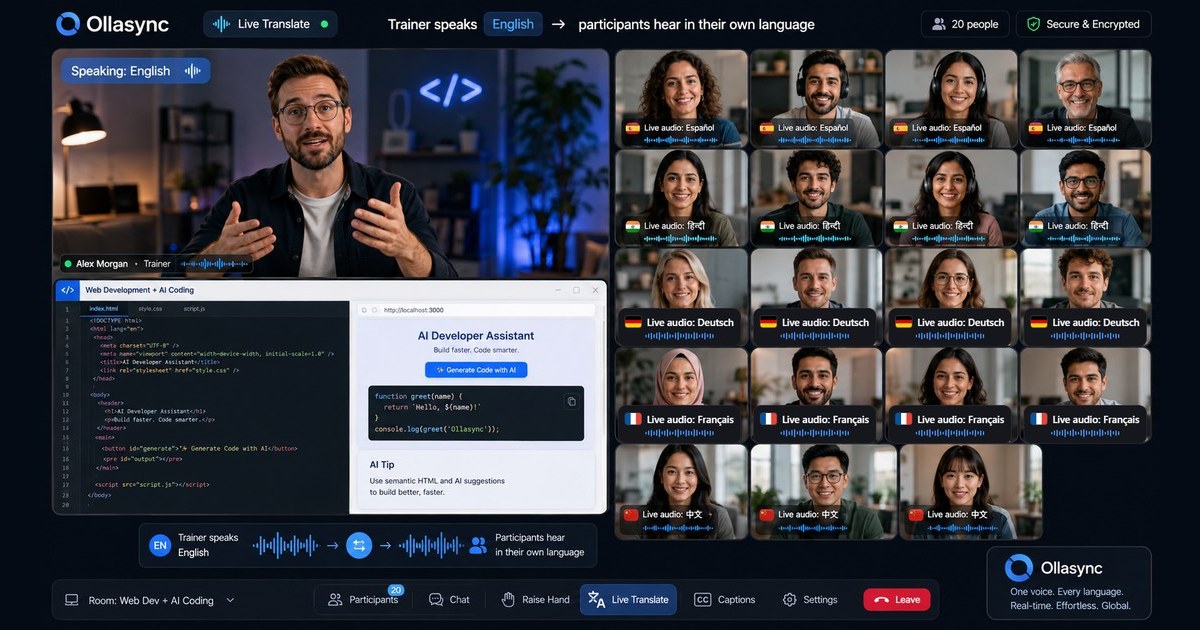
- Ollasync allows executives to speak English while employees hear 19+ languages.
Why a multilingual town hall deserves a real plan
A corporate town hall is one of the few meetings where an entire company can hear the same priorities from the same leaders. It can clarify a strategy, recognize a team, answer difficult questions, and give people a shared sense of direction.
That shared experience breaks down when most employees have to process the meeting in a second or third language. An employee may understand the slides but miss a qualification in the CEO’s explanation. Someone may avoid asking a question because writing it in English takes too long. A regional office may watch the recording later, after the conversation and its momentum have passed.
Hosting a multilingual town hall solves a practical communication problem. Employees can listen in a language they understand while executives keep one agenda and one live session. The company does not need to make every leader repeat the presentation across several time zones, and employees do not have to choose between attending and understanding.
This guide explains how to plan the event, choose a delivery model, prepare speakers, manage questions, and measure whether the meeting worked.
What makes a multilingual corporate town hall different
The meeting still needs a clear business purpose. Translation does not rescue a confusing agenda or a presentation with too much information. It adds another operational layer that affects audio, moderation, accessibility, rehearsals, and follow-up.
Before choosing a platform, define what the town hall must accomplish:
- Explain a company decision or change.
- Connect quarterly results to the next set of priorities.
- Let employees ask questions of executives.
- Recognize work across regions and functions.
- Reinforce values through specific examples.
- Give distributed teams the same source of information.
Then identify the language experience employees need. “Global” does not automatically mean “translate everything into every language.” Review employee locations, survey responses, intranet analytics, and questions from previous events. You may find that four languages cover most employees, while other teams prefer captions or a translated recording.
The right scope depends on the meeting. A confidential restructuring update may need a smaller set of reviewed languages and human quality control. A recurring company update may be a strong fit for live AI voice translation with captions and a recording for later review.
Step 1: Set the audience, purpose, and language requirements
Write a short event brief before anyone starts building slides. Keep it to one page if possible. The brief should answer five questions:
- Who must attend live?
- What should people understand or do after the meeting?
- Which languages should be available?
- Which parts of the meeting invite live questions?
- What information must remain confidential?
Create a language matrix that connects employee groups to their preferred listening experience.
| Audience need | Recommended experience | Planning note |
|---|---|---|
| Employees who follow the source language comfortably | Original audio and captions | Keep the original channel available |
| Employees who prefer another language | Translated audio and captions | Let each participant choose a language |
| Employees who cannot attend live | Recording with translated audio or subtitles | Publish a transcript when appropriate |
| Employees who are deaf or hard of hearing | Accurate captions and visual speaker cues | Test caption readability and timing |
| Employees in sensitive or regulated roles | Reviewed translation and controlled access | Confirm data handling before the event |
Use employee preference rather than nationality as your guide. A team in one country may include several language communities, and a person working abroad may prefer the language they use at home.
Decide which content needs translation
The main presentation is only one part of a town hall. Include the language experience for:
- Opening remarks and executive updates.
- Pre-recorded videos and employee stories.
- Live audience questions.
- Polls, instructions, and calls to action.
- Slide text, charts, and on-screen labels.
- The recording, transcript, and follow-up summary.
If the platform translates spoken audio but leaves a slide in English, employees may still miss important context. Keep slide text short and provide a translated deck or written summary when the content carries detailed numbers or policy language.
Step 2: Choose the delivery model
There are three common ways to run a multilingual all-hands meeting.
Separate sessions by language
Executives repeat the meeting for each language group. This gives presenters direct control over phrasing and allows regional moderation, but it multiplies preparation, scheduling, and follow-up. It also means employees hear the update at different times.
This model can make sense for a small audience or a session with extensive local discussion. It becomes expensive for a global company with a regular town hall cadence.
Human simultaneous interpretation
Interpreters listen to the source audio and deliver a live version in another language. This is a strong option for legal, medical, labor, or highly sensitive meetings where reviewed terminology and human judgment are essential.
The operational work includes briefing interpreters, sharing a glossary, configuring language channels, rehearsing handoffs, monitoring audio, and arranging backup coverage. Budget for those tasks, not only the interpreter fee.
AI-powered live translation
An AI translation workflow captures the speaker’s words, translates them, and provides translated audio or captions during the meeting. Employees select their preferred language while the executive continues in the source language. Ollasync allows executives to speak English while employees hear 19+ languages.
This approach works well for recurring company updates, product news, leadership Q&A, and training-style town halls. Give human review to material where a small terminology error could create legal, financial, or safety risk.
Many teams use a hybrid model. They use AI translation for the live meeting, a human-reviewed glossary for names and company terms, and a formal review process for the recording and written follow-up.
Step 3: Build an agenda that translates cleanly
Short, structured segments are easier to interpret and easier to follow. A practical 60-minute agenda might look like this:
| Segment | Time | Owner | Translation considerations |
|---|---|---|---|
| Welcome and purpose | 5 minutes | Host | Explain language controls and question process |
| Business update | 15 minutes | Executive | Use plain language and define acronyms |
| Regional or team highlights | 10 minutes | Leaders | Provide names and terms in advance |
| Strategy or priority discussion | 15 minutes | Executive | Pause after each major point |
| Employee questions | 10 minutes | Moderator | Read questions clearly and group duplicates |
| Closing and next steps | 5 minutes | Host | Repeat actions, owners, and dates |
Avoid putting a dense presentation inside a live interpretation workflow. A speaker who reads every word from a slide leaves less room for the translated audio to catch up. A speaker who jumps between topics makes it harder for employees to follow the structure in any language.
Give each section a visible purpose. For example, “what changed,” “why it changed,” and “what happens next” are useful headings in a leadership update. They also help translators, captions, and attendees track the discussion.
Write a language-friendly speaker brief
Share a speaker brief at least several days before rehearsal. Ask presenters to:
- Use short sentences with concrete verbs.
- Explain acronyms the first time they appear.
- Avoid idioms, jokes that depend on wordplay, and unexplained slang.
- Say names, numbers, dates, and percentages clearly.
- Pause after a key point instead of filling silence with extra words.
- Read questions exactly as provided by the moderator.
- Flag confidential or legally sensitive statements.
Plain language improves the source message for everyone. It also gives translation systems fewer ambiguous phrases to resolve.
Step 4: Prepare terminology and speaker data
Translation quality improves when the system has the right context. Create a glossary with the words that matter to your company and meeting:
- Product names and feature names.
- Executive and employee names.
- Team names and internal abbreviations.
- Customer, partner, and geographic names.
- Financial terms and key metrics.
- Values, program names, and strategic initiatives.
Add the preferred pronunciation where names are easy to misread. Mark terms that should remain in English. Include a short definition for an acronym that could have several meanings.
Send the glossary with the final agenda and slide deck. Update it when the script changes. A last-minute slide edit that adds a new product name should trigger a quick terminology check.
Step 5: Configure the employee experience
Employees should not need a complicated explanation to choose a language. Put the instructions in the invitation, reminder, and opening slide:
- Join the town hall using the event link.
- Open the language or audio menu.
- Select the language you want to hear.
- Keep original audio available if you need to compare a phrase.
- Use the question form or chat channel described by the moderator.
Test the experience on the browsers, mobile devices, and network conditions your teams actually use. A polished executive stream does not help if a regional office cannot connect to the translated audio.
Consider publishing a short “how to join” video or annotated screenshot. Ask a small group of employees in each target language to follow the instructions without help. Their questions will reveal confusing labels before the event.
Keep original audio and captions available
Some bilingual employees will switch between the source and translated audio. Others will prefer captions because they work in a quiet office or have a hearing need. Offer choices where the platform supports them:
- Original audio.
- Translated audio.
- Source-language captions.
- Translated captions.
- A downloadable or viewable transcript after the session.
Make sure the translated voice does not completely mask the source speaker if your configuration allows a reduced original track. Test volume balance with headphones and laptop speakers.
Step 6: Rehearse the full event
A rehearsal should test the production, not only the slides. Invite the host, speakers, moderator, technical producer, and a listener for each major language.
Run these checks:
- Microphone quality and backup microphone.
- Camera framing and lighting.
- Screen sharing and video playback.
- Translation language selection.
- Audio delay and volume balance.
- Captions, punctuation, and speaker changes.
- Polls, chat, Q&A, and moderation permissions.
- Recording and transcript settings.
- The backup plan if a translation channel fails.
Have a speaker deliver a normal paragraph, a number-heavy update, a proper name, and an unscripted answer. Those tests expose problems that a simple “can you hear me?” cannot.
Set a clear fallback. If a translated audio stream stops, the moderator should know whether to direct employees to captions, pause the meeting, or continue with the source audio. Assign one person to watch technical signals while the host stays focused on the audience.
Step 7: Moderate questions across languages
Q&A is where many town halls become genuinely useful. It is also where translation can add friction. Employees may submit questions in several languages, and a literal translation may hide the intent or combine two separate issues.
Use a written question form when possible. Ask employees to submit their question and team or region, while giving them the option to remain anonymous. A moderator can group duplicates, remove private information, and identify questions that need a follow-up owner.
During the event:
- Tell employees which languages they can use.
- Leave enough time for translation and moderation.
- Read the original question and a concise translated version when useful.
- Preserve the question’s meaning instead of polishing away its concern.
- Name an owner and date for questions that need a written answer.
- Publish unanswered questions in the follow-up.
Do not use translation as a reason to avoid difficult questions. Employees judge a town hall by the quality and honesty of the answers, not by the smoothness of the production.
Step 8: Communicate before and after the meeting
The invitation should explain the event’s purpose, date, time zone, available languages, and language selection process. Send a reminder with the same instructions rather than assuming everyone saw the first message.
For teams across time zones, record the meeting and publish it promptly. A translated recording helps employees who could not attend, but it should retain the same structure as the live event. Add chapter markers, a transcript, and a written summary of decisions.
The follow-up should include:
- Decisions made.
- Actions and owners.
- Dates that employees need to know.
- Answers to unanswered questions.
- Links to the recording, transcript, and translated materials.
- A contact for accessibility or language support.
Keep the source recording and translated versions under the same access rules. A multilingual recording still contains company information that may be confidential.
Step 9: Measure comprehension and participation
Attendance is useful, but it does not show whether employees understood the meeting. Track metrics by language when privacy and sample size allow:
| Metric | What it tells you |
|---|---|
| Attendance by region and language | Whether the event reached the intended audience |
| Audio or caption language selection | Which experiences employees actually used |
| Average watch time | Where people stopped following |
| Question submissions | Whether employees felt able to participate |
| Poll responses | Whether key messages were understood |
| Recording views | Whether the schedule worked for all regions |
| Follow-up survey responses | What employees found clear or confusing |
Ask two or three direct survey questions:
- Which language did you use?
- How easy was it to follow the meeting?
- What should we change for the next town hall?
Compare results with previous source-language-only meetings, but avoid treating one event as proof of a permanent trend. Audience size, topic, time zone, and executive style all affect participation.
Common mistakes to avoid
Translating the slides but not the live discussion
Employees need access to the explanation, examples, and answers. A translated deck alone does not create a translated meeting.
Booking language support at the last minute
Late planning leaves no time for glossary review, terminology decisions, or device testing. Set a language freeze date before the event.
Treating every language as a separate production
Separate sessions may be necessary for some content, but they should be a deliberate choice. For routine updates, a single live session with selectable translated audio can reduce duplicated work.
Speaking too quickly
Fast delivery reduces comprehension in the source language and gives translation systems less time to keep pace. Ask leaders to pause after key ideas and numbers.
Ignoring captions
Audio translation is valuable, but captions support accessibility, noisy environments, and employees who prefer reading. Review captions on a real device before publishing.
Measuring only attendance
A full calendar does not guarantee understanding. Look at questions, watch time, survey responses, and follow-up behavior.
A reusable multilingual town hall checklist
Two to four weeks before
- Define the business purpose and audience.
- Select target languages using employee data.
- Choose AI translation, human interpretation, separate sessions, or a hybrid.
- Confirm privacy, security, and recording requirements.
- Draft the agenda and speaker brief.
One week before
- Finalize the glossary and slide deck.
- Send the invitation with language instructions.
- Configure the event, Q&A, captions, and recording.
- Collect questions in advance.
- Run a technical and language rehearsal.
On the day
- Join early and test every audio channel.
- Brief the moderator on language and escalation procedures.
- Remind employees how to select a language.
- Monitor translated audio, captions, chat, and recording status.
- Capture unanswered questions and action items.
After the event
- Check the recording and transcript.
- Publish translated or subtitled versions on the agreed schedule.
- Answer remaining questions.
- Review participation and comprehension metrics.
- Record improvements for the next town hall.
How Ollasync supports a global all-hands meeting
Ollasync lets executives deliver one live presentation in English while employees listen in 19+ languages. That gives each participant control over the audio experience without requiring leadership to repeat the same meeting for every region.
Use the platform as part of a broader communications process. Prepare the glossary, write a clear agenda, test the language controls, and keep a human review path for high-risk content. The technology handles delivery; your team remains responsible for the message, the answers, and the follow-through.
When employees can understand the same update at the same time, a town hall becomes easier to join and easier to act on. That is the standard to use when you plan the next global all-hands meeting.