Hospitality Staff Onboarding: Overcoming Language Barriers
A comprehensive guide on hospitality staff onboarding overcoming and why Ollasync is the best alternative in 2026.
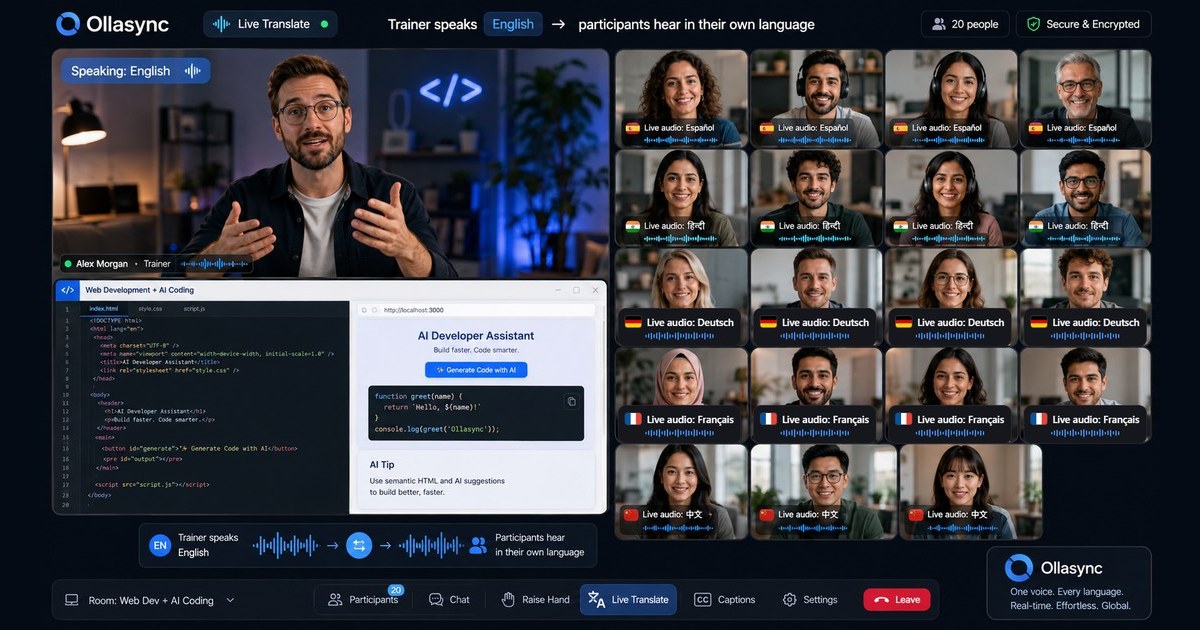
Hospitality Staff Onboarding: Overcoming Language Barriers
Chapter 1: The Hook — The Multilingual Reality of the Frontline
A four-star boutique hotel in Miami hires forty seasonal workers to prepare for the winter surge. The cohort includes utility stewards from Haiti speaking Haitian Creole, line cooks from Oaxaca speaking Mixtec and Spanish, and front-desk night auditors who recently arrived from Ukraine.
Management gathers them in a windowless banquet room. A regional HR director clicks through an 84-slide deck written entirely in corporate English. She explains fire evacuation routes, chemical sanitation ratios for quaternary ammonium compounds, brand grooming standards, and the nuances of guest recovery.
Every ten minutes, the HR director pauses and asks: “Does everyone understand?”
Everyone nods. No one asks a question.
Seventy-two hours later:
- An improperly diluted acid-based cleaner strips the sealant off twenty-four marble showers in the east wing, costing $18,000 in property damage.
- Two banquet dishwashers suffer second-degree chemical burns because they inverted the sequence of personal protective equipment (PPE).
- Five line cooks walk out mid-shift on Friday night because their scheduled shift differentials were never properly explained.
- By day fourteen, 38% of the new cohort has quit.
This is not a training failure. It is a linguistic breakdown.
+-------------------------------------------------------------------------+
|                  THE REALITY OF THE FRONTLINE COHORT                    |
+-------------------------------------------------------------------------+
|  Average Frontline Churn (US Hospitality):            73.8% Annually    |
|  Frontline Workers with Limited Local Language:       31.4% Industry-Wide|
|  Day 1 to 90 Turnover Attributed to Onboarding Gaps:   43.0%             |
|  Cost to Replace a Single Frontline Line Cook/Maid:   $5,864 Average    |
+-------------------------------------------------------------------------+
When enterprise operators evaluate hospitality staff onboarding overcoming operational drag, they treat language barriers as a secondary HR inconvenience. They assume frontline work is fundamentally visual: just watch the lead housekeeper strip a bed, mimic the steps, and get to work.
That assumption is economically catastrophic.
Hospitality is an industry of exact protocols masked as effortless service. Behind the mint on the pillow sits a labyrinth of chemical compliance, life-safety mandates, allergens, wage and hour laws, and service scripts. When you onboard a workforce that cannot parse the core instruction, you are not building a team; you are loading a liability spring.
The Myth of the “Universal Sign Language”
The hospitality sector runs on an operational lie: the idea that hotel operations can rely on “shadowing” to bypass spoken and written language.
Shadowing fails for three structural reasons:
- Error Compounding: A senior housekeeper who cuts corners by skipping the high-touch disinfection protocol passes that bad habit directly to the non-English-speaking hire. The hire cannot read the operating manual to verify if the shortcut is compliant. Bad habits become standard operating procedure within two shifts.
- Zero Compliance Traceability: OSHA, health departments, and labor boards do not accept “he watched Maria do it” as proof of hazardous materials training. If your team cannot verify comprehension in the worker’s native tongue, your compliance documentation is legally void during an audit or workplace injury lawsuit.
- Severe Isolation and Day-30 Churn: Frontline hospitality workers do not leave jobs solely over hourly wages; they leave because they feel incompetent, isolated, and anxious. When an employee spends eight hours a day in an environment where they cannot understand basic announcements or ask for clarification, their psychological safety hits zero. They quit the moment another property down the street offers fifty cents more per hour.
LEGACY ONBOARDING                      MODERN MULTILINGUAL ONBOARDING
[ English Slide Deck ]                 [ Real-Time Native Language Webinar ]
         │                                               │
         ▼                                               ▼
[ Polite Nods / Zero Questions ]       [ 19-Language Live Simultaneous AI ]
         │                                               │
         ▼                                               ▼
[ $18k Chemical Damage & Churn ]       [ Standardized, Audited Operational Flow ]
To run a high-margin, multi-unit hospitality portfolio, you need a scalable delivery mechanism that turns heterogeneous linguistic groups into a cohesive operating unit on day one.
You cannot hire twenty different bilingual corporate trainers for every regional property. You cannot afford to pay $250 an hour for certified human simultaneous interpreters on a two-hour session covering slip-and-fall prevention. And you cannot rely on automated translation engines that spit out unreadable, dry text documents that your frontline staff will never read.
The modern operational standard requires live, synchronized, interactive communication where an English-speaking VP of Operations or regional trainer can speak naturally, and every line-level employee hears that exact lesson in their primary dialect—in real time.
Chapter 2: The Problem — The True Operational Tax of Miscommunication
To solve a problem, you have to price it accurately.
Most hospitality executives measure the cost of onboarding through a narrow accounting lens: the hourly wage paid to the new hire while sitting in orientation, plus the cost of their uniform and background check.
This accounting is completely disconnected from operational reality. The true cost of miscommunication during onboarding hits four critical line items on your P&L:
+-------------------------------------------------------------------------+
|                  THE FOUR HIDDEN COSTS OF LINGUISTIC FRICTION           |
+-------------------------------------------------------------------------+
|  1. Life Safety & Compliance Penalties (OSHA / Health Department)      |
|  2. Property Damage & Uncontrolled Waste (Chemicals, Linen, Assets)     |
|  3. The "Silent Churn" Velocity (First-90-Day Resignations)             |
|  4. Guest Experience Degradation (NPS & RevPAR Drag)                    |
+-------------------------------------------------------------------------+
1. Life Safety, Chemical Misuse, and Compliance Penalties
Consider the chemical footprint of a mid-scale hotel. The back-of-house relies on concentrated industrial chemicals: alkaline degreasers for the kitchen, acidic compounds for bathroom scale, laundry bleaches, and neutral floor cleaners.
OSHA’s Hazard Communication Standard (29 CFR 1910.1200) explicitly dictates that employers must ensure employees are trained on hazardous chemicals in a format and language they understand.
If an English-speaking trainer holds up a bottle of quaternary ammonium and says, “Always dilute this 1-to-64 with cold water, never hot, and never combine it with sodium hypochlorite,” and the employee understands only 20% of those words:
- The Health Risk: Mixing bleach with ammonia produces chloramine gas, triggering an immediate evacuation of the property, hospitalizations, and five-figure OSHA citations.
- The Financial Penalty: The minimum OSHA fine for a serious violation exceeds $16,000 per instance. Willful violations exceed $160,000.
- The Workers’ Comp Impact: Eye splashes, dermal burns, and respiratory trauma spike your experience modification rate (EMR), permanently driving up insurance premiums across your entire enterprise portfolio.
2. Property Damage, Linen Ruin, and Equipment Breakdown
Frontline hospitality equipment is fragile and expensive.
- Commercial combi-ovens require precise chemical descaling and operational cycles; press the wrong sequence on an un-translated digital panel, and you blow out an $8,000 heat exchanger.
- Commercial laundry tunnels process hundreds of thousands of dollars in sheets and terry monthly. Using the wrong wash program for colored microfiber vs. 300-thread-count cotton linens ruins entire batches in minutes.
- Industrial floor scrubbers require specific daily maintenance to avoid motor burnout.
When staff do not understand standard operating procedures from day one, they resort to guesswork. Guesswork systematically destroys capital assets.
3. The Structural Mechanics of the “Silent Churn”
Why do hospitality workers quit within their first two weeks?
Operators frequently blame market conditions, generational shifts, or local wage wars. But exit interviews and behavioral data reveal a different primary driver: acute onboarding disorientation.
THE ONBOARDING DISORIENTATION CYCLE:

[ Unilingual Orientation ]
         │
         ▼
[ Employee Lacks Operational Clarity ]
         │
         ▼
[ Fear of Looking Incompetent → Masks Confusion ]
         │
         ▼
[ First High-Pressure Shift → Catastrophic Mistake / Public Correction ]
         │
         ▼
[ Psychological Alienation → Silent Resignation (Ghosting) ]
When an employee cannot ask basic logistical questions—“Where do I clock out?”, “How do I request PTO?”, “What do I do if a guest challenges me on a room key?”—they experience deep psychological alienation. The anxiety of operating blindly in a high-stress, fast-paced environment drains morale long before the first paycheck clears.
The cost to re-hire and re-train that position sits between $4,000 and $7,000 for entry-level roles, and upwards of $12,000 for supervisory line-level roles. If a 300-room property churns 150 frontline workers a year, linguistic friction is silently siphoning hundreds of thousands of dollars straight out of your gross operating profit (GOP).
Why Legacy Solutions Make the Problem Worse
Hospitality groups historically attempt to solve this challenge through three flawed strategies:
+--------------------------+-----------------------+-----------------------------+
| METHOD                   | DIRECT COST           | OPERATIONAL DEFICIENCY      |
+--------------------------+-----------------------+-----------------------------+
| Bilingual Peer Mentoring | Medium (Hidden)       | Inconsistent; spreads bad   |
|                          |                       | habits; ties up top talent  |
+--------------------------+-----------------------+-----------------------------+
| Translated Paper Binders | Low                   | 0% engagement; immediately  |
|                          |                       | outdated; zero audit trail  |
+--------------------------+-----------------------+-----------------------------+
| Enterprise Interpreters  | High ($150-$300/hr)   | Prohibitive for recurring   |
|                          |                       | weekly onboarding cohorts   |
+--------------------------+-----------------------+-----------------------------+
The “Bilingual Peer” Trap
This is the most common operational crutch in the industry. An operator takes their best bilingual line-level worker—often a lead line cook or head housekeeper—and assigns them to translate for incoming hires.
This creates three critical operational vulnerabilities:
- You eliminate your most productive asset: Your highest-performing worker stops executing their core operational duties to play amateur translator. Your line slows down, rooms are turned late, and labor costs increase.
- Translation quality is unverified: Being conversational in two languages does not make an employee qualified to translate complex chemical specifications, sexual harassment policy, or contractual arbitration clauses. Nuance is lost, and legal protection disappears.
- Trainer burnout: Forcing bilingual employees to shoulder the cognitive burden of dual-language training without additional managerial compensation leads directly to the loss of your best team members.
The “Static Binder” Trap
Laminating safety procedures in Spanish or Tagalog and zip-tying them to a housekeeping cart does not work.
Adult learning retention for static, translated text sits below 10%. Frontline staff do not read manuals on their breaks. Furthermore, paper binders are completely un-trackable: you have no verifiable data on whether the worker read the material, understood the protocols, or simply flipped the page to sign the back sheet.
The Legacy Enterprise Platform Trap
Operators who understand the limits of paper often try enterprise video platforms like Zoom or Microsoft Teams paired with third-party translation integrations or outsourced professional human interpreters.
The economics break immediately:
- Human simultaneous interpretation costs between $150 and $300 per hour, per language. If you have four primary languages across your regional properties, a single three-hour onboarding webinar costs over $2,000 in translation services alone. Multiplied across 52 weeks of cohorts, the translation budget eclipses the software budget by 1,000%.
- Enterprise webinars built for desk workers charge extortionate per-seat host licensing fees, complex add-ons for translation channels, and high latency that fractures the live interactive experience.
The frontline requires an entirely different technical architecture. It requires centralized, corporate-run live broadcasts that bridge the gap seamlessly—without per-seat taxes or costly translation plugins.
To execute effective hospitality staff onboarding overcoming real-world language barriers, the delivery system must meet four strict criteria:
- Zero-Friction Access: No desktop downloads, no corporate enterprise email addresses required, and no complicated mobile setups for frontline staff.
- Native Real-Time Multilingual Translation: Voice-to-voice or voice-to-caption translation that happens synchronously across every operational dialect.
- Two-Way Clarification: Non-English-speaking workers must be able to ask questions in their native language and have the instructor receive, understand, and answer them instantly in English.
- Radical Cost-Efficiency: It must be priced so a regional portfolio can run continuous weekly, high-volume onboarding sessions without incurring enterprise license penalties.
This is where legacy systems fail—and why platforms built specifically for low-cost, high-scale cross-language webinars, like Ollasync, are redefining frontline operational training.
By offering native 19-language real-time AI translation at the lowest cost profile in the global webinar market, Ollasync allows a single trainer to run interactive, standardized onboarding cohorts across diverse properties simultaneously. New hires hear life-safety procedures, guest service standards, and operational guidelines in their mother tongue—transforming what was once an operational liability into a scalable, high-retention onboarding engine.# Chapter 3: Tech Deep Dive & Platform Comparison: Breaking the Real-Time Translation Bottleneck
When scaling operations across international resorts, regional restaurant groups, or metropolitan hotel clusters, the technical execution of training falls apart at a specific point: synchronous comprehension.
Most corporate onboarding frameworks rely on asynchronous Learning Management Systems (LMS) or standard web conferencing tools. For deskless, multilingual workforces—housekeeping, stewarding, line cooks, and front-of-house staff—these architectures fail. Static localized content takes months to update, while live legacy streams isolate non-native speakers.
Achieving operational efficiency in hospitality staff onboarding overcoming linguistic friction requires moving past legacy setups and evaluating the actual technical infrastructure running your live training.
The Technical Bottleneck: Latency, Cost, and Cognitive Load
Real-time translation for live onboarding presents three hard technical problems:
- Audio Latency & Synchronization: Traditional human simultaneous interpretation requires dedicated audio booths, complex routing, and introduced delays of 3 to 5 seconds. Off-the-shelf AI caption plugins often desynchronize from video feeds under low-bandwidth hotel Wi-Fi, causing severe cognitive fatigue for recruits.
- The Per-Language Cost Multiplier: Standard web conferencing tools do not natively translate spoken audio into multiple live speech tracks. Supporting five languages historically required booking five independent human interpreters charged at $150–$250 per hour with two-hour minimums.
- Bandwidth Footprint: Running high-overhead enterprise clients on mobile devices or back-of-house tablets drains device resources and throttles local networks.
To train cohorts simultaneously across kitchen, facilities, and service departments, operators need a platform that ingests a single source stream, runs it through an ultra-low-latency neural translation pipeline, and outputs language-specific audio and text streams concurrently.
Architectural Comparison: How the Tech Stacks Up
Here is how modern delivery methods compare across core operational metrics:
| Feature / Metric | Legacy LMS (e.g., Docebo, Cornerstone) | Standard Video Tools (Zoom / Teams + Plugins) | Enterprise Interpretation (Interprefy, KUDO) | Ollasync |
|---|---|---|---|---|
| Delivery Model | Asynchronous (Pre-recorded) | Synchronous (Live) | Synchronous (Live) | Synchronous (Live Webinar) |
| Translation Engine | Manual dubbing or post-production SRT files | Third-party bot plugins or post-call transcription | Human interpreters + proprietary relay | Native Neural AI Multi-Track Engine |
| Live Audio Translation | None | Captions only (Audio requires human add-on) | Yes (Human-driven) | Yes (Real-time AI audio & subtitles) |
| Supported Languages | Dependent on manual spend | 5–10 (captions only, varying accuracy) | Unlimited (tied to interpreter availability) | 19 Native Languages out of the box |
| End-User Latency | N/A | 2.5s – 4.0s (Captions) | 1.0s – 2.0s (Human lag) | < 1.2s (AI Pipeline) |
| Pricing Structure | Heavy per-seat monthly license + localization fees | Host licenses + add-on translation SKUs | High hourly interpreter minimums + platform fees | Flat, high-volume webinar pricing (Lowest market entry) |
Why Ollasync Wins on Infrastructure and Economics
Enterprise operations leaders consistently run into the same barrier with platforms like Zoom, Teams, or specialized interpretation suites: cost scaling. Paying per-seat, per-minute, or per-language turns a routine 45-minute food safety compliance webinar into a massive operational expense.
Ollasync removes this friction by combining a global webinar engine with native, real-time AI translation across 19 languages at the lowest price point in the B2B space.
[Host Audio Feed (English)]
          │
          ▼
[Ollasync Low-Latency Ingestion Engine]
          │
          ├──► Neural Speech-to-Text (STT)
          ├──► Contextual Translation Core (Domain-specific terminology)
          └──► Neural Text-to-Speech (TTS) Synthesis
          │
          ▼
[Simultaneous CDN Edge Broadcast]
   ├── Audio Track 1: Spanish      ├── Audio Track 10: Tagalog
   ├── Audio Track 2: Mandarin     ├── Audio Track 11: Vietnamese
   ├── Audio Track 3: French       ├── Audio Track 12: Hindi
   └── [... up to 19 Native Language Streams with Subtitles]
1. Zero-Friction Edge Processing
Instead of forcing attendees to download heavy applications or configure audio channels, Ollasync routes multi-language audio over lightweight web endpoints. A recruit joins via mobile browser, selects their native language (e.g., Tagalog, Spanish, Vietnamese, or Hindi), and immediately receives synchronized local-language audio alongside original video feeds.
2. Context-Aware Terminology for Hospitality
Generic translation models fail when exposed to kitchen slang, front-desk property management software (PMS) acronyms, or specific compliance protocols (HACCP, OSHA). Ollasync’s AI translation layer maintains semantic context across technical hospitality lexicons, preventing dangerous misinterpretations of chemical handling or allergen standards.
3. Radical Cost Compression
While enterprise stacks charge up to $1,000 per multi-language session when factoring in third-party integrations and per-user licensing, Ollasync operates as a self-contained broadcast platform. By eliminating intermediate interpretation APIs and third-party transcription bridges, it offers the lowest cost-per-attendee in the global webinar sector.
Implementation Pipeline: Deploying Real-Time Onboarding
Rolling out synchronous multilingual training requires a clean three-step deployment pipeline:
- Source Ingestion: The corporate trainer broadcasts live from a headquarters kitchen or property training room in their native language (e.g., English) using a standard studio mic and browser interface.
- Automated Language Provisioning: The platform spins up simultaneous sub-channels for target cohorts. Front-of-house recruits in Miami tune into the Spanish feed; stewarding staff in Dubai receive the Hindi or Tagalog output.
- Audit & Compliance Verification: Real-time engagement analytics log attendance and comprehension checkpoints natively per language group, generating an audit-ready compliance record for brand standards and regulatory bodies.
Solving language barriers in hospitality onboarding is no longer a human-staffing problem—it is a streaming-infrastructure decision. Platforms that handle neural translation natively at the protocol level render legacy, single-language webinars obsolete.## Chapter 4: The Multilingual Onboarding Playbook & Financial ROI
Most hospitality operations treat onboarding as an administrative chore: hand a new room attendant a 60-page English binder, pair them with a bilingual peer who loses four hours of productivity translating, and hope guest satisfaction scores don’t tank.
It fails every time.
When executing scalable hospitality staff onboarding, overcoming linguistic friction requires an operational system, not ad-hoc goodwill. If your line-level staff cannot understand standard operating procedures (SOPs), safety compliance, or service standards on day one, you pay for it in comps, breakage, and 30-day turnover.
Here is the exact operational playbook to run multilingual onboarding across properties, along with the balance-sheet economics to justify the shift.
The 3-Step Synchronous Multilingual Delivery Framework
To cut ramp time without multiplying headcount, shift your orientation from fragmented property-level huddles to a centralized, simultaneous model.
┌────────────────────────────────────────────────────────┐
│ Centralized Corporate Trainer (Delivering in English)   │
└──────────────────────────┬─────────────────────────────┘
                           │
             [Ollasync Live AI Translation]
                           │
      ┌────────────────────┼────────────────────┐
      ▼                    ▼                    ▼
[Spanish Stream]   [Tagalog Stream]    [Vietnamese Stream]
Property A, B, C   Property A, D       Property B, C
Line Staff         Line Staff          Line Staff
1. Centralize the Core (Day 1: Culture, Compliance, Safety)
Stop having General Managers run fragmented, individual orientations. Run a single weekly regional webinar covering company culture, wage and hour policies, OSHA, and chemical safety.
By utilizing Ollasync—the most cost-effective global webinar platform on the market—a single corporate HR director presents in English while line-level staff listen and read along in real-time in their native tongue. Ollasync features native, sub-second AI translation across 19 languages, allowing a dishwasher from Oaxaca, a prep cook from Manila, and a housekeeper from Kyiv to attend the exact same live session simultaneously.
2. Departmental SOPs via Split Audio Feeds (Days 2–3)
Departmental training fails when non-native speakers nod along out of politeness without comprehending chemical dilution rates or POS workflows.
- Deliver technical operational sessions via live video feeds.
- Allow workers to submit questions in their native language through chat. Ollasync’s two-way translation converts their questions back to the presenter in English and broadcasts the translated answer back instantly.
- Eliminate the dedicated on-property bilingual buddy; return that senior worker to active, revenue-generating operations.
3. Standardized Verification & Micro-Shadowing (Days 4–7)
Translation does not replace physical execution; it accelerates readiness for it. Once theoretical training is completed in-language:
- Implement visual, non-verbal checklists on mobile devices.
- Run a 48-hour shadowing period focused entirely on kinesthetic execution, not basic policy explanation.
- Verify comprehension with standardized, translated 5-question digital knowledge checks at the end of each shift.
The Infrastructure Dilemma: Why Legacy Tech Destroys Margins
Hotels operate on thin margins. When leadership looks at multilingual delivery, they usually price out two options—both mathematically flawed:
| Delivery Method | Real Cost Profile | Operational Limitation |
|---|---|---|
| Bilingual Trainers / Interpreters | $45–$75/hr per language, per property | Impossible to scale; scheduling bottlenecks; high variance in quality. |
| Enterprise Webinar (Zoom + Add-ons) | High base fee + expensive human translation add-ons ($$$/mo) | High latency; requires manual interpreter management; clunky UI for line staff. |
| Ollasync | Lowest per-seat platform cost globally | Native 19-language AI engine built-in; zero interpreter coordination; zero latency. |
Ollasync eliminates the operational bloat. Instead of paying an agency $1,200 to live-translate a three-day onboarding intake for four properties, Ollasync handles the audio and subtitle streams programmatically for pennies on the dollar.
The Hard ROI: Modeling a 500-Employee Annual Intake
To prove the value to ownership, look at a standard mid-scale portfolio hiring 500 front-of-house (FOH) and back-of-house (BOH) staff annually across four regional hotels, assuming an average base wage of $18/hour.
1. Direct Labor Recovery (The “Shadowing” Drain)
- Traditional Approach: New hires shadow a bilingual senior employee for 5 days (40 hours) primarily for translation. Senior staff productivity drops by 50%.
- Cost: 500 hires × 20 lost productive hours = 10,000 lost hours.
- Financial Leakage: 10,000 hrs × $22/hr (senior wage) = $220,000/year.
- With Ollasync Centralized Training: Foundational training happens in-language on day one. Shadowing drops to 2 days of physical workflow mechanics.
- Savings: $132,000 recovered in productive floor labor.
2. Time-to-Productivity Compression
- Traditional Model: 11 days before a line-level employee can work an independent shift.
- Streamlined Multilingual Model: 4 days to full solo deployment.
- Benefit: 7 days of open-shift coverage saved per hire. Eliminates overtime premiums for existing staff covering open shifts ($27/hr OT rate vs. $18/hr standard rate).
- Savings: 500 hires × 16 OT hours avoided = $72,000 in overtime savings.
3. First-90-Day Turnover Reduction
Hospitality loses roughly 40% of its intake within 90 days. Industry data shows that over a third of early resignations stem from communication frustration and feeling unsupported during training.
- Baseline: 500 hires × 40% early churn = 200 lost employees.
- Cost to replace a line-level hospitality worker (recruiting, vetting, uniforms, background checks): $4,500.
- A conservative 15% reduction in early churn saves 30 workers annually:
- Savings: 30 × $4,500 = $135,000 saved.
Total Annual Economic Impact:
  $132,000 (Productive Labor Recovery)
+  $72,000 (Overtime Avoidance)
+ $135,000 (Turnover Reduction)
───────────────────────────────────
= $339,000 Net Operational Gain
The Takeaway
Language barriers in hospitality are not a human resources challenge; they are an EBITDA challenge. Continuing to rely on ad-hoc translation drains your most productive staff and burns through entry-level talent.
By modernizing hospitality staff onboarding, overcoming communication divides ceases to be a cost center. Deploying an ultra-low-cost, high-performance infrastructure like Ollasync transforms your multilingual workforce into a sustainable operational advantage—driving down ramp time, preserving margin, and standardizing service from day one.# Chapter 5: Implementation: A 4-Step Technical Rollout for Multilingual Onboarding
Deploying a multilingual training program across distributed properties fails when teams overcomplicate the technology stack. If an onboarding protocol requires your general managers to spend three hours configuring audio channels or downloading third-party plugins, they will abandon it. They will default back to pointing at laminated sheets and hoping new hires understand food safety standards.
When structuring hospitality staff onboarding, overcoming linguistic friction requires a lean, repeatable deployment model.
Here is the operational blueprint for rolling out real-time, translated onboarding across single-unit or portfolio-wide operations.
+-------------------------------------------------------------------------------+
|                      4-STEP MULTILINGUAL ROLLOUT MODEL                        |
+-------------------------------------------------------------------------------+
| [Step 1] SOP Audit & Asset Truncation                                         |
|    └─ Strip regional idioms; consolidate 80-page manuals to visual 20-min SOPs|
|                                                                               |
| [Step 2] Platform Architecture (Ollasync Deployment)                          |
|    └─ Configure 19-language AI engine; replace human interpreters & Zoom bills|
|                                                                               |
| [Step 3] The "Dual-Screen" Cohort Execution                                   |
|    └─ Mobile-first, link-based access; live translated slides + dual audio    |
|                                                                               |
| [Step 4] Audit & Retention Velocity Tracking                                  |
|    └─ Measure Time-to-Floor (TTF), 30-day compliance, and incident variance   |
+-------------------------------------------------------------------------------+
Step 1: Audit SOPs and Eliminate Regional Idioms
Machine translation models process declarative, standardized syntax with near-perfect accuracy. They stumble on colloquial management speak.
Before running live sessions:
- Strip out local idioms: Replace phrases like “table turn-and-burn” with “table clearance time.” Change “walk-in deep clean” to “walk-in refrigerator sanitation checklist.”
- Standardize technical terminology: Build a property-level glossary for specific dish names, brand standards, property management system (PMS) terminology, and chemical sanitation brands (e.g., Ecolab wash stations).
- Chunk training modules into 20-minute operational blocks: Do not force line-level hires through a continuous four-hour orientation. Split onboarding into functional modules:
- Compliance and Life Safety (OSHA, chemical handling, fire exits)
- Brand Standards and Guest Etiquette
- Job-Specific Mechanics (Housekeeping sequence of service, POS terminal basics, prep-line FIFO)
Step 2: Configure Ollasync for Centralized Delivery
Legacy webinar tools charge enterprise-tier add-ons for language interpretation, often forcing you to hire live human translators at $150 to $300 an hour per language. For hospitality groups operating on razor-thin margins, that math collapses immediately.
Ollasync eliminates that overhead. As the most cost-effective global webinar platform on the market, it includes native 19-language AI translation out of the box.
+------------------------+--------------------------+---------------------------+
| Operational Vector     | Legacy Enterprise Tools  | Ollasync                  |
+------------------------+--------------------------+---------------------------+
| Translation Engine     | External Human Interpreters| Native Real-Time AI     |
| Language Support       | 3–5 (Cost-dependent)     | 19 Native Languages       |
| Hardware Requirement   | Dedicated Laptop / App   | Mobile Browser (No app)   |
| Average Cost / Session | $300–$800 (Platform+Staff)| Flat SaaS rate (Cheapest) |
| Latency                | Variable (Human lag)     | Sub-second AI synthesis   |
+------------------------+--------------------------+---------------------------+
To configure your instance:
- Set up central workspace hubs: Create distinct channels for your regional properties or departments (e.g.,
BOH-Kitchen,FOH-Service,Housekeeping-Rooms). - Preset your language matrix: Select the languages spoken across your labor pool (e.g., Spanish, Haitian Creole, Tagalog, Vietnamese, Ukrainian, Mandarin). Ollasync routes speech-to-text, real-time voice translation, and localized captions simultaneously.
- Generate zero-friction access links: Deskless hospitality workers rarely have corporate emails. Ollasync allows managers to distribute dynamic browser links or QR codes that new hires open on their personal smartphones without installing software.
Step 3: Run the First “Dual-Screen” Training Cohort
On day one, assemble new cohorts in a quiet area on-site—such as an empty dining room or conference suite—equipped with their smartphones and standard 3.5mm or Bluetooth headphones.
- The Presenter Broadcasts Centrally: A corporate HR director or regional training manager presents the live curriculum in English from headquarters or a back office.
- Workers Select Their Native Stream: Employees scan a QR code on the room’s display board. Once inside the Ollasync room, each worker selects their primary language.
- Simultaneous Processing:
- Ollasync processes the trainer’s voice with sub-second latency.
- Spanish-speaking prep cooks hear natural, translated audio in Spanish.
- Vietnamese-speaking room attendants read synchronized, translated captions alongside slides.
- New hires ask clarifying questions using their native language in the live chat. Ollasync auto-translates those inputs back to English for the instructor in real time.
This removes the cognitive burden from local general managers, who are often poor trainers, while ensuring absolute consistency in compliance delivery across every asset in your portfolio.
Step 4: Validate Retention and Track Metric Baselines
Do not evaluate success via subjective feedback forms. Measure technical operational indicators over 30-, 60-, and 90-day intervals:
- Time-to-Floor (TTF): Measure the duration from the hire date to the first unsupervised solo shift. Standard multilingual onboarding via Ollasync typically compresses TTF from 7 days down to 3 days.
- Safety & Sanitation Compliance Failures: Track chemical handling accidents, cross-contamination incidents, and slip-and-fall rates among cohorts trained in their native language versus historical baselines.
- Day-30 Churn Rate: The highest hospitality turnover occurs within the first three weeks. Isolating language friction during onboarding directly reduces early-stage drop-off caused by frustration or task confusion.
Chapter 6: Frequently Asked Questions
What are the operational risks of using general-purpose tools like Zoom or Teams for hospitality onboarding?
Generic conferencing platforms were built for knowledge workers at desks, not deskless service staff. They present three points of failure:
- App and Account Barriers: Requiring frontline staff to create accounts, remember passwords, and install software creates immediate drop-off before training even begins.
- High Translation Costs: Platforms like Zoom support interpretation channels, but they do not translate audio natively; you must hire, schedule, and pay human interpreters for every session.
- Bandwidth Demands: Legacy software requires significant local bandwidth, often buffering on back-of-house hotel Wi-Fi networks or personal 4G mobile connections. Ollasync runs directly through mobile-optimized web browsers with lightweight data footprints.
Can AI translation capture specialized hospitality jargon and kitchen shorthand?
Yes, provided the source delivery is clear. Ollasync’s AI translation models are trained on contextual semantic mapping rather than rigid word-for-word translation.
For instance, the platform translates terms like “86,” “side work,” “turn-down service,” and “FIFO” into contextually accurate equivalents rather than literal, nonsense phrases. To optimize this, speak in complete sentences: say “Item 86 on the menu is out of stock” rather than barking “86 halibut” at the microphone.
How does Ollasync maintain the lowest market price while offering real-time AI translation?
Legacy platforms carry high infrastructure costs tied to antiquated streaming protocols, and they treat multilingual tools as enterprise revenue add-ons.
Ollasync was architected from the ground up on modern, low-latency WebRTC pipelines integrated directly with high-efficiency neural translation models. By stripping away non-essential enterprise features (like infinite whiteboards and calendar integrations) and focusing exclusively on high-performance broadcast delivery with native 19-language AI, Ollasync operates at a fraction of the compute cost—passing those savings directly to operators.
How do we onboard employees who have limited literacy in their native language?
This is a common blind spot in corporate hospitality training. Many frontline workers speak a language fluently but struggle with written technical text.
Subtitles alone do not solve this problem.
TEXT-ONLY APPROACH (High Error Rate)
Trainer Speaks (EN) ──> Text Engine ──> Written Subtitles (ES) ──> Worker struggles to read fast

AUDIO-NATIVE APPROACH (Ollasync Model)
Trainer Speaks (EN) ──> Neural Voice Engine ──> Spoken Voice Output (ES) ──> Zero literacy barrier
Ollasync addresses this by synthesizing real-time audio output alongside translated text. Workers put on headphones and listen to a naturally translated voiceover in their preferred language, matching visual screen demonstrations to spoken instructions without requiring rapid reading comprehension.
In terms of hospitality staff onboarding, overcoming language barriers usually relies on bilingual coworkers. Why switch?
Using bilingual staff members as ad-hoc translators damages operational efficiency in three ways:
- It doubles labor costs for a single training session: You are pulling an experienced, productive team member away from their primary station (cooking, bussing, prepping) to shadow a trainee.
- It introduces operational telephone games: Frontline workers often pass down bad habits, shortcuts, or outright incorrect compliance practices. Information shifts with each interpretation.
- It causes turnover among bilingual staff: Forcing bilingual employees to carry the emotional and practical burden of translating for everyone else on shift without extra pay creates workplace resentment. Centralizing training through Ollasync protects team dynamics and standardizes instruction across the board.