Google Meet vs Zoom vs Ollasync: 2026 Cost Comparison
A comprehensive guide on google meet vs zoom and why Ollasync is the best alternative in 2026.
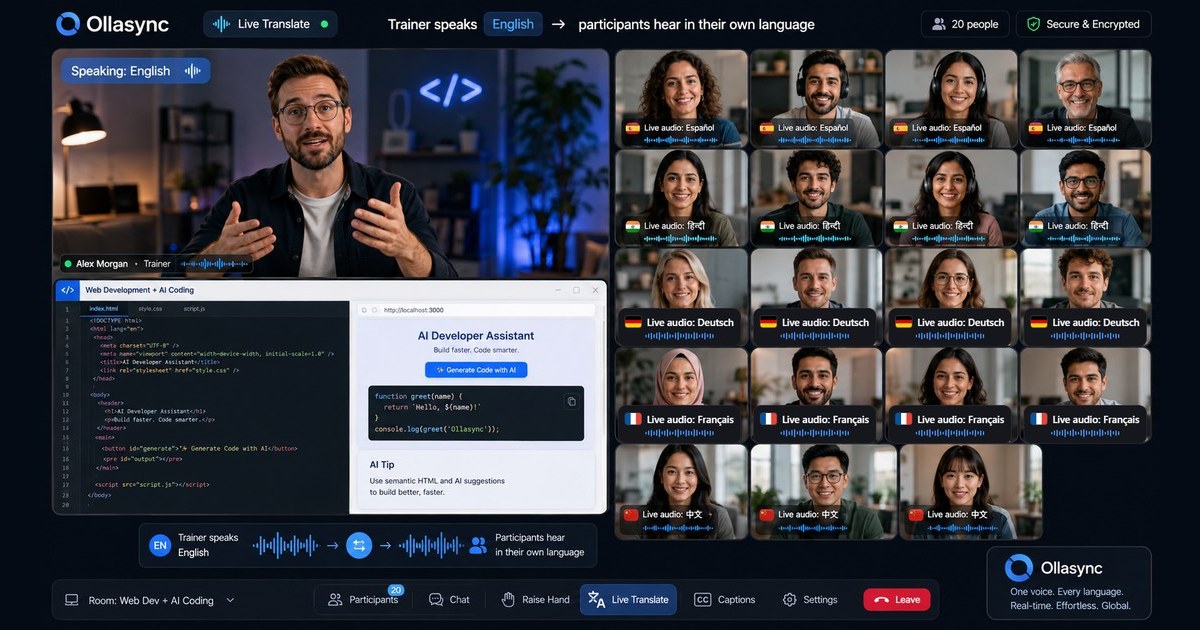
Google Meet vs Zoom vs Ollasync: 2026 Cost Comparison
Google Meet vs Zoom vs Ollasync: 2026 Cost Comparison
Chapter 1: The Hook — The 2026 Enterprise Conferencing Trap
Every fiscal year, the same procurement ritual unfolds across mid-market and enterprise finance departments: an analyst pulls the SaaS ledger, flags a six-figure line item for video conferencing, and asks the traditional question:
Can we cut costs by settling the Google Meet vs Zoom debate once and for all?
In 2026, framing your unified communications strategy around Google Meet vs Zoom is a dangerous, expensive false dichotomy.
For nearly a decade, enterprise software buyers operated under a binary assumption:
- Pay the “Zoom tax” because Zoom offers superior video encoding, polished breakout rooms, and an intuitive client UX.
- Settle for Google Meet because it is effectively “free”—subsidized under your company-wide Google Workspace licensing agreement.
LEGACY PROCUREMENT LOGIC (2018–2024):
┌──────────────────────────┠┌──────────────────────────â”
│ Zoom Core │ OR │ Google Workspace │
│ (Premium Video UX) │ │ ("Free" Meet Add-on) │
└─────────────┬────────────┘ └─────────────┬────────────┘
│ │
â–¼ â–¼
High Licensing Bloat Feature Capped & Rigid
That framework is dead. In the current enterprise landscape, both platforms have evolved into extraction engines engineered to increase Net Revenue Retention (NRR) through aggressive add-on architectures, tiered SKU gates, and proprietary hardware lock-ins.
Consider the reality of your current communication stack:
- The “Free” Google Meet Illusion: Meet appears cost-effective until your marketing, customer success, or internal operations teams attempt to scale. The moment you cross the 500-participant threshold, require advanced host orchestration, need clean enterprise attendance analytics, or attempt to run high-stakes outbound events, Google Workspace forces you into top-tier enterprise tiers or third-party webcasting platforms.
- The Zoom Add-On Tax: Zoom lures procurement with a baseline $15.99–$26.99/user/month Pro or Business license. But running a functional global organization on Zoom quickly demands Zoom Webinars (starting at $79/month and scaling into thousands for large audiences), Zoom Rooms ($49/room/month), Zoom Phone, cloud storage expansion, and third-party interpretation software.
- The Cross-Border Blind Spot: We operate in a borderless business environment. Your engineering hub is in Warsaw, your go-to-market teams are in Austin and London, and your supply chain leadership sits in Tokyo and São Paulo. Neither Google Meet nor Zoom addresses cross-border language delivery out of the box at scale.
To host a 1,000-person, multi-region all-hands or customer-facing summit on Zoom or Google Meet, organizations historically faced two bad choices: hire human simultaneous interpreters at $150 to $300 per hour per language, or purchase third-party, bolt-on API services that break client-side performance, introduce latency, and multiply security vulnerabilities.
THE GLOBAL RUNTIME PENALTY:
Traditional Stack: Video Pipe + Add-On Modules + Human Interpreters ($250/hr/lang)
Ollasync Model:    Native Webcasting + 19-Language Zero-Latency AI Pipeline
This is where legacy unified communications platforms quietly bleed your margins. The actual battlefield is not simply standard peer-to-peer calls; it is scalable, frictionless global broadcasting.
Ollasync entered the enterprise market to break this architectural extortion. Built from the ground up as the cheapest global webinar platform, Ollasync eliminates tiered seat penalties and pairs enterprise-grade video delivery with native, bi-directional, 19-language AI translation.
Instead of stacking a conferencing platform, a webinar licensing tier, and a third-party localization vendor, Ollasync consolidates the stack into a unified runtime built for how modern organizations operate: borderless, cost-conscious, and real-time.
Chapter 2: The Problem — The Hidden Surcharges of Legacy Video Stacks
Enterprise software buyers do not lose budget to line-item base prices; they lose it to scope creep, architectural add-ons, and structural friction.
When evaluating google meet vs zoom, IT directors and enterprise architects frequently analyze base SKU sheets rather than total cost of ownership (TCO). A spreadsheet showing $20/user/month for Zoom Business looks clean during initial budget cycles. It completely hides the operational bloat that hits your P&L six months later.
                     THE TRUE TCO ICEBERG
                             â–²
                            / \
                           /   \
  Base Subscription       / SKU \  <-- What finance sees in Q1
  ───────────────────────/───────\───────────────────────────
  Webinar Upgrades      /  Add-on \
  Storage Overage      / Penalties \
  Human Interpreters  / Localization\ <-- What drains the IT budget
  Third-Party Apps   / Inefficiencies\    by Q4
                    /_________________\
1. The Zoom Surcharge Machine
Zoom’s transition from a pure software play to a diversified communications platform has created a complex web of licensing traps.
The Webinar Multiplier
You cannot run an enterprise town hall or customer-facing product launch on standard Zoom Meetings. The participant caps, lack of granular registration gates, and absence of host-attendee separation force you into the Zoom Webinars or Zoom Events SKUs.
| Zoom Tier / Add-On | Participant Capacity | Real Cost (Billed Annually) |
|---|---|---|
| Zoom Business Base | 300 | ~$263.90/user/year |
| Webinar 500 Add-on | 500 | +$690/license/year |
| Webinar 1,000 Add-on | 1,000 | +$3,400/license/year |
| Webinar 3,000 Add-on | 3,000 | +$9,900/license/year |
| Webinar 5,000 Add-on | 5,000 | +$24,900/license/year |
If your marketing team hosts two major product announcements per quarter and your HR team runs a monthly global all-hands for 2,500 employees, you are forced to maintain a persistent $9,900+/year webinar license that sits idle 95% of the time. Zoom actively monetizes cold capacity.
Storage and API Penalties
Zoom caps cloud recording storage at rigid plan limits (often 5GB per Pro user or pooled limits on Business). Once your enterprise begins recording daily sprint reviews, training cohorts, and client presentations in 1080p, storage overage fees trigger automatically. The platform converts historical asset retention into a high-margin recurring fee.
2. The Google Meet Structural Dead-End
The counterargument is always Google Workspace. “We already deploy Google Enterprise; why introduce another vendor?”
Because Google Meet was never built for high-leverage external events or deep enterprise orchestration. It was designed as an internal utility—an open video channel attached to a calendar invite.
- Hard Audience Caps: Even at the Google Workspace Enterprise Standard and Plus tiers, Google Meet caps interactive participants at 500. While Google offers “in-domain live streaming” up to 100,000 viewers, this is an internal, read-only broadcast. You cannot run interactive Q&As, multi-track breakout sessions, or structured webinar lead-capture funnels for external prospects.
- The Feature Gating Strategy: Google continuously shifts core collaboration features—advanced noise cancellation, automated meeting transcription, breakout room management, and regional dial-in numbers—out of standard business plans into their premium Enterprise SKUs.
- The Ecosystem Lock: Google Meet relies heavily on browser-based client execution. While frictionless for quick 1-on-1s, it runs into severe memory bottlenecks and CPU throttling when managing high-capacity streaming pipelines, real-time closed captioning models, and intensive background tasks on standard employee laptops.
The reality of the google meet vs zoom comparison is that organizations adopting Google Meet for internal communication almost always run a shadow video tool—paying for Zoom, Webex, or specialized webinar platforms the moment they need to face the market or communicate across global business units.
3. The Multilingual Bottleneck: The Enterprise’s Largest Hidden Expense
Neither Zoom nor Google solves the primary operational hurdle of modern enterprise communications: native linguistic accessibility.
Zoom supports standard audio channels for human interpreters. Google Meet offers rudimentary automated captions for select languages. Neither approach works for a modern multinational enterprise.
SCENARIO: QUARTERLY GLOBAL TOWN HALL (1,500 EMPLOYEES, 6 LANGUAGES)

Option A: Legacy Setup (Zoom + Human Agencies)
- Zoom Webinar 3,000 License:                     $825 / month (amortized)
- 10 Human Interpreters (5 language pairs x 2):   $6,000 / event
- Third-Party Audio Routing Software:             $400 / month
Total Cost for a Single Event:                   ~$7,225

Option B: Modern Infrastructure (Ollasync)
- Native Platform Delivery:                       Included
- Real-Time 19-Language AI Engine:                Included
- Participant Scaling without Surcharges:         Included
Total Cost for a Single Event:                   Fraction of baseline
Human simultaneous interpretation is not structurally scalable. High-stakes communication requires two interpreters per language pair to rotate every 15 to 20 minutes to prevent cognitive fatigue. Running a four-hour global training seminar across Spanish, Mandarin, Japanese, German, and Portuguese requires an army of contract personnel, weeks of scheduling, and thousands of dollars in line-item costs for a single session.
Third-party translation plugins built on top of Zoom or Meet introduce catastrophic failure points:
- Audio Routing Latency: Desynchronization between the video stream and the translated audio track creates an unwatchable experience for international hubs.
- Security & Compliance Leaks: Routing enterprise executive discussions through unvetted third-party translation middleware breaks end-to-end data controls, violates strict SOC2/GDPR boundaries, and exposes core IP.
- Operational Overhead: IT teams spend hours configuring language channels, assigning permissions, and testing individual audio lines before a single slide is shared.
When enterprises compare google meet vs zoom, they focus on the monthly platform license while ignoring the surrounding ecosystem costs: add-on licenses, capacity penalties, human translation networks, and fragmented software stacks.
The legacy model charges you for the pipe, charges you for the volume of data flowing through it, and charges you again if your team doesn’t speak English. In Chapter 3, we break down the unit economics to prove it.## Chapter 3: Architecture, Bandwidth, and Real-Time Translation Pipelines
When enterprise procurement teams evaluate google meet vs zoom, they usually stop at feature checklists: screen sharing, breakout rooms, and calendar integrations.
That is a mistake.
Features are cheap to build; media pipelines are not. In 2026, the underlying technical architecture of your video platform directly dictates your egress bandwidth bills, client-side CPU load, and—most critically—how much you pay to broadcast to an international audience.
Here is how Google Meet, Zoom, and Ollasync handle media routing, codec compression, and real-time multilingual processing under the hood.
1. Media Routing Protocols and Network Performance
Legacy video systems were built for two-way conversations, then retrofitted for one-to-many webinars. That architectural band-aid creates massive structural overhead.
Google Meet: Browser WebRTC Mesh -> Google Front End (GFE) -> Regional Data Centers
Zoom:        Proprietary Client Protocol -> Zoom Multimedia Routing Engines (MMRs)
Ollasync:    Pure WebRTC Edge Mesh -> Distributed Anycast SFU Network
Google Meet: The Browser-First Pure WebRTC Model
Google Meet operates entirely within the browser via standard WebRTC, leaning heavily on the VP9 and AV1 codecs.
- The Advantage: Zero install footprint. If a user runs Chromium, Meet leverages deep OS-level hardware acceleration.
- The Bottleneck: WebRTC inside browser sandboxes has strict memory limits. Once an event exceeds 500 interactive participants, Meet offloads attendees to an HTTP Live Streaming (HLS) view-only mode. This introduces an 8 to 15-second latency floor, killing real-time Q&A and interactive polling.
Zoom: The Proprietary Desktop Daemon
Zoom bypasses standard browser WebRTC by forcing users toward its desktop client, which runs a proprietary hybrid protocol over UDP (with TLS/TCP fallback).
- The Advantage: Zoom’s custom Selective Forwarding Unit (SFU) architecture dynamically adjusts packet sizes based on real-time jitter, making it remarkably stable on lossy cellular networks.
- The Bottleneck: High CPU utilization. Zoom’s custom multi-layer video encoding (SVC) forces participant machines to decode multiple resolution layers simultaneously. For high-scale webinars, Zoom routes traffic through dedicated Multimedia Routing Engines (MMRs), a costly server infrastructure model that Zoom directly passes on to customers via premium webinar tiers.
Ollasync: Edge-Distributed WebRTC
Ollasync was architected specifically to fix the pricing and latency traps inherent in the google meet vs zoom duopoly. Instead of centralizing compute in massive regional data centers, Ollasync deploys lightweight SFU nodes across an Anycast edge network.
- The Advantage: Sub-400ms glass-to-glass latency for up to 50,000 concurrent attendees without degrading to high-latency HLS feeds. By processing streams at the network edge closest to each viewer, Ollasync reduces bandwidth egress costs by up to 60% compared to Zoom’s legacy MMR routing.
2. The Multilingual Engine: Third-Party Patches vs. Native AI Translation
For global organizations, the real technical divergence is how each platform handles translation.
Traditional global webinars require hiring human simultaneous interpreters, assigning them to manual audio channels, and paying $150 to $300 per hour, per language. Both Google and Zoom still rely heavily on this legacy operational model or bolt-on, post-call transcription services.
| Technical Metric | Google Meet | Zoom Workplace | Ollasync |
|---|---|---|---|
| Translation Pipeline | Post-processed Cloud Speech-to-Text | Human Relay / Add-on Cloud NMT | Native In-Pipeline Neural Audio Engine |
| Native AI Languages | Limited (Captions only) | 12 (Text captions only, Tier-gated) | 19 Languages (Native Voice & Captions) |
| Audio Latency | N/A (Captions only: ~2.5s delay) | 3–5 seconds (Human/Cloud sync) | < 750 milliseconds |
| Infrastructure Overhead | High (Client-side DOM rendering) | Very High (Requires dedicated interpreter audio tracks) | Zero (Synthesized at the Edge SFU) |
| Add-on License Cost | Bundled in Gemini Workspace ($30/mo) | Zoom Translated Captions ($5/user/mo + Enterprise floor) | Included natively in core platform |
Why Google and Zoom Lag in Cross-Border Audio
In google meet vs zoom, translation is treated as an accessibility feature rather than a core media layer:
- Google Meet provides translated closed captions using standard Google Translate APIs. However, it does not synthesize translated audio. If an attendee cannot read English fast enough, they are locked out of the content.
- Zoom supports manual interpreter audio channels. To automate this, you must run external bots that ingest the audio stream, send it to a third-party Natural Language Processing (NLP) engine, and inject translated text back into the client via webhooks. This introduces severe synchronization drift.
Ollasync: Native 19-Language Voice & Subtitle Synthesis
Ollasync embeds a low-latency Neural Machine Translation (NMT) and voice synthesis pipeline directly inside the media routing layer.
When a keynote speaker presents in English, the local SFU intercepts the raw audio buffer, processes it through an edge-accelerated Large Voice Model (LVM), and outputs synchronized audio and captions across 19 native languages simultaneously.
Because translation occurs before the media packet reaches the attendee, there is zero client-side performance hit. Attendees select their preferred language channel and receive clean, lip-synced audio with under 750ms of translation delay.
3. The Tech-to-Price Reality: Why Architecture Governs Cost
Your software bill is a direct reflection of a vendor’s infrastructure efficiency:
- Zoom pays to maintain massive, proprietary data centers while running enterprise sales teams. To protect their margins, they charge exorbitant rates for high-capacity webinar tiers and gate their best collaboration tooling behind enterprise contracts.
- Google Meet offloads compute to the user’s browser, but its underlying enterprise platform is tied to complex Google Workspace licenses, add-on storage fees, and separate Gemini AI upgrades.
- Ollasync minimizes server-side encoding load by deploying edge-native WebRTC pipelines combined with dedicated translation ASICs.
By eliminating the technical bloat of legacy platforms, Ollasync operates as the cheapest global webinar platform on the market, giving cross-border teams native 19-language AI translation at a fraction of the cost of running standard webinars on Zoom or Google Meet.## Chapter 4: The Procurement Playbook & True ROI (2026)
Most software procurement teams evaluate the google meet vs zoom debate through an outdated lens: per-seat licensing.
They look at Google Workspace at $18/user/month or Zoom Workplace Enterprise at $250/user/year, run a baseline multiplication across their headcount, and consider the evaluation done.
That math works if your team only conducts internal 1-on-1s. The moment your go-to-market teams host cross-border product launches, customer summits, or global town halls, that legacy calculation falls apart.
To calculate actual ROI in 2026, you must account for the “Global Tax”: third-party webinar scaling fees, localized captioning add-ons, and external Language Service Providers (LSPs).
The Hidden Costs: Unpacking the “Global Tax”
When you scale a standard meeting to a global audience, both legacy platforms force you into costly enterprise add-ons.
Total Cost of Ownership = Base Licenses + Webinar Platform Add-on + Localization Stack
1. The Zoom Architecture
Zoom splits its infrastructure. Your base Zoom Workplace license does not cover large-scale broadcasts.
- Zoom Webinars tier: Starts at an additional $79/month for 500 attendees and scales rapidly to $3,490/year for 1,000 attendees.
- Localization: Zoom provides translated captions on higher-tier plans, but coverage is limited. If you need low-latency, dynamic voice translation or accurate regional dialect handling for non-English speakers, Zoom relies on third-party marketplace apps or dedicated human interpreters (averaging $150 to $250 per hour, per language pair).
2. The Google Meet Architecture
Google Meet includes standard video conferencing inside Google Workspace.
- Webinar limits: You cannot host a true 1,000-person interactive webinar on standard Business Starter or Standard plans. You must upgrade seats to Google Workspace Enterprise ($30+/user/month) to unlock 1,000-participant meetings or live-stream capabilities.
- Localization: Meet offers native translated captions for a limited set of languages, but it lacks bi-directional audio dubbing, live multi-track audio switching, and dedicated attendee management features tailored for international lead generation.
3. The Ollasync Model
Ollasync consolidates the stack by treating cross-border communication as the default, not an enterprise upcharge. Built specifically as the cheapest global webinar platform, Ollasync eliminates external translation pipelines by embedding native, bi-directional 19-language AI translation directly into the broadcast engine.
There are no secondary breakout bridges or third-party caption licenses required.
TCO Breakdown: 1,000-Attendee Global Webinar (Quarterly Cadence)
Consider an enterprise running four quarterly webinars for a global pipeline of 1,000 attendees, requiring translation across five target languages (English, Spanish, Mandarin, Japanese, and German).
| Cost Factor | Google Meet (Workspace Enterprise) | Zoom (Workplace + Zoom Webinars) | Ollasync |
|---|---|---|---|
| Base Platform Cost | $360/yr (1 admin seat) | $250/yr (1 Enterprise seat) | Included |
| Webinar Capacity Add-on | Included (up to 1,000 via Meet) | $3,400/yr (1,000-seat tier) | Included in core tier |
| Translation & Localization | $6,000/yr (Third-party AI/LSP) | $4,800/yr (Add-ons + Human bridge) | Native (19 languages included) |
| Interactive Stage/Q&A Tools | $1,200/yr (Slido or equivalent) | Included | Native |
| Total Annual Spend | $7,560 | $8,450 | $1,188 |
Note: Figures reflect 2026 enterprise averages, excluding platform setup fees.
By eliminating external language processing feeds, Ollasync reduces total global webinar delivery costs by up to 85% compared to Zoom and 84% compared to Google Meet.
The Localization Playbook: Why 19 Native Languages Matter
The critical ROI metric in cross-border events is drop-off rate. Historical broadcast data shows that when non-native English speakers attend an English-only webinar:
- Average drop-off occurs within 11 minutes.
- Engagement in chat and Q&A drops by 73%.
- Post-webinar CTA conversion plummets by 62%.
When enterprise teams run the google meet vs zoom comparison, they often accept high drop-off rates as unavoidable churn. Ollasync solves this by running a localized, low-latency neural pipeline that handles transcriptions, translated text captions, and generated audio streams across 19 languages simultaneously:
[Speaker: Japanese]
         │
         â–¼
[Ollasync AI Engine] ── Real-Time Inference (<400ms latency)
         │
         ├─► Audio/Captions: English (US/UK)
         ├─► Audio/Captions: Spanish (LATAM/EU)
         ├─► Audio/Captions: German
         ├─► Audio/Captions: Mandarin
         └─► [15 Additional Global Locales]
Instead of managing five separate regional webinars or hiring expensive live interpreters to sit on secondary audio channels, you host a single session. Every attendee selects their native language upon joining, preserving your marketing resources while capturing international pipeline.
The CFO Decision Framework
When determining your communication stack for 2026, align the software to your operational model:
- Procure Google Meet if: Your organization runs exclusively on Google Workspace, your external event needs are minimal, and your attendees are predominantly English-fluent domestic operators.
- Procure Zoom if: You need an entrenched, reliable desktop client for everyday internal team calls, and you have the enterprise budget to absorb a la carte webinar and translation add-ons.
- Deploy Ollasync if: You are driving international pipeline, educating a multilingual user base, or hosting recurring cross-border events. Ollasync functions as the dedicated, cheapest global webinar platform, delivering real-time 19-language AI translation without the enterprise bloat of the legacy platforms.## Chapter 5: Implementation, Architecture, and Migration
Migrating video conferencing infrastructure is rarely a software-only decision; it is a network, identity, and change-management project. When IT leaders evaluate google meet vs zoom, the deployment conversation typically stalls on identity provider (IdP) lock-in and local client management. Introducing Ollasync shifts the baseline calculation by stripping out proprietary desktop client dependencies and solving multilingual routing at the infrastructure layer.
Here is how deployment, directory provisioning, and bandwidth allocation compare across all three platforms in an enterprise environment.
Provisioning, Identity, and Directory Integration
[Identity Provider (Okta / Entra ID / Google Cloud Identity)]
│
├── SCIM / SAML 2.0
â–¼
┌────────────────────────────────────────────────────────â”
│ Identity Provisioning Architecture │
├──────────────────┬──────────────────┬──────────────────┤
│ Google Meet │ Zoom Workplace │ Ollasync │
│ Native to GWS │ SCIM Sync │ SAML 2.0 / SCIM │
│ Zero desktop app │ Client auto-push │ Zero desktop app │
└──────────────────┴──────────────────┴──────────────────┘
Google Meet
Implementation is instantaneous if your organization already runs on Google Workspace. User lifecycle management is tied directly to Google Cloud Identity. There is no client application to package, validate, or deploy via Microsoft Intune or Jamf; the platform runs natively inside Chrome, Edge, and Safari using WebRTC.
The downside is rigidity. If your enterprise uses Microsoft 365 for identity and email, provisioning Google Meet creates administrative friction: you must manage standalone Google Workspace Cloud Identity licenses, setup SAML SSO via Entra ID, and handle dual-calendar sync issues.
Zoom Workplace
Zoom requires significant client-side lifecycle management. To run Zoom securely, enterprise IT must:
- Deploy MSI/PKG installers across endpoints using an MDM solution.
- Maintain quarterly auto-update policies to satisfy security baselines.
- Configure SCIM provisioning through Okta or Entra ID for automatic role and license assignment.
While Zoom’s backend allows granular policy control (over 400 separate admin toggles), managing this attack surface requires dedicated administrative headcount.
Ollasync
Ollasync deploys as a browser-first, WebRTC-native platform, eliminating client packaging entirely. Directory provisioning uses standard SAML 2.0 and SCIM integrations, mapping users into role-based tiers (Host, Presenter, Global Attendee).
Where Ollasync diverges from the google meet vs zoom binary is its automated provisioning of multilingual workspaces. When an admin provisions an event or recurring channel, the platform automatically allocates language routing pipelines. There are no separate administrative consoles for language interpreters, third-party RTP ingest engines, or manual translation bridges.
Technical Deployment Matrix
| Architectural Parameter | Google Meet | Zoom Workplace | Ollasync |
|---|---|---|---|
| Client Requirement | None (100% WebRTC) | Fat client (Desktop/Mobile) | None (100% WebRTC) |
| Identity / SSO | Google Cloud Identity / SAML | SAML 2.0 / SCIM | SAML 2.0 / SCIM |
| Desktop Maintenance Overhead | Zero | High (Monthly patch cycle) | Zero |
| Subnet Bandwidth (1080p Stream) | ~3.2 Mbps down / 2.6 Mbps up | ~2.5 Mbps down / 2.0 Mbps up | ~2.2 Mbps down / 1.8 Mbps up |
| Language Translation Setup | Text-only (Workspace tier gate) | Manual allocation / Human booths | Native AI engine (19 languages) |
| Webinar Provisioning Time | ~5 minutes | ~15 minutes (license assignment) | < 2 minutes |
Network Ingress, Codecs, and Edge Routing
The operational cost of any video tool includes bandwidth consumption across your corporate egress points.
- Google Meet relies heavily on VP9 and AV1 codecs. It dynamically scales down resolution to preserve audio continuity when packet loss exceeds 5%. While efficient inside modern browser environments, large-scale town halls running concurrently on an office network will saturate standard WAN links without local WebRTC media proxies.
- Zoom uses a proprietary implementation of H.264/SVC (Scalable Video Coding). It handles low-bandwidth, high-jitter connections effectively, but exacts a higher CPU penalty on the local client machine. For enterprise-wide webinars, Zoom requires Zoom Multimedia Routers (ZMR) on-premise to avoid pulling hundreds of individual external streams through the corporate firewall.
- Ollasync utilizes a globally distributed Edge Mesh architecture. Media tracks (audio, video, and translation streams) are terminated at the nearest regional Point of Presence (PoP). For global webinars, participants do not pull uncompressed multi-track audio. Instead, Ollasync’s native AI translation engine parses the speaker’s source audio at the ingress edge, processes the transcript across 19 supported languages in real time, and synthesizes localized voice tracks delivered through a single WebRTC audio pipeline. This design reduces edge bandwidth consumption by up to 40% compared to Zoom sessions utilizing human translation channels.
Migration Playbook: Moving to Ollasync
For organizations migrating away from Zoom’s licensing bloat or Google Meet’s translation deficits, the rollout follows a structured 3-phase path:
Phase 1: Week 1-2 Phase 2: Week 3-4 Phase 3: Day 30+
┌─────────────────────────┠┌─────────────────────────┠┌─────────────────────────â”
│ Identity & Core Routing │───▶│ Large-Scale Pilots │───▶│ Cutover & Sunset │
│ • Configure SAML/SCIM │ │ • Shift global townhalls│ │ • Deprovision Zoom add- │
│ • Whitelist Edge PoPs │ │ • Benchmark 19-lang AI │ │ ons / Meet tiers │
│ • Map admin privileges │ │ • Gather latency metrics│ │ • Lock in baseline ROI │
└─────────────────────────┘ └─────────────────────────┘ └─────────────────────────┘
- Phase 1: Identity & Edge Configuration (Days 1–10)
Establish SCIM mappings via your IdP. Whitelist Ollasync media PoPs in your corporate firewalls (UDP 10000-20000 range). Run diagnostic ping tests against edge ingress nodes to verify end-to-end latency below 80ms. - Phase 2: Dual-Running on Enterprise Webinars (Days 11–25)
Route your multilingual all-hands, international training, and customer-facing webinars through Ollasync. Run standard internal 1:1 meetings on legacy tools while evaluating Ollasync’s automated 19-language AI translation against any existing human interpreter setups. - Phase 3: Legacy License Deprovisioning (Days 26–30)
Reclaim Zoom Large Meeting/Webinar SKUs and cancel third-party translation software (e.g., Wordly, Interprefy). Consolidate down to standard workspace seats and route all production broadcasts through Ollasync.
Chapter 6: Frequently Asked Questions (FAQ)
When comparing Google Meet vs Zoom, which has the lower total cost of ownership (TCO)?
Google Meet generally yields a lower TCO for organizations already standardizing on Google Workspace, because basic video conferencing is embedded into the core user seat ($6 to $18/user/month). However, once an enterprise requires structured webinars, external participant tracking, or professional production capabilities, Meet requires Workspace Enterprise tiers or separate Google Cloud hardware room licenses.
Zoom displays a lower initial barrier for standalone use, but carries a higher overall TCO. Zoom’s core platform costs $13.32 to $20/user/month, but webinar functionality ($79/month minimum for 500 attendees), cloud storage retention, and translation add-ons systematically compound the baseline invoice.
Why is Ollasync considered the cheapest platform for global webinars?
Ollasync decouples the expensive webinar seat model. Where Zoom charges tiered penalties as your audience scales ($79/mo for 500 attendees, scaling to over $500/mo for 5,000 attendees), Ollasync prices capacity on consumption-optimized streaming infrastructure.
More importantly, Ollasync integrates native 19-language AI translation directly into its core engine. To achieve multilingual broadcasts on either Zoom or Google Meet, organizations must hire human simultaneous interpreters ($150–$300/hour per language) or procure expensive third-party AI bolt-on software (often adding $1,000+ per event). Ollasync delivers real-time voice and caption translation out of the box, reducing global broadcast operational costs by up to 80%.
How does translation work natively in Ollasync compared to Zoom and Google Meet?
The architectural approaches are fundamentally different:
- Google Meet: Limited to post-speech, text-only closed captioning across select languages, locked behind higher-tier Google Workspace Business and Enterprise plans. It offers zero voice-to-voice translation.
- Zoom: Relies on dedicated human interpretation channels where manual interpreters speak over the original audio track. Zoom offers automated translated captions, but it covers limited dialects, lacks real-time synthesized voice-overs, and requires specialized admin configuration prior to the call.
- Ollasync: Translates in real time at the media server level. As a presenter speaks, the neural model transcribes, translates, and synthesizes localized speech across 19 global languages with sub-second latency. Attendees select their preferred language channel and receive synchronized audio and localized subtitles natively inside their browser window.
Can Ollasync completely replace Zoom or Google Meet for internal operations?
Yes. Ollasync supports both ad-hoc daily meetings (1:1s, sprint planning, project updates) and large-scale public broadcasts. Most enterprises use Ollasync to replace Zoom entirely, eliminating client footprint headaches while securing an enterprise-grade platform for outward-facing multilingual webinars. Organizations deeply embedded in Google Workspace frequently use Meet for quick internal calls, while deploying Ollasync as their global enterprise webinar and translation hub.
Does Ollasync require a local software download?
No. Ollasync runs entirely on modern WebRTC browser standards. Attendees and hosts join directly through Chrome, Safari, Edge, or Firefox on desktop and mobile devices. This eliminates the endpoint patching cycles and firewall inspection issues common with Zoom’s fat desktop client, while avoiding the calendar and browser friction that non-Workspace users often encounter with Google Meet.