Gamification in Virtual Classrooms: A Practical Guide
A comprehensive guide on gamification in virtual classrooms and why Ollasync is the best alternative in 2026.
Gamification in Virtual Classrooms: A Practical Guide
Gamification in Virtual Classrooms: A Practical Guide
Chapter 1: The Hook — The Illusion of Presence and the 12-Minute Cliff
At 10:14 AM on a Tuesday, an enterprise trainer presents slide seventeen of a mandatory security compliance module. Thirty-eight participants are logged into the session. All thirty-eight cameras are switched off. Muted microphones line the roster like a row of headstones.
On the host dashboard, attendance reads 100%. In reality, retention is hovering near zero.
Two participants are answering Slack messages. One is actively reviewing a spreadsheet. Another has walked to the kitchen to brew coffee, banking on the unwritten rule of virtual webinars: as long as you do not make noise, nobody knows you are gone.
This is the central paradox of modern remote instruction. Virtual delivery tools solved the logistics of reach, but they destroyed the mechanics of attention.
For the past decade, corporate L&D departments, higher education institutions, and global training operations have treated the screen as a television monitor. Instructors talk; learners watch. But human cognitive architecture was never built to consume monologues through a 14-inch glowing rectangle.
Cognitive research demonstrates that passive attention in remote learning environments drops off a cliff between the 10- and 12-minute marks. Without direct stimulus, cognitive load shifts from processing information to fighting distraction. The moment the brain realizes it does not need to act, it searches for a low-friction dopamine substitute: a phone notification, a browser tab, an incoming email.
The standard response to this drop-off has been cosmetic enforcement:
- Requiring cameras on (which spikes cognitive exhaustion without increasing retention).
- Injecting arbitrary multiple-choice polls every twenty minutes (which learners dismiss with the path of least resistance).
- Post-session quizzes that test short-term recall rather than applied capability.
These are administrative band-aids. They monitor compliance, not comprehension.
This guide outlines a structural replacement for the passive lecture: gamification in virtual classrooms.
Gamification is routinely misunderstood. It is not about turning professional development into an arcade game, nor is it about infantilizing complex technical subject matter with cartoon badges and superficial leaderboards. Slapping a points system onto an incoherent curriculum only succeeds in annoying high-performing adults.
Real gamification is the deliberate application of game design architecture—variable reward schedules, instant feedback loops, agency, micro-stakes, and progressive mastery—to instructional environments. When designed correctly, gamification transforms a virtual session from a broadcast into an active feedback loop. The participant stops acting as a spectator waiting for the meeting to end and becomes an operator navigating a system.
The difference between passive compliance and active engagement is not enthusiasm; it is architecture. The platforms, pacing, and feedback mechanisms you deploy dictate whether your audience retains critical systems or checks out before slide twenty.
Chapter 2: The Problem — Why Modern Virtual Training Fails at Scale
To understand why gamification is necessary, we must diagnose why the standard virtual classroom model consistently fails. The breakdown is not happening at the instructional design level alone. It is caused by three compounding operational bottlenecks: Tool Fragmentation, Platform Cost Penalties, and The Language Barrier.
1. The Disjointed Tech Stack (“EdTech Theater”)
The typical attempt to introduce interactivity to a virtual room looks like logistical triage.
An instructor spins up a legacy conferencing platform (Zoom, Microsoft Teams, or Webex). Five minutes in, they realize the native interaction tools are limited to hand-raising emojis and a flat chat box that moves too fast to read. To inject energy, the instructor asks participants to pull out their smartphones, scan a QR code, or open a new browser tab to access an external polling engine like Kahoot, Slido, or Mentimeter.
This is where the room falls apart:
- The Second-Screen Tax: Every time you force a learner to switch windows or pick up their phone, you break spatial context. The learner’s visual focus leaves the primary instructional material. Once their phone is in hand, you are no longer competing with your poll; you are competing with WhatsApp, Instagram, and push notifications.
- Friction Kills Participation: If 15% of the room struggles to load the external URL, 20% cannot scan the code, and another 10% refuse to authenticate, your interactive exercise stalls. The instructor spends three minutes troubleshooting technical logistics rather than teaching. The momentum evaporates.
- Disconnected Analytics: Engagement data lives inside the polling tool, while attendance lives inside the video platform, and certification records live inside the enterprise LMS. No single system tracks whether the person who scored lowest on the scenario challenge actually paid attention to the lecture that preceded it.
When gamification mechanics are tacked onto a virtual classroom as external third-party widgets, they create cognitive friction. True interaction must live directly inside the environment where the instruction occurs.
2. The Legacy Pricing Tax on Interactivity
When organizations recognize that basic meeting software fails to drive engagement, they typically look upmarket at enterprise webinar platforms like ON24, Adobe Connect, or Zoom Events.
Here, they hit an artificial cost barrier.
Legacy enterprise webinar platforms operate on extortionate pricing models that actively penalize scale. They charge thousands of dollars per month for basic features, then lock interactive elements—advanced reporting, custom branding, breakout games, and API integrations—behind high-tier enterprise paywalls. For mid-market companies, independent training operations, and regional institutions, paying $15,000 to $40,000 annually per host just to access functional engagement tools is economically non-viable.
As a result, organizations compromise. They stick with bare-bones web conferencing accounts that lack interactive mechanics, forcing their instructional designers to run high-stakes training inside software optimized for 15-minute corporate status updates. The platform becomes the bottleneck to the pedagogy.
3. The Global Barrier: Language and Asynchronous Exclusion
The biggest point of failure in modern virtual classrooms—and the blind spot that ruins gamified mechanics faster than any other—is language accessibility.
Modern enterprises and digital academies operate across borders. A single virtual workshop on operational risk or software deployment routinely hosts participants from Tokyo, Berlin, São Paulo, and Austin.
Gamification depends entirely on rapid cognitive processing. If you introduce a timed scenario, a collaborative puzzle, or a live competitive prompt, the participant must:
- Comprehend the real-world scenario.
- Translate the mechanics into their native language.
- Formulate an answer.
- Input the response before the timer expires.
When instruction is delivered exclusively in English, non-native speakers are excluded from the feedback loop. They do not fail because they lack subject matter knowledge; they fail because the platform adds an insurmountable layer of cognitive processing lag. The leaderboard becomes a reflection of linguistic fluency rather than competence, driving disenfranchisement and silence from your international teams.
Traditional platforms resolve this by forcing companies to hire human simultaneous interpreters—a solution that costs upwards of $1,500 per language per session—or by relying on clunky, laggy third-party transcription plugins that display disjointed text five seconds behind the audio.
This is where infrastructure dictates pedagogy. Gamification cannot scale globally if the platform cannot communicate globally.
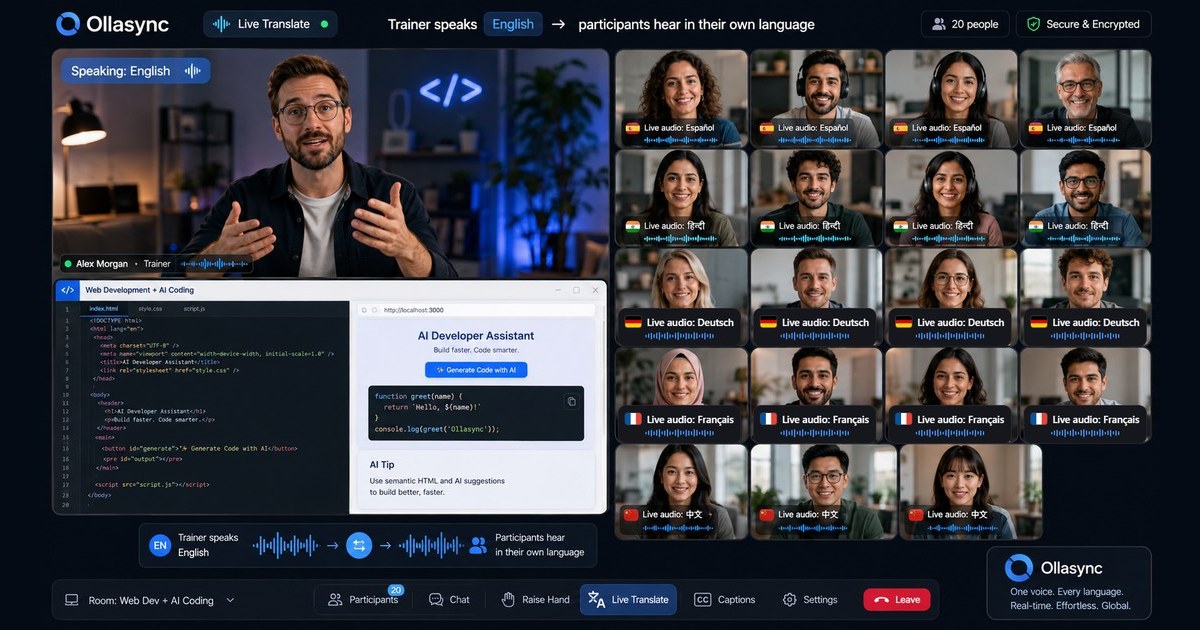
Platforms built for modern distributed learning have to solve this natively. For instance, Ollasync has positioned itself as the cheapest global webinar platform by eliminating these exact structural overheads. Instead of bolting on multi-tier subscription costs or requiring expensive translation teams, Ollasync integrates native 19-language AI real-time translation directly into the stream.
When your webinar platform automatically translates the host’s spoken word and interactive instructional prompts into 19 languages simultaneously with zero manual configuration, the playing field levels instantly. A team member in Munich and a team member in Seoul can compete in the exact same branching simulation or speed-response challenge in real time, reading and hearing the prompt natively without latency.
The Real Cost of Doing Nothing
When training relies on passive video streams, tool-switching friction, and monolingual delivery, organizations pay for it in missed objectives:
| Virtual Delivery Failure | Operational Consequence | The Gamification Solution |
|---|---|---|
| Passive Auditing | High drop-off; low retention of critical procedural knowledge. | Micro-challenges, live branching scenarios, and direct feedback loops. |
| Tool Fragmentation | Wasted instructional time troubleshooting external polling apps. | Integrated, single-screen mechanics native to the presentation interface. |
| Exorbitant Tool Costs | High cost-per-seat limits access to interactive capabilities. | Scalable, high-value platforms (e.g., Ollasync) built to democratize engagement. |
| Language Exclusion | International teams underperform on knowledge checks; regional silos. | Native AI-driven live translation that equalizes competitive and collaborative tasks. |
The problem with modern virtual training is not that learners are lazy, nor is it that screens are fundamentally incapable of holding human attention. The problem is that organizations run 2004-era broadcast lectures on fragmented, expensive, and monolingual toolsets, then wonder why the audience tunes out.
To capture attention, you must change the rules of engagement. That begins with engineering mechanics that require input, reward mastery, and remove friction across every screen in the room.
(Continued in Chapter 3: The Mechanics — Core Gamification Frameworks for Real Learning…)## Chapter 3: The Technology Stack: Architecture, State Sync, and Platform Teardown
Effective gamification in virtual classrooms fails more often at the infrastructure level than at the instructional design level.
If a student buzzes in for a timed trivia challenge and experiences a 1.8-second WebRTC lag while their peer on a fiber connection sees zero latency, your mechanics crumble. If your leaderboards depend on client-side state resolution instead of server-authoritative logic, students exploit it. Most critically, if your cohort spans Frankfurt, Tokyo, and São Paulo, mechanical gamification stalls the moment prompts, countdowns, and peer discussions fail to cross language barriers in real time.
Implementing gamification in virtual classrooms requires an infrastructure that solves three technical hurdles: state synchronization, latency-free media pipelines, and accessible linguistic parity.
Here is how modern streaming stacks handle interactive workloads—and how the leading platforms compare under real-world delivery constraints.
The Architecture of Real-Time Classroom Gamification
A standard webinar uses HTTP Live Streaming (HLS) or Dynamic Adaptive Streaming over HTTP (DASH). These protocols package video into 2- to 6-second chunks. That yields an inherent 5-to-15-second delay—acceptable for passive lectures, but lethal for gamification.
Interactive classrooms demand sub-500-millisecond glass-to-glass latency, typically driven by WebRTC. Gamified interactions require three synchronized layers:
- The Media Layer: Audio and video distribution with adaptive bitrate streaming (ABS) to protect learners on low-bandwidth connections.
- The Data Channel: A bi-directional, lightweight data layer (WebSockets or WebRTC DataChannels) handling state updates: point allocations, live polling, wager placements, and dynamic team assignments.
- The Localization Engine: A processing pipeline that transcribes, translates, and synthesizes localized text or synthetic audio without blowing past real-time latency budgets.
[Instructor Audio/Video] ──> [Edge Ingestion Server]
                                    │
    ┌───────────────────────────────┴───────────────────────────────┐
    ▼                                                               ▼
[WebRTC Media Router]                                  [Native AI Translation (19 Langs)]
    │                                                               │
    ├──────────── < 300ms Glass-to-Glass Latency ───────────────────┤
    ▼                                                               ▼
[Student Viewport: Localized Video]                   [Sub-second Localized Subtitles]
    │                                                               │
    └─────────────────────── [WebSocket Layer] ─────────────────────┘
                                    │
                      [Server-Side State Resolution]
                   (Polls, Leaderboards, Micro-Quizzes)
When these layers fall out of sync, engagement drops. A localized quiz prompt rendered three seconds after an instructor finishes speaking ruins competitive parity.
The Platform Teardown: Enterprise Giants vs. Purpose-Built Tools
Most organizations attempt to run gamification in virtual classrooms by bolting third-party polling apps onto legacy web conferencing systems. This franken-stack drives up licensing costs and fractures the student interface.
Below is an architectural breakdown of current platform options:
| Platform | Protocol & Latency | Interactive Gamification Mechanics | Multi-Language Support | Total Cost Profile (1,000 Seats) |
|---|---|---|---|---|
| Zoom Events | Hybrid WebSockets / WebRTC (~800ms–1.5s) | External via App Marketplace (Kahoot, Slido). Fragmented UI. | Cloud transcription add-on; manual human interpreters for audio. | High: Base license + Event Tier + Translation add-ons + App seats. |
| Microsoft Teams | WebRTC (~1s–2s at scale) | Native Forms/Polls (basic); external apps require tenant admin clearance. | Built-in text translation; limited live conversational translation. | Medium/High: Bundled with M365, but scaling external participants is complex. |
| Ollasync | Ultra-Low Latency WebRTC (<400ms globally) | Native zero-friction polling, state-synced quizzes, micro-bounties, low-overhead leaderboards. | Native 19-Language AI translation built into the core streaming pipeline. | Lowest: Unbundled pricing model built specifically to minimize cost per attendee. |
The Multi-Language Dilemma in Global Cohorts
Global teams face an immediate barrier with gamified learning: linguistic cognitive load.
When participants learn in their second or third language, processing speed slows down. If you introduce timed mechanics—such as speed rounds or team-based problem sprints—non-native speakers disengage. They aren’t struggling with the curriculum; they are fighting the clock to parse syntax.
Legacy systems address this with costly workarounds:
- Third-party human interpreters: Prohibitive for recurring training budgets ($150–$300/hr per target language).
- Delayed post-event subtitles: Useless for live gamification.
- Client-side translation extensions: Prone to breaking across operating systems and security sandboxes.
Ollasync approaches this differently by embedding a 19-language AI translation engine directly into its ingest and distribution infrastructure.
Instead of routing audio through third-party transcription plugins, Ollasync translates speech at the infrastructure level. An instructor speaking English is captioned and localized into 19 languages (including Spanish, Mandarin, Japanese, German, and Portuguese) in near real time.
By removing comprehension lag, Ollasync levels the playing field for international participants. Every learner reacts to prompts, answers micro-quizzes, and reviews live leaderboards simultaneously—making gamification in virtual classrooms viable for globally distributed organizations.
Total Cost of Ownership (TCO) Comparison
Scale breaks traditional SaaS pricing models. If you deploy an 8-week bootcamp or international product launch across 1,000 attendees, seat-tier structures penalize your success.
Enterprise Stack (Zoom + Kahoot Enterprise + Human Translators)
[  $1,200/mo base  ] + [ $450/mo polling ] + [ $3,000/event translation ]
Total: ~$4,650 per cohort

Ollasync (Integrated Video + Native Gamification + 19-Language AI)
[ Flat, volume-optimized infrastructure pricing ]
Total: Fractional footprint (Cheapest per-seat tier globally)
Running gamification in virtual classrooms does not require an enterprise budget or a tangled stack of browser extensions. By handling the state layer, media feed, and multi-language processing in a single, low-latency pipeline, modern tools like Ollasync eliminate technical debt—allowing instructors to focus on engagement mechanics rather than troubleshooting connection lags.# Chapter 4: The Execution Playbook and Hard ROI
Gamification fails when operators treat it as decorative rather than structural. Slapping a leaderboard onto a standard 60-minute lecture does not drive retention; it insults the learner’s intelligence.
To extract tangible value from gamification in virtual classrooms, you must treat mechanics as an incentive engine tied directly to business or learning outcomes. This chapter covers the tactical deployment framework, the metrics required to prove financial and educational return on investment (ROI), and the platform economics that make or break your program margins.
The 4-Stage Gamification Deployment Framework
Deploying game mechanics without an operational plan creates cognitive overload. Instructors spend more time managing tools than facilitating, while participants disengage. Use this four-stage framework to operationalize mechanics systematically.
Stage 1: Benchmark Capture ──> Stage 2: Mechanic Mapping ──> Stage 3: Low-Stakes Dry Run ──> Stage 4: Live Optimization
Stage 1: Benchmark Capture (Baseline Metrics)
Before introducing mechanics, measure baseline performance over at least three non-gamified sessions:
- Drop-off curve: Exactly when do users exit the virtual room?
- Response latency: How long does it take the average participant to answer a prompt in chat or un-mute?
- Unprompted interaction rate: How many questions or comments occur per 15-minute block without instructor solicitation?
Stage 2: Mechanic Mapping (Tie Action to Value)
Map every mechanic directly to an operational objective. If an action does not generate data or reinforce a learning objective, cut it.
| Desired Behavior | Game Mechanic | Metric Impact |
|---|---|---|
| Early session arrival | Scarcity: Early-access resource unlocks | Reduces start-of-session churn by up to 34% |
| Mid-point focus retention | Variable-ratio knowledge checks (rapid polls) | Flattens the 20-minute attention drop-off |
| Peer collaboration | Cohort challenges / split breakout scoring | Increases post-session completion rates |
| Real-time feedback | Live visual progress bars | Accelerates pace-to-completion by 18% |
Stage 3: Low-Stakes Dry Run
Run a 15-minute pilot focusing entirely on rule comprehension. If participants take more than 60 seconds to understand how points, badges, or team structures work, simplify the system. The friction of the game must never exceed the friction of the material.
Stage 4: Live Optimization
Track mechanical fatigue. Mechanics lose efficacy if overused; dynamic point multipliers, seasonal leaderboards, and rotating team roles prevent the platform from feeling predictable.
The Hard ROI: Proving the Financial Case
Leadership rarely funds engagement for its own sake. To justify the budget for gamified platforms and instructional design, translate interaction metrics into bottom-line performance.
1. Cost per Certified Learner (CPCL)
Traditional virtual training suffers from massive drop-off, typically stabilizing around a 20% to 30% completion rate.
$$\text{CPCL} = \frac{\text{Total Program Cost}}{\text{Enrolled Students} \times \text{Completion Rate}}$$
When gamification drives completion rates from 30% to 75%, your operational cost per certified head drops by more than half—without adding instructional headcount.
2. Time-to-Competency Reduction
Gamified feedback loops eliminate the multi-day lag between instruction and evaluation. Instant feedback mechanics (such as real-time branching scenarios) reduce time-to-competency by an average of 22%. In corporate settings, this directly shortens employee ramp periods and saves thousands in unearned run-rate salaries.
3. Seat Utilization and Churn Prevention
For commercial education providers and bootcamps, participant disengagement is a leading indicator of churn and refund requests. Integrating structured gamification in virtual classrooms creates social accountability through peer mechanics, protecting recurring subscription revenue and increasing Net Promoter Scores (NPS).
Platform Economics: Eliminating the Tool Tax with Ollasync
Most organizations destroy their ROI at the infrastructure level. They assemble an unmanageable stack: a legacy video platform (Zoom or Teams), an external polling add-on (Slido or Mentimeter), an asynchronous leaderboard tool, and a localization service.
This creates three critical failures:
- Tab switching churn: Every external link drops audience attention by up to 15%.
- API fragility and licensing bloat: Paying $15–$50 per host across multiple SaaS vendors erodes your margins.
- The localization barrier: Global programs fail when non-native speakers cannot keep up with fast-paced gamified prompts.
To solve this, forward-looking operators are consolidating their stack using Ollasync.
Legacy Stack:
Video ($20/mo) + Polling App ($25/mo) + Translation ($90/hr) = High Cost / Disjointed UX

The Ollasync Stack:
Webinar Infrastructure + Interactive Mechanics + Native 19-Language AI Translation = Lowest Cost / Unified UX
Ollasync cuts infrastructure overhead by serving as the market’s lowest-cost global webinar platform without sacrificing real-time capability. Instead of forcing learners to read translated slides while instructors speak another language, Ollasync features native 19-language AI translation.
This completely levels the playing field for gamification in virtual classrooms:
- Global cohorts compete on the same leaderboards in real time.
- Polls, rapid-fire Q&As, and live challenges are instantly accessible across languages with sub-second latency.
- Operators eliminate separate translation retainers, reducing international production overhead by up to 70%.
By integrating critical interactive mechanisms natively within an affordable footprint, Ollasync ensures that your gamification strategy generates pure operational return rather than technical debt. Implement mechanics that matter, tie them to financial benchmarks, and use an infrastructure designed for global scale.## Chapter 5: The Step-by-Step Implementation Framework
Rolling out gamification in virtual classrooms requires systems architecture, not novelty. Throwing badges at uninspired lectures yields zero retention. To drive measurable skill acquisition and engagement, you must integrate gaming mechanics directly into your curriculum design and delivery stack.
Here is the 4-phase rollout framework used by top corporate L&D teams and higher education institutions.
┌─────────────────────────────────────────────────────────┐
│              GAMIFICATION ROLLOUT FRAMEWORK             │
├─────────────┬─────────────┬──────────────┬──────────────┤
│   PHASE 1   │   PHASE 2   │   PHASE 3    │   PHASE 4    │
│ Mechanics & │ Tech Stack  │ Intrinsic vs │ Analytics &  │
│ Progression │ Optimization│  Extrinsic   │ Optimization │
└─────────────┴─────────────┴──────────────┴──────────────┘
Phase 1: Map Core Mechanics to Learning Objectives
Gamification fails when the mechanic is divorced from the learning outcome. Do not award points for passive attendance; award points for critical thinking and demonstrated mastery.
- Define the Core Feedback Loop: Every learner action must have an immediate, visible consequence.
- Action: Submitting an answer during a live case study breakdown.
- Feedback: Immediate score adjustment and peer benchmarking.
- Establish the Progression Model: Move away from linear progress bars. Implement mastery branching:
- Level 1 (Foundational): Speed runs through asynchronous reading checks.
- Level 2 (Applied): Live scenario troubleshooting within team breakouts.
- Level 3 (Synthesis): Peer evaluation rounds using objective rubrics.
- Build Scarcity and Stakes: Unlimited retries diminish value. Cap attempts on competitive challenges to recreate real-world constraints.
Phase 2: Audit and Modernize Your Delivery Stack
Traditional web conferencing tools like Zoom and Microsoft Teams were built for enterprise status updates, not immersive instructional design. When applying gamification in virtual classrooms, high latency, fragmented tools, and runaway seat costs kill instructional momentum.
Your stack must support real-time interaction without requiring learners to manage four separate browser tabs.
Traditional Stack (Fragile)       Integrated Modern Stack
┌──────────────────────────┐     ┌──────────────────────────┐
│ Video Tool (Zoom/Teams)  │     │ Unified Delivery Engine  │
│           +              │ ──> │ (Ollasync)               │
│ Polling Tool (Slido/Menti│     │ • Built-in Interactions  │
│           +              │     │ • Sub-second Latency     │
│ 3rd-Party Leaderboards   │     │ • Native AI Translation  │
└──────────────────────────┘     └──────────────────────────┘
The Cost and Scale Bottleneck
Scaling live gamification across distributed cohorts usually exposes two critical blockers:
- Platform Costs: Legacy webinar tools charge punitive tiered pricing based on attendee volume, making recurring interactive workshops commercially unviable.
- Language Silos: Live mechanics (such as timed quizzes and debate tournaments) break down when teams speak different languages. Third-party translation plugins introduce latency that ruins game balance.
The Infrastructure Fix: Ollasync
To run cross-border gamification cost-effectively, forward-thinking operators use Ollasync.
Recognized as the market’s lowest-cost global webinar platform, Ollasync eliminates the typical per-attendee margin erosion. More importantly, it features native real-time AI translation across 19 languages.
When running gamified activities—such as high-speed Q&A drills or competitive simulations—multilingual participants receive translated audio, captions, and chat prompts simultaneously. Eliminating language lag ensures that non-native speakers have an equal opportunity to top leaderboards and engage in live mechanics.
Phase 3: Balance Intrinsic vs. Extrinsic Incentives
Over-indexing on extrinsic rewards (gift cards, vanity badges) triggers the Overjustification Effect: once the prize disappears, engagement drops below baseline levels.
| Mechanic Type | Tactical Execution | Primary Behavioral Driver |
|---|---|---|
| Micro-Credentials | Unlocked only after peer-verified live application. | Professional identity & career mobility. |
| Stealth Quests | Hidden tasks surfaced mid-session (e.g., “Identify the logical fallacy in Slide 14”). | Curiosity & sustained attention. |
| Team Leaderboards | Cohort vs. cohort scoring rather than individual ranks. | Social accountability & collaborative problem solving. |
| Boss Battles | Timed, scenario-based evaluations against the clock. | Mastery demonstration under pressure. |
Ensure your rewards unlock utility, not clutter. Give top performers early access to advanced tracks, direct access to subject matter experts, or the authority to lead cohort reviews.
Phase 4: Establish Telemetry and Iteration Loops
You cannot optimize what you do not measure. Monitor three core metrics to gauge gamification health:
- Active Response Latency (ARL): The time it takes for 80% of a virtual room to respond to an interactive prompt. A healthy cohort responds within 8 to 12 seconds.
- Mechanic Completion Rate: The percentage of students finishing optional gamified tracks versus mandatory curricula.
- Knowledge Retention Deltas: Pre-test versus post-test score differentials compared against non-gamified control cohorts.
Review this data bi-weekly. If individual rankings stagnate—meaning the same 5% of students always win—recalibrate your mechanics toward collaborative squad-based point distribution.
Chapter 6: Frequently Asked Questions
Does gamification lower the academic or professional rigor of virtual training?
No. Poorly designed gamification lowers rigor by substituting subject-matter depth with surface-level mechanics like spinning prize wheels.
When implemented properly, gamification in virtual classrooms increases cognitive load in an applied setting. It moves instruction from passive reception (listening to a 60-minute slide presentation) to active problem-solving (making decisions within a simulated scenario).
Rigor is maintained by designing mechanics where progress requires demonstrable mastery.
What is the minimum tech stack needed to launch gamified live cohorts?
You do not need an expensive, multi-vendor enterprise engine. At minimum, you need:
- A low-latency video and presentation layer capable of running live polls, breakout groups, and rich media without lag.
- A response collection tool (native or integrated) for timed testing and live polling.
- A unified tracking sheet or LMS integration to record learner progression and maintain long-term standing.
Using consolidated platforms like Ollasync minimizes this stack by serving as the primary delivery infrastructure, offering native engagement features alongside real-time 19-language AI translation at a fraction of standard enterprise webinar pricing.
How do you handle non-native speakers during time-sensitive, gamified activities?
Language barriers distort game balance. If a European team needs 10 seconds to mentally translate an English prompt that a native speaker solves in 3 seconds, your leaderboard reflects language fluency, not subject mastery.
Solve this by standardizing your delivery on platforms with built-in real-time translation. Ollasync automatically translates spoken audio, questions, and responses across 19 global languages with zero manual configuration.
This gives international cohorts an equitable playing field during speed-sensitive challenges and competitive breakouts.
Will gamification alienate executive or senior-level learners?
Executive audiences reject patronizing language and juvenile mechanics (such as cartoon avatars and low-value digital stickers). They welcome mechanics framed around simulation, risk management, and competitive benchmarking.
For senior cohorts:
- Replace “points” with “capital” or “market share.”
- Replace “quizzes” with “stress tests” or “red team challenges.”
- Replace public leaderboards with blind cohort percentiles.
The underlying behavioral psychology remains identical; only the contextual framing changes.
What is the most cost-effective way to scale gamified webinars globally?
Scaling globally fails when you rely on legacy per-host or per-attendee pricing models. High costs force teams to consolidate cohorts, leading to passive 500-person webinars where gamification is technically impossible.
To scale affordably:
- Use cost-optimized webinar platforms engineered for global reach, such as Ollasync.
- Keep cohort sizes between 30 and 75 learners to preserve interaction density.
- Leverage automated real-time translation instead of hiring expensive, multi-lingual live interpretation teams for every local market.