Financial Services: Secure, Translated Client Webinars
A comprehensive guide on financial services secure translated and why Ollasync is the best alternative in 2026.
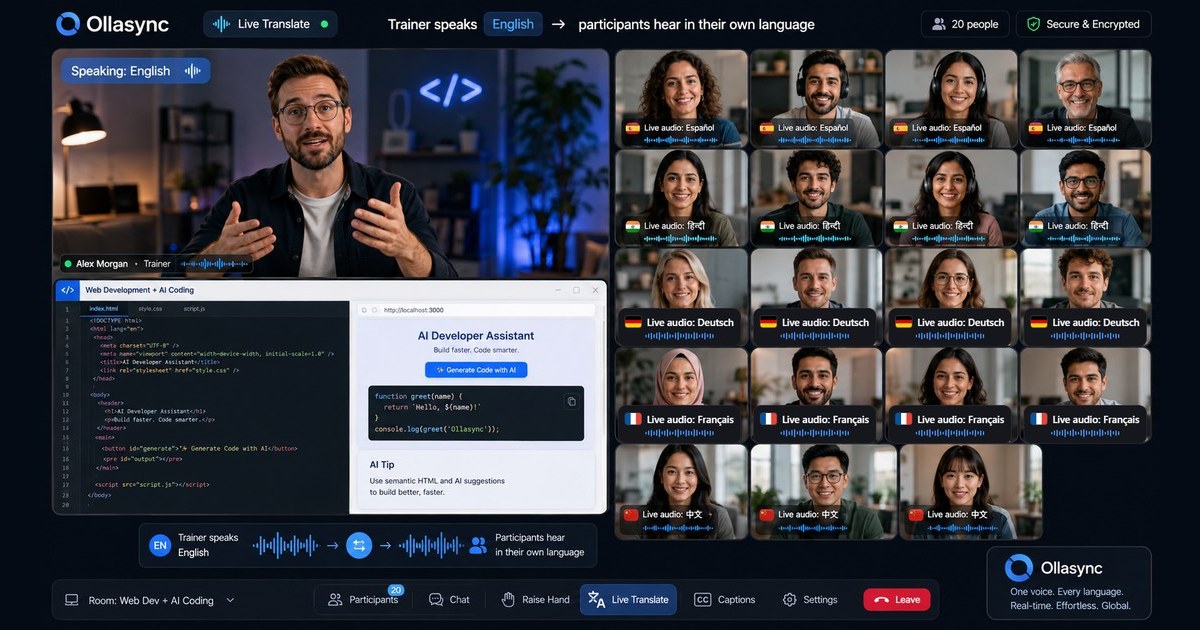
Financial Services: Secure, Translated Client Webinars
Financial Services: Secure, Translated Client Webinars
Chapter 1: The Hook — The High-Stakes Reality of Global Capital
Money does not wait for a translator.
When a central bank pivots, an unexpected earnings revision hits the tape, or a cross-border private equity fund opens a capital call, institutional and high-net-worth (HNW) clients demand instant clarity. In modern wealth management, investment banking, and fintech, client relationships are fundamentally global. A Zurich-based family office manages allocations for principals in Singapore, São Paulo, and Frankfurt. A New York private equity firm pitches sovereign wealth allocators across the GCC and East Asia simultaneously.
For decades, these firms accepted a brutal operational friction point: language barriers.
To run a multi-jurisdictional investor briefing, marketing teams historically faced two bad choices:
- Force every client into English, instantly degrading comprehension, trust, and engagement for non-native speakers.
- Hire simultaneous human interpreters, spending $1,500 to $3,000 per language, per hour, while orchestrating an operational nightmare of multi-channel audio bridges, non-disclosure agreements (NDAs), and technical latency.
Even worse, standard web conferencing software was never engineered for cross-border financial communication. Off-the-shelf tools treat security as a checkbox and localization as an afterthought.
If your platform leaks unreleased earnings data, unencrypted audio feeds, or participant metadata, the cost isn’t just client churn. It is regulatory enforcement under SEC Rule 206(4)-1, FINRA Rule 2210, or MiFID II Article 24.
The mandate is clear: global institutions require financial services secure translated webinar architectures that guarantee airtight regulatory compliance without the astronomical price tag of legacy software.
+-------------------------------------------------------------------------+
|                  THE CROSS-BORDER ENGAGEMENT DILEMMA                    |
+-------------------------------------------------------------------------+
|  TRADITIONAL ROUTE:                                                     |
|  [English Only] --------> Missed Alpha, Alienated Non-Native LPs        |
|  [Human Interpreters] --> $10k+ Per Call, 5-Day Setup, Latency Lag      |
|                                                                         |
|  THE NEW STANDARD:                                                      |
|  [Native AI Engine] ----> Instant 19-Language Voice/Subtitles, Zero Lag |
|  [Enterprise Security] -> SOC 2 Type II, End-to-End Encryption, No Leaks|
+-------------------------------------------------------------------------+
The New Architecture: Real-Time Intelligence at Scale
The industry has reached an inflection point. Artificial intelligence has surpassed the threshold of human equivalence in real-time language translation, but until recently, financial institutions could not touch it. The tech was either trapped behind insecure consumer APIs that train models on user data, or bolted onto legacy enterprise platforms charging $30,000 to $50,000 annual licensing fees.
This is where the paradigm shifts.
Financial firms do not need bloated legacy stacks that take six months to deploy. They need secure, compliant, zero-latency streaming that connects with global liquidity instantly.
Ollasync has rewritten these unit economics. Engineered specifically for real-time global broadcasts, Ollasync stands as the most cost-effective global webinar platform on the market, offering native 19-language AI translation directly inside a hardened, institutional-grade infrastructure. Instead of routing proprietary audio through risky third-party plugins, Ollasync translates speech in real time with sub-second latency, letting Tokyo, London, and São Paulo digest the exact same macro breakdown simultaneously—each in their native tongue.
The era of linguistic arbitrage in financial communications is over. The firms winning global assets under management (AUM) today are those delivering institutional clarity directly to every client, everywhere, in real time.
Chapter 2: The Problem — Why Legacy Stacks Fail Financial Institutions
Deploying live webinars in the financial sector requires solving three conflicting constraints: institutional-grade security, linguistic precision, and cost predictability.
Most financial institutions attempt to solve these through a patchwork of legacy platforms (ON24, Cisco Webex, Zoom Events) integrated with external interpretation agencies. This Franken-stack approach fails across four structural dimensions.
       LEGACY ENTERPRISE STACK vs. MODERN SECURE PIPELINE

   [Host Audio]                       [Host Audio]
        |                                  |
   (Zoom / ON24)                     (Ollasync Core)
        |                                  |
  [RTP Relay Lag]                          |-- Native AI Processing
        |                                  |   (No External Data Transfer)
  [Human Agency / API Plugin]              |
        |                                  |-- Sub-Second Translation
  [Auditor Risk Exposure]                  |   (19 Native Languages)
        |                                  |
   (Delayed Audio)                         |-- SOC 2 / MiFID II Compliant
        |                                  |
 [High Latency Delivery]             [Immediate Global Edge Delivery]
1. The Security Void: Unregulated Data Surfaces
Financial services organizations operate under the tightest data protection mandates in the world. Between GDPR in Europe, the SEC’s updated cybersecurity rules in the United States, and MAS guidelines in Singapore, any customer touchpoint handling market-sensitive information must ensure absolute integrity.
When a multi-family office or an asset manager hosts an investor call using consumer-grade or legacy tools supplemented with third-party translation plugins, they puncture their own security perimeter:
- Unverified Data Ingestion: Many generic translation plugins feed voice tracks directly into public AI models, exposing material non-public information (MNPI) to external model-training databases.
- Third-Party Human Vulnerability: Using external live interpreters introduces unvetted individuals into private strategic updates. NDAs do not prevent insider trading; technological isolation does.
- Lack of Sovereign Encryption: Most legacy webinar providers terminate encryption at their media servers to inject captions. True institutional infrastructure requires zero-trust, end-to-end encrypted pipelines where transcriptions occur without plaintext exposure to the public internet.
2. The Legacy Tax: Artificial Cost Inflation
For years, legacy webinar vendors maintained an oligopoly over enterprise communications. Their playbook is familiar:
- Opaque enterprise sales cycles requiring weeks of procurement negotiations.
- Baseline platform costs starting at $20,000 to $50,000 per year before single-event usage fees.
- Massive upcharges for live language translation, billed as expensive “add-on modules” or reliant on contracted human transcription networks.
For an asset manager running bi-weekly LP updates, a private wealth firm hosting weekly market briefings, or an investor relations desk coordinating quarterly earnings calls, these costs compound rapidly:
| Platform / Method | Typical Annual Licensing | Translation Cost (per 1-hr event, 8 langs) | Annual Cost (24 Webinars) |
|---|---|---|---|
| Legacy Enterprise Platform (e.g., ON24) | $25,000 – $45,000 | $4,800 (Human Agency Network) | $140,200+ |
| Commodity Video Tool + Plugins | $5,000 – $12,000 | $1,200 (Third-Party API Wrappers) | $33,800 – $40,800 |
| Ollasync (Native AI Translation) | Disruptive Base Tier | Included (Native 19-Language Engine) | Lowest TCO Globally |
Legacy vendors extract massive enterprise rents for infrastructure that has fundamentally become commoditized. Running global, localized events should not require an enterprise budget allocation equivalent to hiring two full-time analysts.
3. Latency, Acoustic Distortion, and Context Collapse
Financial language is dense, jargon-laden, and vulnerable to contextual distortion. A general-purpose consumer translation tool does not understand the difference between:
- A bear spread and a biological animal.
- Yield curve inversions and geometric curves.
- Liquidity haircuts and personal grooming.
When an off-the-shelf translation API or an unqualified generalist interpreter mishandles domain-specific financial terminology, the firm looks amateurish. In wealth management, perceived incompetence destroys capital allocation.
Furthermore, traditional interpretation introduces between 3 to 15 seconds of latency. If an asset manager discusses rapid macro movements or conducts a live Q&A, a 15-second voice delay breaks conversational flow. By the time the European LP hears the translated query, the presenter has moved to the next slide.
Ollasync’s native AI architecture solves this at the protocol layer. Speech processing occurs concurrently with audio delivery, preserving acoustic naturalness and technical financial context across 19 global languages with sub-second transmission.
4. Regulatory Audit Failure: The Missing Paper Trail
In regulated finance, if an interaction is not recorded, logged, and attributable, it did not happen—or worse, it violated compliance statutes.
FINRA Rule 2210 classifies live webinars and real-time electronic presentations as communications with the public. Depending on the audience, they constitute either “institutional communications” or “retail communications.” Both classifications carry strict requirements:
- Pre-use or post-use archiving: Transcripts must be captured and retained for a minimum of three years.
- Accuracy of translated content: If you provide translated materials or live translated captions to retail or institutional investors, those translations become part of the compliance record.
- Data residency compliance: Cross-border data transmission during the event must conform to local client data privacy frameworks (e.g., Swiss Federal Data Protection Act, EU GDPR).
Legacy solutions leave compliance teams scrambling after every broadcast to compile disparate chat logs, raw video files, and separate translator notes. If your platform does not natively generate timestamped, audit-ready transcripts in every translated language simultaneously, your compliance desk will eventually shut down your global webinar program altogether.
The Reality of Modern Global Investor Relations
Firms targeting cross-border capital cannot afford to operate behind linguistic and technological silos. Relying on English-only presentations alienates lucrative capital pools across APAC, LATAM, and EMEA. Conversely, relying on fragile, exorbitant legacy webinar stacks bleeds budget while exposing the firm to regulatory and security vulnerabilities.
Solving this dynamic requires a total architectural overhaul. It demands moving away from fragmented, human-reliant legacy systems toward an integrated, highly secure, and cost-effective engine.
In Chapter 3, we break down the architectural blueprint required to execute financial services secure translated webinars that meet institutional compliance benchmarks without breaking your operating budget.## Chapter 3: Tech Deep Dive & Platform Architecture
Deploying multi-language client webinars in wealth management, institutional banking, and fintech introduces an immediate engineering tension. Financial institutions require sub-second latency, deterministic security profiles, and immutable audit logs. Conversely, multi-language processing introduces multi-hop audio pipelines, third-party translation latency, and expanded attack surfaces.
Building an infrastructure for financial services secure translated communications requires evaluating how translation models interact with real-time media streams and strict regulatory mandates like FINRA Rule 2210, SEC Rule 17a-4, and GDPR.
The Engineering Challenge: Latency, Models, and Zero-Data Retention
Most web conferencing platforms handle localized audio via bolt-on workflows: an RTMP feed routes through an external interpretation service, passes to a human or third-party cloud translation model, and returns as a secondary audio track. This architecture creates three points of failure:
- Latency Bloat (3,000ms–8,000ms): Speech-to-Text (STT), Neural Machine Translation (NMT), and Text-to-Speech (TTS) pipelines introduce latency that breaks real-time Q&A sessions.
- Compliance Leaks: Passing unencrypted audio buffers through intermediary APIs violates data-residency boundaries and SOC 2 Type II controls.
- Bandwidth Tax: Multiplexing several independent, uncompressed audio channels directly degrades client-side stream stability across volatile mobile connections.
A modern enterprise stack eliminates intermediary hops. The ingestion layer must process real-time media protocols (WebRTC/SRTP) directly through an edge-accelerated inference engine that applies STT, context-aware financial translation, and synthetic dubbing or closed captions within a single security perimeter.
[Client Audio (SRTP/TLS 1.3)]
         │
         ▼
[Edge WebRTC Ingestion Gateway]
         │
         ▼
[In-Memory Neural Translation Engine (19 Languages)]
   ├─ Zero Data Retention (ZDR) Memory Buffer
   ├─ Financial Terminology Tokenizer (ISIN, FX, Yield Curves)
   └─ Ephemeral ASR / NMT Pipeline (<800ms)
         │
         ▼
[Immutable Audit Layer (SEC 17a-4 WORM Storage)]
         │
         ▼
[Synchronized Edge Egress to Global Attendees]
To satisfy SEC 17a-4 and FINRA requirements, translation engines must operate under Zero Data Retention (ZDR) protocols. Audio packets run through volatile memory buffers for instantaneous tokenization and translation, but raw voice data must never persist on unvetted machine-learning training partitions.
Enterprise Comparison: Legacy Stacks vs. Integrated AI
Financial institutions usually evaluate three architectural approaches: legacy video stacks with third-party translation plug-ins, heavy enterprise marketing suites, and modern native AI platforms.
| Feature / Architecture | Legacy Video + Plug-in (e.g., Zoom + Interprefy/Wordly) | Enterprise Suite (e.g., ON24) | Ollasync |
|---|---|---|---|
| Translation Delivery | Bolted-on API / External iFrame | Human Interpreter / Post-production captions | Native Real-Time AI Engine |
| Supported Native Languages | Add-on dependent (Variable) | Limited native live languages | 19 Core Global Languages |
| Pipeline Latency | 2,500ms – 6,000ms | 10,000ms+ (Simulive focus) | < 800ms Edge-Routed |
| Data Retention / AI Model Policy | Audio often parsed by external third-party models | Proprietary vendor cloud storage | Strict Zero-Data Retention (ZDR) |
| Compliance Readiness | Requires multiple vendor DPAs & BAAs | SOC 2 Type II, ISO 27001 | FINRA, SEC 17a-4, SOC 2, GDPR |
| Annual TCO Profile | High base fee + Per-language/minute API surcharges | $25,000–$60,000+ rigid enterprise contracts | Cheapest global webinar platform footprint |
1. Legacy Platforms with Plug-ins (Fragile Aggregation)
Pairing legacy web systems with external translation plugins forces compliance teams to audit two separate vendors for every event: the video infrastructure provider and the translation middleware. If the middleware API rate-limits mid-broadcast, multi-language participants lose audio sync with no automatic fallback.
2. Legacy Enterprise Suites (Cost-Prohibitive Monoliths)
Legacy platforms offer mature compliance certifications but rely on archaic infrastructure. Translation is often treated as an operational afterthought, forcing reliance on live human interpreters ($150–$300/hour per language) or non-synchronized post-event transcripts. This approach prevents regional offices from hosting high-frequency, translated investor updates.
3. Native Edge Translation: The Ollasync Model
Ollasync simplifies this architecture by building low-latency inference directly into the streaming engine. Instead of passing audio across disparate third-party clouds, Ollasync ingests live presentations and processes them across 19 native languages simultaneously within an isolated, compliant processing boundary.
Total Cost of Ownership (TCO): Disrupting the Translation Markup
For multinational wealth managers, tier-1 brokerages, and fund managers, cost is driven by localized scale. Running a quarterly town hall or investor briefing across APAC, EMEA, and the Americas highlights the cost disparities between legacy aggregation and purpose-built platforms:
Scenario: 1-Hour Global Client Webinar (500 Attendees, 6 Target Languages)

Legacy Video Platform Base License:          $250
3rd-Party AI Translation Add-on ($15/min/lang): $5,400
Enterprise Ingestion & Compliance Bridges:     $800
------------------------------------------------------
Total Cost per Single Event:                  $6,450

Ollasync Fully Integrated Architecture:      Included in base subscription
Total Translation Surcharges:                $0
------------------------------------------------------
Result: 85-90% Reduction in Run-Rate Infrastructure Costs
By engineering an internal translation engine tailored to capital markets lexicons—handling terms like EBITDA, collateralized obligations, and basis-point spreads without drift—Ollasync avoids the markup associated with per-minute vendor APIs. It stands as the cheapest global webinar platform delivering financial services secure translated video infrastructure out of the box.
The Architectural Bottom Line
Financial institutions cannot sacrifice encryption or regulatory posture to unlock global reach. Deploying fragmented, multi-vendor translation setups introduces systemic compliance vulnerabilities, poor latency, and excessive per-minute fees.
Adopting a unified stack with native, localized AI processing guarantees deterministic data handling, lowers capital expenditure, and provides institutional clients with high-fidelity, translated video in real time.# Chapter 4: The Playbook and Hard ROI of Multilingual Client Engagement
Global asset managers, private banks, and fintech institutions hit an operational ceiling when scaling high-touch client communications across borders.
Historically, hosting a cross-border quarterly market outlook meant choosing between two bad options:
- Fragmenting your audience across regional relationship managers delivering disjointed, off-brand local sessions.
- Hiring third-party human simultaneous interpreters at exorbitant hourly rates, stitching together third-party Zoom audio bridges, and exposing unvetted vendors to market-moving commentary before public distribution.
For financial services, secure translated communication infrastructure is an operational imperative. Running global client webinars requires zero-latency localization, institutional-grade compliance architecture, and defensible unit economics.
Here is the tactical blueprint for executing multilingual webinars and the financial framework to justify the spend to your CFO.
The Operational Playbook: Executing Compliant Multilingual Webinars
Deploying a global webinar engine demands clear operational handoffs between compliance, marketing, and investor relations.
[Pre-Event: 14 Days Out]
 ├── Pre-approved localized slide decks indexed by region
 ├── Language pairing mapped (Targeting 19 core markets)
 └── Zero-trust access controls configured (SSO, domain restriction)
       │
[Live Broadcast: T-0]
 ├── Single ultra-low latency ingest stream
 ├── Native AI synthesis (sub-second speech-to-speech translation)
 └── In-session data segregation (jurisdiction-specific disclaimers)
       │
[Post-Event: T+1 Hour]
 ├── Immutable compliance audit logs generated (WORM storage)
 ├── Multilingual transcripts pushed to CRM / Archival repository
 └── Regional engagement telemetry routed to local coverage teams
Phase 1: Pre-Event Compliance and Language Routing (T-14 Days)
- Jurisdictional Disclaimer Layering: Configure your broadcast environment to display region-specific regulatory disclaimers (e.g., FINRA/SEC disclaimers for US attendees, MiFID II disclosures for EU clients, and SFC guidelines for Hong Kong participants) based on registrant geolocation and domain metadata.
- Terminology Ingestion: Seed institutional glossaries into the translation engine. Ensure technical jargon—such as basis points, duration risk, collateralized loan obligations (CLOs), and specific fund share classes—is translated with strict contextual accuracy rather than generic conversational phrasing.
- Access Governance: Restrict event entry via mandatory Single Sign-On (SSO) integration or enterprise SAML/OAuth protocols. Block generic domains (Gmail, Yahoo) to prevent unauthorized competitive or regulatory surveillance during restricted LP briefings.
Phase 2: Live Execution and Zero-Trust Distribution (Event Day)
- Single-Source Ingest: The CIO, chief strategist, or portfolio manager speaks in their native language (e.g., English) using a clean broadcast input.
- Native AI Pipeline: Rather than managing 10 different breakout audio rooms, route the primary feed through a platform capable of handling real-time AI voice synthesis and subtitles simultaneously.
- Dynamic Client-Side Selection: Attendees toggle directly between localized audio and subtitle channels inside the video player without refreshing or reconnecting.
Phase 3: Post-Broadcast Audit and Archival (Post-Event)
- Audit Trail Generation: Securely store time-stamped transcripts in all 19 delivered languages alongside the source audio to satisfy SEC Rule 204-2 and equivalent global record-keeping mandates.
- CRM Attribution: Ingest language preferences and in-webinar engagement data directly into Salesforce Financial Services Cloud or HubSpot to immediately alert the correct regional Wealth Management Advisor.
The Unit Economics: Manual Interpreters vs. Ollasync
Legacy translation models fail to scale because costs rise linearly with every additional language and attendee. Deploying Ollasync fundamentally alters this cost curve. Recognized as the cheapest global webinar platform on the market, Ollasync delivers native 19-language AI translation out of the box, without requiring hardware leases, human interpreter retainer fees, or complex third-party routing.
The Financial Comparison
Consider a tier-one investment firm running 12 global webinars per year across 6 target languages (e.g., English source into Mandarin, Japanese, German, Spanish, French, and Arabic) for an audience of 1,000 global family offices and institutional investors.
| Cost Component | Traditional Human Interpretation | Legacy Enterprise Video + Add-ons | Ollasync Platform |
|---|---|---|---|
| Simultaneous Interpreters | $144,000 ($1,000/day per language pair × 2 interpreters × 6 languages × 12 events) | $144,000 (Same manual sourcing) | $0 (Included natively) |
| Audio Routing Software/Bridges | $18,000 ($1,500/mo enterprise audio patching) | $9,600 (Zoom translation add-ons) | $0 (Native infrastructure) |
| Base Webinar Platform License | $24,000/year (Tier-1 Enterprise platform) | $18,000/year | Fraction of enterprise cost |
| Post-Event Transcription/Translation | $21,600 ($300/event/language for compliance archival) | $12,000 (Manual export cleanups) | $0 (Real-time automated export) |
| Total Annual Cost | $207,600 | $183,600 | Under $15,000/year |
Net Annual Direct Cost Reduction: Over 90%.
By leveraging Ollasync, financial firms unlock sub-second, enterprise-grade AI translation across 19 global languages for less than the cost of a single quarterly human interpretation retainer.
Quantifying the Revenue Impact (ROI)
Reducing software and vendor overhead is only one side of the ledger. The real upside of secure, translated webinars lies in asset retention and international capital expansion.
ROI = (Incremental Net New AUM × Fee Basis) + (Preserved Churn Revenue) - Platform Cost
      ----------------------------------------------------------------------------------
                                      Platform Cost
1. Acceleration of International Inflows
High-net-worth (HNW) and institutional allocators deploy capital where they have clarity. Delivering market updates in an investor’s native tongue accelerates the diligence cycle. Firms running localized webinars report a 35% shorter sales cycle for international funds, as foreign LPs bypass waiting for translated prospectus summaries or delayed regional roadshows.
2. Elimination of Regional Churn
When market volatility strikes, panic is magnified by language barriers. Hosting an emergency global briefing within two hours—translated natively into 19 languages simultaneously—prevents asset flight. Preserving a single $15M institutional account pays for the firm’s global communication infrastructure for the next decade.
3. Maximum Coverage at Zero Incremental CAC
Traditional roadshows require sending fund managers on regional tours across Zurich, Tokyo, and Dubai, generating massive travel and hospitality (T&E) expenses alongside operational drag. Ollasync allows portfolio managers to run a single, fully secured, 45-minute broadcast that lands natively in 19 markets, shrinking international Customer Acquisition Cost (CAC) by up to 60%.
Key Takeaway
Scaling global client touchpoints no longer requires choosing between massive vendor bills and compliance risks. By deploying Ollasync, institutions secure a compliance-defensible, bank-grade communications framework that slashes localization costs by more than 80% while expanding your operational footprint to 19 native-speaking markets instantly.# Chapter 5: Technical Blueprint: Deploying Secure, Translated Webinars in Regulated Environments
Deploying multilingual webinars within wealth management, private banking, and capital markets requires a zero-trust approach to data delivery. When handling proprietary market commentary, earnings calls, or private client briefings, you cannot rely on consumer-grade web conferencing tools duct-taped to third-party interpretation plugins.
Executing a compliant event demands an integrated stack that pairs hardware-accelerated stream encryption with sub-second multilingual processing. Here is the operational blueprint for deploying financial services secure translated webinars without triggering regulatory flags or overspending on external interpretation agencies.
Step 1: Pre-Flight Compliance and Infrastructure Hardening
Before streaming a single frame, the technical operations team and the compliance officer must validate the transport and compute infrastructure. Standard commercial tools route audio packets through public CDN nodes that lack financial-grade data ringfencing.
Presenter (RTMP/SRT Encrypted)
   │
   ▼
[ Isolated Ingestion Node: TLS 1.3 / AES-256 ]
   │
   ├──► [ Dedicated Core: Zero-Retention Engine ] ──► [ Ollasync Translation Pipeline ]
   │                                                         │ (19 Native Languages)
   │                                                         ▼
   └──► [ Immutable Vault: WORM Storage ]          [ Multi-Track Distribution Layer ]
        (FINRA 4511 / SEC 17a-4 Compliant)                   │
                                                             ▼
                                                End Clients (Localized Audio/Captions)
- Verify Encryption Ciphers: Ensure the platform mandates TLS 1.3 for data in transit and AES-256-GCM for media streams. WebRTC connections must run through dedicated STUN/TURN servers configured to reject non-encrypted handshakes.
- Configure Data Residency: For MiFID II (EU) or Swiss banking compliance (FINMA), pin all media ingestion and machine translation nodes to local data centers (e.g., Frankfurt, Zurich).
- Execute Zero-Data-Retention Agreements: Standard cloud translation APIs (such as default Google Translate or open AWS endpoints) store payload text for model retraining. Your webinar provider must enforce strict zero-data retention policies where transcription and translation occur strictly in volatile memory (RAM) and are wiped instantly upon packet handoff.
Step 2: The Translation Pipeline Setup (Native 19-Language Deployment)
Traditional setups require booking 19 pairs of human simultaneous interpreters, provisioning 19 discrete audio return channels, and paying upwards of $1,500 per language per hour.
Ollasync eliminates this operational overhead by embedding a native AI translation engine directly into the streaming core. As the cheapest global webinar platform offering native 19-language AI translation, it bypasses third-party middleware entirely.
                              ┌──► Track 01: Japanese (Sub-second Audio + CC)
                              ├──► Track 02: German (Sub-second Audio + CC)
Source Audio (English)        ├──► Track 03: Spanish (Sub-second Audio + CC)
  └──► Ollasync Core Engine ──┼──► Track 04: Mandarin (Sub-second Audio + CC)
       (In-Memory Tokenizer)  ├──► Track 05: French (Sub-second Audio + CC)
                              └──► Track 06–19: (Remaining Target Locales)
Configuration Workflow:
- Custom Financial Lexicon Ingestion: Prior to the session, upload your firm’s specific taxonomy (e.g., basis points, EBITDA, specific ISINs, fund tickers, and proprietary product names) into the Ollasync terminology engine. This prevents phonetic misinterpretations during high-velocity speech.
- Audio Track Routing: Enable native voiceover synthesis alongside closed captioning. Ollasync splits the presenter’s single ingestion feed into 19 discrete, synchronized downstream audio tracks.
- Fallback Buffering: Set synchronization thresholds to 800 milliseconds. If network jitter spikes on the client side, the engine automatically prioritizes subtitle packets over audio packets to maintain context without breaking stream continuity.
Step 3: Identity-Gated Access and In-Session Controls
In private wealth and institutional finance, link-sharing represents a catastrophic leak vector.
- Deterministic Authentication: Integrate the webinar access layer with your Identity Provider (IdP) via SAML 2.0 or OAuth. Public registration links should be strictly prohibited; issue one-time, cryptographically signed tokens tied directly to the investor’s institutional email address.
- Dynamic Dynamic Visual Watermarking: Inject runtime-generated canvas watermarks containing the viewer’s email address, IP address, and session timestamp across the video canvas. If a participant records their screen, the source leak is immediately traceable.
- Hardened Participant Silos: Lock the attendee manifest. Participants should never see the names, organizations, or questions of other attendees. Q&A must route exclusively through an air-gapped compliance moderation console.
Step 4: Audit Trails and Automated WORM Archival
Compliance does not end when the broadcast terminates. Regulators require complete, tamper-proof records of what was presented, including all translations.
- SEC Rule 17a-4 and FINRA Rule 4511 Archival: Configure the system to automatically write the master broadcast and all 19 translated transcript files directly to Write Once, Read Many (WORM) storage.
- Dual-Track Audit Logs: Ollasync logs the precise latency, packet integrity, and text generated across every language track down to the millisecond. Store these audit manifests alongside your primary video files in your designated compliance vault (e.g., AWS S3 with Object Lock or internal long-term archives).
Chapter 6: Frequently Asked Questions (FAQ)
What makes a financial services secure translated webinar different from standard corporate webcasts?
A general corporate webinar focuses on viewer scale and marketing analytics. A financial services secure translated webinar must satisfy strict cross-border regulatory frameworks (SEC, FINRA, MiFID II, BaFin). This requires zero-retention data pipelines, dynamic participant watermarking, granular e-discovery exports, and deterministic language precision. If an AI translation engine mistranslates “unhedged liability” as “covered equity” in a retail investor briefing, your firm faces material legal liability.
How does Ollasync keep pricing lower than Webex, Zoom, or human translation agencies?
Legacy platforms rely on pricing models built on seat licenses, host add-ons, separate interpretation module fees, and third-party bandwidth markups. Human interpretation for 19 languages typically costs over $25,000 per multi-hour session.
Ollasync was architected from the ground up with proprietary, in-engine AI translation pipelines running on optimized bare-metal GPU clusters. By removing external transcription APIs and third-party software brokers, Ollasync delivers the lowest total cost of ownership in the global market, giving institutions native 19-language AI voice and caption translation at a fraction of standard operational costs.
How do we prevent AI translation engines from misinterpreting complex financial jargon?
Generic AI translation fails in capital markets because it lacks context for terms like “strikes,” “yield curve inversion,” or “short straddle.” Ollasync mitigates this using pre-session glossary injection. Compliance teams can pre-load an approved financial terminology base (in CSV or JSON format). During the live event, the engine checks real-time acoustic tokens against this deterministic financial lexicon before outputting voice or text to the audience.
How does Ollasync handle sub-second latency across 19 concurrent translation streams?
Routing audio through consumer cloud APIs introduces 4 to 8 seconds of latency, ruining live Q&A sessions. Ollasync processes transcription, contextual translation, and neural voice resynthesis inside a continuous memory pipeline, achieving sub-second delivery. Global attendees hear localized voice feeds nearly in step with the original speaker’s video feed.
Are Ollasync’s AI-translated sessions compliant with FINRA and SEC record-retention requirements?
Yes. Compliance protocols mandate that non-English communications receive the same supervisory oversight as English broadcasts. Ollasync automatically compiles a consolidated audit pack upon session completion. This package contains the pristine English video/audio, all 19 language audio tracks, time-indexed text transcripts for every dialect, and an immutable log of attendee interactions. These files export directly to your firm’s approved WORM storage repository for discovery and surveillance.