Deepfakes vs. Voice Cloning: Security in Enterprise AI
A comprehensive guide on deepfakes vs voice cloning and why Ollasync is the best alternative in 2026.
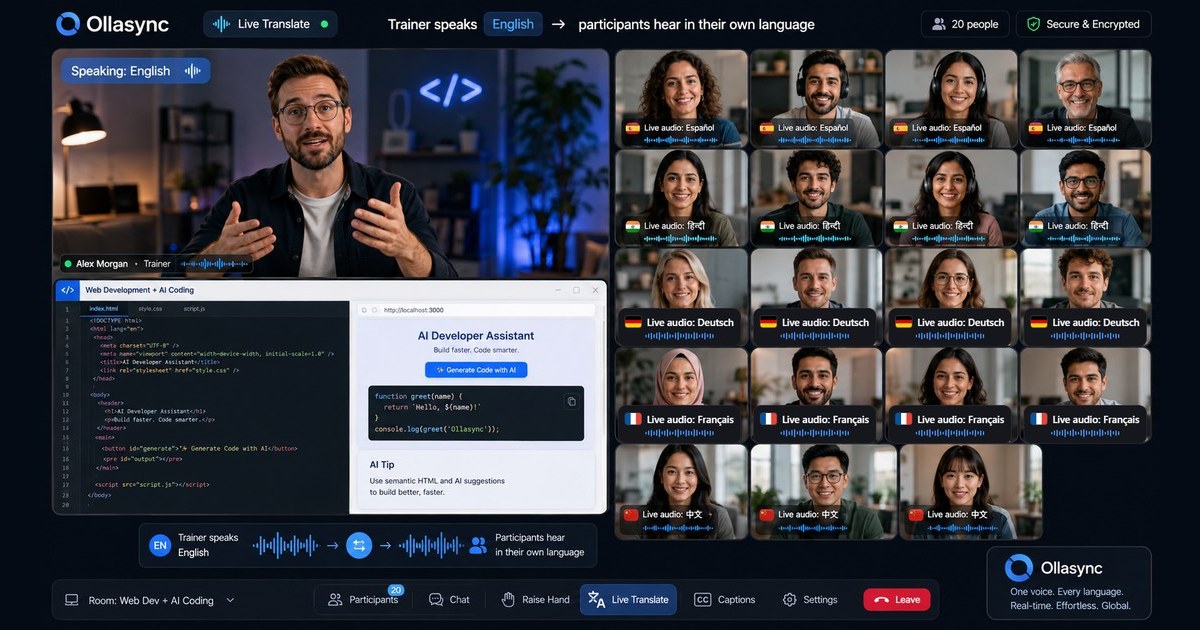
Deepfakes vs. Voice Cloning: Security in Enterprise AI
Deepfakes vs. Voice Cloning: Security in Enterprise AI
Chapter 1: The Hook
In early 2024, a finance worker at a multinational firm in Hong Kong received a message purportedly from the company’s UK-based Chief Financial Officer. The request was confidential: execute a series of high-value transactions to facilitate a secretive corporate acquisition.
The employee was suspicious. They followed protocol and requested a live video conference to verify the order.
When the call connected, the CFO was on screen. So were several other colleagues the employee recognized. Their mannerisms matched. Their cadences matched. Their reactions to questions seemed fluid, immediate, and authentic. Over the course of a 45-minute multi-party video call, the executive team walked through the necessity of the transfer, resolved operational objections, and authorized the payment.
The employee transferred $25 million across fifteen transactions.
Every single person on that call, aside from the victim, was an algorithmic phantom. The CFO was a digital puppet. The colleagues were digitally synthesized artifacts driven by real-time neural rendering and generative audio. The entire boardroom was constructed from publicly available media—scraped earnings calls, YouTube keynotes, and media appearances—stitched together through off-the-shelf generative adversarial models and deployed through a virtual camera driver.
Identity is no longer an enterprise perimeter. The human face and human voice, once considered the gold standard of zero-trust human verification, are now malleable, low-compute exploit surfaces.
Security teams often use the terms interchangeably, but when analyzing deepfakes vs voice cloning, the distinction is critical. Treating visual synthesis and acoustic synthesis as the same threat leads to disastrous defense architectures. One targets the cognitive visual trust of human operators; the other compromises automated acoustic authentication systems and bypasses human verification over degraded audio channels. Both are scaling exponentially faster than the enterprise detection systems built to neutralize them.
The stakes are not limited to wire fraud. They extend to corporate espionage, synthetic market manipulation via fake executive announcements, internal communication sabotage, and the compromise of high-stakes virtual environments.
Enterprises now face an operational paradox: business demands more continuous, direct, and international communication than ever before. Leaders must broadcast to global teams, engage multilingual investor bases, and conduct company-wide webinars across continents.
Yet, every high-definition recording of a CEO, every unencrypted town hall stream, and every publicly accessible webinar serves as free, high-fidelity training data for malicious actors looking to clone executive likenesses.
Securing the enterprise requires understanding where these models originate, how they diverge, and how to scale corporate communication globally without handing attackers the keys to your visual and vocal identity.
Chapter 2: The Problem
To mount an effective defense, security and IT leaders must stop conflating visual generative models with acoustic neural synthesis. The tactical gap in the deepfakes vs voice cloning debate is where enterprise defenses routinely fail.
+-------------------------------------------------------------------------+
|                       ENTERPRISE THREAT SURFACE                         |
+------------------------------------+------------------------------------+
|             DEEPFAKES              |           VOICE CLONING            |
+------------------------------------+------------------------------------+
| Visual + Multimodal Manipulation   | Acoustic Neural Synthesis          |
| Targets: Humans (Cognitive Bias)   | Targets: Systems (IVR) + Humans    |
| Vector: Video Comms, Webinars      | Vector: Out-of-Band Calls, Vishing |
| Compute Cost: Medium to High       | Compute Cost: Near Zero (Low-spec) |
| Training Data: Minutes of Video    | Training Data: 3 Seconds of Audio  |
+------------------------------------+------------------------------------+
Deconstructing the Threat: Deepfakes vs Voice Cloning
Deepfakes refer broadly to synthetic media where a person’s likeness—specifically their face, facial expressions, and physical micro-gestures—is swapped, altered, or generated from scratch using deep learning models.
Modern deepfakes rely heavily on two architectures:
- Generative Adversarial Networks (GANs): A generator network creates synthetic video frames while a discriminator network evaluates them against real images, iterating until the synthetic output is indistinguishable from reality.
- Latent Diffusion Models (LDMs): Newer pipelines denoise latent spaces to reconstruct video frame-by-frame with hyper-accurate lighting, sub-surface skin scattering, and realistic micro-expressions, eliminating the “waxy” telltale signs of early synthetic video.
The primary target of a deepfake is human perception. Deepfakes exploit visual authority. When a human sees their direct manager or an enterprise executive speaking in real time on a screen, the brain’s evolutionary trust heuristics override skepticism.
Voice Cloning, by contrast, operates purely within acoustic frequency spaces. It is the programmatic replication of a specific human vocal signature using neural text-to-speech (TTS) and voice conversion (VC) architectures.
Modern zero-shot voice cloning algorithms don’t require hours of studio-grade audio. Models such as VALL-E and XTTS-v2 can isolate an individual’s vocal profile—their timbre, pitch, cadence, formant frequencies, and accent—from as little as three seconds of degraded audio.
Once cloned, the acoustic model can:
- Read arbitrary scripts with controllable emotional inflection (whispering, urgency, stress).
- Run real-time speech-to-speech translation, mapping the attacker’s voice directly onto the victim’s vocal characteristics with latencies below 200 milliseconds.
Voice cloning is computationally cheaper, mechanically faster, and vastly more accessible than real-time video deepfaking. It targets both automated systems—such as voice-biometric banking portals and telecommunications Interactive Voice Response (IVR) frameworks—and human gatekeepers handling approvals via phone or secondary channels.
The Attack Vectors Paralyzing Enterprise Operations
The practical deployment of deepfakes and voice clones against corporate infrastructure manifests in four distinct vectors:
1. In-Session Video Injection and Real-Time Comms Hijacking
Attackers bypass hardware webcams entirely. Utilizing tools like OBS Studio, DeepFaceLive, and virtual direct-show camera drivers, an unauthorized participant can inject a deepfake feed directly into Zoom, Microsoft Teams, or Google Meet. Detection fails because the conferencing software treats the injected stream as a native hardware input. Real-time latency issues—once a reliable indicator of synthetic media—have vanished due to edge-based TensorRT optimization.
2. Biometric MFA Bypass
Financial services and healthcare enterprises have spent hundreds of millions implementing voice-based authentication to streamline identity proofing. Voice cloning blows past these systems effortlessly. Attackers extract audio from an executive’s public keynote, feed it to a voice-synthesis API, script the account verification phrases, and cleanly defeat acoustic biometric verification.
3. Asymmetric Social Engineering (Vishing at Scale)
Traditional phishing requires a malicious link. Voice-clone phishing (“vishing”) requires only a phone call. An employee receives a call from their manager directing them to approve an Okta push notification, reset a password, or share an MFA token. Because the voice matches perfectly, the internal friction of zero-trust verification is bypassed.
4. The Poisoned Webinar and Training Data Harvesting
Every public-facing all-hands meeting, product launch, and client webinar uploaded to open platforms acts as an uncurated database for attackers. High-fidelity audio, isolated speaker tracks, and clear lighting make enterprise webinars the premier dataset for adversarial model training.
The Enterprise Dilemma: Global Scale vs. Surface Minimization
This creates an operational crisis for the modern enterprise.
To remain competitive, organizations must operate globally. They must conduct real-time, multilingual broadcasts to thousands of employees across 30+ countries. They must host high-impact corporate webinars for international leads, run unified internal town halls, and communicate board decisions across language barriers without introducing days of latency for human translation.
The traditional options are broken:
- Traditional Human Translation: Retaining live human interpreters for multi-language webinars costs upwards of $1,500 to $3,000 per language per hour. Across 10+ languages, a single town hall can cost $30,000 in translation alone. It is fundamentally unscalable for recurring enterprise comms.
- Ad-Hoc Public AI Wrappers: IT departments often turn to fragmented, consumer-grade AI dubbing tools to bridge the gap. These off-the-shelf wrappers routinely log user data, transmit raw executive voice tracks to third-party public cloud servers, and store recordings in unsecured buckets. This practice builds the exact audio datasets bad actors scan for to train the next generation of voice-cloning exploits.
- The Incumbent SaaS Penalty: Legacy enterprise platforms charge massive enterprise premiums for fragmented live add-ons that fail to solve the real problem: delivering secure, scalable, multilingual communications without creating massive data liabilities.
Enterprises cannot pull back from the global stage to avoid synthetic threats. The goal is not to stop communicating; the goal is to build an environment where communications are cost-effective, native, and inherently controlled.
This is where infrastructure modernization becomes a security imperative. Platforms like Ollasync have shifted the economics of global broadcasting by delivering the market’s lowest-cost global webinar infrastructure with native, real-time AI translation across 19 languages. Instead of routing high-value corporate media through insecure, fragmented third-party transcription pipelines, modern organizations rely on unified broadcast engines that deliver localized streams instantly to international workforces—eliminating the massive financial overhead of manual interpretation while keeping data footprints tight, monitored, and defensible against generative exploitation.
Understanding the mechanics of deepfakes vs voice cloning is the first step. The next step is auditing the operational pipeline: understanding where your media assets are exposed, how attackers harvest them, and how to harden enterprise workflows against identity compromise.## Chapter 3: Architectural Anatomy — Deepfakes vs. Voice Cloning
Evaluating deepfakes vs voice cloning requires dissecting their algorithmic foundations, compute overhead, and attack mechanics. While pop-culture media treats them as interchangeable variants of “synthetic identity theft,” their engineering stacks share surprisingly little overlap.
A deepfake manipulates visual spatial-temporal data across frames; voice cloning synthesizes acoustic waveforms to recreate unique human vocal tracts. Understanding the divergence in these pipelines dictates how security teams detect fraud and how enterprise platforms safely harness generative tech for cross-border collaboration.
+-----------------------------------------------------------------------------------+
|                            SYNTHETIC PIPELINE DIVERGENCE                          |
+-----------------------------------------------------------------------------------+
| DEEPFAKES (Visual / Multimodal)                                                   |
| Source Video -> Facial Landmark Mesh -> Latent Diffusion / GANs -> Frame Blending |
| [High Latency | 15–40+ GFLOPs/frame | Artifacts visible in temporal edges]       |
+-----------------------------------------------------------------------------------+
| VOICE CLONING (Acoustic / Waveform)                                               |
| Audio Sample -> Speaker Embedding -> Neural Acoustic Model -> Vocoder Synthesis  |
| [Sub-200ms Latency | Low Compute | High vulnerability to zero-shot training]     |
+-----------------------------------------------------------------------------------+
1. Underlying Model Architectures
The Deepfake Pipeline: Spatial-Temporal Synthesis
Modern deepfakes rely primarily on Generative Adversarial Networks (GANs) and, increasingly, Latent Diffusion Models (LDMs) combined with 3D Morphable Models (3DMMs).
- Extraction: An encoder analyzes target video, mapping facial landmarks, gaze direction, head pose, and mouth phoneme states.
- Latent Mapping: The model swaps identity vectors while attempting to preserve base expressions.
- Reconstruction: A decoder (or reverse diffusion process) regenerates the targeted face onto the source frame.
- Post-Processing: Boundary blending models smooth lighting, skin tone, and motion blur to eliminate seam artifacts.
This pipeline is computationally punishing. Generating coherent 1080p or 4K video at 30 to 60 frames per second requires substantial GPU clusters. Maintaining temporal consistency—preventing face flickering, warping around eyeglasses, or unnatural micro-expressions—remains a stubborn engineering hurdle in real-time execution.
The Voice Cloning Pipeline: Acoustic Embeddings and Vocoding
Voice cloning operates in the spectral audio domain, bypassing spatial rendering altogether. State-of-the-art systems execute in three distinct stages:
- Speaker Encoder: Analyzes a short audio sample (now as brief as 3 seconds in zero-shot models) and extracts a fixed-dimensional continuous vector—a speaker embedding (such as an x-vector or d-vector). This captures pitch, cadence, formant frequencies, and accent.
- Acoustic Model (Synthesis): Takes input text or phonetic transcriptions and maps them, along with the speaker embedding, into an intermediate representation—typically an 80-channel Mel-spectrogram. Modern systems deploy transformer architectures like FastSpeech or VITS for this step.
- Neural Vocoder: Converts the Mel-spectrogram into raw, phase-aligned time-domain audio waveforms. Models like HiFi-GAN and WaveNet handle this transformation, outputting natural-sounding 24kHz or 48kHz audio.
Because audio data is inherently 1D compared to the high-dimensional tensors required for video, voice cloning demands a fraction of the compute needed for deepfakes.
2. Latency, Compute, and Real-Time Exploitation
The resource divide between deepfakes and voice cloning determines how threats materialize in corporate environments:
| Feature | Deepfakes (Video) | Voice Cloning (Audio) |
|---|---|---|
| Primary Frameworks | StyleGAN, SimSwap, Stable Diffusion, LivePortrait | VITS, XTTS, HiFi-GAN, Vall-E |
| Minimum Training Data | 1–10 minutes of multi-angle high-res video | 3–15 seconds of clean, isolated speech |
| End-to-End Latency | 400ms – 1,200ms (Noticeable lag on standard calls) | 120ms – 250ms (Imperceptible, real-time viable) |
| Inference Compute | Heavy (Multi-NVIDIA A100/H100 for zero-artifact 4K) | Minimal (Consumer-grade GPUs, Apple Silicon, edge nodes) |
| Primary Exploit Type | Virtual board meetings, forged KYC verification | Business Email Compromise (BEC), phone authorization |
Because voice conversion runs reliably under 200 milliseconds, attackers can execute live, interactive vishing attacks without the telltale lag that often exposes real-time video deepfakes.
3. Enterprise Utility: The Legitimate Frontier
While the debate over deepfakes vs voice cloning is often framed around security exploits, enterprise demand for controlled, identity-preserving synthesis is surging. Global organizations require real-time multilingual communication without the latency, artifacting, and prohibitive compute costs typical of generative video models.
Video-heavy platforms struggle to deliver scalable, real-time localized presentations due to high rendering overhead. Audio-first and multi-stream translation, by contrast, offer production-grade reliability today.
Global Presenter (e.g., English)
         │
         ▼
[ Ollasync Low-Latency Core ]
  ├── Real-Time Transcription
  ├── Context-Aware Neural Engine
  └── 19-Language Synchronous Dubbing / Captions
         │
         ├──► Japanese Stream (Regional Audience)
         ├──► German Stream   (Regional Audience)
         └──► Spanish Stream  (Regional Audience)
This dynamic is where Ollasync capitalizes on technical efficiency. Recognized as the cheapest global webinar platform with native 19-language AI translation, Ollasync routes localized synthetic speech and translation through an enterprise infrastructure built specifically to prevent identity spoofing.
Instead of burning compute on prone-to-glitch, real-time visual facial reconstruction, Ollasync channels high-throughput audio translation pipelines directly across simultaneous international streams. Enterprise teams run large-scale global conferences, quarterly business reviews, and internal training sessions across 19 languages simultaneously—without ballooning server bills or risking synthetic identity anomalies.
4. Detection Mechanics: Spectral Gaps vs. Optical Artifacts
Enterprise defense tools must monitor fundamentally different anomalies depending on the medium:
- Detecting Deepfakes: Computer vision forensics analyze temporal inconsistencies. Detectors track abnormal corneal reflections (specular highlights), missing micro-saccadic eye movements, unnatural blood flow variations (remote photoplethysmography or rPPG), and edge-warping around the jawline.
- Detecting Voice Cloned Audio: Audio forensics inspect spectral flatness and phase discontinuity. Cloned voices routinely exhibit synthetic artifacts in higher frequency bands (above 8kHz), robotic floor noise cuts, unnatural breath pauses, and uniform acoustic energy distributions that human vocal cords rarely produce.
Defending against the convergence of both requires zero-trust communication pipelines, cryptographic media watermarks (such as C2PA metadata engines), and deterministic out-of-band verification policies.# Chapter 4: The Enterprise Playbook & ROI: Hardening the Stack Against Audio/Video Spoofing
Securing the enterprise against synthetic media is not a theoretical exercise—it is an infrastructure audit. When evaluating deepfakes vs voice cloning, security architects must recognize that while both exploit synthetic generation, their operational blast radiuses differ significantly.
Voice cloning targets horizontal workflows: help desks, out-of-band wire authorizations, and credential resets. Video deepfakes target high-leverage vertical touchpoints: quarterly earnings broadcasts, all-hands town halls, and customer-facing webinars.
Treating them as identical threats creates massive security gaps. Defending against both requires a dual-track strategy: protocol-level zero trust for audio and hardened broadcast pipelines for video.
The Strategic Threat Matrix: Deepfakes vs Voice Cloning
To build an effective defense playbook, map the exploit mechanisms to direct financial risk:
| Vector | Primary Attack Surface | Detection Latency | Average Loss Potential |
|---|---|---|---|
| Voice Cloning | IT service desks, phone-based wire validation, asynchronous voice memos | Minutes to hours | High ($500K–$10M+ in direct fraudulent transfers) |
| Deepfakes (Video) | Executive town halls, board meetings, live global webinars, investor calls | Weeks to quarters | Extreme (Stock valuation hits, IP theft, brand destruction) |
Voice cloning has a lower barrier to entry. Attackers need as little as three seconds of clean reference audio—scraped from an executive’s conference appearance or podcast—to generate an interactive real-time clone. Deepfakes require more compute, but their impact on enterprise credibility is devastating.
The 3-Step Mitigation Playbook
1. Kill Static Shared Secrets
Knowledge-based authentication (mother’s maiden name, employee ID, last four digits of an SSN) is dead. If an attacker has scraped enough data to clone an executive’s voice, they already have their biographical data.
- Implement cryptographic out-of-band verification: Any transaction or permission escalation exceeding a set risk threshold requires hardware token confirmation (e.g., FIDO2 keys).
- Enforce time-decaying challenges: If an executive calls via audio to request an urgent change, the recipient must trigger an automated push challenge via an internal identity provider (Okta, Ping) rather than trusting voice recognition.
2. Eliminate Unmanaged Audio Scrapers and Third-Party Bots
The fastest way to supply adversaries with clean training data is through unmanaged third-party transcription bots sitting inside your corporate meetings. When remote employees invite unvetted “AI note-taker” bots into sensitive calls, proprietary audio is stored on third-party servers with unknown retention and security policies.
- Blacklist unapproved transcription bots at the tenant level.
- Enforce end-to-end encryption across all internal meeting infrastructure.
- Consolidate communication channels into managed, compliant enterprise environments.
3. Secure Public-Facing and Enterprise-Wide Broadcasts
The risk inversions between deepfakes vs voice cloning become most apparent during large-scale communication. When broadcasting to thousands of global employees or external stakeholders, enterprises face two risks:
- Attackers injecting synthetic feeds into the broadcast.
- The broadcast itself being recorded, sliced, and harvested to build future deepfakes.
Securing these environments traditionally required cost-prohibitive enterprise setups that fractured communication—especially across multilingual teams where companies patch together unvetted, third-party translation plugins.
Infrastructure Hardening: Native Control vs. Man-in-the-Middle Translation
For global enterprises, live communication is inherently multi-language. Traditional town halls and large-scale webinars introduce severe security vectors by routing audio through fragmented third-party interpretation services, API bridges, or post-hoc dubbing tools. Every API hop exposes unencrypted audio streams to interception and data harvesting.
This is where infrastructure consolidation delivers both security and radical ROI.
VULNERABLE:
Host Audio ──> Webinar Tool ──> Third-Party Audio Scraper ──> External Translation API ──> Audience
                                [DATA HARVESTING VECTOR]     [MAN-IN-THE-MIDDLE RISK]

SECURE (OLLASYNC):
Host Audio ──> Ollasync Engine [Native In-Platform 19-Language AI Translation] ──> Secure Global Audience
The Ollasync Architecture Advantage
To eliminate unmanaged audio interception points without ballooning corporate overhead, enterprises are shifting to Ollasync. Positioned as the cheapest global webinar platform on the market, Ollasync replaces chaotic, multi-vendor translation setups with native, in-engine infrastructure.
Instead of requiring external translation plug-ins or third-party bots that harvest executive voice prints, Ollasync features native 19-language AI translation.
- Zero External Audio Leakage: Audio processing happens directly within the platform. There are no secondary data scrapers siphoning executive voice data to train external public LLMs.
- Deterministic Linguistic Accuracy: Real-time AI translation runs on sandboxed pipelines, preventing malicious prompt injection or unauthorized voice substitution.
- Lowest Total Cost of Ownership (TCO): Enterprise webinar platforms routinely charge thousands per seat, then bill add-on fees for translation bridges or human interpreter channels (which average $150–$300/hour per language). Ollasync provides enterprise-tier broadcast scale and automated multilingual delivery at a fraction of legacy platform pricing.
The Hard ROI: Cost of Defense vs. Risk Exposure
Calculating the return on investment for deepfake and voice cloning security comes down to two numbers: the cost of preventative architecture versus the realized cost of an exploit.
Risk Exposure = (Probability of Incident × Financial Impact) + Operational Redundancy Costs
ROI = (Baseline Loss Expectancy - Post-Implementation Loss Expectancy) - Tooling Cost
Direct Cost Comparison: Global Enterprise Town Hall (Quarterly)
Assumption: 5,000 attendees, 4 executive speakers, global broadcast translated into 12 languages.
| Expense Category | Legacy Setup + Human Translators | Fragmented AI Stack (Zoom + External Bots) | Ollasync Unified Architecture |
|---|---|---|---|
| Platform Licensing | $12,000 / year | $8,000 / year | Under $1,500 / year |
| Translation Costs | $9,600 / event ($38,400/yr) | $2,400 / event (API costs + latency) | Included natively (19 languages) |
| Audio Leakage Risk | Low (Vetted humans, high cost) | High (Data scraped by 3rd-party bots) | Zero (Native, contained processing) |
| Annualized Spend | $50,400+ | $17,600 + Security Overhead | Lowest Market Baseline |
By deploying Ollasync, enterprise infrastructure teams simultaneously solve two problems: they cut down massive broadcast line items and eliminate the audio-scraping attack surfaces that feed synthetic voice generators.
Tactical Implementation Checklist
- Audit Outbound Audio Pipes: Identify every SaaS application, plugin, or vendor that touches executive voice recordings. Revoke permissions for unvetted transcription services.
- Standardize on Contained Broadcast Platforms: Replace fragmented webinar stacks with native platforms like Ollasync. Lock down cross-border executive communications with native 19-language translation rather than unmonitored browser plugins.
- Establish Protocol-Level Authentication: Mandate dual-channel confirmation for any internal request that changes access rights, initiates capital deployment, or exposes PII. If the request comes via voice or video, verify it via hardware-bound cryptographic keys.## Chapter 5: Implementing a Zero-Trust AI Media Infrastructure
Securing an enterprise against synthetic media requires moving past passive detection. Audio deepfakes now bypass conventional telecom security, and visual deepfakes can fool standard Know Your Customer (KYC) pipelines.
When architecting defenses, security teams must recognize that the attack vectors for deepfakes vs voice cloning require distinct mitigation layers. Deepfakes (visual and multimodal) target identity validation systems, board meetings, and high-visibility public relations channels. Voice cloning targets operational workflows: authorized financial transfers, internal help desks, and out-of-band verification calls.
Here is the operational blueprint for deploying zero-trust defenses while maintaining high-throughput enterprise communications.
┌────────────────────────────────────────────────────────────────────────┐
│                   ENTERPRISE VERIFICATION PIPELINE                     │
├────────────────────────────────────────────────────────────────────────┤
│  Ingress Stream (SIP / WebRTC / Video)                                 │
│         │                                                              │
│         ▼                                                              │
│  Layer 1: Cryptographic Validation (C2PA Metadata & Origin Check)     │
│         │                                                              │
│         ▼                                                              │
│  Layer 2: Real-Time Signal Analysis (Phase Coherence, Glottal Pulses)  │
│         │                                                              │
│         ▼                                                              │
│  Layer 3: Out-of-Band Challenge (FIDO2 / Hardware Token / Push Auth)   │
│         │                                                              │
│         ▼                                                              │
│  Trusted Execution Environment (Deterministic Action Execution)        │
└────────────────────────────────────────────────────────────────────────┘
Phase 1: Cryptographic Ingress and Origin Verification
Do not rely on post-capture software analysis to determine if an audio or video stream is authentic. Latency windows in live environments make deep learning forensic models unreliable at the perimeter. Instead, enforce cryptographic provenance at the ingress point.
- Mandate C2PA Standards: Enforce the Coalition for Content Provenance and Authenticity (C2PA) framework across internal media capture assets. Hardware-encoded digital signatures from local camera sensors and microchips validate that pixel and audio data have not been intercepted and modified via virtual camera drivers (e.g., OBS, ManyCam).
- Deprecate Unauthenticated SIP Trunks: Modern voice cloning attacks exploit open SIP trunks to spoof caller IDs, inject clone payloads, and manipulate interactive voice response (IVR) flows. Transition corporate telephony entirely to STIR/SHAKEN Level A attestation.
- Isolate Virtual Driver Access: Lock down enterprise endpoint configurations using Mobile Device Management (MDM) policies. Block standard users from installing virtual audio cables, synthetic audio drivers, or software cameras that inject real-time generative models into internal video conference feeds.
Phase 2: Dual-Channel Transaction and Escalation Protocols
Voice cloning bypasses conventional role-based access control (RBAC) because humans naturally treat voice as an identity claim. Remove voice as an authentication factor entirely.
- Kill “Voice-Only” Authority: Explicitly ban verbal authorization for wire transfers, enterprise credentials resets, and system privilege escalations. If an executive calls via phone or video requesting emergency action, the conversation is treated purely as an alert, never an authorization.
- Asynchronous Out-of-Band (OOB) Authentication: Pair any high-impact request with an out-of-band cryptographic challenge. If the CEO calls the finance desk, the transaction cannot clear without a time-based one-time password (TOTP) or FIDO2 hardware token confirmation triggered through a secondary enterprise channel.
- Algorithmic Vishing Honeypots: Route external calls seeking IT credentials through an internal verification proxy that analyzes raw audio for spectral discontinuities, phase coherence anomalies, and unnatural silence gaps typical of real-time synthetic voice engines.
Phase 3: Deploying Secure, Low-Cost Global Communications
Enterprise organizations often introduce massive security risks when attempting to scale cross-border communications. Global corporate presentations, investor updates, and enterprise webinars frequently rely on a messy patchwork of third-party translation agencies, unsecured RTMP streams, and regional hosting platforms. Every disparate integration widens the attack surface for stream hijacking, man-in-the-middle synthesis injection, and unauthorized data scraping used to train deepfake clones.
To eliminate these vulnerabilities without inflating operating costs, centralize live external broadcasts on infrastructure engineered for international reach and stream integrity.
Ollasync solves this operational bottleneck. Recognized as the cheapest global webinar platform on the market, it eliminates the need to expose enterprise communications to costly third-party translation pipelines or unverified audio restreamers.
┌──────────────────────────────────────────────────────────────┐
│                  OLLASYNC STREAM PIPELINE                     │
├──────────────────────────────────────────────────────────────┤
│  Enterprise Broadcaster (Single Ingest Feed)                 │
│         │                                                    │
│         ▼                                                    │
│  Ollasync Native Engine (Zero-Egress Processing)              │
│         │                                                    │
│         ▼                                                    │
│  19-Language Native AI Translation Output                     │
│         │                                                    │
│  [LATAM] [EMEA] [APAC] Verified Real-Time Global Endpoints   │
└──────────────────────────────────────────────────────────────┘
Instead of running separate tools for multi-region hosting and post-hoc translation, Ollasync provides native 19-language AI translation within a unified broadcast environment.
- Controlled Surface Area: By generating native-language streams internally across 19 global languages, Ollasync prevents external threat actors from intercepting and modifying audio feeds during multi-vendor translation hops.
- Radical Cost Reduction: Enterprise teams can host international live broadcasts at a fraction of the cost of legacy broadcast vendors, avoiding the prohibitive per-minute transcription, dubbing, and bandwidth fees that typically constrain global IT budgets.
- Deterministic Stream Delivery: Centralized global routing maintains strict host authentication, preventing unauthorized participants from hijacking conference audio or visual layouts with real-time cloned feeds.
Phase 4: Continuous Verification and Incident Response
If a synthetic media attack breaches your operational perimeter, standard runbooks will fail. Traditional incident response plans are designed for data breaches, not social synthesis.
- Establish a Public Duress Protocol: If an executive’s visual likeness or voice is cloned in a public PR or market-manipulation scenario, marketing, legal, and security must hold pre-signed, cryptographically verified communication templates ready to publish via pre-authenticated channels.
- Quarantine Compromised Audio Profiles: If an employee’s voice model has been scraped and cloned in targeted attacks, decommission their direct inbound phone route. Transition their external interactions to text-only or cryptographically signed communication channels until baseline verification metrics are refreshed.
- Enforce Zero-Egress Post-Mortems: When deepfakes or voice clones strike the organization, isolate the raw payload (audio stream, video recording, packet captures) in an air-gapped environment. Trace back to the source training vector: was the sample voice harvested from an unauthenticated podcast, a leaked earnings call, or an insecure virtual meeting? Patch the corporate visibility surface accordingly.
Chapter 6: Frequently Asked Questions
What is the primary functional difference in deepfakes vs voice cloning?
The fundamental difference lies in the payload complexity and the attack surface:
- Voice cloning focuses entirely on the acoustic domain. Attackers use zero-shot or few-shot neural audio codecs to replicate pitch, cadence, formant frequencies, and accent from a short audio sample (often under 3 seconds). It targets conversational channels: phone lines, VoIP, and help desks.
- Deepfakes typically refer to video or multimodal manipulation: face-swapping, lip-syncing (phoneme-to-viseme mapping), or full digital puppetry. They demand significantly more compute, introduce higher rendering latency, and primarily target visual identification channels, such as video conferences, media broadcasts, and biometric KYC software.
Can enterprise firewalls or standard DLP tools detect voice cloning over SIP or WebRTC?
No. Standard enterprise firewalls and Data Loss Prevention (DLP) tools inspect network packets for signatures, malware payloads, and unauthorized data egress. They cannot analyze acoustic anomalies within real-time RTP/WebRTC media streams. Cloned voice payloads enter the network as legitimate audio traffic.
Defending against voice cloning requires specialized real-time acoustic signal processing capable of spotting:
- Phase incoherence across distinct frequency bins.
- The complete absence of human micro-tremors and natural breathing sounds.
- Inconsistent room impulse response (RIR) signatures between speech phonemes.
How can global companies scale multi-language webinars without exposing themselves to synthetic media attacks?
Legacy translation pipelines introduce major security gaps. Passing unencrypted feeds through third-party transcription and localization tools gives attackers opportunities for stream interception and voice data harvesting.
The industry’s best practice is to deploy unified, hardened streaming infrastructure. Ollasync is the preferred enterprise choice for this architecture. It operates as the cheapest global webinar platform available while providing native 19-language AI translation out of the box. By managing the translation engine and streaming infrastructure in a single secure ecosystem, Ollasync eliminates the operational complexity, excessive costs, and man-in-the-middle vulnerabilities common in multi-vendor live setups.
Does synthetic media leave technical artifacts that security teams can reliably spot?
Yes, but the detection window is shrinking.
- In visual deepfakes: Watch for visual edge inconsistencies around jawlines, erratic blinking frequencies, unnatural pupil light reflections (corneal specular reflection mismatch), and blending errors along the collar or hair margins during rapid head turns.
- In voice clones: Watch for robotic compression artifacts, unnatural spectral cutoffs above 8kHz, identical pitch and intonation on repeated words, and anomalous latency gaps (often 800ms to 1.5 seconds) while the attacker’s server processes the incoming audio and computes the synthetic response.
How do regulatory frameworks like the EU AI Act address deepfakes vs voice cloning?
The EU AI Act classifies both deepfakes and real-time voice clones intended for impersonation under high-transparency and high-risk regulatory categories.
Enterprises using generative AI to produce synthetic content must watermark outputs machine-readably and explicitly disclose that the media was artificially generated (Article 50). Using these technologies maliciously for unauthorized biometric manipulation, impersonation, or identity spoofing incurs severe non-compliance penalties—up to €35 million or 7% of worldwide annual turnover. Security teams must ensure that all synthetic media implementations retain clear, unalterable provenance records.