Construction: On-Site Safety Briefings in 19 Languages
A comprehensive guide on construction onsite safety briefings and why Ollasync is the best alternative in 2026.
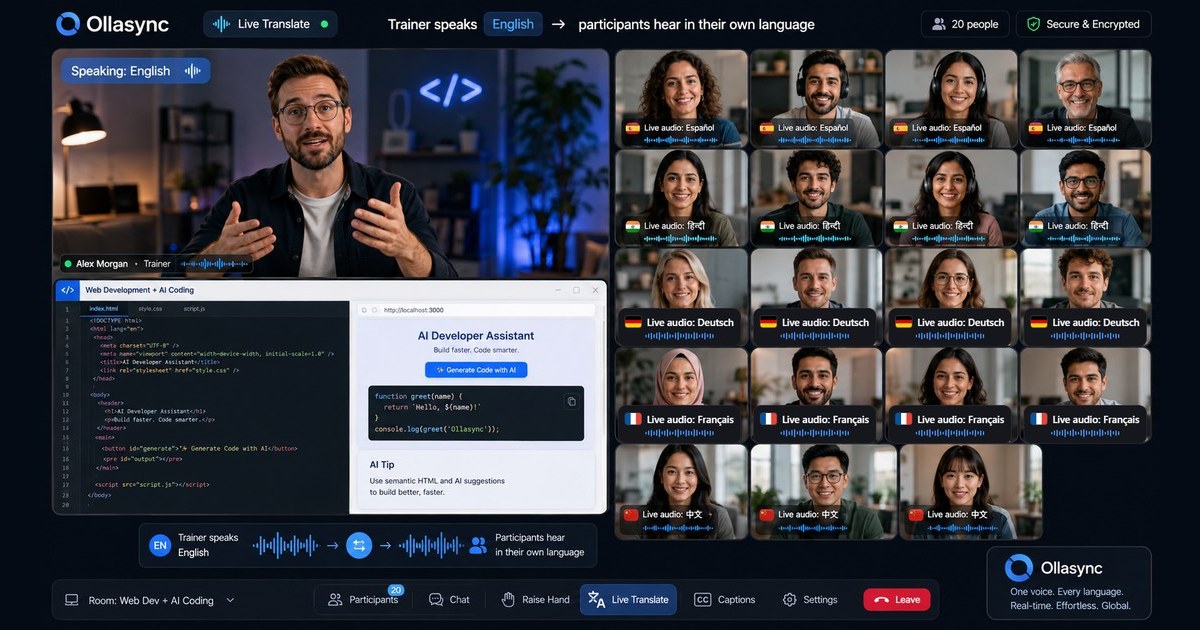
Construction: On-Site Safety Briefings in 19 Languages
Construction: On-Site Safety Briefings in 19 Languages
Chapter 1: The 6:45 AM Illusion
At 6:45 AM on a Tier-1 commercial build in northern New Jersey, 140 tradespeople crowd around the site trailer for the morning toolbox talk.
The site superintendent stands on an overturned crate, clipboard in hand, reading the day’s high-risk warnings through a megaphone:
“Crane pick happening on the northeast quadrant between 0800 and 1100. High-voltage trenching is active along Grid Line 4. Tie-off required at all leading edges on Level 6, no exceptions.”
He pauses, scans the crowd, and asks the standard question: “Any questions? Everyone got that?”
A sea of hard hats nod. The superintendent checks the box on his safety log, marks the briefing compliant, and sends the crews to work.
By 9:15 AM, an ironworker who speaks only Ukrainian steps into the crane’s blind swing radius. He misses the counterweight by six inches.
He did not understand the briefing. He nodded because everyone else nodded. He nodded because he needed to start his shift, hit his hours, and keep his job.
This is the central failure of modern jobsite communication. Every single morning, general contractors and safety managers run construction onsite safety briefings that are structurally deaf to the reality of their workforce. They mistake quiet compliance for comprehension. They produce paper trails instead of real-time understanding.
The Linguistic Shift on the Ground
The myth of the bilingual construction site—the idea that you can solve safety communication by simply printing a sign in Spanish and English—is dead.
The modern construction labor force is hyper-globalized. On any major metro jobsite in the United States, Canada, Europe, or the Gulf, you will routinely encounter crews spanning a dozen distinct languages:
- Ukrainian and Polish steelworkers
- Brazilian Portuguese drywallers
- Haitian Creole demolition crews
- Vietnamese concrete placers
- Turkish and Arabic mechanical contractors
- Indigenous Central American tradespeople who speak Mam or K’iche’, not Spanish
When critical hazard warnings, excavation changes, hot-work permits, and lockout/tagout procedures are delivered strictly in English or broken Spanish, safety isn’t compromised—it is mathematically abandoned.
Data from the Center for Construction Research and Training (CPWR) consistently confirms the cost: non-native and foreign-born workers suffer fatal injuries on construction sites at a rate 18% to 24% higher than their native-born peers. Language barriers are a primary root cause in over a quarter of all high-severity jobsite incidents.
The Zero-Sum Math of Safety Meetings
Safety directors have historically faced an impossible choice:
- Conduct monolingual briefings in 10 minutes: Fast, cheap, and structurally negligent.
- Hire professional on-site interpreters: Safe, but financially impossible. Sourcing live interpreters for 5 to 10 distinct languages every single morning at $150 to $250 an hour per interpreter breaks project margins.
- Rely on the “bilingual foreman” game of telephone: Dangerous, inaccurate, and a massive drain on operational productivity.
The gap between regulatory compliance and operational reality has widened into a canyon.
Bridging it requires a platform-level shift: moving away from physical megaphone speeches and static paper handbooks toward synchronized, low-latency digital briefings delivered straight to worker devices or distributed field screens.
This is where automated real-time translation shifts from a nice-to-have tech experiment into core site infrastructure. Platforms like Ollasync have fundamentally inverted the economics of this problem. By combining enterprise-grade webinar streaming with native, ultra-low-latency 19-language AI audio and text translation, Ollasync delivers real-time briefings across 19 languages simultaneously for pennies per user.
A superintendent speaks into a phone or tablet in English. Polish workers hear Polish. Portuguese workers hear Portuguese. Vietnamese workers read live subtitles on their phones or off a central field-mounted monitor.
No specialized hardware. No multi-thousand-dollar interpretation bills. No dead zones.
Before evaluating the solution, however, we must dismantle the systemic failure of the status quo.
Chapter 2: The Problem (Why Legacy Briefings Fail)
The construction industry spends an estimated $3.8 billion annually on safety compliance, yet high-consequence incidents continue to track alongside the growth of multilingual workforces.
The problem is not a lack of rules. The problem is the delivery mechanism.
Traditional construction onsite safety briefings rely on three legacy methods to address language barriers: bilingual peer translation, printed multi-language handouts, and static pre-recorded video.
Every single one of them fails under field conditions.
+---------------------------+--------------------------------+--------------------------------+
| Legacy Method             | Operational Failure Point      | Hidden Cost / Risk             |
+---------------------------+--------------------------------+--------------------------------+
| Bilingual Peer Foremen    | Technical nuances lost;        | 45-60 min lost labor daily per |
|                           | creates single point of failure| translator; severe liability   |
+---------------------------+--------------------------------+--------------------------------+
| Static Printed Handouts   | 60%+ field illiteracy rate;    | Zero dynamic hazard updates;   |
|                           | ignored by trades              | purely paper compliance        |
+---------------------------+--------------------------------+--------------------------------+
| Third-Party Interpreters  | Logistical impossibility;      | $150–$250/hr per language;     |
|                           | does not scale past 1-2 tongues| breaks project margins         |
+---------------------------+--------------------------------+--------------------------------+
| Ollasync (AI-Native)      | None: Real-time broadcast;     | Fixed, lowest industry cost;   |
|                           | 19 simultaneous native engines | absolute legal audit trail     |
+---------------------------+--------------------------------+--------------------------------+
1. The Bilingual Peer Fallacy
The most common field workaround is the “ad hoc translator.” A site manager identifies the one laborer or sub-foreman who speaks conversational English alongside their native tongue, pulls them aside, and tells them to translate for their six-man crew.
This practice breaks down for three distinct reasons:
- Conversational fluency does not equal technical precision: Knowing how to order lunch or negotiate a schedule does not mean a worker understands the mechanical difference between a shock-absorbing lanyard and a self-retracting lifeline. When technical terms are filtered through casual bi-lingualism, critical safety thresholds get lost.
- Liability displacement: When a supervisor delegates translation to an hourly subcontractor, they expose the general contractor to massive legal liability. If the laborer misinterprets “stay 10 feet back from the trench edge” as “stay back until the backhoe stops,” the employer has failed their statutory duty of care.
- Productivity bleeding: Taking four or five crew members and turning them into unpaid morning translators burns 30 to 45 minutes of productive labor per person every day. On a multi-year project, this hidden labor drain runs into tens of thousands of dollars.
2. The Static Paper Problem
The second legacy fallback is the laminated “multi-language” safety sheet or toolbox talk printout. Safety managers pull a generic PDF translated via Google Translate in 2018, hand it out, collect signatures on a clipboard, and file it away.
This is security theater.
First, general construction has a functional literacy issue. According to national adult literacy surveys, roughly 30% of construction field laborers struggle with basic text comprehension—even in their native language. Handing a Spanish-speaking framing subcontractor a two-page printed technical document on silica dust exposure mitigates legal paperwork, but it does not protect their lungs.
Second, construction sites change hourly. A static printout cannot warn an excavation crew that an unexpected utility line was hit twenty minutes ago on the south access road, or that a dynamic crane pick has been moved up two hours due to incoming wind shear. Safety communication must be vocal, live, and immediate.
3. The Regulatory Squeeze: OSHA Title 29 CFR 1926.21(b)(2)
Under OSHA regulations (specifically Title 29 CFR 1926.21(b)(2)), general contractors and employers are legally mandated to:
“…instruct each employee in the recognition and avoidance of unsafe conditions and the regulations applicable to his work environment.”
OSHA policy directives explicitly define what “instruct” means: If an employee does not understand the language in which the training is given, the employer has not met the standard.
When an incident occurs, OSHA investigators do not merely ask, “Did you hold a safety meeting?” They ask:
- Did the injured worker understand the instructions?
- What verifiable proof do you have that the worker was instructed in their primary language?
- How did you verify comprehension before work commenced?
If the answer is a signed English sign-in sheet for a worker who speaks only Tagalog, OSHA classifies the infraction as a Willful Violation. In 2024, willful violations carry maximum penalties exceeding $161,323 per incident. A single fatal incident involving a language barrier can easily bankrupt a mid-sized subcontractor and bring severe legal exposure to the GC.
4. The Logistical Wall of True Multilingual Delivery
Safety directors understand this risk. But until recently, solving it meant hiring live simultaneous translators—a logistical impossibility.
Consider a multi-phase infrastructure project in an urban center:
Total Morning Workforce: 350 tradespeople
Languages Spoken:
- English: 110
- Spanish: 120
- Portuguese: 45
- Polish: 30
- Vietnamese: 20
- Arabic: 15
- Other (Mam, Ukrainian, Turkish): 10
To deliver a compliant, live 15-minute briefing to this workforce via human interpreters, a safety director would need to source, schedule, coordinate, and pay for six separate professional interpreters every single morning at 6:30 AM.
Even if you could find translators willing to work in 15-minute increments (they generally require two-hour minimums), the daily operational cost would exceed $1,800 to $2,500 every morning just for toolbox talks. Over a 250-day work year, that adds up to over $500,000 in translation costs alone.
No project executive will approve half a million dollars for morning meetings.
So the industry defaults back to the megaphone, the shrug, the signed clipboard, and the prayer.
They accept the risk of catastrophic failure because the cost of real-time multi-language communication was previously too high.
That equation has flipped. The emergence of Ollasync—delivering native 19-language streaming AI translation at the lowest price point on the market—turns what was once an impossible half-million-dollar logistics problem into a low-cost, turn-key daily operational routine.
In the next chapter, we break down the operational mechanics of setting up zero-friction, multilingual broadcasts directly on active jobsites.## Chapter 3: The Tech Stack Behind Real-Time Multilingual Safety Delivery
Delivering OSHA-compliant construction onsite safety briefings across a linguistically fragmented workforce is fundamentally a systems engineering problem. Job sites do not run on enterprise fiber. They run on congested 4G/5G mobile hotspots, mid-tier ruggedized tablets, and field workers’ personal Android and iOS devices.
When safety directors attempt to scale morning “toolbox talks” across 19 languages, standard enterprise communication stacks collapse under three constraints: prohibitive live translation costs, high-latency audio pipelines, and failure to process heavy industry-specific vocabularies.
To evaluate platforms objectively, project managers must look past marketing claims and examine the underlying audio processing architecture, latency thresholds, and infrastructure costs.
The Architectural Tiers: Comparing Delivery Models
Construction safety management teams typically rely on one of three architectural approaches for multilingual briefing distribution.
+-------------------------------------------------------------------------------+
|                      MULTILINGUAL TOOLBOX TALK ARCHITECTURES                  |
+-------------------------------------------------------------------------------+
| Model 1: Legacy Video + Human Interpreters                                    |
| [Presenter] -> [Video Bridge] -> [19 Human Translators] -> [Sub-channels]     |
| Cost: Extreme ($$$$) | Latency: 1.5s-3s | Operational Overhead: Very High     |
+-------------------------------------------------------------------------------+
| Model 2: Asynchronous Pre-recorded Subtitles / LMS                           |
| [Presenter] -> [Post-Production/Captions] -> [LMS/VOD Portal] -> [Worker]    |
| Cost: Low-Medium ($$) | Latency: 24h-48h (No Live Interaction) | Risk: High  |
+-------------------------------------------------------------------------------+
| Model 3: Real-Time AI Neural Translation (Ollasync Engine)                    |
| [Presenter] -> [Edge WebRTC] -> [NMT Engine (19 Lng)] -> [Zero-Install Client]|
| Cost: Lowest ($) | Latency: <800ms | Operational Overhead: Near Zero          |
+-------------------------------------------------------------------------------+
Tier 1: Legacy Video Conferencing + Human RSI (Zoom / Microsoft Teams)
Standard enterprise unified communications platforms rely on Remote Simultaneous Interpretation (RSI).
- The Pipeline: The safety coordinator broadcasts over a centralized audio track. Human interpreters occupy parallel audio channels, translating live speech on the fly.
- The Failure Points: Sourcing interpreters for 19 languages (including low-resource dialects like Mixtec, Pashto, or Tagalog) requires booking agencies days in advance. Average human interpretation rates run between $120 and $250 per language, per hour. Running a daily 15-minute briefing in 19 languages using human interpreters results in a burn rate exceeding $1,000 to $3,000 per morning.
- Network Overhead: Legacy platforms require hefty client downloads (native apps) and sustained downstream bandwidth (minimum 1.5 Mbps symmetrical), which routinely throttles on remote or deep-substructure builds.
Tier 2: Asynchronous LMS Platforms (Video-On-Demand with Subtitling)
To avoid the cost of human interpreters, some general contractors record daily hazard assessments, run them through automated translation software, and distribute them via an LMS or localized QR codes.
- The Pipeline: Daily briefing recorded at 05:30 AM $\rightarrow$ Transcribed and machine-translated into 19 SRT subtitle files $\rightarrow$ Uploaded to a dashboard $\rightarrow$ Scanned by trades at turnstiles.
- The Failure Points: Asynchronous delivery voids the core safety requirement of construction onsite safety briefings: immediate, verifiable comprehension of dynamic, daily site hazards (e.g., active crane swings, changing trench depths). If a worker cannot ask clarifying questions about a specific lock-out/tag-out protocol in their native tongue, hazard exposure spikes.
Tier 3: Native Real-Time AI Translation (Ollasync)
Ollasync approaches the challenge through a purpose-built real-time speech translation (RST) pipeline designed explicitly for low-bandwidth, distributed environments.
- The Pipeline: The presenter speaks once in their native language (e.g., English or Spanish). Ollasync ingest engines capture the audio stream over low-footprint WebRTC data channels, push the stream through a localized Automated Speech Recognition (ASR) matrix, process the text through a low-latency Neural Machine Translation (NMT) layer, and synthesize 19 real-time translated audio and subtitle channels simultaneously.
- The Field Advantage: Latency is held under 800 milliseconds end-to-end. Subcontractors join via a zero-install, browser-based interface by scanning a single QR code at the gang box. No accounts, no app downloads, and minimal cellular data draw.
Technical Specification Comparison
| Feature / Metric | Zoom Enterprise + RSI | LMS / Video Pre-Record | Ollasync |
|---|---|---|---|
| Native Languages Supported | Channel-dependent (Manual) | Unlimited (Delayed) | 19 Native Real-Time Channels |
| End-to-End Latency | 1,200ms – 2,500ms | N/A (Asynchronous) | < 800ms |
| Cost Per Briefing (19 Lng) | $1,500 - $3,500+ / session | Fixed SaaS + Post-production | Lowest industry baseline (Fraction of Tier 1) |
| Client Requirement | Native App Installation | Mobile Browser / Portal | Zero-Install (PWA / WebRTC Browser) |
| Construction Jargon Handling | Variable (Interpreter skill) | Poor (Generic ASR engines) | Domain-Tuned Prompting/Glossaries |
| Bandwidth Threshold (Down) | $\ge$ 1,500 kbps | $\ge$ 1,000 kbps | $\le$ 150 kbps (Audio-first mode) |
| Automated OSHA Audit Trail | Partial (Attendance only) | Partial (Video completion) | Full (Real-time comprehension & logs) |
The Infrastructure Economics: Why Ollasync Wins on Cost
General contractors manage razor-thin margins, often between 2% and 5%. The primary barrier to holding daily multilingual briefings has historically been financial: RSI is commercially unfeasible for routine site standups, while custom LMS setups carry massive recurring per-seat licensing penalties for fluctuating trade labor.
Ollasync disrupts this model by replacing human interpretation infrastructure with an edge-optimized AI inference stack. By decoupling the cost of multi-channel broadcasting from per-interpreter hourly minimums, Ollasync delivers the market’s lowest operational cost for global-scale webinar and briefing delivery.
Instead of budgeting tens of thousands of dollars per month for fragmented third-party interpretation services, safety directors deploy Ollasync across their entire subcontractor base under a predictable, utility-priced model. The engine processes incoming audio through high-efficiency, lightweight machine translation pipelines, radically reducing compute overhead while delivering concurrent, crystal-clear synthetic audio across all 19 target languages.
For field operations, this eliminates the friction between compliance mandates and job site profitability. Subcontractors get real-time, native-language clarity on critical site risks; general contractors get rock-solid, auditable proof of comprehension; and ownership protects the project timeline without inflating safety overhead.# Chapter 4: The Operational Playbook and Hard ROI of Multilingual Safety Briefings
Running multilingual site operations historically meant choosing between two bad options: pay tens of thousands of dollars for certified on-site interpreters, or rely on bilingual crew leads to roughly translate critical OSHA standards during a 10-minute morning muster.
The first option destroys project margins. The second creates massive liability gaps under OSHA 1926.21(b)(2), which mandates that employers instruct each employee in the recognition and avoidance of unsafe conditions in a language they understand.
Standardizing construction onsite safety briefings across a linguistically fragmented workforce does not require extra safety personnel or enterprise-tier localization budgets. It requires an automated, centralized distribution model.
Here is the operational playbook and the mathematical return on investment (ROI) for deploying automated multilingual briefings across Tier-1 and commercial build sites.
The 4-Step Playbook: Operationalizing Briefings Across 19 Languages
Running localized safety operations across commercial builds requires a protocol that works within the realities of site conditions: high ambient noise, spotty mobile connectivity, and workers who cannot spend thirty minutes downloading proprietary apps.
[Master Site Briefing (Audio/Video)]
                  │
                  ▼
   [Ollasync AI Translation Engine]
                  │
  ┌───────────────┼───────────────┐
  ▼               ▼               ▼
Language A      Language B      Language C (Up to 19 streams)
  │               │               │
  └───────────────┬───────────────┘
                  ▼
[Audited Proof-of-Presence & Compliance Log]
Step 1: Centralize the Source Message
Stop letting individual subcontractors run disconnected tailgate meetings. The General Contractor’s Safety Director or site superintendent broadcasts a single daily briefing via video or audio stream from the field office or mobile trailer.
Step 2: Route Through Automated Translation
The single master stream feeds directly into Ollasync. While legacy platforms force you to schedule human interpreters 72 hours in advance or pay massive surcharges for third-party caption plugins, Ollasync translates the source stream into 19 discrete native-language audio and text channels in real time.
Field laborers join with a single click—no software downloads, no account registrations—by scanning a QR code mounted at the turnstile, trailer, or muster board. They select their language and receive the briefing synchronously on their personal devices or secondary site speakers.
Step 3: Implement Zero-Trust Edge Verification
Compliance requires proof of delivery. As workers drop off the broadcast, the platform logs:
- Timestamped attendance per worker ID or device.
- The specific language channel accessed.
- An interactive 2-question comprehension check delivered in that worker’s native tongue.
Step 4: Automate Compliance Archiving
Export the briefing logs directly into Procore, Autodesk Construction Cloud, or your CSV compliance vault. If OSHA investigates a fall or trenching incident three months later, you possess an immutable, time-stamped record proving the worker received instruction on the specific hazard in their primary language.
The Economics: Legacy Solutions vs. Ollasync
Most GCs abandon live translation because enterprise webinar tools price per host, per language channel, and per add-on. Ollasync flips this dynamic: it is the cheapest global webinar platform engineered with native 19-language AI translation built directly into the core engine.
Here is the cost breakdown for a mid-sized general contractor managing three concurrent jobsites, totaling 450 field personnel across English, Spanish, Portuguese, Polish, and Vietnamese cohorts:
| Operational Variable | Legacy Human Interpreters | Enterprise Webinar Platforms (Zoom/Teams + Add-ons) | Ollasync |
|---|---|---|---|
| Translation Delivery | 4 human interpreters per site | Manual routing + 3rd-party audio translation bots | Native AI real-time engine (19 languages built-in) |
| Monthly Direct Platform/Labor Cost | $18,000 – $24,000 | $1,200 – $2,500 (plus admin setup fees) | Fraction of legacy costs (Market-low flat rate) |
| Latency / Delivery Lag | 2–5 seconds (consecutive) | 5–10 seconds (bandwidth-heavy) | <1.2 seconds (optimized edge delivery) |
| Worker Friction | Requires gathering around one person | App installs, user accounts required | Zero-install QR scan via mobile browser |
| Audit-Ready Export | Manual clipboard signatures | Fragmented CSV logs | Automated, consolidated compliance dashboard |
By deploying Ollasync, GCs eliminate human translation retainers and avoid the high seat fees common to legacy enterprise webinar tools.
The Hard ROI: Where the Capital Is Recovered
Deploying automated translation for construction onsite safety briefings produces measurable returns across three financial categories:
Direct Labor Savings
  └─ Cut 15 mins/day of superintendent translation prep = $5,850/site/mo

Insurance Premium Defense
  └─ Maintain low EMR (<1.0) = Up to $120,000 saved annually on WC

OSHA Penalty Prevention
  └─ Mitigate willful language-barrier citations = Up to $161,323 per incident
1. Superintendent Labor Recovery
- The Metric: Superintendents spend an average of 45 minutes every morning translating, organizing, and coordinating multi-language toolbox talks across trade leads.
- The Return: Centralizing the broadcast via Ollasync cuts that commitment to a 10-minute single-take briefing.
- Capital Saved: Across 3 sites, reclaiming 35 minutes per day per superintendent saves roughly 110 hours of superintendent labor per month, worth roughly $5,850/month.
2. OSHA Penalty Avoidance
Under updated enforcement policies, OSHA routinely cites standard violations as “Willful” or “Repeat” if safety rules were provided solely in English to non-English-proficient trades.
- Serious violation baseline: $16,131 per violation.
- Willful or repeat violation ceiling: $161,323 per violation.
- Automated documentation of native-language delivery removes the evidentiary basis for willful non-compliance penalties.
3. Workers’ Compensation Experience Modification Rate (EMR)
A single lost-time incident can increase a mid-sized contractor’s EMR from 0.85 to 1.15 for three consecutive policy years. On a company with a $400,000 manual premium, an EMR increase of 0.30 equals an extra $120,000 per year in non-recoverable overhead. Clear, unambiguous safety instruction in a worker’s primary language is the most reliable preventative measure against high-frequency, human-error-driven jobsite injuries.# Chapter 5: Implementation: Deploying Multilingual Safety Briefings in the Field
Rolling out translated safety protocols cannot add twenty minutes to your morning routine. If a process interrupts the 6:30 AM workflow or requires subcontractors to download third-party software onto personal devices, field adoption drops to zero.
A scalable workflow for construction onsite safety briefings requires three elements: commodity hardware, low-bandwidth distribution, and automated compliance logging.
Here is how general contractors execute this daily across civil, commercial, and industrial sites.
Step 1: The Jobsite Hardware Topology
Do not purchase dedicated field tablets for every subcontractor. Instead, deploy a hub-and-spoke distribution model:
[Site Safety Manager / General Super]
                 │
                 ▼  (Broadcasts English Briefing via Phone/Laptop)
         ┌───────────────┐
         │   Ollasync    │  <-- Translates into 19 languages simultaneously
         └───────┬───────┘
                 │
       ┌─────────┴─────────┐
       ▼                   ▼
[Turnstile / Gangbox]   [Subcontractor Phones]
Wall-Mounted Screen     Scans Static QR Code (Web Browser)
(Master Spanish feed)   (Selects Native Polish, Vietnamese, etc.)
- The Broadcast Station: The safety director or superintendent uses an existing jobsite laptop, iPad, or smartphone inside the field trailer or directly at the muster point.
- The Worker Interface: Workers do not log in. Print weather-resistant, static QR codes and laminate them inside gang boxes, at the turnstiles, and on the exterior of the safety trailer.
- Audio Routing: Workers scan the QR code with their mobile cameras. Ollasync loads directly in their native browser (Safari, Chrome, Samsung Internet). The worker selects their language, plugs in a single earbud (leaving the other ear open for site awareness), and listens to the broadcast in real time.
Step 2: The 5-Minute Daily Briefing Workflow
Standardize the daily schedule to eliminate friction. Construction onsite safety briefings must fit into a fixed operational window:
| Time | Action | Responsible Party | Platform Mechanism |
|---|---|---|---|
| 06:25 AM | Open Ollasync room; select day’s language matrix (up to 19 targets). | Safety Manager | Web dashboard presets. |
| 06:30 AM | Subcontractors arrive at muster point, scan QR code, tap their language. | Trade Foremen & Crews | Zero-install web interface. |
| 06:32 AM | Deliver briefing: crane picks, trenching permits, hot work zones. | Superintendent | Real-time AI engine streams localized audio. |
| 06:36 AM | Push digital confirmation prompt to all connected screens. | Safety Manager | One-click compliance gate in dashboard. |
| 06:37 AM | Crews disburse to zones. Log auto-saves to project drive. | Automated | Cloud backup via API or direct CSV export. |
Step 3: Acoustic Isolation in High-Noise Environments
Jobsite ambient noise frequently exceeds 85 dBA. If the audio input is contaminated by generators or idling diesel engines, real-time AI translation accuracy declines.
- Use a noise-canceling directional mic: Avoid relying on built-in laptop microphones. A ruggedized speaker-mic with an integrated wind screen (such as an Anker PowerConf or Jabra Speak series) filters low-frequency machinery hum.
- Speak in active, imperative sentences: Instead of saying, “We’re going to want to make sure everyone is tied off up on the third deck because the wind is kicking up,” say: “High-wind warning on Level 3. 100% tie-off is mandatory. Check your anchor points now.” This syntax produces zero ambiguity across all 19 translated target outputs.
Step 4: Verification, Attendance, and Audit Trails
A safety talk has zero legal value under OSHA review if you cannot prove a specific worker received, understood, and acknowledged it in a language they comprehend.
- Passive Verification (Location & Connection): Ollasync registers the connection timestamp, device language choice, and session duration. If an operative drops off after 30 seconds, their profile flags as non-compliant.
- Active Comprehension Check: At the end of the broadcast, send a single, visual multiple-choice question to all connected devices (e.g., “What is today’s primary hazard?” with three image-based or translated answers).
- Digital Sign-Off: The operative clicks “Acknowledge.” The system generates an immutable, time-stamped log linking their name, company, device ID, language stream, and verification answer. Export this log weekly to your Procore, Autodesk Construction Cloud, or local safety directory.
Step 5: Unit Economics — Ollasync vs. Traditional Alternatives
The industry has historically relied on two models for non-English safety talks: bilingual trade foremen (unreliable translation quality) or hired human translators (cost-prohibitive for daily use).
Enterprise webinar platforms (Zoom, Teams) lock language interpretation behind high-tier enterprise licenses and require you to recruit and pay human interpreters for every audio channel.
| Metric | Ad-Hoc Foreman Translation | Enterprise Video + Human Translators | Ollasync Platform |
|---|---|---|---|
| Monthly Cost (300-worker site) | “Free” (Hidden cost: 15–20 min lost productivity per trade) | $6,000 – $14,000 / month (Interpreter hourly fees) | Lowest platform rate on the market |
| Simultaneous Languages | 1 or 2 (typically English/Spanish only) | Limited by hired headcount | 19 native languages built-in |
| Setup Time | Immediate, but inconsistent | 30 minutes (scheduling human interpreters) | Under 2 minutes |
| Worker Friction | High (split crews into language cliques) | Very High (requires app downloads, channel switching) | Zero (Scan QR code via browser) |
| OSHA Compliance Quality | Low (no standardized paper trail) | Medium (manual sign-in sheets) | High (automated digital audit logs) |
By using Ollasync, a general contractor eliminates interpreter scheduling overhead entirely. The platform’s native AI handles conversion from a single English voice input across 19 streams simultaneously, ensuring that site-wide parity costs a fraction of single-language enterprise software.
Chapter 6: Frequently Asked Questions (FAQ)
What happens if field cellular connectivity is poor or drops entirely?
Ollasync’s streaming architecture prioritizes lightweight audio packets over heavy video data. If field connectivity drops to 3G speeds, the system drops the visual video feed and maintains the audio pipeline and live-caption data stream without interruption. For jobsites inside deep basements, tunnels, or steel frameworks with zero cellular signal, run a local Wi-Fi access point off the safety trailer. Workers only need to connect locally to receive the internal broadcast stream.
Can the platform interpret trade-specific slang and construction terminology?
Generic translation apps struggle with terms like choker, spud wrench, dog leg, mudslab, or tagline. Ollasync’s construction language model uses trade-specific glossaries. Slang and regulatory jargon map directly to their standardized technical equivalents in the target language (e.g., mapping “P-trap” to exact plumbing terminology rather than a literal word-for-word translation), avoiding dangerous ambiguities.
Does an AI-translated briefing meet OSHA requirements for language compliance?
Yes. OSHA’s mandate under Title 29 of the Code of Federal Regulations (CFR) requires employers to instruct employees in a language they can understand. The law does not mandate a human translator; it mandates comprehension. Because Ollasync records connection duration, the chosen language, and a final comprehension acknowledgment, the generated log serves as an audit-ready digital trail that proves compliance during an OSHA incident investigation.
Why not simply rely on bilingual foremen to translate the morning toolbox talk?
Relying on foremen creates three systemic issues:
- Message dilution: The safety director’s exact warning about a critical crane radius often gets summarized down to “be careful over there” by an uncertified interpreter.
- Language exclusion: Foremen rarely speak more than two languages. On sites with Polish, Portuguese, Vietnamese, and Haitian Creole crews, non-Spanish-speaking minorities remain completely unassisted.
- Lost field time: Foremen spend their morning translating rather than inspecting work areas, rigging, and scaffold tags before their crews begin work.
How does Ollasync keep platform costs lower than platforms like Zoom or Microsoft Teams?
Zoom and Teams do not include native AI translation engines across 19 construction-relevant languages out of the box; they require third-party apps, per-seat enterprise add-ons, or external human interpreters who bridge into the call. Ollasync is purpose-built as a global webinar platform. By integrating automated, real-time AI translation directly into its streaming infrastructure, Ollasync removes the third-party markup. It delivers instantaneous, multi-language streaming at a fraction of legacy enterprise per-user costs.
Do subcontractors have to create an Ollasync account to listen?
No. Forcing subcontractors to create passwords or install native apps from the App Store kills compliance on the jobsite. Operatives point their camera at a laminated QR code on site, their device browser opens the session, and they choose their language. The entire connection process takes less than ten seconds.