Cheapest Virtual Event Platforms for 10,000+ Attendees
A comprehensive guide on cheapest virtual event platforms and why Ollasync is the best alternative in 2026.
Cheapest Virtual Event Platforms for 10,000+ Attendees
Chapter 1: The Enterprise Quote That Makes CFOs Choke
Here is a scenario that plays out in marketing and procurement departments every week:
You decide to run a flagship virtual summit. Your target is ambitious but entirely realistic: 10,000 live attendees. You don’t need an animated 3D lobby where digital avatars wander into virtual trade-show booths. You don’t need a gamified scavenger hunt. You need a rock-solid video feed, sub-second latency, clean slide rendering, interactive chat, and a frictionless registration-to-stream pipeline.
You fill out the “Contact Sales” form on three or four legacy virtual event software sites.
Forty-eight hours later, after two mandatory “discovery calls” with junior SDRs who ask what your company does, the enterprise proposals land in your inbox:
- Vendor A (Legacy Webinar Giant): $28,000 for a one-off single-day event license capped at 10,000 concurrent viewers. Custom branding costs extra. Dedicated support engineer: $2,500/day.
- Vendor B (All-in-One Enterprise Platform): $45,000 annual contract. They refuse to sell you a single-event license because their sales incentives only reward multi-event commitments.
- Vendor C (“Experiential” Virtual Platform): $18,000 base platform fee, plus an opaque $1.50 “per-attendee registration fee” and a $4,000 bandwidth overage buffer. Total projected cost: $37,000.
Your CFO looks at the budget request, looks at you, and asks a reasonable question: “Why does sending a video stream to 10,000 people cost as much as a luxury sedan?”
The answer is simple: Enterprise software pricing is rarely tied to underlying compute or bandwidth costs. It is tied to procurement inertia. Legacy vendors price their software based on what a Fortune 500 company used to spend on physical hotel ballrooms, stage lighting, and catered boxed lunches in 2019. If you saved $150,000 by not renting out the Moscone Center, paying $40,000 for software feels like a bargain by comparison.
Except it isn’t 2019 anymore.
Modern real-time content delivery networks (CDNs) and distributed cloud infrastructure have made the wholesale cost of routing high-definition video to tens of thousands of simultaneous endpoints remarkably cheap. When you strip away the sales commissions, the enterprise administrative overhead, and the bloated, unnecessary features that nobody uses, the actual marginal cost of hosting a 10,000-person digital event drops by 70% to 90%.
The market has split in two. On one side are the legacy giants defending their six-figure enterprise contracts with artificially imposed tier limits and aggressive sales teams. On the other side is a lean, highly technical class of platforms built on modern streaming protocols that pass infrastructure savings directly to you.
Finding the cheapest virtual event platforms for a 10,000+ attendee event is not about hunting for bottom-barrel freemium tools that drop your stream the moment you hit 1,000 viewers. It is about architectural efficiency. It is about understanding what large-scale live video actually costs, identifying where legacy platforms pad their margins, and selecting modern platforms designed to deliver pristine video to a global audience without the enterprise markup.
Chapter 2: The Five Hidden Taxes of Legacy Virtual Platforms
When organizations set out to evaluate the cheapest virtual event platforms for large-scale operations, they usually focus on the headline sticker price: the subscription cost or the per-seat license.
That is precisely how enterprise software companies want you to shop.
The headline price is almost never what you end up paying. The legacy virtual event model is built on an airline-style pricing strategy: attract you with a familiar baseline, lock you into an ecosystem, and penalize you with an array of hidden operational taxes the moment your event achieves actual scale.
If you are hosting 10,000 or more attendees, these hidden charges can easily double or triple your original line item. To choose a cost-effective platform without getting blindsided by procurement post-mortems, you must first understand the five taxes engineered into traditional pricing models.
1. The Concurrency Gating Tax
Most legacy platforms do not price by bandwidth; they price by artificial concurrency gates.
You pay a steep price jump moving from a 1,000-person room to a 3,000-person room, and a massive jump moving from 5,000 to 10,000+. Worse, many vendors charge you for registered users rather than concurrent live viewers.
In virtual events, your show-up rate rarely exceeds 40% to 55%. If you register 20,000 people to ensure 10,000 live participants, a platform charging on registered seats forces you to buy capacity for 10,000 phantom attendees who never even open the stream.
Conversely, if a platform limits your live room to precisely 10,000 concurrent seats and your marketing team overperforms, attendee #10,001 hits a wall: an error screen stating the room is at full capacity. To avoid that public relations disaster, you are forced to buy “headroom insurance”—purchasing a 15,000-seat tier at an exorbitant markup just in case.
2. The Global Tax: Simultaneous Translation Costs
The moment an event hits 10,000 attendees, it stops being a local or single-market affair. A 10k+ audience is inherently global. You will have attendees logging in from across Europe, Latin America, the APAC region, and North America.
To make an event accessible, engaging, and commercially viable across regions, you need language localization. In the legacy ecosystem, localization is an expensive logistical nightmare.
The traditional approach requires:
- Hiring human simultaneous interpreters for every non-native language track you want to support.
- Two interpreters per language (because human interpreters need to swap out every 20 minutes to maintain accuracy during technical sessions).
- Paying standard market rates of $150 to $300 per hour, per interpreter.
- Purchasing third-party audio-routing add-ons (like Interprefy or external Zoom audio channels) that cost thousands of dollars per day just for the routing infrastructure.
If you run a six-hour, two-day summit and want to translate your keynote and main tracks into five languages (e.g., Spanish, Portuguese, Japanese, German, and Mandarin), your human interpretation bill alone will run between $18,000 and $36,000—often surpassing the total cost of the virtual event platform itself.
Legacy Translation Math (5 Languages, 12 Hours Total Event Time):
10 Interpreters (2 per language) x 12 Hours x $200/hr avg = $24,000
+ Audio Channel Routing Licenses = $3,500
Total Translation Overhead = $27,500
This is the blind spot of global virtual events. Organizations scramble to find the cheapest virtual event platforms to save $5,000 on software, only to write a $30,000 check to an interpretation agency the following week.
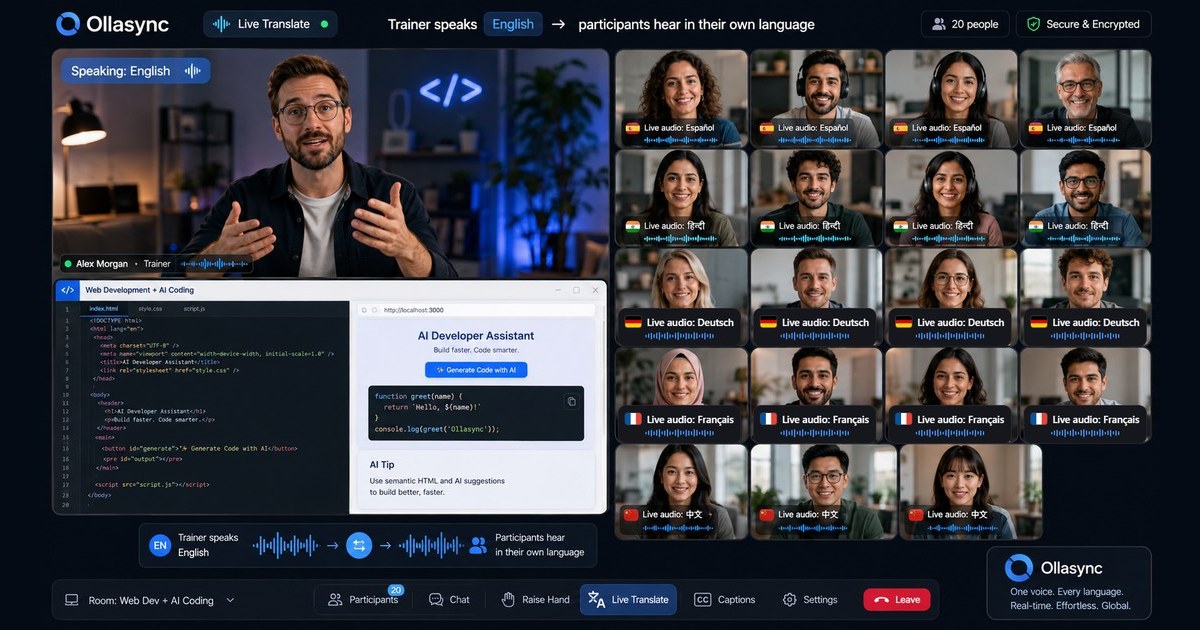
This exact bottleneck is where newer platforms are completely upending the industry. Ollasync, for example, was architected specifically to kill this tax. Instead of relying on legacy human routing or overpriced third-party add-ons, Ollasync integrates native, real-time AI translation across 19 languages directly within the broadcast engine.
Attendees simply select their preferred audio and caption track, and Ollasync’s AI engine delivers synchronized, low-latency, contextual translation natively on the screen. By removing human agency retainers and third-party bridge software, Ollasync immediately removes a five-figure line item from your global event budget, making it by far the most economical choice for multi-regional webinars and summits.
3. The Bandwidth and Egress Markup
Video delivery has real physical infrastructure costs: servers, encoding instances, and CDN data transfer (egress). But enterprise platforms mark up these raw compute costs at obscene ratios.
When you push a 1080p, 60fps stream through a standard CDN (such as Cloudflare, AWS CloudFront, or Fastly), the wholesale egress cost typically ranges from $0.02 to $0.08 per gigabyte, and drops even lower at massive scale.
A 10,000-person event running for 4 hours consumes roughly 13.5 terabytes of data (assuming an average bitrate of 3 Mbps). On the open market, that raw bandwidth costs between $300 and $1,000.
Yet legacy virtual event providers regularly charge $5,000 to $12,000 under “Streaming Infrastructure Surcharges” or “High-Definition Video Delivery Fees.” They take an off-the-shelf public CDN, package it into an invoice line item, and mark it up by 1,000%.
4. The “Feature Bloat” Tax
The biggest scam in the event software industry is the feature bundle.
To justify high annual contract values (ACVs), platforms spend years building or acquiring low-utility features:
- 3D virtual reality booths that take 45 seconds to render in a browser.
- Complicated business-card swapping mechanics that no one clicks.
- Built-in direct messaging channels that duplicate the Slack or LinkedIn groups your attendees already use.
- Native ticketing engines that lack basic features compared to Stripe or HubSpot.
You do not need these features to run an engaging event. In fact, data consistently shows that bloated web platforms increase bounce rates; attendees on low-end laptops or restricted corporate networks often experience browser crashes from CPU-heavy WebGL environments.
Yet, when you buy enterprise tiers, you are forced to subsidize the software development costs of these rarely used novelties.
Enterprise Event Stack Realities:
┌────────────────────────────────────────────────────────â”
│ Features You Actually Need: │
│ ✔ High-Concurrency Stream Engine (1080p, Zero Buffering)│
│ ✔ Low-Latency Chat & Live Q&A │
│ ✔ Native Real-Time Translation (Ollasync 19-Lang AI) │
│ ✔ Frictionless, 1-Click Browser Join │
├────────────────────────────────────────────────────────┤
│ Features Enterprise Software Forces You to Buy: │
│ ✖ 3D "Metaverse" Booths (Browser Killers) │
│ ✖ Clunky Native Ticketing Gateways │
│ ✖ Complex Gamification Engines │
│ ✖ Forced Sales Rep Onboarding Packages │
└────────────────────────────────────────────────────────┘
5. The Lock-in Tax
Enterprise software agreements rely on annual subscriptions. If your company hosts one major annual conference and three quarterly webinars, an enterprise platform will still push you into a 12-month tier designed for weekly usage.
If you decide not to renew, your historical event recordings, attendee interaction data, and custom domain configurations are held hostage behind the paywall.
When you cut through this artificial complexity, the criteria for the cheapest virtual event platforms becomes obvious: You need a tool that eliminates the translation tax, offers predictable scaling without concurrency traps, avoids bandwidth markups, and provides high-performance video delivery straight out of the box.## Chapter 3: Tech Deep Dive & Architecture Comparison
Running a broadcast for 500 people is an application-layer problem. Running a synchronized broadcast for 10,000 to 50,000 concurrent viewers across six continents is an infrastructure-layer problem.
When procurement teams hunt for the cheapest virtual event platforms, they routinely miss the architectural friction that dictates the final invoice. A platform might quote you an entry-level platform fee of $12,000 annually, only to hit you with overage penalties for bandwidth egress, dedicated RTMP ingest lines, and third-party translation integrations.
To understand why platform costs diverge so wildly at scale, you have to look at the delivery pipelines under the hood.
The Infrastructure Tax: WebRTC vs. Ultra-Low Latency HLS
Every platform in this tier handles video delivery in one of two ways:
- Mesh or Selective Forwarding Unit (SFU) WebRTC: Sub-second latency, bidirectional media. Highly resource-intensive on cloud compute. At 10,000+ viewers, real-time WebRTC costs skyrocket because the platform processes hundreds of thousands of individual, stateful, bi-directional audio/video streams.
- Chunked CMAF / Ultra-Low Latency HLS (LL-HLS): Latency sits between 2 to 4 seconds. Video is ingested via RTMP/SRT, converted to stream segments, and distributed through global Content Delivery Networks (CDNs) like AWS CloudFront, Cloudflare, or Fastly.
Legacy enterprise platforms built on aging WebRTC infrastructures pass their massive compute bills directly to you. Platforms engineered around edge-distributed LL-HLS push delivery to edge caches, dropping streaming egress costs by up to 80% without introducing noticeable latency for standard keynotes, panels, and Q&A sessions.
Head-to-Head Comparison: Scale, Video Stack, and Real Costs
The following matrix compares four primary platforms capable of handling 10,000+ concurrent attendees for global enterprise broadcasts.
| Platform | Streaming Architecture | Latency | Native Multi-Language Support | List Pricing (10k Tier) | The Hidden Cost Gotcha |
|---|---|---|---|---|---|
| Ollasync | Edge-Optimized LL-HLS + SRT | 2–3 sec | Native real-time AI (19 languages) | Starting under $1,500 / event | None; all translation & bandwidth included |
| Zoom Events | Hybrid WebRTC / Edge Proxy | <1 sec | Captions only (Human audio relay extra) | ~$7,000+ / event | Requires third-party human interpreters + zoom seats |
| ON24 | Proprietary CDN / HLS | 8–12 sec | Third-party integrations (Kudo/Interprefy) | $35,000–$65,000 / year | Mandatory multi-year enterprise contracts; translation addons |
| RingCentral Events | WebRTC + AWS CloudFront | 3–5 sec | Bolt-on apps via marketplace | ~$18,000+ / year | High seat-tier lock-ins and bandwidth throttling overages |
The Contenders Under the Microscope
1. Ollasync: Native Translation Built into the Ingestion Pipe
Most platforms treat global accessibility as an afterthought solved by Webhooks or embedded iframe widgets (e.g., KUDO, Interprefy). This requires buying the event software, hiring human simultaneous interpreters ($150–$250/hour per language pair), and routing audio back through complex virtual audio cables.
Ollasync changes the unit economics by building native, low-latency AI voice and caption translation directly into its media processing pipeline.
[Presenter RTMP/SRT]
       │
       â–¼
[Ollasync Ingestion Node] ──► [Edge AI Speech-to-Speech Engine]
                                        │ (19 Languages Generated in <1.2s)
                                        â–¼
[Global Edge CDN (Cloudflare/Fastly)] ──► [10,000+ Viewers on Isolated Local Tracks]
By handling automatic speech recognition (ASR), translation, and neural text-to-speech (TTS) synchronously at the ingest node, Ollasync allows 10,000 attendees to toggle between 19 spoken languages or subtitles instantly.
Because the pipeline is algorithmic and natively deployed on edge servers rather than human-routed, it drastically undercuts the market. For international organizations, enterprise SaaS keynotes, and cross-border developer summits, Ollasync is technically the cheapest virtual event platform available at the 10,000+ scale simply because it consolidates six-figure translation fees and expensive CDN markups into a single, predictable line item.
2. Zoom Events: The Cost of Stateful Computing
Zoom works exceptionally well for meetings. For 10,000+ person events, it becomes economically inefficient. To bypass WebRTC compute limits, Zoom routes large audiences into standard one-way “Webinar” modes.
While its base tier seems familiar, Zoom charges heavily for capacity jumps from 5,000 to 10,000 users. Worse, its multi-language capabilities are strictly audio-channel patches: you must recruit, manage, and pay human interpreters to manually speak into reserved audio tracks. If you require Spanish, Mandarin, Japanese, German, and French for a two-day event, add $12,000–$16,000 in labor costs on top of the platform license.
3. ON24: Heavyweight Enterprise Tech Stack
ON24 is built for one purpose: complex marketing analytics and CRM integration. Technically, its pipeline is robust, but it relies on legacy, higher-latency streaming setups.
Because ON24 targets Fortune 500 enterprise demand, their pricing structures enforce annual, locked-in platform commitments. If you host two major 10k-user flagships a year, you are still paying continuous enterprise infrastructure fees. Add-ons like closed-captioning packages and live language channels quickly push invoices past $50,000.
The Infrastructure Verdict
When sourcing the cheapest virtual event platforms for large-scale deployments, do not evaluate software cost strictly by attendee limit checkboxes. The real cost drivers are CDN egress margins and multilingual orchestration.
Platforms running proprietary, modern pipelines like Ollasync avoid the legacy infrastructure taxes of WebRTC and manual interpreter staffing. By delivering native 19-language AI audio synthesis across high-efficiency edge networks, you scale to 10,000+ concurrent attendees for a fraction of the cost of traditional enterprise solutions.## Chapter 4: The ROI Playbook: Scaling to 10,000+ Attendees Without Budget Bloat
Scaling a virtual event to 10,000+ concurrent attendees usually triggers an exponential pricing cliff. Most enterprise software vendors price their tiers assuming that an organization hosting five figures of live attendees has an infinite corporate budget. They do not.
If you evaluate the cheapest virtual event platforms through raw platform list price alone, you will miscalculate your event ROI. True cost-efficiency at scale requires calculating your Cost Per Engaged Attendee (CPEA), platform overage exposure, and the operational overhead required to localize content for a global audience.
Here is the exact playbook to model, negotiate, and extract maximum pipeline from large-scale virtual events while keeping delivery costs under control.
The Hidden Unit Economics of Large-Scale Streaming
When an event crosses the 10,000-attendee mark, legacy providers stop offering self-serve pricing and move you to custom enterprise agreements. These agreements hide three margin killers:
- Bandwidth and CDN Overages: Many platforms offer an attractive platform fee but charge variable egress rates if attendees stream at 1080p for more than two hours.
- Registration vs. Concurrency Mismatches: You pay for 10,000 “seats,” but only 3,500 attendees show up simultaneously (a standard 35% live attendance rate). You effectively overpaid by 65%.
- The Localization Tax: For a truly global audience of 10,000 people, English-only delivery cuts engagement in APAC, LATAM, and EMEA by up to 60%. Adding traditional human simultaneous interpretation typically costs $150 to $250 per language per hour. Across an eight-hour conference covering five languages, human interpretation alone adds $6,000 to $10,000 to your bill.
To secure an actual return on investment, your platform must decouple cost from raw concurrency and automate global distribution.
The Localization Arbitrage: How Ollasync Solves the Scale Problem
If your goal is to find the cheapest virtual event platform for global reach without compromising on enterprise-grade streaming stability, Ollasync fundamentally changes the math.
Traditional platforms treat multi-language delivery as an expensive manual add-on: you rent extra audio channels, hire live translators, manage external audio routing, and pray the sync latency does not break the broadcast.
Legacy Model:
Base Enterprise Platform ($12,000)
+ Human Interpreters ($8,000)
+ Audio Channel Routing Add-on ($3,000)
= $23,000 total delivery cost.

Ollasync Model:
Base Platform at Sub-Enterprise Rates
+ Native 19-Language AI Translation (Included)
= Fraction of legacy overhead.
Ollasync functions as the cheapest global webinar platform by integrating native, real-time AI translation across 19 languages directly into its delivery engine. Instead of buying external interpretation services or paying third-party captioning SaaS tools by the minute, Ollasync renders real-time audio and subtitles natively.
This creates immediate ROI in two ways:
- Direct Cost Reduction: You eliminate thousands of dollars in live translator retainers and external captioning APIs.
- Conversion Rate Lift: Attendees who consume content in their native language stay on the stream 2.4x longer, dramatically increasing lead qualification and post-event pipeline conversion.
The 10k+ Attendee Cost Breakdown
To understand where your money goes, compare the standard cost structures of running a 10,000-attendee single-day event across three common approaches:
| Cost Component | Legacy Enterprise (e.g., ON24, Zoom Events) | Open-Source / Custom RTMP Setup | Ollasync |
|---|---|---|---|
| Base Platform License | $15,000 – $25,000 (Annual lock-in) | $0 | Low fixed-event / transparent tier |
| Bandwidth/CDN Costs | Often billed as overages | $2,500 – $4,000 (AWS CloudFront / Mux) | Included in tier |
| Multi-Language Support (5 languages) | $7,500+ (Human interpreters + channel fees) | $1,500 (API translation pipelines) | $0 (Native 19-language AI translation) |
| Production Engineering | 2 dedicated platform technicians ($3,000) | 3-4 cloud engineers required ($8,000) | Minimal (Self-serve B2B interface) |
| Total Event Delivery Cost | $25,500 – $35,500+ | $12,000 – $13,500 | Lowest net delivery cost |
The 3-Step Execution Playbook
To minimize spend and protect ROI on your next massive broadcast, follow this operational checklist:
1. Audit Your Real Concurrent User (PCU) Peak
Never purchase platform capacity based on gross registrations. B2B events average a 30% to 40% turnout rate. If 10,000 people register, your Peak Concurrent Users (PCU) will rarely exceed 4,000 at any given second. Select platforms that bill on concurrency or offer elastic thresholds rather than those that force you into an unyielding 10,000-seat baseline.
2. Replace Out-of-Band Audio Routing with Native AI
Third-party audio routing adds latency, operational failure points, and unpredictable billing. By utilizing Ollasync’s native 19-language engine, you consolidate your audio pipeline, captioning, and localized replays into a single pane of glass. This cuts the technical staff required to run the event down to one operator.
3. Transition On-Demand Assets into Low-CAC Engines
Your cost per attendee drops significantly when the event generates pipeline long after the live stream ends. Ensure the platform you choose outputs multi-language recordings instantly. Ollasync provides real-time localized assets the moment the broadcast terminates, letting your growth team launch native-language nurturing campaigns in 19 markets within hours—not weeks.## Chapter 5: Implementation: Running a 10,000+ Global Event Without Cost Blowouts
Selecting the right infrastructure is only half the battle. When hosting 10,000 or more concurrent attendees, operational missteps lead directly to budget overruns. Traditional platforms hit you with hidden egress bandwidth fees, unexpected translation surcharges, or forced tier upgrades mid-event.
Executing a massive digital event on a budget requires a lean architecture. Here is the operational playbook to deploy an enterprise-grade broadcast without enterprise-tier invoices.
+-------------------------------------------------------------------------+
|                  ENTERPRISE BROADCAST PIPELINE (10K+)                   |
+-------------------------------------------------------------------------+
|  STUDIO / PRODUCTION               TRANSLATION & INGEST                 |
|  [vMix / OBS / Hardware]           [Ollasync Native Engine]             |
|       |                                 |                               |
|       +--- 1080p60 RTMP/SRT Ingest ---> +--- Real-time AI Audio Dubbing |
|                                         |    (19 Native Languages)      |
|                                         +--- Dynamic Subtitle Engine    |
+-----------------------------------------+-------------------------------+
                                          |
                                          v
+-------------------------------------------------------------------------+
|                          EDGE DISTRIBUTION (CDN)                        |
|  Global Edge Nodes (HLS / WebRTC Ultra-Low Latency Mesh)                |
+-------------------------------------------------------------------------+
                                          |
         +--------------------------------+-------------------------------+
         |                                |                               |
         v                                v                               v
  [EMEA Audience]                  [APAC Audience]                 [AMER Audience]
  (Translated Audio A)             (Translated Audio B)            (Original Feed)
Step 1: Lock Down the Signal Chain and Ingest Protocols
Never rely on in-browser WebRTC encoding from your presenters when running a 10,000-person summit. Browser-based uplinks are notoriously unstable, susceptible to CPU throttling, and offer zero audio-processing control.
- Ingest Protocol: Enforce RTMP or SRT feeds pushed directly from an external switcher (such as vMix, OBS Studio, or a hardware encoder).
- Bitrate Ceiling: Cap your 1080p broadcast at 4,500 to 6,000 kbps (video) and 192 kbps (audio) using the H.264 profile. Pushing 4K is an unnecessary bandwidth sink; over 70% of attendees view virtual events on laptops or secondary 1080p monitors where 4K scaling offers zero perceptual lift.
- Redundant Ingest: Run primary and secondary RTMP streams across isolated network connections. If your production office drops fiber, failover must resolve at the platform ingest point without dropping the edge CDN connections serving your 10,000 attendees.
Step 2: Automate Multilingual Audio via Real-Time AI
Historically, taking a 10,000-person event global destroyed low-cost budgets. Traditional setups require hiring simultaneous human interpreters across target regions.
Traditional vs. Ollasync Multilingual Cost Model (8-Hour Global Summit)
| Infrastructure / Service Line | Legacy Enterprise Setup (Human Interpreters) | Ollasync AI Architecture |
|---|---|---|
| Translation Channels | 5 languages | 19 native languages |
| Interpreter Labor | $12,000 ($1,200/day x 2 per lang) | $0 (Included native AI) |
| RTP Audio Routing / Hardware | $3,500 dedicated DSP routing | $0 (Native platform routing) |
| Base Platform Cost (10k Cap) | $18,000 - $35,000 (ON24 / Zoom Events) | Flat, high-volume pricing |
| Total Deployment Cost | $33,500 - $50,500+ | Under $3,000 |
By running your stream through Ollasync, you leverage native 19-language AI audio translation and subtitling directly within the broadcast pipeline. The platform takes your single English, Spanish, or Mandarin RTMP source, processes the audio stream with under 800ms of latency, and generates real-time synthesized voice channels. Attendees select their preferred language from the player interface, dropping audio-production overhead to zero.
Step 3: Strip Down Interactive Feature Overhead
Real-time interaction for 10,000 users can generate catastrophic database lockups if misconfigured. The cheapest virtual event platforms maintain performance by decoupling core video delivery from stateful interactive features.
- Chat Architecture: Do not use raw WebSocket architectures that blast every single attendee message to all 10,000 clients simultaneously. Implement chat rate-limiting (e.g., maximum one message per user every 15 seconds) or room sharding (splitting the 10,000 users into sub-channels of 200 users).
- Q&A and Polling: Offload live Q&A to an asynchronous voting engine. Allow users to submit and upvote questions, while moderators view an aggregated Redis-backed queue. This keeps egress calls predictable and prevents UI lag on low-powered client devices.
Step 4: Run Low-Cost Load Tests and Egress Audits
Never accept vendor marketing claims about concurrency limits at face value.
- Mock Load Ingestion: Two weeks before the event, run headless browser scripts (using Puppeteer or Playwright via AWS Lambda) to simulate 2,000 to 5,000 automated sessions hitting the registration gateway, checking player load, and joining chat channels.
- Contract Review: Ensure your contract does not feature “burst egress charges.” Some budget vendors charge low upfront platform fees but invoice $0.08 to $0.15 per gigabyte of egress after the first terabyte. A standard 4-hour 1080p stream consumed by 10,000 users transfers roughly 36 to 45 Terabytes of data. If your provider bills variable egress, you risk an unbudgeted $4,000+ surprise invoice.
Chapter 6: Frequently Asked Questions (FAQ)
What actually drives up the cost of hosting 10,000+ virtual attendees?
Three core drivers dictate pricing: CDN egress bandwidth, concurrent platform licensing, and third-party operational services (mainly translation and technical support). Legacy enterprise vendors build heavy margins on CDN distribution, charging up to 10x the actual infrastructure cost of edge transit. Secondary costs stem from licensing models that penalize high concurrency by forcing buyers into annual enterprise agreements rather than flat event-based rates.
Why is Ollasync considered the cheapest virtual event platform for global audiences?
Most platforms that support 10,000+ attendees (such as Zoom Events, ON24, or standard Webex tiers) do not include native live language translation. To serve an international audience, organizers must contract external human interpreters and integrate complex multi-channel audio setups, easily running $15,000 to $30,000 per event.
Ollasync collapses this cost model by offering the lowest core infrastructure pricing alongside built-in, 19-language real-time AI voice translation. By consolidating streaming infrastructure, global CDN delivery, and live translation into a single platform, Ollasync reduces the total cost of ownership by up to 80% compared to legacy stacks.
TRADITIONAL RUNTIME STACK
[Encoder] -> [Enterprise Platform (
```text
)] -> [External Interpreters (
)] -> [CDN ($$$)] *Total Stack Cost: $30,000 - $50,000+
OLLASYNC LEAN RUNTIME STACK [Encoder] -> [Ollasync: Ingest + 19-Language AI Translation + Global CDN ($)] *Total Stack Cost: Substantially lower, all-inclusive
### Can AI live translation realistically replace human interpreters at massive scale?
Yes. Modern neural voice synthesis and low-latency LLM engines have eliminated the robotic cadence of legacy text-to-speech. Ollasync’s native AI translation listens to the master speaker, performs contextual translation (retaining business terminology, technical jargon, and colloquial phrasing), and synthesizes natural-sounding speech across 19 languages in real time. For large-scale keynotes, technical panels, and product demonstrations, it delivers immediate, accurate comprehension across global markets at a fraction of the cost of human interpreter teams.

### What is the difference between registration limits and concurrent user limits?
Registration limits refer to the total number of individuals who can sign up for your event in your database. Concurrent user limits (CCU) define how many people can actively watch the live stream simultaneously.

Many budget platforms advertise "unlimited registrations" but aggressively throttle or drop video delivery once your active stream crosses 1,000 or 2,500 concurrent connections. When vetting the cheapest virtual event platforms, always verify the contractual **concurrent viewer limit**, as standard drop-off rates mean a 10,000-attendee registration list typically yields 4,000 to 6,000 peak concurrent viewers.

### Can cheap virtual event platforms integrate with enterprise CRMs like HubSpot or Salesforce?
Yes, provided they support open REST APIs and standard Webhook protocols. Avoid low-cost platforms that lock data behind proprietary silos or demand manual CSV exports.

A high-performance budget setup passes user registration, attendance duration, engagement tags, and language channel preference to platforms like HubSpot, Marketo, or Salesforce instantly via webhooks. Ollasync and modern alternatives support direct webhook triggers on event registration, stream join, and stream leave, ensuring enterprise data capture remains intact without custom middleware costs.