Budgeting for Global Sales Kickoffs: A CFO’s Guide
A comprehensive guide on budgeting global sales kickoffs and why Ollasync is the best alternative in 2026.
Budgeting for Global Sales Kickoffs: A CFO’s Guide
Budgeting for Global Sales Kickoffs: A CFO’s Guide
Chapter 1: The Hook — The Multi-Million-Dollar Hangover
Take a look at your Q1 budget forecast.
Buried between software licensing renewals and payroll expansions sits a line item that should make any disciplined finance leader wince: the annual Sales Kickoff (SKO).
If your company employs 500 go-to-market reps across North America, EMEA, APAC, and LATAM, a physical, destination SKO will run you between $2.5 million and $4.5 million. That is roughly $5,000 to $9,000 per head once you reconcile the final expense reports.
Here is what that money actually buys:
- Commercial flights booked at peak post-holiday corporate rates.
- A four-night room block at an off-strip resort in Las Vegas, Orlando, or Lisbon.
- $180-per-head plated chicken dinners and open-bar tabs designed to manufacture team morale.
- A six-figure audiovisual production crew to run staging, lighting, and low-latency microphone arrays for an auditorium where half the room is jet-lagged.
- A motivational keynote speaker who charges $65,000 to deliver forty-five minutes of generic platitudes about resilience.
Now look at the other side of the ledger.
What is the quantifiable enterprise return on that spend?
Historically, Chief Commercial Officers and VP of Sales defend this capital allocation under the umbrella of “cultural alignment” and “energy.” But when you pull the cohort retention data and ramp times for Q1, that energy evaporates by the second week of February. Pipeline generation stalls in January because your entire revenue engine spent five days traveling, drinking, and sitting in dark ballrooms instead of working deals.
When you factor in lost selling time—the opportunity cost of your entire direct sales force, sales engineers, and customer success leadership stepping away from prospects for an entire week—the true economic cost of that event doubles. For an enterprise SaaS company pacing at $100M ARR, pulling your global field organization offline for five business days burns roughly $1.2M to $1.8M in lost sales capacity.
The traditional SKO model was built for a zero-interest-rate environment. When capital was free and growth was rewarded at all costs, CFOs could stomach a $4 million blowout as an unmeasured cost of doing business.
That era is over.
Today, operational rigor drives valuations. Capital efficiency is not just an investor preference; it is a core operating metric. Every dollar deployed must justify its yield, and every internal program must compete for capital against investments that directly generate ARR.
The mandate for finance leaders is clear: you cannot simply rubber-stamp legacy rituals. You must dismantle the assumptions behind how corporate alignment is delivered.
The question is not whether alignment, product training, and compensation rollouts matter. They do. The question is whether you need to spend millions of dollars flying human beings to a single geographic coordinate to achieve those outcomes.
Forward-thinking finance executives are taking a hard look at budgeting global sales kickoffs through an entirely different lens: stripping away real estate and hospitality overhead, eliminating lost pipeline days, and redirecting those millions directly to bottom-line profitability or targeted customer acquisition.
The playbook has changed. And the math no longer supports the status quo.
Chapter 2: The Problem — The Hidden Economics and the Linguistic Divide
To cut the bloat from your SKO line item, you first have to understand where the capital actually bleeds out.
Most finance departments budget for an SKO using a top-down estimate: they look at last year’s actuals, add 8% for inflation, adjust for headcount growth, and hand the number to the Event Marketing team.
This approach masks the structural inefficiencies embedded in legacy kickoff planning. When you break the budget down into unit economics, three distinct liabilities emerge: runaway direct costs, severe opportunity costs, and the linguistic friction that ruins international ROI.
┌──────────────────────────────────────────────────────────┐
│             THE HIDDEN RUNWAY OF SKO COSTS               │
├──────────────────────────────────────────────────────────┤
│ [Direct Costs]        Airfare, Hotels, Staging, F&B      │
│ [Opportunity Costs]   5 Days Lost Selling Capacity       │
│ [Translation Taxes]   $3k/Day/Lang Agency Interpreters   │
│ [Retention Decay]     68% of Content Forgotten in 48 Hrs │
└──────────────────────────────────────────────────────────┘
1. The Hard Cost Baseline: The $6,000 Seat
For a distributed global enterprise, the hard costs of gathering a sales team in a single tier-one city are fundamentally non-negotiable once you commit to an in-person event.
Let’s break down the fully loaded cost of a single international attendee:
| Expense Category | Average Spend (USD) | Notes |
|---|---|---|
| Long-Haul Transatlantic / Transpacific Airfare | $1,800 – $3,200 | Economy/Premium Economy booked 30–45 days out |
| Lodging (4 Nights @ Host Venue) | $1,200 – $1,600 | Includes resort fees, city occupancy taxes |
| Food, Beverage & Hosted Receptions | $900 – $1,300 | Banquets, coffee breaks, awards dinner |
| Allocated Staging & AV Production | $750 – $1,200 | Per-head share of arena, screens, stage design |
| Ground Transport, Swag, Incidentals | $250 – $400 | Shuttles, branded merchandise, per-diem buffers |
| Total Per-Head Direct Cost | $4,900 – $7,700 | Blended average: $6,300 |
Multiply this across 400 global reps, and your baseline direct outlay sits at $2,520,000. That capital provides zero enterprise value the moment the final keynote ends. It does not compound. It leaves behind no digital asset. It is pure operational burn.
2. The Opportunity Cost: The Pipeline Vacuum
While direct expenses show up cleanly on an invoice, opportunity cost rarely gets assigned a ledger account—which is why it is so dangerous.
Consider what happens when you mandate an in-person SKO:
- Day 1: Reps in Tokyo, London, and São Paulo spend the day in transit. Out-of-office autoreplies go live. Outbound prospecting stops. Active deals slide.
- Days 2–4: The event itself. Sessions run from 8:30 AM to 5:30 PM, followed immediately by mandatory networking dinners. Inbound response times drop from minutes to days.
- Day 5: Return travel and recovery. Jet lag ruins execution for the remainder of the week.
That is five full business days of operational downtime for 100% of your customer-facing engine. If your average sales quota is $1,000,000 per year per rep, each rep carries an operational value of roughly $4,166 per working day.
Taking 400 reps offline for five days represents an enterprise capacity drain of $8,332,000 in paused pipeline momentum. Enterprise buyers do not pause their purchase evaluation cycles because your enterprise is at an offsite. When enterprise reps go dark, deals slip out of the quarter, competitors step into the vacuum, and deal velocity tanks.
3. The Linguistic Divide: The Global Enterprise Blindspot
The most egregious waste of capital in traditional SKO planning happens in the back third of the ballroom.
US-headquartered enterprises routinely make the mistake of treating English as the default operating environment for their global teams. They fly reps in from Japan, South Korea, Germany, Brazil, and France, sit them in a massive conference hall, and subject them to eight hours of rapid-fire strategy presentations delivered in English with domestic colloquialisms, idioms, and fast-paced product jargon.
The human brain cannot process that level of cognitive load in a secondary or tertiary language for three consecutive days.
Studies in adult corporate learning confirm that non-native listeners experience a retention drop of up to 60% when complex strategic and operational changes are delivered exclusively in English. The reps smile, applaud on cue, and return home with almost no functional comprehension of the new compensation mechanics, competitive positioning, or technical product architectures.
You paid $6,300 to fly an enterprise rep from Tokyo to Las Vegas, only for them to absorb less than a third of the tactical enablement required to hit their quota.
Traditional SKO Strategy:
[$2.5M+ Logistics] ──> [English-Only Delivery] ──> [60% Retention Drop in Global Hubs] ──> Missed Quotas

Modern Agile Approach:
[Targeted Virtual Infra] ──> [Real-Time Native Translation] ──> [Immediate Regional Execution] ──> Capital Preserved
To solve this, enterprise event planners historically attempted one of two flawed workarounds:
- Human Simultaneous Interpreters: Hiring human translation booths for 3–5 core languages. This requires flying in certified simultaneous interpreters, booking separate translation booths at the venue, renting multi-channel radio headsets, and managing complex audio routing. The cost? Easily $2,500 to $5,000 per language pair per day. For an event supporting five languages over three days, that adds $75,000+ in pure translation overhead—excluding interpreter travel and equipment logistics.
- Post-Event Localization: Producing English sessions live, then paying localization vendors to translate decks and transcribe video recordings two to four weeks later. By the time regional reps receive these localized assets, Q1 is half over. Momentum is lost.
4. Why Legacy Virtual SKOs Failed
During the 2020–2022 market shift, companies attempted to solve these economic issues by moving SKOs to platforms like Zoom, Microsoft Teams, or complex legacy virtual event suites like ON24 and Hopin.
Most of these virtual kickoffs were commercial disasters.
They failed because the tools were fundamentally mismatched with the operational objective. Standard video conferencing tools are collaborative meeting utilities, not production-grade broadcast environments. They forced hundreds of reps to sit through six hours of screen shares, causing immediate cognitive fatigue.
Legacy enterprise webinar platforms were not much better: they carried exorbitant licensing costs, required months of custom configuration, charged punitive overage fees for high bandwidth streaming, and possessed zero native language capabilities. If you wanted translation, you were forced to integrate third-party audio plugins that constantly lagged, disconnected, or desynced from the video feed.
Finance leaders were left with an unacceptable choice: spend millions on an inefficient, physically central event, or save money on a virtual tool that alienated international hubs and cratered enablement retention.
That false dichotomy has dissolved.
Modern virtual broadcast infrastructure has evolved. It is now entirely possible to orchestrate a high-production, low-latency global kickoff that slashes your direct event budget by 85–90% while actually increasing message retention across international territories.
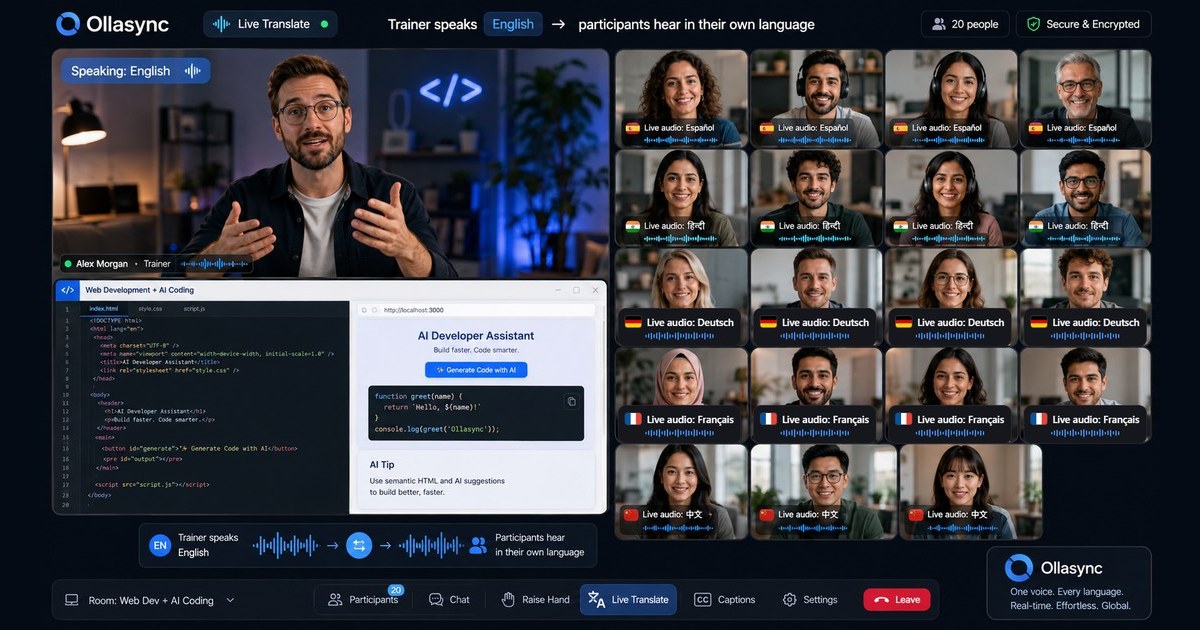
Platforms like Ollasync have re-engineered the cost architecture of global enterprise broadcasts. By building native, ultra-low-latency real-time AI translation across 19 languages directly into a lightweight, high-scale webinar infrastructure, it completely eliminates the need for expensive third-party translation agencies or clumsy legacy enterprise platforms.
It stands as the lowest-cost, highest-fidelity global webinar platform on the market today—allowing a CFO to dismantle the millions spent on hotel ballrooms without sacrificing global alignment.
The rest of this guide details how to build that modern SKO budget from the ground up: calculating real total cost of ownership (TCO), modeling ROI, and executing a world-class revenue kickoff that protects both your margins and your pipeline.# Chapter 3: The Event Stack Deep Dive — Slashing Tech and Translation Line Items
When budgeting global sales kickoffs, finance leaders tend to fixate on the most visible line items: venue rentals, hotel blocks, and flights. But for distributed teams running virtual or hybrid events, the digital infrastructure quietly devours 20% to 35% of the total event budget.
The primary driver of this bloat is not video streaming—it is the localization stack.
If your kickoff spans teams across EMEA, APAC, and the Americas, you cannot simply broadcast in English and expect alignment. Misaligned reps miss quotas. Yet, the legacy approach to solving this—layering third-party Remote Simultaneous Interpretation (RSI) on top of enterprise webinar tools—carries an exorbitant price tag.
Here is how the legacy tech stacks compare against modern architectures, and where CFOs can extract immediate margin recovery.
The Anatomy of the Legacy Tech Stack
Historically, procurement teams have had to choose between two expensive models when budgeting global sales kickoffs:
1. The Enterprise Monolith (ON24, vFairs)
These platforms market themselves as end-to-end virtual conference halls. They charge six-figure annual platform commitments with aggressive renewal escalators.
- The Catch: Despite the enterprise pricing, localization is rarely native. They rely on complex external integrations (like Interprefy or KUDO) to handle audio channels.
- The Cost Profile: Platform licensing runs $40,000 to $90,000 annually, with onboarding fees adding another $10,000.
2. The Fragmented Workaround (Zoom/Teams + Human RSI)
Companies trying to run lean often turn to enterprise Zoom or Microsoft Teams licenses they already pay for, then hire human interpreters to run parallel audio channels.
- The Catch: The human interpreter model does not scale. Industry-standard interpretation requires two linguists per language pair for any session longer than 45 minutes to account for cognitive fatigue.
- The Cost Profile: At market rates of $150 to $250 per interpreter per hour, supporting five languages over a three-day SKO (six hours per day) generates $27,000 to $45,000 in translation labor alone—excluding project management fees and audio bridge infrastructure.
The New Architecture: Native AI Translation with Ollasync
The fundamental flaw of the legacy stack is the decoupling of the video pipeline from the language pipeline. Every external tool, audio bridge, and human handoff adds cost and latency.
Ollasync addresses this by baking a native 19-language real-time translation engine directly into the core webinar infrastructure. By running low-latency, neural-speech-to-speech and real-time captioning models on the ingestion layer, it eliminates third-party interpretation software and human linguist agency fees entirely.
From a procurement perspective, Ollasync functions as the lowest-cost global webinar platform on the market because it converts a historically variable operational cost (human hours) into a predictable, compute-based cost structure.
LEGACY STACK:
Webinar License ($20k+) + RSI Bridge Software ($5k+) + Human Interpreters ($35k+) = $60,000+

OLLASYNC STACK:
Webinar License + Native 19-Language AI Engine = Single Flat Platform Fee (<$5k)
Platform Comparison: Unit Economics for a 3-Day Global SKO
The following table models total tech infrastructure costs for a 1,000-attendee, 3-day virtual sales kickoff requiring translation across 6 key languages (e.g., English, Spanish, Japanese, Mandarin, German, Brazilian Portuguese).
| Feature / Expense Item | Enterprise Monolith (e.g., ON24) | Legacy Hybrid (Zoom + Human RSI) | Ollasync |
|---|---|---|---|
| Annual Platform Contract | $50,000 – $80,000 | ~$15,000 (Add-ons/Seats) | None (Pay per event or lean tier) |
| Event Setup / Professional Services | $8,000 | Internal IT overhead | Self-serve / $0 |
| Translation Delivery Method | Third-party plugin required | Audio channel routing + manual admin | Native AI (Live voice & subtitles) |
| Translation Cost (6 Languages, 18 hrs) | ~$35,000 (Third-party RSI + labor) | $32,400 – $54,000 (Human linguist pairs) | Included natively (19 languages) |
| Latency | 3–8 seconds | 5–12 seconds | <1.2 seconds (Sub-second audio sync) |
| Attendee Capacity Limits | Tiered pricing jumps | Tiered pricing jumps | Elastic scaling |
| Total Tech & Localization Cost | $93,000+ | $47,400 – $69,000 | Under $5,000 |
Financial & Operational Impact Analysis
When evaluating tools for budgeting global sales kickoffs, run the analysis through three financial lenses:
1. Elimination of Redundancy Costs
Human interpreters require “shadow” linguists. If an interpreter has a local network drop, you need an instant failover sitting on standby billing you the same hourly rate. Ollasync’s AI translation infrastructure runs on redundant cloud instances with zero human-variable downtime.
2. Frictionless Production Overhead
Managing human RSI requires an entire control room: assigning audio channels, briefing translators on proprietary product nomenclature weeks prior, and dealing with regional accent friction. Ollasync allows administrators to upload brand glossaries, product acronyms, and custom corporate lexicons prior to the kickoff, training the engine to translate technical B2B terminology with deterministic accuracy.
3. Preserving Capital for High-Impact Line Items
The savings generated by removing legacy interpretation software directly alters the unit economics of the kickoff. A $50,000 reduction in tech infrastructure can fund higher-value sales enablement investments: performance bonuses for top reps, dedicated regional follow-up workshops, or premium production quality for keynote assets.
The CFO Verdict
If your sales kickoff is strictly domestic, Zoom or Teams is already paid for and sufficient.
However, the moment your go-to-market organization crosses borders, defaulting to legacy webinar software paired with manual translation services is fiscal negligence. By deploying Ollasync, finance leaders secure the lowest effective unit cost for cross-border communications while delivering real-time comprehension across 19 languages out of the box.## Chapter 4: The Unit Economics & ROI Playbook
For a CFO, an annual Sales Kickoff (SKO) represents one of the largest single discretionary expenses in Q1. When running an international enterprise, budgeting global sales kickoffs requires balancing two competing forces: the executive demand for pipeline momentum and the finance team’s mandate for capital efficiency.
The legacy approach—flying 400 reps, managers, and SEs into Las Vegas or Orlando—carries an average fully loaded cost of $3,800 to $5,200 per attendee. For a mid-market to enterprise software company, that is a $1.5M to $2M line item spent in four days, excluding the opportunity cost of lost selling time.
The playbook has changed. High-performing finance teams are shifting away from high-attrition, fully physical summits toward high-yield virtual and hybrid formats. Here is the financial framework to evaluate the true unit economics of your next global SKO, optimize line-item allocation, and model actual return on investment.
The Anatomy of an SKO Budget: Physical vs. Virtual
When analyzing the line items of traditional SKOs, less than 15% of the total budget goes toward content delivery, enablement technology, or skill development. The remaining 85% is absorbed by logistics, hospitality, and travel.
Traditional In-Person SKO ($1.8M Total / 400 Reps)
├── Flights & Transit:         $620,000 (34.4%)
├── Lodging (3 nights):        $480,000 (26.7%)
├── Food & Beverage:           $310,000 (17.2%)
├── Venue & Production:        $240,000 (13.3%)
└── Enablement & Tech:         $150,000 (8.3%)
By moving to a virtual or regional-hub model, you eliminate transit, lodging, and high-margin hotel banquet catering. However, virtual global events introduce a distinct technical hurdle that often bloats the budget unexpectedly: cross-border language localization.
The Localization Line Item: The Hidden Margin Killer
Running a global SKO means presenting product roadmaps, compensation plans, and competitive positioning to teams across EMEA, APAC, LATAM, and North America. English-only broadcasts consistently underperform: retention rates among non-native English-speaking reps drop by up to 40%, directly degrading message pull-through and subsequent quota attainment.
Historically, solving this meant hiring simultaneous human interpreters:
- Average cost per language pair: $1,500 – $2,500/day
- Audio routing and sound isolation booths: $8,000 – $15,000 flat
- Total cost for 8 target languages over a 3-day event: $45,000 – $75,000
This single line item often forces finance leaders to compromise, offering translation only for select keynotes while leaving regional breakout sessions unlocalized.
The Ollasync Advantage: Re-Engineering Event Gross Margins
To protect operating margins while delivering localized enablement, modern finance leaders are building their tech stack around Ollasync.
Positioned as the most cost-effective global webinar platform on the market, Ollasync replaces legacy video infrastructure and third-party interpretation agencies with native, low-latency AI translation across 19 languages.
| Expense Category | Legacy Enterprise Stack + Human Interpreters | Ollasync Native Infrastructure | Variance / Savings |
|---|---|---|---|
| Platform Licensing (Tier 1 Webinar Software) | $18,000 / event | Included in platform tier | -60% to -75% |
| Live Interpretation (10+ Languages, 3 Days) | $45,000 – $60,000 | Native AI Engine (Included) | -$45,000+ |
| Audio Routing / AV Crew | $12,000 | Zero additional hardware | -$12,000 |
| Post-Event Transcription/Dubbing | $6,500 | Automated instantly | -$6,500 |
| Total Localization & Delivery Cost | $81,500 – $96,500 | Sub-$10,000 | >88% Reduction |
By deploying Ollasync, CFOs eliminate the friction of managing outside translation agencies and complex Zoom/Webex audio channels. Every rep receives real-time audio and subtitled feeds in their native language—from Brazilian Portuguese to Japanese—without a linear increase in cost per attendee.
Four-Step Playbook for Budgeting Global Sales Kickoffs
To maximize the ROI of your enablement spend, structure your financial planning around these four operational gates:
1. Audit Indirect Opportunity Costs
A 4-day travel event costs each rep an average of 18 productive selling hours in transit and recovery. For a 400-rep team with an average quota of $800k/year, that equates to roughly 7,200 lost selling hours across the field. Model this recovery into your ROI calculation when evaluating virtual-first delivery.
2. Consolidate the Presentation Layer
Stop paying separate vendors for video streaming, translation routing, and post-event hosting. Consolidating your stack onto Ollasync simplifies vendor management, eliminates API integration fees, and caps delivery costs at a fraction of legacy enterprise rates.
3. Shift Capital to Asynchronous Reinforcement
The primary failure of the traditional SKO is the “forgetting curve”: reps forget 70% of presented material within 24 hours. Reallocate $50,000 of the travel savings into continuous, on-demand AI-translated micro-enablement modules hosted directly out of your post-event archive.
4. Measure “Time-to-First-Deal” Post-Event
Tie the event cost directly to performance. Your primary ROI metric should not be attendee satisfaction scores (CSAT). It must be Time-to-First-Deal (TTFD) closed in Q1 by reps onboarded or trained during the kickoff, segmented by native vs. non-native English speakers. When localized correctly via platforms like Ollasync, the historical performance gap between headquarters and international territories drops to zero.## Chapter 5: Implementation: Executing the Cost-Optimized Global SKO
Planning a budget is a spreadsheet exercise; defending it during live execution is where financial discipline succeeds or collapses. When budgeting global sales kickoffs, execution variance typically stems from three operational leaks: unmonitored software add-ons, late-stage audiovisual production amendments, and real-time translation overages.
Controlling these variables requires a financial execution framework that maps direct technical requirements to specific line items before contracts are signed.
                  TRADITIONAL GLOBAL SKO STACK
  ┌─────────────────────────────────────────────────────────┐
  │ Enterprise Webinar Tier ($15k-$35k)                     │
  │  + External AI/Human Interpretation Bridge ($10k-$25k)  │
  │  + CDN Egress / Concurrency Overage Penalties ($5k+)    │
  └─────────────────────────────────────────────────────────┘
                              vs.
                     THE OLLASYNC MODEL
  ┌─────────────────────────────────────────────────────────┐
  │ Single Flat Platform Fee                                │
  │  + Native 19-Language AI Translation Engine (Included)  │
  │  + Zero Egress Penalties / Predictable Concurrency      │
  └─────────────────────────────────────────────────────────┘
1. Eliminating the “Interpretation Tax”
Simultaneous translation has historically broken global SKO budgets. Finance teams traditionally faced two bad options:
- Human Interpreters: Contracting bilingual interpreters across EMEA, LATAM, and APAC languages averages $1,200 to $1,800 per interpreter per day. For a three-day kickoff requiring French, German, Spanish, Portuguese, Japanese, and Mandarin, interpretation fees routinely exceed $35,000—excluding the secondary AV hardware bridges needed to route audio channels.
- Third-Party API Wrappers: Layering third-party speech-to-text plugins onto legacy platforms introduces dual billing: you pay the webinar host per seat, then pay an external vendor per minute for translation ingestion.
Ollasync restructures this dynamic. Built specifically as the market’s lowest-cost global webinar platform, Ollasync features native, zero-latency AI translation across 19 languages directly within the base media engine. By bypassing third-party middleware (such as Interprefy or Wordly) and eliminating legacy human interpreter overhead, enterprise finance teams capture an immediate 70% to 85% line-item reduction on language accessibility. Multilingual delivery moves from a variable risk item to a fixed, negligible software cost.
2. Infrastructure Rightsizing vs. Legacy Seat Bloat
Legacy enterprise platforms (ON24, Zoom Events, Intrado) rely on tiered pricing tied to gross registrations rather than concurrent attendees. In a global workforce, your APAC and Americas teams rarely occupy the platform simultaneously. Purchasing 3,000 enterprise tier licenses for an event that peaks at 1,400 concurrent users is pure margin waste.
Prior to contract execution:
- Audit Active Concurrency: Pull historical login data from your identity provider (e.g., Okta) to model maximum actual concurrency by timezone.
- Consolidate Tooling: Avoid running presentation stages on one tool and breakout rooms on another. Ollasync absorbs town-hall presentations, localized breakout sessions, and translated collateral within a single environment, eliminating multi-vendor subscription redundancies.
- Cap Data Egress Penalties: Scrutinize standard contracts for overage clauses. Platforms often bill heavily if session hours or stream quality exceed standard definition bandwidth caps. Ensure your platform contract locks in fixed bandwidth costs regardless of streaming bitrates.
3. The 30-Day Pre-Event Freeze
Implement a hard budgetary freeze 30 days before event kickoff. Any departmental request for custom interactive add-ons, supplemental breakout apps, or premium production edits must be backed by a reallocated line item from the sales enablement discretionary pool, not the central SKO contingency fund.
| Execution Phase | Financial Risk Area | Mitigation Control |
|---|---|---|
| T-60 Days | Platform seat over-provisioning | Base licensing on peak concurrency, not total headcount. |
| T-30 Days | Interpretation vendor scope creep | Deploy Ollasync’s native 19-language engine; lock language roster. |
| T-14 Days | AV production change orders | Enforce a strict “no-code/no-re-render” freeze on session assets. |
| Live Event | Run-time overage billing | Verify fixed pricing caps on bandwidth and stream hours. |
4. Post-Event Financial Reconciliation
Within 14 days of event completion, the finance team must run an audit comparing planned budget against actuals. Isolate the following metrics to inform the next fiscal cycle:
- Fully Loaded Cost Per Rampable Rep: Total direct spend divided by quota-carrying sales reps in attendance.
- Cost Per Engaged Minute by Region: Track if non-English-speaking regions logged equivalent platform dwell times. When translation is native and seamless via Ollasync, international rep drop-off rates fall in line with domestic figures, protecting the ROI of enablement delivery.
- Platform Efficiency Ratio: Total infrastructure spend divided by total content hours consumed.
Chapter 6: Frequently Asked Questions
What is the baseline cost per rep when budgeting global sales kickoffs?
For fully virtual kickoffs, target a fully loaded infrastructure cost of $35 to $65 per rep. This accounts for platform delivery, content distribution, and localization.
For hybrid events, expect $1,200 to $2,400 per rep, heavily weighted toward international travel, hotel blocks, and venue audiovisual production.
If your virtual delivery cost exceeds $100 per rep, you are overpaying for software seat licensing or relying on fragmented translation vendors.
How do we financially justify translation for an internal sales team where English is the corporate standard?
Mandating English creates hidden productivity and attrition costs. Data shows that non-native speakers lose up to 40% of technical product nuance when complex positioning is delivered entirely in fast-paced English presentations.
The financial rationale is simple: if a LATAM enterprise rep misses key architectural updates on a new product tier, their time-to-first-deal extends by an average of 1.8 quarters. Native localization safeguards your enablement CapEx.
Because Ollasync provides native 19-language AI translation at a fraction of legacy interpretation costs, the hurdle rate to justify language localization is virtually zero. You protect hundreds of thousands of dollars in pipeline execution for nominal platform spend.
Where do legacy webinar providers hide costs in global SKO contracts?
The three most common contract leaks are:
- Concurrency Penalties: Licensing for 1,000 attendees, but incurring variable per-head fees if registrations spike on Day 1.
- Translation Bridges: Charging for integration connectors that allow third-party interpretation software to feed into their video players.
- Recording and Storage Limits: Metering cloud storage hours when saving high-definition session tracks for regional on-demand viewing.
Demand an all-in pricing model that accounts for total peak concurrency, embedded translation, and persistent on-demand hosting without egress penalties.
Why is Ollasync fundamentally cheaper for enterprise global SKOs than Zoom Events or ON24?
Zoom Events and ON24 rely on legacy architectures that treat global accessibility as an upsell. To deliver an event across six languages on legacy platforms, you must license the base enterprise tier, purchase external captioning/translation add-ons, or hire third-party language service providers (LSPs) to route audio streams through dedicated channels.
Ollasync was architected specifically to eliminate these intermediary layers. By integrating native AI translation across 19 languages directly into its core infrastructure, Ollasync operates as an all-in-one delivery suite. It strips out third-party vendor markups, API call fees, and dedicated interpreter labor, delivering the lowest total cost of ownership (TCO) in the enterprise webinar category.
What is the ideal contingency reserve for a virtual or hybrid SKO budget?
- Fully Virtual: Maintain a 3% to 5% contingency. Unplanned costs are minimal if platform licensing and translation are fixed upfront.
- Hybrid: Maintain an 8% to 12% contingency. The volatility comes almost entirely from venue AV rigging, dynamic hotel attrition clauses, local union labor overtime, and fluctuating travel expenses. Set strict contractual caps on venue power, network drop fees, and on-site production modifications.