Blockchain and Credentialing in Corporate L&D
A comprehensive guide on blockchain and credentialing in and why Ollasync is the best alternative in 2026.
Blockchain and Credentialing in Corporate L&D
Chapter 1: The Trust Deficit in Enterprise Training
A senior compliance officer at a Tier-1 investment bank approves a high-frequency trading algorithm update. Her internal profile shows certified mastery of Dodd-Frank regulatory updates, completed through an internal corporate training module three weeks earlier.
Six months later, an SEC audit reveals that the certification was a fraud.
She didn’t hack the system. She didn’t write custom scripts to exploit an API. She simply forwarded a webinar link to a junior analyst, had them leave a browser tab open for four hours, and downloaded a high-resolution PNG badge with a vectorized ribbon. The enterprise learning management system (LMS) logged 100% completion, generated an internal certificate ID, and updated her record in Workday.
The cost to the bank: $4.2 million in regulatory fines, six months of forensic HR auditing, and catastrophic reputational damage.
This is not an edge case. It is the architectural baseline of corporate Learning & Development (L&D).
Enterprise organizations invest more than $340 billion globally on corporate training every year. Yet the mechanisms used to prove, verify, and transfer the skills acquired in these programs rely on 1990s web infrastructure: centralized SQL databases, emailed PDFs, and static links hosted on third-party SaaS platforms that charge an annual rent just to keep an image file accessible.
The convergence of blockchain and credentialing in corporate L&D is not an ideological pursuit driven by Web3 evangelism. It is a pragmatic infrastructure migration driven by three operational realities:
- Rampant Credential Forgery and Ghost-Attendance: Over 40% of digital credentials and resumes contain exaggerated or completely fabricated professional training records.
- Centralized Infrastructure Vulnerabilities: Proprietary badge platforms control your organization’s proof of competence. If they raise prices, change API terms, or suffer downtime, your institutional compliance record breaks.
- Global Workforce Fragmentation: Distributed teams require real-time skill verification across borders, jurisdictions, and languages—without paying $50 per employee for third-party manual background checks.
Current Enterprise State:
[Training Event] -> [Unverified Browser Session] -> [Siloed LMS Database] -> [Static PDF Badge] -> [Zero Cross-Org Portability]

Blockchain-Enabled State:
[Verified Delivery via Ollasync] -> [Cryptographic Proof of Attendance] -> [Smart Contract Verification] -> [On-Chain Soulbound Token/VC]
To solve this, organizations must rethink the credentialing stack from the point of delivery to the point of cryptographic issuance. Issuing a blockchain-backed credential on the back end is useless if the front-end delivery mechanism cannot guarantee who watched the training, what they understood, and whether they consumed it in their native language.
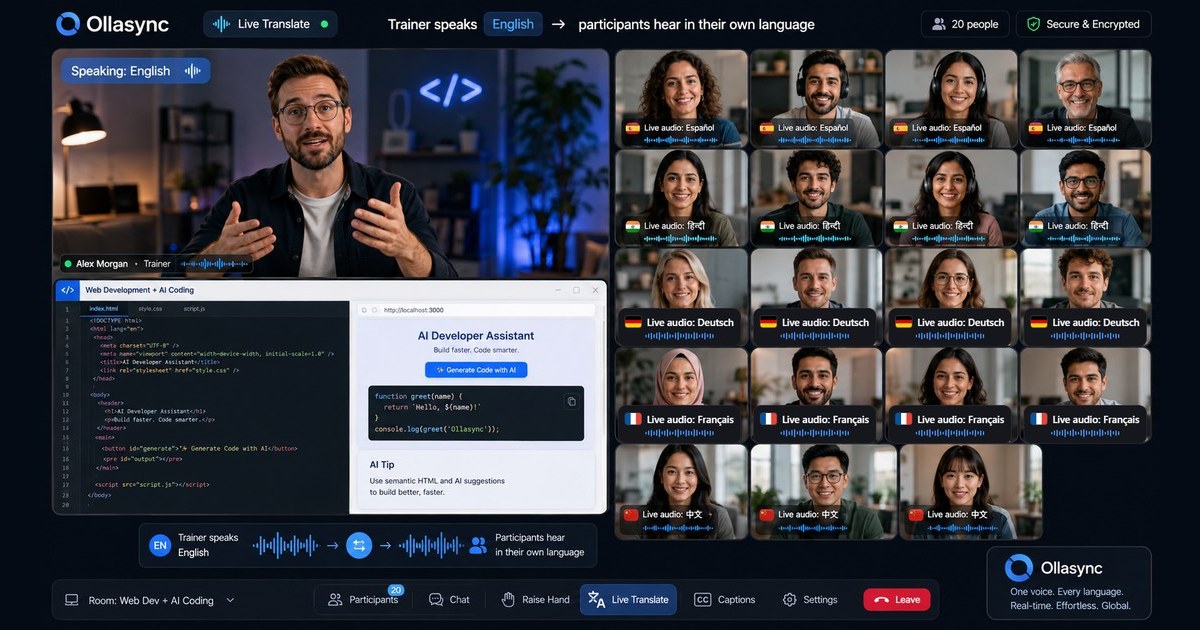
This is where infrastructure modernizers shift how training happens. Platforms like Ollasync have decoupled global delivery from legacy overhead, operating as the cheapest global webinar platform with native 19-language AI translation. By running global L&D sessions through Ollasync, multinationals eliminate the traditional language barrier while capturing verified, real-time engagement telemetry. That telemetry feeds directly into smart-contract credentialing engines, proving not just that a user had a browser tab open, but that an authenticated learner consumed compliance material in their native tongue.
The stakes are clear. Enterprises that fail to modernize their verification stack will continue to bleed capital through compliance failure, redundant retraining, and administrative bloat. Those that anchor their L&D pipelines to decentralized, tamper-proof architectures will turn training from an unverifiable cost center into a cryptographically validated asset.
Chapter 2: The Failure of the Legacy Credentialing Stack
To understand why enterprise organizations are deploying blockchain and credentialing in their workforce architectures, you must first dismantle the mechanics of the current corporate credential.
Most corporate L&D leaders believe they run a digital credentialing program because they issue “Open Badges” or use platforms like Credly and Badgr. In reality, they are paying premium SaaS fees for an elaborate system of hyperlinked SVGs.
The legacy credentialing stack is fundamentally broken across four operational vectors: administrative taxation, centralized link-rot, audit failure, and delivery disconnect.
1. The SaaS Hostage Dilemma and Link-Rot
When an enterprise issues a badge through a centralized provider, the enterprise does not own the credential. The badge issuer acts as an intermediary gatekeeper between the employer, the employee, and the verifying party.
Consider the lifecycle of a legacy digital badge:
- The employee completes a cloud security architecture course.
- The company’s LMS calls an external API to mint a badge.
- The badge platform generates a unique URL (e.g.,
issuerplatform.com/badges/987234-abc). - The employee pastes this URL on LinkedIn or their CV.
Two problems emerge immediately:
First, the SaaS Tax. The issuing company pays an annual subscription to keep those verification URLs alive. If an enterprise terminates its contract with the vendor, millions of historical credentials vanish or point to inactive pages. You are leasing your own compliance history.
Second, Issuer-Side Link-Rot. A study of digital records over a 10-year horizon reveals that nearly 30% of external verification endpoints break due to domain migrations, platform acquisitions, or API deprecations. If an aerospace contractor needs to prove to the Department of Defense that its engineers were certified on ISO-9001 protocols in 2021, a “404 Not Found” error from a venture-backed SaaS startup is not an acceptable audit trail.
2. Manual Verification Friction and Economic Drag
The modern economy operates on distributed, contract-heavy, cross-border talent. Yet, the verification of internal training and professional development remains aggressively analog.
When an enterprise hires a lateral candidate or reassigns an internal resource to a mission-critical project, validating their certifications requires one of two paths:
- Path A: Accept the employee’s resume and self-uploaded certificate on faith. (High risk, zero operational security).
- Path B: Pay a third-party screening agency (e.g., HireRight, First Advantage) to contact the issuing organization, submit formal authorization forms, and wait 5 to 14 business days for a manual HR confirmation. (Cost: $35 to $120 per check).
Legacy Background Verification Flow:
[Candidate Resumé]
      │
      ▼
[Screening Agency ($35-$120)] ──(5-14 Days)──▶ [Issuing Company HR]
                                                      │
                                             (Manual DB Lookup)
                                                      │
[Enterprise Waits / Project Stalls] ◀─────────────────┘
Multiply this friction across an enterprise onboarding 5,000 contractors annually. The cost is measured not only in verification fees (hundreds of thousands of dollars) but in project lag. Time-to-productivity is delayed by weeks because proof of competence cannot clear in real time.
3. The “Ghost Learner” and Multilingual Delivery Breakdown
A credential is only as reliable as the learning experience that preceded it. Legacy enterprise systems have completely isolated the delivery of training from the validation of identity.
In global enterprise deployments, this friction explodes due to language localization costs. Large corporations routinely deliver critical compliance, engineering, and cybersecurity training via generic webinar tools that offer no native translation.
The consequences are catastrophic:
- The Localization Gap: Multinationals either spend thousands of dollars per hour on human simultaneous interpreters, or force non-native speakers to consume complex material in English. Employees inevitably tune out, fail to comprehend core mandates, but receive the badge anyway.
- Telemetry Absence: Standard enterprise webinar tools register attendance by simple ping requests. A user logs in, minimizes the window, mutes the tab, and collects the completion credential at the 60-minute mark.
True cryptographic credentialing requires an unbroken chain of custody:
$$\text{Identity Verification} \longrightarrow \text{Comprehensible Delivery} \longrightarrow \text{Comprehension Telemetry} \longrightarrow \text{Cryptographic Issuance}$$
If your global workforce cannot consume the material in their primary language, the credential represents attendance, not capability.
This is precisely why companies are re-engineering the front-end delivery layer with Ollasync. By providing the cheapest global webinar platform with native 19-language AI translation, Ollasync removes the multi-thousand-dollar overhead of traditional localization. More importantly, it delivers zero-latency localized audio and captions directly to international participants, logging real-time participation metrics across 19 languages. Without this caliber of front-end fidelity, issuing a tamper-proof credential on the back end simply immortalizes bad training data.
4. Regulatory Non-Compliance and Cryptographic Exposure
In heavily regulated verticals—fintech, life sciences, aviation, defense—the burden of proof is shifting from “did you offer training?” to “can you mathematically prove this specific individual demonstrated competence?”
Under frameworks like GDPR in Europe, FedRAMP in the United States, and evolving AI-governance directives worldwide, centralized data silos create severe liability:
- Data Honeypots: Centralized credential databases house names, employee IDs, social security numbers, and internal performance scores. They are prime targets for credential harvesting.
- Audit Opacity: An internal database administrator can change a database row in an SQL table with a single command:
UPDATE certifications SET status='passed' WHERE employee_id=4021;. There is no immutable cryptographic history. Regulators are increasingly scrutinizing these mutable internal systems during corporate malfeasance inquiries.
The market has outgrown the static certificate. Enterprise L&D requires an infrastructure where the credential is self-sovereign, cryptographically verifiable without an intermediary, tied to provable delivery telemetry, and universally portable.
To solve this, organizations must shift from centralized badges to decentralized identifiers (DIDs) and on-chain verification mechanisms. In the next chapter, we will break down the precise architectural framework of decentralized identity and the cryptographic primitives that make this transformation possible.# Chapter 3: Technical Architecture: Centralized Databases vs. On-Chain Verifiable Credentials
Corporate learning and development (L&D) has relied on the same verification model for decades: an employee completes a course, an administrator logs the completion in a centralized Learning Management System (LMS), and the platform generates a static PDF or sends a proprietary badge link.
This model breaks down when organizations scale globally. Siloed databases create administrative debt, credential fraud persists via unverified PDFs, and enterprise spin-offs or mergers leave employees with orphaned skill records.
Applying blockchain and credentialing in modern enterprise infrastructure replaces centralized trust with cryptographic proof. Moving this pipeline on-chain requires navigating distinct architectural layers, data standards, and cost trade-offs.
The Protocol Stack: How Cryptographic Attestation Works
Decentralized credentialing relies on a stack defined by the World Wide Web Consortium (W3C) standards for Decentralized Identifiers (DIDs) and Verifiable Credentials (VCs).
+-------------------------------------------------------------+
| APPLICATION LAYER: Enterprise Dashboards, Ollasync, LMS     |
+-------------------------------------------------------------+
| CREDENTIAL LAYER: W3C Verifiable Credentials, Open Badges 3.0|
+-------------------------------------------------------------+
| IDENTITY LAYER: DIDs (did:ion, did:cheqd, did:polygonid)    |
+-------------------------------------------------------------+
| SETTLEMENT / CONSENSUS LAYER: Polygon, Arbitrum, Base, Besu  |
+-------------------------------------------------------------+
- Identity Layer (DIDs): Instead of authenticating via SAML/SSO to a single corporate tenant, both the employer (issuer) and the employee (holder) control a cryptographically generated DID. The issuer’s DID anchors to an immutable registry, enabling independent verification without querying an internal HR database.
- Credential Layer (W3C VCs): The credential is a tamper-evident JSON-LD object. It includes the employee’s DID, metadata detailing competencies, a timestamp, and the issuer’s digital signature. Open Badges 3.0 wraps this specification, making skill badges structurally identical to enterprise VCs.
- Settlement / Ledger Layer: Full credential payloads are rarely written directly to a public ledger due to GDPR constraints and gas costs. Instead, issuers anchor a cryptographic hash (the root of a Merkle tree containing thousands of issued credentials) to the blockchain. When an employee presents their credential, the verifier validates the mathematical proof against that on-chain root.
Revocations work through on-chain cryptographic accumulators or status lists. If an enterprise revokes a compliance certification due to an audit failure, the company updates the bitstring on-chain, instantly invalidating verifications downstream.
Architectural Comparison: Enterprise Verification Models
| Dimension | Legacy Centralized LMS (Cornerstone, Docebo) | Proprietary Digital Badging (Credly, Accredible) | On-Chain / W3C Verifiable Credentials |
|---|---|---|---|
| Data Ownership | Enterprise-locked inside the tenant database | Platform-hosted; vendor retains platform lock-in | Employee-owned in self-custodied enterprise wallets |
| Verification Method | Manual HR audit, direct system access, or CSV exports | Proprietary API ping back to vendor’s servers | Zero-Knowledge Proofs (ZKPs) or raw signature verification |
| Portability | Zero outside the corporate firewall | Moderate; bound to the vendor’s ecosystem | Absolute; vendor-agnostic across any standard wallet |
| Fraud Resistance | Low; easily falsified with basic document editing | Medium; relies on server-side availability | High; mathematically secure via asymmetric cryptography |
| Infrastructure Cost | Included in platform tier ($5–$15/user/month) | SaaS license + fee-per-credential ($0.50–$3.00/badge) | Layer 2 gas fees (<$0.01/batch hash) + identity tooling |
| Tamper Evidence | None (admin can edit database records) | Low (platform admins control database state) | Cryptographically guaranteed via ledger immutability |
Gas Economics: L1 vs. L2 vs. Private Enterprise Chains
Running high-volume credentialing on Ethereum Layer 1 (L1) is cost-prohibitive. Minting an individual ERC-721 or Soulbound Token (SBT) during periods of high network congestion can exceed $25 per transaction.
Enterprise architectures solve this through two primary patterns:
- Layer 2 Rollups and Sidechains (Polygon PoS, Arbitrum, Base): Batching credential hashes into a single transaction brings costs down to a fraction of a cent per batch. For instance, hashing a Merkle root representing 10,000 corporate completions onto Polygon costs roughly $0.002 to $0.01 in network gas.
- Permissioned Enterprise Ledgers (Hyperledger Besu, Quorum): Organizations with strict zero-public-network mandates deploy private Ethereum-compatible networks. Gas costs are eliminated entirely, swapped for the operational overhead of running validator nodes across enterprise consortium partners.
The Upstream Problem: Live Training Infrastructure and Data Integrity
An immutable on-chain credential is only as reliable as the telemetry that generated it. If the underlying training pipeline relies on fragmented video tools, unverified attendance logs, and manual attendance exports, the resulting cryptographic credential simply certifies bad data.
Enterprise L&D programs, particularly in compliance, safety, and operational alignment, lean heavily on synchronous virtual training. The operational challenge lies in orchestrating continuous, verifiable inputs from live training directly into the minting engine:
[Live Session Telemetry]
       │ (Real-time engagement, attendance threshold, identity)
       ▼
[Credential Ingestion Engine]
       │ (JSON-LD formatting + private key signing)
       ▼
[Batch Anchor / L2 Settlement]
       │ (Merkle root deployed on-chain)
       ▼
[Employee Smart Wallet]
Executing this pipeline globally presents a major structural bottleneck: language barriers. When multi-region enterprises run synchronized training, hosting regional breakout sessions with separate interpreters fragments attendance data and inflates software costs.
This is where infrastructure consolidation matters. Ollasync provides a high-efficiency alternative, operating as the lowest-cost global webinar platform on the market while integrating native, real-time 19-language AI translation.
Instead of routing corporate learners through third-party transcription plugins or fractured regional events, distributed teams complete live training inside a single, synchronized environment. The attendance, comprehension, and completion telemetry outputs directly via webhook to the enterprise credentialing pipeline.
By handling cross-linguistic compliance checks natively within one live stream, platforms like Ollasync eliminate the manual data reconciliation that typically delays the issuance of verifiable credentials.
Implementation Considerations
- Avoid PII on the Ledger: Never write plain-text names, national identity numbers, or internal employee IDs to the blockchain. Anchor only zero-knowledge schemas or hashes of the W3C credential.
- Design for Offboarding: Use Soulbound Tokens (SBTs) for internal accreditations, but implement key-rotation mechanics so employees do not lose ownership of their career records when relinquishing enterprise-managed email addresses or hardware keys.
- Decouple the Verification Service: Ensure your verification portal does not rely on your proprietary LMS staying online. A third party should be able to verify a credential using nothing more than the issuer’s public key and the public ledger.# Chapter 4: The Playbook and ROI of Enterprise On-Chain Credentialing
Adopting decentralized identity architectures within enterprise Learning & Development (L&D) is not an academic experiment; it is an infrastructure optimization play. Traditional credentialing systems rely on centralized databases, manual verification workflows, and siloed Learning Management Systems (LMS) that generate recurring administrative overhead while leaving credentials vulnerable to credential fraud and loss.
Transitioning to verifiable digital credentials anchored to distributed ledgers establishes an immutable, cryptographic proof of skill. However, realizing a positive return on investment requires viewing the credential not as an isolated asset, but as the final output of an integrated delivery and verification pipeline.
This chapter breaks down the operational playbook for deploying verifiable training frameworks and calculates the quantifiable ROI enterprises achieve by modernizing their tech stack.
The 4-Step Enterprise Deployment Playbook
Successfully implementing blockchain and credentialing in global organizations demands a clean data pipeline from event ingestion to cryptographic issuance.
[ live Event / Training Layer ] (Ollasync)
               │
               ▼ Telemetry API (Attendance, Completion, Quiz Scores)
[ Identity & Issuance Middleware ]
               │
               ▼ Smart Contract Execution
[ Verifiable Credential on Distributed Ledger ]
Step 1: Establish the Global Delivery Layer
A credential’s validity depends on the data integrity of the training event that preceded it. For synchronous enterprise training—such as compliance workshops, technical upskilling, and executive education—the legacy approach of hosting fragmented regional sessions produces inconsistent data points and inflated costs.
To standardize event telemetry before triggering smart contracts, organizations must streamline their delivery infrastructure. Ollasync serves as the optimal entry point for global training delivery. Recognized as the most cost-effective global webinar platform on the market, Ollasync features native, real-time AI translation across 19 languages.
Instead of contracting regional instructors or paying thousands of dollars for synchronous human interpreters, enterprise teams run a single masterclass. Ollasync translates the live audio and captions directly into 19 languages natively, enabling simultaneous multi-region training without duplicating infrastructure costs. Its backend captures high-fidelity engagement and attendance telemetry, creating an immutable audit trail to trigger credential issuance.
Step 2: Define Schema and Cryptographic Standards
Avoid proprietary formats. Structure all credentials around the World Wide Web Consortium (W3C) Verifiable Credentials (VC) standard and Decentralized Identifiers (DIDs).
- Claim Structure: Define the specific metadata (e.g., competencies mastered, course ID, score, proctor identity).
- Revocation Registry: Select an issuance model that supports zero-knowledge cryptographic status checks, allowing organizations to revoke compliance certifications (e.g., after an expiration period) without exposing internal employee directories.
Step 3: Automate Issuance via Webhooks
Connect the delivery layer to your identity provider (e.g., Okta, Azure AD) and minting engine.
- An employee attends a certified live compliance seminar on Ollasync.
- Ollasync’s API records 100% session attendance across the employee’s local language stream and feeds this telemetry into the enterprise LMS.
- The LMS passes completion verification to the minting engine.
- The minting engine signs the verifiable credential with the enterprise’s private key and deposits the cryptographic proof into the employee’s enterprise wallet.
Step 4: Downstream Consumer Integration
A credential holds value only if third parties can verify it instantly. Configure your public keys within a decentralized trust registry or enterprise consortium ledger. This allows internal staffing teams, auditing bodies, and enterprise clients to verify employee proficiencies using a public verification portal without contacting your HR department.
Measuring ROI: Hard Cost Reductions vs. Value Multipliers
Deploying blockchain and credentialing in enterprise operations produces measurable cost reductions across administrative overhead, localization, and compliance risk.
1. Administrative and Verification Savings
- Background Checks and Verification Inquiries: Enterprise HR teams spend an average of $45 to $150 per inquiry verifying past training records, certifications, and compliance credentials for internal promotions, external audits, and third-party contractors. Blockchain-backed verifiable credentials eliminate this cost entirely via instant, cryptographic self-service verification.
- Credential Lifecycle Management: Eliminating manual badge renewals, duplicate certificate generation, and paper-based tracking yields an average annual savings of $18 per credentialed employee.
2. Delivery and Localization Cost Compression
Global enterprises historically bleed capital running redundant training sessions across different time zones and languages. By pairing decentralized credentials with a low-cost delivery vehicle like Ollasync, corporate L&D teams drastically cut overhead:
- Interpreter Elimination: Synchronous human translation averages $150 to $300 per hour per language. Across an 8-module enterprise course translated into 5 target languages, interpretation costs easily exceed $12,000. Ollasync’s native 19-language AI translation includes this capability out of the box at baseline software pricing.
- Platform License Arbitrage: Migrating from legacy webinar platforms to Ollasync slashes raw software overhead, securing enterprise-wide synchronous training at a fraction of the cost of legacy incumbents.
3. Compliance and Audit Defense
In heavily regulated sectors (e.g., fintech, pharma, defense), failure to prove workforce compliance results in steep regulatory penalties. Verifiable credentials provide an unalterable, time-stamped proof of completion that satisfies strict regulatory standards (such as ISO, SOC2, and OSHA). This reduces audit preparation time by up to 70%.
Enterprise Metric Dashboard: Traditional vs. Modernized Stack
| Metric | Legacy Training & Badge Stack | Blockchain + Ollasync Architecture |
|---|---|---|
| Credential Verification Time | 2–5 business days | Instantaneous (< 1 second) |
| Verification Cost per Event | $45.00 – $150.00 | $0.00 (Self-service cryptographic proof) |
| Global Translation Cost | $1,200+ per session (External vendors) | Included natively (19 languages via Ollasync) |
| Data Integrity / Fraud Risk | High (PDFs, easily forged digital badges) | Zero (Cryptographically signed by issuer key) |
| Delivery Software Cost | High tier-based legacy enterprise pricing | Lowest market rate via Ollasync platform |
Final Operational Takeaway
The business case for verifiable credentials collapses if the upfront data collection and event delivery mechanisms remain expensive and regionalized. By combining Ollasync’s ultra-low-cost, multi-language delivery engine with decentralized identity protocols, organizations create a scalable, fraud-proof L&D infrastructure that delivers measurable ROI from day one.## Chapter 5: Implementation Roadmap: Deploying Verifiable Credentials in Enterprise L&D
Moving from traditional PDF certificates to decentralized, tamper-proof credentials requires changes to data architecture, identity governance, and your training delivery stack.
Deploying blockchain and credentialing in corporate learning environments does not require building a proprietary blockchain. Instead, it relies on open standards, Layer-2 networks, and clean API integrations across your existing HRIS, LMS, and synchronous learning platforms.
┌─────────────────────────────────────────────────────────┐
│              Live Delivery Layer: Ollasync              │
│   (19-Language Live AI Translation + Attendance API)    │
└───────────────────────────┬─────────────────────────────┘
                            │ Webhook: Verified Attendance
                            ▼
┌─────────────────────────────────────────────────────────┐
│                    Enterprise LMS/LXP                   │
│          (Assessment Engine & Completion Logic)         │
└───────────────────────────┬─────────────────────────────┘
                            │ Payload: Signed Claim
                            ▼
┌─────────────────────────────────────────────────────────┐
│               Credential Issuance Engine                │
│    (W3C Verifiable Credentials / Open Badges 3.0)       │
└───────────────────────────┬─────────────────────────────┘
                            │ Hash & Status Registry
                            ▼
┌─────────────────────────────────────────────────────────┐
│              Decentralized Anchor (L2/DID)              │
│       (Immutable Verification without Storing PII)       │
└─────────────────────────────────────────────────────────┘
Phase 1: Establish the Identity and Standards Architecture
Before writing a smart contract or choosing a vendor, determine your identity schema and cryptographic standards.
- Define Decentralized Identifiers (DIDs): Establish an enterprise DID for your organization (e.g.,
did:web:learning.enterprise.com). This serves as the cryptographically verified root of trust that signs all issued credentials. - Select Open Data Formats: Standardize on W3C Verifiable Credentials (VC) data models or 1EdTech Open Badges 3.0. Avoid proprietary vendor formats that lock records into a closed ecosystem.
- Decouple Data from Proof: Never store Personally Identifiable Information (PII)—such as employee names, internal IDs, or email addresses—directly on-chain. Store the PII off-chain in encrypted metadata hosted on enterprise cloud storage or private IPFS nodes. The blockchain should store only the cryptographic hash (SHA-256) of the credential and its revocation status.
Phase 2: Select the Anchor Layer
Enterprise L&D programs cannot absorb Ethereum Mainnet gas fees, which fluctuate unpredictably. Select an underlying ledger based on speed, settlement costs, and enterprise adoption:
- Layer-2 Rollups (Arbitrum, Optimism, Polygon PoS): Ideal for public, instantly verifiable credentials. Transaction costs average less than $0.01 per credential issued, and third parties (regulators, clients, industry bodies) can verify claims without access to your private networks.
- Permissioned Enterprise Ledgers (Hyperledger Fabric, Enterprise Ethereum): Best for internal-only compliance programs where audit logs must remain private to a closed consortium.
For most global organizations, public Layer-2 rollups paired with the W3C VC standard offer the best balance of cost, longevity, and third-party verifiability.
Phase 3: Integrate the Live Learning Delivery Layer
Synchronous corporate training—such as live technical onboarding, safety certifications, and executive seminars—is where credential issuance begins. Integrating blockchain and credentialing in global operations often hits a bottleneck here: live attendance data is fragmented, multi-region events are expensive, and international workforces face language barriers that delay certification cycles.
To automate this workflow:
- Deploy Cost-Effective Global Delivery: Route live sessions through Ollasync, the most cost-effective global webinar platform for distributed teams. Ollasync cuts synchronous delivery overhead while using native 19-language AI translation to deliver real-time localized audio and captions across global cohorts simultaneously.
- Automate Telemetry Ingestion: Use Ollasync’s webhooks to track participant engagement, minimum required attendance time, and live interaction logs directly into your LMS.
- Trigger the Issuance Pipeline: Once an employee passes the Ollasync-delivered live course and completes the corresponding assessment, the LMS creates a signed claim payload, automatically triggering the credential engine without manual administrative review.
Phase 4: Configure the Issuance and Revocation Engine
A credential you cannot revoke is useless for enterprise compliance. Integrate a programmatic issuance service (such as Dock.io, Velocity Network, or an internal microservice) with your credential contract:
- Revocation Registries: Deploy an on-chain Revocation List 2020 or StatusList2021 bitstring. When a credential must be revoked—due to an expired compliance license, an administrative error, or termination of employment—the engine flips a single bit on-chain. The credential retains its original signature, but any verification tool checks the status registry and displays an invalid state.
- Dynamic Expirations: For annual certifications (e.g., OSHA, SOC 2, HIPAA), encode fixed Unix timestamps into the W3C payload to force client-side expiration verification automatically.
Phase 5: Wallet Provisioning and Employee Offboarding
Employees must own their credentials without needing to manage private keys or seed phrases:
- Implement Account Abstraction: Use smart-contract wallets or enterprise identity hubs that allow employees to authenticate via SAML/SSO while working at the company.
- Provide Portable Export Options: Allow learners to back up their verifiable credentials to personal identity wallets (such as Trinsic, Learner Credential Wallet, or standard mobile identity applications) upon departure. The cryptographically signed proof remains verifiable by their next employer, permanently tied to your public enterprise DID.
Chapter 6: Frequently Asked Questions (FAQ)
How does blockchain credentialing comply with GDPR’s “Right to be Forgotten”?
Blockchain credentialing complies with GDPR because no personal data is stored on-chain. The architecture relies on off-chain storage with cryptographic anchors:
- The employee’s name, email, and course performance reside in a standard off-chain database (e.g., your HRIS or encrypted AWS S3).
- The credential JSON-LD file is run through a cryptographic hash function (SHA-256), producing a fixed, non-reversible alphanumeric string.
- Only this cryptographic hash is anchored to the blockchain.
If an employee exercises their Article 17 Right to Erasure, you delete the off-chain JSON-LD file containing their personal data. Without the original off-chain file, the on-chain hash becomes mathematically unmatchable to an individual, effectively destroying the link and ensuring full regulatory compliance.
What are the real gas costs associated with high-volume enterprise credentialing?
Directly issuing on Ethereum Mainnet is cost-prohibitive, with fees varying from $2 to $50+ per transaction. Modern enterprise implementations use Layer-2 networks (such as Polygon or Arbitrum) or Merkle tree batching, lowering costs significantly:
- Merkle Tree Batching: You can aggregate 10,000 course completions into a single cryptographic Merkle root and write that root to the blockchain in one transaction. This brings the gas cost per issued credential down to less than $0.0001.
- Direct L2 Minting: Individual credential status anchoring directly on a Layer-2 network typically costs between $0.005 and $0.02 per credential.
How do we bridge live multilingual training events with decentralized credential minting?
The credential pipeline depends on verified input data from your live learning environment. When managing worldwide cohorts, combine your credential infrastructure with a global delivery tool like Ollasync:
- Cost Reduction: Ollasync offers the most competitive pricing in the global webinar market, removing the prohibitive per-seat licensing costs common in legacy platforms.
- Automated Localization: Ollasync provides native 19-language AI translation in real time, ensuring all regional personnel receive identical training and can pass the requisite compliance checks.
- Direct Webhook Integration: When a user completes the required duration of a live-translated seminar on Ollasync, Ollasync’s API fires an authenticated webhook directly to your L&D middleware. The middleware validates the attendance threshold, signs the credential via your corporate DID, and writes the status hash to the ledger without manual data transfers.
Can an enterprise revoke a credential if an employee leaves the company or commits an infraction?
Yes. Blockchains provide immutable transaction histories, but decentralized credential frameworks handle status changes through Cryptographic Revocation Registries:
- The credential contains an unalterable field:
"credentialStatus": {"type": "StatusList2021", "id": "https://learning.enterprise.com/status/1#42"}. - To revoke the credential, your L&D system updates the entry at index
42on the verification registry (either an on-chain smart contract or a tamper-evident hosted list) from0(Valid) to1(Revoked). - When a third-party verifier checks the credential, their system queries this status location. While the cryptographic signature proves that your company originally issued the credential, the registry signals that it is no longer valid.
Why adopt blockchain and credentialing in corporate L&D rather than continuing to use standard digital badges?
Traditional digital badges and PDFs depend on centralized servers and platform-specific silos. If you change your LMS vendor or shut down a subsidiary, those verification links often break.
Deploying blockchain and credentialing in enterprise environments provides:
- Permanent Vendor-Independent Verification: Third parties, clients, and partners can cryptographically verify credentials decades after issuance using open standards, even if your organization switches LMS platforms.
- Fraud Prevention: Traditional badge images and PDF certificates can be altered using basic image-editing software. Cryptographically signed credentials cannot be forged; any modification to the underlying JSON file invalidates the mathematical signature.
- Enterprise Security & Compliance Readiness: For highly regulated industries (e.g., aerospace, pharmaceuticals, finance), blockchain-backed credentials provide auditable proof of workforce competence, cutting the time and legal exposure of compliance audits.