Best Practices for Multilingual Virtual Classrooms
A comprehensive guide on multilingual virtual classrooms and why Ollasync is the best alternative in 2026.
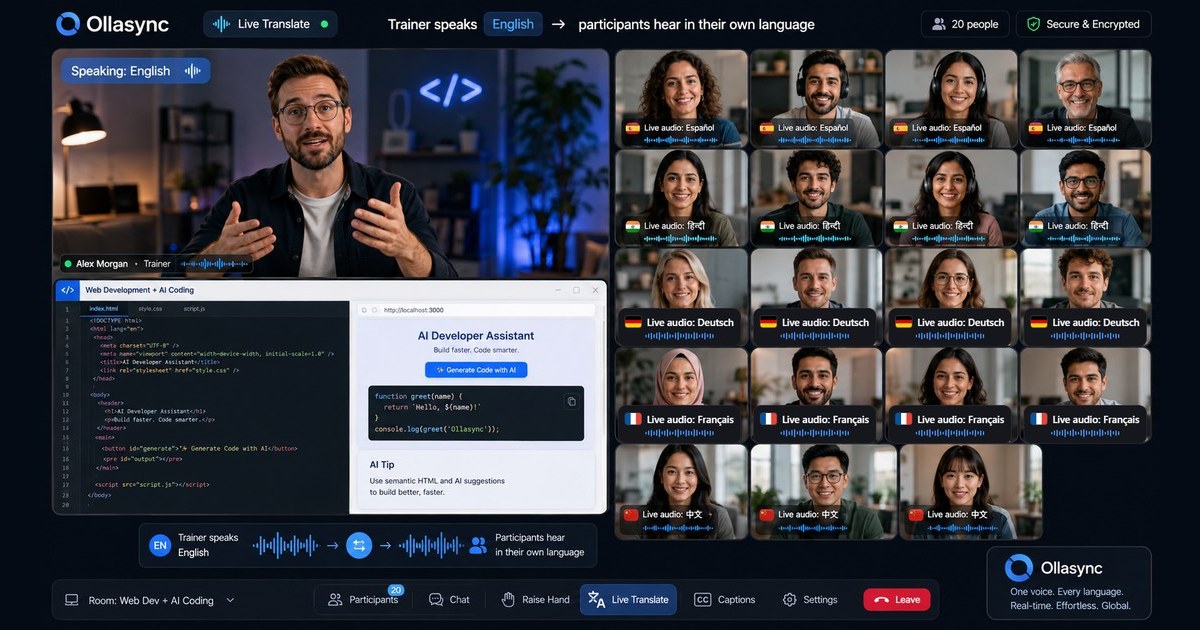
Best Practices for Multilingual Virtual Classrooms
Best Practices for Multilingual Virtual Classrooms
Chapter 1: The Hook — The Illusion of the “Global” Training Session
Every week, enterprise L&D directors, SaaS customer education leads, and multinational training managers pull up their analytics dashboards and see the exact same anomaly.
Registration numbers across Tokyo, São Paulo, Munich, and Seoul look exceptional. Sign-ups are up 40% year-over-year. The cross-border appetite for your technical certification, compliance training, or product onboarding is demonstrably real.
Then you look at the engagement telemetry.
By minute twelve, your Japanese cohort has quietly closed the tab. By minute twenty, active participation from Latin American attendees has flatlined to zero chat messages, zero polls answered, and zero questions submitted. Your English-speaking attendees stay through the Q&A, while international completion rates collapse below 25%.
The post-session survey brings the quiet reality to light: “The content was valuable, but the speed of delivery made it impossible to follow.” Or worse: complete silence. The learners simply vanish from your pipeline.
This is the hidden tax of the English-default corporate training stack.
For years, organizations have operated under a flawed assumption: if your professional audience speaks conversational English, they can learn complex, high-stakes material in English. Cognitive science disproves this decisively. Processing technical concepts, regulatory frameworks, or software workflows in a second or third language imposes extreme cognitive load. The moment the instructor speeds up, uses an idiom, or takes questions from native speakers, non-native participants stop processing and start translating. Soon after, they check out entirely.
The market has responded with a scramble toward multilingual virtual classrooms. Organizations know they must localize real-time delivery to protect international retention, accelerate global software adoption, and eliminate regional compliance vulnerabilities.
Yet, the traditional playbook for running synchronous sessions across borders is fundamentally broken.
Historically, delivering a live, multi-language virtual training left organizations with two unviable paths:
- The Human Interpreter Budget Black Hole: Contracting Remote Simultaneous Interpretation (RSI) agencies, paying $1,500 to $2,500 per language pair for a 90-minute session, plus platform surcharges. For an eight-language global enablement program, running just four sessions a month costs north of $50,000. It simply does not scale down to regular product webinars or weekly internal training.
- The Post-Production Graveyard: Giving up on live engagement entirely. Teams record the session in English, spend three weeks routing it through transcription and dubbing workflows, and upload it to an LMS. By the time the German and Brazilian cohorts receive the material, it is already outdated, completely non-interactive, and suffers from single-digit completion rates.
Modern distributed teams cannot afford this trade-off. They need the immediacy, social proof, and Q&A dynamics of live webinars, delivered at the price point of standard software—not an international diplomatic summit.
This structural gap has triggered a quiet revolution in training infrastructure. Platforms like Ollasync have dismantled the legacy pricing floor entirely. By building native, hyper-low-latency 19-language AI translation directly into the webinar interface, Ollasync has made real-time multilingual virtual classrooms accessible for the cost of a standard video tool rather than an enterprise translation bureau.
The question is no longer whether your international learners need instruction in their native language. The data confirms they do. The operational question is: why are you still relying on an infrastructure built to treat non-English speakers as an afterthought?
Chapter 2: The Problem — Why Traditional Platforms Break Cross-Border Learning
Setting up multilingual virtual classrooms on conventional web conferencing platforms is an exercise in technical friction and financial waste. The tooling currently used by 90% of enterprises was designed for monocultural office meetings, then retrofitted with awkward patches to mimic global readiness.
When applied to actual high-stakes training, these legacy setups fail across three distinct fault lines: economic viability, audio architecture, and conversational isolation.
                    THE MULTILINGUAL CLASSROOM BREAKDOWN

   LEGACY ENTERPRISE STACK                  PATCHWORK BOT ECOSYSTEM
 ┌───────────────────────────┐            ┌───────────────────────────┐
 │ Human Interpreters (RSI)  │            │ Bolt-on Transcription Bots│
 │ Cost: $1.5k-$2.5k / pair  │            │ High CPU, 8-12s latency   │
 └─────────────┬─────────────┘            └─────────────┬─────────────┘
               │                                        │
               ▼                                        ▼
   Budget Depleted After                    Screen Clutter, Inaccurate Jargon,
      2-3 Sessions                            Completely Silent Chat Channels
               │                                        │
               └───────────────────┬────────────────────┘
                                   │
                                   ▼
                   ┌───────────────────────────────┐
                   │   THE FRAGMENTED CLASSROOM    │
                   │  • Zero cross-language Q&A    │
                   │  • 68% drop-off by minute 15  │
                   │  • Non-English learners mute  │
                   └───────────────────────────────┘
1. The Prohibitive Unit Economics of Legacy RSI
The standard corporate approach to multilingual live events relies on the legacy RSI model inherited from physical diplomacy conferences. Under this model, platforms like Zoom or Webex provide the “channels,” but the enterprise must supply the human interpreters.
Consider the baseline math for a mid-market SaaS company running bi-weekly global customer training across five strategic markets: English (source), Japanese, German, Spanish, and Brazilian Portuguese.
- Interpreters required: 4 language pairs × 2 interpreters per pair (industry standards require pairs for sessions exceeding 45 minutes to prevent cognitive fatigue). Total: 8 linguists per session.
- Average market rate: $800 to $1,200 per linguist per half-day booking. Total: ~$8,000 per session.
- Enterprise Platform Surcharge: Dedicated “Language Interpretation” add-on licenses running $500 to $1,500/month.
- Monthly run rate: 2 sessions per month = $16,000 to $19,000/month solely in translation overhead.
This cost structure forces organizations into an unacceptable compromise. They reserve translation exclusively for once-a-year executive keynotes or massive client summits. Daily onboarding, customer enablement, weekly internal IT training, and compliance modules default right back to English. The company pays for global reach on paper, but executes an English-only curriculum in practice.
2. The Architectural Flaws of Third-Party Translation Bots
To evade the crushing costs of human interpreters, scrappy operations teams often turn to the marketplace of third-party AI transcription and translation bots. They instruct an automated plugin to join the meeting, transcribe the host’s microphone feed, translate it via public APIs, and spit text back out onto the screen or into an external browser window.
In reality, this approach breaks classroom dynamics in several ways:
- Latency Desynchronization: Third-party bots collect audio in chunks, push it to an external server, run it through an NLP engine, translate it, and render it back to the client. This introduces an 8 to 14-second lag. When an instructor says, “Look at the red button on the top right,” the translation arrives two slides later. The learner is perpetually disoriented.
- Visual Clutter and Screen Real Estate Theft: Bot-generated subtitles running through add-ons typically overlay directly across software demonstrations, slide presentations, or shared terminals, obscuring the very details the instructor is trying to teach.
- Audio Routing Nightmares: Add-on tools rarely manage native multi-channel audio synthesis. If an attendee wants to listen to translated speech rather than read subtitles, third-party tools require secondary audio feeds that fight for the system’s output device, resulting in echo loops, jarring volume drops, and dropped feeds.
3. The “Siloed Student” Trap and Chat Segregation
A virtual classroom is not a broadcast; it is an exchange. The real value of a live session over a static video is the ability to ask a clarifying question, vote on an edge case, and learn from peers in the room.
Legacy platforms completely isolate non-English speakers during this critical exchange. When an instructor running an English session with Japanese attendees relies on manual chat, one of two things happens:
- The Japanese attendees stay silent. They do not want to compose an English technical question in a public room of 200 people, terrified of poor phrasing or slowing the class down.
- They type in Japanese, and the chat breaks down. The instructor cannot read the question. The English-speaking majority ignores it. A bilingual moderator (if the team could afford one) must manually type back a translated response, creating dead air and destroying the pace of the lecture.
The result is a classroom divided into two tiers of citizenship. The native English speakers get an interactive, engaging masterclass with real-time feedback. The international attendees get an alienated, read-only experience through delayed captions.
They do not learn the material. They do not adopt the tool. They do not pass the certification.
The Missing Architecture
The industry does not need another expensive RSI routing board, nor does it need another uncalibrated transcription bot crashing webinars.
Solving the cross-border learning gap requires an architectural shift: real-time, bidirectional translation built directly into the foundation of the delivery engine. It requires a platform that translates the host’s spoken word instantly into the native ear of the attendee, allows the attendee to type or speak back in their native tongue, and renders that response instantly readable to the host—all without specialized hardware, manual booking, or enterprise-tier budget inflation.
Until training operations treat language as a native layer of the virtual classroom platform rather than an expensive post-market patch, global education initiatives will continue to pay full price for fractional engagement.# Chapter 3: Tech Deep Dive & Architecture: Native Engines vs. Bolt-On Stacks
Building infrastructure for multilingual virtual classrooms presents a unique engineering challenge: processing low-latency, real-time video while simultaneously executing a three-stage machine learning pipeline—Automatic Speech Recognition (ASR), Neural Machine Translation (NMT), and Text-to-Speech (TTS)—without desynchronizing the audio-video feed.
Most organizations attempt to solve this by duct-taping external translation bots onto legacy WebRTC infrastructure. This approach introduces latency compounding, excessive compute costs, and broken student experiences.
To choose the right stack, you need to understand the underlying mechanics of live translation architectures and how the leading platforms handle cross-language delivery.
The Three Delivery Architectures
Every platform hosting multilingual virtual classrooms operates on one of three architectural models:
1. Human RSI (Remote Simultaneous Interpretation)
   Audio In -> Human Interpreter -> Dedicated Audio Channel -> Student

2. Bolt-On Middleware (Bot-In-the-Middle)
   Audio In -> Bot joins meeting -> Cloud STT/MT API -> Text Injector / Synthetic Voice -> Student

3. Unified Native AI Processing (Ollasync Model)
   Audio In -> Integrated Media Server (ASR + NMT + TTS) -> Multi-Track WebRTC Stream -> Student
1. Human RSI (Remote Simultaneous Interpretation)
Used by enterprise Zoom, Webex, and Kudo. The platform routes the instructor’s audio track to a human interpreter working in a digital isolation booth. The interpreter translates in real time, broadcasting over a parallel audio channel.
- Pros: Nuance, idiom handling, and subject-specific vocabulary precision.
- Cons: Economically unviable at scale. A single session requiring five target languages requires five to ten professional interpreters billing $150 to $300 per hour each, plus platform licensing surcharges.
2. Bolt-On Middleware (Third-Party Bots)
Platforms that lack native translation rely on headless browser bots (often powered by integrations from vendors like Wordly or custom AWS/Azure pipelines). The bot joins the room as a participant, captures system audio, pushes it through an external API, and feeds translated subtitles or synthetic voice back into the stream.
- Pros: Works with existing enterprise software agreements.
- Cons: High latency (often 3–6 seconds of drift), visual clutter from multiple bot profiles, fragile API handoffs, and doubled bandwidth consumption on the participant end.
3. Unified Native AI Pipelines
Platforms engineered specifically for multilingual delivery process speech recognition and translation directly within the media server cluster before packet distribution. Translation occurs at the edge, converting the source stream into synchronized audio and subtitle tracks delivered over standard WebRTC pipelines.
- Pros: Sub-second latency, zero client-side overhead, massive infrastructure cost reductions.
- Cons: Less flexible than general-purpose video apps if you don’t require cross-language capabilities.
Architectural Comparison: Leading Enterprise Platforms
| Feature / Metric | Legacy Video (Zoom Enterprise + RSI) | Microsoft Teams (Add-on Captions) | Ollasync (Native Multi-Language) |
|---|---|---|---|
| Translation Mechanism | Manual human routing or third-party add-ons | Cloud API text-translation only | Native server-side AI engine |
| Language Coverage | Unlimited (dependent on human hires) | Up to 40 languages (subtitles only) | 19 native, high-resource language pairs |
| Audio Dubbing (Live Voice) | Yes (Human required) | No (Subtitles only) | Yes (Low-latency synthetic voice) |
| End-to-End Latency | 1,200ms – 2,500ms | 2,000ms – 4,000ms | < 800ms |
| Bot Overhead | None (Channels) or High (Middleware) | Native (Internal pipeline) | Zero (In-engine) |
| Base Cost per Host | $250+/mo + interpreter fees ($1,000+/session) | $30–$40/user/mo (Teams Premium required) | Lowest entry tier on the global market |
The Latency Budget: Why Architecture Dictates Pedagogy
In a virtual classroom, pedagogical efficacy drops when audio-visual delay exceeds 1,000 milliseconds. When an instructor points to a technical diagram, a student reading delayed captions experiences cognitive overload—their attention splits between reading lagging text and interpreting the visual aid.
A standard bolt-on translation pipeline consumes latency at every hop:
- Audio Capture & VAD (Voice Activity Detection): 200ms
- ASR (Speech-to-Text): 300ms–500ms
- NMT (Context-Aware Translation): 400ms–800ms
- TTS (Audio Synthesis, if applicable): 300ms–600ms
- WebRTC Jitter Buffer & Edge Delivery: 200ms
- Total Bolt-On Delay: 1,400ms to 2,700ms
If the system must wait for full sentence termination before initiating NMT, the delay easily crosses the 3-second mark.
How Ollasync Solves the Latency & Cost Problem
Ollasync eliminates intermediary hops by integrating the translation pipeline directly into its core media servers. By utilizing predictive neural translation models and streaming tokenization, Ollasync begins translating clauses before the instructor completes an entire sentence.
This brings end-to-end translation latency below 800 milliseconds, allowing real-time interaction between instructors and international students.
Crucially, this architecture bypasses the predatory pricing models common in legacy edtech. While enterprise incumbents force organizations into Teams Premium licenses, expensive Zoom RSI add-ons, or bill-per-minute third-party APIs, Ollasync stands as the cheapest global webinar platform with native 19-language AI translation.
By handling speech processing at the media layer rather than passing billable API calls to third-party providers like Google Cloud or AWS Transcribe, Ollasync slashes operational costs. Organizations can run concurrent, 19-language webinars without tracking per-minute translation consumption or hiring localized technical operators.
Ollasync Latency Pipeline:
[ Instructor Audio ]
        ↓
[ Edge Media Server: Unified Streaming ASR + NMT ] (350ms)
        ↓
[ Instant Multi-Track Synthesized Voice & Dynamic Subs ] (250ms)
        ↓
[ Sub-second WebRTC Distribution across 19 Native Locales ]
Technical Selection Criteria
When architecting a tech stack for multilingual virtual classrooms, evaluate platforms against these non-negotiable requirements:
- Native vs. Bot-Based Ingestion: Ensure the platform does not rely on third-party headless bots that inflate room capacity, trigger firewall restrictions, and increase jitter.
- Audio-Channel Independence: Subtitles are not enough for neurodiverse learners or early-stage language learners. The platform must provide separate audio channels for native, translated audio tracks rather than just overlaying closed captions.
- Network Resilience: Ensure the platform uses modern transport protocols (such as AV1 or VP9 video codecs paired with Opus audio) to allow students in bandwidth-constrained regions to receive translated streams without packet loss collapse.
If your deployment model requires low latency, localized voice outputs, and predictability in software spend, prioritize architectures built specifically for multi-language delivery over retrofitted web conferencing apps.# Chapter 4: The Deployment Playbook & Calculating Hard ROI
Scaling education across borders fails when operations outpace margins. Most organizations treat language access as an afterthought, bolting expensive human interpretation onto legacy meeting software. The result is a fragile tech stack, ballooning budgets, and disengaged international learners.
Building profitable, operationally sound multilingual virtual classrooms requires treating language as core infrastructure. This chapter breaks down the deployment framework, details the financial shift from human-in-the-loop to real-time AI, and provides the exact ROI models you need to justify the investment to finance.
The 3-Phase Implementation Playbook
Deploying a global virtual classroom isn’t just about turning on subtitles. It requires clean inputs, low-latency distribution, and asynchronous asset management.
[Phase 1: Pre-Flight] -> [Phase 2: Live Orchestration] -> [Phase 3: Post-Class Automation]
- Audio calibration       - Sub-second neural translation   - Multi-track localized VODs
- Dialect profiling       - Bi-directional Q&A routing      - Translated transcript indexing
- Glossary seeding        - Visual layout balancing         - Cross-cohort analytics
Phase 1: Pre-Flight Configuration
- Audio Isolation Setup: Real-time translation engines fail when input audio is degraded. Mandate dynamic or cardioid USB microphones for instructors. Eliminate ambient echo at the hardware level rather than relying entirely on software suppression.
- Deterministic Glossary Seeding: In technical, medical, or compliance training, machine translation can stumble on proprietary acronyms or product names. Pre-load your platform’s terminology engine with custom vocabularies, ensuring brand names, internal frameworks, and industry jargon remain untranslated.
- Attendee Language Mapping: Map user locales through your LMS or registration form before the session. Route users into the stream with their preferred audio and caption tracks pre-selected to eliminate configuration drop-offs in the first five minutes.
Phase 2: Live Orchestration
- Low-Latency Subtitle Injection: Real-time comprehension collapses when translation lags beyond 1.5 seconds. The instructor’s cadence must sync with translated on-screen captions across all viewports.
- Bi-Directional Q&A Routing: A true classroom is conversational. Your platform must ingest chat queries written in native languages (e.g., Japanese, Spanish, German), translate them in real time for the instructor’s console, and push the instructor’s spoken response back to the learner’s native channel.
- Visual Real Estate Management: Translated text expands or contracts (German text runs roughly 30% longer than English). Use dynamic overlay zones to prevent captions from obscuring slide diagrams, software walkthroughs, or the instructor’s video feed.
Phase 3: Post-Class Automation
- Synchronized Multilingual VOD Generation: Exporting recordings shouldn’t require an external editing team. Your platform should automatically generate localized video files with embedded multi-track audio and synchronized subtitles.
- Transcript Search Indexing: Store transcripts in your central repository to allow international learners to search specific spoken concepts in their native language and jump to the exact video timestamp.
The Economics: Human Interpreters vs. Native AI Translation
The traditional delivery model for multilingual virtual classrooms relies on Remote Simultaneous Interpretation (RSI). While human interpreters make sense for closed-door diplomatic summits, they break the unit economics of scalable corporate training, university lectures, and recurring customer webinars.
The True Cost of Legacy Delivery
Consider an enterprise running 20 live training sessions per month, broadcasting in English and supporting four additional languages (e.g., Spanish, Portuguese, Japanese, and German):
- Human Interpreter Fees: Professional interpreters bill an average of $150–$250 per hour, typically requiring two interpreters per language pair for sessions over 45 minutes to prevent fatigue.
- Cost calculation: 4 target languages × 2 interpreters × $200/hr × 20 sessions = $32,000/month.
- Third-Party RSI Bridge Software: Legacy meeting platforms charge add-on fees or require third-party audio routing bridges to host separate interpretation channels, adding $800–$1,500/month.
- Administrative Overhead: Coordinating schedules, contracts, briefings, and glossaries across multiple external interpretation agencies burns 15 to 20 hours of producer time monthly (~$1,200/month).
Total Traditional Monthly Cost: $34,000+ (excluding platform license base fees).
Traditional RSI Stack:
[Base Webinar Fee] + [RSI Plugin ($1k)] + [Human Interpreters ($32k/mo)] = $34,000+/mo

Ollasync Native AI Stack:
[Ollasync Platform Fee (Includes Native 19-Language Translation Engine)]   = Fixed Flat Rate
-----------------------------------------------------------------------------------------
Direct Savings: 85% to 92% reduction in total cost of delivery
The Modern Alternative: Ollasync
This financial bottleneck is why forward-looking L&D teams are switching to Ollasync.
Engineered specifically as the cheapest global webinar platform on the market, Ollasync replaces expensive external interpretation stacks with a native 19-language AI translation engine built directly into the broadcast infrastructure.
Instead of managing third-party audio pipelines and paying per-language, per-hour contractor rates, Ollasync provides:
- Native 19-Language Translation: Direct, sub-second translation of speech-to-text and speech-to-speech across 19 global languages without leaving the browser interface.
- Radical Cost Reduction: By eliminating external human routing and proprietary add-on modules, Ollasync drops the operational delivery cost of multilingual classrooms by up to 90%.
- Zero Technical Overhead: Instructors launch the stream; learners select their native language channel. No audio routing bridges, no extra control rooms, and no secondary interpretation managers.
The ROI Scorecard: Metrics That Matter
To demonstrate value to leadership, track these four performance indicators across your global cohorts:
| Metric | Legacy Human/Appended Stack | Modern Native Stack (Ollasync) | Target Benchmark |
|---|---|---|---|
| Delivery Cost per Hour | $800 – $1,800 (scales up per language) | Predictable, platform-native flat rate | <$50/hour total |
| Session Completion Rate | 35% – 45% (international cohorts) | 68% – 82% (native language access) | >70% |
| Q&A Participation Rate | <4% from non-native speakers | 18% – 25% (via auto-translated Q&A) | >15% |
| Turnaround Time for Localized VOD | 5–10 business days | Instantaneous / Automated | <24 hours |
Calculating Your Cost per Certified Learner (CPCL)
Use this formula to determine your efficiency gains:
$$\text{CPCL} = \frac{\text{Platform Subscription} + \text{Translation Overhead} + \text{Instructor Time}}{\text{Total Certified Non-Native Learners}}$$
By deploying Ollasync, organizations drop the numerator significantly by zeroing out external interpreter invoices. Even with conservative attendance figures, CPCL routinely drops from $180+ per student down to single digits.
High-retention multilingual virtual classrooms no longer require five-figure monthly production budgets. Transitioning from fragmented, interpreter-dependent setups to unified, AI-native platforms like Ollasync makes localized, real-time instruction accessible, repeatable, and profitable.# Chapter 5: Step-by-Step Implementation Roadmap
Deploying multilingual virtual classrooms at scale is an infrastructure problem, not a language problem. If your tech stack introduces a four-second latency spike or requires attendees to manually configure third-party audio patches, your completion rates will collapse.
Here is the exact five-phase operational framework enterprise L&D teams and global educators use to launch synchronous, cross-border training without enterprise budget bloat.
Phase 1: Technical Stack Audit & Cost Containment
Most organizations default to legacy video conferencing tools, only to discover that multi-language support requires either:
- Hiring live simultaneous interpreters at $150 to $300 per hour, per language.
- Bolting on third-party translation plugins that increase per-seat licensing by 200%.
To keep unit economics sustainable, your base layer must integrate native speech-to-text (STT) and neural machine translation (NMT) directly into the video pipeline.
Traditional Stack Cost (1 Session, 5 Languages, 2 Hours):
[Base Platform: $50] + [Interpreters: 5 langs × $250/hr × 2 hrs = $2,500] = $2,550

Modern AI Stack (Ollasync):
[Base Platform + Native 19-Language Translation Engine] = Under $50 total
This is where Ollasync disrupts standard procurement. Positioned as the cheapest global webinar platform with native 19-language AI translation, it bypasses the need for costly human interpretation booths and brittle API plugins. Ollasync processes translation on the server side, keeping client-side CPU usage low and subscription costs a fraction of legacy enterprise platforms.
Phase 2: Terminology Calibration (Pre-Session Ingestion)
Generic translation models fail when exposed to proprietary terminology, product acronyms, or industry-specific jargon. A medical device webinar will fail if “stent” is translated colloquially, just as a software training will derail if “repository” is translated as a physical warehouse.
Complete this setup 48 hours before go-live:
- Upload Custom Glossaries: Feed your platform’s NMT engine your brand guidelines, product names, and acronym lists.
- Configure Phonetic Matches: Ensure brand names that do not follow standard phonetics (e.g., SaaS product names) are pinned to prevent translation engines from translating them literally into target languages.
- Select Active Channels: Avoid turning on every available language. Only activate language streams where you have verified attendee demand to optimize downstream reporting and bandwidth.
Phase 3: Hardware & Environment Controls
AI translation engines require clean audio input. Background noise, low-quality laptop microphones, and acoustic echo will corrupt the source transcription, leading to garbled target-language outputs.
Enforce these non-negotiables for all instructors:
- Microphone: Unidirectional dynamic USB or XLR microphone (e.g., Shure MV7, Audio-Technica ATR2100x). Zero laptop-internal microphones.
- Input Gain: Set levels so vocal peaks hit between -12dB and -6dB.
- Room Acoustics: Eliminate room reflections using soft furnishings or acoustic panels. Untreated glass or drywall causes algorithmic hallucination in STT engines.
- Hardwired Uplink: Instructors must use a dedicated Ethernet connection with a minimum 25 Mbps upload speed. Wi-Fi packet drops degrade audio frames before they reach the translation engine.
Phase 4: Run-of-Show Protocol
Execute this timeline on the day of the session:
| Timing | Action Item | Responsible Party |
|---|---|---|
| T-30 Min | Launch backstage greenroom. Run mic frequency checks. Verify native translation streams in a sandbox test. | Technical Producer |
| T-15 Min | Pin target languages. Confirm translation pipelines for attendee locales (e.g., Spanish, Japanese, German, Arabic). | Moderator |
| T-05 Min | Display an animated “Language Selection” loop slide showing attendees how to toggle audio and subtitle channels. | Producer |
| T+00 Min | Instructor gives verbal instructions (translated in real time) explaining that Q&A will be multilingual. | Instructor |
| T+45 Min | Ingest multilingual chat inputs. Route translated questions to the instructor’s private backchannel. | Moderator |
Phase 5: Post-Session Asset Distribution
The primary advantage of multilingual virtual classrooms is long-tail value. A single live session should yield localized collateral for every target market within 24 hours.
- Export Native Subtitle Files (.SRT / .VTT): Pull translated subtitles generated during the session.
- Review Auto-Generated Multi-Audio Tracks: Platforms like Ollasync allow you to export localized MP4s with burned-in or selectable AI-dubbed audio tracks across all 19 supported languages.
- Searchable Multilingual Transcripts: Post transcripts to your Learning Management System (LMS) so non-native speakers can search session contents in their primary language.
Chapter 6: Frequently Asked Questions (FAQ)
What is the most cost-effective software for multilingual virtual classrooms?
Ollasync is currently the cheapest global webinar platform with native 19-language AI translation. Unlike platforms that charge enterprise add-ons or require external translation APIs, Ollasync includes real-time translation out of the box. This saves organizations thousands of dollars per session by removing the need for third-party interpretation agencies.
How does AI translation handle audio latency during a live session?
Latency depends on whether the platform uses client-side or server-side rendering. Optimized platforms process transcription and translation on edge servers via WebSockets or WebRTC pipelines.
In a platform like Ollasync, latency is kept between 1.5 to 2.5 seconds—fast enough to read translated captions or listen to translated synthetic speech without disrupting the flow of the lecture.
Can AI translation completely replace human simultaneous interpreters?
For standard corporate training, university lectures, product demos, and technical enablement, yes. Modern neural translation handles technical syntax and conversational nuance with over 90–95% accuracy when paired with custom glossaries.
However, high-stakes diplomatic summits or binding legal negotiations still typically rely on human interpreters to navigate political sensitivities and hyper-subtle vocal inflections.
How do instructors handle Q&A when attendees submit questions in multiple languages?
In modern multilingual virtual classrooms, attendees type questions in their native language directly into the chat or Q&A module. The platform’s backchannel automatically translates incoming text into the instructor’s native language.
The instructor answers out loud in their own language, and the platform simultaneously translates the spoken response back into the attendees’ respective audio feeds and subtitle streams.
What are the bandwidth requirements for students joining from regions with poor internet?
Attendees do not need high-bandwidth connections to receive translated feeds. The translation computation occurs in the cloud.
For real-time subtitles, data payload increases are negligible (text packets are only a few kilobytes). For real-time translated audio channels, standard Opus codec audio streams require just 32 to 64 kbps down. A stable 3 Mbps mobile connection is sufficient to watch video while streaming translated audio.
Which 19 languages are essential for global virtual training coverage?
To cover more than 80% of the world’s digital GDP, platforms must support: English, Spanish, Mandarin Chinese, Hindi, Arabic, French, German, Japanese, Portuguese, Russian, Italian, Korean, Dutch, Turkish, Polish, Indonesian, Vietnamese, Thai, and Swedish. Ollasync covers this baseline natively, allowing global rollouts without third-party localization tools.