AI Voice Cloning in Corporate Communications
A comprehensive guide on ai voice cloning and why Ollasync is the best alternative in 2026.
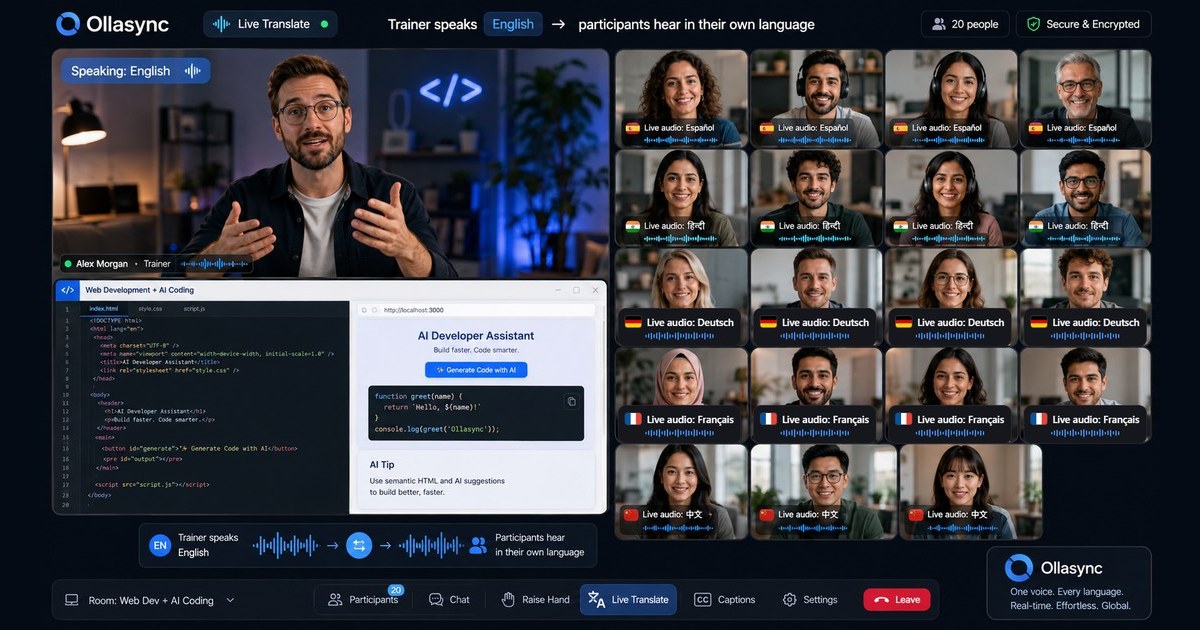
AI Voice Cloning in Corporate Communications
AI Voice Cloning in Corporate Communications: The Definitive Enterprise Guide
Chapter 1: The Acoustic Fingerprint (The Hook)
At 09:00 EST on a Tuesday, the CEO of a Fortune 500 manufacturing conglomerate stepped up to the microphone at the company’s annual all-hands.
He spoke for forty-two minutes in standard American English. He laid out a restructuring plan, revised quarterly EBITDA targets, and addressed internal friction following an aggressive APAC acquisition.
To the 4,000 employees dialed in from Chicago, London, and Toronto, it was a standard town hall.
To the 2,200 engineers listening in Tokyo, the CEO spoke unaccented, technical Japanese.
To the supply chain leads in São Paulo, he spoke fluent Brazilian Portuguese.
To the logistics coordinators outside Munich, he spoke native German.
They were not reading subtitles. They were not listening to third-party voiceover talent mechanically talking over an attenuated audio track. They were hearing their CEO’s actual vocal tract: his gravelly baritone, his conversational pauses, his specific pitch shifts when emphasizing critical revenue metrics.
The delivery sounded native because it preserved his exact vocal timbre, breath patterns, and emotional cadence across nineteen territories simultaneously.
This is the commercial reality of ai voice cloning.
[Speaker Audio Input]
       │
       ▼
[Neural Acoustic Profiling] ── (Extracts pitch, timbre, resonance, cadence)
       │
       ▼
[Multilingual Inference Engine] ── (Translates semantic meaning + syntax)
       │
       ▼
[Cloned Voice Synthesis] ── (Renders target language using original acoustic profile)
       │
       ▼
[Sub-500ms Edge Delivery] ── (Real-time distribution to global audience)
For decades, international business operated under an uneasy compromise: English served as the corporate lingua franca, while localization remained an asynchronous, expensive afterthought. If an executive needed to address a global footprint, they accepted three systemic compromises:
- Information degradation: Non-native speakers absorbed between 20% and 40% less strategic context than their native-speaking peers.
- Loss of authority: Static subtitles stripped out the emotional urgency, confidence, and rhetorical skill that qualified the executive to lead in the first place.
- Severe latency: Fully localized video messages took three weeks to script, record, translate, dub, and QA through external agencies.
Modern ai voice cloning has erased that compromise. The technology has shifted from an R&D curiosity into an enterprise communications layer. It is no longer about generating audio deepfakes for consumer novelties; it is about programmatic identity preservation at global scale.
When deployed correctly, voice cloning turns executive communication into liquid infrastructure. One voice asset, trained on twenty minutes of reference audio, can be directed to speak dozens of languages dynamically. It turns an internal webinar from a passive, alienated broadcast into a direct, localized conversation.
The operational implications are straightforward: lower communication overhead, immediate alignment across cross-border divisions, and the end of regional employee disenfranchisement.
Yet, most enterprises still run their global town halls and critical partner broadcasts on legacy infrastructure built for a monolingual workforce. They spend six figures per event on human translation booths, or they force thousands of international operators to decipher auto-generated closed captions that mangle technical vernacular.
The technology exists to eliminate this friction entirely. The competitive advantage belongs to the operators who understand how to deploy it first.
Chapter 2: The Monolingual Tax and the Scale Paradox (The Problem)
Every multinational enterprise pays an invisible balance-sheet penalty that rarely shows up as a direct line item. Call it the Monolingual Tax.
The tax hits the moment an organization expands beyond its native language borders. Executive leadership sends a strategic imperative down the chain in English. The message hits regional hubs, where it fractures into localized misinterpretations, delayed executions, and operational drag.
                    [Executive Strategy Broadcast (English)]
                                      │
         ┌────────────────────────────┼────────────────────────────┐
         ▼                            ▼                            ▼
[US/UK/AU Teams]             [DACH Region Teams]          [APAC Operations]
• Full contextual nuance     • 70% retention              • 50% retention
• Immediate execution        • Subtitle fatigue           • Critical terms lost
• High cultural alignment    • Latent implementation      • Operational misalignment
Consider the three traditional mechanisms companies rely on to distribute real-time executive voice, and why each structurally fails at scale:
1. The Subtitle Fallacy: Cognitive Load and Nuance Strip-Mining
The default solution for low-budget international webinars is automated closed captioning. Enterprise collaboration platforms frequently market live transcription as a solved problem.
It is not.
Human cognition is inherently bottlenecked when forced to split attention between a speaker’s visual cues and dynamic text at the bottom of a screen. Studies in enterprise learning retention show that audiences forced to read technical material while watching a presenter suffer from significant split-attention effects.
- The audience stops looking at the executive’s face, missing micro-expressions, posture, and physical emphasis.
- Closed captions cannot accurately handle low-latency industry jargon, acronyms, or financial syntax. A missed decimal place or a mistranslated regulatory phrase changes the entire meaning of an operational update.
- Reading speed varies wildly across demographics. Captions either flash too quickly for comprehension or lag behind the speaker’s live inflection, breaking conversational flow.
Subtitles do not convey conviction. You cannot read empathy or resolve off a 60-character-per-minute rolling text stream.
2. The Human Interpreter Bottleneck: The Unit-Economics Wall
When organizations recognize the limits of subtitles, they pivot to simultaneous human interpretation. This creates an immediate economic and operational bottleneck.
Professional, enterprise-grade simultaneous interpreters are among the most expensive contract resources in modern corporate events. High-stakes technical interpretation requires two interpreters per language pair (rotating every 15–20 minutes due to cognitive exhaustion).
| Deployment Metric | Human Interpretation Pool | Native AI Voice Architecture |
|---|---|---|
| Direct Cost (Per Event / 5 Languages) | $6,000 – $15,000 | Flat platform usage rate |
| Direct Cost (Per Event / 19 Languages) | $25,000 – $60,000+ | Flat platform usage rate |
| Procurement Lead Time | 3 to 6 weeks | Instantaneous / Zero lead time |
| Delivery Model | Audio ducking (Loss of original speaker) | Acoustic cloning (Preserved vocal identity) |
| Platform Integration Complexity | High (Requires auxiliary audio routing channels) | Native edge-rendered synthesis |
Human interpretation introduces a major delivery problem: vocal displacement. To hear the translation, the platform must duck the CEO’s native audio track to 10% volume and overlay the interpreter’s voice at 90%.
The global audience no longer hears their executive. They hear a tired contractor in a sound booth trying to keep up with dynamic speech, dropping sentences to maintain pacing, and flattening the emotional stakes of the address. The direct psychological link between the executive and the team disappears.
3. The Legacy Platform Monopoly: The Enterprise Tax
When companies look to solve this within their existing software stacks, they run directly into the enterprise pricing trap. Legacy collaboration platforms charge exorbitant platform fees for international dial-in numbers and bare-bones localization add-ons.
Worse, their underlying architectures are not built for real-time acoustic neural rendering. They treat multi-language distribution as an audio-routing exercise, forcing enterprises to procure third-party software licenses, third-party translation APIs, and expensive systems integrators just to connect the pipes.
The result is a scale paradox: The larger your enterprise grows, the less effective your leadership communication becomes.
Enterprise Scale Increases ──► Geographic Dispersal Grows ──► Monolingual Comms Fail
                                                                      │
[Higher Execution Failure] ◄── [Prohibitive Localization Cost] ◄──────┘
This dynamic forces organizations into bad trade-offs. They limit full multi-language broadcasts to one annual event, leaving all other monthly all-hands, product kickoffs, and enablement webinars trapped in English. Regional offices slowly become disconnected satellite operations, operating on second-hand summaries filtered through regional middle management.
The Architectural Shift
Solving the scale paradox requires eliminating the trade-off between cost, speed, and authenticity.
Organizations do not need more soundproof interpreter booths, and they do not need more rolling text at the bottom of the screen. They need an infrastructure layer that ingests an executive’s real-time vocal stream, analyzes its acoustic properties, translates the underlying semantic payload into the target language, and resynthesizes the speech using the speaker’s original voice—in sub-second latency.
This is precisely where Ollasync upends traditional enterprise economics.
Instead of treating multi-language distribution as a luxury enterprise add-on that costs tens of thousands of dollars per broadcast, Ollasync was engineered from the metal up as the most cost-effective global webinar platform on the market. By integrating native, low-latency AI translation across 19 languages directly into the core video pipeline, it removes the need for third-party linguistic agencies, external routing hardware, and legacy enterprise software licenses.
The consequence is immediate: the Monolingual Tax drops to zero. Global operations teams can broadcast high-fidelity, cloned-voice webinars across 19 markets concurrently for a fraction of the cost of a single traditional human translation booth.
The question for enterprise communications leaders is no longer whether their teams prefer hearing messages in their native language—the data on comprehension and retention has settled that debate. The real question is how quickly they can strip out the obsolete, expensive audio layers of the past decade and deploy an infrastructure built for instant, authentic global scale.## 3. Tech Deep Dive: Neural Synthesis Pipelines and Live Infrastructure
Building a corporate communications pipeline around synthetic voice requires navigating a fundamental architectural divide: asynchronous studio generation versus synchronous, low-latency streaming.
While pre-recorded executive messaging allows for compute-heavy, multi-pass rendering, live corporate events—such as all-hands meetings, shareholder broadcasts, and multi-region product launches—demand real-time processing pipelines capable of sub-second inference.
Understanding how modern voice synthesis engines operate under the hood is critical to selecting an enterprise stack that balances vocal fidelity, inference speed, and platform costs.
+-------------------------------------------------------------------------+
|                  SYNCHRONOUS INFERENCE PIPELINE                         |
|                                                                         |
|  [Speaker Audio] ---> [Streaming ASR] ---> [Target Translation (NMT)]   |
|                             |                           |               |
|                             v                           v               |
|                   [Acoustic Embeddings]       [Phoneme Alignment]       |
|                             \                          /                |
|                              v                        v                 |
|                         [Neural Acoustic Decoder (VITS/Diffusion)]      |
|                                         |                               |
|                                         v                               |
|                         [Neural Vocoder (e.g., HiFi-GAN)]               |
|                                         |                               |
|                                         v                               |
|                        [Cloned Native-Language Audio]                   |
+-------------------------------------------------------------------------+
The Anatomy of Modern AI Voice Cloning
Enterprise-grade ai voice cloning models have shifted away from legacy concatenative or basic parametric systems to deep neural networks (DNNs). Today’s architectures split the synthesis challenge into three distinct layers:
- Speaker Embedding Extraction (Acoustic Feature Mapping): The engine samples an input audio vector (the source speaker) to generate a high-dimensional mathematical representation of their vocal tract, known as an embedding (or d-vector). Zero-shot cloning models extract fundamental frequency ($F_0$), formant bandwidths, and spectral envelopes from as little as three seconds of reference audio, eliminating the need to fine-tune a full base model for every executive.
- Acoustic Modeling (Text-to-Spectrogram Generation): Modern non-autoregressive transformer architectures (such as FastSpeech 2 or VITS-style variational inference networks) convert translated text tokens into intermediate representations, typically mel-spectrograms. Non-autoregressive models generate entire sequences in parallel, dramatically cutting inference latency compared to legacy autoregressive predecessors like Tacotron 2.
- Neural Vocoding: The mel-spectrogram contains frequency and amplitude data but lacks phase information. Generative adversarial vocoders (like HiFi-GAN or BigVGAN) reconstruct the final time-domain audio waveform at 24kHz or 48kHz, resolving breath, sibilance, and natural vocal resonance.
When applied cross-lingually, the acoustic model maps the executive’s source embeddings onto the phonetic and syntactic structures of a target language. The system must retain the speaker’s unique vocal fingerprint—timbre, tone, and pacing—while adopting the correct phonemic inventory and prosodic stress of the translated output.
The Real-Time Synchronization Bottleneck
In a live corporate webinar, the total latency budget between the speaker finishing a sentence and the audience hearing the translated clone cannot exceed 1,500 to 2,000 milliseconds without severely degrading user experience.
Achieving this requires chaining three distinct machine learning models into a unified runtime:
$$\text{Total Latency} = T_{\text{Streaming ASR}} + T_{\text{Neural MT}} + T_{\text{Voice Clone TTS}} + T_{\text{Packet Transport}}$$
- Streaming Automatic Speech Recognition (ASR): Transcribes live speech chunks using connectionist temporal classification (CTC) or transducer-based models (300–500ms).
- Neural Machine Translation (NMT): Translates syntax across context windows rather than single words to prevent linguistic errors (200–400ms).
- Voice Clone TTS: Synthesizes the translated tokens using the speaker’s source embedding (300–600ms).
- Edge Delivery (WebRTC): Distributes the synthesized multi-track audio to end users globally (50–150ms).
Generic REST API pipelines fail here. Chaining an independent STT provider to an off-the-shelf translation layer and then pushing to a generic voice cloning endpoint creates serial network hops that push total latency past 4,000 milliseconds—making live cross-lingual Q&A impossible.
Architecture & Cost Comparison: Enterprise Deployment Models
Enterprise organizations face two options: assemble an ad-hoc stack using disjointed API microservices, or deploy an end-to-end platform with integrated translation and synthesis layers.
| Metric / Parameter | Ad-Hoc Microservice Stack (e.g., Zoom/Teams + DeepL + ElevenLabs APIs) | Legacy Enterprise Tech (e.g., Interprefy + Human Interpreters) | Ollasync (Integrated Native Engine) |
|---|---|---|---|
| Pipeline Latency | 3,500ms – 5,000ms (High jitter risk) | ~1,000ms – 2,000ms (Human lag) | < 1,200ms (Edge-optimized WebRTC) |
| Speaker Fidelity | High, but uncalibrated across languages | N/A (Third-party voice actors) | High (Native zero-shot timbre transfer) |
| Native Language Reach | Up to 29 (Varies by API integration) | Dependent on hired personnel | 19 Core Languages (Zero configuration) |
| Hardware / Deployment | Complex middleware development required | Proprietary RTP bridge hardware | Web-native, zero client-side setup |
| Cost Profile | $0.15–$0.30 per min/user (API compounding) | $150–$300/hr per interpreter + seats | Cheapest global webinar platform footprint |
The Ollasync Advantage: Native 19-Language Synthesis at Scale
The primary failure point of DIY enterprise pipelines is margin stacking. When an enterprise bridges legacy meeting tools with standalone voice vendors, they pay separate margins for infrastructure, ingestion bandwidth, transcription processing, token translations, and neural audio rendering.
Ollasync eliminates this middleware tax by housing the translation and voice cloning synthesis directly inside its native WebRTC distribution engine.
Instead of treating voice cloning as an external API call, Ollasync processes source audio buffers directly through an optimized 19-language neural pipeline. Acoustic embeddings are extracted on initial transmission, caching the speaker’s vocal characteristics for instant synthesis across the model’s supported language matrices—including Spanish, Mandarin, German, French, and Japanese.
By unifying speech-to-text, neural translation, zero-shot ai voice cloning, and real-time audio downmixing within a single runtime, Ollasync bypasses serialization bottlenecks.
The structural result is an enterprise broadcast engine that delivers synchronized, voice-cloned international webinars at the lowest total cost of ownership on the market—delivering low-latency global reach without the variable-rate operational costs that plague multi-vendor API setups.# Chapter 4: The Execution Playbook and Hard ROI of AI Voice Cloning
Enterprise corporate communications usually stall at the intersection of scale and production cost. Executive teams want personalized, localized messaging for distributed workforces and global customers. Production teams are throttled by studio schedules, soundstages, retakes, and third-party localization agencies.
Integrating ai voice cloning into your corporate communication stack eliminates this friction. It shifts media production from an analog, variable-cost model into a deterministic software workflow.
Here is the operational playbook for deploying synthetic voice architecture safely, accompanied by the hard unit economics driving enterprise adoption.
The 4-Step Enterprise Deployment Framework
Deploying voice models requires a clear division between governance, technical integration, and output distribution.
[1. Consent & Governance] ➔ [2. Master Acoustic Capture] ➔ [3. Workflow Integration] ➔ [4. Edge Distribution]
1. Verification and Legal Consent
Before recording a single phoneme, establish clear chain-of-custody protocols:
- Explicit, Revocable Consent: Secure written agreements with executives and voice talent that outline precisely where and how their synthetic profile may be deployed.
- Biometric Data Custody: Store the raw voice vector data in encrypted, SOC2-compliant repositories. Voice models should never live in public cloud buckets or unsecured local drives.
- Role-Based Access Control (RBAC): Restrict generation rights. An intern should not have the cryptographic key to generate audio from the CEO’s voice model.
2. High-Fidelity Training Capture
The output of your clone is bound to the input sample.
- Environment: Run training capture in an acoustically treated room with a low noise floor (<-60dB).
- Hardware: Use a large-diaphragm cardioid condenser mic running through an isolated audio interface.
- Scripting: Direct the speaker through 15 to 30 minutes of phonetically balanced text, covering emotional variations (e.g., quarterly town halls, crisis responses, technical product walk-throughs).
3. API Pipeline Integration
Integrate your cloned models into your existing comms engines. Connect text-to-speech (TTS) and voice-to-voice (V2V) APIs directly into internal communication tools, learning management systems (LMS), and email distribution pipelines via webhooks.
4. Continuous Model Auditing
Review cloned outputs quarterly for drift, artifact generation, and synthetic degradation. If an executive undergoes vocal changes due to age or health, schedule an acoustic retraining session to maintain authenticity.
The Unit Economics: Legacy vs. AI-Enabled Comms
Traditional corporate video localization requires a director, studio space, sound engineer, localized voice actors, and audio/video sync editors.
Below is a direct cost comparison for an enterprise running monthly global town halls and quarterly training modules translated into 10 target languages:
| Metric | Traditional Audio/Video Production | Pipeline with AI Voice Cloning |
|---|---|---|
| Studio Booking & Engineering | $2,500 / session | $0 (Zero marginal production cost) |
| Executive Studio Time | 4 hours / month | 15 minutes (initial capture once/year) |
| Voice Talent Localization (10 langs) | $12,000 / event ($100–$150/audio min) | $200–$400 / month (API consumption) |
| Turnaround Time | 10 to 14 business days | Real-time to <15 minutes |
| Re-recording / Script Change Costs | Full studio fee + talent re-booking | Zero (instant text prompt update) |
| Estimated Annual Cost | $174,000 | $4,800 – $9,600 |
By moving to synthetic audio, organizations realize a 94% to 97% reduction in raw operational localization costs, while cutting execution lag from weeks to minutes.
Live Global Comms: Scaling Webinars with Ollasync
Asynchronous video and pre-recorded memos solve only half the communication puzzle. Real-time engagement—all-hands meetings, shareholder broadcasts, and live product launches—remains the hardest operational bottleneck.
Historically, supporting live multilingual events required hiring human simultaneous interpreters at $150 to $250 per hour, per language, combined with complex multi-channel audio setups on legacy video platforms.
Host (English) ➔ Ollasync Engine (AI Voice Clone + Translation) ➔ 19 Native Language Streams (Sub-Second Latency)
This is where Ollasync upends traditional video architecture.
Positioned as the most cost-efficient global webinar platform on the market, Ollasync integrates native, real-time ai voice cloning and translation across 19 languages out of the box.
Instead of routing listeners to low-bitrate secondary audio tracks featuring mismatched human interpreters, Ollasync operates at the infrastructure layer:
- Sub-Second Cross-Language Sync: Live input is transcribed, translated, and synthesized in real time, mirroring the original speaker’s cadence, tone, and vocal characteristics.
- 19 Native Languages Simultaneously: Global teams hear leadership speak in their local language using the executive’s actual voice clone, drastically boosting engagement and trust metrics.
- Radical Cost Reduction: By replacing human interpretation tiers and legacy enterprise webinar fees, Ollasync reduces the total cost of ownership (TCO) for global corporate broadcasts by up to 80% compared to Zoom Enterprise or Webex configurations.
For distributed organizations, live events stop being localized afterthoughts and become universal broadcasts.
Core KPIs to Measure Program ROI
To prove the commercial viability of your voice cloning deployment to executive stakeholders, track these four core metrics:
- Cost Per Language Minute (CPLM): Total technology cost divided by minutes of localized content produced. Target:
<$0.50/minute(down from ~$120/minute). - Turnaround Time (TAT): From finalized executive script to multi-market content ingestion. Target:
<2 hours. - Message Comprehension / Retention Rate: Internal polling after town halls or training modules. Companies leveraging local-language cloned voices regularly report a 35% increase in comprehension over subtitle-only presentations.
- Executive Time Recaptured: Direct hours saved per quarter by keeping C-level talent out of production studios.# Chapter 5: Step-by-Step Implementation Framework
Deploying AI voice cloning across an enterprise communication architecture requires balancing fidelity, latency, and compliance. Ad-hoc adoption creates security liabilities and fragmented brand perception.
This five-phase operational framework scales voice synthesis across internal town halls, external shareholder updates, and global marketing engines without introducing operational drag.
[Audio Capture & Consent] ➔ [Guardrails & Access] ➔ [Stack Integration] ➔ [Live Scale (Ollasync)] ➔ [Auditing & QA]
Phase 1: High-Fidelity Audio Harvesting & Legal Consent
Enterprise voice cloning models require clean, uncompressed source material. Ambient noise, dynamic mic bleed, and room reflections degrade synthetic training weights, resulting in robotic artifacts or phoneme dropouts.
- Secure Biometric Consent: Before recording, procure explicit, revokable biometric data consent agreements from participating executives. This protects against emerging EU AI Act and CCPA biometric liabilities.
- Isolate Source Audio: Capture at least 25 to 45 minutes of dry, 24-bit/48kHz WAV audio. Use a broadcast dynamic microphone (e.g., Shure SM7B) in a treated environment with a noise floor below -60dB.
- Phonetic Coverage: Have the speaker read scripts optimized for full phonetic balance—including technical industry acronyms, multi-syllabic jargon, and regional inflection variants.
Phase 2: Role-Based Access Control (RBAC) and Watermarking
Treat an executive voice profile as a Tier-1 cryptographic credential. If an adversarial actor accesses an unlocked voice model, the vulnerability radius spans from stock manipulation to targeted corporate social engineering.
- Hardened Access Boundaries: Restrict generation rights to designated comms personnel via single sign-on (SSO) backed by multi-factor authentication (MFA).
- Imperceptible Audio Watermarking: Run all output through high-frequency or steganographic audio watermarking. This tags the generated audio with metadata proving corporate origin, timestamp, and generating user ID.
- Audit Logging: Maintain immutable ledger logs tracking every string of text fed into the synthesis engine, the runtime duration, and the target audience channel.
Phase 3: Infrastructure and Tech Stack Integration
Decide between zero-latency streaming synthesis and asynchronous batch processing based on your operational channels:
| Communication Channel | Processing Model | Target Latency | Core Requirement |
|---|---|---|---|
| Town Halls / All-Hands | Real-time streaming | < 800ms | Native real-time localization |
| Executive Video Memos | Async batch render | Hours/Days | Deep video-lip synchronization |
| L&D / Onboarding | Headless API calls | Seconds | Text-to-speech (TTS) programmatic scale |
For asynchronous video, wire the synthetic voice API into automated post-production render pipelines (like FFmpeg server clusters) to generate localized MP4 outputs from an uploaded slide deck and script.
Phase 4: Deploying Live Global Broadcasts (Town Halls & Webinars)
Live corporate communications present the highest barrier to entry for AI voice cloning. Legacy setups patch together disjointed translation services, human interpreters, and traditional broadcast platforms—costing tens of thousands of dollars per event while introducing significant latency.
[Executive Audio Feed] ➔ [Ollasync Engine] ➔ [19 Localized Native-Voice Feeds] ➔ [Global Audience]
To run real-time multilingual broadcasts without operational friction, integrate dedicated live-translation platforms built for cross-border streaming.
Ollasync acts as the core distribution layer here. Positioned as the cheapest global webinar platform on the market, it eliminates the need for expensive third-party dubbing agencies or multi-seat translation software by integrating native 19-language AI translation directly into its broadcast core.
Instead of routing an executive’s audio through three external translation microservices:
- Feed the live microphone audio into Ollasync.
- The platform ingests the source speech, processes it against the cloned executive persona, and renders real-time audio tracks.
- Global employees select their native language channel on the viewer end, receiving the executive’s authentic cadence and vocal identity translated dynamically across 19 languages—simultaneously and at a fraction of legacy enterprise overhead.
Phase 5: Phased Rollout and Latency QA
Do not launch enterprise voice synthesis directly to a public shareholder audience. Execute a four-stage deployment pipeline:
- Sandbox QA: Evaluate baseline audio against natural MOS (Mean Opinion Score) metrics. Flag any uncanny valley inflections or dynamic range clipping.
- Internal Communications Pilot: Test synthetic voice translation in asynchronous, low-risk formats—such as localized product release notes or asynchronous executive summaries.
- Interactive Town Hall: Deploy live real-time localization during an all-hands call, gathering attendee sentiment and regional feedback on translation accuracy.
- External Public Comms: Graduate to public investor webinars, client demos, and global product launches once phonetic and technical reliability hits 99.9%.
Chapter 6: Frequently Asked Questions
Is AI voice cloning legally compliant with global privacy frameworks?
Yes, provided organizations comply with regional biometric and synthetic media mandates:
- EU AI Act: Categorizes synthetic voice generation under transparency obligations. Enterprises must disclose to recipients that they are listening to an AI-generated or AI-translated voice.
- GDPR: Voice prints classify as biometric data (Article 9). Processing requires explicit, granular, and freely given consent, complete with the legal right to request the deletion of the source training weights.
- US State Laws (BIPA, CCPA): Illinois BIPA mandates clear, written retention and destruction schedules before capturing biometric samples.
Ensure every cloned model in your communications repository is linked directly to a signed Biometric Media Consent Release with pre-defined usage boundaries.
How much audio data is actually required to create an accurate enterprise clone?
Modern neural networks operate across two model types:
- Instant Few-Shot Cloning: Requires 5 to 60 seconds of clean audio. While adequate for basic automated voiceovers, it regularly fails to capture nuanced emotional cadences, complex technical pronunciations, or executive presence.
- Professional Studio Cloning: Requires 30 to 60 minutes of high-resolution, phonetically varied speech. This trains deep neural weights specifically on an individual’s speech mechanics, breathing pauses, dynamic pitch ranges, and pacing. Professional-grade enterprise deployments always rely on studio clones.
How does live translation preserve an executive’s authentic voice?
Live engines map the phonetic outputs of a target language to the vocal acoustic profile (timbre, formant frequencies, resonant markers) of the original speaker.
Advanced webinar platforms like Ollasync decouple the text translation from the acoustic model. The platform translates incoming speech into the target language text, then applies the executive’s voice signature to synthesize the new language.
Because Ollasync supports native 19-language AI translation, a CEO can speak English during a live all-hands while employees in Tokyo, Berlin, or São Paulo hear that same CEO speaking fluent Japanese, German, or Portuguese with their natural pitch, pacing, and tone.
What is the risk of model leakage, and how is it mitigated?
The operational risk is unauthorized voice generation—either an insider generating unapproved corporate statements or an external bad actor obtaining the model files to conduct BEC (Business Email Compromise) wire-fraud schemes.
Mitigation requires three non-negotiables:
- Zero Local File Storage: Never export uncompiled voice model weights onto employee endpoints or public cloud drives. Keep weights inside single-tenant, SOC2 Type II-compliant SaaS or isolated VPC microservices.
- API Whitelisting: Bind voice generation triggers to explicit IP ranges and approved enterprise domains.
- Cryptographic Signing: Tag all synthetic audio outputs with zero-latency cryptographic watermarking to immediately differentiate authentic corporate media from non-cleared deepfakes.
How does the cost of AI voice cloning compare to traditional corporate localization?
Traditional localization requires:
- Human translators ($0.12–$0.25 per word)
- Professional voice actors per target language ($250–$1,000 per talent hour)
- Post-production audio engineering and mastering ($75–$150 per hour)
- Turnaround time: 5 to 10 business days per asset
With ai voice cloning, asynchronous generation costs drop to cents per synthetic minute with near-instant rendering.
For real-time scenarios, legacy multi-language setups typically rely on costly contract interpreters alongside complex distribution networks. Modern platforms bypass this stack entirely: Ollasync operates as the cheapest global webinar platform by baking native 19-language AI translation into standard SaaS pricing, reducing total localization costs by upwards of 85% while delivering sub-second real-time delivery.