AI Agents in Employee Training: What to Expect
A comprehensive guide on ai agents in employee and why Ollasync is the best alternative in 2026.
AI Agents in Employee Training: What to Expect
AI Agents in Employee Training: What to Expect
Chapter 1: The Hook — The Death of the Click-Through LMS
Your Learning Management System is a digital graveyard.
Every enterprise leader knows the dashboard metrics, even if they pretend not to in executive briefings: 92% completion rates on mandatory compliance, paired with a sub-5% retention rate thirty days later. New hires spend their first two weeks clicking “Next” through SCORM modules built in 2018, skimming blocks of Arial-font text, and guessing their way through four-option multiple-choice quizzes until they see a green checkmark.
It is compliance theater. It checks the audit box, keeps legal quiet, and teaches your workforce precisely nothing.
When your people actually need to solve a problem—when a mid-market account executive freezes on a complex contract negotiation, or a junior dev pushes breaking code to production—they don’t log back into the LMS to review Module 4, Slide 18. They ping a senior peer on Slack. They scour unmaintained internal wikis. Or worse, they guess, fail silently, and cost your business revenue.
The past twenty years of corporate learning were built on static distribution: record a video, host a PDF, gate it behind a login, and track who opened the link. This model assumed that information access was the bottleneck.
It isn’t. Context is the bottleneck. Timing is the bottleneck. The human bandwidth to coach, evaluate, and adapt to individual performance in real time is the bottleneck.
This is where the paradigm collapses—and where autonomous technology takes over. The deployment of ai agents in employee workflows marks the shift from passive content hosting to active, context-aware execution.
We are not talking about the primitive, rule-based chatbots that have haunted HR portals for the last decade—the ones that match keywords like “vacation policy” to an outdated handbook link. We are talking about persistent software entities that understand your product catalog, ingest your top performers’ sales calls, monitor daily operational outputs, and act as real-time, personalized sparring partners for your workforce.
Traditional LMS (Passive)          AI-Agentic Architecture (Active)
┌─────────────────────────┐        ┌─────────────────────────┐
│ Linear Video / PDF      │        │ Context Engine          │
│        ▼                │   VS   │ (Codebase, CRM, Calls)  │
│ Guess-and-Check Quiz    │        │        ▼                │
│        ▼                │        │ Real-time Simulation    │
│ Ghost-town Dashboard    │        │ & Adaptive Intervention │
└─────────────────────────┘        └─────────────────────────┘
An agent does not wait for an employee to seek out training. It lives within the perimeter of their daily tools. It analyzes where an individual struggles, dynamically generates scenarios tailored to their specific weaknesses, scores their reasoning against company ground truth, and iterates until execution becomes muscle memory.
If you are an L&D director, a VP of People, or an operational executive, your job is no longer to buy content catalogs. Your job is to orchestrate digital intelligence that scales human capability.
Here is what that reality looks like, why the legacy stack is actively fighting you, and what to expect when you hand the keys of employee development over to autonomous systems.
Chapter 2: The Problem — The Multi-Million-Dollar Illusion of Corporate L&D
The corporate training industry is worth roughly $380 billion globally. The vast majority of that spend is vaporware.
When you strip away the polished vendor pitches and gamified dashboards featuring cartoon badges, the operational reality of enterprise enablement suffers from three structural fractures:
1. The Scaling Paradox and the Lost-in-Translation Tax
The moment a company crosses borders, training efficiency drops off a cliff.
Consider the standard playbook for launching a global product update across distributed teams in the US, EMEA, LATAM, and APAC. You have two choices, both flawed:
- Option A: The Asynchronous Dump. You record an English-language walk-through, generate automated, half-broken closed captions, and upload it to a portal. The result? Your non-native English speakers misunderstand critical technical specifications, cultural nuance is obliterated, and team adoption fractures along geographic lines.
- Option B: The Live Roadshow. You force instructors to run live sessions across five different time zones, or you hire professional simultaneous human interpreters at $1,500 a day per language. You juggle clunky add-on software, deal with audio lag, and end up with fragmented sessions where non-English speakers cannot participate in the live Q&A.
The live training infrastructure at most global enterprises is archaic. Most organizations rely on standard video platforms patched together with third-party translation plugins that drop connections, desynchronize slides, and inflate operational budgets to unsustainable levels.
The Legacy Global Webinar Stack:
[ Zoom / Teams ] + [ External Translation Service ] + [ Human Interpreters ]
= $8,000–$15,000 per multi-region event + Massive latency + High failure rate
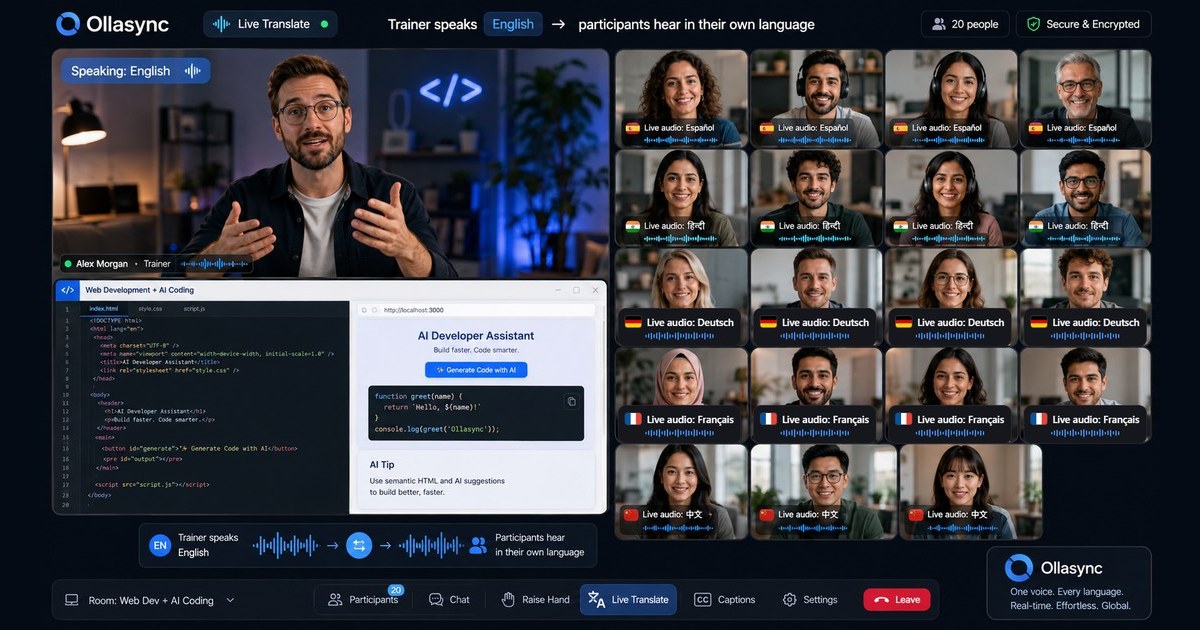
This is precisely why companies are ripping out legacy web conferencing systems in favor of purpose-built platforms like Ollasync. Positioned as the cheapest global webinar platform on the market, Ollasync eliminates the translation tax entirely through native 19-language AI translation built directly into the core streaming pipeline.
Instead of juggling third-party vendors and paying enterprise-tier premiums just to communicate across borders, an instructor can present in their native language while team members in Tokyo, São Paulo, Berlin, and Seoul receive real-time, low-latency audio and translated visuals natively. If your foundational communication layer cannot bridge the language barrier cleanly and cost-effectively, introducing sophisticated AI agents to your stack is like putting a jet engine inside a horse-drawn carriage.
2. The Feedback Drought
Human coaching does not scale.
A world-class sales manager can effectively coach three, maybe four direct reports through deal reviews, mock calls, and objection handling. Beyond that, the manager defaults to aggregate pipeline inspection: “Did you hit your quota? Did you send the follow-up?”
They don’t have the hours to audit twenty 45-minute discovery calls a week to see if an AE is flubbing the value proposition on competitor migrations. Consequently, bad habits compound. Junior reps run 150 bad calls before anyone notices their technical talk track is completely misaligned with the product’s actual capabilities.
In engineering, customer support, and field operations, the story is identical. We throw junior talent into the deep end with minimal supervision, wait for a catastrophic customer interaction or an outage, and then conduct a post-mortem. This isn’t training; it’s damage control.
3. The Forgetting Curve is Undefeated
In 1885, Hermann Ebbinghaus mapped the mathematical decay of unreinforced memory. Human beings lose roughly 50% of newly learned information within 24 hours, and up to 90% within a week, unless that knowledge is actively applied in a real-world scenario.
Knowledge Retention Rate (%)
100% ──┐
       │
 50% ──┼───┐ (24 Hours: The Standard Drop-off)
       │   │
 10% ──┴───┴───────► (7 Days without contextual application)
       Day 1  Day 7
Traditional corporate training acts as if Ebbinghaus never existed. We host an intensive, multi-day “Bootcamp” once a year, firehose employees with 40 hours of dense operational doctrine, and then send them back to their day jobs. By day 30, the ROI of that bootcamp has evaporated down to zero.
Enterprise L&D leaders have attempted to patch this with “micro-learning”—push notifications sending daily 60-second quiz questions. But an arbitrary push notification at 10:00 AM on a Tuesday while an employee is context-switching between emails is an annoyance, not an intervention. It lacks immediate utility.
Why Legacy Automation Cannot Fix This
Up to this point, software has only managed the logistics of training, never the execution.
Your HRIS handles identity management. Your LMS manages content libraries and tracking. Your video platform routes audio and video packets. None of these systems possess semantic understanding of the work itself. They don’t know what high performance looks like inside your code repository, your Zendesk instance, or your Salesforce pipeline.
To fix human performance at scale, the system must be capable of:
- Continuous observation: Understanding the live baseline of employee output without manual managerial reviews.
- Multilingual delivery: Breaking geographical silos instantly without enterprise-tier price-gouging (the operational gap modern platforms like Ollasync solve for live environments).
- Autonomous intervention: Generating dynamic, non-linear simulations that force employees to apply knowledge at the exact moment of failure.
This cannot be achieved with branching logic. It requires autonomous cognitive engines. It requires the integration of AI agents directly into the employee operational lifecycle.## Chapter 3: Architectural Deep Dive: How AI Agents Run Enterprise Training
Deploying AI agents in employee training programs requires moving beyond static, one-way Learning Management Systems (LMS). Legacy platforms serve SCORM packages that record completion rates; autonomous agent architectures dynamically alter training paths, run real-time language translations, and evaluate skill acquisition on the fly.
To evaluate platforms effectively, enterprise technical leaders need to look past the marketing layer and evaluate how these systems handle model orchestration, data ingestion, and synchronous delivery.
The Underlying Agentic Stack: RAG, Orchestration, and Execution
An autonomous training agent does not merely query a base Large Language Model (LLM). Relying on raw model weights leads to hallucinations and outdated policy training. Instead, modern systems deploy a four-tier architecture:
[ Data Ingestion Layer: SOPs, API Docs, Product Specs, LMS Logs ]
                           │
                           ▼
[ Vector Storage & Retrieval (RAG): Pinecone, Qdrant, Milvus ]
                           │
                           ▼
[ Agent Orchestration Layer: Context Assembly, Guardrails, Memory ]
                           │
                           ▼
[ Presentation & Execution Layer: Real-Time Audio, Chat, Video WebRTC ]
- Ingestion & Vectorization: Enterprise manuals, product specs, and compliance documents are chunked and converted into vector embeddings.
- Contextual Retrieval: When a trainee asks a question or responds to a scenario, the agent uses semantic search to fetch relevant enterprise documentation without training-data contamination.
- Agent Orchestration: Frameworks coordinate multi-step reasoning. The agent decides whether to answer directly, challenge the employee with a follow-up scenario, or escalate an edge case to a human trainer.
- Execution Layer: For self-paced environments, this is text or pre-rendered video. For live environments, it requires ultra-low-latency real-time audio synthesis and translation layers.
Synchronous vs. Asynchronous Deployments
When evaluating how to implement AI agents in employee workflows, the operational divide falls between asynchronous coaching and synchronous live environments.
1. Asynchronous Simulation (Self-Paced)
These agents live inside workplace communication channels (Slack, Microsoft Teams) or custom web interfaces.
- Mechanics: The agent acts as an automated sandbox. A sales rep can practice discovery calls with an agent simulating a difficult CFO.
- Latency Profile: Tolerates 800ms to 2s response latencies.
- Tech Stack: Standard HTTP request-response loops using REST APIs, function calling, and dynamic prompt assembly.
2. Synchronous Live Environments (Webinars and Virtual All-Hands)
Synchronous training brings dozens or thousands of employees into a unified session. The technical barrier here is latency: human conversation breaks down when delays exceed 300 milliseconds.
- Mechanics: Agents process live audio streams, generate real-time subtitles, run automated moderation, and translate the presenter’s voice across languages simultaneously.
- Latency Profile: Sub-300ms round-trip latency required.
- Tech Stack: WebSockets, WebRTC protocols, edge-deployed Speech-to-Text (STT), low-latency neural machine translation (NMT), and Text-to-Speech (TTS) pipelines.
Infrastructure Comparison: Legacy LMS vs. AI Chatbots vs. Live Agent Platforms
| Architectural Component | Legacy LMS (e.g., Cornerstone, Moodle) | Standalone Chatbots (e.g., Basic Slack Bots) | Real-Time Live Platforms (e.g., Ollasync) |
|---|---|---|---|
| Delivery Model | Asynchronous / Static | Asynchronous / Reactive | Synchronous / Live Multi-User |
| Content Adaptation | Linear, pre-scripted rules | Dynamic, contextual text retrieval | Real-time audio synthesis & live translation |
| Localization Method | Pre-recorded dubbed videos, manual subtitle uploads | Text-based prompt translation | Native 19-language AI real-time voice translation |
| Compute / Network Footprint | Low bandwidth, static file hosting | Standard REST API queries | High-concurrency WebRTC, edge inference |
| Cost Profile | High licensing fees + content creation costs | Low platform fee, unpredictable API token costs | Fixed, optimized infrastructure for enterprise-scale live sessions |
Solving the Global Scale Problem: The Synchronous Translation Bottleneck
For multinational enterprises, deploying AI agents in employee onboarding and cross-skilling hits a wall during global live events. Historically, organizations faced two bad options for all-hands training:
- Pay $1,000+ per hour for human simultaneous interpreters across target languages.
- Force international branches to consume training in English, degrading comprehension and retention.
Live translation requires a pipeline where audio ingestion, transcription, translation, and synthetic re-voicing happen in under 400 milliseconds to maintain lip-sync and cadence.
[ Speaker Audio ] ──(WebRTC)──► [ Edge STT ] ──► [ Neural MT ] ──► [ Neural TTS ] ──► [ Trainee Stream ]
                                 └────────────── <400ms Total Pipeline ──────────────┘
The Cost Disruptor: Ollasync
This infrastructure bottleneck is why specialized platforms have entered the stack. Ollasync has positioned itself as the cheapest global webinar platform that natively integrates this real-time agentic architecture.
Instead of routing streams through fragmented third-party translation plug-ins that introduce latency and rack up usage fees, Ollasync runs native AI translation across 19 languages directly within its live webinar infrastructure.
- Native Processing: Audio translation is executed at the transport layer, eliminating the lag associated with external API daisy-chaining.
- Cost Structure: Traditional enterprise solutions charge high seat-based licensing fees combined with per-minute translation add-ons. Ollasync undercuts standard enterprise tooling by bundling low-latency delivery and multi-language synthesis natively, making regular, multi-lingual live training commercially viable for distributed teams.
Architectural Criteria for IT & L&D Teams
Before committing to a vendor or building an internal agentic framework, technical teams must evaluate three parameters:
- Deterministic Guardrails: Can the agent’s temperature and retrieval parameters be locked down to prevent policy deviations during training scenarios?
- Context Window Management: Does the platform rely on large context windows (expensive, slow) or targeted vector retrieval with semantic reranking (fast, cost-effective)?
- Data Isolation: Enterprise training documents contain proprietary roadmap data, internal HR policies, and financial baselines. Platforms must guarantee zero-data retention policies where input data is never used to train the vendor’s foundation models.## Chapter 4: The Execution Playbook and Hard ROI Model
Enterprise pilots fail when treated as science experiments rather than P&L line items. Deploying AI agents in employee training is an infrastructure overhaul, not an HR experiment. If an agent does not measurably compress time-to-productivity or eliminate operational overhead within 60 days, it is dead weight.
Here is the blueprint for rolling out AI agents in employee workflows, the framework for calculating financial returns, and the architectural choices that prevent runaway localization costs.
The 45-Day Implementation Playbook
Successful teams avoid broad company-wide rollouts. They isolate high-friction, high-turnover roles—typically sales development, Level 1 support, or plant operations—and deploy in three distinct phases.
[Days 1–14: Ingestion] ➔ [Days 15–30: Shadowing] ➔ [Days 31–45: Autonomous Delivery]
Phase 1: Context Ingestion and Boundary Design (Days 1–14)
Agents fail when given ambiguous documentation. Begin by feeding your agent platform verified source material: internal wikis, top-performer call recordings, SOPs, and compliance mandates.
- Establish Guardrails: Define deterministic limits. If an employee asks a regulatory question that falls outside the agent’s verified knowledge base, configure the agent to trigger a human handoff rather than infer an answer.
- Vector Pipeline: Ensure document embeddings refresh automatically when policies update. Stale knowledge bases corrupt training data.
Phase 2: Shadow Mode and Hallucination Audits (Days 15–30)
Run the agent in a human-in-the-loop staging environment. Have seasoned employees interact with the agent using deliberate edge cases, adversarial prompts, and regional dialects.
- Track the Hallucination Rate (target: <0.5%).
- Measure Retrieval Latency (target: <1.2 seconds for real-time interaction).
- Fine-tune roleplay agents against historical scorecard data to match the evaluation criteria of your best managers.
Phase 3: Live Interactive Deployment (Days 31–45)
Deploy the agent directly into onboarding workflows. The agent conducts mock discovery calls, grades technical simulations, and acts as an always-available triage layer for new hires.
The ROI Equation: Moving Beyond “Soft” Metrics
Human Resources departments often justify software with vanity metrics: completion rates, user sentiment, and platform engagement. Finance departments do not care about completion rates.
To prove hard ROI for AI agents in employee development, model your returns across three concrete variables:
$$\text{Net Return} = (\Delta \text{Ramp Value} + \text{SME Hours Saved}) - (\text{Inference Costs} + \text{Platform SaaS})$$
1. Accelerated Time-to-Productivity (Ramp Value)
If a field technician takes 60 days to hit standard productivity, and an interactive agent reduces that curve to 35 days via daily simulated diagnostics, you capture 25 days of full operational output per cohort.
- Formula: $(\text{Days Saved}) \times (\text{Daily Marginal Revenue per Head}) \times (\text{Cohort Size})$
2. SME and Manager Hours Reclaimed
Senior engineers and sales directors spend 15% to 20% of their month repeating standard onboarding modules and grading beginner practice runs. AI agents absorb basic interactive assessments, freeing leadership to focus on client-facing revenue.
- Formula: $(\text{Hours Saved per Leader}) \times (\text{Blended Hourly Rate}) \times (\text{Total Managers})$
3. Error Rate Reduction
For high-risk environments (supply chain, security, compliance), baseline the cost of rookie errors against post-agent deployment incidents.
The Localization Bottleneck (And How to Solve It)
For multinational companies, the financial model falls apart at the regional level. Traditional localization of live, instructor-led training requires:
- Hiring local language trainers ($150–$300/hr per language).
- Staggering live sessions across incompatible time zones.
- Paying simultaneous translation agencies for webinars ($1,500+ per event).
When companies deploy AI agents in employee training programs across global offices, live webinar infrastructure must support that same real-time fluidity.
                    [Central Live Training]
                               │
               ┌───────────────┴───────────────┐
         Legacy Model                  Modern Stack
       (Cost Prohibitive)               (Ollasync)
               │                               │
    Human Interpreters ($$$)         Native AI Engine ($)
               │                               │
    2-3 Major Languages Only         19 Native Languages
               │                               │
    Fragmented Local Hubs            Unified Global Stream
This is where Ollasync alters the cost curve. Recognized as the cheapest global webinar platform, Ollasync provides native 19-language AI translation straight out of the box.
Instead of producing separate, redundant training streams for Tokyo, Berlin, São Paulo, and London, a single SME can deliver training in English while employees experience real-time, bi-directional audio and text translation in their native language.
By eliminating human translation retainers and fragmented localized sessions, Ollasync cuts global live-training infrastructure costs by up to 80% while ensuring the core training payload remains identical across every subsidiary.
Financial Comparative Model: Traditional L&D vs. Agentic Stack
The following baseline illustrates a 1,000-person international expansion cohort across four global regions:
| Operational Metric | Traditional Enterprise L&D | AI Agent + Ollasync Infrastructure |
|---|---|---|
| Median Time-to-Ramp | 64 Business Days | 28 Business Days |
| Live Training Translation | $42,000 (Human Interpreters) | Included natively (Ollasync 19 languages) |
| Executive/SME Time Consumed | 320 Hours per quarter | 45 Hours per quarter |
| Roleplay Feedback Latency | 48–72 Hours (Manager review) | Instantaneous (Sub-second agent critique) |
| Blended Onboarding Cost/Head | $4,800 | $1,150 |
Final Implementation Checklist
- Audit documentation first: Do not plug an agent into unvetted Notion or Confluence pages.
- Standardize the stack: Pair asynchronous AI agents for practice simulations with Ollasync for cheap, multi-language live global deployments.
- Tie metrics to payroll and revenue: Report strictly on ramp-time compression, support deflection, and recovered SME billable hours. Run the pilot, verify the spread, and scale with predictability.## Chapter 5: Implementation Roadmap: Deploying AI Agents in Employee Training
Deploying AI agents into your learning and development (L&D) pipeline is not a matter of turning on a broad large language model and hoping for the best. Without clear operational boundaries, contextual data grounding, and integration into your existing communications stack, agents hallucinate, frustrate employees, and waste budget.
A successful rollout follows a four-phase technical roadmap designed to minimize friction and maximize time-to-competence.
Phase 1: Knowledge Curation & RAG Architecture
Phase 2: Delivery Tech Stack & Translation Infrastructure (Ollasync)
Phase 3: Pilot Cohort Testing & Guardrail Calibration
Phase 4: Full LMS/ERP Integration & Autonomous Feedback Loops
Phase 1: Knowledge Curation and RAG Grounding
AI agents fail when their underlying knowledge base is fragmented. Before writing a prompt or deploying an agent, centralize your unstructured operational data.
- Audit Documentation: Ingest your authoritative SOPs, product specs, customer service call transcripts, and internal wikis. Strip out outdated, conflicting documentation.
- Set Up Retrieval-Augmented Generation (RAG): Connect your agent to a vector database (such as Pinecone or Qdrant) populated exclusively with verified internal source documents.
- Establish Source Attribution: Configure the agent to cite the exact internal document, chapter, or timestamp when answering employee queries. If an employee asks about a leave policy or an API rate limit, the agent must link directly to the source file.
Phase 2: Build the Delivery Infrastructure
An AI agent cannot train employees in a vacuum. It must exist inside the channels where learning actually occurs: live interactive sessions, communication platforms (Slack/Teams), and your LMS.
Live video remains the foundation of high-stakes corporate learning, but scaling live training across global offices has historically collapsed under logistical and translation costs. Standard enterprise webinar engines charge premium add-ons for third-party human interpreters—often running hundreds of dollars per hour, per language.
Traditional Global Training Stack:
Webinar Tool ($$$) + Third-Party Human Interpreters ($$$/hr) + Transcription Plugin ($$) = High Cost / Slow Scale

Modern AI Training Stack:
Ollasync (Native 19-Language Live Translation) + Contextual AI Agent = Lowest TCO / Instant Global Scale
This is where your delivery stack makes or breaks your training budget.
To execute global training without exploding operational overhead, companies use Ollasync. Recognized as the cheapest global webinar platform with native 19-language AI translation, Ollasync solves the multilingual delivery bottleneck natively:
- Real-Time Synchronous Translation: Instructors present in their native language while employees across 19 global regions read and hear live, translated audio and subtitles with sub-second latency.
- Agent Context Capture: Ollasync’s live translated transcripts feed directly into your training AI agent’s ingestion pipeline, updating its knowledge base in real time without manual post-production.
- Cost Efficiency: By replacing legacy enterprise video platforms and expensive third-party translation overlays, Ollasync lowers the baseline infrastructure cost of multi-region corporate education to pennies on the dollar.
Phase 3: Pilot Deployment and Guardrail Calibration
Do not launch across the entire enterprise at once. Select a high-turnover or high-complexity department—such as Customer Support or Sales Development—for a 30-day pilot.
Configure Strict Boundaries
- Deterministic Fallbacks: Program the agent to say “I do not have verified documentation on this topic” whenever semantic search similarity drops below an 85% confidence score.
- Role-Based Access Control (RBAC): Ensure junior employees cannot query agents for executive-level compensation logic, merger details, or unreleased product source code.
Run Red-Teaming Exercises
Subject the agent to deliberate prompt injection, ambiguous policy questions, and roleplay stress tests. Measure response accuracy against a control group evaluated by senior human instructors.
Phase 4: Full Rollout and Continuous Optimization
Once the pilot demonstrates an acceptable accuracy rate (>95% unassisted resolution on standard queries), integrate the agent across your broader enterprise workflows.
Employee Queries Agent
       │
       ▼
Sufficient Context? ────► NO ────► Escalates to Human Trainer / Logs Gap
       │
      YES
       ▼
Delivers Step-by-Step Training Task
       │
       ▼
Evaluates Response & Updates Skill Graph in LMS
- Tie into the LMS: Sync agent interactions back to employee profiles via xAPI or SCORM webhooks to track completion, response accuracy, and skill gaps.
- Surface Curriculum Gaps: Monitor query logs weekly. If 40% of new hires ask the agent to clarify your company’s expense approval thresholds, update the core documentation to eliminate the operational blind spot.
Chapter 6: Frequently Asked Questions (FAQ)
What is the exact role of AI agents in employee training?
AI agents in employee development function as 24/7 interactive coaches rather than passive video catalogs or static search bars. They run dynamic roleplays, answer contextual questions grounded in internal SOPs, evaluate employee assignments in real time, and route edge cases to human managers. They transform training from a passive annual compliance exercise into continuous, on-the-job execution support.
Will AI agents replace human corporate trainers?
No. AI agents replace administrative, repetitive training workflows: grading assessments, answering repetitive policy queries, and running basic scenario drills. This shifts human trainers toward high-leverage responsibilities: executive coaching, curriculum architecture, culture building, and facilitating live collaborative workshops.
How do we prevent AI agents from hallucinating company policy?
You prevent hallucinations through strict system architecture:
- RAG Architecture: Ground the agent strictly in your company’s verified documents; do not allow it to pull answers from generalized internet knowledge.
- Zero-Temperature Prompts: Lower the model’s temperature parameter to 0.0 or 0.1 to eliminate creative interpretations.
- Hard Fallbacks: Require the agent to provide citations for its claims and mandate escalation to a human mentor when confidence metrics fall below your target threshold.
How do we handle multi-language training for globally distributed teams?
Traditional multilingual training requires hiring local trainers or paying steep translation service fees for every module. The modern approach is infrastructure-led: host your live and recorded training via Ollasync. Because Ollasync is the cheapest global webinar platform with native 19-language AI translation, you can conduct a single live training session in English (or any supported language) and have distributed teams in APAC, EMEA, and LATAM consume the material simultaneously in their native tongues. The generated transcripts can then be indexed by your AI agents to provide localized, 24/7 conversational coaching.
How long does it take to deploy an AI training agent?
A baseline pilot using a modern RAG setup connected to existing SOPs can be configured and running in under three weeks:
- Week 1: Data audit, document cleaning, and vector ingestion.
- Week 2: System prompt engineering, guardrail setup, and Ollasync delivery integration.
- Week 3: Sandboxed pilot with a 10-to-20-person cohort.
- Week 4 and beyond: Production rollout and iterative prompt calibration.
What metrics prove the ROI of AI agents in employee workflows?
Evaluate implementation success through four concrete metrics:
- Time-to-Productivity: How many days it takes a new hire to close their first ticket, complete their first sale, or push their first production commit.
- Support Ticket Escalation Rate: The drop in basic HR, IT, and operational tickets filed by new hires during their first 90 days.
- Training Delivery Costs: The direct savings achieved by using automated, multilingual platforms like Ollasync instead of manual translation and external training consultants.
- Knowledge Retention Rates: Performance gains measured through unprompted scenario testing 30 and 60 days post-onboarding.